Agent Memory Architecture: Layered Design Strategies for 2026
Discover how to differentiate short-term, episodic, and semantic memory in agent memory architecture for enhanced AI performance and cost savings.

What an Agent Memory Architecture Actually Does
If your agent looks smart in a demo and falls apart under real traffic, memory design is often the reason. Teams mix live context, old interactions, and durable knowledge into the same place, then wonder why answers get noisier, prompts get bigger, and costs keep creeping up.
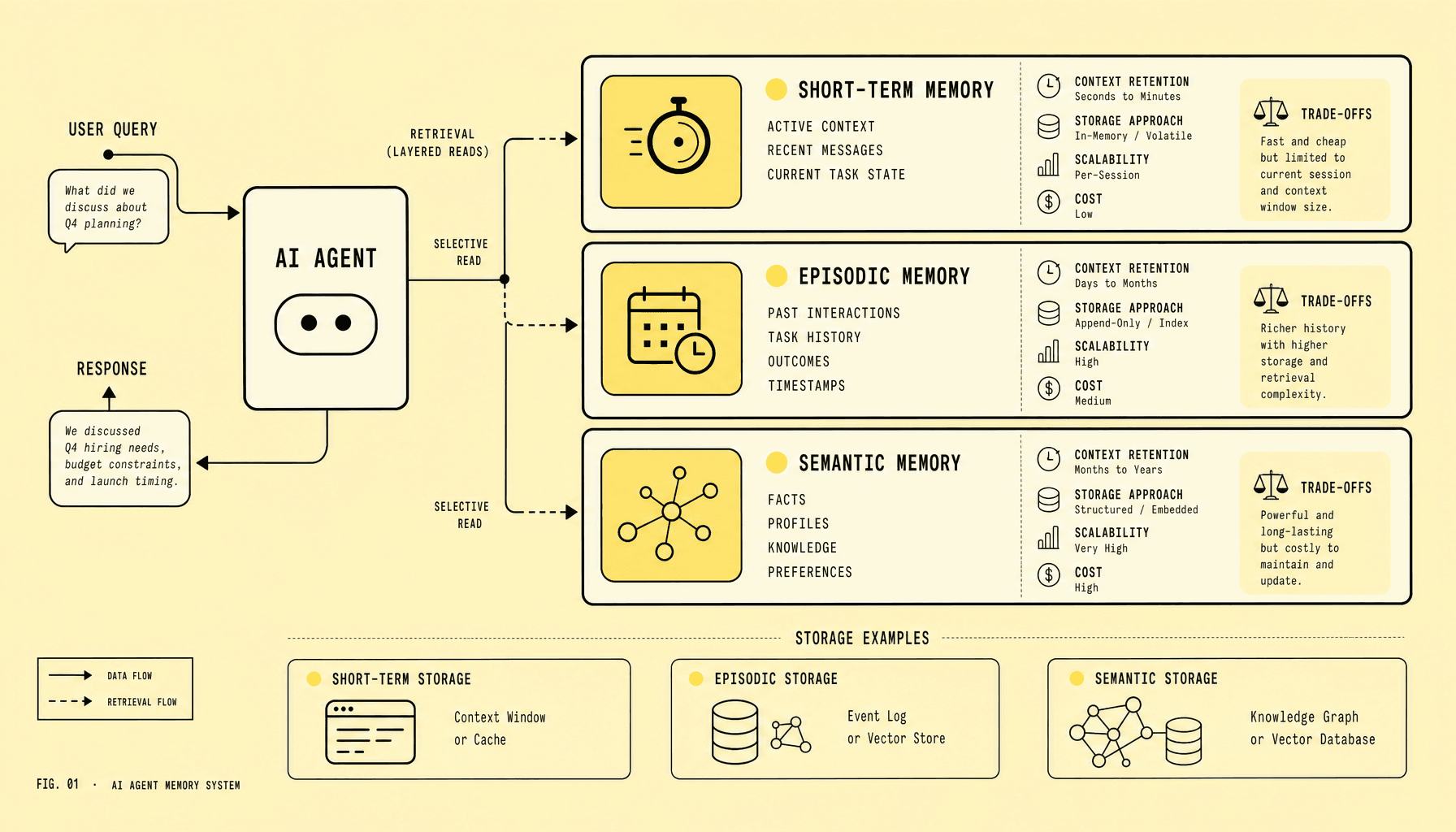
An agent memory architecture separates active context, past experience, and durable knowledge so an agent can respond accurately without becoming slow or expensive. In practice, AI agent memory works best as layers: short-term memory for the current task, episodic memory for prior events, and semantic memory for stable facts.
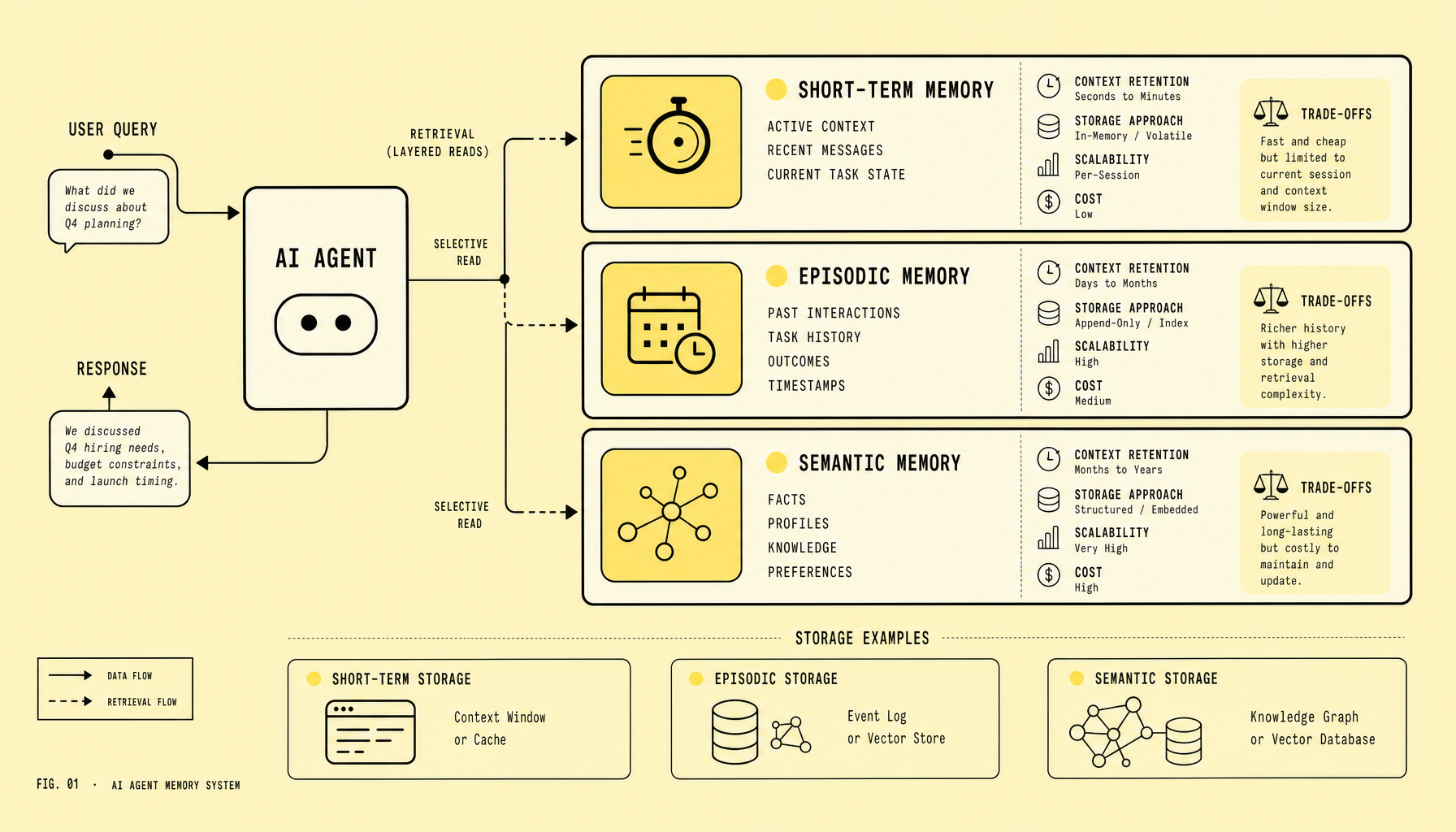
Most production failures happen because teams blur those roles. They stuff everything into one prompt, one vector index, or one session store -- then relevance drops, token cost rises, and retrieval gets noisy. A practical memory architecture for AI agents keeps working context in fast session state, stores episodes in logs or Postgres-style records, and keeps long-lived knowledge in retrieval-friendly stores. Consistency in environments is critical here, because memory behavior that looks fine in a demo often breaks once latency, scale, and prompt limits show up.
Key Takeaways for Choosing an Agent Memory Architecture
- Choose short-term memory for active context -- current turns, tool outputs, and task state. It is fast and useful, but token cost and context-window limits make it poor for long-running recall.
- Use episodic memory to store prior interactions, task runs, failures, and outcomes. It helps agents learn from experience, but only if retrieval is selective and summaries stay clean.
- Use semantic memory for stable knowledge -- policies, facts, product docs, and normalized user preferences. Keep it durable in systems like Postgres or a vector database, not buried in prompts.
- The best agent memory architecture combines all three layers. Separate working context, experience history, and durable knowledge so AI agent memory stays relevant, scalable, and cost-controlled.
- Be disciplined. Consistency in environments is critical -- the same chunking, embedding, and retrieval rules should apply across dev and production, or memory quality drifts fast.
Agent Memory Architecture Comparison: Short-Term vs Episodic vs Semantic
If your agent keeps everything in the prompt, it may look capable in a demo but become brittle in production. These three memory types solve different problems, and treating them as interchangeable is where things start to break.
Short-term memory handles the current task. Episodic memory preserves what happened before. Semantic memory stores stable facts, rules, and distilled knowledge. A strong agent memory architecture separates these layers so retrieval stays relevant, latency stays predictable, and cost does not keep rising as sessions grow.
The common mistake is using short-term memory as durable memory. That can work for a while. Then context windows fill, token cost climbs, and important details get harder to surface at the moment they are actually needed.
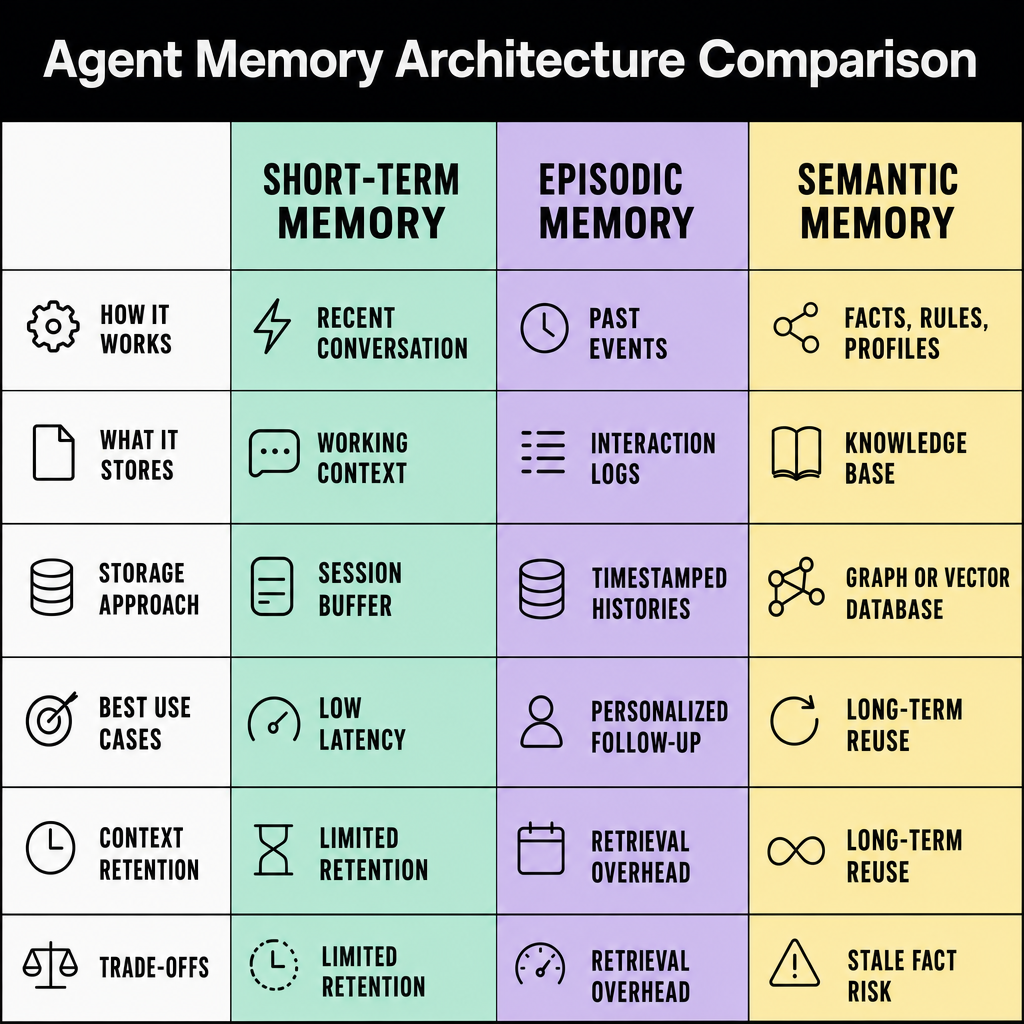
| Memory type | What it stores | Typical storage | Best fit | Main trade-off |
|---|---|---|---|---|
| Short-term memory | Active conversation, tool outputs, session state | Prompt buffer, Redis, in-memory cache | Live chat, workflow execution, immediate reasoning | Fast but fragile; poor durability and rising token cost |
| Episodic memory | Timestamped events, actions, outcomes, failures | Event store, Postgres, logs | Task replay, user history, recovery, personalization | Durable but retrieval quality depends on event design |
| Semantic memory | Facts, preferences, policies, summarized knowledge | Vector database, Postgres, knowledge store | Long-term recall, grounded answers, reusable knowledge | Scalable recall, but embeddings can drift or retrieve loosely relevant items |
How the layers differ in practice
Short-term memory is the fastest layer because the model sees it directly in the current prompt. Keep it tight: recent turns, current variables, and compact summaries.
Episodic memory works like an event history. You store discrete moments such as a failed API call, a completed onboarding flow, or a user's last approved action. Retrieval often uses metadata filters, IDs, time ranges, or similarity against prior runs. That gives systems continuity without stuffing old transcripts into the prompt.
Semantic memory stores meaning rather than moments. You extract durable facts from prior interactions, documents, or repeated episodes, then retrieve them from a vector database or a structured store such as Postgres.
Here is the simplest rule I know. If the information describes what is happening now, it is short-term. If it records what happened at a specific time, it is episodic. If it captures what remains true across sessions, it is semantic.
Cost, scalability, and trade-offs
Short-term memory gets expensive as prompts grow. Episodic and semantic memory shift more of that cost toward retrieval and storage, which usually scales better than prompt stuffing. The trade-off is real: more schema design, more summarization rules, more re-ranking, more cleanup.
That said, most teams should start with short-term memory plus one durable layer. Add the third only when the use case clearly needs both past events and persistent facts.
When to Use Each Memory Type in AI Agent Memory Systems
Start small. Most teams do not need every memory layer on day one, and adding all three too early usually creates overhead before it creates value.
Use short-term memory when the agent only needs session continuity -- the current chat, recent tool calls, and active task state. A support copilot answering a live customer issue, a coding assistant fixing one file, or workflow automation handling a single run usually fits here. Store it in the prompt, a rolling summary, Redis, or in-memory session state. Fast. Cheap enough. Fragile once sessions get long, context windows fill up, or token cost starts climbing.
Use episodic memory when past interactions should influence future behavior, but only as specific experiences. This is where many production agents start becoming meaningfully useful. A task agent that retries failed runs, a research agent that should remember which sources it already reviewed, or a support copilot that should recall a user’s prior unresolved issue needs more than a session buffer. It needs timestamped events in Postgres, event logs, or a vector index over task summaries. You are not storing facts here. You are storing what happened, under which conditions, and with what result.
Use semantic memory when the knowledge itself should persist and be reused across sessions. Product policies. Internal terminology. Stable workflow rules. Reusable codebase conventions. This is durable domain knowledge, not chat history. A semantic layer usually sits in a knowledge store or vector database with embeddings, metadata filters, and retrieval rules. It creates personalization and consistency -- but only if the knowledge stays clean. Consistency in environments is critical, and the same applies to memory pipelines. If indexing, chunking, and retrieval differ between dev and production, relevance breaks fast.
Practical selection guide
For chat continuity, choose short-term memory.
For prior task recall, choose episodic memory.
For durable domain knowledge, choose semantic memory.
In practice, the best memory architecture for AI agents combines them in that order. At Imversion Technologies Pvt Ltd, this is the practical rule I recommend: start with robust AI agent memory for working context, add selective episodic logging for recurring workflows, and introduce semantic memory only when reusable knowledge justifies the storage, retrieval, and evaluation overhead.
How a Production Agent Memory Architecture Combines All Three
Once an agent has to operate across longer sessions, repeated workflows, and stable business rules, one memory layer stops being enough. The fix is not dumping everything into one store. It is routing each memory type by purpose, then controlling what gets retrieved and what gets written back.
A practical pipeline usually works like this: a new request enters short-term memory first -- current user input, task state, recent messages, and fresh tool output. Then the system decides what to fetch. If the agent needs precedent, it queries episodic memory for similar past runs, such as a failed API recovery flow or a support case with the same account pattern. If it needs stable knowledge, it retrieves semantic memory -- policies, product facts, schema rules, or approved operating guidance.
Retrieval alone is not enough.
You need ranking, reranking, and summarization between layers, or your AI agent memory becomes noisy and expensive. Teams often over-retrieve, then wonder why answer quality drops. More memory can make the agent worse if irrelevant or stale items crowd out the useful ones. A good memory architecture for AI agents scores results by recency, similarity, source quality, and task fit, then compresses them into a compact working set before they enter the prompt. Consistency across environments also matters: retrieval behavior that differs between staging and production is difficult to debug and can hide memory-quality issues.
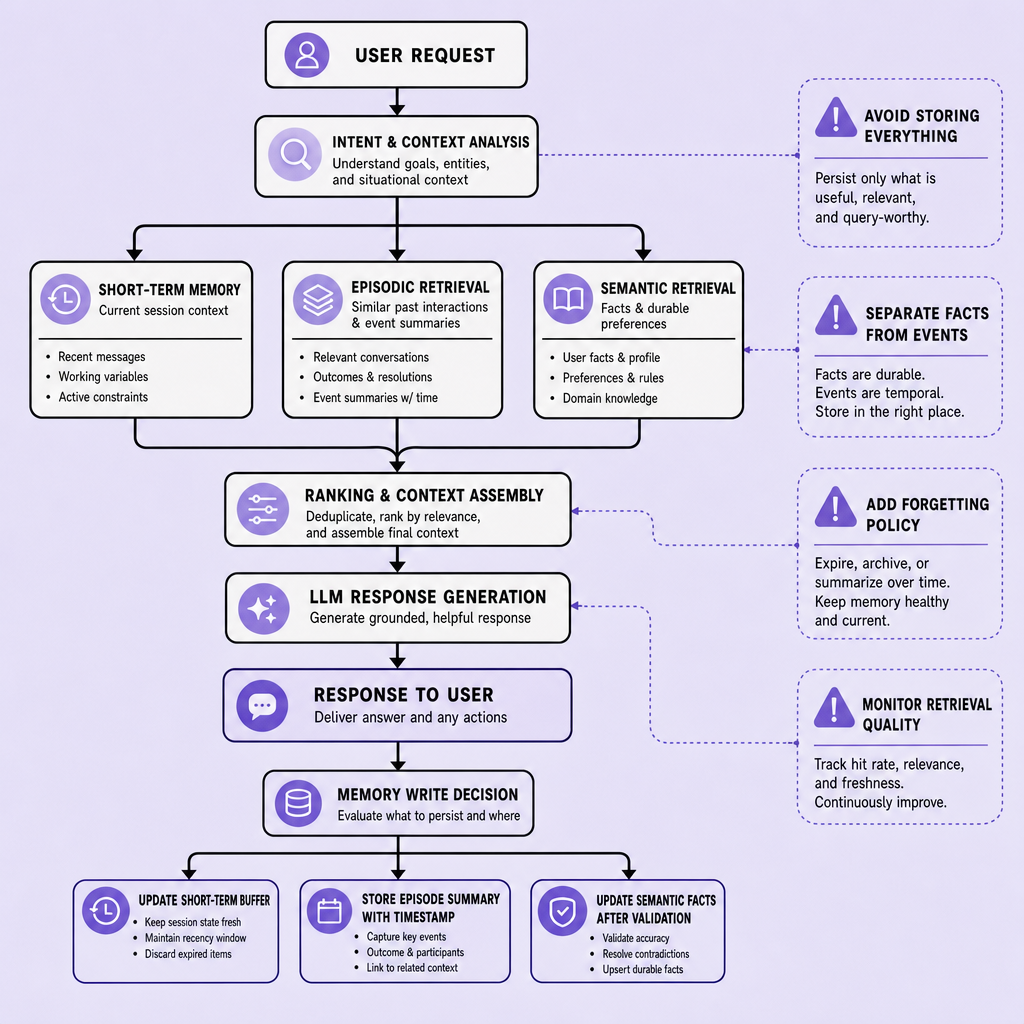
After the task completes, write back selectively. Store raw event logs in episodic memory, promote reusable facts to semantic memory only after validation, and update short-term memory only for the active session. The tradeoff is added system complexity, but the payoff is cleaner context, safer recall, and more predictable cost as the agent scales.
Common Agent Memory Architecture Mistakes and How to Avoid Them
Most memory problems do not come from having too little data. They come from keeping the wrong data, retrieving it badly, and sending too much of it back to the model.
The biggest mistake is simple: teams treat more memory as better memory. It is not. Low-quality AI agent memory becomes noise, hurts retrieval relevance, inflates token cost, and makes agents harder to debug.
The first failure pattern is storing everything. Raw chat logs, verbose tool traces, duplicate summaries, and low-signal observations quickly pollute memory. Without write rules, the agent keeps saving items that never help future tasks. Without a forgetting policy, stale memories keep resurfacing long after they stop being useful. Avoid this by defining what is worth saving, when to summarize it, and when to expire or demote it.
Another common mistake is collapsing all memory into one store. Facts and events are not the same. Durable user preferences, product facts, or stable definitions fit semantic memory. Task runs, errors, decisions, and outcomes fit episodic memory. When both are stored and retrieved the same way, the agent may recall an outdated event as if it were a standing fact.
Poor chunking and weak metadata create a quieter but equally damaging problem. Oversized chunks blur intent, while missing timestamps, source labels, task IDs, or user IDs make filtering unreliable. Retrieval then finds memories that look similar but belong to the wrong task or time period.
A final mistake is overloading short-term memory. Pushing too much into the prompt raises cost and reduces focus. Keep active context lean, retrieve selectively, and monitor retrieval quality, latency, prompt size, and memory writes so problems appear before users see them.
Frequently Asked Questions
What is the difference between episodic memory and semantic memory in an AI agent?
Episodic memory stores time-bound experiences such as actions, failures, and outcomes, while semantic memory stores durable knowledge such as rules, facts, and normalized preferences. The practical difference is that episodic memory answers “what happened before,” and semantic memory answers “what is generally true.”
How does an agent memory architecture reduce token costs?
A good agent memory architecture reduces token costs by keeping only live context in the prompt and moving older or stable information into retrievable stores. This prevents repeated prompt stuffing, shortens context windows, and lets the system fetch only the few memories that are relevant to the current task.
When should I add semantic memory to an agent memory architecture?
You should add semantic memory when the agent needs reusable knowledge across sessions, users, or workflows, not just continuity within one interaction. It becomes valuable when policies, product facts, definitions, or persistent preferences must stay consistent without being reintroduced manually in every prompt.
Why do many AI agent memory systems retrieve irrelevant results?
Many AI agent memory systems retrieve irrelevant results because they save low-signal data, use weak metadata, or rely on similarity search without enough filtering and reranking. Retrieval quality usually improves when memories are written with clear schemas, tagged with context, and scored by recency, source trust, and task relevance.
What are the best implementation practices for short-term memory, episodic memory, and semantic memory?
The best implementation approach is to keep short-term memory minimal, write episodic memory as structured events, and promote only validated facts into semantic memory. Teams should also define retention rules, monitor retrieval precision, version embeddings and chunking logic, and test memory behavior in production-like environments before scaling.
Make Imversion a preferred source on Google
Like this kind of AI and software analysis? Add Imversion as a preferred source so Google can highlight our articles for you in Search, AI Overviews, and AI Mode.