Agentic AI FNOL: Streamlined Triage for 2026
Explore how agentic AI FNOL can transform claims triage by automating intake processes while keeping critical decisions with human adjusters.

What agentic AI FNOL should automate first
Claims teams lose time in the same place every day: rekeying intake data from calls, emails, forms, photos, and PDFs, then chasing missing details across handoffs.12 That is the first problem to fix. Agentic AI FNOL should automate the high-volume, low-discretion steps first: AI claims intake, multimodal extraction, completeness checks, severity scoring, and routing. Licensed humans should still retain coverage interpretation, liability assessment, and settlement authority -- those decisions carry legal, regulatory, and fairness risk.34
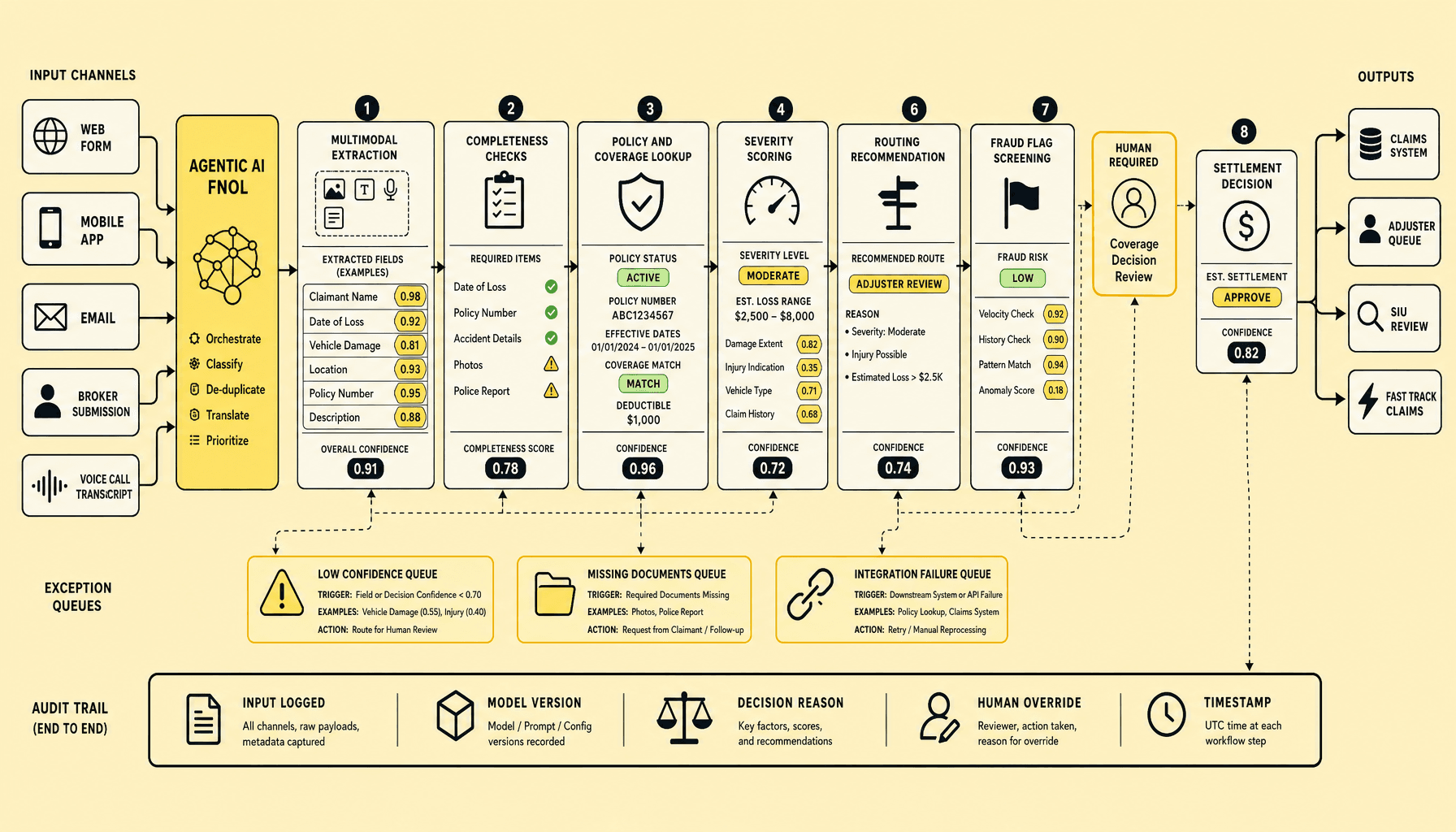
Start at the front door. FNOL automation delivers the most value where teams still move information manually into claims systems and lose time cleaning up incomplete files later.12 So the first target for claims triage automation is structured intake plus decision support: extract claim facts, score field-level confidence, verify required data, look up policy context, estimate severity, and route clean files into Guidewire or Duck Creek while low-confidence cases move to an exception queue with a full audit trail.54 We recommend shadow mode first -- usually for several weeks -- because regulated workflows need proof that routing is accurate, explainable, and fair before production authority expands, and because user experience can make or break adoption even when the underlying workflow works.36
Key Takeaways for agentic AI FNOL and claims triage
- Keep scope tight. The best use of agentic AI FNOL is front-end execution: FNOL automation for intake, multimodal extraction, completeness checks, severity scoring, fraud signals, and claims triage automation -- not coverage interpretation or settlement authority, which should stay with human adjusters.34
- Gate every action with confidence scores. High-confidence fields can post into Guidewire or Duck Creek; low-confidence fields should trigger review, missing-info outreach, or an exception queue. Fewer blind handoffs means fewer callbacks and cleaner files.52
- Integration matters. Connect AI outputs to claims systems, document stores, and audit logs, and define exception rules for unreadable documents, conflicting facts, or policy-match failures.56
- Build governance in from day one -- audit trails, bias and fairness testing, human override paths, and regulatory controls are mandatory in claims triage automation.57
- Roll out in shadow mode first. At Imversion Technologies Pvt Ltd, we’d treat this as the practical path: compare AI recommendations against adjuster decisions for a fixed pilot period, then track adjuster minutes saved and claim cycle-time reduction before any production autonomy.14
Map the agentic AI FNOL workflow from intake to routing
If intake is messy, everything downstream gets slower and more expensive. The highest-value workflow is still the first one: capture the claim, structure it, check it, enrich it, score it, and route it fast. That is where FNOL automation creates immediate operational lift because it cuts manual rekeying, reduces missing-information callbacks, and speeds first touch.24
The seven-stage operating workflow
Start with intake across every real channel claims teams already handle: web, mobile, email, broker portals, and voice.24 For voice, use ASR to turn the call into a transcript; for email and attachments, use OCR and document AI on PDFs, photos, and forms; for video, extract frames and metadata, then link them to the claim record.24 Good AI claims intake does not just transcribe. It runs dynamic question flows based on loss type, reported injuries, drivable status, property occupancy, or police involvement, so the system asks for what is missing while the claimant is still engaged.2
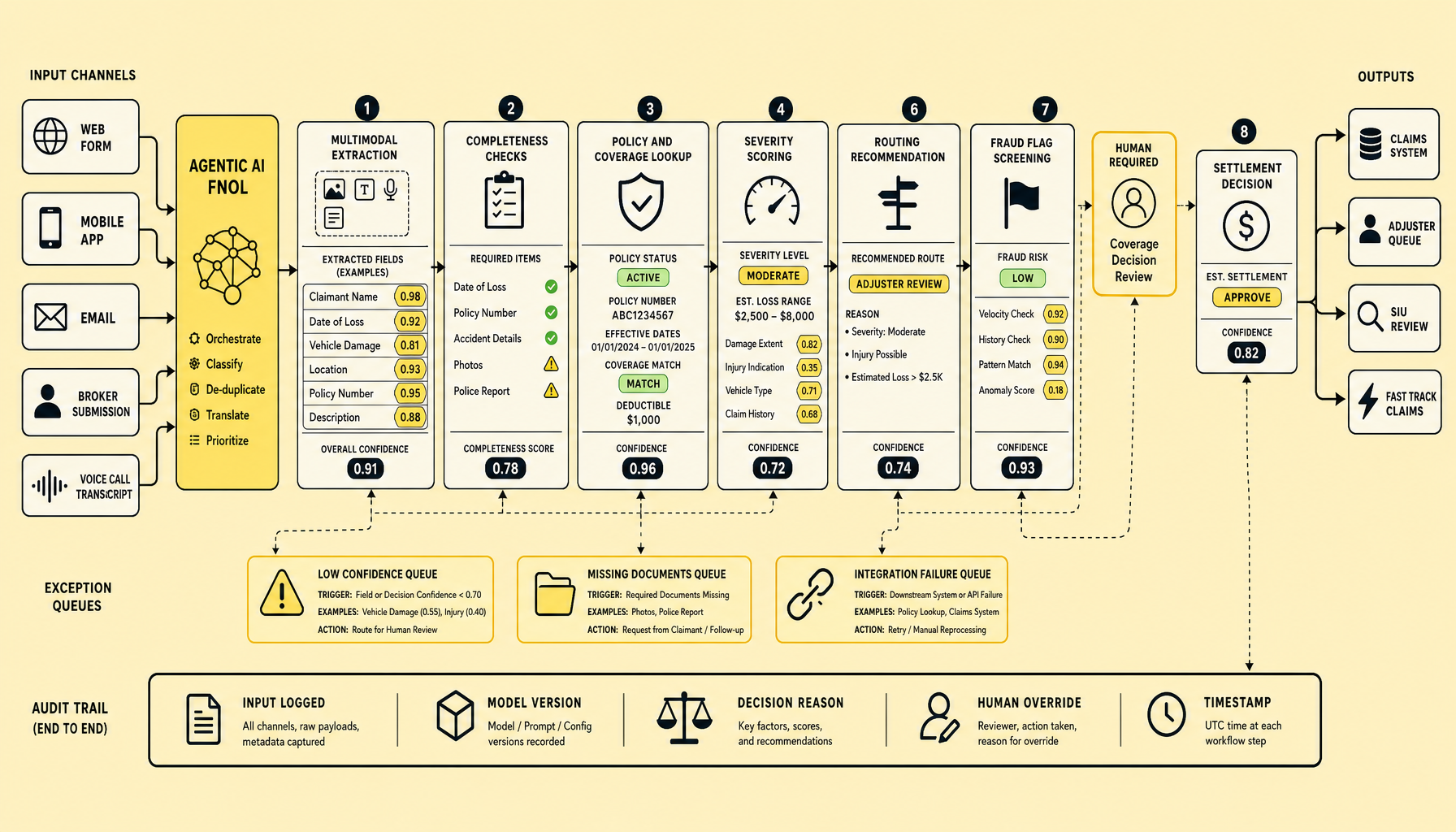
Next comes multimodal extraction. The agent maps transcript text, police reports, repair estimates, images, and video into structured FNOL fields: date of loss, policy number, location, claimant identity, parties involved, injury indicators, vehicle or property details, and visible damage signals.56 We recommend field-level confidence scores, not one blanket score. A VIN at high confidence can auto-fill. A date of loss at lower confidence should hit an exception queue.
Then run completeness checks against required fields and documents by line of business and jurisdiction. Missing driver details, absent photos, unsigned statements, inconsistent addresses -- all of these should trigger follow-up tasks before the claim reaches an adjuster.24
Enrich, score, and route -- but stop short of adjudication
Once intake data is structured, the next temptation is to hand too much authority to the model. That is where discipline matters. Policy lookup should pull context from the policy administration system and claims platform -- Guidewire or Duck Creek are common targets -- but only to support claims triage automation and insurance claims routing.57 Use coverage status, deductibles, endorsements, and effective dates as routing inputs. Do not let the model decide coverage. Operational usefulness and legal authority are not the same thing.
From there, severity scoring estimates urgency and complexity, routing sends the claim to the right queue, and fraud flags surface anomaly patterns for human review.46 If the process is fast but opaque, teams will bypass it. So log every extraction, confidence score, policy lookup, routing reason, fraud signal, and human override in an audit trail. That record supports exception handling, bias and fairness testing, and regulatory review.34
Set the human-AI boundary for agentic AI FNOL decisions
The boundary needs to be explicit before rollout starts. Use agentic AI FNOL for fact collection, structuring, and insurance claims routing; require a human in the loop for regulated claim determinations.
This split is not caution for its own sake. It is cleaner operationally. Agentic AI insurance systems are strong at repetitive intake and claims triage automation across chat, voice, email, documents, and images, but adverse or material claim decisions demand defensible judgment, traceable reasoning, and licensed authority.324 We recommend encoding decision rights in workflow rules before model tuning, because unclear ownership creates more risk than imperfect extraction accuracy.
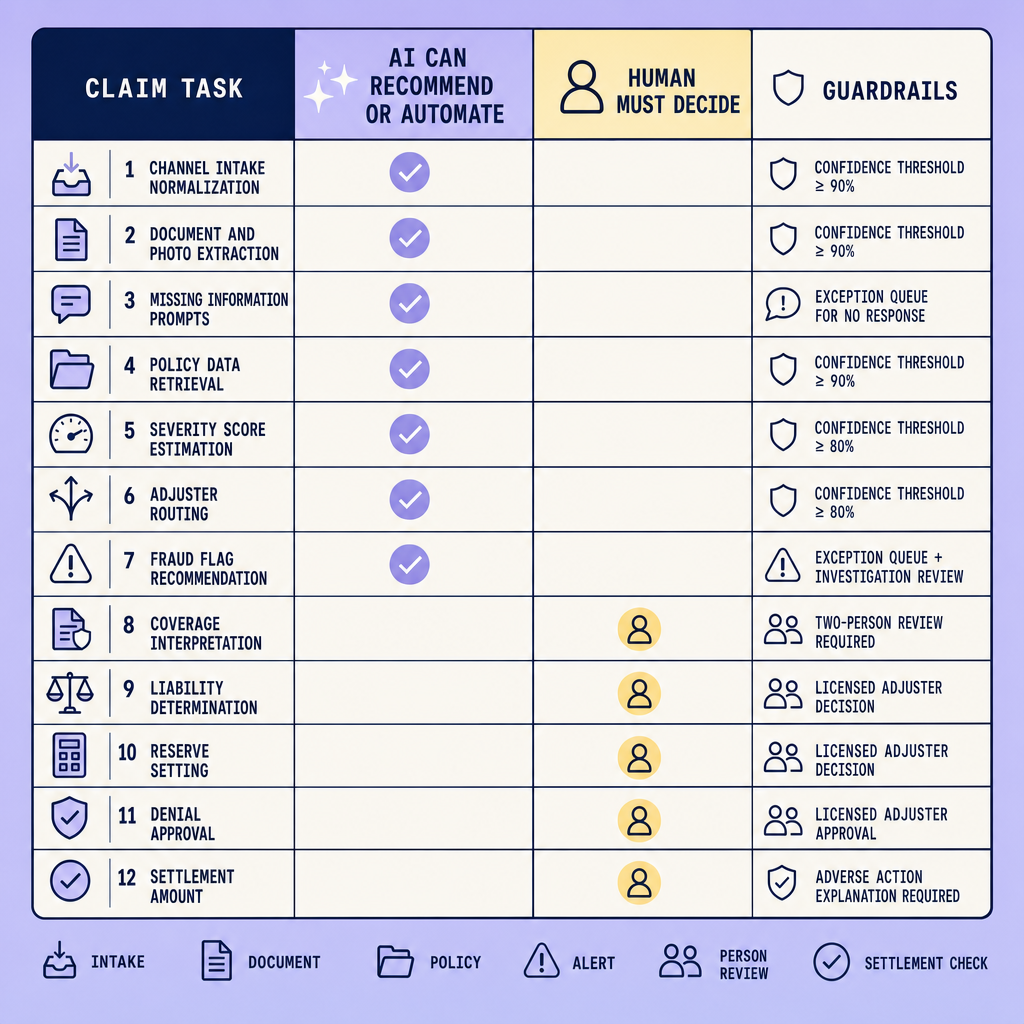
| Task | AI role | Human role | Confidence threshold | Escalation trigger |
|---|---|---|---|---|
| Intake prompting | Ask dynamic FNOL questions, collect missing facts | Review unusual narratives or vulnerable-customer cases | Auto-continue at workflow level | Contradictory answers, distress signals, jurisdiction-specific disclosures |
| Multimodal extraction + completeness checks | OCR/ASR/document AI extracts fields, validates required data | Confirm low-confidence or legally material fields | Auto-post fields at ≥0.90; review at <0.904 | Policy number, date of loss, claimant identity, injury flag below threshold |
| Severity scoring + routing suggestions | Score complexity, segment loss type, recommend queue | Accept, override, or reprioritize | Auto-route simple claims at ≥0.854 | Severe injury, litigation indicator, catastrophe event, VIP handling |
| Fraud flagging | Surface anomaly signals and referral recommendations | Decide SIU referral scope and next steps | Never auto-adverse solely on model output | Protected-class skew, weak evidence, high-impact referral |
Keep coverage interpretation, liability analysis, reserves, settlement authority, denials, and subrogation decisions with a licensed adjuster. AI can still support those workflows. But the decisions themselves carry regulatory, financial, and fairness consequences that need human review, documented rationale, and appeal-ready audit trails.58
In practice, the tradeoff is autonomy versus auditability. More automation speeds FNOL automation. Less discretion improves defensibility. We would integrate the AI layer into Guidewire or Duck Creek with immutable audit logs -- source document, extracted field, confidence scores, prompt version, model version, routing outcome, human override, and timestamp. That design usually gives teams the gain they want: fewer manual touches up front, faster triage, and safer escalation paths.46
Build the core components for agentic AI FNOL: confidence scores, integration, and exception queues
A model can extract fields impressively in a demo and still fail badly in production. Trustworthy AI claims intake depends on control points, not clever prompts. If the workflow cannot say what it extracted, how sure it is, where it sent the claim, and why a human stepped in, it does not belong in production. That is especially true for FNOL automation and claims triage automation, where bad data moves fast.34
Confidence design
Use confidence at two levels: field and document. Field-level confidence scores decide whether a value can flow straight into the claims schema, whether it needs a secondary rule check, or whether it belongs in an exception queue. A policy number at 0.99 and a date of loss at 0.62 should not be treated the same. They often are. That is a mistake.24
Document-level confidence is different. It answers whether the packet as a whole is usable for downstream insurance claims routing. We recommend pairing model confidence with business rules: missing insured name, no loss date, identity mismatch between FNOL form and police report, unclear injury indicators, duplicate claim signals. If claimants get unclear follow-ups or repeated requests, intake quality drops and manual work comes back.
Design the confidence threshold and the exception queue together, or the queue will drown your adjusters.
Integration architecture
Controls mean very little if the AI sits off to the side and nobody trusts the output path. Do not run AI in isolation. Production AI claims intake has to write back to the system of record through API integration -- typically Guidewire, Duck Creek, or a comparable claims platform -- so extracted data, routing outcomes, and human corrections stay in one governed workflow.57 In practice, that means mapping outputs to a stable claims schema, enriching with policy and prior-claims lookup, and recording every handoff.
The audit trail should capture source document, extracted value, confidence score, model version, prompt or rule used, timestamp, destination field, and human override. Because regulated operations need replayability, not just logs.53
Exception handling
This is where production reality shows up. Exception queues are where reliability becomes operational. Build them by failure mode first: missing documents, low-confidence dates, contradictory party details, coverage lookup failure, unclear severity, fraud flags. Generic review queues break fast.
The tradeoff is straightforward. Push straight-through processing only where confidence and rules agree; send contradictions to humans early. That approach keeps claims triage automation fast without letting automation outrun claim quality, fairness review, or compliance controls.46
Meet bias, fairness, audit, and regulatory requirements
Governance is not a cleanup step after launch. It has to be part of implementation from day one. In agentic AI insurance workflows, the risky point is not only settlement -- it is also intake and routing, where claims triage automation and fraud flags can create disparate impact by slowing service for certain claimant groups before any human decision is made.34
Test fairness across the workflow, not just the final claim outcome
A final claim decision can look neutral while earlier workflow steps quietly skew service levels. For FNOL automation and AI claims intake, we should test segment-level error rates across language, channel, geography, claimant age bands where permitted, and loss type. Check extraction accuracy, completeness prompts, severity scores, fraud flags, and routing destinations -- not just closure outcomes. A practical control is a shadow-mode baseline that compares AI vs. human triage on override rate, false-escalation rate, and delay introduced by exception queues.24
Make recommendations explainable and reviewable
If a recommendation cannot be explained, it will not survive regulatory or operational scrutiny for long. Severity and routing recommendations need reason codes: missing injury indicator, low-confidence VIN, prior-loss mismatch, photo damage signal, policy lookup failure. Log model version, prompt or ruleset version, input artifacts, confidence scores, destination queue, and every human override. That audit trail supports regulatory compliance, internal QA, and post-incident review.56
Lock down access, evidence, and monitoring
Controls also need to hold up after go-live, not just during testing. Use role-based access controls, retention rules for source documents and transcripts, and documented reviewer playbooks inside Guidewire or Duck Creek workflows. And monitor drift after go-live. We see the best results when teams keep controls simple because simple controls are easier to audit, maintain, and defend.57
Launch with shadow mode and measure adjuster time saved
A broad rollout sounds efficient until it floods adjusters with edge cases and exceptions. Start narrow. Then prove it.
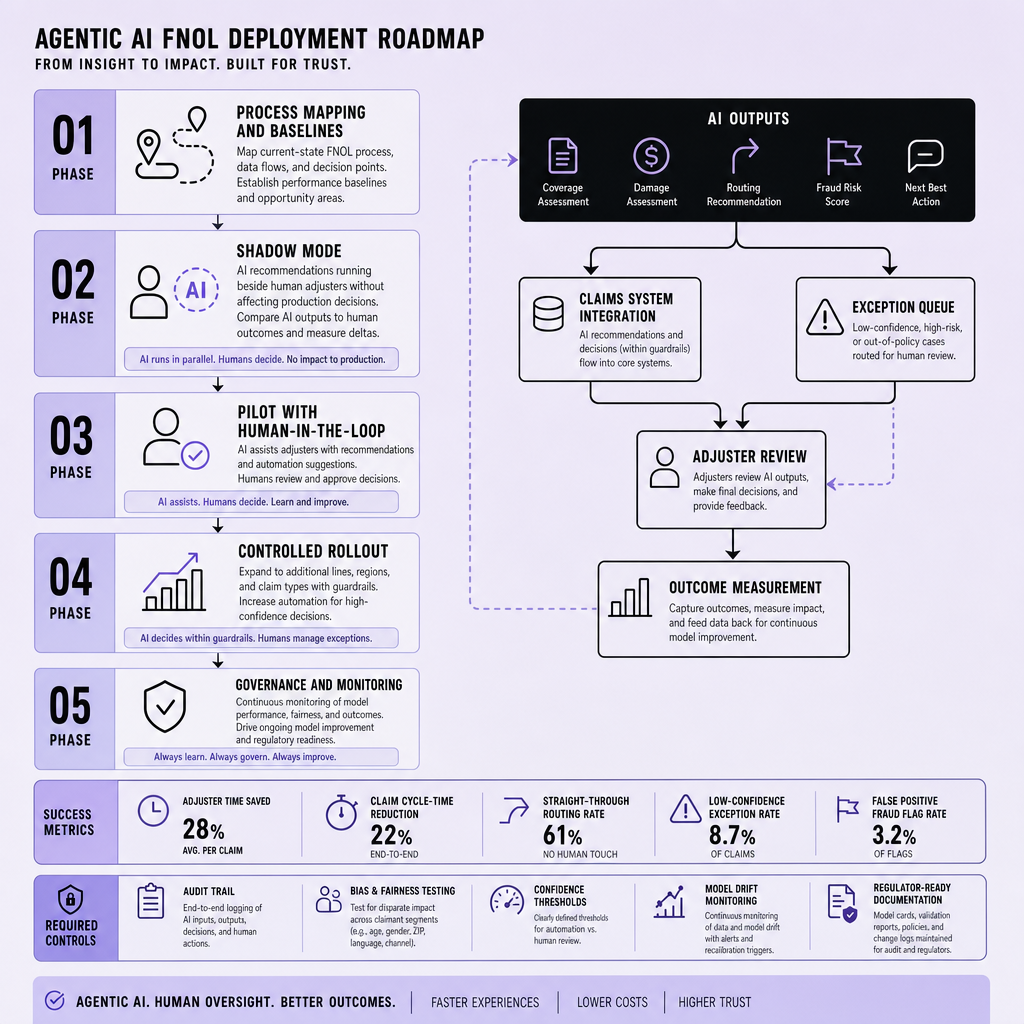
For agentic AI FNOL and claims triage automation, the safest rollout is a staged one: map the current intake-to-routing workflow, capture a baseline KPI set, replay historical claims offline, then run shadow mode before granting any production authority.34 We recommend launching by claim line or loss type with cleaner documentation patterns first -- for example, simple auto physical damage or low-complexity property intake. Narrow scope slows headline rollout. But it makes confidence thresholds, exception rules, and adjuster trust much easier to calibrate.
Sequence the rollout in controlled phases
First, document every handoff: FNOL entry, extraction, completeness checks, policy lookup, severity scoring, fraud flags, and insurance claims routing into Guidewire or Duck Creek queues. Then capture baseline KPI values: adjuster handling minutes, manual rekey rate, exception rate, first-contact resolution, and claim cycle time.52
Next, run historical replay or offline testing against prior claims to validate extraction accuracy and routing logic before live traffic.46 After that, enable shadow mode -- the system produces recommendations, confidence scores, and audit logs, but adjusters still make the routing decision.3
Keep threshold tuning at the field and action level, not one global score.
Then use a limited A/B rollout by claim type, tighten exception queue rules, and only expand once false escalations and missed edge cases are stable. We prefer this approach because a fast model that creates rework will fail operationally.
Measure outcomes in plain operational terms: adjuster time saved per claim, percent of claims routed without manual rekeying, exception rate, first-contact resolution, and cycle-time reduction.524
References
- AI Claims Processing: The Complete 2026 Guide for Insurance Leaders
- Top 10 FNOL Automation Platforms: Comparison Guide 2026 - FurtherAI
- Agentic AI Workflows Explained for Insurance - Notch
- FNOL automation: How AI is transforming claims intake - Assured
- The Complete Guide to AI Automation for Insurance: 25 Ways Agents Are ...
- How to Automate Insurance Claims Triage With Agentic AI Workflows
- Agentic Claims: AI-Powered Claims Automation - Peak3
- Insurance Claims Triage with Agentic AI: An n8n Blueprint
Footnotes
-
Top 10 FNOL Automation Platforms: Comparison Guide 2026 - FurtherAI ↩ ↩2 ↩3
-
https://www.assured.com/blog/fnol-automation-step-by-step ↩ ↩2 ↩3 ↩4 ↩5 ↩6 ↩7 ↩8 ↩9 ↩10 ↩11 ↩12 ↩13
-
https://www.notch.cx/post/agentic-ai-workflows ↩ ↩2 ↩3 ↩4 ↩5 ↩6 ↩7 ↩8 ↩9 ↩10
-
https://jinba.io/blog/automate-insurance-claims-triage ↩ ↩2 ↩3 ↩4 ↩5 ↩6 ↩7 ↩8 ↩9 ↩10 ↩11 ↩12 ↩13 ↩14 ↩15 ↩16 ↩17 ↩18 ↩19 ↩20 ↩21 ↩22
-
https://vcasoftware.com/ai-for-claims-processing/ ↩ ↩2 ↩3 ↩4 ↩5 ↩6 ↩7 ↩8 ↩9 ↩10 ↩11 ↩12 ↩13
-
https://www.kriv.ai/articles/insurance-claims-triage-with-agentic-ai-an-n8n-blueprint ↩ ↩2 ↩3 ↩4 ↩5 ↩6 ↩7 ↩8
-
Agentic Claims: AI-Powered Claims Automation - Peak3 ↩ ↩2 ↩3 ↩4
-
https://www.cassidyai.com/blog/the-complete-guide-to-ai-automation-for-insurance ↩
Frequently Asked Questions
What is agentic AI FNOL in practical terms?
Agentic AI FNOL is a workflow layer that can gather claim details, interpret incoming documents and media, decide what information is missing, and recommend the next operational step without replacing human claim authority. In practice, it works best as an orchestrator across channels, extraction models, business rules, and adjuster review queues rather than as a standalone chatbot.[^3][^6]
How does agentic AI FNOL differ from basic FNOL automation?
Basic FNOL automation usually digitizes intake forms or transcribes calls, while agentic AI FNOL can also sequence tasks, trigger follow-up questions, reconcile conflicting inputs, and recommend routing based on confidence and business rules. The distinction is that agentic systems manage the workflow logic between tools, not just a single capture step.[^4][^8]
Why should insurers avoid fully automated coverage decisions?
Insurers should avoid fully automated coverage decisions because coverage interpretation often depends on policy language, jurisdiction, endorsements, causation facts, and documented reasoning that must stand up in complaints, audits, or litigation. Automation can prepare the file and surface relevant policy context, but final determinations require accountable human judgment and clear legal authority.[^1][^5]
How do you keep exception queues from overwhelming adjusters?
The best way to control exception queues is to classify failures by type, assign service-level targets by risk, and route only material uncertainty to humans. A mature design separates missing-data follow-up, low-confidence extraction review, policy-match failures, and suspected fraud so senior adjusters are not distracted by simple data-quality corrections.
What metrics matter most after an agentic AI FNOL rollout?
The most useful post-launch metrics are straight-through intake rate, manual rekey reduction, adjuster minutes saved per claim, exception aging, override rate by queue, and cycle-time improvement by claim type. Those measures show whether the system is creating durable operational value or merely shifting work into hidden review steps.[^1][^2]
Make Imversion a preferred source on Google
Like this kind of AI and software analysis? Add Imversion as a preferred source so Google can highlight our articles for you in Search, AI Overviews, and AI Mode.