Agentic Automation Logistics: Streamlining GCC Freight Operations 2026
Explore the benefits of agentic automation logistics in GCC freight forwarding. Learn about reduced errors, improved efficiency, and phased rollouts.

On this page
How agentic automation logistics improves GCC freight forwarding operations
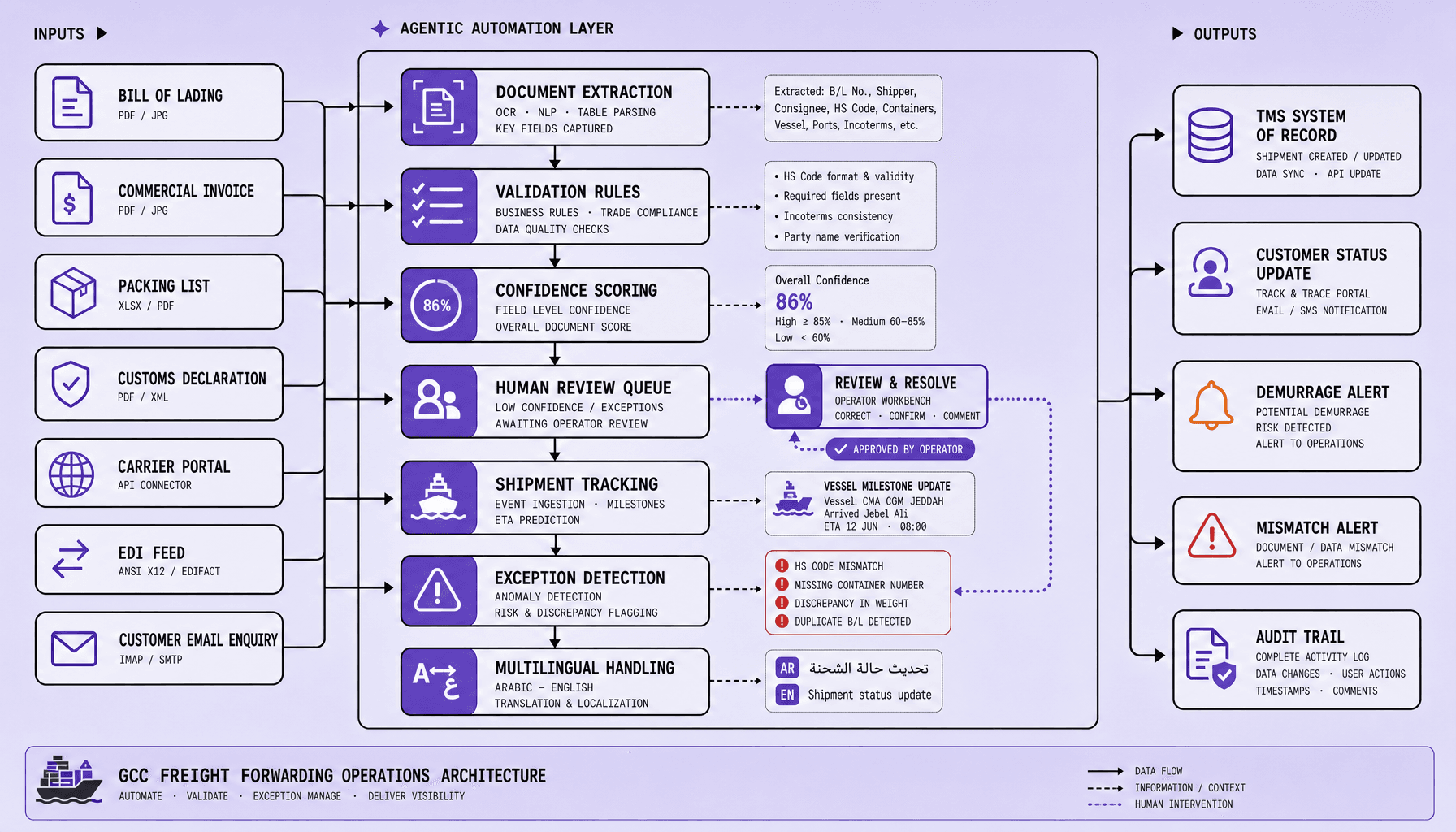
Freight teams across the GCC do not struggle because documents exist. They struggle because the same shipment data shows up in PDFs, inboxes, carrier portals, WhatsApp attachments, and EDI feeds, then someone still has to rekey it all under time pressure. Agentic automation logistics improves GCC freight forwarding by doing more than OCR. It extracts, validates, compares, routes, and escalates bills of lading, invoices, packing lists, customs files, and shipment events across UAE, KSA, Oman, Qatar, Bahrain, and Kuwait workflows.12
That manual effort breaks quickly on messy trade lanes. A stronger freight forwarding automation flow classifies documents, runs bill of lading extraction, checks container numbers, HS codes, seal numbers, weights, and Incoterms against the TMS, then pushes only low-confidence or high-risk exceptions into a review queue.345
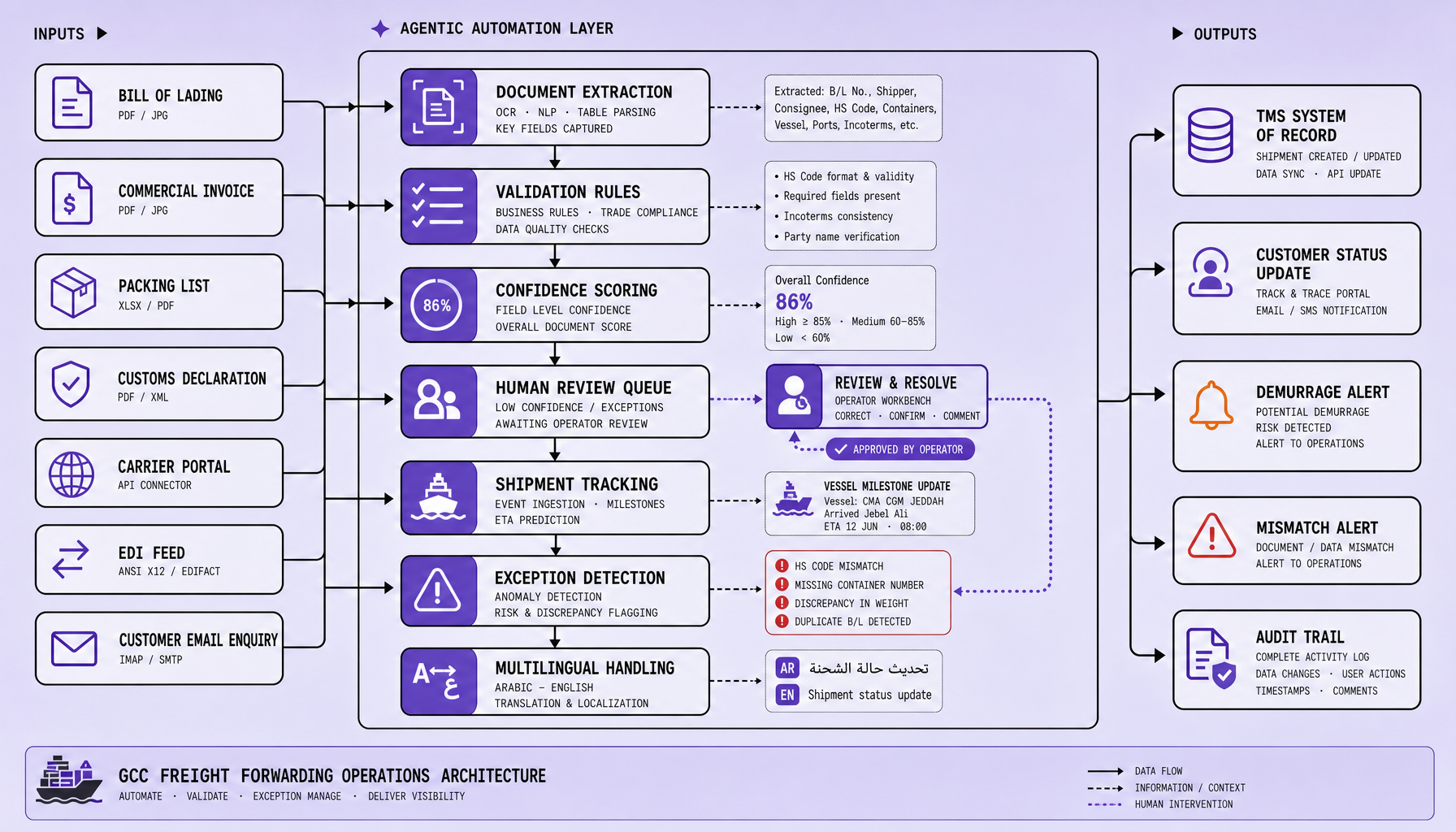
GCC operations are multilingual and exception-heavy, so logistics document automation has to handle Arabic-English fields, stamp-heavy forms, poor scans, and carrier-specific layouts -- not just clean templates.126 In practice, that means fewer manual touchpoints per shipment, faster customer status replies from portal and EDI data, and earlier alerts for demurrage risk or document mismatches.47
A sensible rollout starts with one document type -- usually the bill of lading -- before expanding to invoices, packing lists, and customs declarations. Clarity beats complexity here. Even at Imversion Technologies Pvt Ltd, the better path is phased control, confidence thresholds, and human review where the cost of being wrong is high.
Key Takeaways for agentic automation logistics
-
Start where the pain is repetitive and measurable: bills of lading, invoices, packing lists, and customs declarations. This is where logistics document automation saves the most time -- by extracting fields like container numbers, HS codes, seal numbers, and Incoterms, then validating them against the TMS, booking data, and customs records.135
-
Confidence-based review is the control layer, not a fallback. In GCC trade lanes, mixed Arabic-English documents, poor scans, carrier-specific layouts, and stamp-heavy forms make 100% straight-through processing unrealistic, so low-confidence fields should go to review queues instead of being pushed blindly into operations.126
-
Integrate freight forwarding automation with the TMS first, then EDI feeds, carrier portals, and customer status workflows. If extracted data never updates shipment milestones, exceptions, and customer responses, the system is just moving work around.47
-
Quantify ROI per shipment, not per month. Track minutes saved on rekeying and follow-ups, touchpoints removed, and mismatches caught -- bill of lading extraction errors, invoice-to-packing-list quantity gaps, customs data inconsistencies, and demurrage-risk exceptions.34
-
Roll out in phases. One document type first. Then expand once accuracy, review thresholds, and exception rules are backed by data.
Which GCC freight documents should agentic automation logistics handle first
If the first automation target is too broad, the rollout gets noisy fast. GCC forwarders are better off starting with four document classes: the bill of lading, commercial invoice, packing list, and customs declaration. These are the highest-friction files across UAE, KSA, Oman, Qatar, Bahrain, and Kuwait because they arrive in different formats, from different parties, and still drive core shipment, billing, and compliance decisions.146
The first scope should be document-first freight forwarding automation -- not “automate everything.” A better rollout starts where fields are repetitive, volume is high, and there is a clear system of record for validation, usually the TMS, booking record, purchase order, or customs master data. Clarity is better than complexity. The workflow should stay narrow at the start.
What the agent should monitor and do
Real intake is messy. A practical agent watches shared inboxes, carrier and customer portals, scanned attachments, WhatsApp/PDF uploads, and shared folders because forwarding operations rarely receive documents in a standard format.126 It then classifies document type, extracts key fields, and validates them against bookings, purchase orders, customs data, and the TMS.
For bill of lading extraction, the core fields are shipper, consignee, notify party, vessel, voyage, port of loading, port of discharge, place of delivery, container numbers, seal numbers, package count, gross weight, freight terms, and cargo description.38
For the commercial invoice, extract supplier and buyer names, invoice number, invoice date, line items, SKU or item description, quantity, unit price, total value, currency, country of origin, and Incoterms. Then compare invoice value, consignee, and item descriptions to the purchase order and shipment booking.15
For the packing list, capture carton or pallet count, package marks, item quantities, gross weight, net weight, dimensions, and container mapping. Mismatch checks matter here -- quantity against invoice, weight against bill of lading, and packaging details against booking.13
For customs document processing, extract importer and exporter details, HS code, declaration number, customs value, origin, duty-relevant fields, and Arabic-English text where required.56
Set confidence thresholds by field, not just by document. HS codes and invoice values deserve stricter review than vessel names.
That field-level control matters because document variability is normal here -- carrier-specific layouts, stamp-heavy forms, mixed Arabic-English fields, poor scans. Teams should route low-confidence or high-risk exceptions to human review instead of forcing straight-through automation on every file.125
Why document variability and confidence-based review matter in agentic automation logistics
The biggest failure mode in freight automation is not low accuracy. It is false confidence. Blind straight-through processing is a bad design choice for GCC freight forwarding. The safer model is trust architecture: extract, score, validate, compare, then escalate only the risky parts.
Because the inputs are messy.
A bill of lading from one carrier may place container numbers, seal numbers, and freight terms in predictable boxes; another may bury them in dense tables or footnotes. Customs document processing gets harder on GCC lanes because forms are often stamp-heavy, scan quality is uneven, and Arabic-English documents mix printed text, handwriting, and free-text cargo descriptions on the same page.125 Add country-specific requirements across UAE, KSA, Oman, Qatar, Bahrain, and Kuwait, and pure OCR pipelines start to break down fast.46
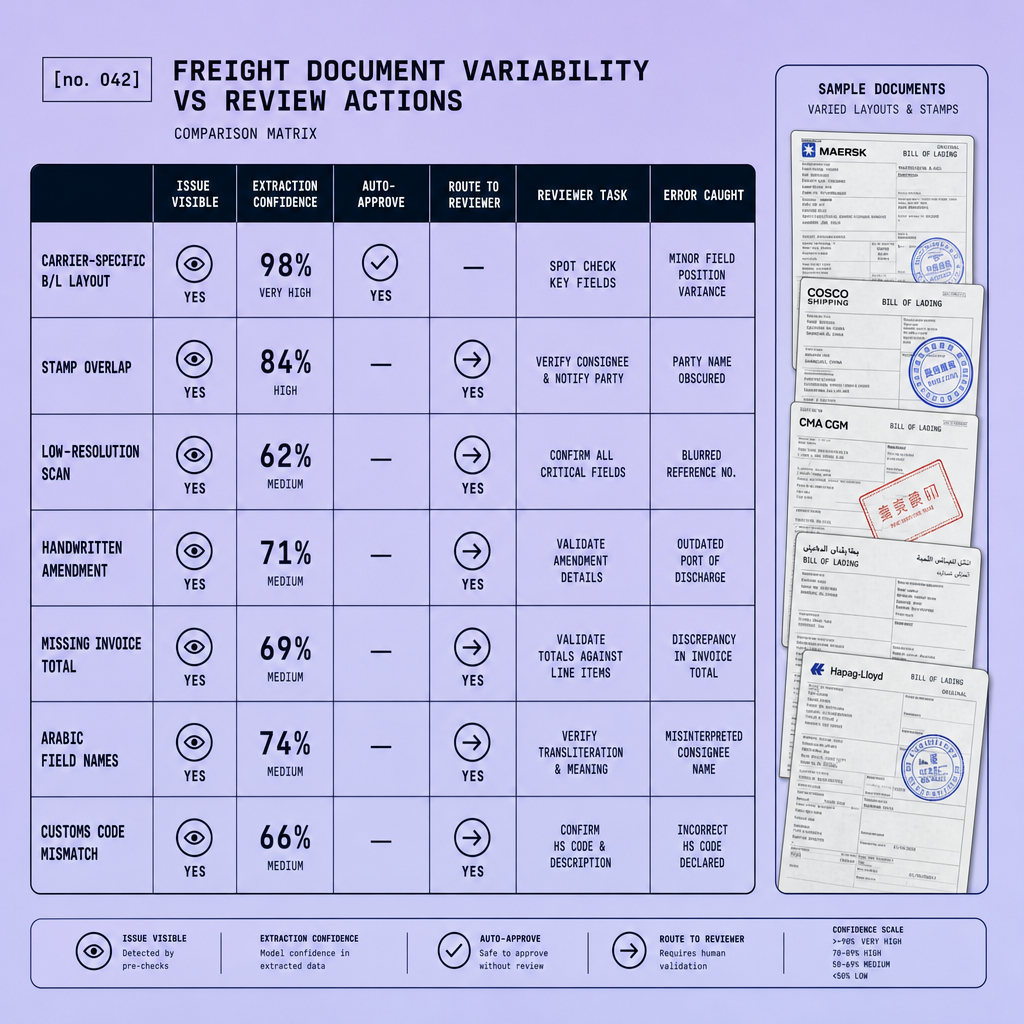
This is where logistics document automation needs discipline, not optimism. A strong agentic workflow does not just run bill of lading extraction and hope for the best. It assigns a confidence score at the field level -- not only at the document level -- then tests those fields against validation rules and business context.12 Container number format, HS code structure, invoice totals, gross weight, consignee name, and Incoterms can each be checked before anything reaches the TMS.
Low confidence is not failure. It is the right trigger for a human-in-the-loop review.
What should trigger review
Review queues should exist for a reason, not as a dumping ground. Teams should route documents into an exception queue when either extraction confidence drops below a defined threshold or business risk rises above it. Practical triggers include:
- quantity mismatches between packing list and invoice
- value mismatches that affect customs duty or VAT
- weight differences between B/L, packing list, and booking
- consignee or importer inconsistencies
- missing HS codes, vessel/voyage details, or seal numbers
- unreadable scans, overlapping stamps, or mixed-language fields35
One caveat matters: thresholds should differ by field. A low-confidence cargo description might be tolerable if the shipment is low risk. A low-confidence customs value should never auto-post. Understanding why a field is risky is what keeps freight forwarding automation reliable.
That is also how logistics document automation scales in practice -- by reducing manual rekeying on clean files while concentrating human effort on the few exceptions that can cause delays, penalties, or compliance errors.76
How agentic automation logistics can automate shipment tracking, customer status enquiries, and demurrage alerts
Operations teams do not just process documents. They chase updates, answer the same status question repeatedly, and notice demurrage risk later than they should. So the useful place to automate is not only extraction. It is the update loop itself.
Automate the updates first. Then automate the chasing.
In GCC forwarding, manual follow-up across carrier portal pages, NVOCC sites, terminal systems, email threads, and EDI messages burns hours that should never be spent on copy-pasting milestones into a TMS or replying to the same “Has my shipment departed?” question ten times a day. Strong shipment tracking automation fixes that by treating operational events as a workflow, not a lookup task.47
Pull milestones from every source, then normalize them
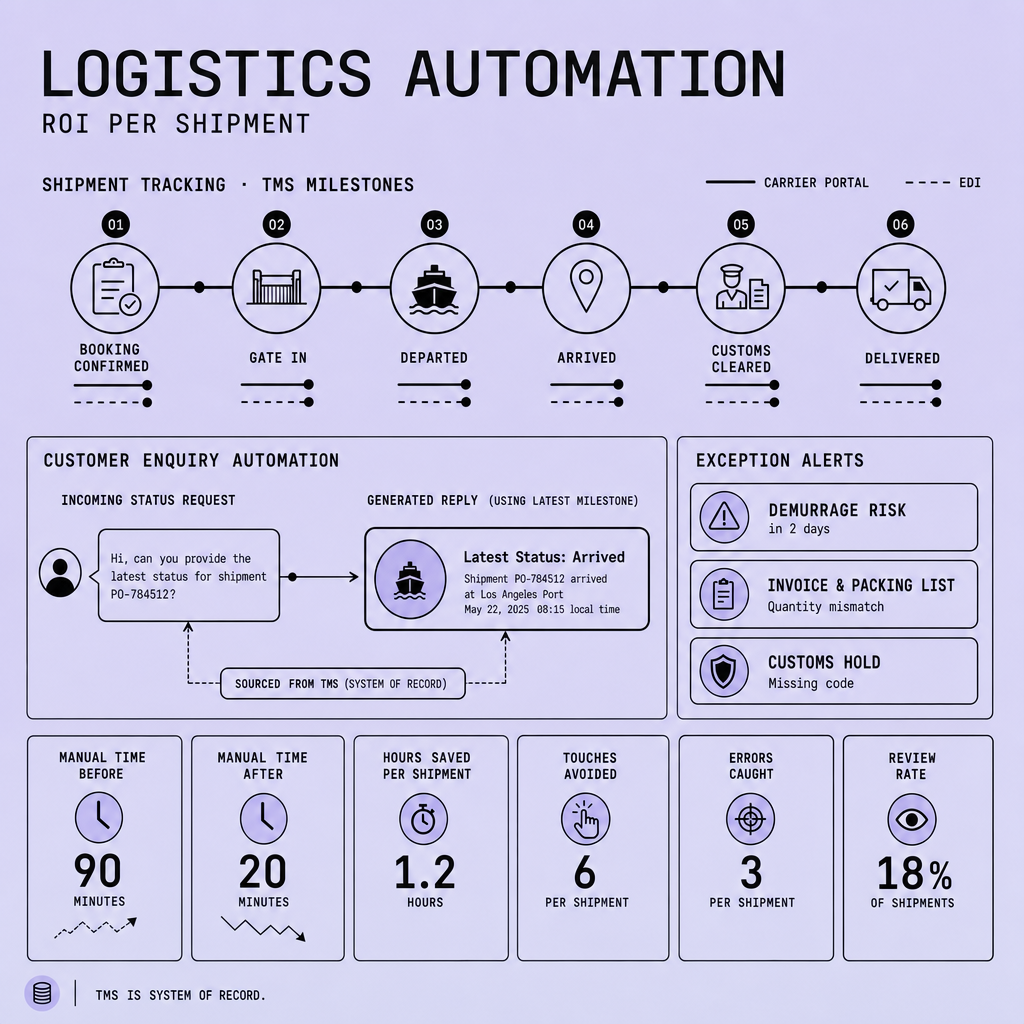
An agent should collect shipment milestones from the sources teams already use: carrier portal events, NVOCC tracking pages, terminal status screens, customs systems, and EDI feeds such as booking, departure, arrival, gate-in, gate-out, discharge, and delivery confirmations.46 Raw statuses are messy, though. One portal says “Loaded on board.” Another says “Vessel departed.” A terminal may only show “full out.” The workflow should map all of them to a standard status model inside the TMS -- booked, gated in, departed POL, arrived POD, customs hold, out for delivery, delivered.
Understanding why a shipment is late matters more than simply flagging that it is late, so the agent should store both the normalized milestone and the source text. That gives operators context.
Automate first-response customer updates
Most status enquiries are predictable: Has the container sailed? Has customs cleared in Jebel Ali? Is delivery confirmed in Riyadh? Did the truck exit the terminal in Dammam? These can be answered automatically by pulling the latest milestone, ETA change, container number, and hold status from the TMS record and sending a structured reply in English or Arabic, depending on the lane and customer preference.46
Keep escalation paths open. Always.
If milestones conflict, if a customs hold appears without a release update, or if the explanation could become commercially sensitive, route the case to an operator instead of guessing.
Trigger alerts before costs pile up
A useful freight forwarding automation setup watches for exceptions, not just updates. Practical alert rules include:
- no departure milestone after planned cutoff
- mismatch between B/L, invoice, packing list, or customs data such as container numbers, seal numbers, HS codes, or Incoterms15
- customs hold or inspection status56
- container discharged but not cleared or picked up within the free-time window, creating demurrage or detention risk47
In practice, this cuts 10-20 manual touchpoints per shipment and saves 15-30 minutes of status work on files with multiple updates, while surfacing costly errors before they become claims, penalties, or angry calls.47
How TMS integration and multilingual trade lanes shape the automation design
Automation fails quietly when it becomes a side system. One version of the truth sits in the inbox workflow, another in the extraction layer, and a third in the TMS. In freight forwarding, that drift shows up as wrong container numbers, stale milestones, customs mismatches, and unclear exception ownership.47
The automation layer should not become a second database. It should read from source systems, make controlled decisions, and write back to the TMS as the system of record.
A practical design usually combines three integration paths.
Anchor every decision in the TMS
The TMS should provide the booking, job file, customer master, carrier references, milestones, and validation rules. The agent compares extracted fields from bills of lading, invoices, packing lists, and customs files against that baseline before posting updates. The workflow is straightforward: ingest, extract, validate, escalate low-confidence fields, then write verified data back to the job record with timestamps and operator actions.125
Avoid workflows that stop at spreadsheets. Disconnected extraction may save a few minutes, but staff still rekey data into the operating system. The value appears when verified fields update shipment records, trigger tasks, and preserve an auditable exception trail for disputes, customs checks, and demurrage reviews.47
Use APIs, EDI, and portal connectors for different job types
APIs fit modern carrier, customer, and customs integrations where near-real-time shipment tracking automation matters. EDI still matters for milestone feeds, status messages, and structured exchange across established partners. Portal connectors fill the remaining gaps, such as carrier sites, terminal portals, and customs screens that still require controlled retrieval or submission steps.46
Each connector needs guardrails: idempotent write-backs, retry logic, partner-specific field mapping, and queue-based exception handling. A failed or duplicated update can hide a detention or demurrage risk.
Design for Arabic, mixed-language fields, and entity normalization
Multilingual trade lanes are not an edge case in the GCC. They are the operating environment. GCC trade lanes often combine Arabic and English in the same customs document processing flow, sometimes in the same field.56 A consignee name may appear in English on the invoice, Arabic on the declaration, and transliterated differently on the bill of lading.
So the agent needs Arabic support, bilingual OCR or extraction, and normalization rules for company names, port names, addresses, HS codes, and cargo descriptions. Variants such as “Abdul Rahman Trading,” “Abdelrahman Trd.,” and the Arabic equivalent may refer to the same party. The system should attempt that match, score confidence, and log why it accepted or escalated it.
In agentic automation logistics, trust comes from traceability: source file, extracted value, matched master record, confidence score, reviewer action, and final write-back.
That audit trail is what makes multilingual customs and tracking workflows usable in higher-risk operations.12
How to quantify ROI per shipment and roll out agentic automation one document at a time
Automation projects often get approved on vague efficiency language and then stall because nobody can tell what improved per shipment. That is avoidable. Measure ROI at the shipment level, not as a broad annual automation promise. It keeps agentic automation logistics tied to day-to-day operations.
Build a per-shipment ROI model first
Start with baseline metrics for one lane, one team, and one document type -- for example, UAE to KSA import shipments using bills of lading. Track four numbers before launch: manual handling time, number of touches, enquiry first-response time, and exception rate.
A practical model looks like this:
- Minutes saved per shipment: time spent opening PDFs, keying fields into the TMS, checking container numbers, seal numbers, HS codes, or Incoterms, and chasing missing data. Logistics document automation is strongest where teams repeat the same checks across inboxes, portals, and EDI feeds.14
- Touches avoided: email handoffs, rework loops, and duplicate entry into customs or billing workflows.7
- Errors caught early: mismatches between bill of lading, invoice, packing list, and customs declaration before clearance or invoicing.35
- Service level gain: reduced customer enquiry handling time because shipment milestones are already updated from carrier portals or EDI.47
Keep the math simple:
ROI per shipment = labor minutes saved + rework avoided + penalty or billing leakage prevented.
Do not assume straight-through processing on every file. Mixed Arabic-English fields, poor scans, and layout variation make confidence-based review important in freight forwarding automation.12
Roll out one document at a time
Start with the document that creates the most friction -- usually the bill of lading. Define confidence thresholds, route low-confidence fields to a review queue, and compare baseline vs post-launch for 4 to 6 weeks.37
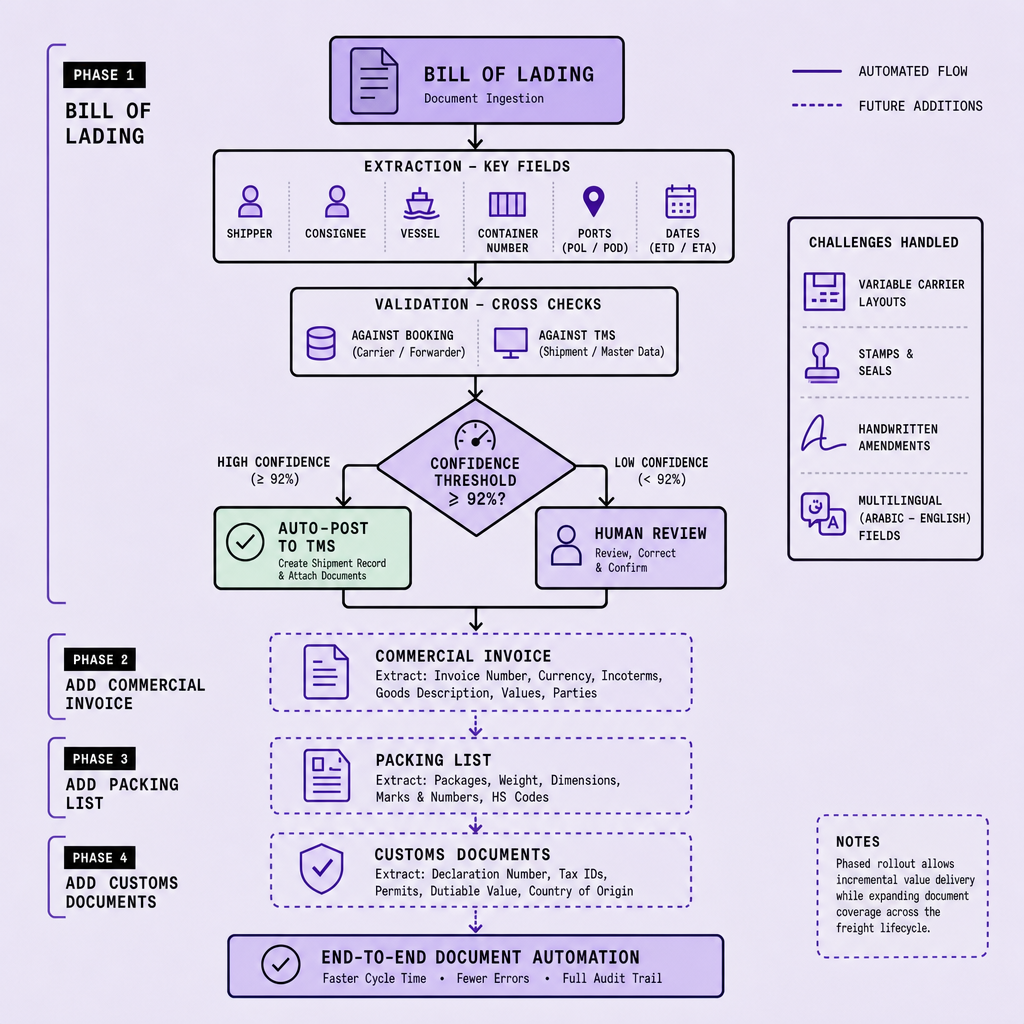
Choose one lane, one document type, and one operations team first. Teams learn the exception patterns before scaling to Oman, Qatar, Bahrain, or Kuwait.
Expand only after the pilot is stable:
- Pilot rollout: B/L extraction and validation into the TMS.32
- Phase two: invoices and packing lists with cross-document checks.15
- Phase three: customs declarations, portal tracking, and exception alerts for demurrage or billing mismatches.56
Focus on exception patterns, not just automation volume. Otherwise teams automate noise instead of improving the workflow.
References
- Agentic Document Extraction in Logistics - Landing AI
- Bill of Lading Guide 2026 and AI Process Automation - iCustoms.AI
- AI for Logistics: Automating Shipping, Tracking, and Compliance
- Agentic Document Platform for Logistics & Supply Chain - Reducto
- Supply Chain Automation Use Cases: Where AI Earns ROI in 2026
- Bills of Lading Bottlenecks Solved with Generative AI - LinkedIn
- 5 Steps to Automate Customs Docs for Freight Forwarders in 2026
- Agentic AI Logistics Dubai: Customs, Freight, Invoicing, and Supply ...
Footnotes
-
https://landing.ai/industries/logistics ↩ ↩2 ↩3 ↩4 ↩5 ↩6 ↩7 ↩8 ↩9 ↩10 ↩11 ↩12 ↩13 ↩14 ↩15 ↩16 ↩17
-
https://reducto.ai/industries/logistics-supply-chain ↩ ↩2 ↩3 ↩4 ↩5 ↩6 ↩7 ↩8 ↩9 ↩10 ↩11
-
https://www.icustoms.ai/blogs/simplify-bill-of-lading-with-process-automation/ ↩ ↩2 ↩3 ↩4 ↩5 ↩6 ↩7 ↩8 ↩9
-
https://ayoob.ai/blog/ai-for-logistics ↩ ↩2 ↩3 ↩4 ↩5 ↩6 ↩7 ↩8 ↩9 ↩10 ↩11 ↩12 ↩13 ↩14 ↩15 ↩16
-
https://ustechautomations.com/resources/blog/automate-customs-documentation-freight-forwarding-workflow-guide-2026 ↩ ↩2 ↩3 ↩4 ↩5 ↩6 ↩7 ↩8 ↩9 ↩10 ↩11 ↩12 ↩13 ↩14
-
https://www.ateamsoftsolutions.com/agentic-ai-logistics-dubai-customs-freight-invoicing-and-supply-chain-automation-for-trading-and-distribution-companies/ ↩ ↩2 ↩3 ↩4 ↩5 ↩6 ↩7 ↩8 ↩9 ↩10 ↩11 ↩12 ↩13
-
https://www.kognitos.com/blog/supply-chain-automation-use-cases-2026/ ↩ ↩2 ↩3 ↩4 ↩5 ↩6 ↩7 ↩8 ↩9 ↩10 ↩11
-
https://www.linkedin.com/posts/psolum_how-intelligent-document-processing-is-closing-activity-7484237545845977088-xcAf ↩
Frequently Asked Questions
What is agentic automation logistics in a freight forwarding context?
Agentic automation logistics is an AI-led operating layer that can ingest shipment documents and events, decide what to validate, trigger follow-up actions, and escalate only uncertain or risky cases to humans. Unlike basic OCR or macros, it combines extraction, rule checks, system updates, and exception handling into one auditable workflow.[^1][^4]
How does agentic automation logistics reduce compliance risk without slowing operations?
It reduces compliance risk by separating low-risk straight-through work from high-risk exceptions using field-level confidence, business rules, and cross-document checks. That design preserves speed on clean files while forcing review on sensitive values such as customs amounts, HS codes, consignee identity, or missing shipment references.[^2][^7]
Why should GCC forwarders normalize milestone data instead of just reading carrier portals?
Milestone normalization matters because raw status messages vary by carrier, terminal, and EDI partner, which makes customer updates and internal reporting inconsistent. Converting source phrases into a standard TMS status model lets teams automate replies, compare SLA performance across lanes, and detect exceptions earlier without losing the original event text.
How should a team choose confidence thresholds for multilingual trade lanes?
Teams should set thresholds by field criticality, lane risk, and document condition rather than using one blanket score. For example, bilingual consignee names may allow a lower automation threshold if matched to master data, while customs value, HS code, and container number should require stricter acceptance because errors there can affect clearance, duty, and billing outcomes.[^7][^8]
What KPIs prove an agentic automation logistics pilot is ready to expand?
A pilot is ready to expand when it shows stable extraction accuracy on the first document type, declining reviewer load, faster first-response time on status enquiries, and measurable reduction in preventable mismatches. The strongest expansion signal is not raw automation volume; it is consistent control of exceptions with clear audit trails and reliable TMS write-backs.
Make Imversion a preferred source on Google
Like this kind of AI and software analysis? Add Imversion as a preferred source so Google can highlight our articles for you in Search, AI Overviews, and AI Mode.