AI Agent Production: Bridging the Gap in 2026
Discover the reasons behind stalled AI agent pilots and learn practical strategies to ensure successful AI deployment in enterprise settings.

Why AI Agent Production Breaks After a Strong Pilot
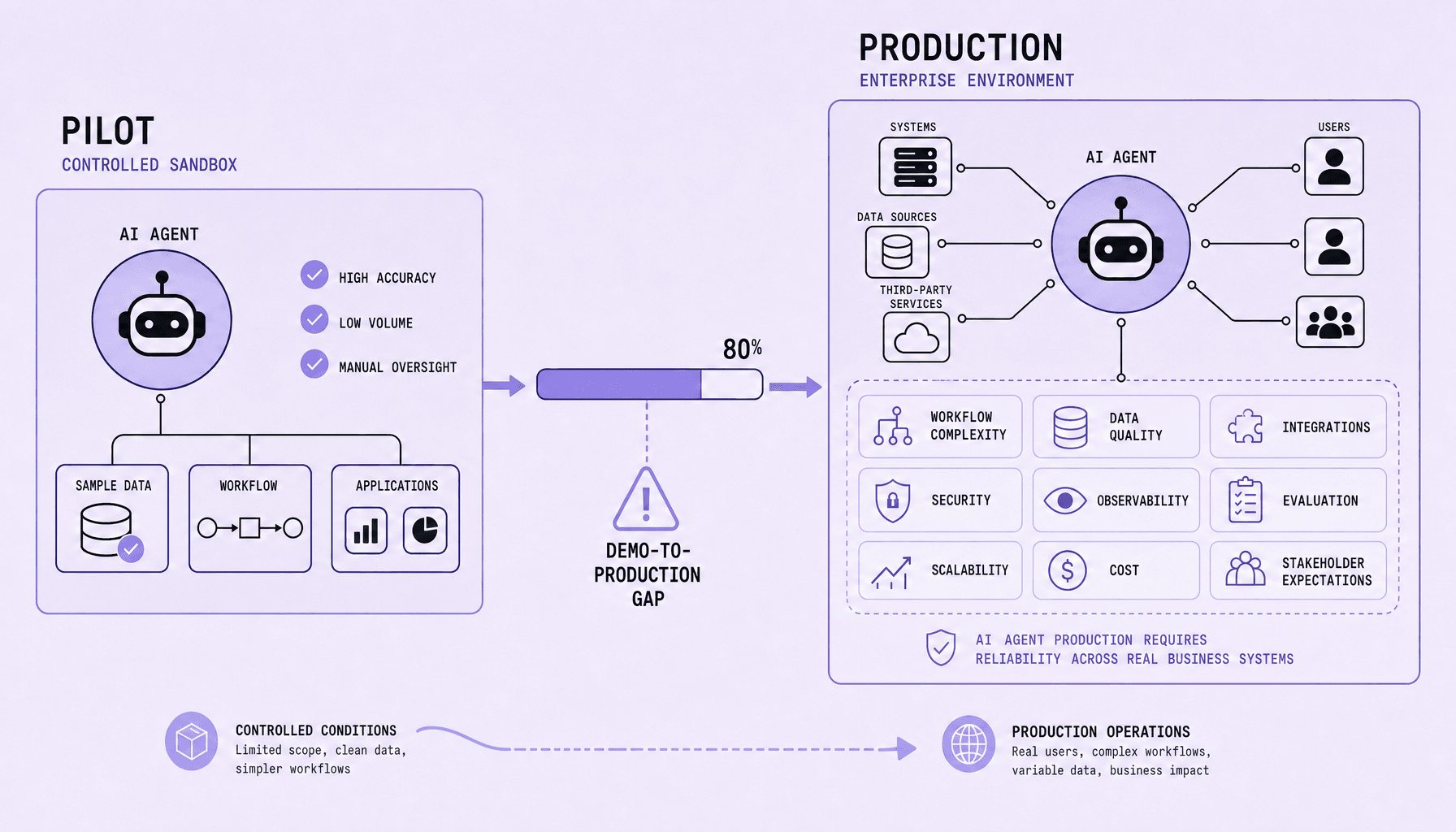
A pilot can look convincing in a demo and still collapse the moment it touches real systems. That is what trips teams up. The agent handles a narrow sandbox well, then falls apart during AI deployment once live workflows, security reviews, and messy enterprise data enter the picture.
In practice, the model is rarely the only problem. Workflow exceptions, CRM or ERP integrations, RBAC, audit logs, latency targets, and failure handling become blockers fast. Teams often skip serious evaluation too. They validate a few happy-path tasks, not error rates, escalation behavior, or hallucination thresholds under load. Monitoring matters as much as deployment, because an agent you cannot trace, measure, and correct will not earn trust. At Imversion Technologies Pvt Ltd, this gap usually looks less like model failure and more like weak production engineering.
Key Takeaways for AI Agent Production
- Strong demos fail in production because AI agent pilots usually avoid messy inputs, exception paths, and cross-system handoffs. Real AI deployment means approvals, retries, fallbacks, and human escalation.
- AI agent reliability is the real gate. If an agent cannot meet clear SLOs for accuracy, latency, error rate, and policy compliance, it is not ready for customer-facing or high-risk enterprise AI workflows.
- Data quality and integrations break more launches than model capability. In practice, stale CRM records, weak knowledge sources, brittle ERP or help desk connectors, and poor state management cause silent failures fast.
- Security should not be optional -- especially in enterprise AI. Put RBAC, audit logs, PII controls, and environment parity into the rollout plan before scale, not after review.
- To reach AI agent production, use phased rollouts, offline and live evaluation, observability for traces and failures, and cost guardrails per workflow. Automate checks where possible because automation reduces human error.
Why AI Agent Pilots Stall at Eighty Percent in Enterprise AI
Most teams do not get stuck because the demo was bad. They get stuck because the last twenty percent is where the hard engineering lives. AI agent pilots usually stall at eighty percent because teams approve the capability they saw on screen, then run into the repeatability, controls, and operational ownership production requires. The model looked smart. The system around it was not ready.
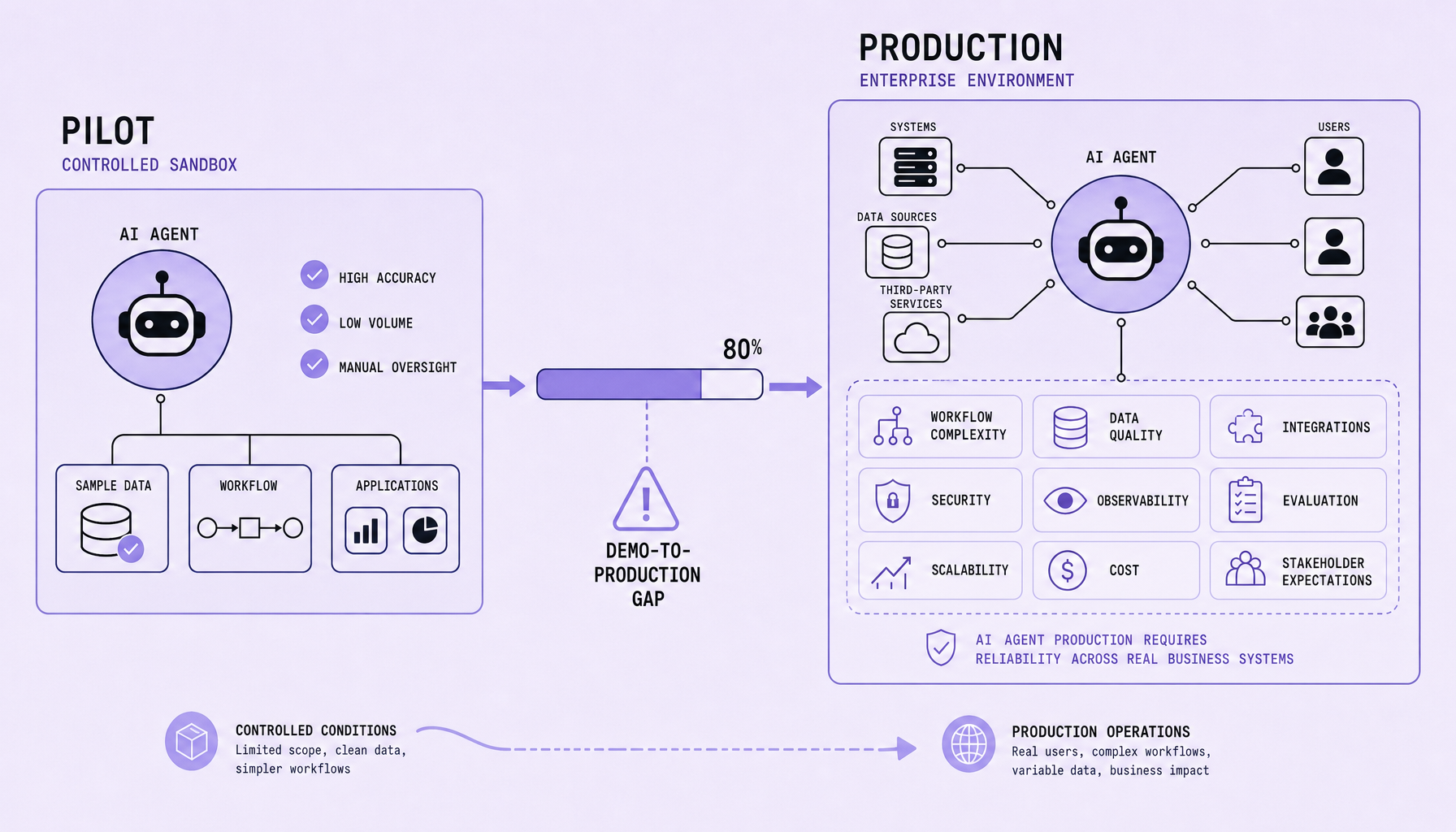
Pilot conditions vs production conditions
Pilots are forgiving. Inputs are cleaner, prompts are hand-tuned, and failure paths are easy to ignore. Production is harsher. You get malformed tickets, duplicated CRM records, missing permissions, API rate limits, stale knowledge base content, and users who do not follow the happy path. Every one of those conditions affects AI deployment.
That changes the questions production teams need to ask. Leaders may greenlight enterprise AI after seeing one narrow task completed end to end. Operations teams need a different checklist: What is the fallback? Who approves exceptions? Where are the audit logs? How do we enforce RBAC, redact sensitive fields, and trace a bad action across systems?
Because partial success is not enough.
Why 80% accuracy is not enough
An agent that succeeds on 8 of 10 tasks can still be operationally unacceptable. If the two failures trigger refunds, expose private data, or route the wrong contract for approval, the error rate is not just a model issue; it is business risk.
A concrete example: a support agent drafts strong replies, classifies tickets correctly most of the time, and automates refund workflows. But if it occasionally invents refund eligibility or misses a compliance condition, you now have customer harm, policy drift, and audit exposure.
That is the gap teams underestimate. A pilot treats misses like edge cases. Production treats them like incidents.
The structural gaps between demo and AI agent production
Once a pilot moves toward rollout, the same AI production readiness gaps keep showing up:
- weak evaluation across edge cases, not just average-case outputs
- brittle integrations with CRM, ERP, help desk, and identity systems
- poor observability across latency, tool failures, retries, and escalation rates
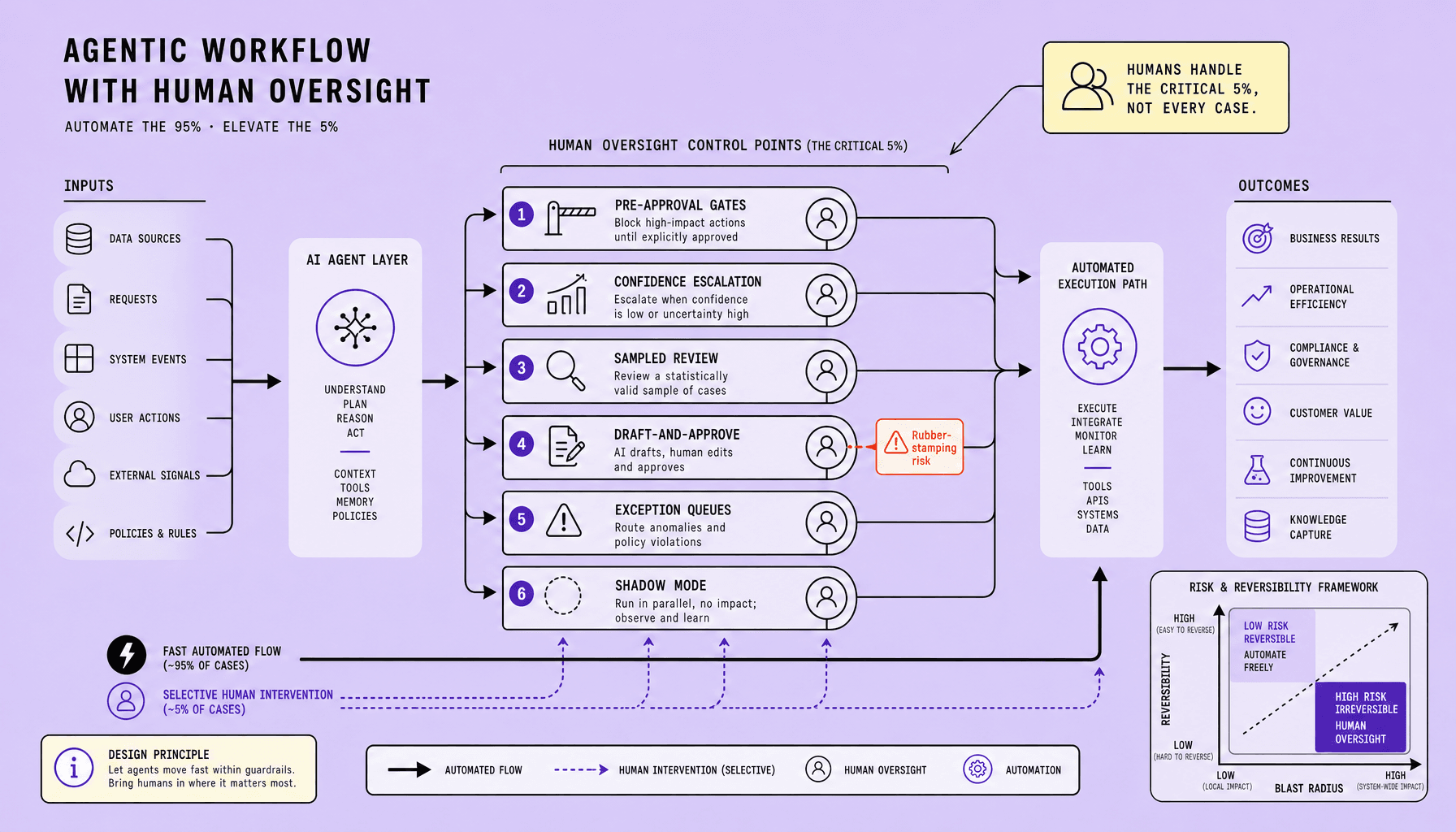
- unclear human-in-the-loop design for exceptions and approvals
- unresolved security and compliance requirements
- rising token, inference, and support costs at scale
Monitoring is as important as deployment -- because you cannot improve AI agent reliability if you cannot see where the workflow breaks.
A practical path forward is simple, even if the work is not: define SLOs, failure thresholds, rollback rules, and human handoff points before rollout. Then phase release by workflow risk, not by demo confidence.
AI Agent Reliability Depends on Workflows, Data Quality, and Integrations
This is where production reliability usually gets decided. Not in the prompt. Not in the benchmark. In the surrounding system. Most reliability failures do not start in the model. They start in the environment around it. That is why AI agent pilots can look strong in review meetings, then weaken during AI deployment as soon as they touch real approvals, records, and systems. For enterprise AI, AI production readiness comes from system design, controls, and evaluation discipline, not prompt tuning alone.
Workflow complexity breaks linear demos
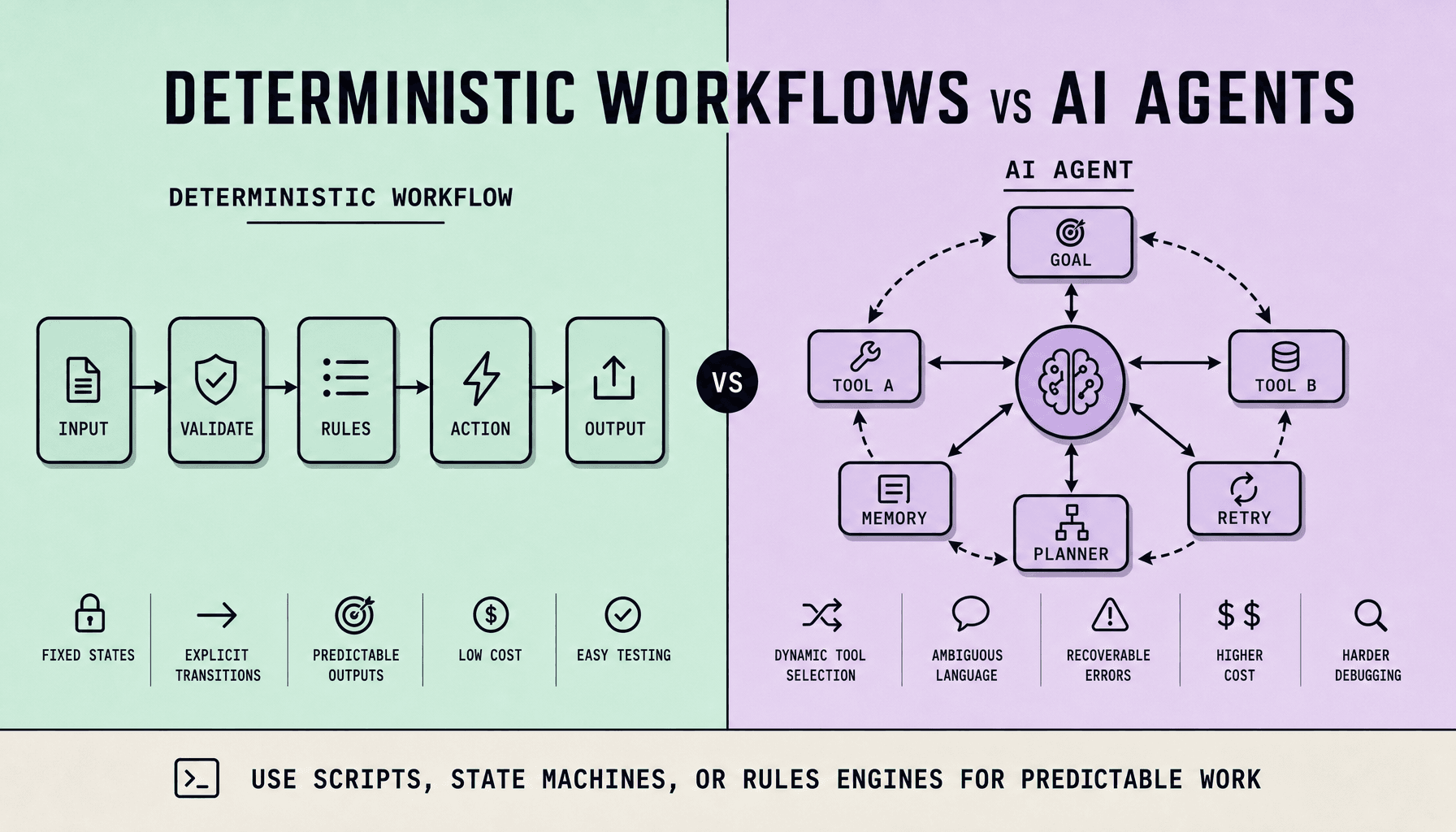
Pilots usually assume a clean path: input, reasoning, action, done. Real operations are not linear.
A quote assistant may read from CRM, check pricing rules in ERP, draft terms, and route exceptions for approval. Then a discount threshold changes, a contract flag requires legal review, or a customer record is missing a tax field. Now the agent needs orchestration, exception handling, retries, and human escalation.
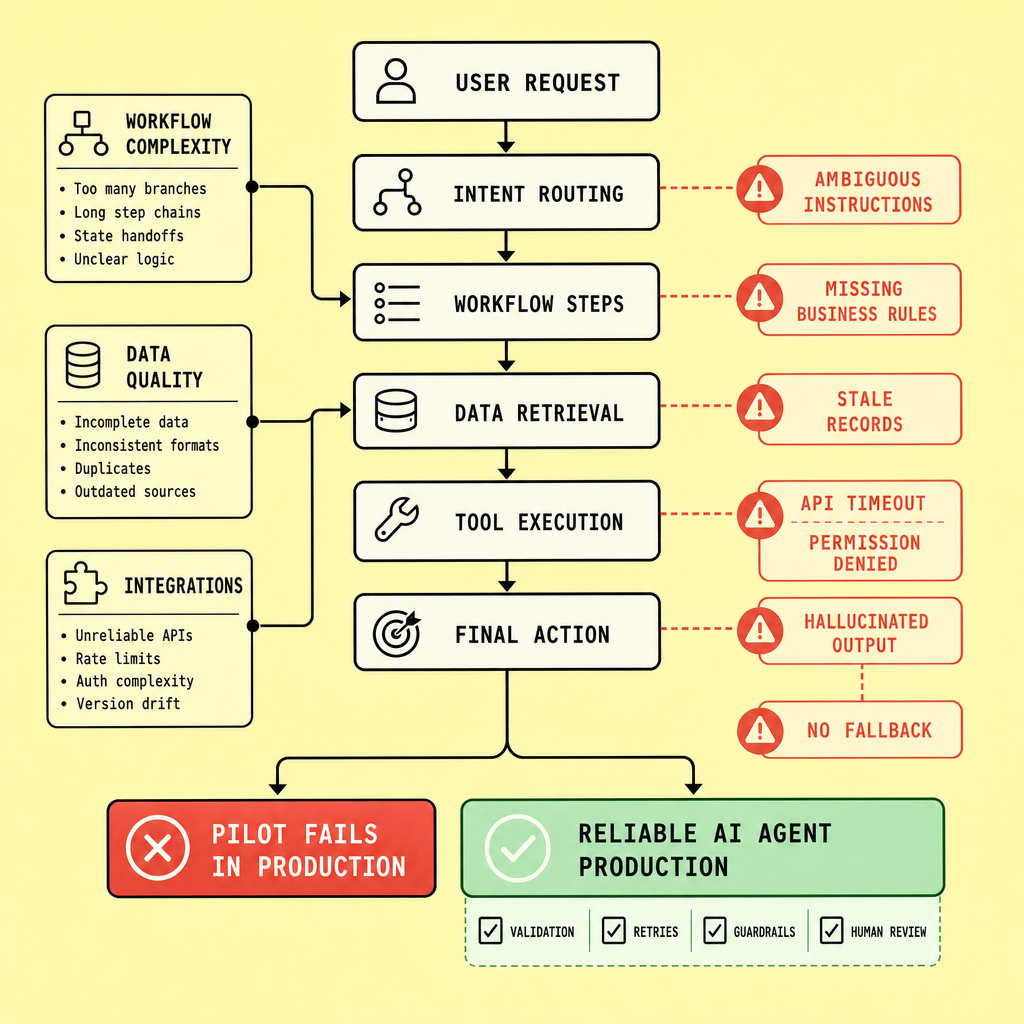
This is where AI agent reliability is won or lost. Broad autonomy sounds efficient, but narrow automation is often safer. Start with a few high-value, high-confidence tasks first, because reliability usually improves faster through workflow constraints than through prompt changes alone.
Data quality degrades output quality fast
Bad source data does not stay contained. Agents amplify the quality of the data they receive. If your CRM has duplicate accounts, your knowledge base is stale, or your document repository mixes inconsistent formats, the agent will produce inconsistent actions and explanations.
Retrieval-augmented generation can help, but it does not fix weak source systems. If a support agent retrieves an outdated refund policy, it can still generate a confident wrong answer. Reducing that risk takes source ownership, freshness checks, document versioning, and evaluation sets built from real failure cases.
Integrations turn prototypes into production systems
This is often the brittle part: the API layer. Authentication expires. Rate limits hit. Payload schemas drift. One field name changes in CRM or ERP, and the agent can fail or write back bad data.
That is why prototypes feel easier than production systems. Production agents need RBAC, audit logs, approval gates for sensitive actions, and observability across latency, error rates, tool-call failures, and fallback frequency. If you cannot trace why an agent acted, you do not have AI production readiness. You have a risky demo.
Security, Observability, and Evaluation Are the Real Gates to AI Agent Production
A pilot is not ready for AI agent production until you can control it, inspect it, and measure it. If your team cannot explain why an agent failed, it cannot safely scale that agent -- no matter how good the demo looked.
Security controls
Security is where many enterprise AI rollouts slow down, and for good reason. Before AI deployment, lock down access with RBAC, scope tool permissions per task, and keep audit logs for prompts, tool calls, retrieved documents, and user actions. You also need clear data handling rules -- what can leave the system, what must be masked, and which records an agent can read or write in CRM, ERP, or help desk flows. Guardrails should cover prompt injection, unsafe tool execution, and policy-violating outputs.
If those controls arrive late, rollout usually stalls late too.
Observability signals
Production failures are rarely clean. They do not always show up as a hard crash or a total outage. Monitoring matters as much as deployment because agent failures are often partial, intermittent, or expensive before they are obvious. Track task success rate, fallback rate, latency, cost per task, incident rate, and escalation volume. Use observability with distributed tracing across model calls, vector retrieval, orchestration steps, and downstream APIs. Set SLOs before rollout. Alert on drift, retries, and abnormal tool usage.
Evaluation before rollout
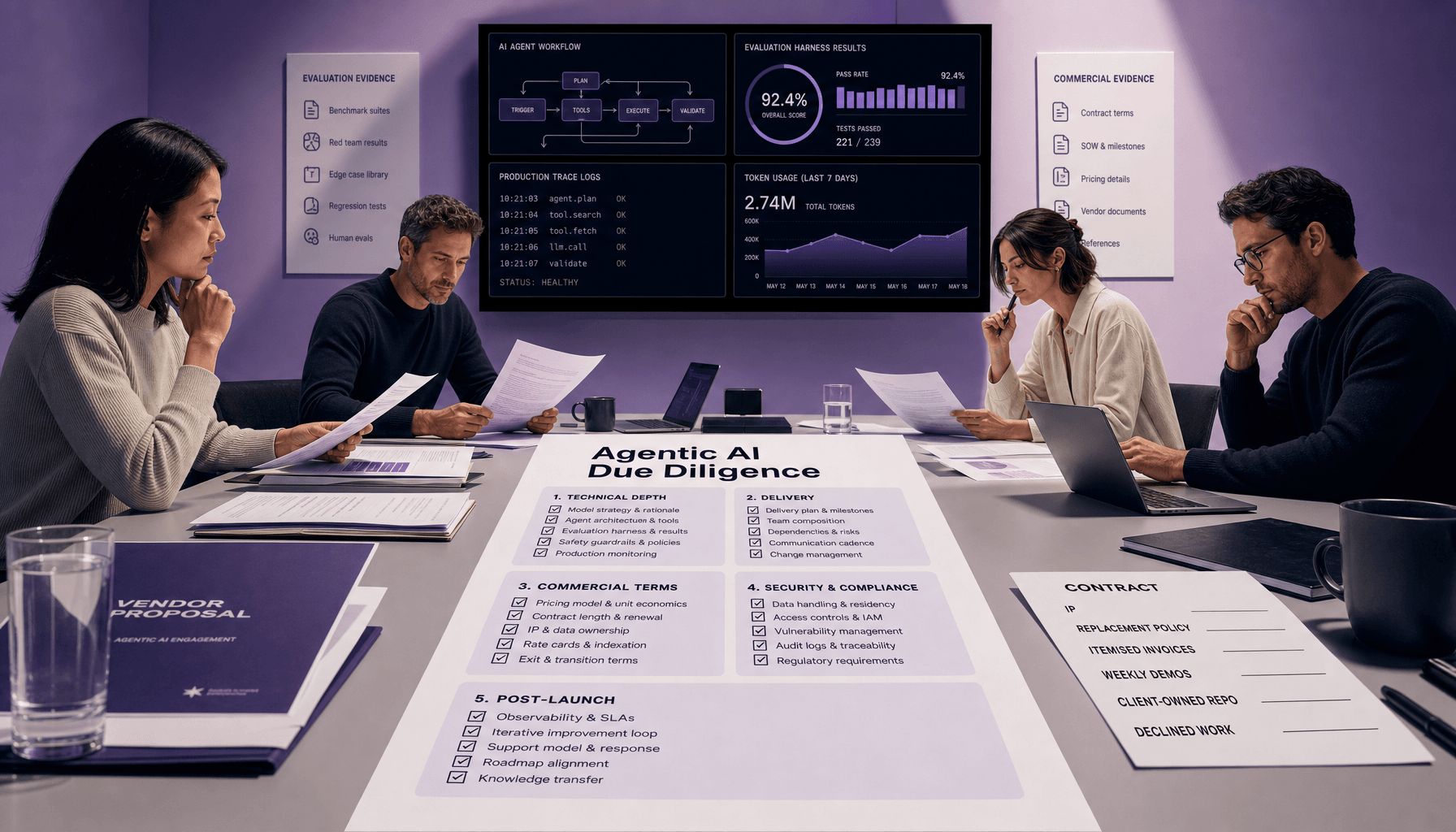
Spot checks are not enough, but many AI agent pilots stop there. That is too weak. Build an evaluation harness with representative tasks, failure cases, policy checks, and regression tests. Score factuality, tool correctness, refusal behavior, recovery paths, and human handoff quality. A practical gate for AI agent reliability: do not ship until the agent is stable on messy inputs, predictable under load, and auditable after every incident.
Scalability, Cost, and Stakeholder Expectations Can Derail AI Production Readiness
A pilot can prove usefulness and still fail AI production readiness because scale changes the economics, operating model, and success criteria.
Scale and cost expose weak AI deployment assumptions
A lot of rollout pain starts here. Teams validate one flow, then overlook concurrency, retries, and peak traffic. Costs rise with longer contexts, multi-step tool use, and fallback calls to larger models. Latency rises too. An agent that feels fine in a demo can become expensive, slow, and brittle once real throughput, support queues, and regional traffic arrive.
Failure recovery is where weak designs surface fastest. If an agent times out during a CRM write, who retries, who audits the partial action, and what is the rollback plan? Without telemetry for latency, error rates, and cost, teams cannot manage unit economics or total cost of ownership.
A practical tradeoff: more autonomy may reduce human effort, but it often increases validation, exception handling, and support burden.
Stakeholder alignment and common mistakes
Technical issues are only part of the problem. Many AI agent pilots are over-scoped, weakly owned, and approved without a production KPI. A pilot may optimize for answer quality in a controlled test. Production value is different: resolution rate, containment, SLA impact, cost per task, and failure thresholds.
Set explicit production KPIs early, or operations teams inherit reliability risk and uncontrolled spend.
Executive expectations can derail AI deployment too. Teams need phased rollout, capacity planning, and a clear owner for budget, reliability, and escalation paths. Security matters, but realistic expectations about latency, throughput, and support overhead matter too.
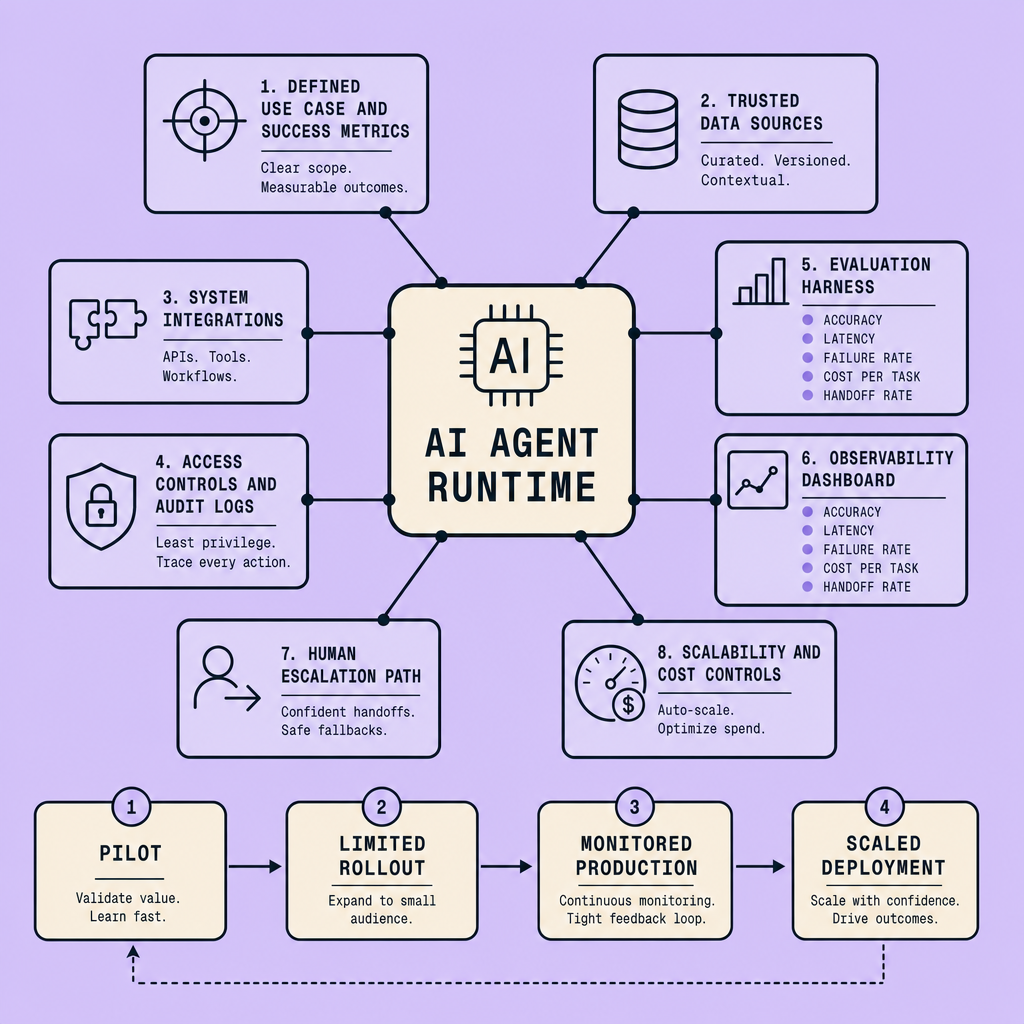
How to Reach AI Agent Production With a Practical Rollout Framework
The fastest path to AI agent production is usually not a bigger model or broader autonomy. It is a smaller initial scope, tighter controls, and clear acceptance criteria rather than broad autonomy on day one.
Define narrow success criteria
Start with one workflow, one owner, and one measurable outcome. Choose a task with bounded inputs, clear policy rules, and an obvious fallback. Set production gates early: task success rate, latency targets, escalation rate, hallucination tolerance, and allowed failure modes. If an agent cannot meet those gates in staging, do not expand it.
Harden data and integrations
Many production failures start in bad context or brittle connectors. Clean source data, lock down prompt inputs, validate schemas at API boundaries, and add retries, idempotency keys, and timeout handling for system calls.
Keep local, staging, and production environments aligned. Differences in models, secrets, prompts, or connector behavior create false signals and slow debugging.
Add human-in-the-loop controls
Permissions should expand in layers. Read-only first, then draft generation, then limited actions behind approval. Use RBAC, audit logs, redaction rules, and manual review for higher-risk outputs. If an agent can trigger messages, refunds, or record changes, approvals and traceability should be built in.
Instrument observability and incident response
Treat the agent like a production service. Log prompts, tool calls, retrieval sources, outputs, latency, token usage, and error classes. Track failure rate, cost per task, and escalation volume. Define incident response before rollout so the team knows how to disable, contain, and review failures.
Production readiness checklist: reliability, security, observability, fallback workflow, and cost guardrails.
Evaluate against production scenarios
Do not test only the clean path. Test messy inputs, partial records, policy exceptions, and degraded dependencies. Use offline evaluation, shadow mode, and canary releases so expansion happens only after the agent passes realistic acceptance tests.
Phase rollout and review cost regularly
Roll out by team, region, or use case. Keep a kill switch. Review cost and performance on a fixed cadence because scale changes both quickly. Some agents should remain constrained where policy ambiguity, financial risk, or weak source data still require human judgment.
Frequently Asked Questions
What is the biggest difference between an AI agent pilot and AI agent production?
The biggest difference is operational accountability. A pilot proves a task can work under controlled conditions, while AI agent production requires repeatable outcomes, audited actions, fallback behavior, and ownership for failures. Production systems must survive bad inputs, dependency outages, and policy constraints without creating unacceptable business risk.
How do you know an AI agent production system is ready to scale?
An AI agent production system is ready to scale when it consistently meets predefined service levels for accuracy, latency, policy compliance, and cost across realistic workloads. It also needs stable integrations, clear rollback procedures, strong observability, and evidence from staged rollouts that performance holds under concurrency and exception-heavy conditions.
Why do enterprise AI agents fail even when the model quality looks strong?
Enterprise AI agents often fail because model quality is only one layer of the system. Real failures usually come from weak workflow design, stale or inconsistent data, brittle API dependencies, missing permissions, and unclear human escalation rules. A strong model cannot compensate for poor operational design around it.
What metrics should teams track after AI deployment goes live?
Teams should track task completion rate, escalation rate, fallback rate, latency by workflow step, cost per completed task, tool-call error rate, and policy violation rate. These metrics show whether the agent is reliable, economical, and controllable in production instead of merely generating plausible outputs.
Why should teams limit scope before expanding AI agent production?
Teams should limit scope first because constrained workflows make it easier to validate data quality, security rules, and integration behavior before complexity compounds. Narrow launches reduce blast radius, create cleaner feedback loops, and generate operational evidence that supports broader automation decisions with less risk and lower remediation cost.
Make Imversion a preferred source on Google
Like this kind of AI and software analysis? Add Imversion as a preferred source so Google can highlight our articles for you in Search, AI Overviews, and AI Mode.