AI Agent State Management: Effective Strategies for 2026
Explore essential strategies for AI agent state management, separating model memory from durable business states and improving overall efficiency.

AI Agent State Management: What Goes Where in Production Systems
Production agents start failing the moment teams treat the prompt like a database. Context windows swell, retries forget what happened, approvals disappear into chat history, and nobody can say which copy of state is correct. The practical fix is simple: keep current-turn thinking in model memory, and move durable agent state, retries, approvals, and progress into systems built to persist and query them.
Teams often confuse agent memory vs state. That breaks fast. AI agent memory should hold recent messages, a compact summary, and retrieved facts relevant to the current turn. But refund status, pending_review approvals, retry state, and final tool results belong elsewhere -- PostgreSQL for business records, Kafka or SQS for event flow, and Temporal or Durable Functions for multi-step progress. At Imversion Technologies Pvt Ltd, we treat the context window as working memory, never the system of record, because long-term productivity only holds up when the state model stays explicit and auditable.
Key Takeaways for AI Agent State Management
-
Treat model context as working memory, not durable truth. Good LLM context management keeps only the current goal, recent turns, retrieved facts, and a compact summary -- never approvals, final decisions, or system-of-record data.
-
Put durable business state in a database such as PostgreSQL or a document store. In practical agent memory vs state design, orders, tickets, customer records, and audit-worthy outcomes must survive retries, crashes, and handoffs.
-
Use queues like SQS or Kafka to move work between services. They carry tasks and events; they do not replace durable storage or workflow state for AI agents.
-
Track long-running progress in a workflow engine such as Temporal or Durable Functions. Store statuses like
pending_review,awaiting_input, andcompleted, plus retry and timeout state. -
Persist human approvals explicitly. Don’t hide them in chat history. Our view is simple: clean state boundaries make production agents easier to debug, audit, and trust.
What AI Agent State Management Actually Covers
If your team is only talking about chat history, you are looking at a small slice of the problem. State in an agent system includes every piece of information the agent reads, updates, depends on, or must recover after failure.
Teams often call all of this AI agent memory. That shortcut creates design mistakes. In practice, agent memory vs state is the first distinction to make: memory is what helps the model reason right now, while state is the larger operational picture the system must preserve, inspect, and control.
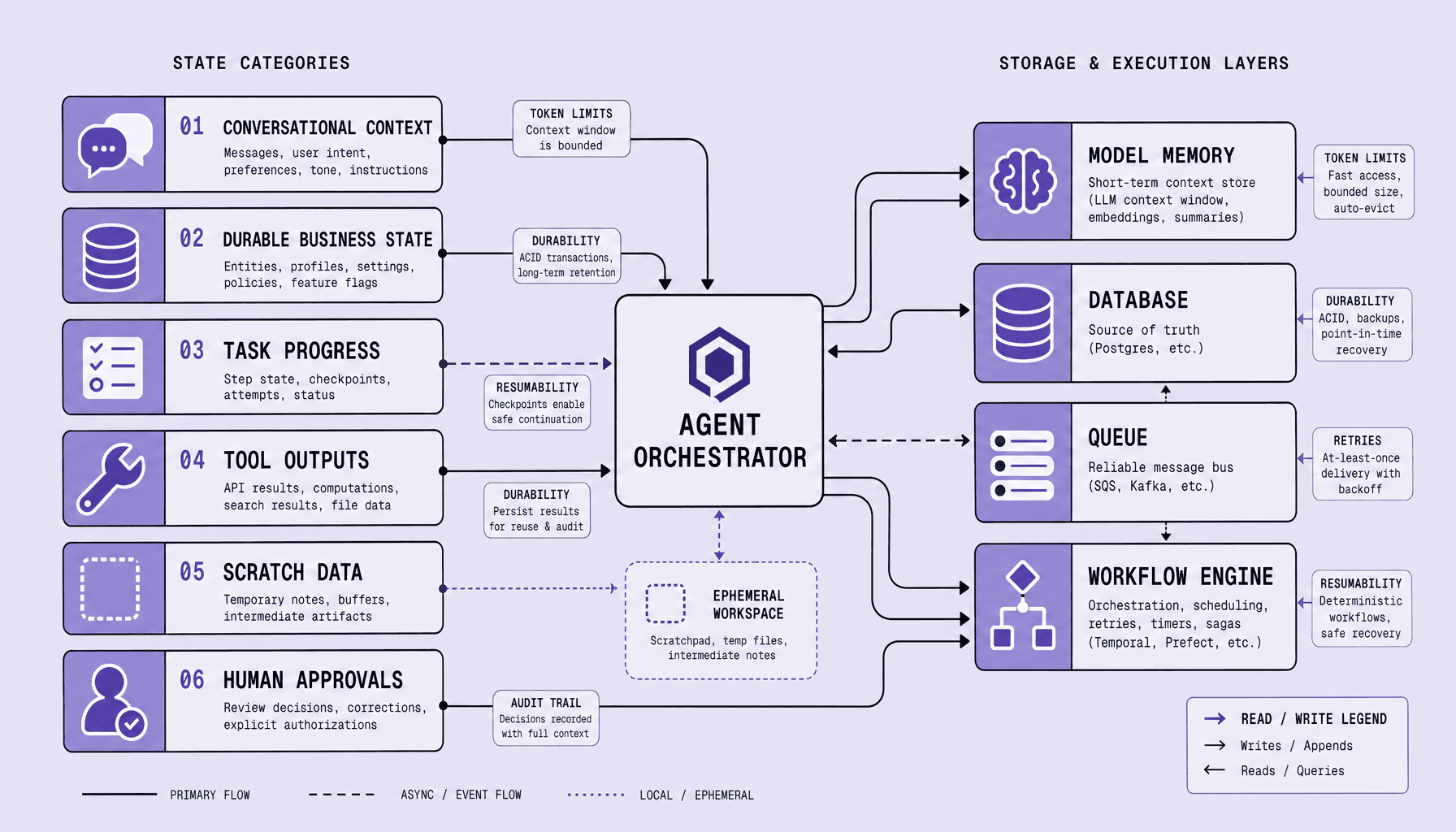
A useful taxonomy looks like this: conversational context for the current turn, durable business state in a system of record, task progress across multi-step work, tool outputs, scratch data for intermediate reasoning, and human approvals or checkpoints. Different data means different rules.
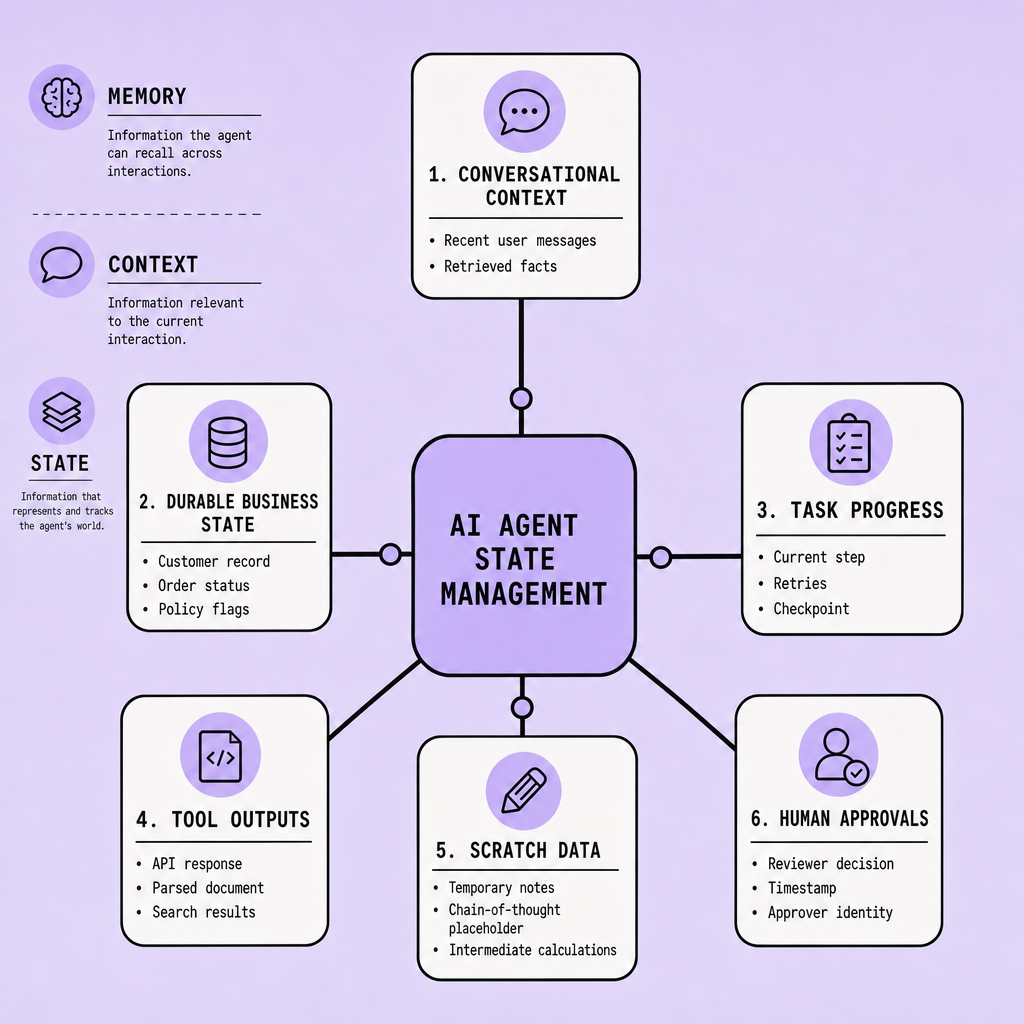
Those rules start with three questions: how long the data should live, which component owns the truth, and what happens if the value disappears. Temporary reasoning notes can be regenerated. A completed approval, workflow step, or external side effect usually cannot.
This is where LLM context management needs discipline. The context window is limited, tokens cost money, and summarization loses detail, so it should hold only working memory: recent turns, the active goal, retrieved facts, and a compact summary. Approvals, refund decisions, retry status, pending_review, user preferences that must persist, and workflow checkpoints are state, not prompt material.
There is also an operational side to state management. Operators may need to inspect current task status, replay a failed step, resume from a checkpoint, or hand work to a person without guessing what the agent already did.
If losing a value would break recovery, auditing, or handoff, it is not just memory.
So classify data by purpose before choosing storage. That boundary makes agent behavior easier to debug, safer to recover, and much clearer to govern in production.
The State Taxonomy: Context, Business State, Task Progress, Tool Outputs, Scratch Data, and Approvals
The first production fix is to stop treating agent memory as one bucket. Mix everything together and the prompt bloats, retries lose work, and ownership of truth gets fuzzy. A simple split works better.
Conversational context
The minimum context the model needs for this turn.
Lifetime: seconds to a session.
Examples: recent messages, active goal, retrieved facts, compact summary.
Keep this in model memory. It is ephemeral, refreshable, and often reconstructable. It is not durable agent state.
Business state
The system-of-record data that must remain correct after the turn ends.
Lifetime: days to years.
Examples: order status, refund decision, customer profile, ticket ownership.
Store this in PostgreSQL or another database. It should be durable, queryable, and auditable.
Task progress
The execution status of a long-running job or multi-step workflow.
Lifetime: until completion or cancellation.
Examples: pending_review, awaiting_payment_check, retry count, timeout state, completed.
This is workflow state. Put it in a workflow engine such as Temporal or Durable Functions.
Tool outputs
Results returned by tools, APIs, retrieval, or code execution.
Lifetime: one turn to moderate retention, depending on reuse.
Examples: search results, payment check response, intermediate tool results.
Cache or persist selectively. Some outputs are only useful for the current turn; others help with replay or debugging.
Scratch data
Temporary working notes used during reasoning.
Lifetime: milliseconds to one run.
Examples: tentative plans, parsed fragments, intermediate notes.
Keep it ephemeral, in memory or short-lived storage. Do not treat it as authoritative.
Approvals
Explicit human decisions that gate actions.
Lifetime: as long as audit, compliance, or operations require.
Examples: approval record, reviewer ID, timestamp, rejection reason.
Store approvals outside the prompt in durable storage, often tied to workflow checkpoints. You can copy approval status into context temporarily, but the source of truth should live outside the model.
AI Agent State Management by Store: What Belongs in Model Memory, Databases, Queues, and Workflow Engines
This is where architecture either holds up or starts leaking. Keep everything in the prompt and the agent may still look fine in a demo, but production exposes the weak spots fast: bloated context windows, lost progress after retries, approvals trapped in chat history, and no authoritative state anyone can trust.
A practical rule is to map state by failure cost. If losing it would cause customer harm, compliance risk, or unrecoverable work, it should not live only in model context.
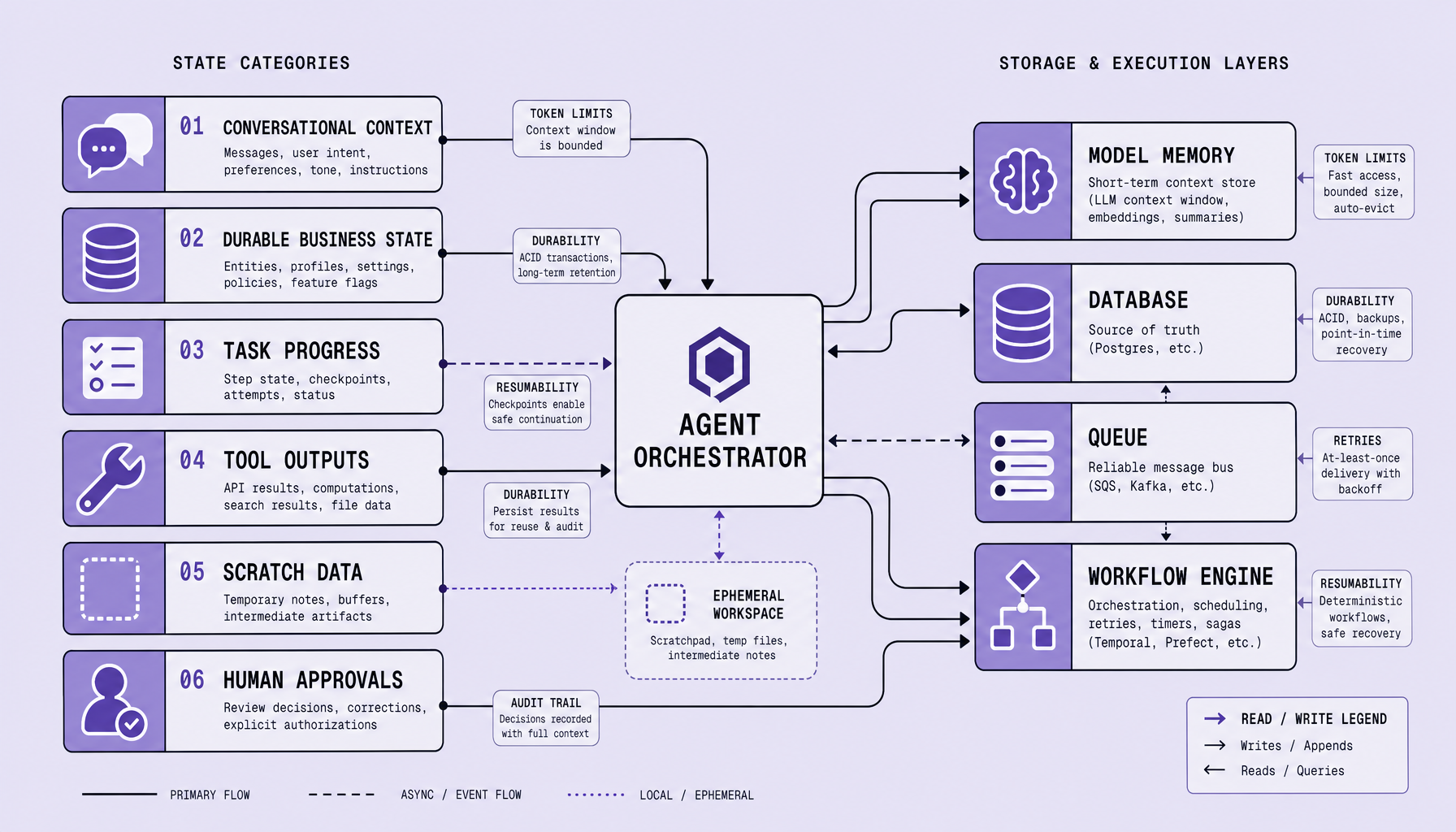
Store mapping by state type
Use model memory for short-lived reasoning only: recent chat turns, the active goal, retrieved facts, and a rolling summary. It is useful, fast, and disposable, but it is not durable agent state.
Put durable business state in a database such as PostgreSQL: customer records, order status, entitlement flags, policy versions, and final decisions such as a refund approval. Clear ownership of this data makes recovery, auditing, and debugging much easier.
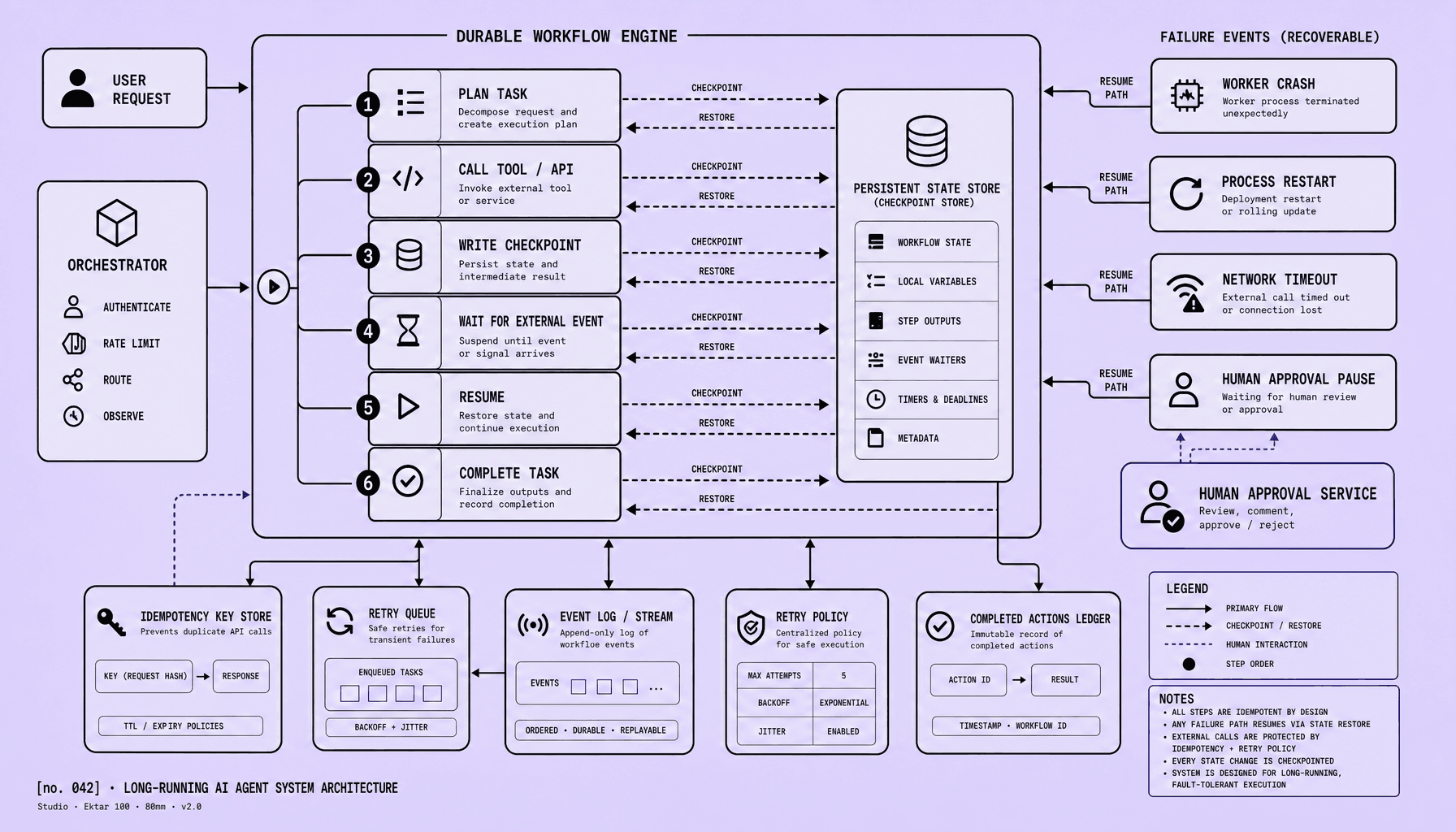
Use a workflow engine when work spans minutes, hours, or people. Temporal or Azure Durable Functions can track step status like pending_review, awaiting_payment_check, or completed, along with retries, timers, and compensation paths.
Use queues like Kafka or Amazon SQS for work dispatch, buffering, and backpressure, not as the source of truth for business state.
| Store | Best fit | Retention | Queryability | Durability / failure handling |
|---|---|---|---|---|
| Model memory | Current-turn reasoning, recent conversation | Short-lived | Low | Weak; refreshable, lossy |
| Database | Durable business state, approvals, final outcomes | Long-lived | High | Strong; transactional, auditable |
| Queue | Job delivery, fan-out, async tasks | Until consumed / retained | Limited | Good for retries, poor for rich state |
| Workflow engine | Multi-step task progress and human handoff | Run lifetime + history | Medium | Strong replay, timeout, retry tracking |
Supporting stores: scratch data and tool outputs
Not everything cleanly fits those four buckets. Scratch data can live in Redis or another cache if it is cheap to recompute. Tool outputs vary: small structured results may fit in a database, while large payloads, files, or raw transcripts often belong in object storage, with metadata in PostgreSQL and diagnostic traces in logs. The operating principle is simple: keep reasoning compact, keep truth durable, and keep process explicit.
What Breaks When You Keep Everything in Model Context
This shortcut is tempting because it removes plumbing. It also creates problems that are hard to unwind later. Keeping all state in the prompt works for demos, but in production it creates three predictable failure modes: prompt bloat, unreliable recovery, and no durable source of truth.
The core mistake is treating model context as both working memory and system of record. As conversations and tool calls accumulate, the prompt gets larger, more expensive, and harder to control. Teams respond by compressing with summaries, but summaries can omit details, flatten distinctions, or carry forward a bad assumption. One incorrect tool result or mistaken summary can then contaminate later turns. The response may still sound coherent, which makes these errors harder to catch than an obvious crash.
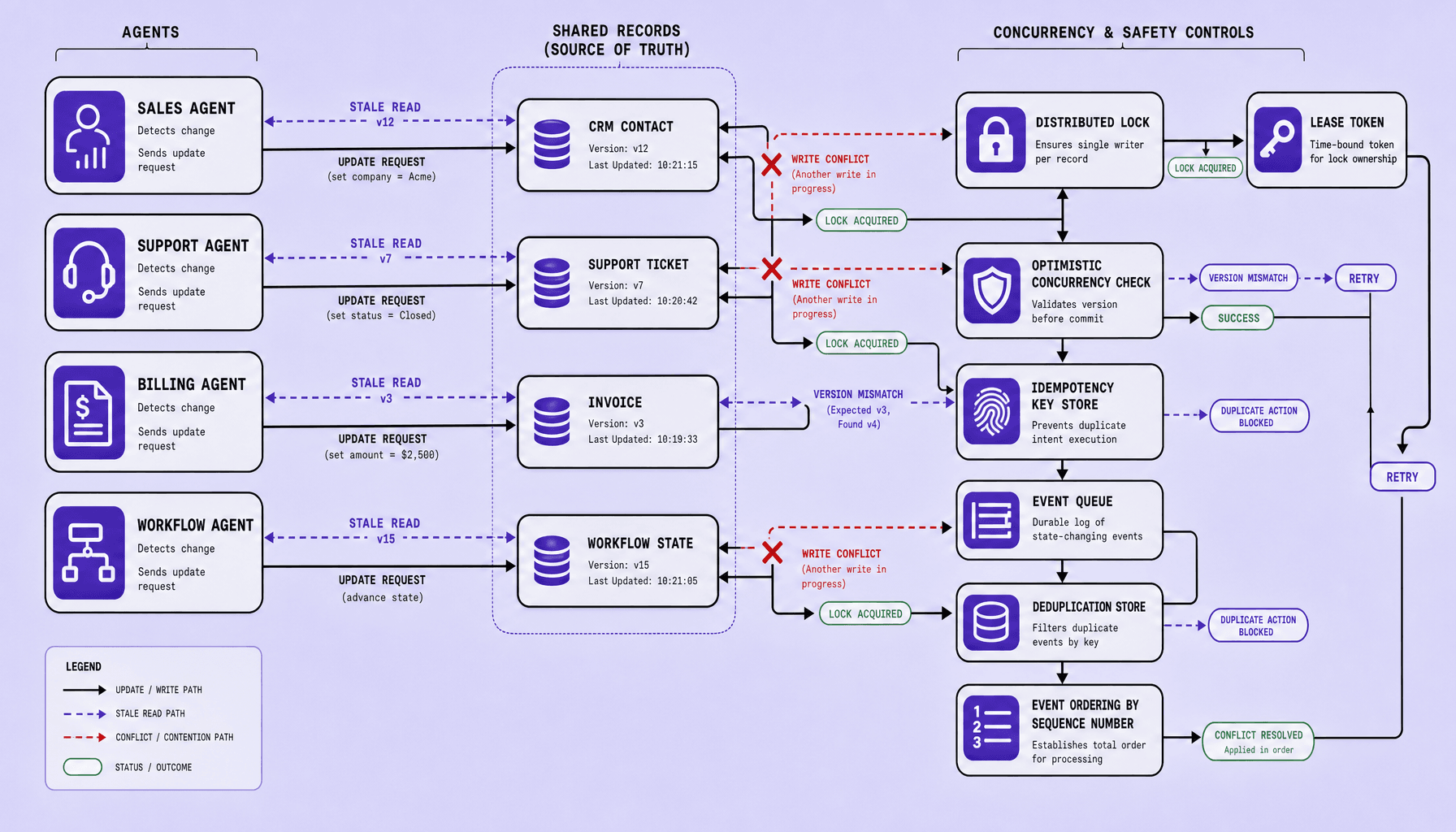
Recovery is the next problem. If task progress exists only in chat history, a restart cannot reliably determine what already happened. In a long-running onboarding flow, the system may not know whether document verification completed, whether approval is still pending_review, or whether a payment check should run again. That leads to duplicate work, skipped steps, or unsafe replays.
You also lose operational visibility. Human reviewers cannot inspect a clean approval record, other services cannot query for stuck work such as awaiting_payment_check, and a replacement agent inherits oversized, fragile context instead of explicit state.
A safer pattern is to keep only current-turn reasoning, recent interaction history, and retrieved facts in model context. Store approvals, task status, tool outputs worth reusing, and workflow checkpoints in durable systems such as PostgreSQL, Redis, queues, or a workflow engine. The tradeoff is more plumbing, but the benefit is recoverability, inspectability, and clearer ownership of truth.
A Decision Framework for Choosing the Right State Store
Most state problems are not storage problems first. They are classification problems. Good AI agent state management starts by assigning one authoritative store per fact, then deciding whether the model also needs a compact, temporary copy for reasoning.
Ask these questions in order:
- Is it needed only for this turn? Put it in AI agent memory or prompt context: recent messages, the current goal, retrieved facts, and short summaries. Treat this as working memory, not durable truth. This is agent memory vs state in practice.
- Must it survive crashes, audits, or handoffs? Put it in a database such as PostgreSQL. That becomes the source of truth for durable agent state, including user records, decisions, and canonical task data.
- Does work span retries, timeouts, or step transitions? Put status, checkpoints, and step outputs in workflow state for AI agents—Temporal, Durable Functions, or similar. Use explicit values like
pending_review,waiting_on_tool, orcompletedso recovery logic is unambiguous. - Do humans need to review or approve it? Store it durably with an approval gate and audit trail, not in chat history or hidden scratchpads.
- Does another service need to query or update it? Keep it outside model context in a system other components can read reliably.
- Is it disposable intermediate data? Keep it in short-lived scratch storage, then delete or replace it once the durable result is written.
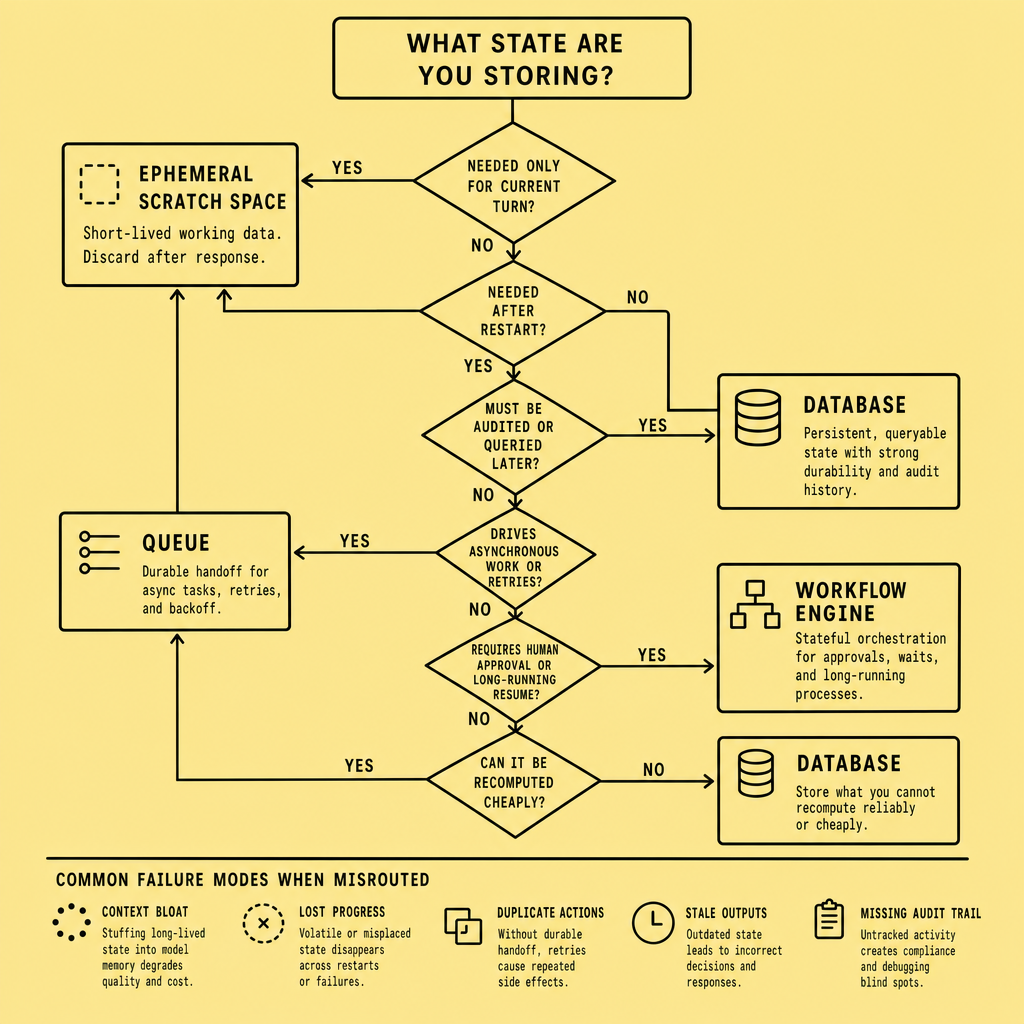
One fact can live twice: a database row as the authoritative store, plus a summarized copy in context for the current turn.
The rule of thumb is simple: if losing it would break the business process, it does not belong only in the prompt.
Frequently Asked Questions
What is the biggest mistake teams make in AI agent state management?
The biggest mistake is giving the language model responsibility for durable operational facts. When business truth, approvals, retries, and execution progress live only in prompt context, the system becomes expensive, hard to recover, and impossible to audit reliably after failures or handoffs.
How does AI agent state management change when agents call many tools?
Tool-heavy agents need explicit policies for which outputs are transient and which become records. Small, reusable structured results should usually be persisted with metadata, while large raw payloads can live in object storage. This prevents repeated tool calls, supports debugging, and avoids overloading prompt context with data the model does not need continuously.
Why should human approvals stay outside the model context?
Human approvals are governance events, not conversational memory. They need timestamps, identities, decision reasons, and a durable trail that other systems can inspect. Keeping approvals outside the model context ensures they survive restarts, can trigger downstream workflow steps, and remain trustworthy during audits or incident reviews.
When should AI agent state management include idempotency and deduplication rules?
It should include them whenever an agent can retry actions, consume queue messages more than once, or call side-effecting APIs. Idempotency keys and deduplication logic protect against duplicate refunds, repeated notifications, and inconsistent state updates, especially in distributed systems where retries are normal rather than exceptional.
Do small agents still need a formal state model?
Yes. Small agents may start with fewer stores, but they still benefit from naming what is temporary, what is authoritative, and what must survive failure. A simple state model prevents ad hoc growth, makes future scaling easier, and reduces the chance that prototype shortcuts become production liabilities.
Make Imversion a preferred source on Google
Like this kind of AI and software analysis? Add Imversion as a preferred source so Google can highlight our articles for you in Search, AI Overviews, and AI Mode.