AI engineering rates 2026: Regional Benchmarking Insights
Discover how AI engineering rates 2026 vary regionally and why total cost plus rework outweighs hourly rates for effective budgeting.

AI engineering rates 2026: the practical regional benchmark
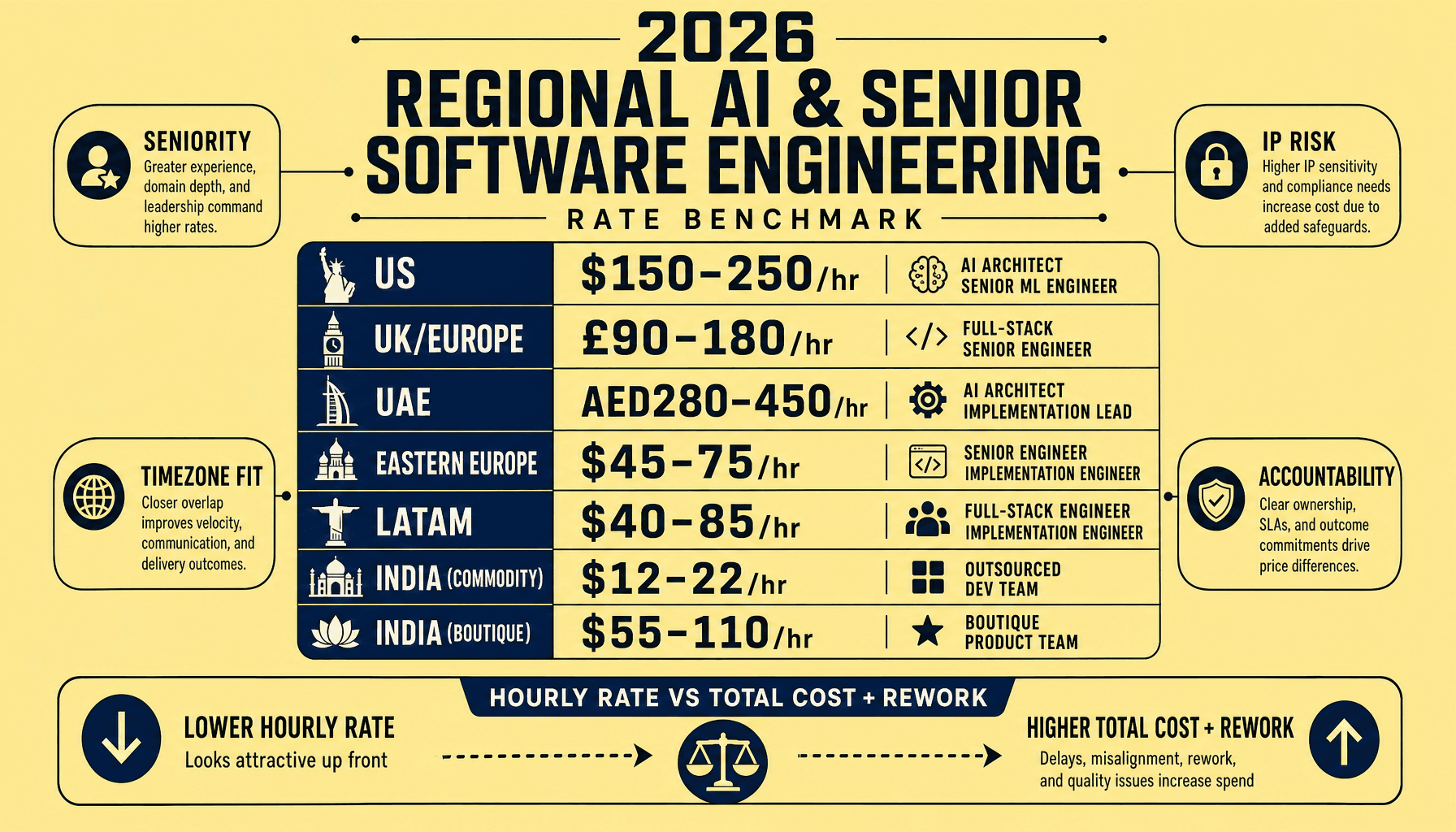
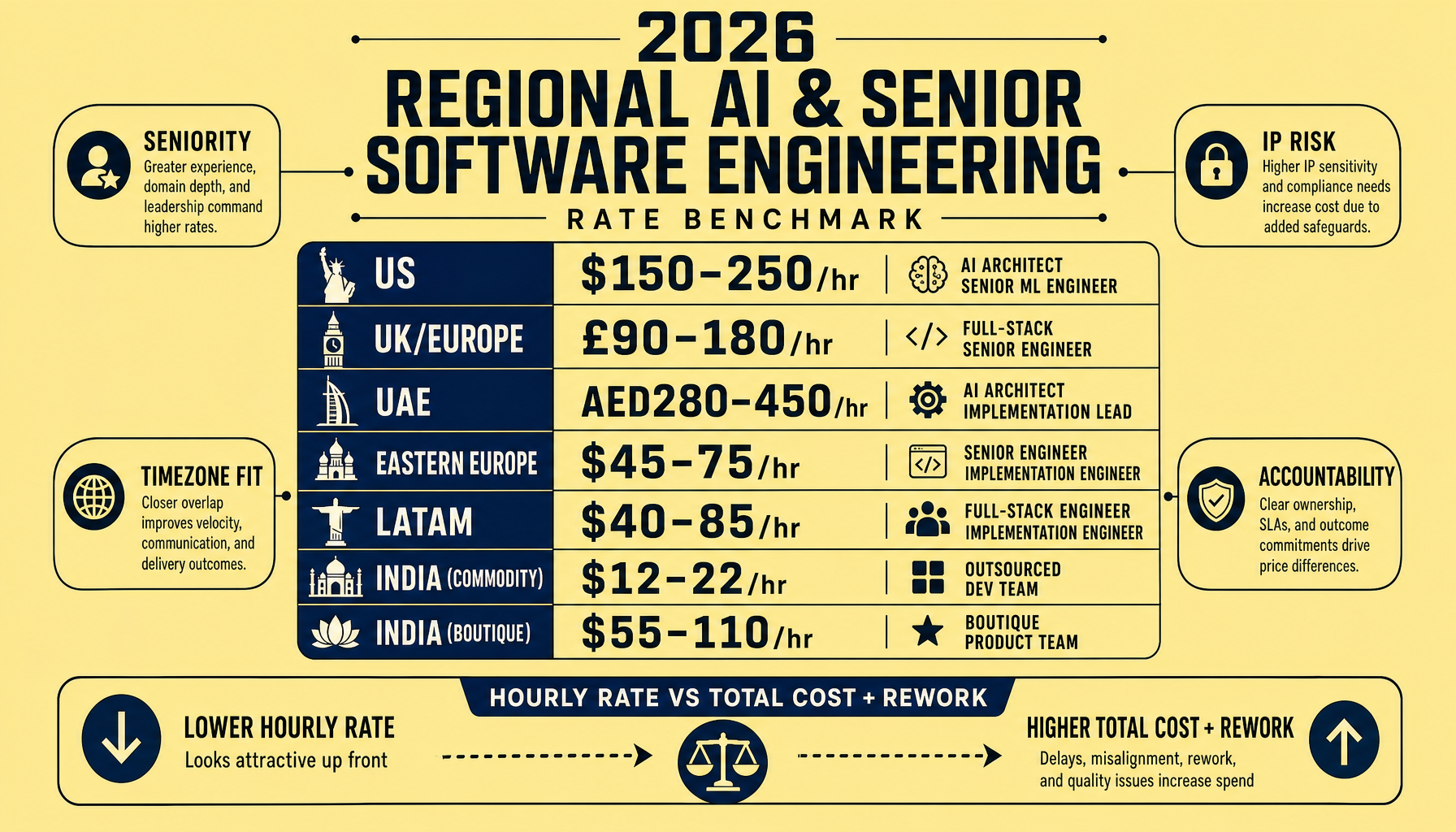
If you buy AI engineering on hourly price alone, you can end up paying twice: once for the quote, then again for rework, delays, and management overhead. AI engineering rates 2026 do fall into clear regional bands -- US $150–250/hr, UK/Europe £90–180, UAE AED280–450, Eastern Europe $45–75, LatAm $40–85, India commodity $12–22, and India boutique $55–110 by role.12345 But hourly price stops being useful pretty quickly once delivery starts. Total cost, accountability, and rework decide whether a team is actually cheap or expensive.
Senior software engineer rates rise with ownership, not just coding skill. A staff engineer, architect, AI/ML engineer, or fractional CTO is priced for design judgment, production accountability, IP sensitivity, and the ability to reduce churn before it hits roadmap or budget.627 In practice, we benchmark regions against delivery mechanics too: overlap hours, sprint demos, code review SLAs, documentation standards, and CI/CD ownership. Those controls cut communication drag -- and they expose the gap between commodity outsourcing and boutique delivery in India, where the latter often costs more per hour but less per shipped feature because clean code improves long-term productivity. At Imversion Technologies Pvt Ltd, we would treat any regional developer rate benchmark as a buying-input, not the decision.
Key Takeaways for AI engineering rates 2026
- The headline AI engineering rates 2026 are clear enough: US $150–250/hr, UK/Europe £90–180, UAE AED280–450, Eastern Europe $45–75, LatAm $40–85, India commodity $12–22, and India boutique $55–110.12345 But buyers who compare only sticker price miss the actual regional developer rate benchmark -- scope ownership, architecture judgment, and production accountability shift outcomes fast.
-
Seniority changes the economics. A senior software engineer, architect, AI/ML engineer, or fractional CTO costs more per hour because they reduce ambiguity, prevent rework, and make better system decisions earlier.67 Clean code improves long-term productivity -- especially in AI systems where data pipelines, prompts, APIs, and infra evolve together.
-
Boutique India and commodity outsourcing are not the same market. One sells accountable delivery with stronger communication and engineering process; the other often sells lower hourly input, higher client management load, and more churn risk.125
-
Practical buying rule: optimize for the total cost of software development, not just AI developer hourly rates. Ask for overlap hours, sprint demos, code review SLAs, documentation standards, and CI/CD ownership. Hourly rate matters. Rework costs more.
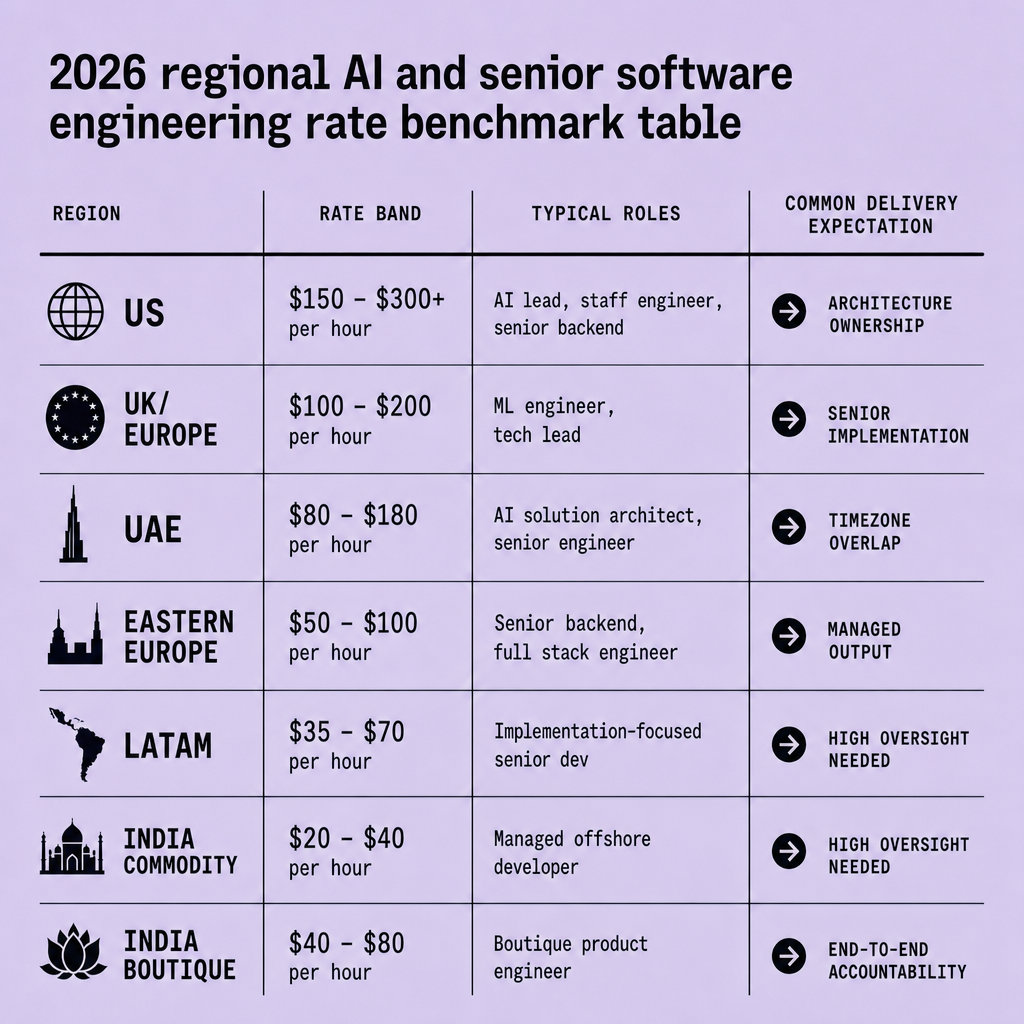
2026 regional AI and senior software engineering rate benchmark table
Start with hourly rate, then pressure-test what the team is actually taking ownership of. The same “senior software engineer” title can mean hands-on implementation in one market and architecture, stakeholder management, incident ownership, and delivery accountability in another.125
| Region | 2026 rate band | Typical roles at that range | Main buying reason |
|---|---|---|---|
| US | $150–250/hr | Senior software engineer, staff engineer, AI/ML engineer, solution architect, fractional CTO | Highest autonomy, product judgment, and business accountability62 |
| UK/Europe | £90–180/hr | Senior engineer, AI consultant, architect, technical lead | Strong enterprise fit, regulated-sector experience, close client collaboration16 |
| UAE | AED280–450/hr | Senior contractor, AI specialist, solution architect | Local-market access, stakeholder management, transformation support4 |
| Eastern Europe | $45–75/hr | Senior backend/frontend/full-stack engineer, AI engineer, lead | Strong value-for-depth, mature engineering practices, solid English127 |
| LatAm | $40–85/hr | Senior software engineer, tech lead, AI/ML engineer | US timezone overlap and faster feedback cycles35 |
| India commodity | $12–22/hr | Junior-to-mid developer, ticket-based team, QA support | Lowest visible cost for narrowly scoped execution15 |
| India boutique | $55–110/hr | Senior engineer, architect, AI/ML engineer, delivery lead | Better ownership, clearer communication, and lower rework than commodity outsourcing125 |
This benchmark shows why software outsourcing rates by country should not be compared in isolation. US, UK/Europe, and UAE pricing often reflects independence, decision quality, documentation discipline, and production accountability, not just coding hours.64
Cheaper regions are not interchangeable.
Eastern Europe often stands out on engineering depth per dollar.17 LatAm often stands out on operating rhythm because timezone overlap can reduce review lag and meeting friction.35 India splits into two markets: commodity outsourcing optimizes for low hourly spend, while boutique teams price higher because they usually offer tighter scoping, code review standards, CI/CD ownership, and clearer handoffs.125
A practical buying rule: require overlap hours, weekly sprint demos, written acceptance criteria, architecture notes, and documented ownership for deploys and incidents. Communication risk is manageable if you design the operating model.
Do not infer that a $12–22/hr team is “5x cheaper” than a $55–110/hr team. Once handholding, missed requirements, and rework enter the equation, total cost can invert fast.
How rates change by role across the US, Europe, UAE, Eastern Europe, LatAm, and India
Teams often blame geography first. That is usually the wrong variable. Role scope moves rates faster than location.
A senior implementer who closes tickets, ships features, and works inside an existing architecture will sit lower in each regional band than a staff engineer, technical architect, AI consultant, or fractional technical lead who owns system design, production ownership, and requirements ambiguity. That is why this regional developer rate benchmark has to be role-adjusted, not just geography-adjusted.125
In the US, the top end of the $150–250/hr range usually buys architecture judgment, regulated-environment discipline, and leadership under uncertainty -- not just faster coding.62 UK and Western Europe follow the same pattern inside the £90–180 range, especially for enterprise platforms, AI integration, and solution design work where accountability extends beyond implementation.16 In the UAE, AED280–450/hr often reflects a similar premium for senior contractors who can manage stakeholders, drive transformation work, and operate with local business context.4
Offshore regions split even more sharply by role. Eastern Europe at $45–75/hr and LatAm at $40–85/hr can be excellent value for strong senior engineers, and LatAm often wins where US-facing teams need daily overlap hours and faster feedback cycles.135 But architecture-grade decision-making, cross-team coordination, and AI strategy ownership will still price toward the top of those bands. Because the work changes.
India shows the clearest split. Commodity outsourcing at $12–22/hr is usually priced for narrower execution -- defined tickets, close supervision, limited design authority. Boutique India teams at $55–110/hr are a different buy: senior engineers, architects, and AI specialists with stronger communication, better documentation habits, and more delivery accountability.125
A lower hourly rate is often fair for a narrower role. The costly mistake is expecting architect-level ownership from implementation-priced staffing.
That is why we benchmark senior software engineer rates and AI developer hourly rates by role first, region second. We also recommend concrete controls to reduce churn: required overlap windows, sprint demos, code review SLAs, architecture decision records, CI/CD ownership, and written acceptance criteria. Clean code improves long-term productivity -- but only if the team has the mandate and seniority to make durable decisions.
Why AI engineering rates 2026 differ: seniority, IP risk, timezone fit, and accountability
Two vendors can both say “senior” and still deliver very different outcomes. Buyers are not paying only for labor. They are paying for risk transfer and coordination speed. That is why AI engineering rates 2026 vary sharply across regions even when the title looks the same.12
Seniority is about decision quality, not years listed on a profile
A true senior, staff engineer, architect, or AI lead does more than ship tickets. They choose model boundaries, data flows, fallback behavior, observability, deployment strategy, and failure handling under ambiguity. That capability helps explain why US rates often sit around $150–250/hr, UK/Europe around £90–180, and strong UAE specialists around AED280–450, especially for stakeholder-heavy work.124
Cheaper markets can absolutely deliver strong engineers. But titles are inconsistent across the global market. A $45–75/hr Eastern Europe engineer or $55–110/hr India boutique engineer may be a better fit than a nominally cheaper option if they can own architecture, write clear RFCs, and reduce rework.15
Test seniority through ownership signals such as code review quality, incident judgment, migration planning, and documentation standards, not CV length alone.
IP-sensitive work and architecture ownership command a premium
Not all tasks carry the same downside. Internal copilots, model evaluation pipelines, proprietary retrieval logic, pricing engines, and regulated workflows involve IP protection, security review, and architectural judgment. Rates rise when the engineer is expected to make durable decisions and limit future exposure.
Staff augmentation usually prices execution. Delivery accountability prices broader ownership.
The more strategic the system, the less sensible it is to buy purely on the lowest AI developer hourly rates.
Timezone fit changes the speed of delivery
Timezone overlap is not cosmetic. It affects bug triage, sprint feedback, stakeholder management, and production response. LatAm often appeals to US teams because same-day collaboration can reduce waiting, meeting friction, and handoff delay.35 UAE premiums can also reflect local presence and enterprise coordination needs.4
Practical fix: require overlap hours, weekly sprint demos, code review SLAs, CI/CD ownership, and written decision logs.
Accountability changes the total cost of software development
The cheapest quote often hides management load. If your team must define every ticket, chase updates, rewrite weak code, and own every incident, low hourly pricing can increase the total cost of software development. In a regional developer rate benchmark, the useful comparison is not rate alone. It is rate plus rework, delay, escalation risk, and who answers when production breaks.
Boutique India vs commodity outsourcing: why the rate gap is really a delivery model gap
A lot of buyers look at India as one pricing bucket. That flattens the real decision. The spread inside India is not noise. It reflects two different products.
At one end, commodity outsourcing often lands around $12–22/hr. At the other, a boutique engineering firm typically sits around $55–110/hr for senior engineers, architects, and AI-focused roles.125 If we flatten those into one India line in a regional developer rate benchmark, we hide the choice buyers actually need to make.
Commodity outsourcing usually fits work that is tightly scoped, low-risk, and easy to verify: backlog cleanup, template-based builds, QA support, repetitive integrations, straightforward CMS work. You are buying capacity. But you usually keep more of the management burden -- detailed specs, frequent check-ins, acceptance criteria, and close task breakdown. Code ownership can be thin. Documentation varies. And if churn hits the team, context often walks out with the developer.
Boutique India is a different model. You are paying for engineering depth, stronger English communication, client-facing accountability, and a higher default bar for code review, technical documentation, testing discipline, and CI/CD ownership. In practice, that often means named senior engineers, sprint demos, overlap hours with client teams, review SLAs, architecture participation, and clearer incident ownership. Clean code improves long-term productivity -- especially once the codebase becomes product-critical and every rushed shortcut starts compounding into rework.
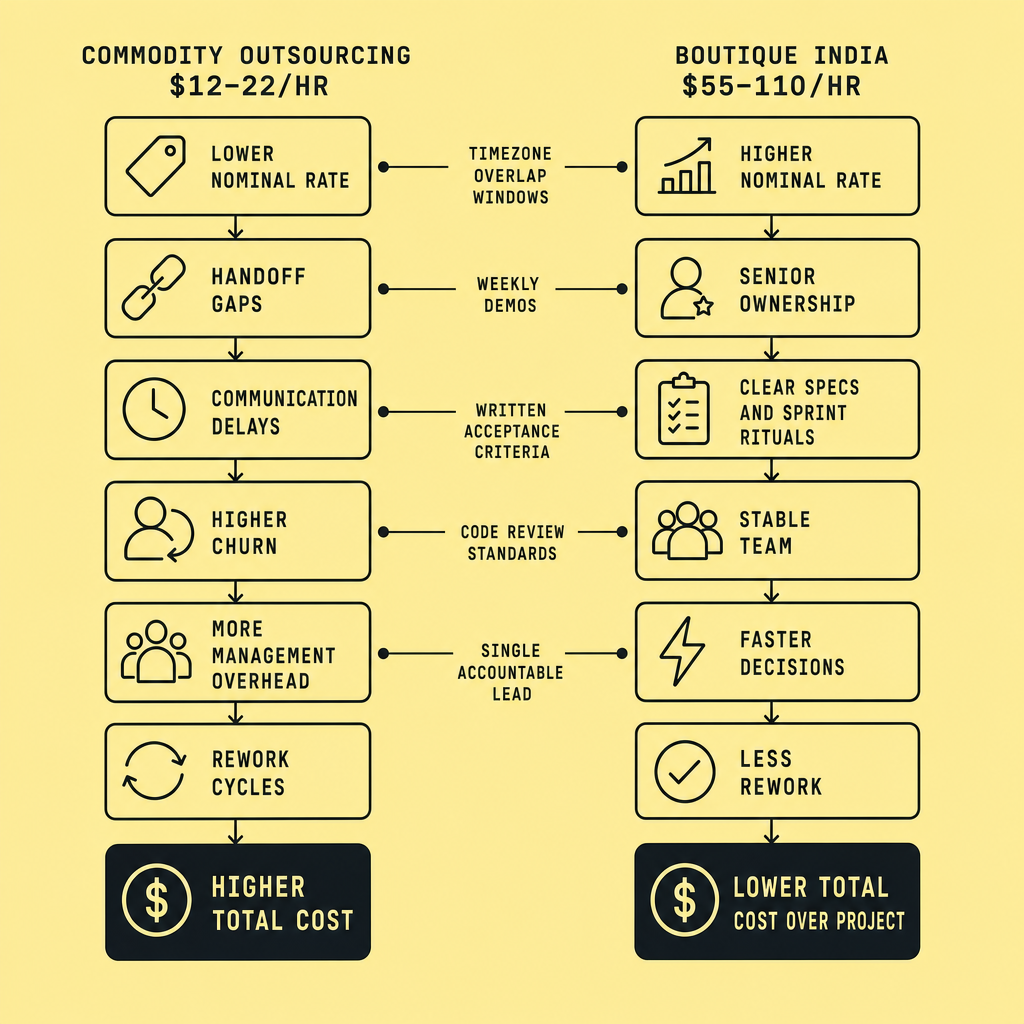
So the rate gap is not just labor arbitrage. It is a shift in expected outcomes.
For buyers comparing software outsourcing rates by country, this is where mistakes happen: they see two India-based options and assume they are interchangeable because the geography matches. They are not. The same distortion shows up in senior software engineer rates and AI developer hourly rates globally -- title alone does not tell you how much ownership comes with the hire.67
If the work is ambiguous, customer-facing, or tied to core IP, the cheaper model often becomes expensive through rework, delays, and heavier internal supervision.
The practical recommendation is simple. Use commodity outsourcing for bounded execution. Use boutique India for product-critical systems, evolving requirements, and work where accountability must sit with the delivery partner, not just your internal manager.
Communication, churn, and total cost: the real math behind software outsourcing rates by country
Sticker price is easy to compare. Delivery cost is not. That is where most buying mistakes happen.
The real benchmark is total cost after rework, coordination delay, and knowledge loss are counted.
A low hourly rate can lose fast. A team at India commodity pricing of $12–22/hr may look dramatically cheaper than Eastern Europe at $45–75/hr or India boutique at $55–110/hr, but one extra cycle of misunderstood requirements, weak review discipline, or partial rewrites can erase that gap.135 The same logic applies at the top end: US AI developer rates of $150–250/hr and UK/Europe senior software engineer rates of £90–180/hr often buy faster decisions, tighter stakeholder communication, and more direct ownership -- not just coding time.162
Communication quality is not “soft.” It is an operating system.
Buyers should require concrete controls:
- At least 3–4 hours of working-day overlap for fast feedback; this helps explain why LatAm remains attractive for US teams despite higher rates than the cheapest offshore options.3
- Written specs before sprint start: acceptance criteria, edge cases, API contracts, non-functional requirements.
- Fixed sprint rituals: planning, daily async updates, weekly demo, retrospective.
- A code review SLA -- for example, first review within one business day.
- CI/CD ownership, with clear rules for test coverage, rollback, and deployment approvals.
- Handoff documentation for every feature, incident, and architectural decision.
- A named escalation path: engineer, tech lead, delivery owner, executive sponsor.
Churn changes the math even more. When developers rotate out, undocumented assumptions disappear, onboarding repeats, and velocity drops while defects rise. Clean code helps because it reduces how much tribal knowledge a replacement needs to become effective. But code alone is not enough; architecture notes, runbooks, and decision logs must survive people changes.
Buyers rarely regret paying slightly more for a team with strong operating mechanisms. They often regret discovering too late that nobody truly owned delivery.
A simple decision framework helps. Choose US, UK/Europe, or UAE for high-risk systems, heavy stakeholder management, regulated work, or ambiguous AI programs.124 Choose Eastern Europe or LatAm for balanced cost-to-seniority and stronger collaboration windows.13 Choose India boutique for cost-sensitive builds that still need accountability. Choose commodity outsourcing only for tightly scoped, well-specified work with active in-house management. That is how software outsourcing rates by country should be compared in a serious regional benchmark.
References
- Software Developer Salaries & Rates by Country 2026
- Global Software Engineer Salary Research 2026
- AI Developer Rates in 2026: USA vs Eastern Europe vs Asia
- AI/ML Engineer Salary Guide 2026: US vs. Eastern Europe
- Software Developer Rates by Country in 2026: U.S. vs. ...
- Senior Software Engineer Salary in Abu Dhabi, United ...
- Software Developer Hourly Rates by Country
- 2026 Average Software Engineer Salary by Country - GEOR
Footnotes
-
Software Developer Salaries & Rates by Country 2026 ↩ ↩2 ↩3 ↩4 ↩5 ↩6 ↩7 ↩8 ↩9 ↩10 ↩11 ↩12 ↩13 ↩14 ↩15 ↩16 ↩17 ↩18 ↩19 ↩20 ↩21 ↩22
-
AI Developer Rates in 2026: USA vs Eastern Europe vs Asia ↩ ↩2 ↩3 ↩4 ↩5 ↩6 ↩7 ↩8 ↩9 ↩10 ↩11 ↩12 ↩13 ↩14 ↩15 ↩16 ↩17
-
Software Developer Rates by Country in 2026: U.S. vs. ... ↩ ↩2 ↩3 ↩4 ↩5 ↩6 ↩7 ↩8 ↩9
-
Senior Software Engineer Salary in Abu Dhabi, United ... ↩ ↩2 ↩3 ↩4 ↩5 ↩6 ↩7 ↩8
-
Software Developer Hourly Rates by Country ↩ ↩2 ↩3 ↩4 ↩5 ↩6 ↩7 ↩8 ↩9 ↩10 ↩11 ↩12 ↩13 ↩14 ↩15 ↩16
-
Global Software Engineer Salary Research 2026 ↩ ↩2 ↩3 ↩4 ↩5 ↩6 ↩7 ↩8 ↩9
-
AI/ML Engineer Salary Guide 2026: US vs. Eastern Europe ↩ ↩2 ↩3 ↩4 ↩5
Frequently Asked Questions
What is the best way to compare AI engineering rates 2026 across regions if currencies differ?
The cleanest comparison is to normalize all quotes into one operating currency, then compare what is included beyond coding time: architecture ownership, review responsibility, documentation, and incident handling. Currency conversion alone is not enough, because two similar hourly numbers can represent very different delivery obligations and risk transfer.[^1][^6]
How should I use AI engineering rates 2026 when budgeting a pilot versus a production system?
A pilot budget should emphasize speed of learning, while a production budget should emphasize maintainability, observability, security, and handoff quality. The same region can be economical for a prototype but expensive in production if the team lacks deployment discipline, documentation habits, or ownership of failure modes.
Why should buyers ask for a trial sprint instead of deciding only from rate cards?
A paid trial sprint reveals planning quality, communication clarity, review speed, and code hygiene under real constraints. It is the fastest way to test whether a vendor can convert requirements into reliable output without excessive supervision, which is a better predictor of total cost than a benchmark rate alone.
What signals show that a vendor can handle low-churn delivery?
Strong low-churn vendors preserve context in systems, not just in people. The most useful signals are architecture decision records, runbooks, stable team composition, named ownership for incidents, and documented onboarding paths. Those mechanisms reduce delivery volatility even when an engineer changes, which directly protects schedule and quality.
How does boutique India differ operationally from commodity outsourcing beyond price?
Boutique India teams usually package seniority with process: tighter scoping, stronger review discipline, clearer escalation paths, and more direct client communication. Commodity outsourcing more often sells capacity against predefined tasks. That distinction matters because global rate surveys consistently show large cost variation by role and market segment, not just by country label.[^3][^8]
Make Imversion a preferred source on Google
Like this kind of AI and software analysis? Add Imversion as a preferred source so Google can highlight our articles for you in Search, AI Overviews, and AI Mode.