AI Fallback Strategies: Enhancing LLM Reliability in 2026
Learn how to implement AI fallback strategies to manage uncertainty and enhance user experience in your AI systems.

How AI Fallback Strategies Keep Uncertain Systems Safe and Useful
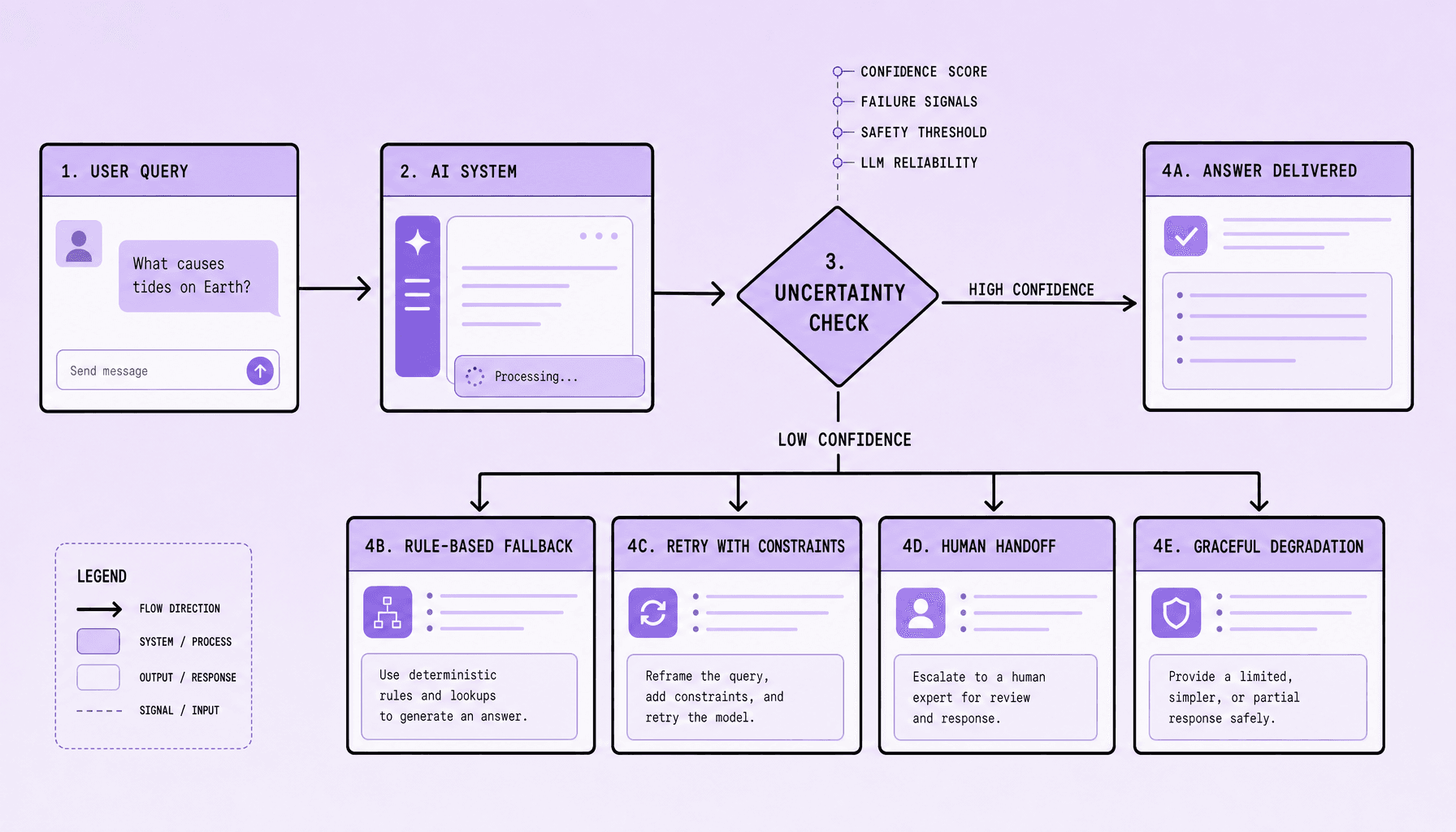
The real problem with AI systems is not that they fail. It is that they fail with confidence. When uncertainty rises, the system should catch it early, switch to a controlled fallback, and keep the user moving instead of guessing.
That is how you improve LLM reliability without pretending the model is always right. In practice, combine confidence scoring with clear triggers such as low retrieval quality in RAG, policy filter hits, contradictory generations, or out-of-scope prompts, then route to the right response path.
A fallback might retry with stricter prompt constraints, switch to a rule-based answer, surface verified help content, or trigger a human handoff. The tradeoff is real: aggressive thresholds can reduce bad answers, but they can also make the system feel evasive. Tune fallback behavior to the risk of the task. In production, monitoring matters as much as deployment, because fallback rates, escalation volume, and unresolved sessions show whether AI error handling is protecting trust or quietly degrading the experience.
FAQs
What are AI fallback strategies?
They define what your system does when a model is uncertain, wrong, or unsupported.
How do you detect AI uncertainty?
Use signals like confidence scores, retrieval failures, output inconsistency, safety triggers, and scope checks.
Why do fallbacks improve LLM reliability?
They stop low-confidence outputs from reaching users without checks, retries, or safer alternatives.
When should an AI system hand off to a human?
When the request is high-risk, policy-sensitive, unresolved after retry, or lacks enough evidence for a safe answer.
What is a graceful fallback in AI system design?
A graceful fallback keeps the interaction useful by offering verified content, asking for clarification, or escalating cleanly.
Key Takeaways for AI Fallback Strategies
-
Build AI fallback strategies into the first version of your AI system design -- not after the first bad output. If the model shows AI uncertainty through weak retrieval, inconsistent responses, or policy hits, switch paths early instead of forcing an answer.
-
Use confidence scoring as a decision layer, not a vanity metric. Combine model confidence, RAG evidence quality, rule-engine checks, and output consistency to decide whether to answer, retry with backoff, or trigger AI error handling.
-
Put hard rule-based controls around high-risk actions. For payments, medical guidance, permissions, or account changes, deterministic rules should override model fluency. Security should not be optional.
-
Define human handoff triggers before launch. Escalate on repeated low-confidence turns, missing evidence, safety flags, or user frustration signals, and pass context into the escalation queue so the handoff feels continuous.
-
Design graceful degradation for user experience. A narrowed answer, verified help article, safe retry, or “I’m not confident enough to answer that” message preserves LLM reliability better than a polished guess. At Imversion Technologies Pvt Ltd, that tradeoff is the right one.
Why AI Fallback Strategies Matter More Than Perfect Model Accuracy
A model can look strong in testing and still fail badly in production. That is the gap teams underestimate. Live traffic brings hallucinations, unsupported claims, unsafe actions, and out-of-scope requests whether you planned for them or not.
So the job is not chasing perfect accuracy. It is deciding what happens next when the model is uncertain.
Good AI system design assumes uncertainty will show up in production and handles it on purpose. Answer when evidence is strong. Retry when the failure looks transient. Switch to a rule-based path when the task is deterministic. Trigger human handoff when the risk is high. That is where AI fallback strategies improve LLM reliability and reduce operational risk.
Business Risk and Compliance
Teams often optimize for answer rate. That is understandable, but it can push the system in the wrong direction. A confident wrong answer can cost more than a visible fallback.
In a banking or healthcare flow, one unsupported claim can create compliance exposure, mislead a user, or trigger unsafe downstream action. If your retrieval-augmented generation pipeline returns weak evidence, your guardrails should block the answer or narrow it to verified content.
There is a practical tradeoff here. A stricter fallback threshold may increase escalations, but it lowers the chance of silent failure. Security should not be optional -- especially when the model can initiate actions, expose sensitive data, or advise on regulated decisions.
User Trust Breaks Faster Than Accuracy Charts Suggest
Users do not experience benchmark scores. They experience moments.
If the system answers fluently and incorrectly, trust drops fast. If it says it is unsure, explains the limit, and offers a clear next step, the experience can still hold together. Strong AI error handling protects credibility because the product behaves predictably under uncertainty instead of bluffing.
System Reliability Depends on Recovery Paths
Even a good model will be wrong sometimes. A production system built as if that never happens will break in all the places that matter.
Reliable systems use confidence scoring, retrieval quality signals, policy filters, circuit breakers, and escalation queues to contain failure. Just as important, they monitor what happens after the fallback. Fallback rates, handoff volume, blocked outputs, and retry success tell you whether the system is truly stable.
The best AI products are not the ones that never fail. They are the ones that fail safely, clearly, and recover without dragging the user down with them.
How to Detect AI Uncertainty with Confidence Scoring and Failure Signals
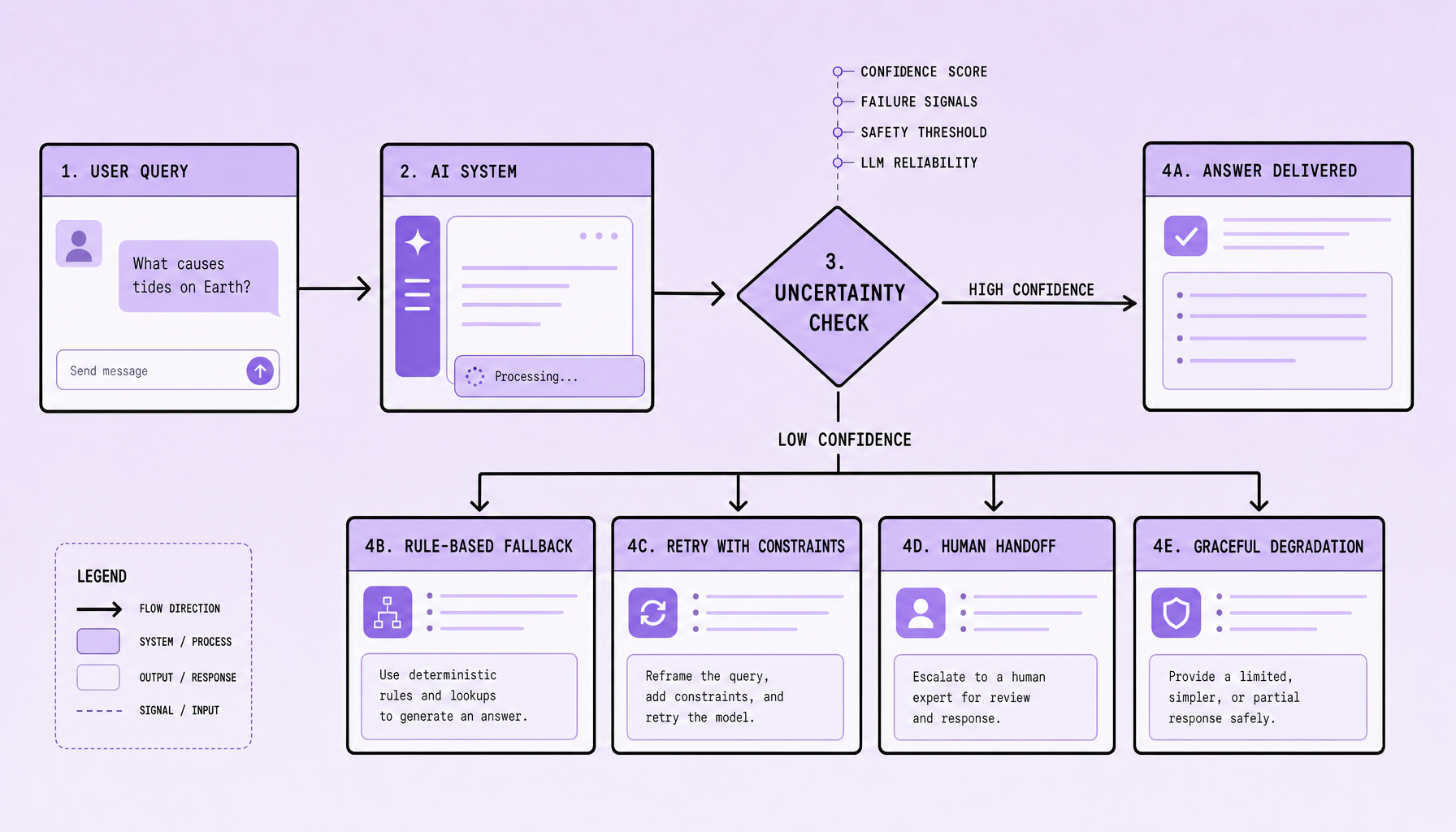
Fluent text is a bad safety signal. It sounds right even when it is wrong. In a reliable AI system, uncertainty detection decides whether the model should answer, retry, fall back, or escalate.
What failure signals should you watch for?
A single confidence score is rarely enough. You need signals from multiple layers:
- low-confidence classification
- weak RAG retrieval matches
- contradictory outputs across retries
- policy classifier hits
- unsupported claims with no evidence
- out-of-domain prompts
- structured-output failures such as malformed JSON, missing fields, or invalid enums
When several signals fail at once, the system should not proceed normally. For example, low-similarity retrieval plus ungrounded claims plus a policy flag is a strong reason to switch to a safer fallback.
Model probability alone is rarely enough; calibration improves when you compare scores against real failure logs.
How should confidence scoring be designed?
Treat confidence as a composite signal, not a single model probability. Raw token probabilities do not reliably map to correctness, so scoring should be calibrated against offline evaluations and production logs.
A simple weighted approach can work:
final_score = 0.35 * retrieval_quality + 0.25 * classifier_confidence + 0.20 * output_consistency + 0.20 * policy_safety_pass
You can also subtract penalties for unsupported outputs, schema breaks, or out-of-domain prompts. Log each signal separately, not just the final score. That gives you something useful to tune later.
How do you set thresholds without breaking UX?
Do not force everything through one hard cutoff. Decision bands work better:
- high score: answer directly
- mid-range score: retry or use a rule-based fallback
- low score: hand off to a human or return a constrained response
Thresholds are a tradeoff. Too strict, and you escalate routine requests and slow the experience. Too loose, and bad answers reach users. Tune them against observed failures such as false approvals, weak retrieval, policy misses, and repeated user corrections.
FAQs
What is the best way to detect AI uncertainty?
Combine confidence scoring, retrieval quality, policy checks, consistency testing, and out-of-domain detection in one decision layer.
Why is model confidence not enough for LLM reliability?
Because fluent output can still be wrong, and raw model scores may not reflect actual correctness.
How does RAG help with AI uncertainty detection?
It exposes retrieval signals such as low similarity, missing evidence, and unsupported claims.
When should an AI system hand off to a human?
When composite confidence is low, policy risk is high, failures repeat, or the workflow is high risk.
What is a common AI error handling mistake?
Relying on one threshold with no signal-level logging.
Which AI Fallback Strategies to Use: Rules, Retries, Handoffs, and Graceful Degradation
Not every failure should get another model call. That mistake is common, and it usually adds cost, latency, and inconsistency instead of improving reliability.
Use different fallback patterns for different failure modes. That is the core rule.
Rule-based fallbacks fit narrow, high-confidence tasks: eligibility checks, policy gating, form validation, and known intents. A rule engine should win whenever the answer must be deterministic. In transactional flows, safety checks should not depend on model judgment alone.
Retries help when the failure is likely transient or recoverable: timeout, rate limit, weak retrieval context, or malformed output. But retries should not be your default AI error handling path. If the model lacks grounding, repeated regeneration often produces a different unsupported answer. Use retry logic with exponential backoff, cap attempts, and refresh retrieval before asking again.
Safe refusal works when the request is out of scope, policy-restricted, or missing required evidence. State what the system cannot do, then offer a valid next step.
Human handoff belongs in high-risk or high-friction flows: billing disputes, account recovery, medical guidance, or repeated failure after verification steps. Route with context -- user message, retrieved documents, confidence signals, and failure reason -- so the human reviewer is not starting cold.
If none of those paths can safely answer, degrade gracefully. Fall back to search, static FAQs, decision trees, or a standard support form. Simple beats broken.
| Approach | Best fit | Strength | Weakness | User impact |
|---|---|---|---|---|
| Rule-based fallback | Deterministic policies, validations | Predictable, auditable | Limited coverage | Clear and fast |
| Retry + retrieval refresh | Timeouts, bad context, format errors | Can recover automatically | Can amplify latency/cost | Usually invisible if capped |
| Safe refusal + human handoff | High-risk, ambiguous, blocked requests | Safer outcomes | More operational overhead | Slower, but more trustworthy |
| Graceful degradation | Low-confidence assistant flows | Preserves usability | Less personalized | Functional, less “smart” |
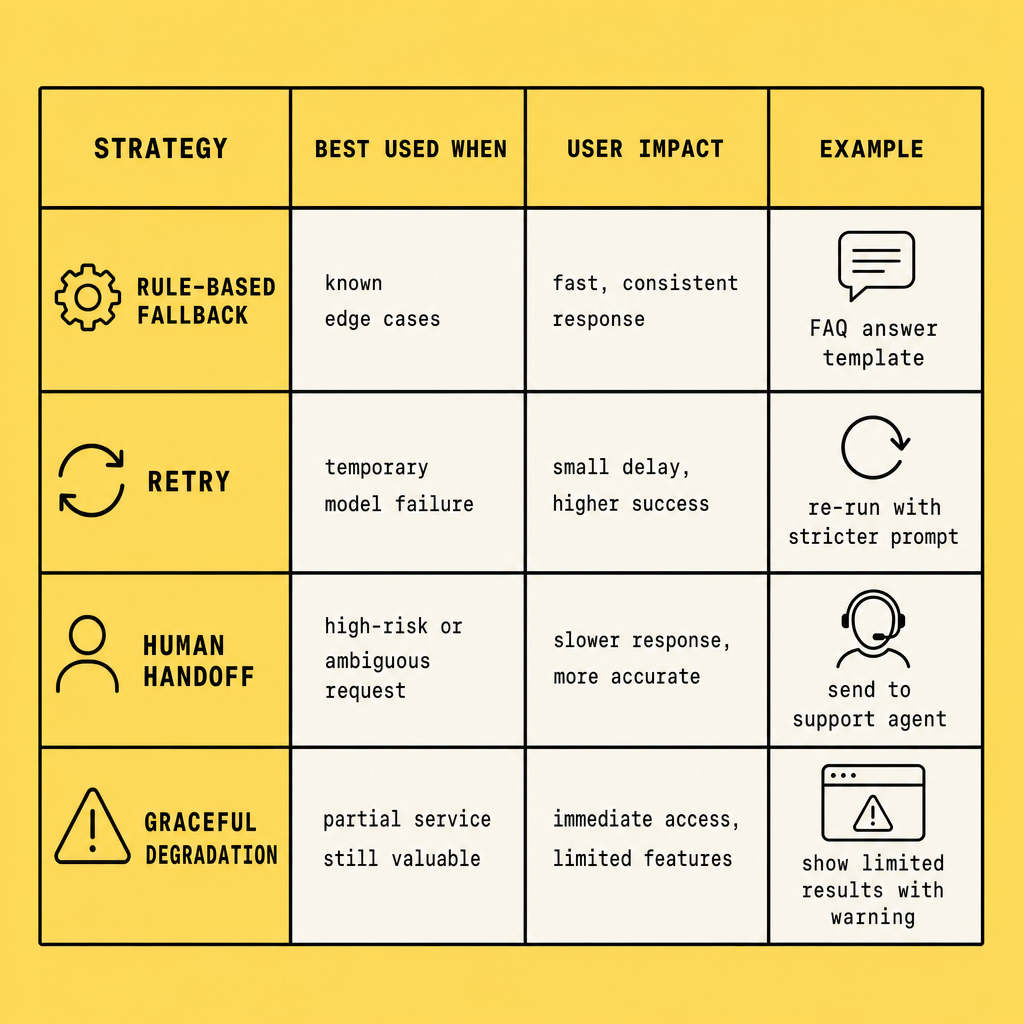
How to choose the right pattern
Start with the reason for uncertainty. Then match the fallback to it: rules for known constraints, retries for transient failures, handoff for material risk, and degradation for broad low-confidence states.
How to sequence fallback chains
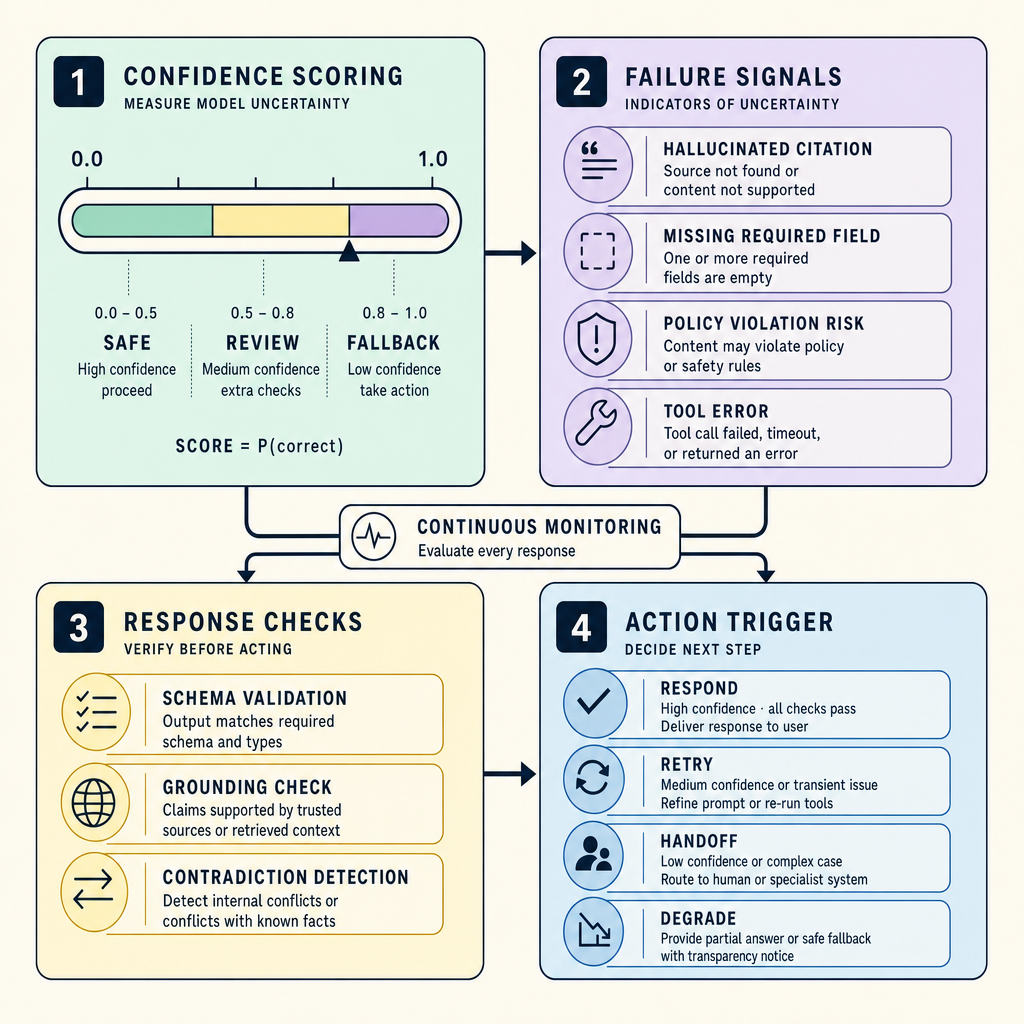
The order matters. Design for safety first, then cost: constrain, verify, escalate. For a support workflow, that can mean: policy filter, retrieval check, one regeneration, circuit breaker, then agent queue. Track fallback rate, retry success, handoff volume, and user abandonment.
How to Design Human Handoff and Graceful Degradation Without Breaking User Experience
A fallback can be technically correct and still feel broken. If the system detects AI uncertainty and then drops the user into a vague error state, the backend worked but the product failed.
The experience has to stay continuous.
Message Design That Explains Limits Without Sounding Broken
A good fallback message should tell the user three things: what happened, what happens next, and what they can do now.
Bad pattern: “Something went wrong.”
Better pattern: “I’m not confident this answer is accurate. I can route you to verified help content or connect you to support.”
That kind of transparency preserves trust without forcing users to interpret a technical failure. Avoid exposing internals like confidence scores, retrieval misses, or classifier names unless the audience actually needs them.
Treat fallback messaging like product UX, not system logging.
Handoff Context Must Travel With the User
A human handoff should not reset the conversation. Pass along the user’s last prompt, relevant workflow or account state, retrieved documents, safety flags, and the reason for escalation. That helps the agent continue the interaction instead of asking the user to start over.
There is another failure pattern here: escalating too late. After several weak retries, trust is already damaged. Define clear triggers for handoff, such as repeated low-confidence retrieval, policy ambiguity, or conflicting outputs, and send a compact case summary with the escalation.
Trust-Preserving UX Patterns for Graceful Degradation
When the model should stop answering, the product should still help. That is what graceful degradation is for.
Useful alternatives include verified FAQ content, structured forms, status pages, rule-based flows, callback requests, or a monitored support channel.
Avoid dead ends. Every fallback state should offer a next step.
Then measure the weak points. Track where users hit fallback states, abandon the flow, or require repeated escalation. That shows whether the design is helping users recover or just hiding failure behind a softer message.
FAQs
What is a human handoff in AI systems?
A human handoff routes the user from the AI to a support agent when uncertainty is too high for a safe or useful answer.
How do you handle AI uncertainty without hurting user experience?
Use clear messaging, preserve context, offer verified alternatives, and avoid forcing the user to restart the interaction.
What should an AI fallback message say?
It should explain the limitation plainly, avoid technical noise, and present a clear next action such as support, verified content, or a form.
Why does context preservation matter during escalation?
It prevents repetition and makes the transition from AI to human support feel continuous.
How does graceful degradation improve LLM reliability?
It does not make the model smarter. It makes the product safer and more reliable by switching to controlled experiences when the model is uncertain.
Frequently Asked Questions
What are the most effective AI fallback strategies for high-risk workflows?
The most effective AI fallback strategies for high-risk workflows combine deterministic rules, strict confidence thresholds, human approval, and full audit logging. In regulated or safety-sensitive use cases, the model should assist with analysis but should not be the final authority for actions such as approvals, diagnoses, payments, or permission changes.
How do AI fallback strategies affect user satisfaction?
AI fallback strategies improve user satisfaction when they reduce confusion, prevent misleading answers, and offer a clear next step. Users usually prefer a transparent limitation with a useful alternative over a confident but incorrect response that wastes time or creates extra work later.
Why should confidence scoring be calibrated instead of using raw model scores?
Confidence scoring should be calibrated because raw model scores often reflect token likelihood rather than answer correctness. Calibration aligns scores with real-world outcomes, making thresholds more meaningful for routing, retries, and escalation decisions in production AI system design.
How many retries should an AI system attempt before switching fallback paths?
Most AI systems should limit retries to one or two attempts before switching to another fallback path. More retries often increase latency and cost without improving reliability, especially when the failure comes from missing evidence, policy constraints, or an out-of-scope request rather than a temporary generation issue.
What is a common implementation mistake in AI fallback strategies?
A common implementation mistake in AI fallback strategies is treating fallback logic as a single error state instead of a decision system. Effective AI error handling requires separate triggers, clear routing rules, logging for each failure signal, and metrics that show whether fallback paths actually resolve user needs.
Make Imversion a preferred source on Google
Like this kind of AI and software analysis? Add Imversion as a preferred source so Google can highlight our articles for you in Search, AI Overviews, and AI Mode.