AI Lead Generation: Understanding Failures in Production
AI lead generation systems often excel in demos but hit roadblocks in real-world use. Learn about common failure points and best practices to ensure success.

Why AI Lead Generation Systems Fail After the Demo
The demo usually looks great. Then the system hits a real sales stack and starts breaking in ways nobody saw in the pitch. That is where most AI lead generation failures actually happen: not in the model, but in messy data, weak integrations, unclear workflows, and low team adoption. This article breaks down where an AI lead gen system fails, how AI sales automation slips inside real operations, and what teams can do to build lead generation automation that creates pipeline instead of noise.
AI Lead Generation Key Takeaways
-
Most AI lead generation demos win in controlled conditions; production fails in messy ones. Clean sample data, narrow prompts, and staged workflows do not reflect duplicate CRM records, missing firmographics, or inconsistent handoffs in a live AI sales pipeline.
-
The biggest failure points are predictable: weak data quality, broken integrations, unclear routing rules, poor rep adoption, and shallow personalization. A strong AI lead gen system needs accurate CRM field mapping across tools like HubSpot, Salesforce, Apollo, and Outreach.
-
Reliable lead generation automation starts with process design, not model hype. Define lifecycle stages, lead scoring thresholds, sync ownership, and fallback rules before rollout.
-
Track ROI with operating metrics, not demo impressions: reply rate, enrichment match rate, MQL-to-SQL conversion, sync error rate, time-to-value, and payback period.
-
Our view is simple -- maintainable workflows, prompts, and integration logic are easier to debug, govern, and scale in AI sales automation.
Why AI Lead Generation Demos Succeed While Production Systems Break
The gap between demo success and production failure is usually operational, not technical. Teams see a polished workflow, assume the hard part is done, and only later discover that the system cannot hold up under daily sales activity. A demo can validate user experience and feature fit. It cannot prove production readiness.
What vendors optimize in a demo
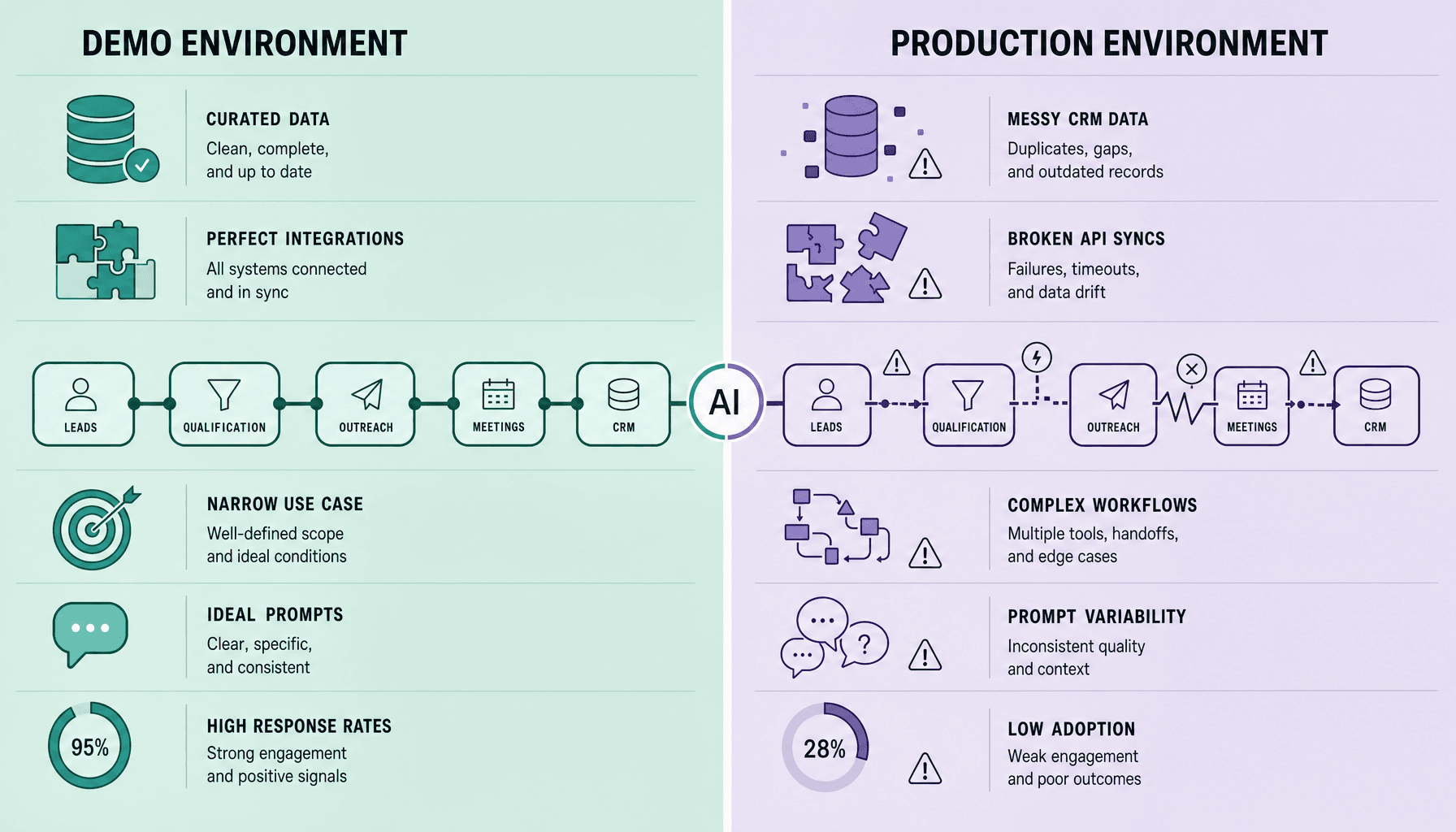
Demo environments are controlled by design. Vendors typically use curated CRM records, complete firmographic fields, clean account hierarchies, and a narrow prompt set that has already been tested. The use case is tight too: score inbound leads, draft one outbound email, enrich a contact, or route to an SDR. Edge cases are limited. Human oversight is strong.
That setup makes an AI lead gen system look smarter than it will in a live sales pipeline. Lead scoring looks accurate because the sample data is complete. Personalization sounds sharp because the model sees ideal account context. Routing rules behave because lifecycle stages and CRM field mapping were prepared in advance.
Just as important, the definition of a “good lead” is rarely challenged during the demo.
What changes after deployment
This is where the nice story meets operational entropy. Salesforce or HubSpot may contain duplicate contacts, stale owners, missing industry values, and inconsistent source fields. RevOps may define an MQL one way, sales leadership another, and regional teams a third. The same system now has to make decisions on unstable inputs.
Scale usually exposes the first real break. In a demo, a tool may score and route 50 records perfectly. In production, one field-mapping error between enrichment, CRM, and sequencing can send enterprise accounts into the wrong workflow and distort reporting.
Demo success proves possibility; production success proves system design.
That shift changes the standard. The system has to work across channels, teams, and time, not just inside one ideal session. Sync reliability, enrichment match quality, routing logic, prompt governance, and team adoption all start affecting outcomes at once.
So the safer path is usually a grounded rollout, not broad automation on day one. Start with one segment, one workflow, and live records. The tradeoff is obvious: slower deployment, but clearer failure signals and lower operational risk. Before expanding, verify that teams agree on lead stages, test with messy real data, and review whether outputs improve downstream pipeline quality rather than just activity volume.
The 5 Failure Points That Undermine AI Lead Generation in Production
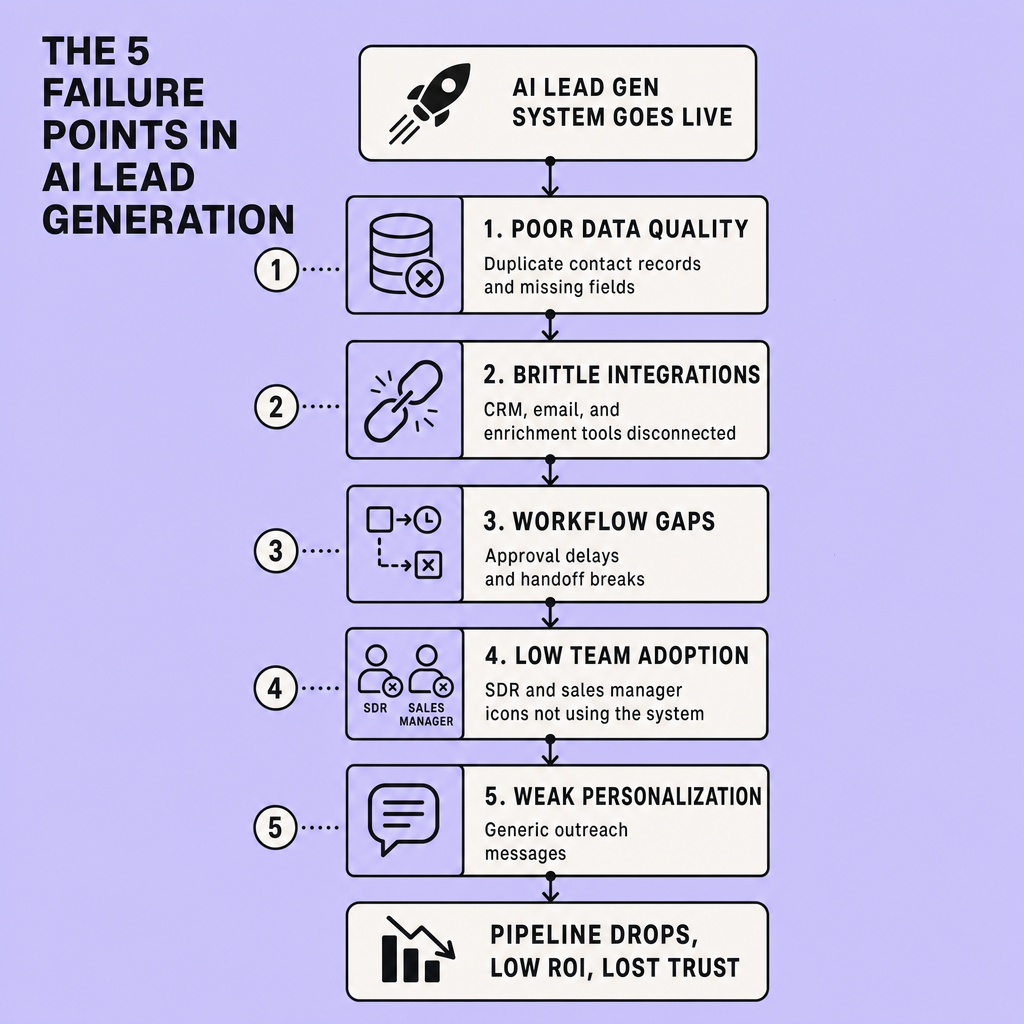
Once the system leaves the demo environment, the same weak spots keep showing up. Most failures come from operations, not model quality. A polished demo can hide the issues that break an AI lead generation system after launch: bad inputs, unstable connections, vague process rules, weak adoption, and shallow personalization. These problems compound fast. Poor data plus weak workflow design can make the system look worse than the model actually is.
Poor data quality distorts scoring and targeting
If Salesforce or HubSpot contains duplicate accounts, stale contacts, missing firmographics, or inconsistent lifecycle stages, lead scoring starts from the wrong baseline. A model can rank leads confidently and still be wrong because the source records are wrong. Bad enrichment can skew targeting, reduce match rates, and send weaker-fit leads to SDRs while stronger opportunities sit untouched.
Brittle integrations break routing and reporting
A demo usually shows one clean API sync. Production uses CRM records, sequencing tools, enrichment vendors, webhooks, call data, and reporting layers at the same time. Small field-mapping errors can create large downstream problems. If lifecycle stages do not map cleanly between systems, routing becomes unreliable, reporting fragments, and attribution gets noisy.
Before scaling AI sales automation, validate sync logic, failure handling, and field ownership system by system.
Weak workflow design creates hidden automation failure
This is where teams hurt themselves. They automate before they define handoffs between marketing, SDR, and AE. Leads get scored but not worked, enriched but not routed, or sequenced but not reviewed. Automation without clear process rules can keep activity high while conversion quality drops. Clear thresholds, ownership, and exception paths reduce drift.
Low sales-team adoption kills output quality
If reps do not trust scores, prompts, or routing, they work around the system. Then data capture weakens, feedback loops disappear, and the AI lead gen system loses the signals it needs to improve. Adoption is not just a training problem. It depends on usability, explainability, and fit with how SDRs and AEs actually work.
Shallow personalization reduces response quality
Personalization tokens are not strategy. A system can insert a first name, company, and job title while still producing generic outreach. If messaging ignores account context, recent activity, or role-specific pain points, response quality usually drops. Reliable personalization depends on verified firmographics, current signals, and controlled prompts rather than mass template variation in B2B lead generation AI.
FAQs
What are the most common failure points in AI lead generation systems?
Poor data quality, brittle integrations, weak workflows, low team adoption, and shallow personalization.
Why does an AI lead gen system work in a demo but fail in production?
Demos use controlled data, narrow use cases, and ideal integrations. Production includes duplicates, missing fields, sync errors, and inconsistent sales process execution.
How does bad CRM data affect AI lead generation?
It degrades lead scoring, targeting, enrichment accuracy, routing, and reporting.
What tools commonly cause integration issues in AI sales automation?
CRMs, sequencing tools, enrichment platforms, webhooks, and internal dashboards.
How can teams improve AI lead generation ROI after launch?
Start with data cleanup, enforce workflow rules, validate API syncs, limit rollout scope, and measure conversion by stage instead of top-line lead volume alone.
How to Build a Reliable AI Lead Gen System That Survives Production
If the system is failing after launch, the answer is usually not a bigger model. It is better system design. A reliable AI lead gen system is built around operational constraints first—messy CRM data, field mapping gaps, lead routing rules, rep behavior, and approval paths—not just a strong demo flow.
Start with one production use case
Most teams try to automate too much too early.
Start with one narrow workflow, such as enrichment plus prioritization for inbound leads in HubSpot or Salesforce. Define the inputs, outputs, owner, SLA, and success metric before you touch prompts or sequences. For example: enrich new form fills with firmographic data, score them against agreed thresholds, then route only qualified records to SDR queues.
Be strict here. If you cannot measure enrichment match rate, sync error rate, MQL-to-SQL conversion, and lead-to-opportunity rate for one workflow, expanding into multichannel automation will multiply confusion, not pipeline.
Fix data before automation
Bad data poisons good logic.
Before scaling AI lead generation, audit duplicate records, missing company domains, inconsistent lifecycle stages, and broken owner fields. Then map every required field across the stack: CRM, enrichment tool, sequencing platform, and reporting layer.
Production systems depend on consistent inputs. If field mapping is loose, personalization degrades, lead routing fails, and the AI sales pipeline becomes hard to trust.
Add human checkpoints where errors are costly
Human-in-the-loop review should sit at high-risk points, not everywhere.
Use QA review for outbound personalization above a certain account value, for routing exceptions, and for prompts that generate claims or account summaries. Do not force manual approval for low-risk enrichment or straightforward scoring updates. Review where mistakes are expensive; automate where rules are stable.
Good governance speeds adoption because teams trust what the system is doing.
Control prompts, workflows, and rollout
Prompt governance should be treated like versioned logic. Store approved prompts, test changes against sample records, and document fallback behavior when integrations fail or data is incomplete. Pair that with playbooks for SDRs and AEs so adoption does not depend on tribal knowledge.
Then roll out in stages. Start with one workflow, validate it through operational metrics and business outcomes, and expand only after the system holds up under real usage.
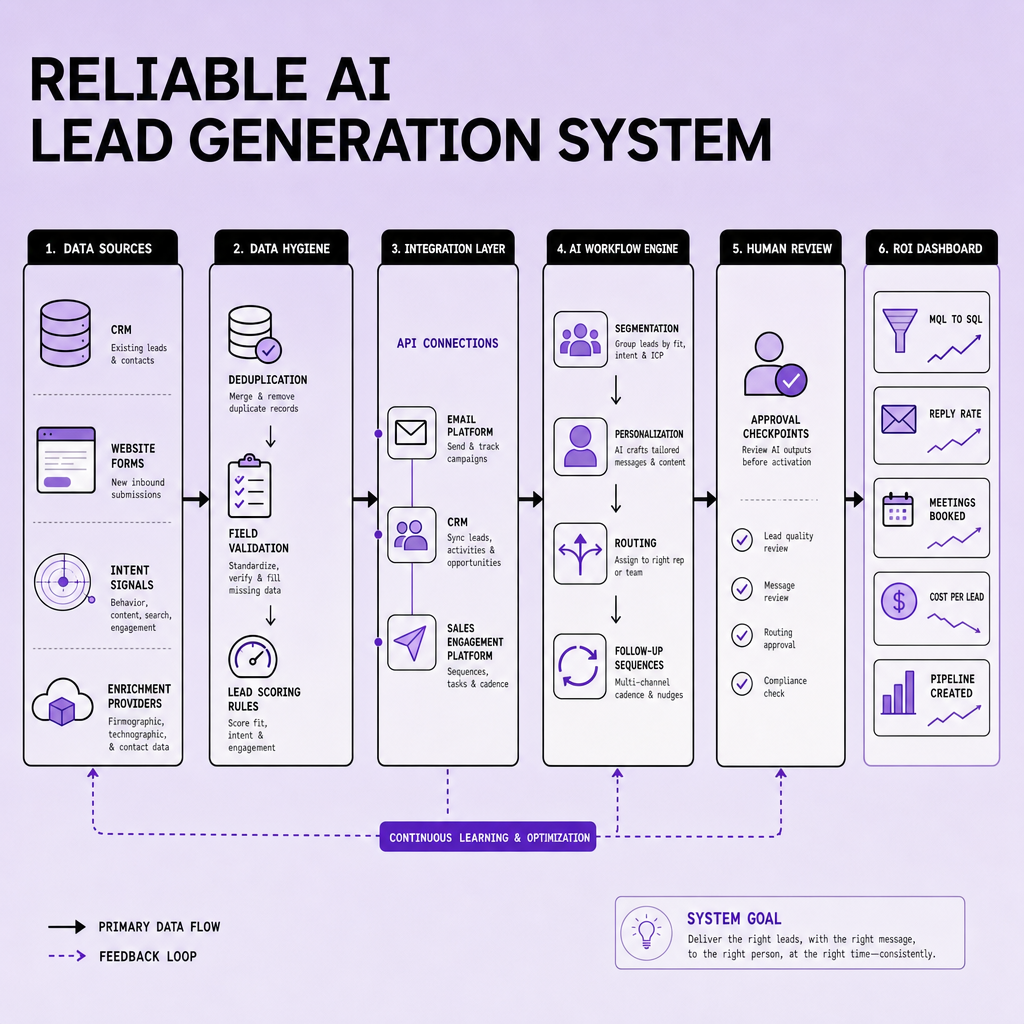
Best Practices, ROI Metrics, and Implementation Tips for AI Lead Generation
A lot of teams judge success too early. They see more activity after launch and assume the system is working, even when downstream conversion quality is getting worse. The best AI lead generation programs are managed like revenue systems, not demo features. That means defining success before launch, assigning ownership, and reviewing workflow drift after launch instead of chasing early activity spikes.
Start with a baseline. Before turning on automation, capture current reply rate, MQL-to-SQL conversion, lead-to-opportunity rate, speed-to-lead, pipeline velocity, CAC, and rep hours spent on research, routing, enrichment, and follow-up. After launch, compare performance by stage, not by raw email volume or lead count alone. More activity is not better if qualification accuracy drops or routing pushes weak accounts into the wrong sequence.
A practical ROI model should connect costs, operating metrics, and revenue outcomes:
- Inputs: software cost, setup time, admin effort, enrichment spend, governance, rep training
- Operational outputs: enrichment match rate, sync error rate, response rate, qualification accuracy, rep time saved
- Revenue outputs: SQL rate, opportunity rate, pipeline created, pipeline velocity, payback period
If the system increases activity but not qualified pipeline, it is not working well enough.
Teams often misread results by tracking top-of-funnel activity and ignoring downstream conversion quality. Adoption matters too. If reps cannot trust the score, edit messaging quickly, or see CRM context where they work, usage drops and the workflow degrades.
For rollout, assign clear ownership across ops, sales, and marketing. One accountable team should own CRM field mapping, lifecycle stages, scoring thresholds, routing rules, and exception handling. Build feedback into the workflow so reps can flag bad enrichment, off-brand messaging, false-positive MQLs, and missed handoffs in one place.
Use a simple 30/60/90-day review cadence: at 30 days, check integrations and sync errors; at 60, review conversion by stage and personalization quality; at 90, evaluate CAC impact, opportunity rate, and payback period.
How do we measure ROI for AI lead generation?
Use both activity and revenue metrics: response rate, qualification accuracy, SQL rate, opportunity rate, pipeline created, rep time saved, CAC movement, and payback period.
What metrics matter most after launching an AI lead gen system?
Watch speed-to-lead, MQL-to-SQL conversion, lead-to-opportunity rate, enrichment match rate, sync error rate, and conversion by lifecycle stage.
Why does AI sales automation fail after a successful demo?
Production adds messy CRM data, broken integrations, weak routing rules, uneven rep adoption, and inconsistent personalization.
How long should we review an AI sales pipeline after launch?
Use structured 30/60/90-day reviews, then move to a recurring operating cadence for workflow tuning, prompt updates, and scoring validation.
What is the best rollout strategy for lead generation automation?
Start with one segment and one workflow with clear ownership. Expand only after data quality, routing, personalization, and CRM visibility are stable.
Frequently Asked Questions
What is the first sign that an AI lead generation system is failing in production?
The earliest warning sign is usually a mismatch between activity and outcomes. If volume rises but reply rates, meeting quality, or stage-to-stage conversion falls, the system is creating noise instead of qualified pipeline. Production failure often appears in operational metrics before it appears in revenue dashboards.
How much data quality is enough before launching AI lead generation?
Data quality does not need to be perfect, but it must be stable enough for routing, scoring, and reporting decisions. Teams should launch only when key fields such as company domain, owner, lifecycle stage, source, and account status are consistently populated and governed across systems.
Why should human review stay inside an AI sales pipeline?
Human review should remain at high-impact decision points because it catches expensive errors that automation alone may miss. Reviews are most valuable for strategic accounts, unclear routing exceptions, sensitive messaging, and generated summaries that influence rep actions or customer-facing outreach.
How does AI sales automation affect ROI timelines?
AI sales automation usually improves ROI in phases rather than all at once. Early gains often come from time savings and faster lead handling, while revenue gains take longer because scoring, routing, and messaging need tuning against real conversion data before pipeline quality improves consistently.
What makes AI lead generation scalable across teams and regions?
Scalable AI lead generation depends on standardized lifecycle definitions, documented workflows, shared field ownership, and localized rules for segmentation and messaging. Systems scale when teams can adapt outreach by market without breaking reporting, routing logic, compliance requirements, or model feedback loops.
Make Imversion a preferred source on Google
Like this kind of AI and software analysis? Add Imversion as a preferred source so Google can highlight our articles for you in Search, AI Overviews, and AI Mode.