AI Product Development: Evolving from Prototype to Production
Understand the transitions in AI product development from prototype to MVP to production, covering essential goals, features, and common pitfalls.

AI Product Development: What Changes From Prototype to MVP to Production
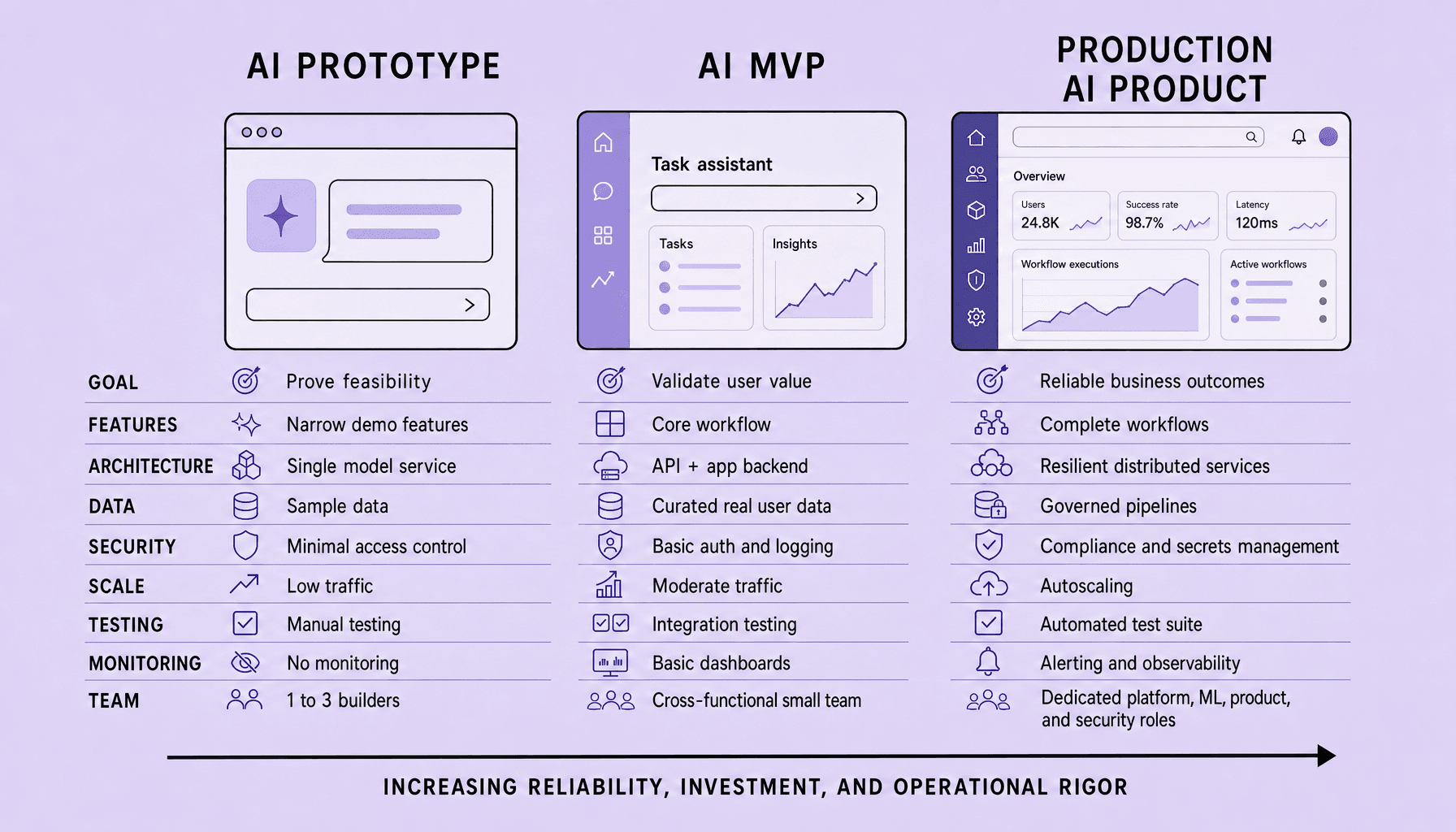
Most teams do not struggle because the model is bad. They struggle because they treat a demo, an MVP, and a production system like the same thing. They are not. In AI product development, the shift is simple: an AI prototype proves feasibility, an AI MVP validates user value, and a production AI product must deliver reliability, security, and scale. The business question changes first. Everything else follows.
That includes goals, features, architecture, data discipline, testing, monitoring, and team expectations. A prototype can live in notebooks with a hosted LLM API and manual review. An AI MVP needs product analytics, fallback flows, evaluation datasets, and a service layer users can actually touch. Production raises the bar again -- RBAC, PII handling, CI/CD, observability, latency targets, incident response, and cost control all become product requirements, not backend nice-to-haves.
Teams get this wrong all the time.
They carry prototype habits into launch, or overbuild too early and burn time before demand is clear. The practical rule is straightforward: change the system when the objective changes. At Imversion Technologies Pvt Ltd, that is the useful lens -- clarity is better than complexity, especially in stage decisions.
Key Takeaways for AI Product Development
-
In the prototype vs MVP discussion, the first question is not feature count. It is business intent. An AI prototype proves possibility fast -- often with notebooks, hosted LLM APIs, and manual review -- while an AI MVP tests real usage, retention, and willingness to pay.
-
The jump to a production AI product changes the operating standard. Teams now need service-based architecture, evaluation datasets, CI/CD, RBAC, PII handling, observability, rollback plans, and clear latency or SLA targets. Once users depend on the system, reliability stops being a bonus.
-
A common transition mistake is carrying prototype habits into later stages. That means weak data pipelines, no human-in-the-loop fallback, poor testing, and security added too late. The opposite mistake shows up too: overbuilding before demand is proven.
-
Move stages only when the current one has answered its core question. Feasibility first. Adoption next. Reliability and scale after that. In practice, AI product development gets easier when each stage has a clear exit criterion tied to the AI product lifecycle.
-
The real shift across an AI prototype, AI MVP, and production system is discipline. More users. More risk. Much less room for guesswork.
AI Prototype vs AI MVP vs Production AI Product: Definitions and Stage Boundaries
A lot of stage confusion comes from judging by polish. A slick interface can still hide prototype-grade operations. The cleaner way to think about the prototype vs MVP question is this: each stage exists to answer a different business question. In the AI product lifecycle, the real boundary is risk tolerance and operating standard.
AI Prototype
An AI prototype is a proof of concept built to answer: can it work? Can a hosted LLM API, a retrieval flow, or a classifier produce useful output on a narrow workflow?
This stage is about feasibility, speed, and learning. So notebooks, scripts, prompt experiments, sample datasets, and manual review are acceptable. Security is light. Testing is informal. Architecture can be ugly -- because the point is to reduce uncertainty fast, not to design for scale.
But a prototype is not ready for real users just because the demo looks impressive. If humans are quietly fixing outputs, if failure cases are not mapped, and if sensitive data handling is still vague, it is still a prototype.
AI MVP
An AI MVP -- a minimum viable product -- answers a harder question: will users adopt it and pay for it?
Now the product needs usable workflows, basic analytics, feedback capture, fallback behavior, and enough consistency that early customers can complete a job without constant intervention. The architecture usually moves from notebooks to services. Evaluation datasets become more deliberate. Logging starts to matter. Cost and latency do too, because user experience now affects retention.
One practical rule: if the team cannot measure usage, task success, or drop-off, it is not really an MVP. Decisions should be backed by data.
Production AI Product
A production AI product answers the operational question: can it run reliably and safely at scale?
Here, service-level objective thinking, governance, RBAC, PII handling, CI/CD, observability, incident response, and model/version control stop being optional. Human-in-the-loop review may still exist -- but as a designed control, not an invisible rescue step.
If uptime, latency, access control, and failure handling are undefined, the system is not production-ready.
A useful classification test:
- Prototype: feasibility proven, operations ignored
- MVP: user value proven, operations partial
- Production: reliability, safety, and governance designed into the product
If the team is still accepting prototype-level failure rates, it does not have a production AI product -- no matter how polished the interface looks.
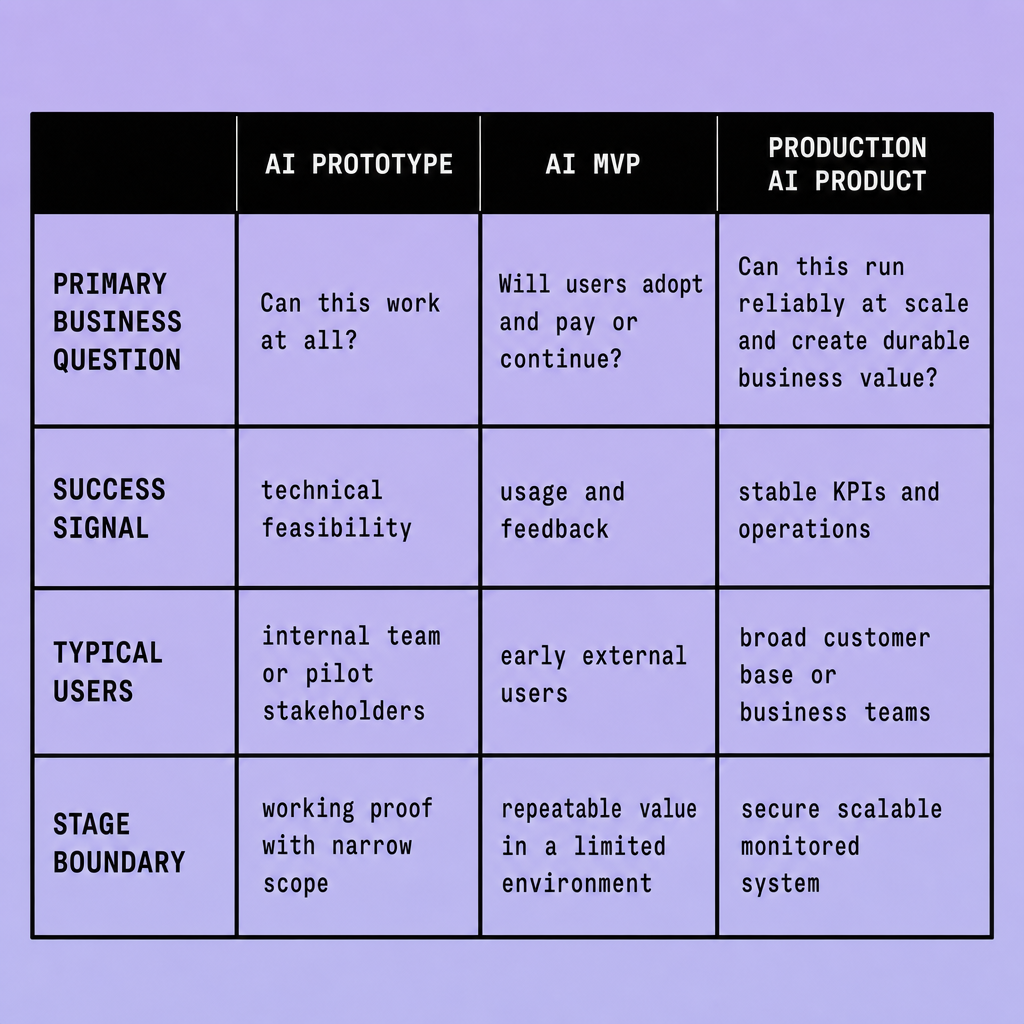
Side-by-Side Comparison of AI Product Development Stages
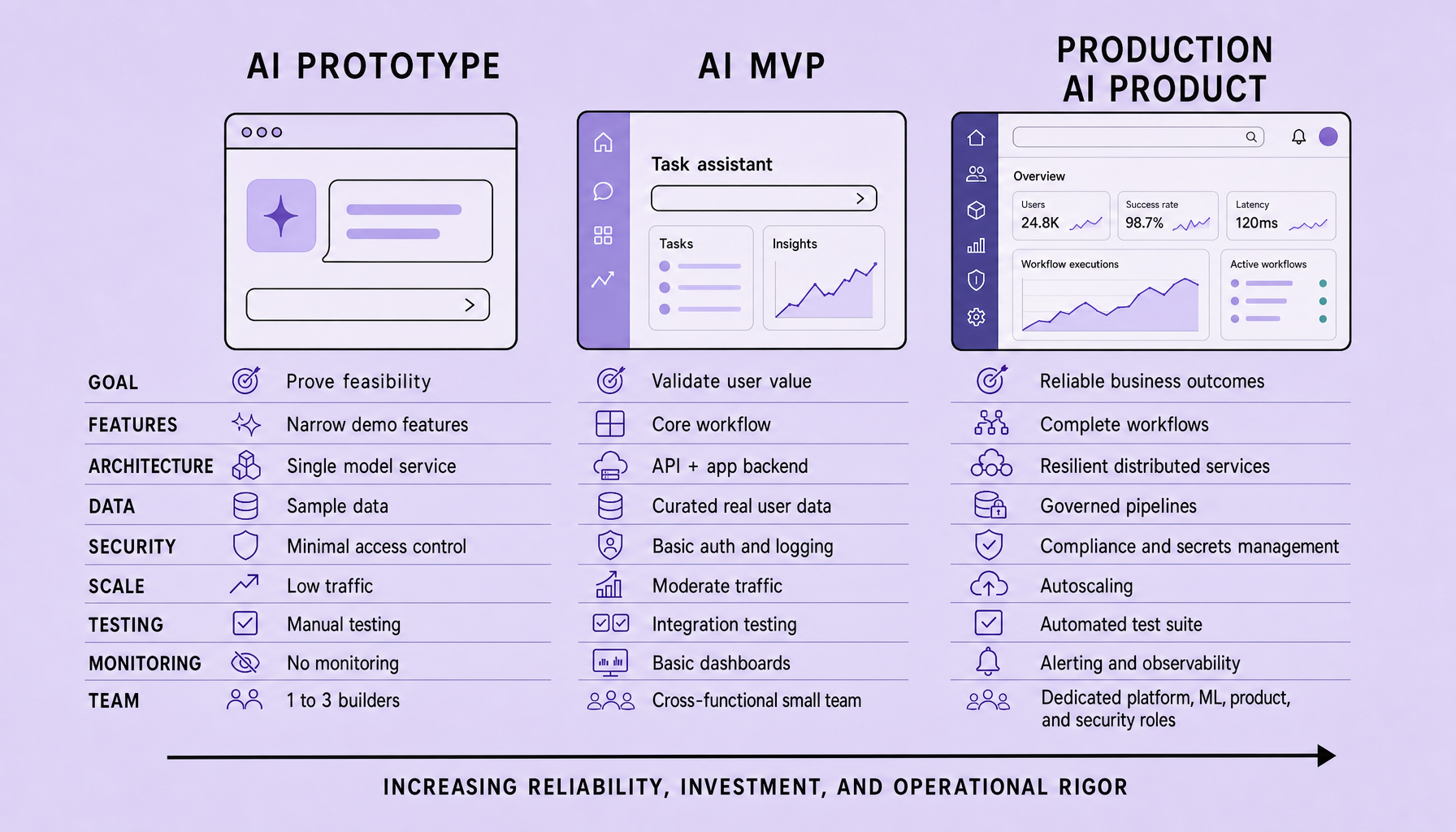
When teams argue about whether something is still a prototype or already an MVP, the fastest way to settle it is to compare operating standards, not UI polish. An AI prototype can survive on speed and manual work. An AI MVP needs usable flows, analytics, and controlled risk. A production AI product must hold up under real traffic, security review, latency expectations, and failure handling.
| Dimension | AI Prototype | AI MVP | Production AI Product |
|---|---|---|---|
| Goal | Prove technical feasibility | Validate user value and demand | Deliver reliable business outcomes at scale |
| Features | Narrow workflow, manual steps, rough UX | Core workflow, feedback loops, fallback paths | Full workflows, admin controls, support tools, auditability |
| Architecture | Notebooks, scripts, hosted APIs | Basic services, app layer, vector database, queues | Hardened services, CI/CD, rollback paths, feature flags |
| Data | Small samples, synthetic data, limited labeling | Real user data with consent, evaluation sets, analytics | Governed pipelines, versioning, PII handling, retention rules |
| Security | Minimal access control | Basic auth, RBAC, secrets management | Policy enforcement, audits, incident response, tighter data controls |
| Scalability | Ignored or deferred | Moderate load planning, cost checks, caching | Capacity planning, SLA targets, latency budgets, resilience |
| Testing | Spot checks, prompt trials, manual review | Structured evaluations, regression checks, human-in-the-loop | Automated test gates, offline and online evals, load and failure tests |
| Monitoring | Little to none | Basic logs, analytics dashboards, alerts on key failures | Observability, drift tracking, cost monitoring, on-call readiness |
| Team / Pressure / Success | 1–3 people; speed wins; success = “it works” | Cross-functional small team; shipping pressure; success = adoption and retention signals | Broader engineering, product, data, security support; success = reliability, ROI, and supportable operations |
Teams often underestimate three rows: data, testing, and monitoring.
Those rows reveal whether a system is only demo-ready or actually usable. A prototype can hide weak data quality behind manual review. An AI MVP usually cannot. A production AI product cannot. Once real users arrive, human-in-the-loop paths, evaluation datasets, observability, and clear ownership stop being optional and become operating requirements.
So use this table with stage-boundary criteria, not by itself. A system may look production-ready in architecture but still be prototype-level in security or testing. The stage only makes sense when matched to its business purpose.
What Changes in AI Product Development Goals, Features, Architecture, Data, Security, and Scale at Each Stage
This is where teams usually underestimate the shift. The biggest change is not feature count. It is operating standard. An AI prototype answers “can this work?” An AI MVP answers “will users use it?” A production AI product answers “can this run safely, reliably, and repeatedly under real demand?”
Goals
In an AI prototype, the goal is speed. Teams test feasibility, compare model behavior, and learn where the idea breaks. Manual review and fragile workflows are acceptable.
In an AI MVP, the goal shifts to market validation. The system must solve one real problem for real users, with enough UX, analytics, and fallback logic to collect honest feedback. It still does not need full enterprise depth.
A production AI product has a harder job: predictable outcomes, operational control, and business continuity. This is where teams get burned if they carry prototype habits into customer-facing systems.
Features
Prototype features are narrow by design: one workflow, one model path, maybe a simple prompt chain, often backed by human review. An MVP adds feedback capture, basic account flows, usage analytics, retry handling, and clearer failure states.
Production changes the standard again. Features now include audit trails, admin controls, model versioning, feature flags, batch and real-time inference paths, and support for edge cases that early demos ignored. Not flashy. Necessary.
Architecture
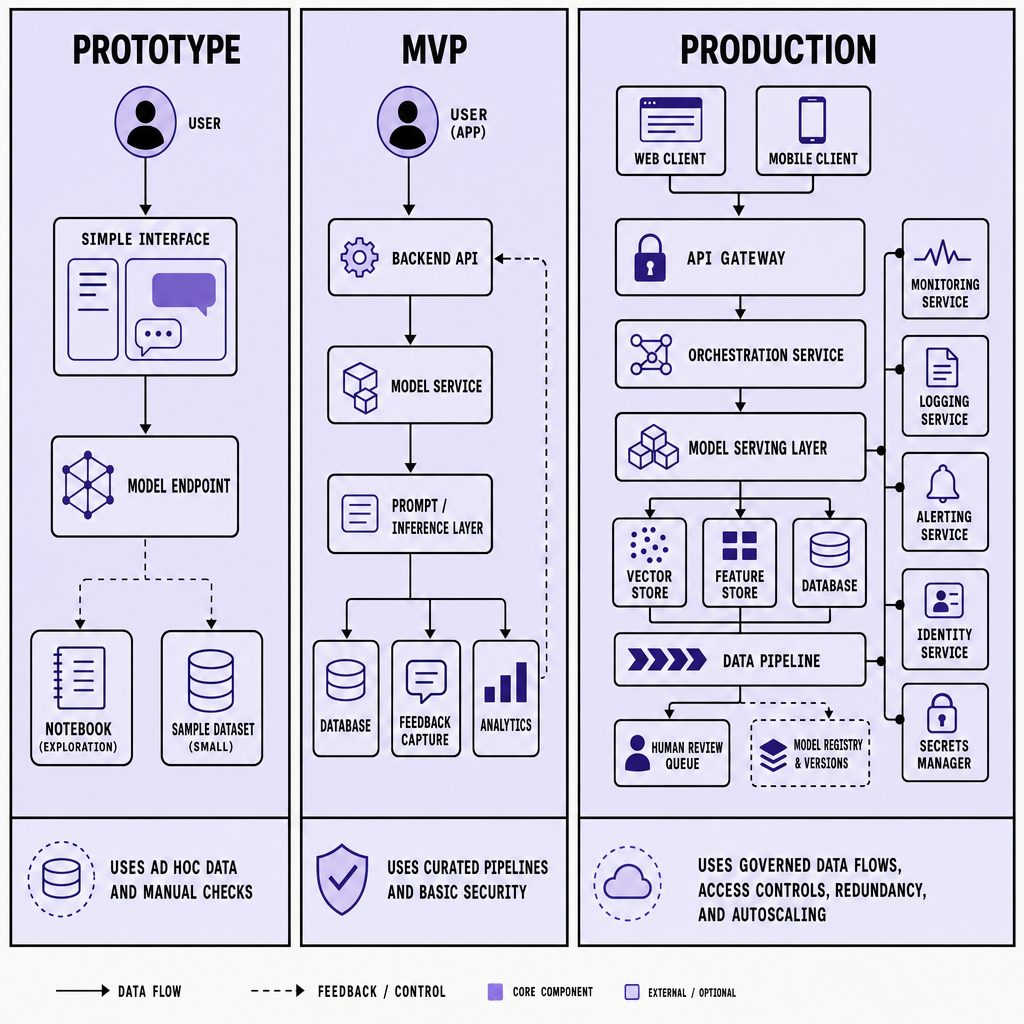
An AI prototype often lives in notebooks, scripts, and hosted model APIs stitched together fast. That is acceptable. Teams should resist enterprise-grade architecture this early unless the domain is regulated or sensitive.
An AI MVP should stop relying on ad hoc scripts for customer-facing behavior. The stack usually moves to services, scheduled jobs, a basic data pipeline, API layers, and a small application backend. A vector database may support retrieval. Queues may handle asynchronous jobs.
Production pushes architecture toward durable services, CI/CD, version control for models and prompts, workflow orchestration, and stronger observability. The tradeoff matters: more structure improves reliability, but too much complexity too early slows learning. Split systems only when the operational need is clear.
Data
Prototype data is small, sampled, and messy. Fine for learning; dangerous for deployment.
An MVP needs repeatable datasets, evaluation sets, logging, and cleaner ingestion. Teams start defining what “good output” means and why. Understanding failure modes matters more than squeezing out one more demo result.
Production requires governed pipelines, PII handling rules, lineage, retention controls, and quality checks. The data pipeline becomes part of the product, not a side task.
Security
Security starts basic in a prototype: limited access, isolated environments, and no sensitive production data if it can be avoided.
In an MVP, customer-facing systems need stronger controls: secret management, encrypted transport, RBAC, logging, and clear boundaries around who can access prompts, outputs, and uploaded files.
Production security becomes compliance-aware. Systems need auditable access controls, PII minimization, environment separation, incident response paths, and vendor review for external model providers.
If a system touches sensitive user data, security maturity should move up faster than product maturity.
Scalability
Prototype scale barely matters. Cost spikes and latency are tolerable if the team is still proving core behavior.
An MVP must handle early usage without falling apart. That usually means caching, async processing, basic service targets, and cost monitoring around inference calls.
A production AI product must plan for concurrency, failure recovery, autoscaling, queue backpressure, and performance tradeoffs between batch and real-time inference. Scale is not just traffic. It is also operational load, cloud cost, and support burden.
Testing, Monitoring, and Team Requirements Across the AI Product Lifecycle
This is where promising systems often stall. Teams focus on model quality, then hit a wall somewhere else -- no evaluation discipline, no observability, no clear owners. That is why many systems get stuck between AI MVP and production AI product.
Testing
An AI prototype needs speed, not ceremony. Testing is mostly spot checks, prompt experiments, and quick reviews against a small evaluation set. The question is simple: does the workflow produce useful output often enough to justify more work?
An AI MVP needs structure. Teams should define task-specific success criteria, build a stable evaluation set, and start regression testing before every prompt, model, or retrieval change. Include failure analysis too -- bad citations, refusal errors, latency spikes, tool-call mistakes. Understanding why outputs fail is what turns demo logic into product logic.
A production AI product raises the bar again. Expect automated regression suites in CI/CD, adversarial test cases, human-in-the-loop review for high-risk flows, and release controls such as feature flags or shadow testing. In practice, production readiness is often blocked less by model performance than by the absence of repeatable QA and support playbooks.
Monitoring
An AI prototype often has no real monitoring. Fine for a short experiment.
An AI MVP should at least track usage analytics, completion rates, user feedback, token spend, and basic latency. If retrieval is involved, log retrieval misses and empty results. This is where teams start seeing whether the product is valuable or just interesting.
A production AI product needs full observability. Not just uptime. Model quality signals, latency by step, drift detection, error rates, fallback frequency, cost per workflow, and audit logs for sensitive actions. And incident response. If prompts, models, embeddings, or upstream data change, the team needs alerts, dashboards, runbooks, and an on-call owner.
Reliable systems matter most once users depend on the output.
Team Requirements
An AI prototype can be built by a product manager and one ML engineer, or one strong full-stack builder using hosted LLM APIs and notebooks.
An AI MVP usually needs a broader mix: product manager, ML engineer, backend engineer, and part-time design or data support.
A production AI product needs named owners for reliability, data pipelines, and operations -- often a product manager, ML engineer, backend engineer, data engineer, and on-call support path. Without ownership, observability data just becomes noise.
Common Mistakes in AI Product Development at Prototype, MVP, and Production Stages
Most teams fail in AI product development not because they move too slowly, but because they upgrade the wrong parts of the system at the wrong time. The recurring mistake is stage confusion: applying production standards to a prototype, prototype shortcuts to an MVP, or MVP habits to a production system.
Stage-specific mistakes
With an AI prototype, the most common error is overengineering. Teams add service layers, vector databases, CI/CD, RBAC, and multi-model routing before they have even shown the core workflow works. That burns time without reducing real uncertainty. A prototype should answer whether the problem is solvable and whether the workflow is worth further investment. It does not need to look like a platform.
With an AI MVP, the mistake shifts from overbuilding to under-instrumenting. Teams launch a decent interface but skip analytics, evaluation datasets, and a fallback flow for bad outputs, low confidence, or model timeouts. As a result, they collect anecdotes instead of product signals. Another common problem is exposing users to unstable prompts or brittle retrieval logic without review paths for risky cases. That creates avoidable trust and support issues.
With a production AI product, the failure pattern flips again. Teams keep treating the system like a demo: weak monitoring, loose governance, no PII handling rules, unclear ownership, and no latency, uptime, or cost targets. In production, reliability, security, and unit economics become product requirements, not backend nice-to-haves.
Clarity is better than complexity -- especially during stage transitions.
A practical rule: only upgrade architecture, security, and observability when the business question changes, and only to the level that stage actually requires.
Best Practices to Move From AI Prototype to AI MVP to Production AI Product
Stage promotion should follow the main risk, not team enthusiasm. If an AI prototype still struggles to prove feasibility, do not wrap it in product code yet. Once user value matters more than raw feasibility, move to an AI MVP. When reliability, security, and repeatable operations become the limiting factor, treat it as a production problem.
Readiness checklist by transition
From AI prototype to AI MVP, teams should have:
- clear exit criteria for the core use case
- a feedback loop with real users
- an evaluation dataset and acceptance test for quality
- basic service architecture beyond notebooks or one-off scripts
- minimum security controls: RBAC, secret management, and PII handling rules
- ownership across product, engineering, and model behavior
From AI MVP to production AI product, the bar changes:
- runbooks, on-call ownership, and incident paths
- baseline test coverage across prompts, APIs, fallback logic, and integrations
- monitoring for latency, failures, output quality, cost, and drift
- defined SLAs, rollout controls, and feature flags
- documented data pipelines and approval rules for model or prompt changes
A useful tradeoff: do not overbuild too early. Full automation, aggressive optimization, or heavy platform work can slow learning at prototype and MVP stages. But underbuilding for too long creates hidden risk, especially when manual review is masking unstable outputs or weak controls.
Because understanding why matters, every promotion decision should tie back to the AI product lifecycle question being answered.
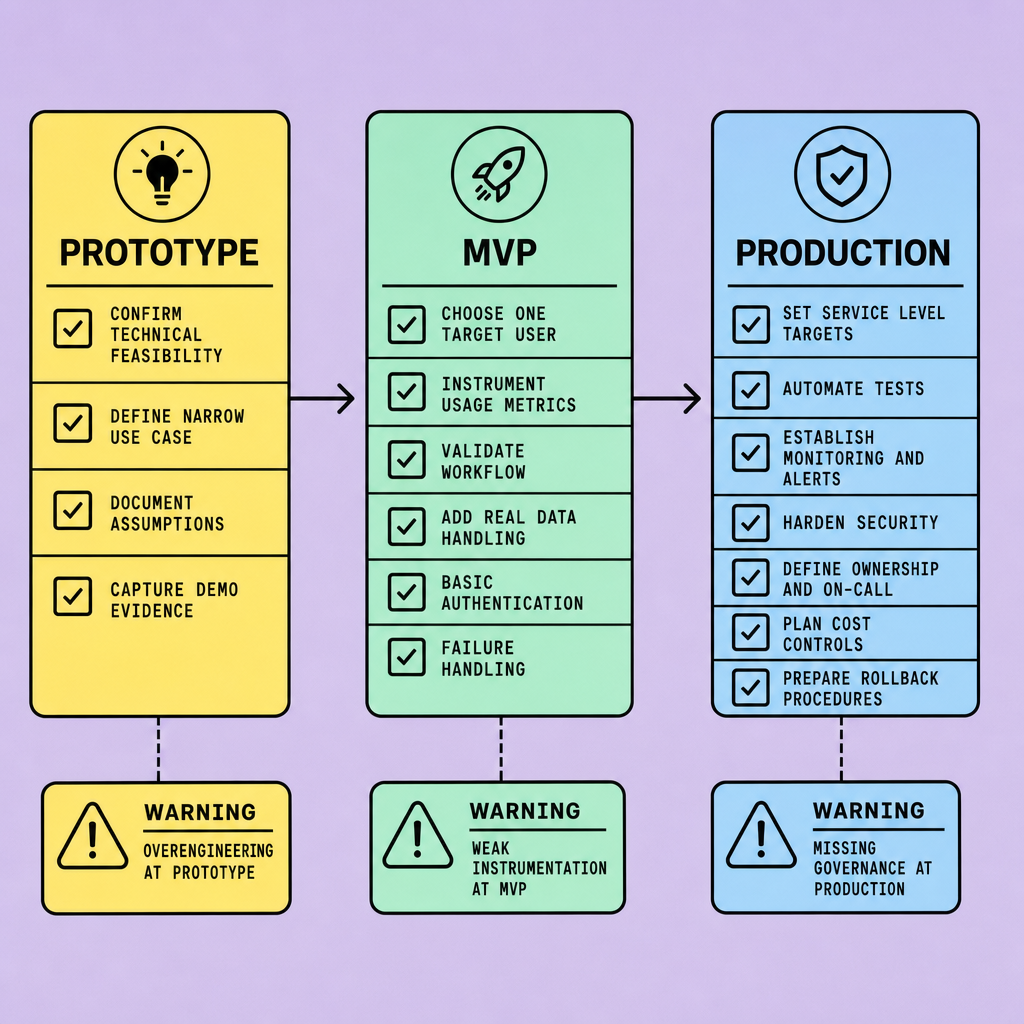
Do not move forward yet if manual review is still hiding core quality problems, security controls are incomplete, or no team role clearly owns production behavior.
Frequently Asked Questions
What is the fastest way to tell whether a system is still an AI prototype or already an AI MVP?
The fastest test is to ask what decision the system is supposed to support. An AI prototype exists to prove technical feasibility, while an AI MVP exists to measure real user behavior and demand. If there is no reliable usage data, feedback loop, or task-success tracking, it is almost certainly still a prototype.
How does AI product development change when moving from MVP to production?
AI product development changes from validating interest to managing operational risk. The team must shift from shipping core workflows to enforcing reliability, security, cost control, rollback, and support readiness. At that point, architecture, monitoring, and ownership matter as much as model quality because failures now affect revenue, trust, and compliance.
Why should AI product development include human review even after launch?
Human review should remain in place whenever outputs can cause material business, legal, or customer risk. In mature systems, it becomes a designed control for exceptions, escalations, or low-confidence cases rather than a hidden fix for routine failures. That distinction protects quality while still allowing automation to scale.
What metrics matter most for a production AI product?
The most important production metrics combine technical health and business impact. Teams should track latency, error rates, fallback frequency, cost per workflow, output quality trends, and user completion rates together. A production AI product is healthy only when it is both technically reliable and economically sustainable.
When should a team rebuild architecture during AI product development?
A team should rebuild architecture only when the current system blocks the next business objective. Rebuilding too early slows learning, while rebuilding too late creates operational fragility. The right trigger is usually a change in required reliability, security, user volume, integration complexity, or the need for repeatable releases and support.
Make Imversion a preferred source on Google
Like this kind of AI and software analysis? Add Imversion as a preferred source so Google can highlight our articles for you in Search, AI Overviews, and AI Mode.