AI RFP Template: Essential Components for Effective Agentic AI Project
This blog outlines how to write an AI RFP template focusing on critical elements like business requirements, use cases, and vendor evaluation.

AI RFP Template for Agentic AI Projects: What to Include
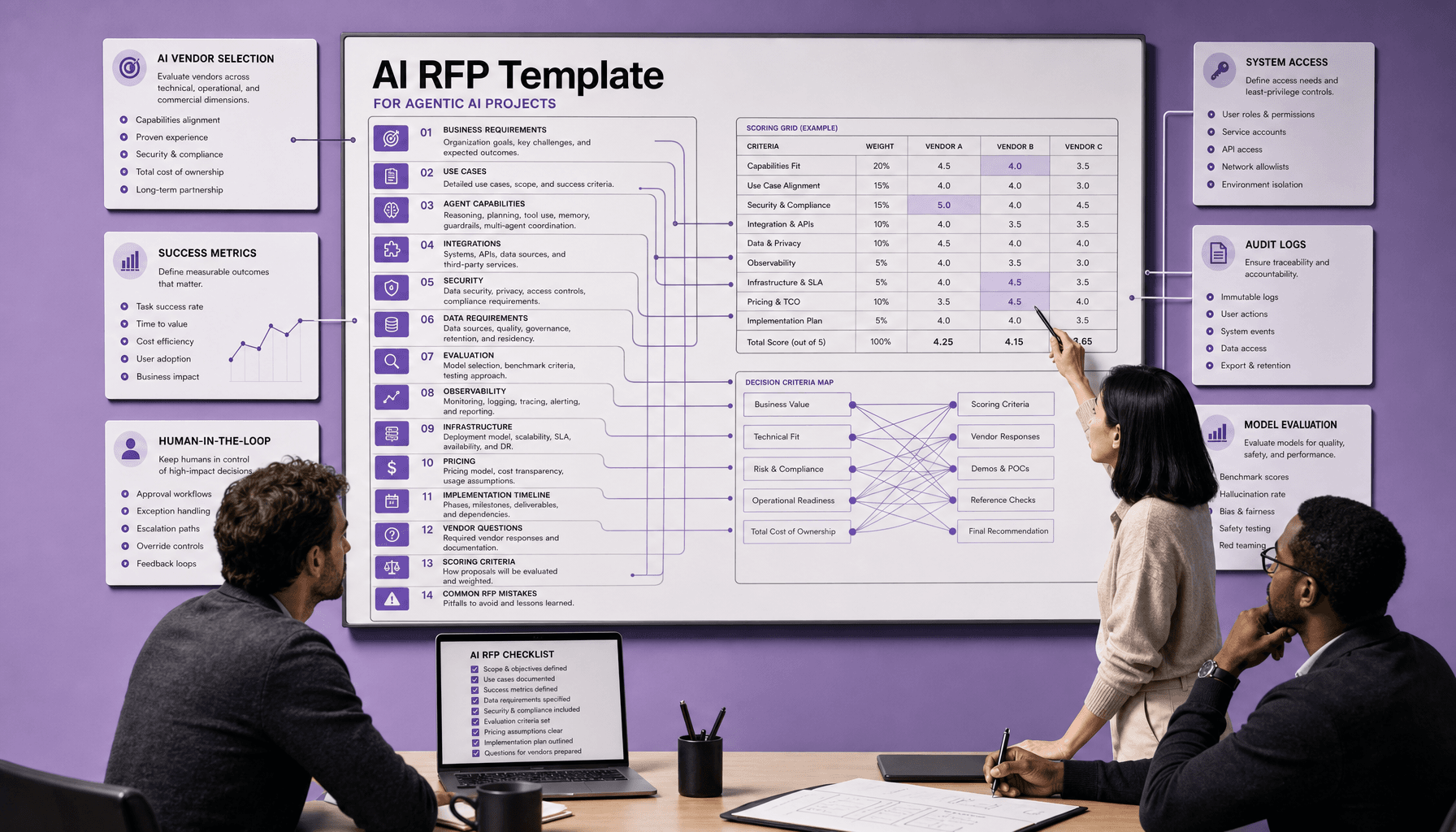
If your RFP only asks for features and pricing, you are setting yourself up to compare polished demos instead of production-ready systems. Your AI RFP template should define how the agent will create business value, what it can and cannot do, how it connects to production systems, and how you will evaluate it. A strong agentic AI RFP covers business requirements, use cases, agent capabilities, integrations, security, data, evaluation, observability, infrastructure, pricing, timelines, vendor questions, scoring criteria, and common mistakes.
Core components to include
Start with business goals, target users, workflows, and measurable AI project requirements such as task completion rate, escalation rate, accuracy, and cost per workflow. Then specify use cases in concrete terms -- CRM updates, help desk triage, invoice validation, ERP actions -- with triggers, approvals, and failure handling.
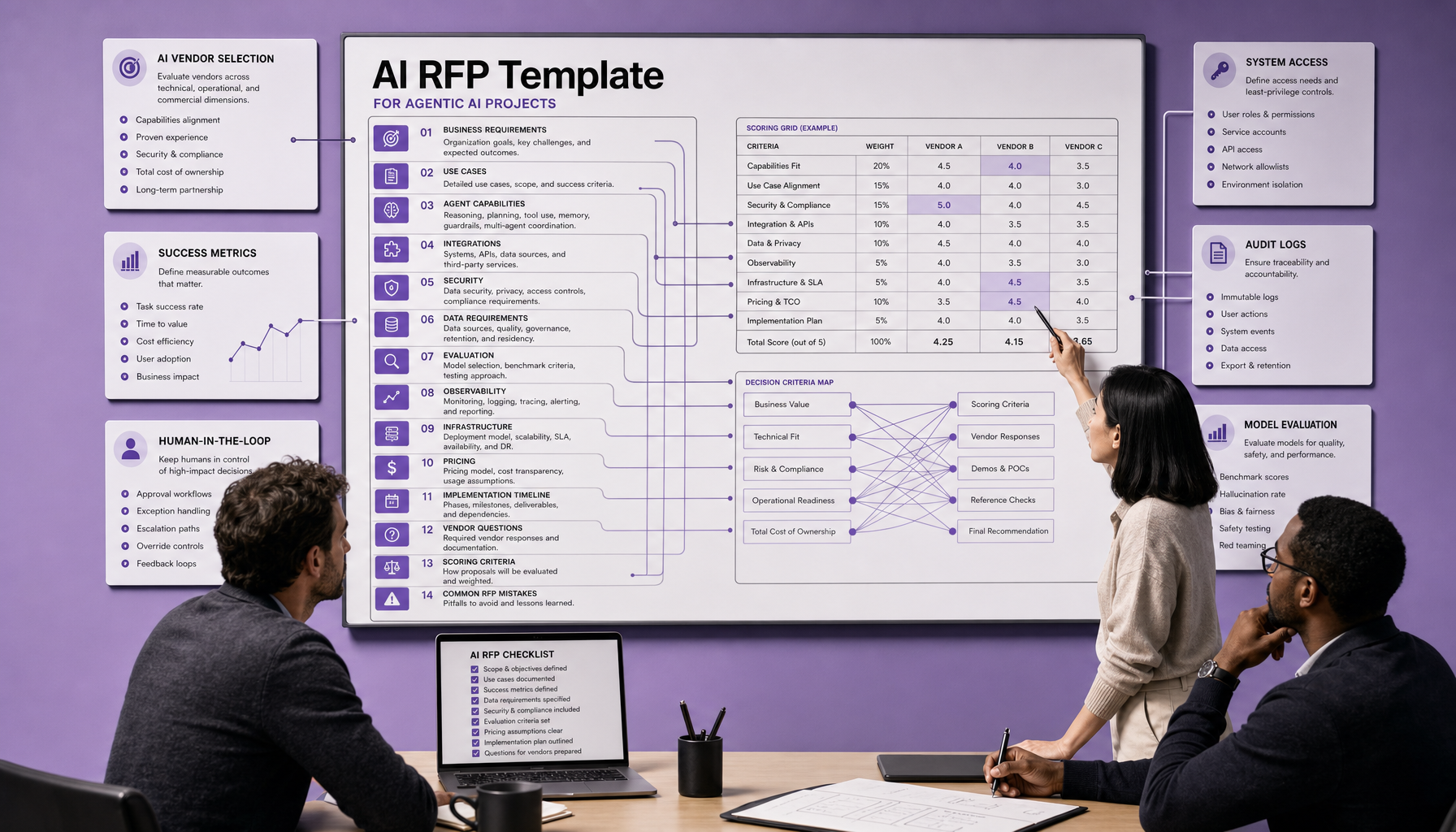
Define agent capabilities clearly: planning, tool use, memory, orchestration, guardrails, and human handoff. Require integration details for IAM, SIEM, vector databases, APIs, Docker, Kubernetes, CI/CD, and cloud deployment options.
Security should not be optional. Ask about data access, retention, tenancy, audit logs, policy controls, observability, latency targets, AI implementation timeline, pricing models, vendor questions, and weighted AI vendor selection criteria. At Imversion Technologies Pvt Ltd, I’d treat vague autonomy boundaries as a red flag.
Key Takeaways
- A strong agentic AI RFP is specific. Your AI RFP template should define business goals, priority workflows, approval points, failure handling, and hard autonomy boundaries -- not just broad AI project requirements.
- For agentic AI projects, production readiness matters as much as feature lists. Ask about CRM, ERP, help desk, IAM, and SIEM integrations, plus observability, security controls, infrastructure, and rollback paths.
- AI vendor selection should use scored evaluation criteria. Compare vendors on agent capabilities, data handling, AI implementation timeline, pricing, and answers to operational risk questions.
- Monitoring is as important as deployment. If the RFP does not require logs, traces, alerts, and KPI tracking, you are still evaluating a demo, not a system.
Why Agentic AI Projects Need a More Specific AI RFP Template
A standard software RFP is too shallow for agentic AI projects. Even a generic AI procurement document usually stops at features, pricing, and model quality. That misses the hard part: defining what the agent is allowed to do, which systems it can touch, when it must pause for human approval, and how you will monitor outcomes after launch.
An agent that drafts answers in a chat window is one thing. An agent that reads a ticket, queries a CRM, updates an ERP record, sends an email, and closes the case is something else entirely. Multi-step action changes the risk profile. So does tool use. So does memory. Your AI project requirements need to spell out autonomy boundaries, workflow orchestration, exception handling, and governance -- not just “supports automation” or “integrates with enterprise systems.”
Here is where vague RFPs fail.
A buyer asks for an “AI support assistant.” One vendor proposes a retrieval chatbot. Another proposes an action-taking agent with help desk and IAM access. Both appear to qualify. But they solve different problems, carry different security exposure, and require different AI implementation timeline expectations, observability, and approval flows. Weak requirements lead to bad AI vendor selection.
The same problem shows up in production. Teams often forget to specify:
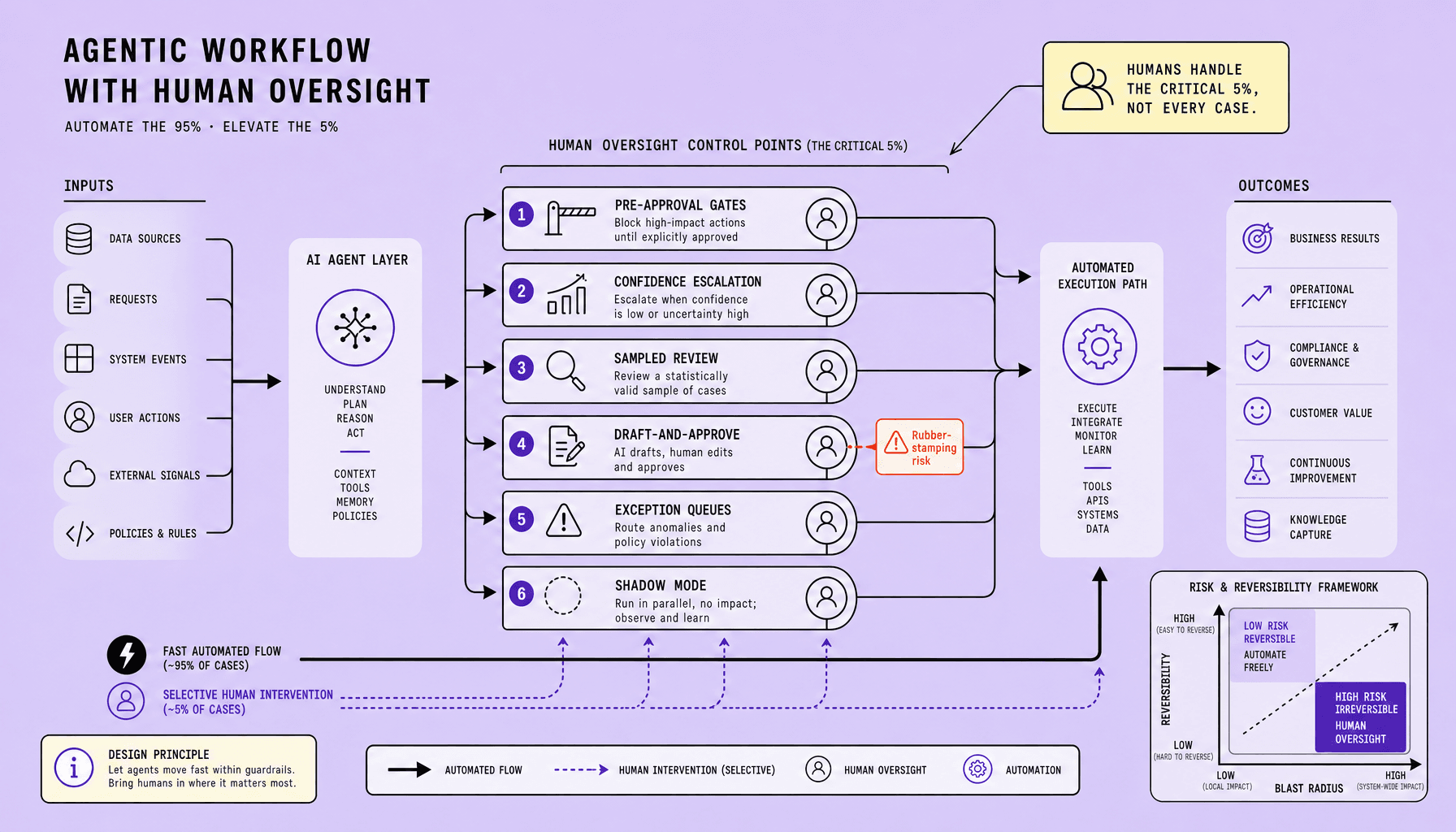
- which actions require human-in-the-loop approval
- acceptable failed action rates and escalation rates
- how the agent handles missing data, API errors, or permission failures
- what logs, traces, and audit records operations teams need
The hard question is not whether a vendor has an agent platform. It is where the agent can act without approval, where it must stop, and how your team will detect drift, bad actions, and policy violations.
A strong agentic AI RFP forces those answers upfront. Monitoring is as important as deployment, so your RFP should require measurable evaluation criteria across task completion, exception paths, latency, security controls, and rollback options. Without that specificity, teams buy demos instead of production systems.
AI Project Requirements: Business Goals, Use Cases, and Success Metrics
If this section is vague, the rest of the RFP will be vague too. A usable AI RFP template for agentic AI projects must force specificity before you ask about models, pricing, or architecture.
Define the business problem before the solution
Your AI project requirements should state the business objective in operational terms, not aspirational language. “Improve support” is weak. “Reduce Tier 1 customer support handling time” is usable. The same applies to finance and sales operations -- “automate invoice review against policy rules” or “update CRM records and draft follow-ups for qualified leads” gives vendors something concrete to scope.
Rank use cases by business value and operational risk before issuing the agentic AI RFP. Broad use cases produce weak vendor responses because vendors fill in the gaps differently. Then you cannot compare them cleanly during AI vendor selection.
Turn workflows into RFP fields
Once the business problem is clear, turn each workflow into a response format vendors cannot dodge.
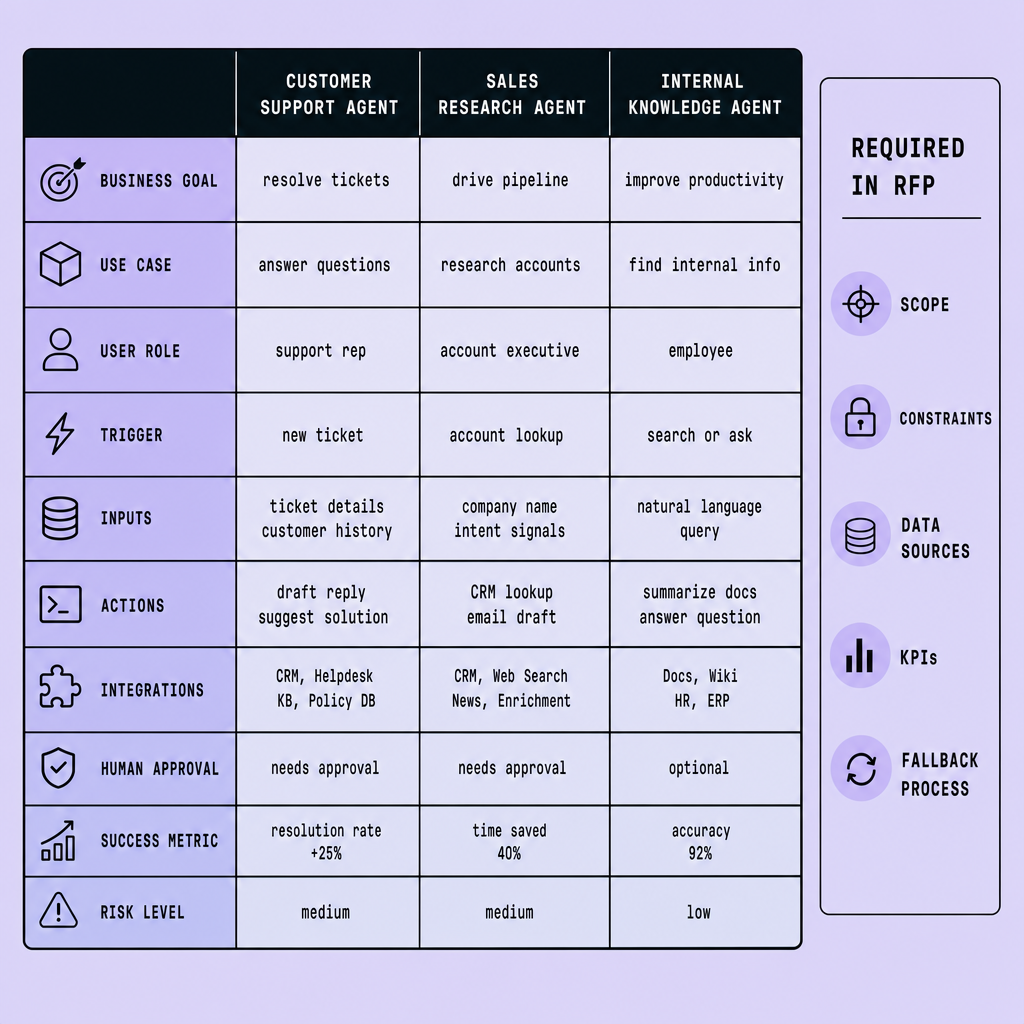
For each priority workflow, require vendors to respond against the same structure:
- target users and business owner
- trigger events
- required inputs and source systems
- expected outputs and action scope
- human approval checkpoint
- exception paths and failure handling
- SLA or response expectations
- KPI and success thresholds
A simple example: an invoice processing agent might trigger when a document lands in an AP queue, extract fields, validate against ERP policy data, and route mismatches to a human approval checkpoint. If confidence drops, data is missing, or a policy rule fails, the workflow should escalate -- not guess.
Define success metrics that matter in production
This is where many RFPs go soft. Use measurable KPIs tied to workflow outcomes: task completion rate, cycle time, human escalation rate, accuracy, and cost per workflow. For customer support, track resolved Tier 1 tickets and escalation rate. For sales ops, measure CRM update completeness and turnaround time. For finance, track invoice processing accuracy and review time.
Monitoring is as important as deployment -- so ask vendors how these KPIs will be captured, audited, and surfaced once the agent is live.
This section of your AI RFP template should read like an operating spec. Clear business requirements create better proposals, tighter AI implementation timeline planning, and fewer surprises later.
Agent Capabilities, Integrations, Security, and Data Requirements
This is where many teams get too vague. Your agentic AI RFP should force vendors to explain how the agent operates in production -- not just what the demo can do.
Agent capabilities buyers should require
Start by separating planning, reasoning, and execution. They are not the same thing. An agent may generate strong answers but still fail at multi-step workflow control, tool selection, or exception handling.
Require specifics on:
- how the agent plans tasks and decides next steps
- what tools it can call, under what permissions, and with what approval gates
- memory scope -- session memory, long-term memory, and whether a vector database is used
- orchestration across multiple agents, APIs, queues, or human review steps
- human handoff rules, escalation triggers, and rollback behavior
- guardrails for sensitive actions such as CRM updates, ERP transactions, or outbound customer messages
Memory, permissions, and tool access must be specified separately. Each creates a different risk surface. A vendor that says “the agent remembers context” has not answered whether that memory persists, who can access it, or whether it can trigger actions from stored data.
Do not accept “enterprise-grade security” as a generic claim. Ask how action approvals, permissions, logging, and data boundaries work inside live workflows.
Integration and infrastructure requirements
Capability claims are easy. Integration details are where the real shape of the project shows up.
Your AI project requirements should ask for named integrations, not broad categories. Request current support and implementation approach for CRM, ERP, ticketing system, document repositories, IAM, SSO, and SIEM connections. If the solution depends on custom connectors, require the vendor to state that clearly.
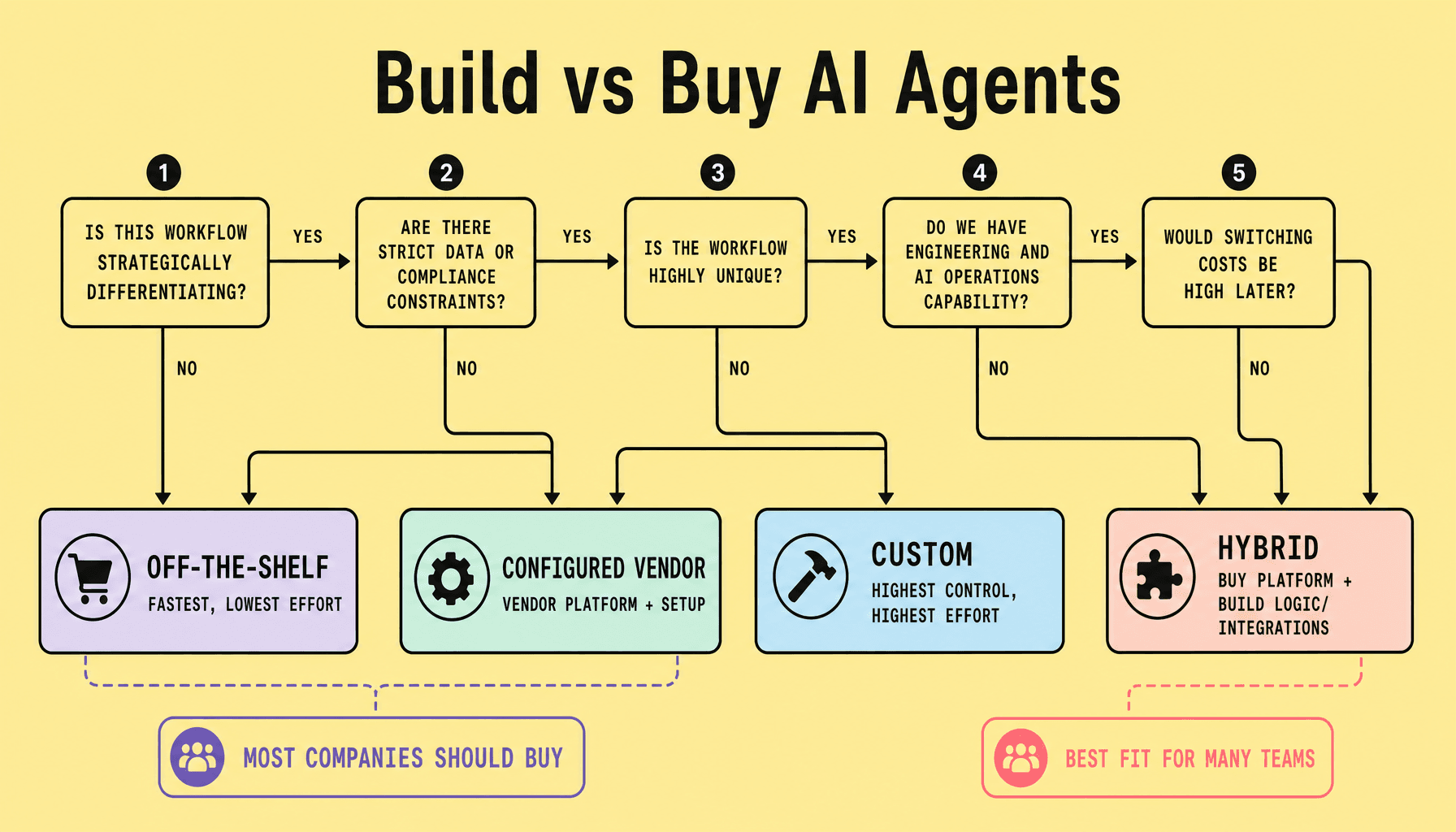
And ask where the agent runs: vendor SaaS, VPC, private cloud, Kubernetes, or hybrid deployment. Consistency in environments is critical -- especially if evaluation, staging, and production behave differently.
Security, data, and auditability requirements
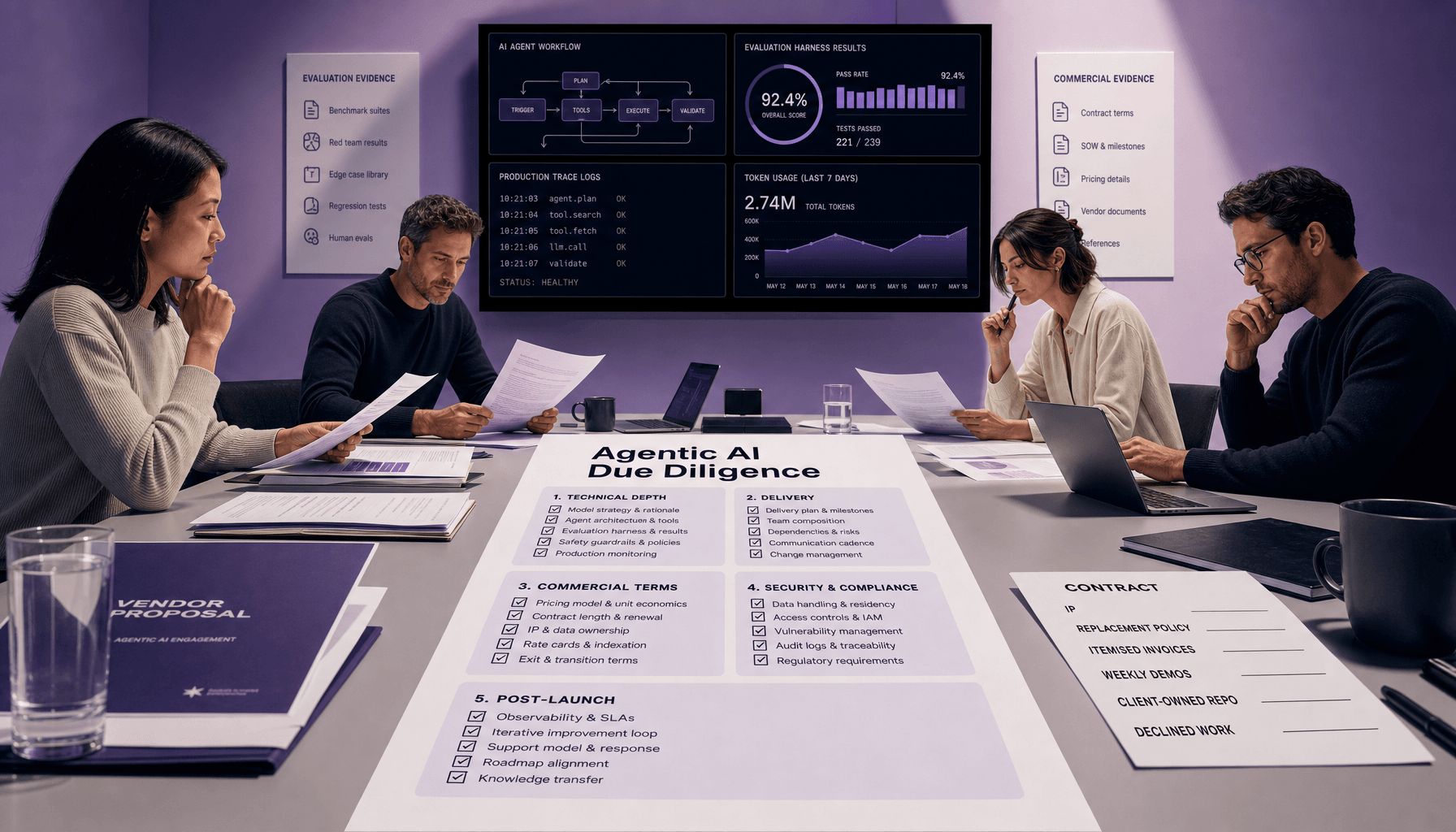
By this point, the pattern should be clear: vague security language is not enough. For AI vendor selection, require vendors to document RBAC, encryption in transit and at rest, audit logs, data retention, deletion workflows, and data residency options. Ask whether they support SSO and whether they can map permissions from your IAM system.
Request evidence of compliance posture such as SOC 2 or ISO 27001 if those matter to your environment. Also require answers on training-data use, tenant isolation, document-level access controls, and whether vendor staff can access prompts, outputs, or stored memory. In a strong AI RFP template, security should not be optional.
Evaluation, Observability, Infrastructure, and AI Implementation Timeline
A polished pilot can hide a lot. Your AI RFP template should require vendors to prove production readiness, not just demo quality. For agentic AI projects, that means measurable evaluation, clear observability, and a realistic AI implementation timeline.
Evaluation Requirements
Ask vendors to define how they will test the system against your AI project requirements. Require evaluation datasets that reflect real workflows, such as support tickets, invoice exceptions, CRM updates, or help desk actions. Then require benchmark tasks, pass/fail thresholds, human review rates, and escalation criteria.
A practical agentic AI RFP should ask:
- What task completion rate, accuracy, and human handoff rate must be met?
- Which actions require human approval before production use?
- How will failure cases, edge cases, and unsafe actions be evaluated?
- What is the cost per workflow at pilot and at scale?
Separate proof-of-concept success from production success. Early accuracy is not enough without operational controls and support processes.
Observability and Incident Handling
Once the agent is live, you need visibility or you are flying blind. Make observability a hard requirement. Require logs, tracing, dashboards, alerts, and an action-level audit trail so teams can see prompts, tool calls, approvals, latency, retries, failures, and human overrides.
Also ask how incidents are handled: severity definitions, ownership, escalation paths, and rollback procedures. If a vendor cannot explain how bad agent actions will be detected, investigated, and reversed, they are not ready for production.
Infrastructure and Timeline
After evaluation and observability, pin down the delivery model. For AI vendor selection, require the deployment model up front: cloud, private VPC, hybrid, or on-prem. Ask about Docker, Kubernetes, CI/CD pipelines, vector database support, latency targets, uptime SLAs, data residency, and scaling expectations.
Then require a phased AI implementation timeline covering pilot, integration, security review, testing, and production rollout. Keep sandbox validation separate from full launch so vendors cannot blur early experiments with production readiness.
Pricing, Vendor Questions, Scoring Criteria, and Common RFP Mistakes
Don’t let vendors hide behind a polished demo. Your AI RFP template should make price, fit, and delivery risk easy to compare.
Pricing and total cost
Ask for pricing in the units that drive TCO: seats, usage, workflows, API calls, storage, implementation fees, and support tiers. Require vendors to separate one-time setup from recurring cost. If the platform needs custom connectors for CRM, ERP, IAM, SIEM, or a vector database, include that in the commercial response.
Also ask what changes pricing, such as higher autonomy, extra environments, private deployment, stricter latency targets, or 24/7 support.
Vendor questions and weighted scoring
If you want cleaner comparisons, ask sharper questions. For AI vendor selection, ask direct questions:
- What integrations are native versus custom?
- How are approvals, human handoffs, and action limits enforced?
- What observability is included for prompts, tool calls, failures, and escalations?
- What timeline, staffing, and support model are assumed?
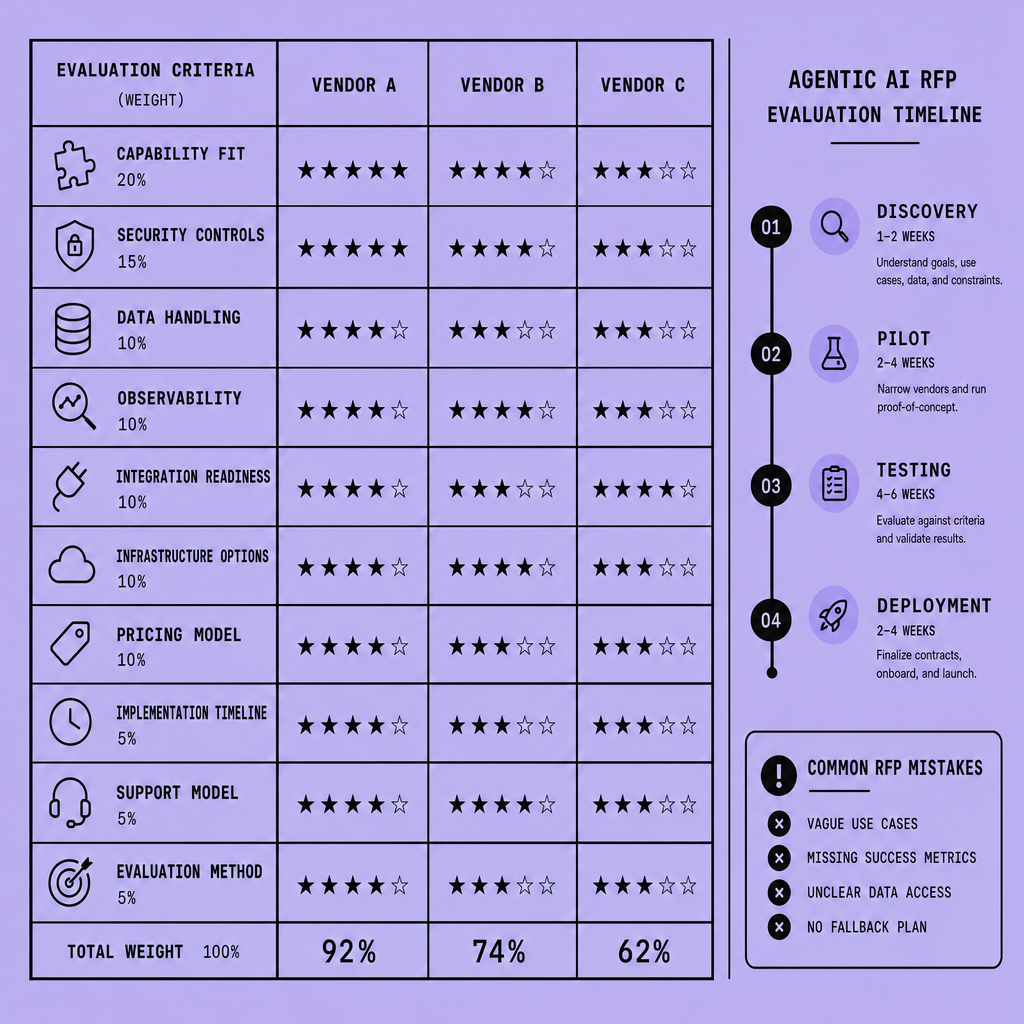
Use a visible weighted scorecard in the RFP. Common criteria include capability, security, integration fit, observability, timeline, and total cost.
Common RFP mistakes
Most RFP mistakes are self-inflicted. Common mistakes include vague requirements, missing success metrics, no approval model, and no production-readiness criteria. Teams also fail to assign ownership for security, integration, or post-launch support.
The biggest mistake is comparing vendors without a common response structure. If answers are not standardized, selection becomes subjective and hard to defend.
FAQs
What should an agentic AI RFP ask about pricing?
Ask for seats, usage, workflows, API calls, implementation fees, support tiers, and custom integration costs.
How do buyers improve AI vendor selection?
Use a weighted scorecard with visible criteria in the RFP.
What belongs in AI project requirements?
Use cases, approvals, failure handling, integrations, KPIs, data controls, and production constraints.
Frequently Asked Questions
What is the difference between an AI RFP template and a standard software RFP?
An AI RFP template should capture decision boundaries, human approvals, data access, monitoring, and workflow-level success criteria that standard software RFPs often miss. Agentic systems do not just provide features; they take actions, call tools, and create operational risk that must be specified before procurement.
How detailed should an AI RFP template be for agentic AI projects?
An AI RFP template for agentic AI projects should be detailed enough that two vendors respond to the same workflow, constraints, and metrics in the same format. The goal is not length for its own sake; it is removing ambiguity so pricing, delivery risk, and capability fit are actually comparable.
Why should AI vendor selection include a live workflow test and not just a demo?
AI vendor selection should include a live workflow test because demos usually show best-case behavior in controlled conditions. A realistic test reveals how the agent handles poor inputs, missing permissions, approval steps, system failures, and audit requirements, which are the factors that determine production readiness.
What security questions matter most in an agentic AI RFP?
The most important security questions in an agentic AI RFP concern who can authorize actions, how permissions are enforced, where data is stored, how logs are retained, and how incidents are investigated. These answers determine whether the platform can operate safely inside real business systems.
How can teams avoid overbuying in an AI RFP template process?
Teams avoid overbuying by separating must-have workflows from future possibilities and scoring vendors against present operational needs first. This keeps the RFP focused on measurable business value, prevents paying for unused autonomy or infrastructure, and reduces the chance of selecting a platform that is impressive but oversized.
Make Imversion a preferred source on Google
Like this kind of AI and software analysis? Add Imversion as a preferred source so Google can highlight our articles for you in Search, AI Overviews, and AI Mode.