AI Ticket Deflection: Achieve 60% Success with Customer Service
Unlock the potential of AI ticket deflection with actionable insights on ticket mix analysis, retrieval strategies, and tool optimization.

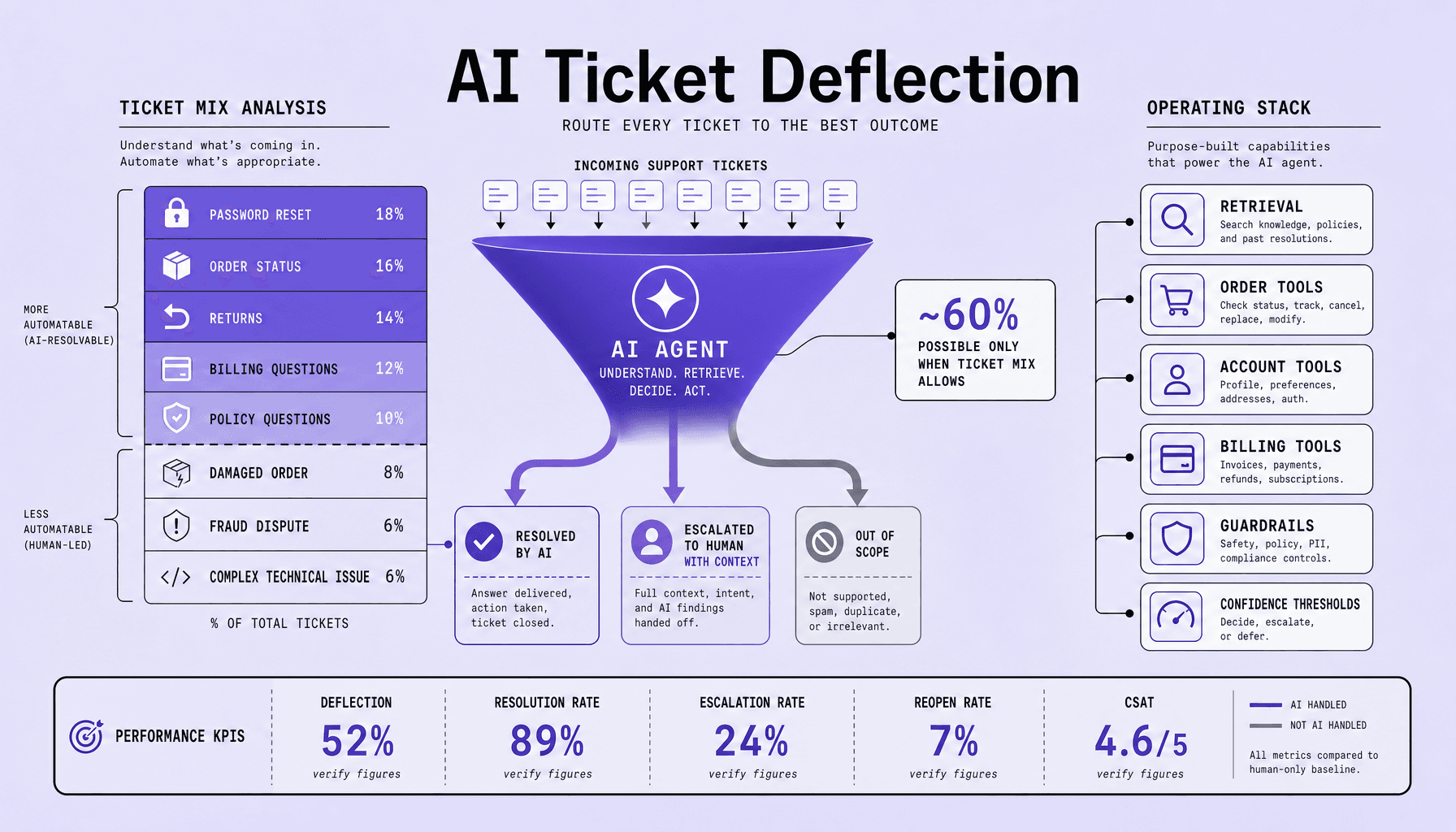
AI ticket deflection can reach ~60%—but only when the queue allows it
A lot of teams hear “60% ticket deflection” and assume the model is the deciding factor. Usually, it is not. The real question is simpler and less exciting: what is actually sitting in the queue?12
A customer service AI agent can reach roughly 60% deflection in the right environment. That means a large share of tier-one contacts is repetitive, policy-bounded, and solvable through retrieval plus limited system actions. If the queue does not look like that, the ceiling falls quickly.
The constraint is usually ticket mix, not model quality. Teams should review 60–90 days of contact data and group tickets by intent, escalation rate, policy risk, and required system access. This step comes first because decisions should be backed by data. If most volume looks like order status, password reset, invoice copy, subscription change, or simple how-to requests, support ticket deflection can be strong.13 If the queue leans toward disputes, fraud, exceptions, or high-emotion complaints, tier-one ticket deflection will be lower.
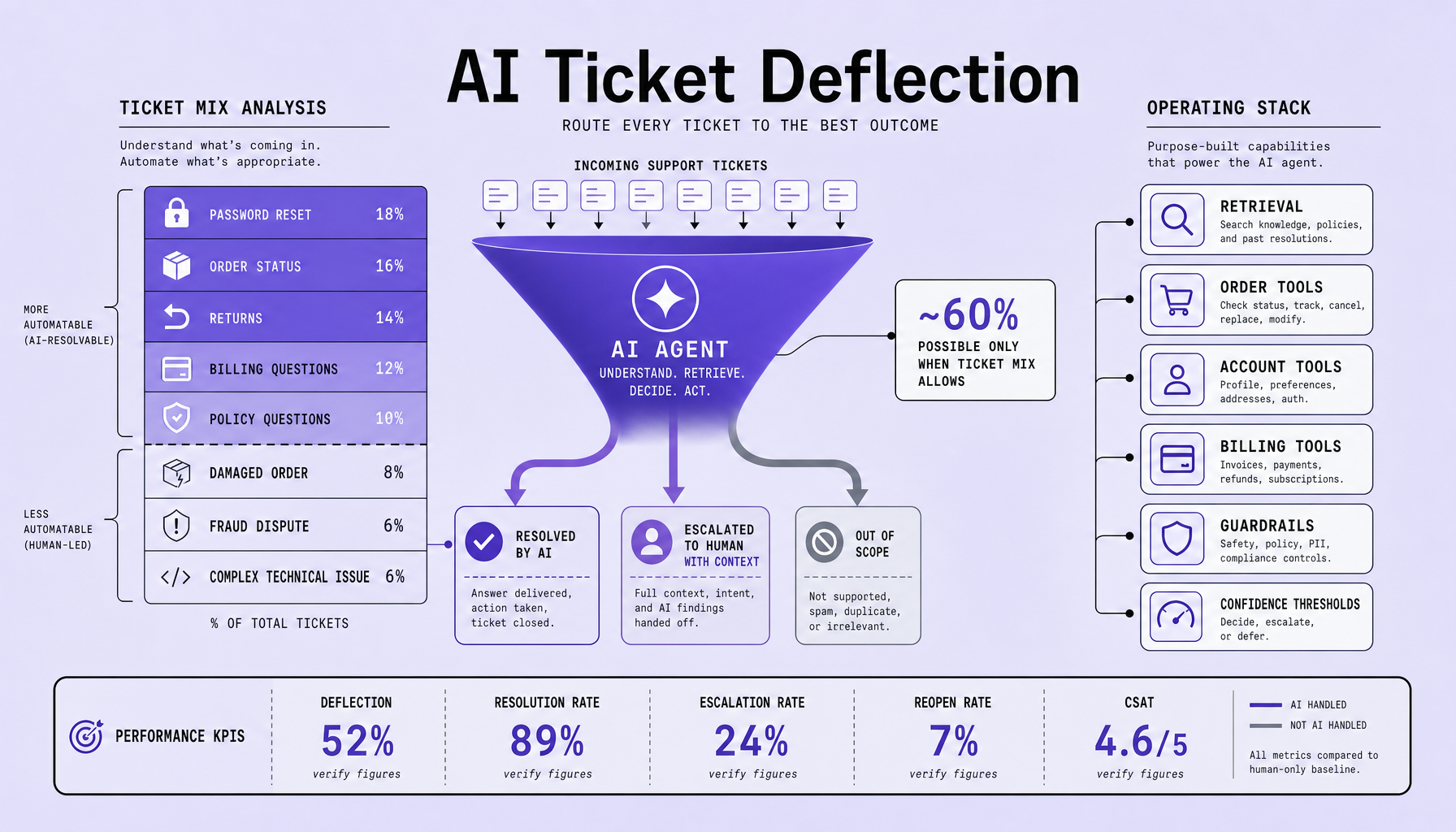
A customer service AI agent performs best when it can retrieve from approved help content, macros, policy docs, and past high-quality resolutions -- then take narrow actions in order, account, or billing systems with guardrails.34 Some published claims cite around 60% reduction in support volume, but those figures should be treated as directional until verified against primary-source data for the specific queue.52
Key Takeaways for AI ticket deflection
-
Hitting roughly 60% AI ticket deflection is usually a queue-design problem before it is a model problem. Teams need 60–90 days of ticket data to measure which tier-one intents are repetitive, policy-bounded, and safe to automate; that ticket mix sets the ceiling.12
-
Strong AI customer support systems do not rely on chat alone. They combine retrieval over approved help content, macros, policy docs, and past successful resolutions with limited tool access for order status, account actions, and billing workflows.13
-
Confidence-based escalation is non-negotiable. A good customer service AI agent should hand off low-confidence, high-risk, or exception cases with full conversation context, so support ticket deflection does not come at the cost of poor resolution quality or frustrated customers.24
-
Measure more than deflection. Support leaders should track support ticket deflection, true resolution, reopen rate, escalation rate, and CSAT together -- because decisions should be backed by data, not headline percentages alone.51
-
A practical rollout often fits an ~8-week path: analyze ticket mix, prepare knowledge, wire tools, set guardrails, pilot, then tune. But any benchmark ROI or deflection claim should be validated against the team’s own baseline before rollout.12
Ticket-mix analysis sets the ceiling for AI ticket deflection
Most AI support discussions start in the wrong place. They start with the model, or the vendor demo, or the benchmark slide. The queue decides more than any of those.
A support team can only reach strong AI ticket deflection if a large share of its inbound work is repetitive, low-risk, and solvable with approved knowledge plus narrow system actions. That is why the first step should be a 60–90 day historical review of tickets across chat, email, and web forms, classified with a clear intent taxonomy.13 At Imversion Technologies Pvt Ltd, this kind of analysis would be treated as the baseline -- because decisions should be backed by data, not benchmark slides.
For each intent, tag five things: channel, average handle time, escalation rate, policy sensitivity, and required systems access. Then split the queue into three buckets:
- good candidates for support ticket deflection
- candidates that need AI triage but human resolution
- poor candidates for automation
The highest-ceiling queues usually have heavy tier-one support volume in intents like order status, password resets, subscription changes, invoice requests, returns status, and basic how-to questions. If roughly 55–70% of inbound tier-one work falls into those repetitive, tool-solvable categories, then ~60% tier-one ticket deflection is plausible.12 If the mix leans toward disputes, fraud, damaged orders, shipping exceptions, policy edge cases, or emotionally charged complaints, the ceiling drops fast.
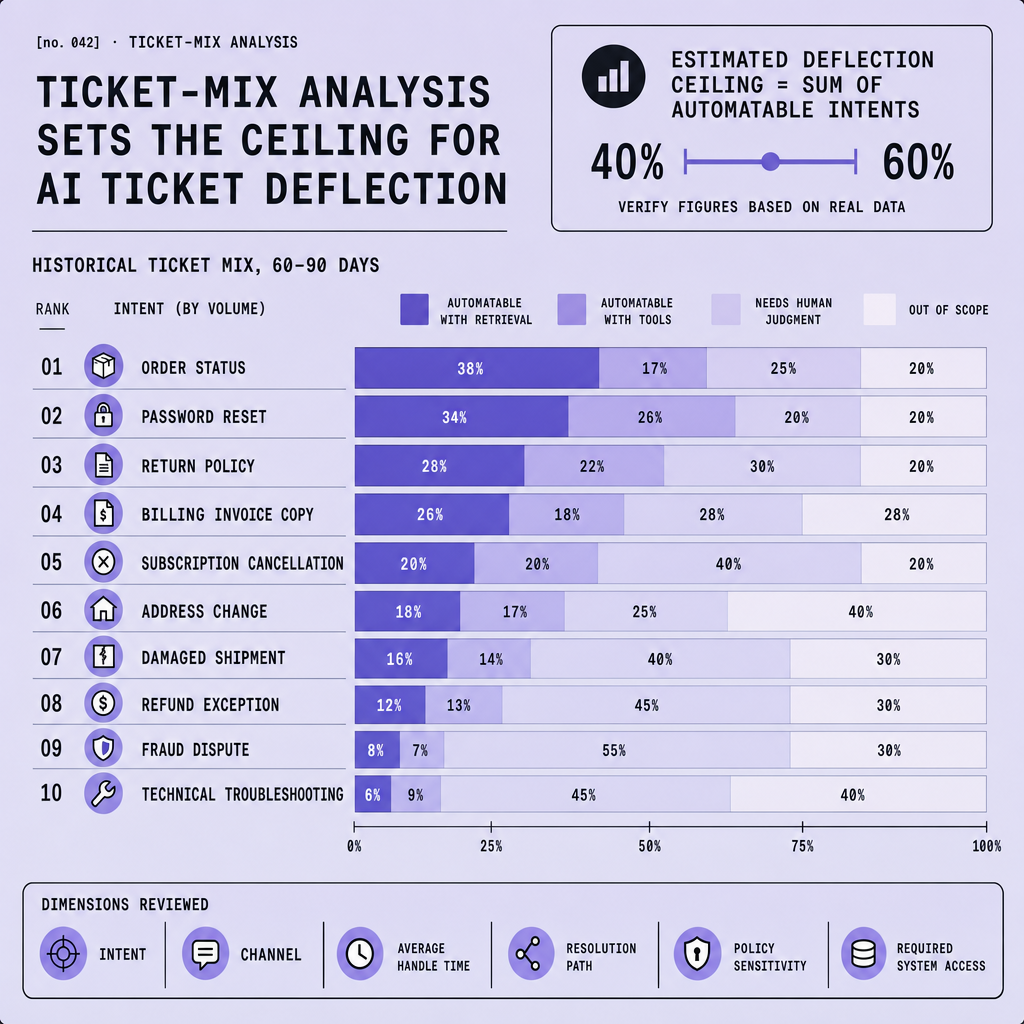
Because queue composition is the constraint.
Teams often make the same mistake: they start with headline vendor benchmarks and assume better prompts will close the gap. They will not. A weak queue mix cannot be fixed with prompt tuning alone. And a customer service AI agent should never be judged on deflection potential without checking what percentage of contacts actually require judgment, exception handling, or sensitive decisions.
Some intent-level benchmarks in secondary sources suggest simple flows like password resets may exceed 70% deflection, while nuanced complaint categories may stay below 25%.52 Useful directional guidance. But those figures need verification against primary-source data before anyone uses them in a board slide or ROI model.
Estimate the ceiling from your own tagged queue first. Then decide whether support ticket deflection is a real operating opportunity -- or just a reporting illusion.
Retrieval plus order, account, and billing tools is what makes AI ticket deflection and AI customer support useful
A polished answer is not the same as solved work. That is where many AI support setups stall.
Retrieval alone will not get a team to meaningful support ticket deflection. It answers questions. It does not complete work.
A customer service AI agent needs both layers: retrieval-augmented generation over approved knowledge, and tightly constrained tools that can act inside core systems. That is the operating stack that turns AI customer support from a search box into actual help desk automation.134
Retrieval handles answer quality
The retrieval layer should pull only from sources support leaders already trust: the help center, internal policy docs, approved macros, product FAQs, and past resolutions that were reviewed and actually solved the issue cleanly.136 This is where the agent learns how to explain a return window, what identity checks apply before an account change, or which billing policy governs a proration edge case.
Still, retrieval-only setups stall quickly. A user asks, “Where is my order?” The agent can describe shipping policy all day, but if it cannot check the order management system, it has not resolved anything. The same applies to “Send me my invoice,” “Pause my subscription,” or “Update the card on file.” Good answers are necessary. They are not sufficient.
Tools handle task completion
Once answer quality is in place, task completion becomes the real differentiator.
The action layer should stay narrow at first. Order lookup. Account verification status. Subscription cancellation or pause. Invoice retrieval. Billing status. Maybe refund eligibility flags -- not refund execution on day one. Teams often wire these actions into the CRM, order management system, and billing system through scoped APIs, with hard permissions, audit logs, and fallback rules.374
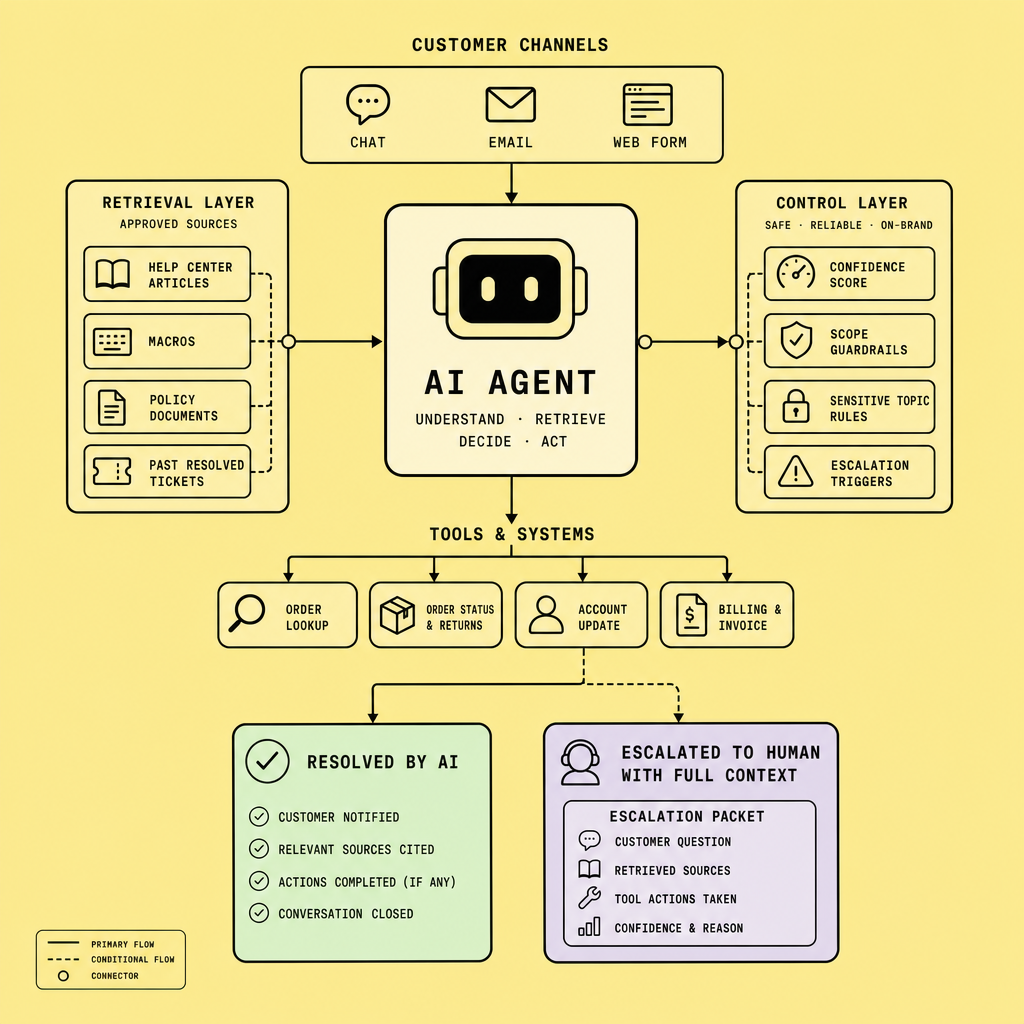
Reliable systems matter more than broad ambition, so the rollout should prioritize a small set of high-volume, low-risk actions before expanding. Every new tool adds permission design, error handling, QA overhead, and failure modes.
Retrieval improves answer relevance; tools determine whether the contact actually disappears from the queue.
This is why retrieval-only pilots often look convincing in demos and weak in production. The closer a queue gets to action-oriented intents, the more a customer service AI agent needs safe transactional capability, not just polished language.12
Confidence-based escalation and guardrails prevent false deflection
Bad deflection looks good in a dashboard for a short time. Then the reopen rate rises, handoffs get messy, and customers lose patience.
A customer service AI agent should not try to win every ticket. It should know when to stop.
That is the control layer most teams underestimate. They chase support ticket deflection, then let the bot answer beyond its evidence, policy authority, or tool access. The number looks better for a week. CSAT usually does not.14 A lower deflection rate with clean escalations is usually better than a higher rate created by forcing the bot past its authority or evidence.
Set escalation rules around uncertainty, not optimism
The temptation is to use one aggressive threshold across the whole queue. That usually creates avoidable failures.
In practice, the agent needs a confidence threshold per intent -- not one blanket threshold for the whole queue. “Where is my order?” can tolerate a lower threshold if the order-management tool returns a clear status. A refund exception cannot.
Escalate to a human handoff when any of these conditions are true:
- confidence falls below the intent threshold
- retrieved sources conflict, are stale, or do not directly support the answer
- the request touches policy-sensitive areas such as refunds, credits, disputes, identity changes, or compliance-bound account actions36
- customer sentiment turns volatile -- repeated dissatisfaction, threats to cancel, signs of distress, or angry repetition
- the required tool path fails, times out, or returns incomplete data
- the user asks for something outside approved scope guardrails
Because clarity is better than complexity, the rule should be simple: if the agent cannot explain why its answer is valid, or cannot complete the action safely, it escalates.
Design the handoff so humans do not start over
Escalation is not just a routing event. If it is designed badly, the human agent ends up repeating the same work and the customer feels the delay immediately.
Bad escalation wastes everyone’s time. Good escalation preserves trust.
The handoff package should include a case summary, customer intent, extracted entities like order ID or invoice number, retrieved sources used, tool outputs, actions attempted, confidence score, and a full audit trail of messages and decisions. If the bot already authenticated the customer or checked an order status, the human agent should see that immediately inside the CRM or ticket view. No rework. No repeated questions.34
Escalation should transfer context, not just the conversation.
For AI customer support, this tradeoff is non-negotiable: aggressive containment lifts short-term support ticket deflection, but disciplined guardrails protect resolution quality and customer trust over time.12
Measure AI ticket deflection against resolution rate and CSAT—not deflection alone
A strong deflection number can still hide a weak support experience. If customers come back, switch channels, or need a human after a failed bot interaction, the system is not doing the job.
A single deflection number is not enough. Leaders should judge AI customer support on a balanced scorecard, because a deflected contact is not automatically a resolved customer problem.12
Track the right metrics separately
The first fix is measurement discipline. Separate the core measures instead of collapsing them into one headline.
Start by separating the core measures:
- Deflection rate: contacts kept from entering the human queue.
- Containment rate: conversations the customer service AI agent handled without human takeover.
- Resolution rate: issues actually solved -- whether by AI or after escalation.
- Escalation rate: sessions handed to a human because confidence, policy, or tool limits were hit.
- Reopen rate: contacts that appear solved, then come back.
- Average handle time: time spent by human agents on escalated cases.
- Contact rate: how often customers need support per order, account, or active user.
- CSAT: whether the customer felt the outcome was useful, clear, and fast.
These are related. They are not interchangeable.
A support ticket deflection program can show high containment while resolution rate falls. That happens when the bot answers confidently, fails on edge cases, and pushes customers into repeat contacts. Or worse -- into channel switching from chat to email to phone. Vanity containment hides that pattern.14
Measure by intent, channel, and cohort
This is where many dashboards fail. A top-line number smooths over the exact differences that operations teams need to see.
Reporting one top-line AI ticket deflection number to executives can make the system look stronger than it is. Strong order-status automation may carry the headline, while billing exceptions, cancellations, complaints, and damaged-order cases perform badly underneath. Understanding why is essential, because the fix is often intent design, not model tuning.
So instrument the system at three levels:
- Intent: order status, return status, password reset, invoice copy, refund exception, complaint
- Channel: chat, email, web widget, messaging
- Cohort: new customers, subscribers, high-value accounts, international users
If containment rises but reopen rate, repeat contact rate, or CSAT worsens, the agent is delaying humans -- not resolving work.
In practice, the cleanest operating view is intent-level: deflection rate, resolution rate, escalation rate, reopen rate, average handle time, and CSAT side by side. That shows where support ticket deflection creates real value and where the AI merely suppresses visible volume.326
An 8-week rollout and ROI math for help desk automation
Teams usually do not fail because the idea is wrong. They fail because they rush past the parts that determine whether the queue is even automatable.
A practical rollout should move fast enough to matter without skipping the work that determines realistic AI ticket deflection.
A production timeline that fits in about 8 weeks
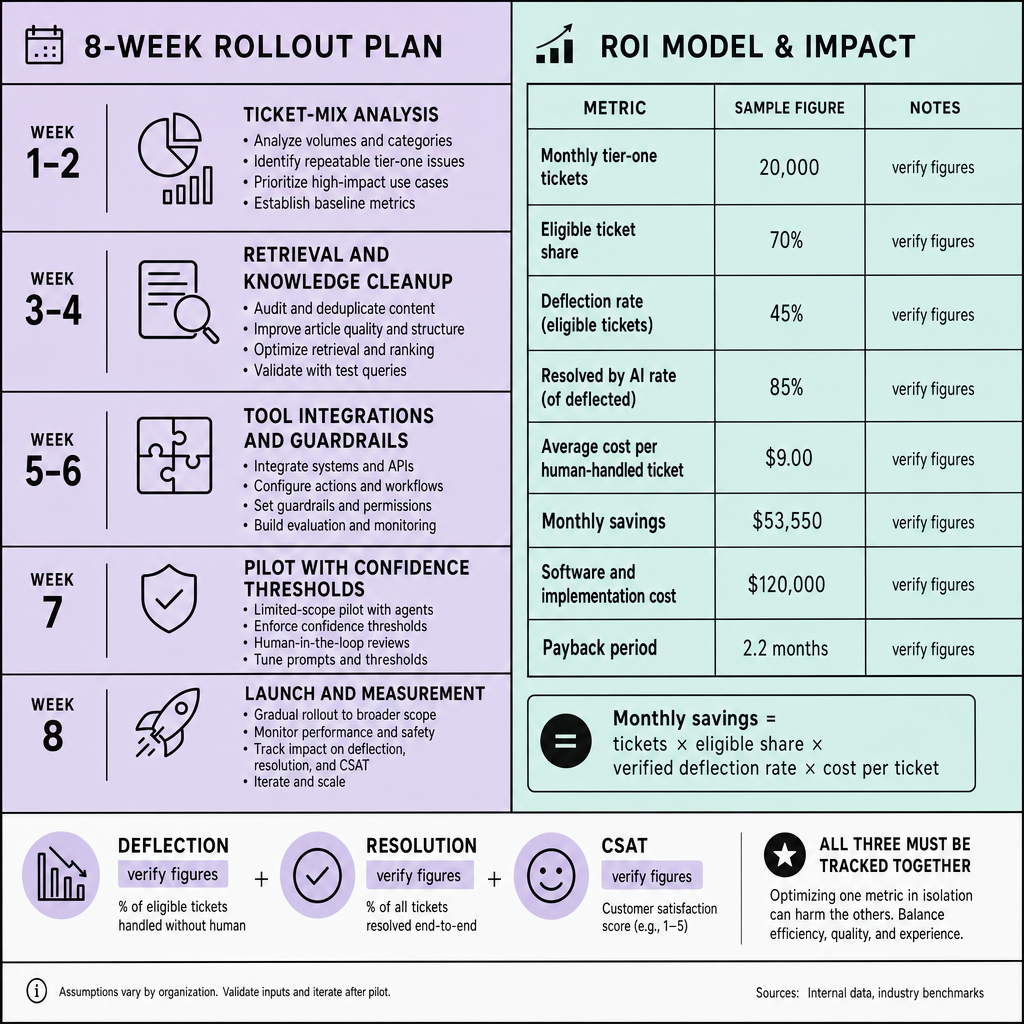
Weeks 1-2: Analyze 60-90 days of tickets, define the intent taxonomy, and score intents for volume, repeatability, policy risk, and tool dependency. This sets the ceiling. If the top intents are order status, password reset, invoice copy, subscription change, and simple return-policy questions, a customer service AI agent has room to work.12
Weeks 2-3: Curate approved knowledge. Go beyond help-center articles and include macros, policy docs, and past high-quality resolutions so retrieval reflects how the team actually solves tickets.34
Weeks 3-5: Integrate the systems that turn answers into outcomes: order lookup, account actions, billing status, refund eligibility checks, CRM notes, and authentication controls. Retrieval alone rarely creates meaningful support ticket deflection; tool access is what turns “here’s what to do” into “done.”13
Weeks 5-6: Add guardrails, confidence thresholds, and escalation paths with full-context handoff. Then run QA against failure modes such as partial orders, duplicate charges, identity mismatch, policy exceptions, and emotionally charged complaints.36
Weeks 6-7: Pilot on one or two high-volume intents first. A broad launch too early can distort ROI if tool reliability and escalation hygiene are still unproven.
Weeks 7-8: Review deflection, containment quality, resolution rate, reopen rate, CSAT, and human takeover reasons. Then decide whether to expand. Public guides and vendor materials often cite large support-volume reductions, but those figures are best treated as directional unless verified in your own queue.527
Simple ROI math
The ROI model should stay plain. If it needs too many assumptions to work, it is probably too optimistic.
Use a plain model:
Monthly savings = Monthly tier-one volume × eligibility rate × achieved deflection rate × cost per human-handled ticket
Then:
- Net monthly benefit = monthly savings - ongoing platform/ops cost
- Payback period = implementation cost / net monthly benefit
A simple structure:
If a team handles V tier-one tickets per month, only E share is eligible for help desk automation, and the bot deflects D of that eligible share, avoided human tickets = V × E × D. Multiply by average human cost per ticket. Then subtract software, maintenance, and QA overhead.
One caveat: cost-per-ticket benchmarks vary widely across sources and support models, so external savings assumptions need verification before finance signs off.51 Staffing impact is usually safer to model as slower hiring, better peak coverage, or agent redeployment to higher-complexity work rather than immediate headcount cuts.
References
- Customer Service AI Agent Statistics 2026: 120+ Data - Digital Applied
- AI support ticket deflection: The complete guide (2026) - eesel AI
- Build a Customer Service AI Agent in 6 Steps | Complete Guide
- AI Ticket Deflection: How to Reduce Your Team's Support Volume by 60%
- The Best AI Tools for Customer Service (2026) - Leland
- Resolve Support Tickets Faster with AI Agents - Fin AI
- AI Customer Support Agent Development | Resolves Tickets
- How AI Agents are Revolutionizing Customer Support and Service ...
Footnotes
-
AI support ticket deflection: The complete guide (2026) - eesel AI ↩ ↩2 ↩3 ↩4 ↩5 ↩6 ↩7 ↩8 ↩9 ↩10 ↩11 ↩12 ↩13 ↩14 ↩15 ↩16 ↩17 ↩18
-
AI Ticket Deflection: How to Reduce Your Team's Support Volume by 60% ↩ ↩2 ↩3 ↩4 ↩5 ↩6 ↩7 ↩8 ↩9 ↩10 ↩11 ↩12 ↩13
-
Build a Customer Service AI Agent in 6 Steps | Complete Guide ↩ ↩2 ↩3 ↩4 ↩5 ↩6 ↩7 ↩8 ↩9 ↩10 ↩11 ↩12 ↩13
-
Resolve Support Tickets Faster with AI Agents - Fin AI ↩ ↩2 ↩3 ↩4 ↩5 ↩6 ↩7 ↩8
-
Customer Service AI Agent Statistics 2026: 120+ Data - Digital Applied ↩ ↩2 ↩3 ↩4 ↩5
-
AI Customer Support Agent Development | Resolves Tickets ↩ ↩2 ↩3 ↩4
Frequently Asked Questions
What is the difference between AI ticket deflection and self-service usage?
AI ticket deflection means a customer issue is handled without entering the human support queue, while self-service usage only shows that a customer viewed or used a support resource. A help-center article can generate high traffic without reducing agent workload, so teams should measure whether contacts were actually avoided, not just whether content was consumed.
How does AI ticket deflection affect staffing plans?
AI ticket deflection usually changes staffing by absorbing repetitive demand and smoothing peaks, not by creating immediate one-for-one headcount reductions. The most reliable financial impact is often slower hiring, lower overtime, and more agent time for exceptions, retention, and high-value cases rather than instant labor cuts.[^3][^5]
Why should teams test AI ticket deflection by channel before a full launch?
Channel-by-channel testing matters because customer behavior, message length, and escalation expectations differ across chat, email, and web forms. An agent that performs well in chat may underperform in email if requests are longer, more complex, or less structured, so phased testing reduces rollout risk and improves intent-specific tuning.[^4][^8]
What data quality problems usually hurt an AI customer-service agent most?
The biggest failures usually come from stale policy content, conflicting macros, weak tagging of past tickets, missing tool permissions, and unresolved identity rules. An agent does not need perfect data to be useful, but it does need one approved source of truth for each policy and action path to avoid confident but incorrect answers.
How should leaders validate AI ticket deflection claims from vendors?
Leaders should ask vendors to break results down by intent, channel, escalation logic, and measurement method instead of accepting a single headline figure. Any claim near 60% should be treated as directional until the team verifies ticket eligibility, containment quality, reopen rate, and CSAT against its own baseline data.[^2][^5]
Make Imversion a preferred source on Google
Like this kind of AI and software analysis? Add Imversion as a preferred source so Google can highlight our articles for you in Search, AI Overviews, and AI Mode.