AI Vendor Selection: Spot Red Flags in Proposals Like a Pro
Discover how to identify red flags in AI vendor proposals. Ensure your AI vendor selection process is foolproof and aligned with your business goals.

AI Vendor Selection: How to Spot Red Flags in Vendor Proposals Fast
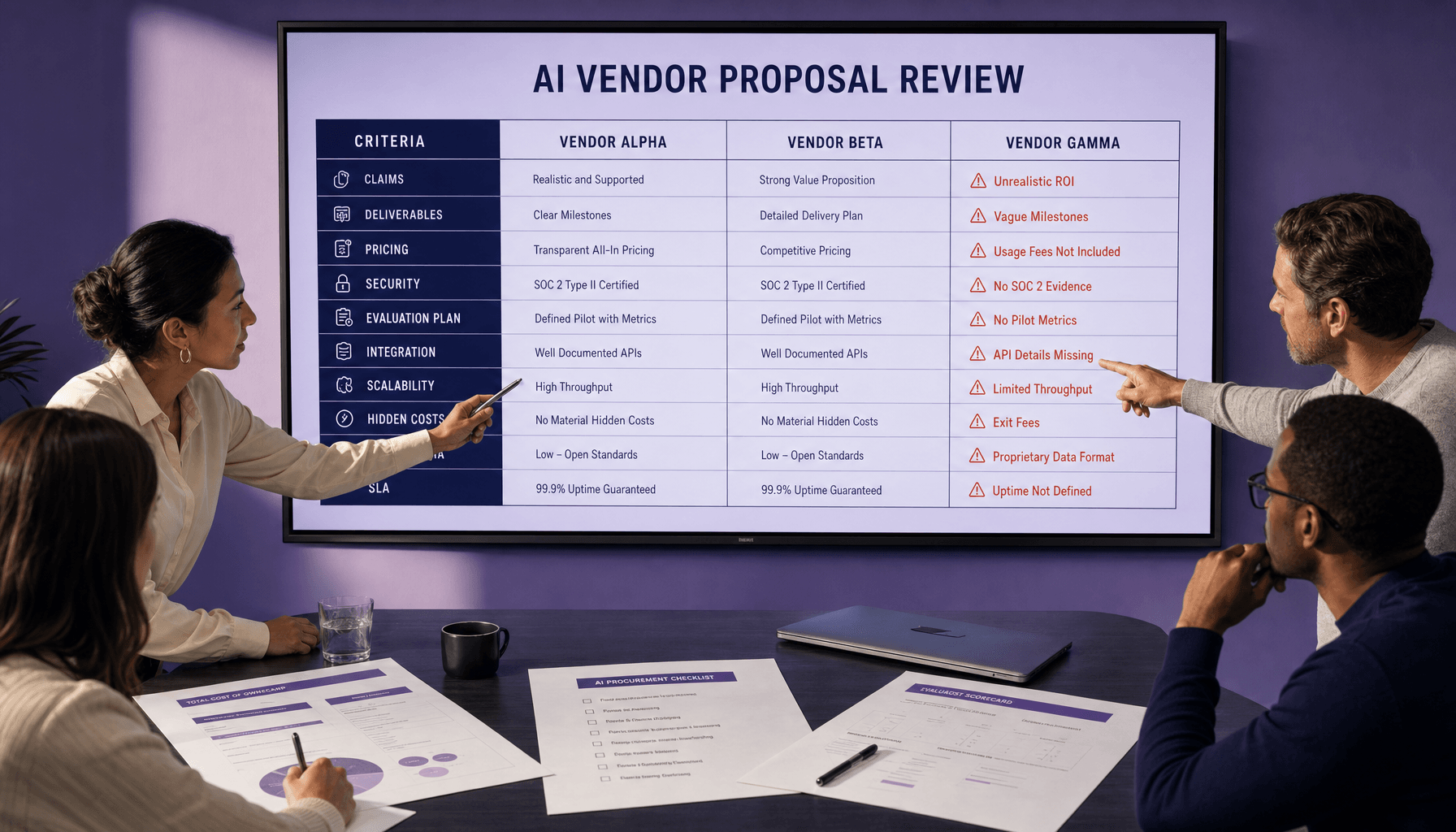
Most AI buying mistakes happen before implementation starts. In AI vendor evaluation, the proposal usually gives the game away: inflated outcome claims, vague deliverables, unclear pricing, weak SLAs, and no credible plan for testing or integration.
Screen proposals for realism, specificity, security, pricing transparency, integration fit, scalability, and accountability. Red flags include “near-perfect accuracy,” undefined milestones, missing acceptance criteria, and fuzzy implementation timelines.
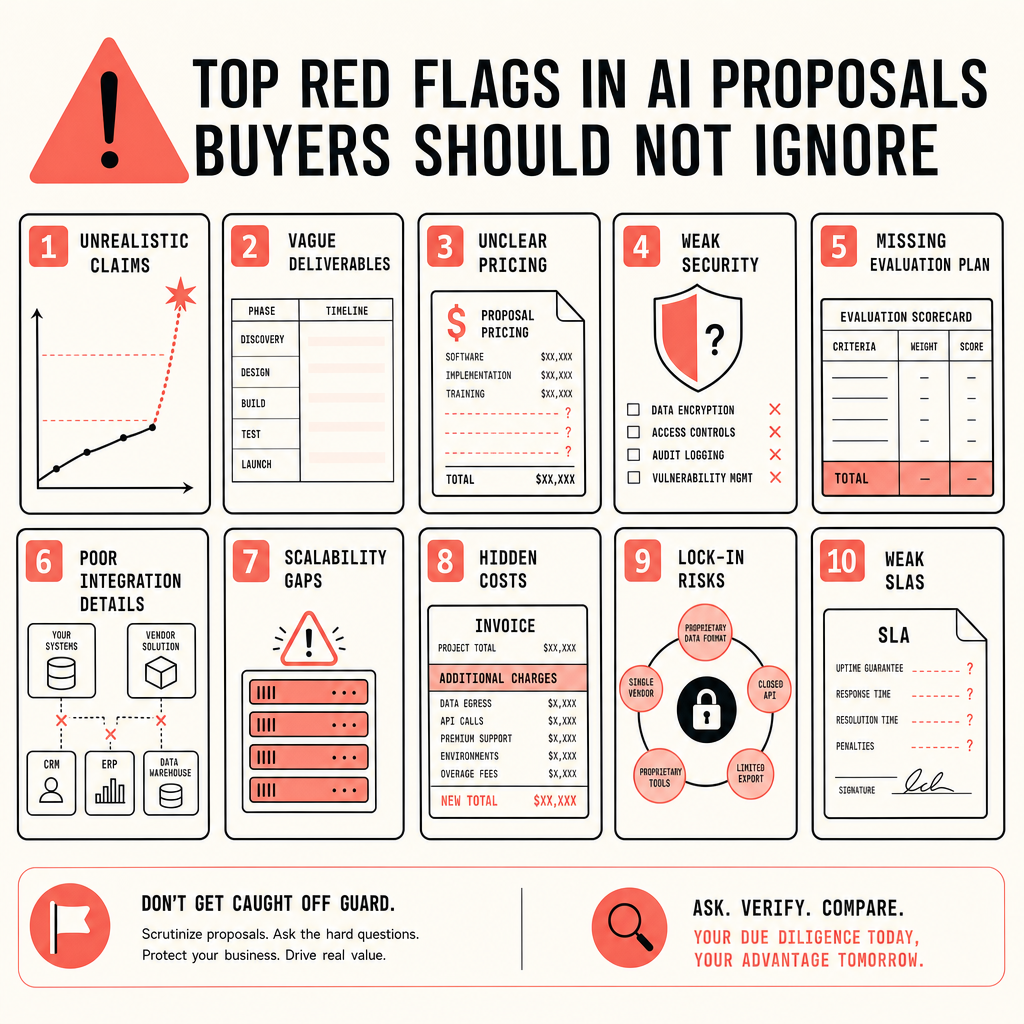
For enterprise AI, security cannot be assumed. Ask for SOC 2 or ISO 27001 status, data residency terms, SSO/SAML support, and incident response details.
Push on commercial terms too. Separate one-time setup fees from recurring charges such as cloud usage, retraining, support, user licensing, and change requests. Confirm how APIs integrate with your stack, what happens at higher volume, how model quality will be measured, and what exit path exists if you leave the platform.
Key Takeaways for AI Vendor Selection
Move past the demo quickly. Good AI vendor selection comes down to proposal quality, operational fit, and commercial clarity.
- Treat unrealistic claims and vague scope as early disqualifiers. If a proposal promises perfect accuracy, instant deployment, or “end-to-end automation” without assumptions, milestones, and acceptance criteria, your evaluation is already showing risk.
- Push on security and evaluation plans. Weak answers on SOC 2 or ISO 27001, data residency, SSO/SAML, human review, test datasets, and success metrics signal poor readiness.
- Demand clear pricing. Separate implementation, integration, model retraining, cloud usage, support, licensing, and change requests.
- Check operational depth. Ask for API documentation, integration architecture, uptime commitments, support SLAs, and scalability limits before you sign.
- Use AI vendor risk assessment to pressure-test lock-in. Ask what you can export—prompts, models, data, logs, and workflows—if the relationship ends.
Why AI Vendor Selection Matters More in Enterprise AI Projects
A polished AI demo can create false confidence fast. What matters is whether the vendor can survive contact with your systems, your controls, your users, and your procurement process. The proposal is where that becomes visible.
That is why AI vendor selection needs more scrutiny than a standard software purchase.
A normal software tool can still deliver value with light customization and a straightforward rollout. Enterprise AI rarely works that way. It depends on data quality, access controls, business rules, model evaluation, retraining paths, and integration with systems like your CRM, ERP, data warehouse, ticketing stack, or internal APIs. If those details are weak in AI proposals, the risk is already visible.
The cost of getting this wrong compounds fast.
Poor vendor fit leads to delayed deployment, unclear accountability, budget overruns, low user trust, and expensive rework. Teams often discover too late that the vendor has no clear plan for acceptance criteria, no answer on SSO or SAML, vague API documentation, weak SLA terms, or missing detail on data residency and support coverage. A proposal that cannot explain implementation usually cannot execute it.
So the review cannot stop at technical fit alone. In practice, AI vendor evaluation is an operational risk assessment.
You are assessing whether the vendor can operate reliably after launch -- not just build a promising pilot. That includes security reviews, handoff clarity, monitoring expectations, cloud cost exposure, retraining responsibilities, and lock-in risk if the model, prompts, or workflow logic cannot be exported. Security should not be optional, especially if the proposal is silent on SOC 2, ISO 27001, audit logs, role-based access, or how customer data is retained.
Strong proposal review helps you catch delivery risk before procurement turns it into contract risk.
A practical rule: if a vendor cannot define scope, pricing line items, integration dependencies, evaluation methods, and support terms in writing, pause the process. At Imversion Technologies Pvt Ltd, this is where disciplined AI consulting separates real delivery partners from persuasive sales teams.
Top Red Flags in AI Proposals Buyers Should Not Ignore
By the time the contract reaches legal, the biggest warning signs are often already sitting in the proposal. Focus on specificity, accountability, and operational fit.
Unrealistic claims and fuzzy scope
Treat promises like “100% accuracy,” “no process change,” or fully autonomous results on day one as warning signs. AI systems depend on data quality, exception handling, review workflows, and ongoing monitoring. A more credible proposal narrows scope, states assumptions, names dependencies, and defines success in practical terms.
Vague deliverables and no evaluation plan
If a proposal says “AI solution” or “intelligent automation platform” without naming outputs, pause the process. You need concrete deliverables such as API endpoints, dashboards, SSO or SAML setup, documentation, training, and acceptance criteria.
The same goes for evaluation. If there is no test method, pilot design, baseline comparison, or rollback plan, the vendor is asking you to commit before proving value. Early-stage discovery work can be appropriate, but the proposal should clearly separate paid discovery from production delivery.
Unclear pricing and hidden costs
Low entry pricing often excludes the expensive parts: integration, data preparation, cloud usage, support tiers, user licenses, change requests, or retraining.
| Proposal area | Red flag | Stronger signal |
|---|---|---|
| Pricing | Single lump sum | Itemized one-time and recurring costs |
| Delivery | Broad promises | Milestones with acceptance criteria |
| Operations | “Managed service” only | SLA, support model, escalation path |
Ask what triggers extra charges and which assumptions affect price.
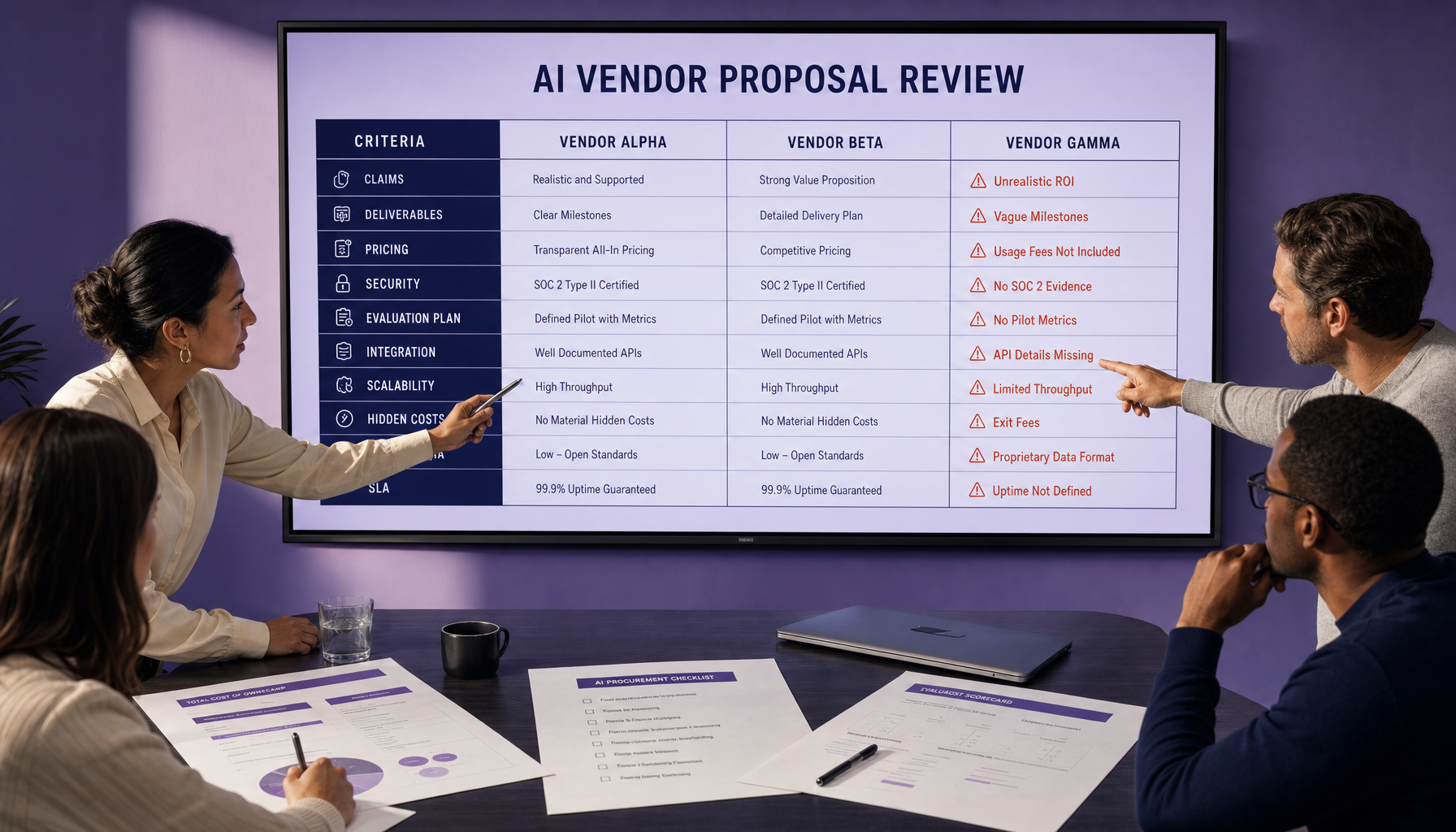
Weak security, integration, and ownership terms
If the proposal barely addresses security, treat that as a major concern. Look for clear treatment of access controls, audit logs, encryption, retention, identity flows, and data handling responsibilities. Integration detail should also be explicit: source systems, API expectations, and ownership boundaries.
Watch for lock-in risks too. Proprietary formats, no export path, limited handoff, and weak SLA terms make future switching harder and support less predictable.
Buyer questions to ask
- What are the acceptance criteria?
- Which integrations are in scope now?
- What is included in model retraining or support?
- How is data exported if we switch vendors?
- What pricing changes with usage, users, or model volume?
A practical recommendation: score proposals against these categories before comparing demos. That may slow selection slightly, but it usually reduces delivery and commercial risk later.
AI Vendor Selection Criteria That Expose Risk Before Contract Signing
If you run vendor review like a demo contest, you will reward polish over substance. A scorecard is usually the better tool.
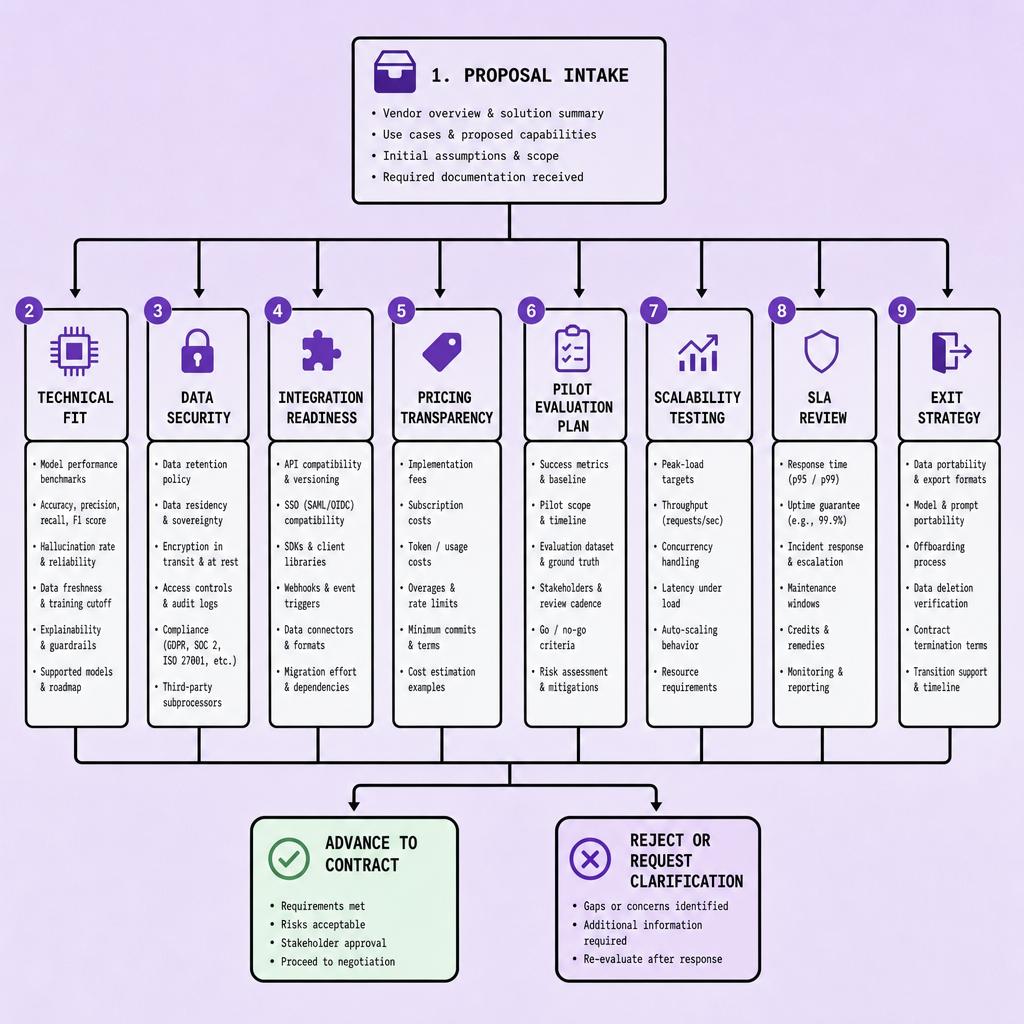
Use a simple weighted checklist in your RFP review and proof of concept process. Score each vendor on a 1-5 scale, and weight security, integration readiness, and long-term ownership higher than presentation quality because those are harder to fix after purchase.
What to score in every proposal
Assess each vendor against clear decision criteria:
- Technical fit: Does the proposal match your use case, data constraints, latency needs, and acceptance criteria? Reject vague claims like “high accuracy” without test conditions.
- Security and governance: Ask for security certifications or audit status, data residency details, access controls, SSO/SAML support, audit logs, retention rules, and incident response terms.
- Implementation scope: Require named deliverables, such as APIs, workflows, dashboards, documentation, training, and timeline assumptions.
- Commercial clarity: Separate one-time fees from recurring charges. Look for extra costs around cloud usage, support tiers, overages, custom integrations, and change requests.
- Evaluation plan: Require a proof of concept plan, test dataset assumptions, acceptance criteria, and business KPIs.
- Integration readiness: Ask for API documentation, webhook support, identity integration, data pipeline requirements, and environment dependencies.
- Operability and scale: Review uptime commitments, SLA terms, support response windows, rollback plans, and expected performance under growth.
Questions buyers should ask
Ask direct questions:
- What is excluded?
- What could delay the timeline?
- Who owns prompts, models, fine-tuning artifacts, and output data?
- How do you avoid lock-in?
- What happens if we switch clouds, stop retraining, or bring support in-house?
If a vendor cannot explain deployment, monitoring, and ownership in plain language, the risk is already visible.
This makes AI vendor selection more defensible. You are not buying a promise. You are buying a system that must integrate, perform, and remain supportable over time.
FAQs
How do you compare AI vendors fairly?
Use a weighted scorecard covering security, technical fit, pricing, integration, SLAs, and ownership, not just demo quality.
What should an AI vendor proposal include?
Clear deliverables, pricing line items, implementation scope, evaluation criteria, integration details, security terms, and support commitments.
What are common hidden costs in enterprise AI projects?
Cloud usage, custom connectors, support upgrades, data preparation, and change requests.
How do buyers reduce AI vendor lock-in risk?
Check contract terms for data ownership, export options, API access, model portability, and transition support.
Why is AI vendor evaluation critical before contract signing?
Because many delivery, security, and commercial risks show up in the proposal before production begins.
Questions Buyers Should Ask During AI Vendor Selection
The best buying questions are rarely flashy, but they expose risk fast. Buyers often get better signals from these answers than from polished demos or slideware. In AI vendor selection, the goal is simple: force specificity, expose risk, and see whether the vendor can support real enterprise AI deployment -- not just sell a concept.
Security, data handling, and compliance
Start here, because security should not be optional.
Ask:
- What certifications or controls do you have today -- such as SOC 2, ISO 27001, SSO/SAML support, audit logs, and role-based access?
- Where will our data be stored, processed, and backed up? Can you support data residency requirements?
- What are your data retention and deletion policies?
- Will our data train shared models, or is it isolated?
A strong answer is direct, documented, and tied to named controls. A weak one stays high level or says details come “after kickoff.”
Model performance and evaluation
Many risky AI proposals sound confident but avoid measurable validation.
Ask:
- What performance assumptions are built into the proposal?
- How will you evaluate accuracy, precision, drift, and human-review thresholds?
- What is the acceptance criteria for launch?
- How often is retraining expected, and who pays for it?
Good vendors define an evaluation plan before deployment. They should explain where the model can fail.
Integration, ownership, and lock-in
This is where weak AI vendor evaluation often misses hidden work.
Ask:
- What systems must we integrate with, and what dependencies sit on our team?
- Do you provide API documentation, runbooks, and implementation timelines?
- Who owns prompts, workflows, outputs, fine-tuned models, and IP ownership of custom work?
- If we leave, what export formats, termination assistance, and transition support are included?
Strong answers reduce lock-in risk. Weak answers make you dependent on proprietary tooling with no clean exit.
Support, SLAs, and total cost
Push past headline pricing.
Ask:
- What response and resolution times apply by severity?
- Are SLA credits included for missed uptime or support targets?
- What costs are one-time versus recurring -- integration, cloud usage fees, retraining, support tiers, change requests, user licenses?
- What assumptions could increase total cost in year one?
For AI vendor risk assessment, this is where hidden costs and weak SLAs usually surface.
Frequently Asked Questions
What should be weighted most heavily in AI vendor selection for regulated industries?
Security controls, auditability, data handling, and contractual accountability should carry the most weight in regulated environments. A strong vendor must prove how it manages access, logging, retention, incident response, and compliance obligations before technical features are treated as differentiators.
How does AI vendor selection change when the proposal includes AI consulting as well as software?
When AI consulting is bundled with software, buyers should separate advisory work from delivery obligations. The proposal should define what is strategy, what is implementation, what outputs are included, and which outcomes depend on customer participation so consulting scope does not mask execution risk.
Why should buyers ask for an exit plan during AI vendor evaluation?
An exit plan reveals whether the vendor supports long-term ownership or depends on lock-in. Buyers should confirm how data, prompts, configurations, workflows, and documentation are exported, what transition support is available, and whether switching costs are predictable before signing.
What is a reasonable pilot structure in enterprise AI proposals?
A reasonable pilot has a fixed scope, known dataset assumptions, baseline metrics, success thresholds, review checkpoints, and a clear decision at the end. It should test operational fit, not just model performance, so buyers can judge usability, support load, and integration effort realistically.
How can procurement teams verify pricing transparency in AI proposals?
Procurement teams should require a cost model that breaks out implementation, infrastructure, usage-based fees, support, retraining, overages, and change requests. Pricing is transparent only when the proposal states assumptions, billing triggers, contract minimums, and the conditions that increase spend over time.
Make Imversion a preferred source on Google
Like this kind of AI and software analysis? Add Imversion as a preferred source so Google can highlight our articles for you in Search, AI Overviews, and AI Mode.