Human Review Queue: Essential Oversight for AI Products
Discover the importance of a human review queue in AI products, addressing oversight gaps and improving quality assurance in AI workflows.

What a human review queue does in AI products
The failure usually does not happen when the model is obviously bad. It happens when the output looks good enough to slip through, then approves the wrong payment, sends the wrong reply, denies the wrong case, or publishes something no one actually reviewed. A human review queue exists to catch that moment.
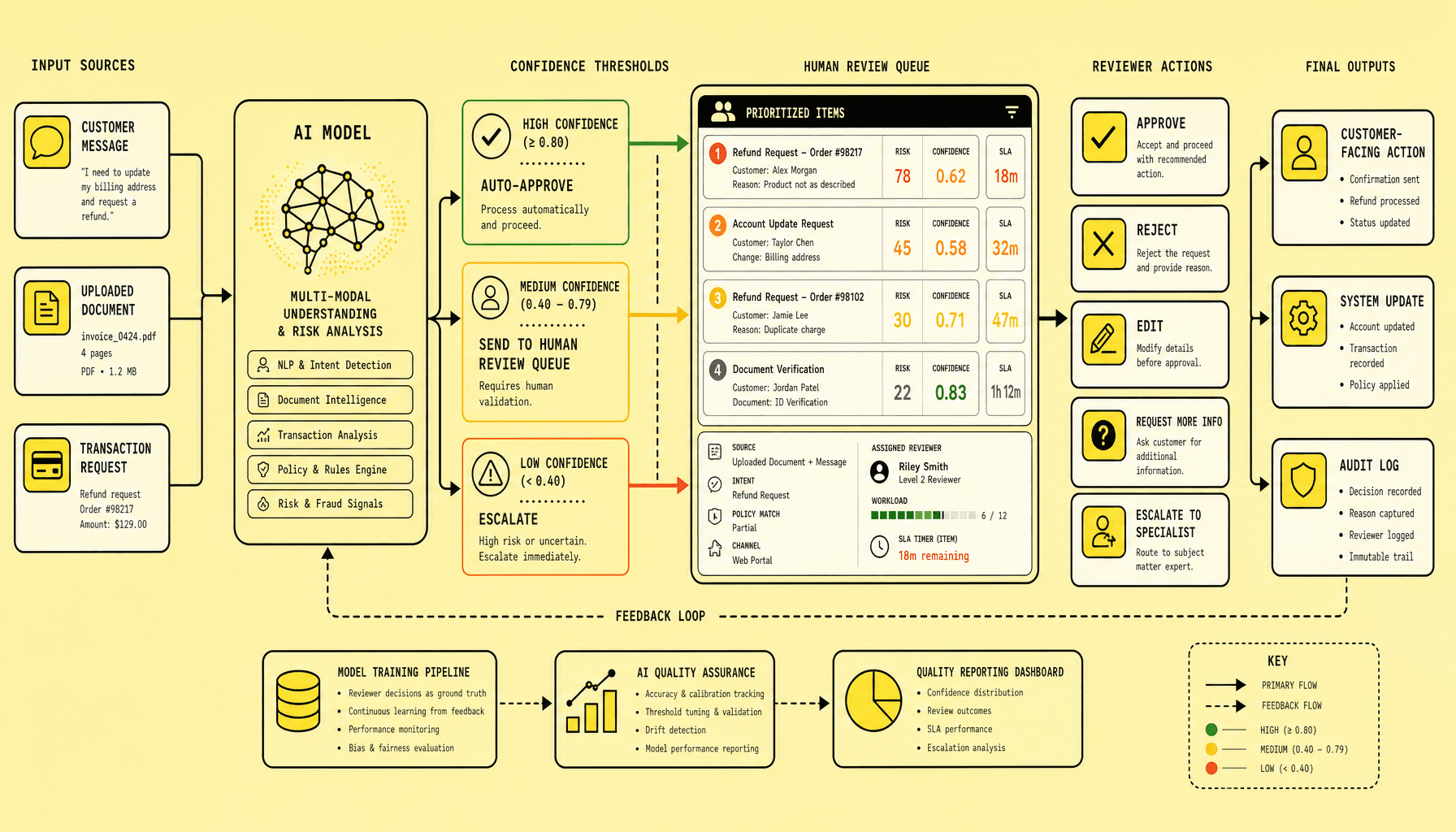
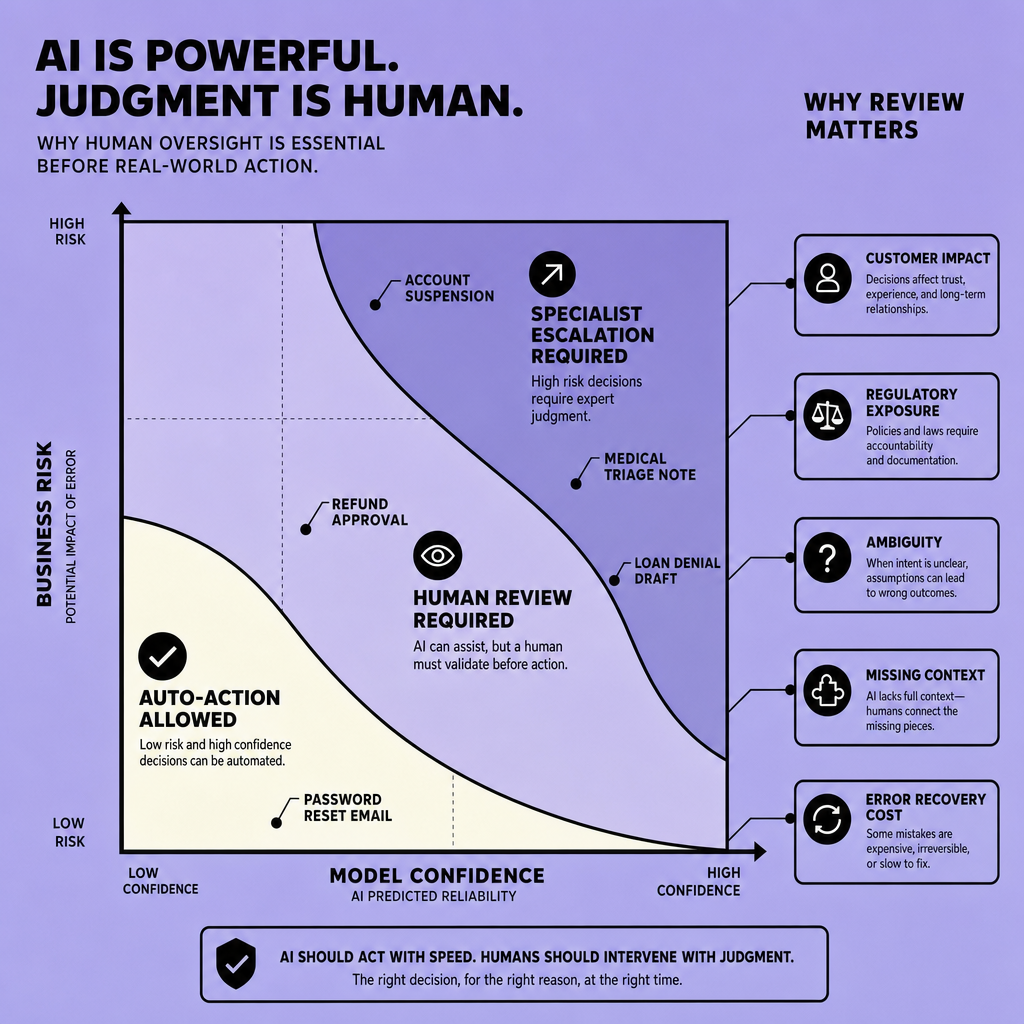
A human review queue is the control layer most AI products lack. It routes uncertain, risky, or high-impact outputs to people before anything is sent, approved, paid, denied, or published. That is how human-in-the-loop AI adds accountability without killing speed.
In practice, the queue sits between model output and action. It collects low-confidence results, policy exceptions, missing-data cases, and edge-case predictions, then gives reviewers clear options: approve, reject, correct, or escalate. Simple. Necessary.
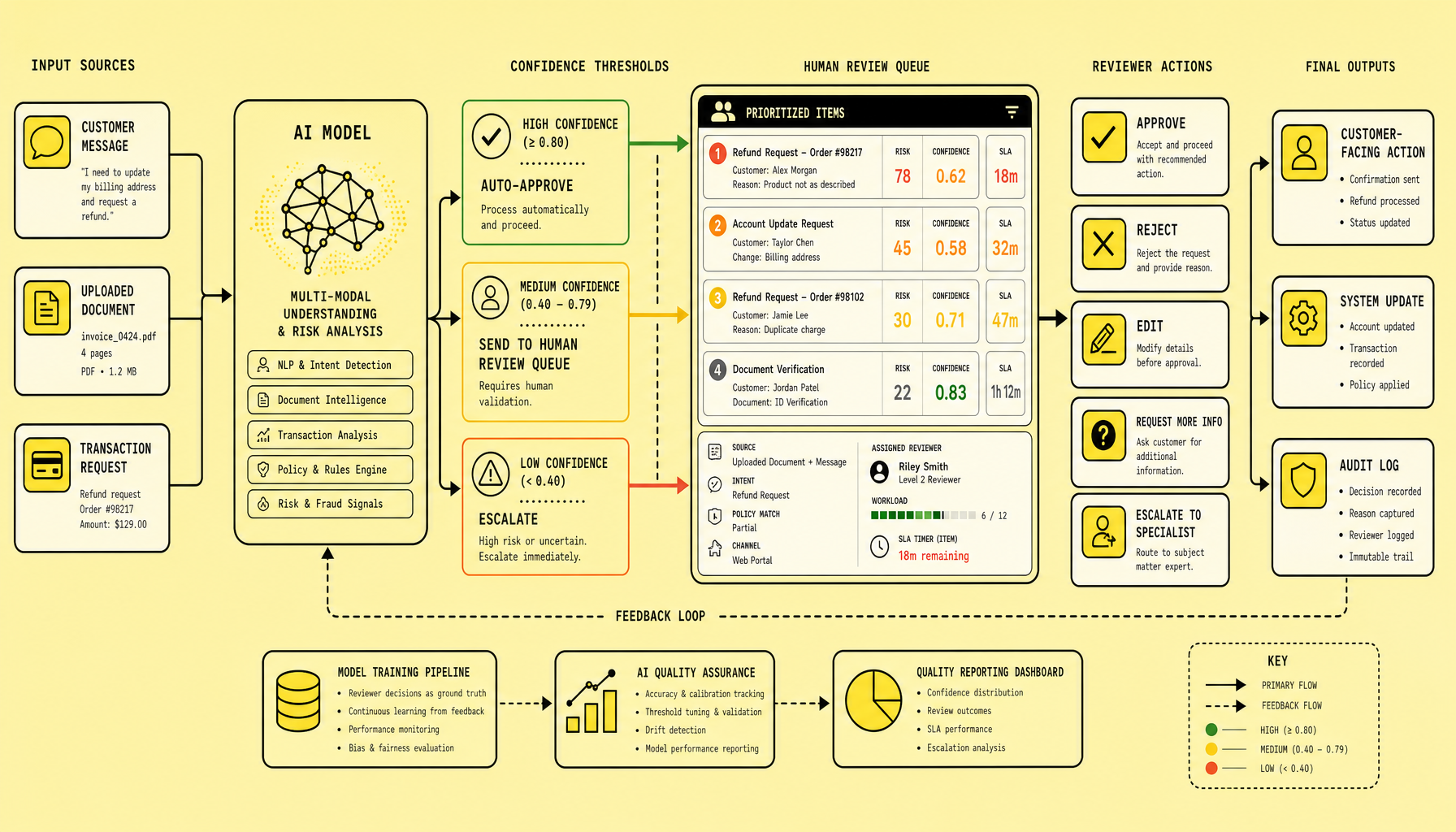
This is where AI quality assurance becomes operational, not theoretical. Teams often automate the prediction step and stop there, then discover too late that no one owns the ambiguous cases. A good human review queue fixes that inside AI workflow automation by defining queue states, routing rules, reviewer roles, and response targets.
One practical rule: do not send everything to humans. Route by AI confidence thresholds and risk. Clarity beats complexity, especially early. A support draft with weak confidence may need review; a regulated finance decision almost always does. At Imversion Technologies Pvt Ltd, that kind of control is what makes AI systems usable in production.
Key Takeaways
-
AI without oversight breaks at the exact moment risk appears. A human review queue gives low-confidence, ambiguous, or policy-sensitive outputs a safe stop before they reach customers, trigger payments, or enter regulated workflows.
-
Good human-in-the-loop AI design is operational, not cosmetic. The queue should include confidence thresholds, clear states like approve/reject/escalate, owner assignment, SLA targets, and audit logs with prompt, model output, reviewer action, and timestamp.
-
Teams often fail by routing either too much or too little to review. If everything gets queued, AI workflow automation loses speed. If almost nothing gets queued, AI quality assurance becomes fake control. Understanding why an item was flagged is what makes threshold tuning and escalation rules workable.
-
The practical balance is simple: automate routine, high-confidence cases; require review for exceptions, edge cases, and high-impact actions. Build accountability into the workflow from day one, not after the first visible failure.
Why AI needs human oversight before real-world action
Production failures are expensive partly because they rarely announce themselves. A model can look accurate in testing and still fail at the exact moment the business can least afford it. That is why a human review queue is not a nice-to-have in production. It is the control layer between prediction and consequence.
Average accuracy hides operational risk. The edge cases cluster around ambiguous inputs, incomplete records, policy exceptions, and unusual customer context. And those are often the cases tied to refunds, payouts, denials, compliance checks, or customer trust. In a support workflow, a polished reply can still violate refund policy. In invoice processing, a single extraction error can route money to the wrong vendor. In healthcare, a false negative can suppress needed review; a false positive can trigger unnecessary work and delay care.
That is the gap scorecards miss. Human-in-the-loop AI improves AI quality assurance because it catches failure modes that standard metrics do not fully capture: hallucinations, low-confidence classifications, bias, and context errors. Reliable systems matter most in customer-facing, financial, safety-sensitive, or regulated workflows.
A practical rule: automate the obvious, review the uncertain.
But uncertainty is not the whole story. That means using AI workflow automation to route outputs by risk, not just by model confidence. A confidence score helps, but it is not enough on its own. Some outputs should enter a human review queue even at high confidence if they touch regulated workflows, large dollar amounts, policy exceptions, or irreversible actions. Understanding why the model produced an answer is often what reveals the real risk.
There is a tradeoff, yes. Review adds cost and latency. But uncontrolled errors are usually more expensive than selective oversight. Chargebacks, compliance exposure, customer churn, manual rework, and damaged trust compound fast.
Strong model performance is not a release criterion by itself; safe routing is.
The upside is not just risk reduction. Human-in-the-loop AI creates feedback loops. Review decisions, rejection reasons, corrected labels, and escalation patterns give teams the raw material to improve prompts, policies, thresholds, and models over time. That is how AI quality assurance becomes operational, not theoretical.
How to design a human review queue that scales
The fastest way to lose the benefits of automation is to bolt on review as an afterthought. A queue that is too broad becomes a backlog machine. A queue that is too narrow becomes theater.
Design the queue as a decision system, not a shared inbox. That is the difference between useful oversight and operational drag.
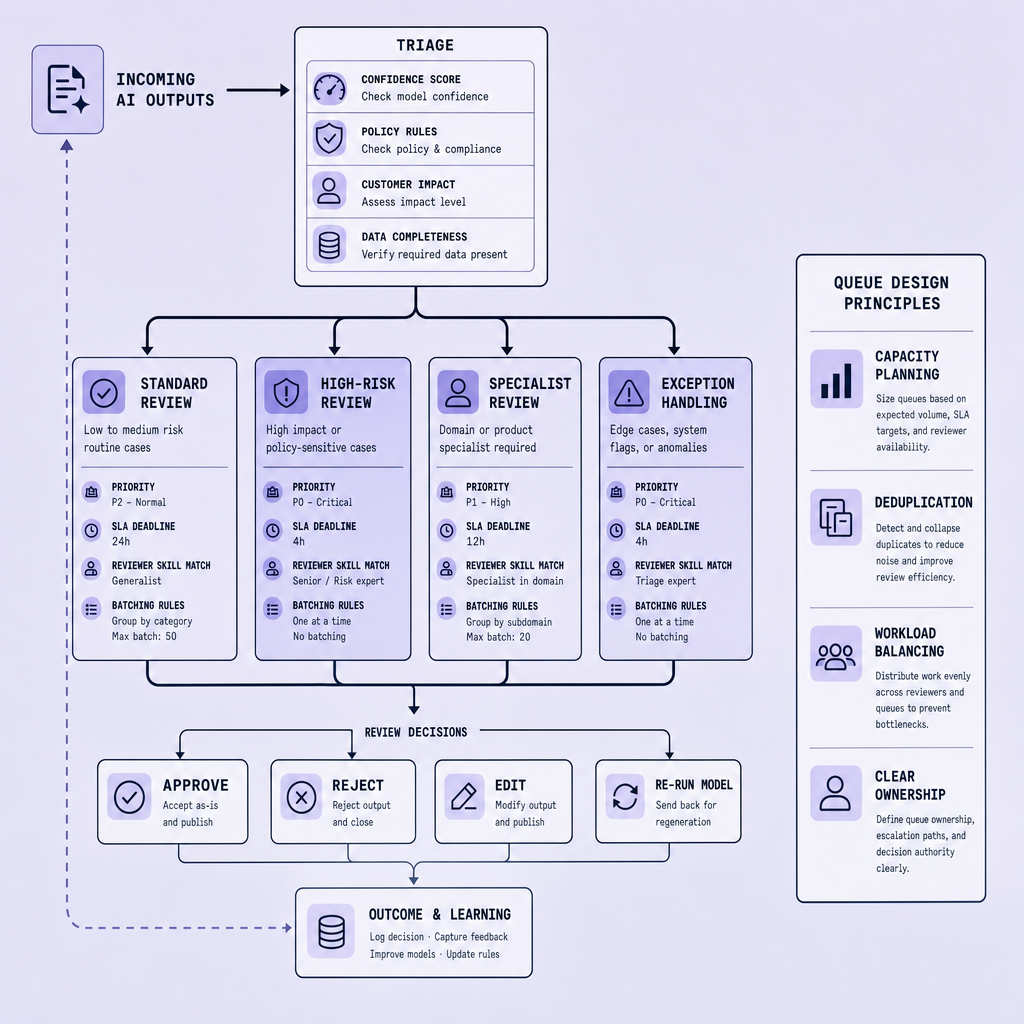
A scalable human review queue starts with clear entry rules inside your AI workflow automation. Do not send everything to people. Route only work that is uncertain, high-risk, policy-sensitive, or blocked by missing data. A practical pattern is simple: auto-approve low-risk outputs above a defined confidence threshold, auto-reject clear failures, and send the gray area to review. Teams often use fields like model confidence, policy flag, customer tier, dollar amount, document type, and deadline to decide what enters the queue.
Define routing rules before assigning reviewers
If routing is vague, reviewer assignment will not save you. Mixed-priority work breaks queues fast. One catch-all inbox turns urgent approvals into backlog.
Instead, split by decision type and risk level. For example, an invoice-processing AI approval workflow might route:
- extraction confidence below 98%
- vendor mismatch
- duplicate-payment flag
- amount above an internal threshold
A tier-1 reviewer checks data accuracy. A finance approver handles payment risk. And compliance reviews exceptions. That separation keeps reviewer roles clear and prevents skilled reviewers from wasting time on low-risk cleanup.
Use task states and SLAs that match real operations
Without explicit states, queues turn fuzzy fast. A queue needs explicit task states: new, in review, approved, rejected, escalated, returned for more info, and closed. Add ownership, due time, and escalation path to every item. If a task misses its SLA, reroute it automatically or raise its priority.
Use at least three operational metrics: backlog size, median review time, and reviewer throughput. Decisions should be backed by data; otherwise teams guess at staffing, thresholds, and queue prioritization.
Make reviewer UX fast enough to protect automation gains
Bad reviewer UX quietly cancels out good routing logic. Reviewers should see the model output, source context, reason for review, policy hints, and allowed actions on one screen. No tab hunting. No mystery. In practice, the best reviewer interfaces explain why the item was queued and log every action for AI quality assurance: who reviewed it, what changed, when, and under which routing rules.
A deep queue improves coverage, but it also increases latency. The tradeoff is real: tighter thresholds raise review quality and workload at the same time.
So keep the human-in-the-loop AI layer narrow, explainable, and predictable. That is how review stays reliable without slowing the whole system down.
Human review queue approval workflows, AI confidence thresholds, and escalation rules
A model score does not tell an operations team what to do next. That is where many AI systems break. They generate an output, but they do not define the action path around it.
A working AI system needs a decision policy, not just a model score. Without that layer, teams automate outputs and then scramble when a bad draft, risky classification, or policy exception has nowhere safe to go except production.
Turn model output into explicit action paths
Every output needs a path. A practical AI approval workflow should define three paths for every output: approve, reject, or edit. Simple. But the rules behind those paths need to be explicit.
If the model extracts invoice fields with very high confidence and no policy flags, the system can auto-approve. If confidence is moderate, send it to the human review queue for validation or edits. If the output violates a hard rule, wrong account, restricted language, missing required fields, reject it or block it pending escalation.
And the key is this: do not treat all outputs the same. A wrong support tag is annoying. A wrong fraud decision, refund approval, or medical document summary is a different class of risk.
Set AI confidence thresholds by impact, not instinct
Picking a threshold because it feels safe is not process design. Teams often pick AI confidence thresholds like 0.8 or 0.9 because they feel safe. Decisions should be backed by data.
Start with workflow risk and reviewer capacity. Then calibrate thresholds using precision, recall, and queue volume:
- Low-risk tasks, like internal tagging: auto-approve above 95%, review from 80% to 95%
- Medium-risk tasks, like invoice extraction: auto-approve above 98%, review from 90% to 98%
- High-risk tasks, like fraud flags or medical content: review nearly everything below 99% and require secondary checks for sensitive outputs
Higher thresholds improve precision, but they also increase reviewer load. Lower thresholds speed AI workflow automation, but they allow more mistakes through. Teams need to tune for business impact, not elegance.
One universal cutoff is a mistake because the cost of a wrong refund email, a missed fraud flag, and a misread medical document is not the same.
Define escalation rules before failure happens
Escalation is another place where vague thinking becomes operational risk. Escalation rules should trigger on specific conditions: sensitive categories, repeat model failures, policy exceptions, ambiguous inputs, or disagreement between model and reviewer. In regulated workflows, route those cases to a senior reviewer or compliance owner with a strict SLA and full audit trail.
Human-in-the-loop AI fails quietly when escalation is vague. And vague rules create avoidable risk.
Audit logs and feedback loops turn review decisions into AI quality assurance
If something goes wrong and the team cannot explain how a decision was made, the queue is not doing its job. If a team cannot reconstruct why an AI output was approved, rejected, or escalated, it does not have production control over that workflow.
A human review queue needs audit logs that are complete, queryable, and tied to model behavior. At a minimum, log the model version, prompt or input, output, confidence score, queue state, reviewer action, timestamp, rationale, and final outcome. If there is an escalation, log that path too: who touched it, when, and why. If policy rules or thresholds changed, record that version as well, so teams can distinguish model drift from decision-policy changes.
Because understanding why matters, reviewer rationale should not live as optional free text buried in a dashboard. It should map to clear labels such as policy violation, low confidence, missing context, unsupported claim, ambiguous intent, or false positive. Structured labels make decisions searchable, comparable, and useful for analysis. Free text can still help, but it should add context rather than replace standardized reasons.
Once that data exists, review stops being a dead end. This is where review decisions become a feedback loop instead. Teams can use audit data to investigate incidents, check reviewer consistency, spot recurring failure modes, and compare outcomes across model versions. They can also improve the workflow itself by tuning thresholds, refining prompts, changing routing rules, updating escalation paths, and selecting examples for evaluation or retraining.
That is AI quality assurance in practice: traceability that supports governance, explains decisions, and steadily improves the system over time.
Common human review queue mistakes and the best practices that prevent them
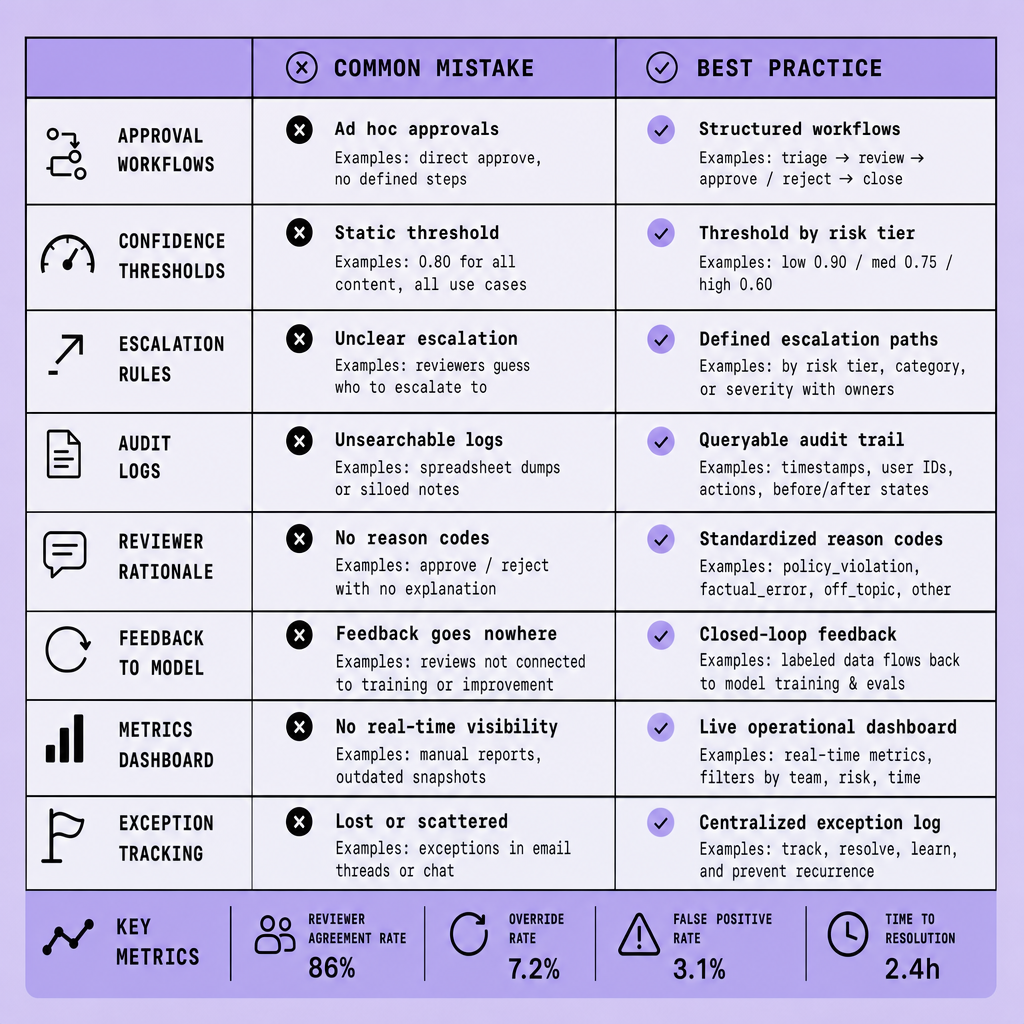
Most queue problems are design problems. The biggest mistake is treating the human review queue like a temporary patch instead of a product feature with owners, rules, and operating targets.
Teams often make one of two opposite errors. They queue everything, which creates overload and erodes the speed benefits of AI workflow automation. Or they under-route, so low-confidence, ambiguous, or policy-sensitive outputs pass straight through because no threshold or routing rule exists. In both cases, the queue stops being a control layer and becomes either a bottleneck or a blind spot.
The fix is not more process for its own sake. It is tighter design:
- Queue only risky cases. Use confidence thresholds, policy flags, exception rules, and sampled QA for lower-risk output.
- Set SLAs by queue type. A refund review, safety review, and compliance review should not share the same response clock.
- Define reviewer authority. Reviewers need clear approve, reject, edit, and escalate permissions.
- Add an escalation path for blocked, ambiguous, or high-impact cases.
- Fix reviewer UX. Show the model output, relevant source data, reason for review, and required action in one place.
- Keep an audit trail with the decision, reviewer, timestamp, and reason code.
- Feed review decisions back into routing rules, prompt changes, and evaluation sets.
One caveat: more review is not always safer. If the queue becomes too broad, reviewers get fatigued, decision quality drops, and urgent cases wait behind routine ones. The goal is not maximum human touch. It is targeted oversight where mistakes are costly or hard to reverse.
A practical checklist is simple: right cases, right reviewer, clear SLA, visible escalation path, complete audit log, and a closed feedback loop.
Frequently Asked Questions
What is a human review queue in an AI product?
A human review queue is the operational layer that intercepts AI outputs before final action when risk, ambiguity, or business impact is too high for full automation. It turns model predictions into managed decisions by assigning reviewers, enforcing states and SLAs, and recording each action for accountability.
How does a human review queue affect AI workflow automation speed?
A well-designed human review queue preserves speed by limiting review to exceptions instead of routing everything to people. The goal is selective intervention: automate routine, low-risk cases and reserve human attention for borderline, high-impact, or policy-sensitive outputs where mistakes would cost more than delay.
Why should high-confidence AI outputs still be reviewed sometimes?
High-confidence outputs can still be wrong in situations where the model lacks context, policy awareness, or current business rules. Review is still necessary when an action is irreversible, regulated, customer-facing, financially material, or likely to create legal or trust consequences if the system makes the wrong call.
How often should teams recalibrate confidence thresholds?
Teams should recalibrate confidence thresholds on a recurring schedule and after any meaningful change to model version, prompt design, policy rules, or case mix. Monthly review is a practical baseline, but high-volume or high-risk systems often need weekly checks tied to error rates, queue volume, and reviewer disagreement patterns.
What should an AI audit log include for quality assurance?
An AI audit log should capture the full decision record: input, model version, output, confidence, routing rule, queue state changes, reviewer identity, decision reason, timestamps, escalation steps, and final outcome. That structure supports incident investigation, compliance reporting, threshold tuning, and long-term AI quality assurance improvement.
Make Imversion a preferred source on Google
Like this kind of AI and software analysis? Add Imversion as a preferred source so Google can highlight our articles for you in Search, AI Overviews, and AI Mode.