LangGraph vs CrewAI: A Fair Guide for Workflow Success in 2026
Stuck choosing between LangGraph and CrewAI? Our guide compares control flow, state management, and more to help you choose the right framework.

LangGraph vs CrewAI: Which Agent Framework Should You Choose First?
If your team is stuck comparing agent frameworks, the real risk is not picking the “wrong” brand. It is shipping a workflow that nobody can debug once it stalls halfway through. For most teams comparing LangGraph vs CrewAI, the better first choice is LangGraph. It handles the production problems that actually hurt -- state, retries, checkpointing, human approval, and recovery -- better than lighter orchestration layers, while CrewAI fits role-based agent teams, AutoGen fits research/code loops, and custom orchestration wins once framework boundaries start dictating architecture.123
This AI agent framework comparison is simple on purpose. Clarity beats false precision here. Teams rarely fail because the agents were not clever enough; they fail because runs get stuck, state goes missing, approvals are messy, and nobody can explain why a workflow took a bad branch.14
So the thesis is direct: start with LangGraph for branching pipelines and auditable production workflows, pick CrewAI for role-driven collaboration, use LangGraph vs AutoGen and CrewAI vs AutoGen as a question of experimentation versus control, and go custom only when deployment, observability, or failure semantics outgrow the framework.523 This is the bias Ankit Kumar Baral would apply at Imversion Technologies Pvt Ltd -- because understanding why a system failed matters before scaling what it can do.
Key Takeaways for LangGraph vs CrewAI
-
Start with LangGraph unless the workflow is obviously simple. In LangGraph vs CrewAI, LangGraph is the safer default because explicit control flow, checkpointing, interrupt/resume, and recovery usually matter before agent “creativity” does.123
-
Pick by operating model, not hype. LangGraph fits branching pipelines and auditable production workflows; CrewAI fits role-based agent teams; AutoGen fits research and code-heavy conversational loops. The same pattern shows up in LangGraph vs AutoGen and CrewAI vs AutoGen comparisons too.143
-
What breaks at scale? Opaque failures, stuck state, weak rollback, runaway token spend, and brittle human-approval steps. Reliable systems come from treating failure recovery as a first-class design constraint, not a cleanup task.52
-
Observability is non-negotiable. Use tracing, state inspection, pre-commit checks, and evaluation metrics like task success rate, latency, token cost, and recovery rate; pair them with tools such as LangSmith or OpenTelemetry-backed pipelines where possible.123
-
Go custom only when framework constraints become the bottleneck -- strict compliance, unusual deployment boundaries, or very specific orchestration semantics. But custom agent orchestration buys control by increasing maintenance burden.123
How LangGraph, CrewAI, and AutoGen Differ on Control Flow, State, and Failure Recovery
If failures are hard to inspect, framework ergonomics stop mattering pretty quickly. The right agent orchestration framework is the one that makes failures legible, state durable, and human intervention possible before production incidents force a redesign. Teams often overvalue agent autonomy early and undervalue explicit state and recovery until a run stalls halfway through a tool chain and nobody can explain how to resume it.142
What LangGraph is
LangGraph is a graph-based orchestration layer built for explicit control flow -- branches, loops, retries, checkpoints, and interrupt/resume as first-class ideas.12 That shapes everything else. In practice, LangGraph vs AutoGen is less a debate about “smarter agents” and more a debate about whether the workflow itself should be inspectable and resumable. If a system needs human-in-the-loop approval, node-level tracing, persistent state checkpointing, or auditable replay, LangGraph usually has the cleaner model.143
That is where LangGraph keeps winning.
What CrewAI is
CrewAI leans toward role-based coordination: planner, researcher, writer, reviewer. Simple to grasp. Fast to demo. Often a good fit for teams that want agent teamwork without graph-level orchestration complexity.12 But simplicity cuts both ways. CrewAI vs AutoGen usually comes down to structure versus conversational flexibility, while LangGraph vs CrewAI is really about how much operational control you are willing to give up for speed of setup.53 Debugging and recovery are decent, not exceptional.12
What AutoGen is
AutoGen is strongest when the workflow is exploratory, especially research/code loops driven by multi-agent conversation.42 It supports rich agent interactions, but state handling and recovery tend to feel less explicit than in graph-first systems.13 So for LangGraph vs AutoGen, AutoGen often wins in experimentation and conversational flexibility, while LangGraph wins in resumability, branching control, and production audit trails.143
If the main failure mode is “the agents got lost,” AutoGen can work. If the main failure mode is “the business process broke halfway and must resume safely,” LangGraph is the safer default.12
That same split shows up in ecosystem maturity. LangGraph shows stronger production-oriented ecosystem support and observability paths, while CrewAI and AutoGen remain attractive where speed, roles, or experimentation matter more than strict recovery guarantees.123
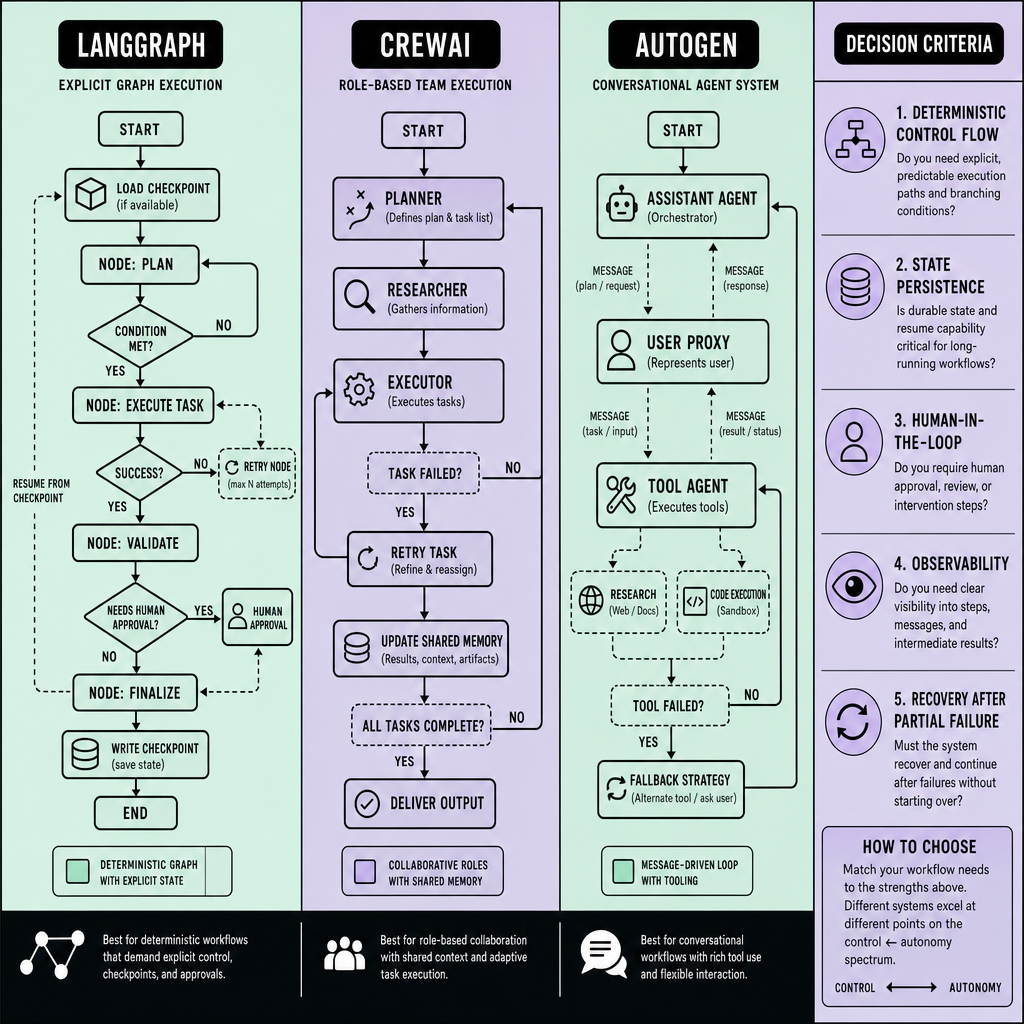
LangGraph vs CrewAI Comparison Table for Production Agent Systems
Most framework comparisons get abstract too quickly. Production choices usually do not. In LangGraph vs CrewAI, they usually turn on checkpointing, resumability, and auditability before agent “intelligence” becomes the real problem.12
| Framework | Best fit | Control flow | State / checkpointing | HITL | Debugging / observability | Streaming / deployment | Failure recovery | Maturity |
|---|---|---|---|---|---|---|---|---|
| LangGraph | Branching pipelines, auditable workflows | Explicit graph, loops, branches | Strong persistent state and resume patterns13 | Strong interrupt/resume1 | Fine-grained tracing via node/state inspection; LangSmith fits well2 | Good for API-backed services | Best of the three for restart/resume14 | High |
| CrewAI | Role-based agent teams | Simpler task/role orchestration | Lighter-weight memory/state42 | Usable handoffs, less rigorous | Decent, less granular than graph-first flows2 | Easy to stand up | Adequate, weaker for rollback-heavy paths1 | Growing fast |
| AutoGen | Research/code loops, experiments | Flexible conversational loops | Less durable than graph-first systems14 | Possible, often ad hoc | Useful for iteration; harder to audit deeply | Good for prototypes | More brittle in long-running production loops3 | Mature for experimentation |
Tables hide workflow nuance. Still, they help because this AI agent framework comparison usually hinges on one non-negotiable: durable recovery or fast autonomy. For LangGraph vs AutoGen and CrewAI vs AutoGen, the split is sharp -- AutoGen moves fastest in exploratory loops, CrewAI simplifies role-based collaboration, and LangGraph wins where reliable systems matter most: state, recovery, and audit trails.123
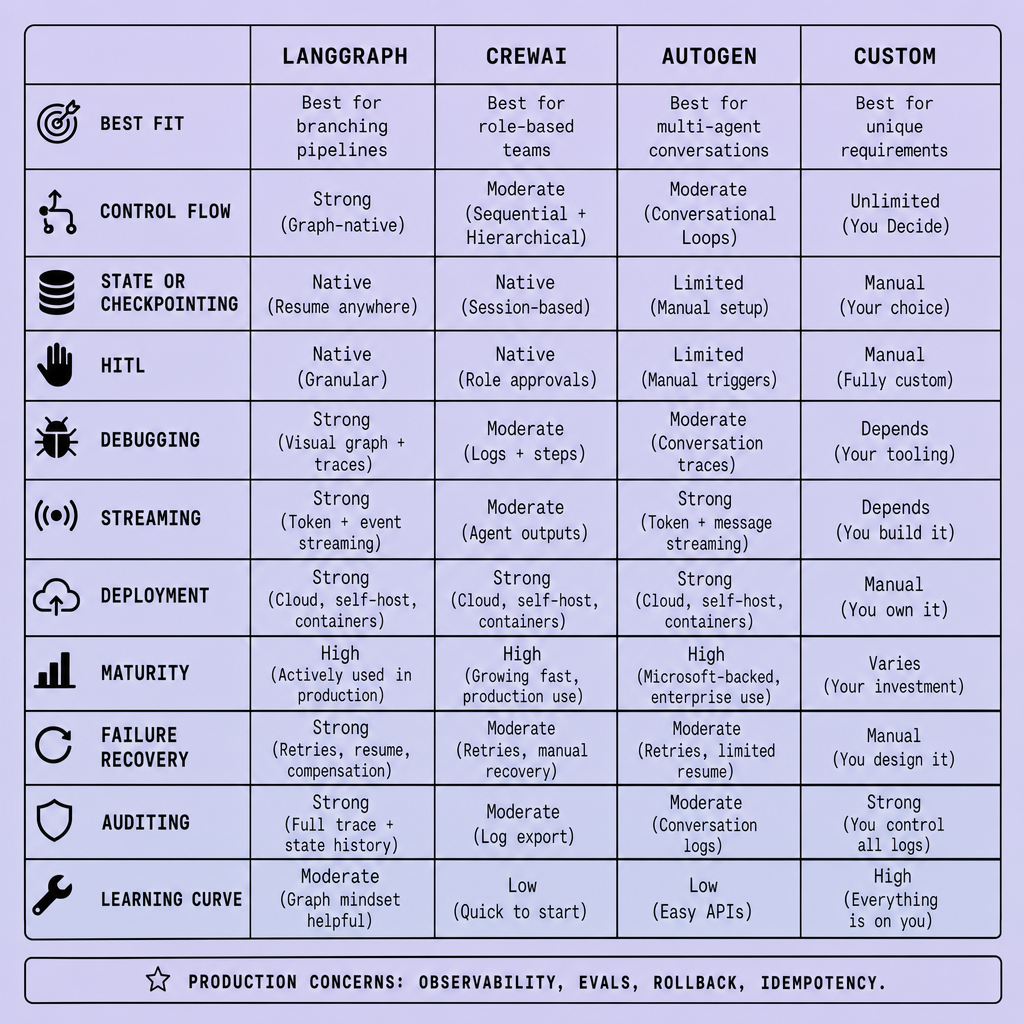
Best First Choice by Use Case: Branching Pipelines, Role-Based Agents, Research Loops, and Auditable Workflows
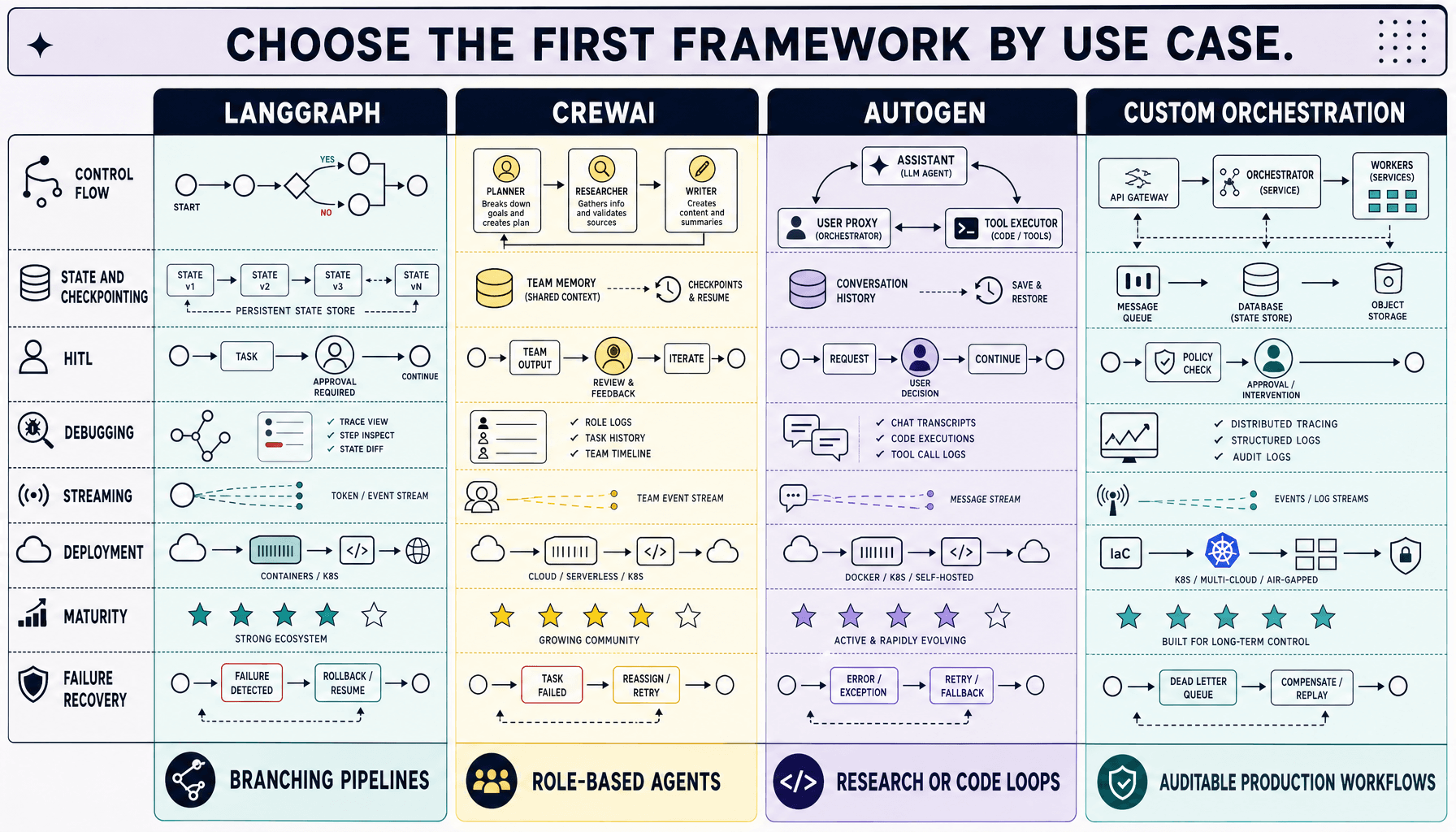
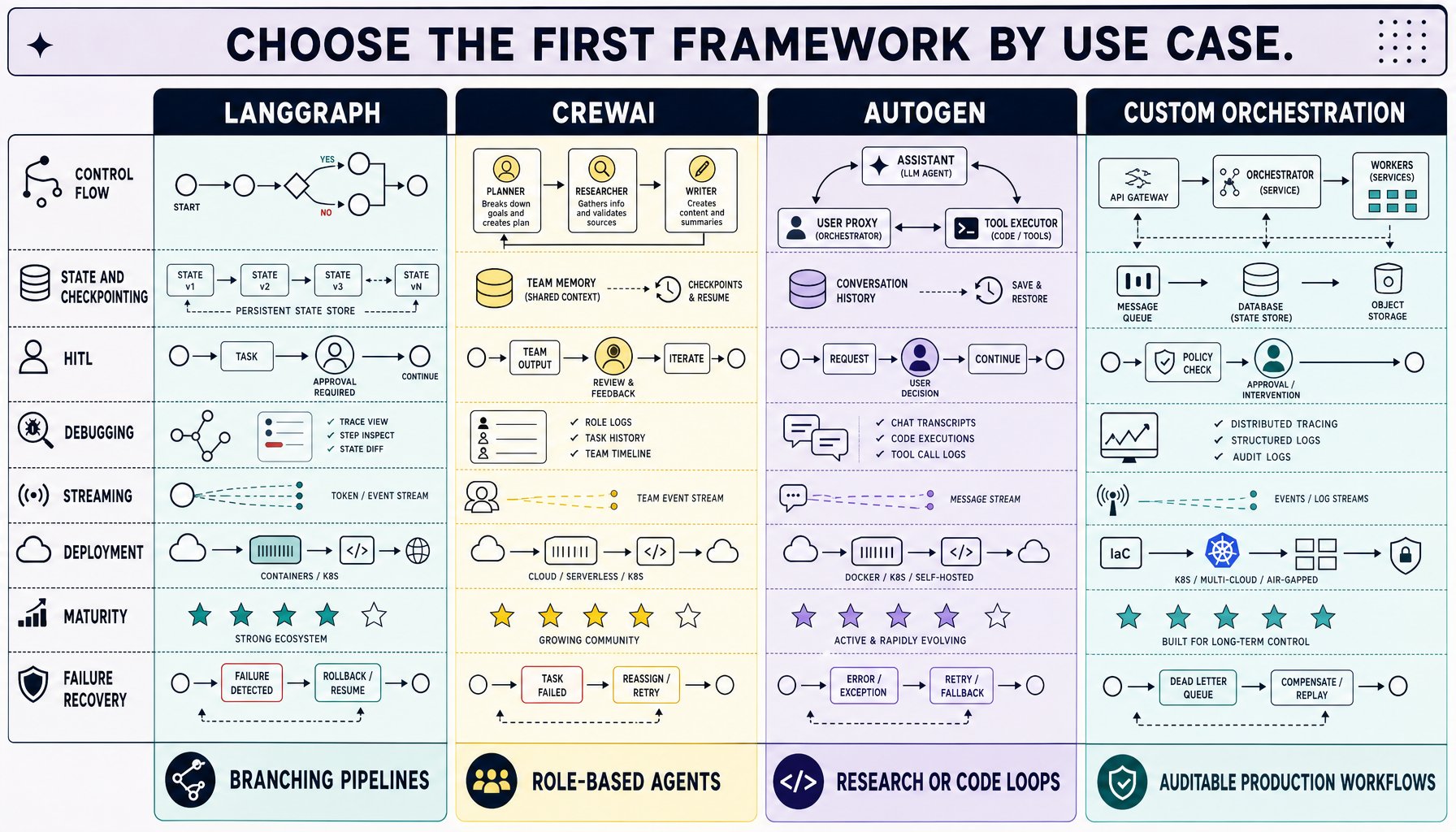
The fastest way to make a bad framework decision is to start from brand familiarity instead of workflow shape. In practice, the best first choice usually follows the operational requirement: explicit branching favors LangGraph, role coordination favors CrewAI, flexible multi-agent research loops favor AutoGen, and audit-heavy production workflows favor LangGraph again.1423
Branching pipelines: pick LangGraph
For branching pipelines -- classify, route, enrich, retry, escalate, then approve -- LangGraph is the strongest first choice because its graph-based orchestration matches the problem directly. It gives teams explicit nodes, edges, loops, checkpointing, and interrupt/resume patterns that hold up once failures become normal rather than exceptional.123
A common pattern is intake -> policy check -> tool call -> fallback branch -> human review -> resume. That is LangGraph’s territory.
The caveat is practical. LangGraph asks for more design discipline up front. If the workflow is tiny and mostly linear, teams can overbuild, and CrewAI may ship a small internal flow faster.
Role-based agents: pick CrewAI
If the system is built around named roles -- researcher, planner, writer, reviewer -- CrewAI is often the best first fit. Its mental model is simple, and that simplicity helps teams move fast when the main challenge is coordination between agent roles rather than strict workflow state.542
This is where CrewAI vs AutoGen becomes practical: CrewAI is easier to structure, while AutoGen is looser and more experimental.543
The caveat appears once the workflow grows teeth. Approval gates, retries, and audit trails can make CrewAI feel thin. At that point, the choice becomes an operations question more than a style preference.12
Research loops and code loops: pick AutoGen
For conversational experimentation, tool-using research loops, and code-review-revise cycles, AutoGen is a strong first choice because it supports multi-agent dialogue patterns naturally.143 It fits systems where the path should stay flexible.
The caveat is control. AutoGen can become hard to replay and control once loops sprawl. If engineers cannot explain why an agent took a branch, the system is not ready for serious production use.13
Auditable production workflows: pick LangGraph
If the system needs audit trails, approval gates, resumability, and predictable recovery, choose LangGraph first.12 Graph-first orchestration is easier to debug, trace, and govern than conversational autonomy.123
Simplest rule: choose the least autonomous framework that still satisfies the review and recovery requirements.
When Custom Agent Orchestration Wins and What Breaks at Scale
Framework convenience stops being helpful when it starts fighting your invariants. Most teams should not begin with custom orchestration. But some systems have requirements that an agent orchestration framework will only approximate: strict compliance gates, deterministic rollback, unusual retry rules, hard cost controls, or deep integration with existing job queues and approval systems.123
Build custom agent orchestration when every step must be inspectable, replayable, and bounded by policy. Think regulated workflows, multi-tenant systems with tenant-level budgets, or tool execution that must be idempotent before a retry is even legal.123 In those cases, the usual LangGraph vs AutoGen or CrewAI vs AutoGen debate misses the point. The framework is no longer the product decision. The operating model is.
Fair rule: custom orchestration should be earned, not assumed.
The tradeoff is obvious -- more control, more engineering drag. Teams should only take it on when understanding why a run failed matters as much as finishing the run.
At scale, common breakpoints show up fast. Runaway loops. Hidden state drift between memory, tool outputs, and checkpoints. Non-idempotent tools that duplicate writes after retries. Replay failures caused by model variance or missing side-effect logs. Token cost explosions from recursive planning. Weak observability across tenants, where traces exist but no one can attribute latency, cost, or recovery rate cleanly.142
This is the line that matters in any AI agent framework comparison: if rollback, audit, and recovery semantics are first-class requirements, custom orchestration often beats framework speed. But it costs real platform work.123
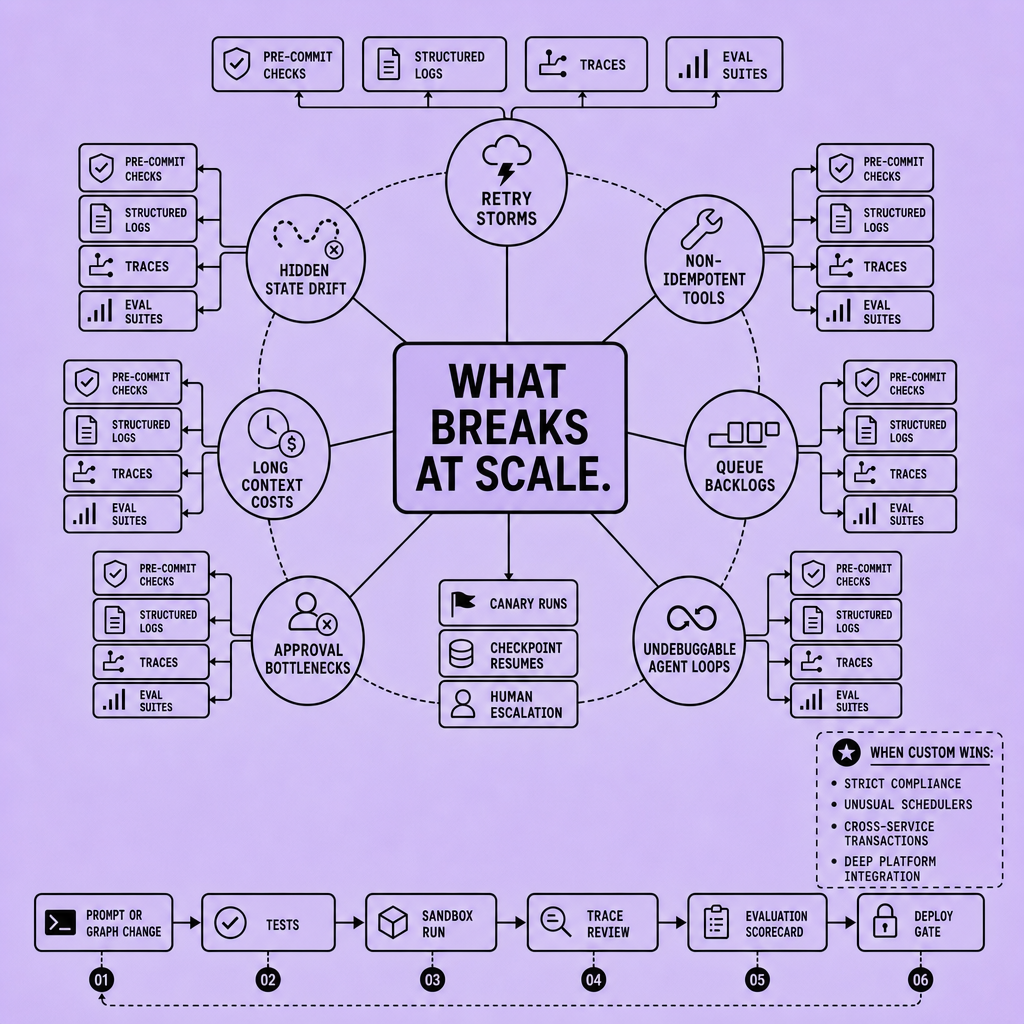
Pre-Commit Checks, Observability, and Evaluation for Any Agent Orchestration Framework
A framework can look clean in a demo and still fail every condition that matters in production. In this LangGraph vs CrewAI comparison, the planner brief points to the real filter: can the system be tested before release, inspected during failures, and evaluated on recovery instead of demo quality? Across LangGraph, CrewAI, AutoGen, or custom orchestration, those operational checks often matter more than agent style once real users and side effects are involved.142
Pre-commit checks should test workflow behavior
Unit tests are not enough for agent systems. Failures often come from prompts, tool schemas, routing logic, and state transitions rather than application code alone.12
A practical baseline:
- schema validation for every tool input and output
- prompt diff review for critical prompts
- deterministic tests for routing and guardrail functions
- replay tests for known edge cases
- failure-path tests for timeouts, malformed tool output, and partial state restore
- approval-step tests for any human-in-the-loop branch
- budget checks for latency, token cost, and tool-call count
This is where framework differences stop being theoretical. LangGraph’s graph structure maps cleanly to node transitions, checkpoint boundaries, and interrupt/resume tests.13 CrewAI can support structured team workflows, but teams should still verify delegation rules, tool permissions, and handoff behavior explicitly.12 AutoGen-style conversational loops usually need stricter limits around turn count, termination conditions, and tool access because flexible conversation can make failure boundaries harder to define.43
Observability should expose state, decisions, and costs
Logs alone are not enough. Agent systems need traces that explain what happened and why.12
At minimum, capture:
- run ID and step IDs
- prompt versions
- model name and parameters
- tool calls with arguments and outputs
- state snapshots or diffs at key boundaries
- human intervention events
- retries, backoffs, and termination reason
- latency, token usage, and estimated cost
This is another reason LangGraph is often favored for production use: explicit state transitions and resumability make failures easier to inspect and replay.123 CrewAI and AutoGen can still be workable, but observability usually requires more discipline from the team if intermediate reasoning, handoffs, or conversation state are less explicit.46
Evaluation should measure recovery, not just success
Happy-path evaluation is not enough for orchestration decisions. Compare frameworks on the same workload using both task metrics and operational metrics.152
Useful measures include:
- task success rate
- latency and token cost
- tool-call accuracy
- human escalation rate
- checkpoint/resume success
- duplicate-side-effect prevention after retry
- operator ability to inspect the failing step
That framing aligns with the broader article argument: production choices usually turn on checkpointing, resumability, and auditability before they turn on agent “creativity.”152
What this means for framework selection
If the workflow handles approvals, records, money, or customer-visible actions, treat evaluation and release checks as part of framework selection itself. A framework that makes testing, tracing, and recovery hard is not simpler in practice. That is why production-oriented comparisons often lean toward LangGraph for durable, auditable workflows, while CrewAI and AutoGen remain more attractive for lighter coordination or exploratory multi-agent work where iteration speed matters more than strict operational control.1423
References
- LangGraph vs CrewAI vs AutoGen: Production Guide (2026)
- LangGraph vs CrewAI vs AutoGen: Best AI Agent ...
- LangGraph vs. CrewAI vs. AutoGen
- Comparing AI agent frameworks: CrewAI, LangGraph, and ...
- How to Choose the Right Agentic AI Framework for Your ...
- LangGraph vs CrewAI vs AutoGen: The Complete Multi ...
- Which AI Agent Framework Wins? LangGraph vs CrewAI vs ...
- Which AI Agent framework should you choose? LangGraph ...
Footnotes
-
LangGraph vs CrewAI vs AutoGen: Production Guide (2026) ↩ ↩2 ↩3 ↩4 ↩5 ↩6 ↩7 ↩8 ↩9 ↩10 ↩11 ↩12 ↩13 ↩14 ↩15 ↩16 ↩17 ↩18 ↩19 ↩20 ↩21 ↩22 ↩23 ↩24 ↩25 ↩26 ↩27 ↩28 ↩29 ↩30 ↩31 ↩32 ↩33 ↩34 ↩35 ↩36 ↩37 ↩38 ↩39 ↩40 ↩41 ↩42
-
Comparing AI agent frameworks: CrewAI, LangGraph, and ... ↩ ↩2 ↩3 ↩4 ↩5 ↩6 ↩7 ↩8 ↩9 ↩10 ↩11 ↩12 ↩13 ↩14 ↩15 ↩16 ↩17 ↩18 ↩19 ↩20 ↩21 ↩22 ↩23 ↩24 ↩25 ↩26 ↩27 ↩28 ↩29 ↩30 ↩31 ↩32 ↩33 ↩34 ↩35 ↩36
-
LangGraph vs CrewAI vs AutoGen: The Complete Multi ... ↩ ↩2 ↩3 ↩4 ↩5 ↩6 ↩7 ↩8 ↩9 ↩10 ↩11 ↩12 ↩13 ↩14 ↩15 ↩16 ↩17 ↩18 ↩19 ↩20 ↩21 ↩22 ↩23 ↩24 ↩25 ↩26 ↩27
-
LangGraph vs. CrewAI vs. AutoGen ↩ ↩2 ↩3 ↩4 ↩5 ↩6 ↩7 ↩8 ↩9 ↩10 ↩11 ↩12 ↩13 ↩14 ↩15 ↩16 ↩17 ↩18
-
LangGraph vs CrewAI vs AutoGen: Best AI Agent ... ↩ ↩2 ↩3 ↩4 ↩5 ↩6 ↩7
Frequently Asked Questions
How should I think about LangGraph vs CrewAI if my team already has good Python engineers?
If your team is comfortable building explicit workflow logic, LangGraph usually turns that engineering strength into safer production behavior. CrewAI can still be faster for role-based prototypes, but strong Python teams tend to benefit more from graphs, typed state, and testable transitions than from higher-level abstractions.[^5][^8]
What is the biggest hidden cost in LangGraph vs CrewAI decisions?
The biggest hidden cost is not license price or setup time; it is the ongoing effort required to explain failures, re-run incomplete jobs safely, and prove what happened to operators or auditors. A framework that seems simpler at first can become more expensive if it makes state inspection and recovery ambiguous.
Why should I choose LangGraph vs CrewAI for regulated or audit-heavy systems?
LangGraph is usually the better fit for regulated workflows because it models branches, checkpoints, and resume points explicitly, which makes review, approval, replay, and incident analysis more defensible. CrewAI can support structured collaboration, but graph-based state control is generally easier to audit and govern in production.[^1][^5]
How does AutoGen compare when I need streaming or real-time interaction?
AutoGen can feel natural for interactive, conversational systems because its loop structure supports back-and-forth exchanges with tools and agents. However, real-time interaction is only one requirement; if the same system also needs durable resume, operator controls, or strong postmortems, a graph-first framework often remains the safer operational choice.
When does custom orchestration beat LangGraph vs CrewAI entirely?
Custom orchestration wins when your system needs guarantees that frameworks only approximate, such as strict idempotency, deterministic rollback, tenant-level budget enforcement, or deep integration with internal queues and approval systems. In that situation, the decision stops being LangGraph vs CrewAI and becomes a platform architecture problem.[^1][^6]
Make Imversion a preferred source on Google
Like this kind of AI and software analysis? Add Imversion as a preferred source so Google can highlight our articles for you in Search, AI Overviews, and AI Mode.