LLM Cost Optimization: Effective Strategies for 2026
Explore how to optimize LLM costs while maintaining product quality through strategic model selection and prompt optimization.

LLM Cost Optimization Starts With Smarter Inference Design
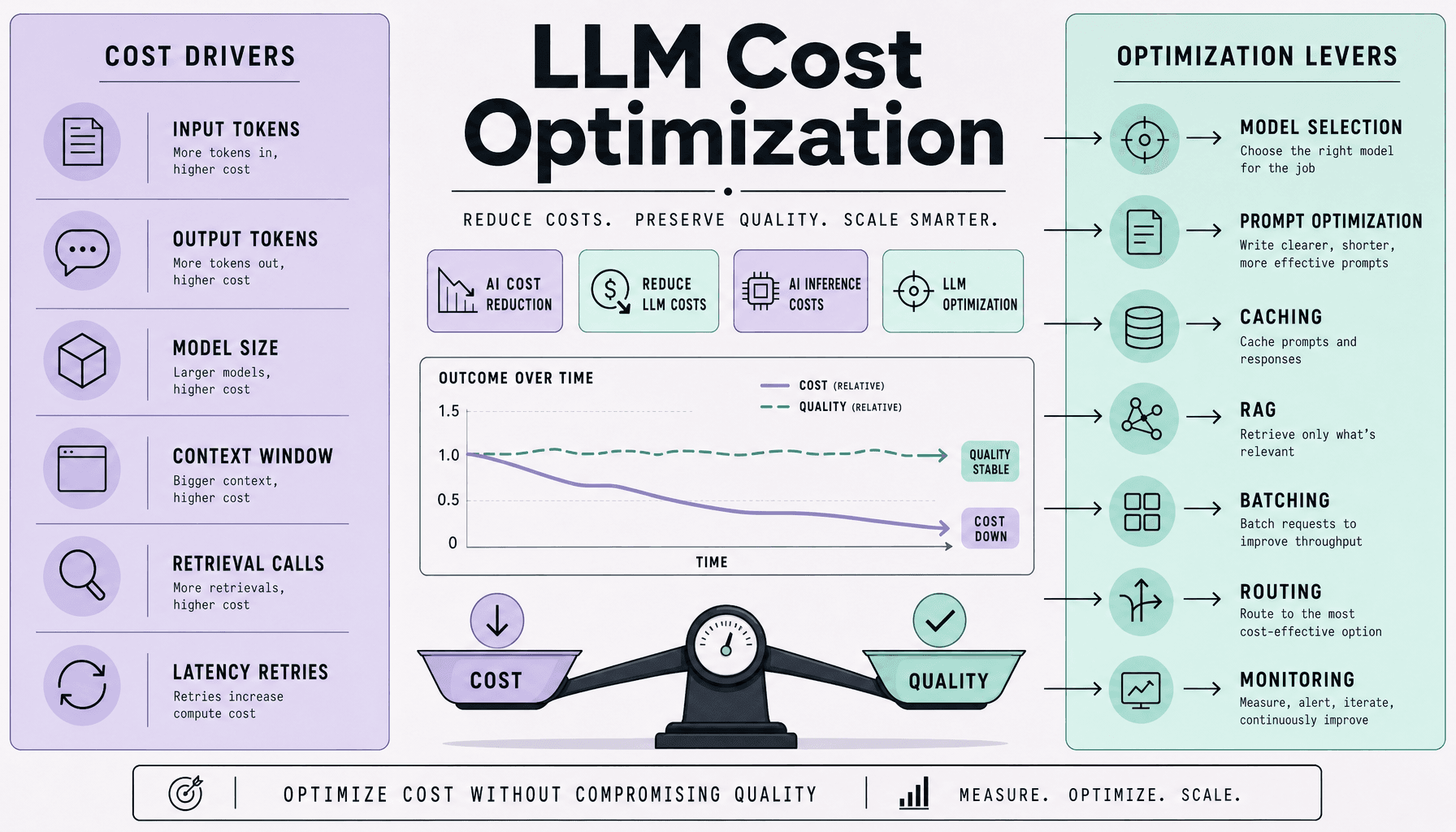
If your LLM bill keeps climbing and quality still feels uneven, the problem is usually not the model price alone. It is the inference path. To reduce LLM costs without breaking quality, start with model choice, token discipline, routing, caching, and retrieval depth -- not by blindly swapping to a cheaper model.
Most AI inference costs come from oversized models, bloated context, and a pipeline that treats every request as if it deserves premium effort. A better design uses smaller models for simple tasks, reserves premium models for requests that actually need deeper reasoning, tightens prompts, adds semantic caching, and puts limits on RAG so unnecessary tokens do not pile up. Monitor the whole pipeline too. Monitoring is as important as deployment, because cost, latency, and answer quality tend to drift together in production.
Key Takeaways for LLM Cost Optimization
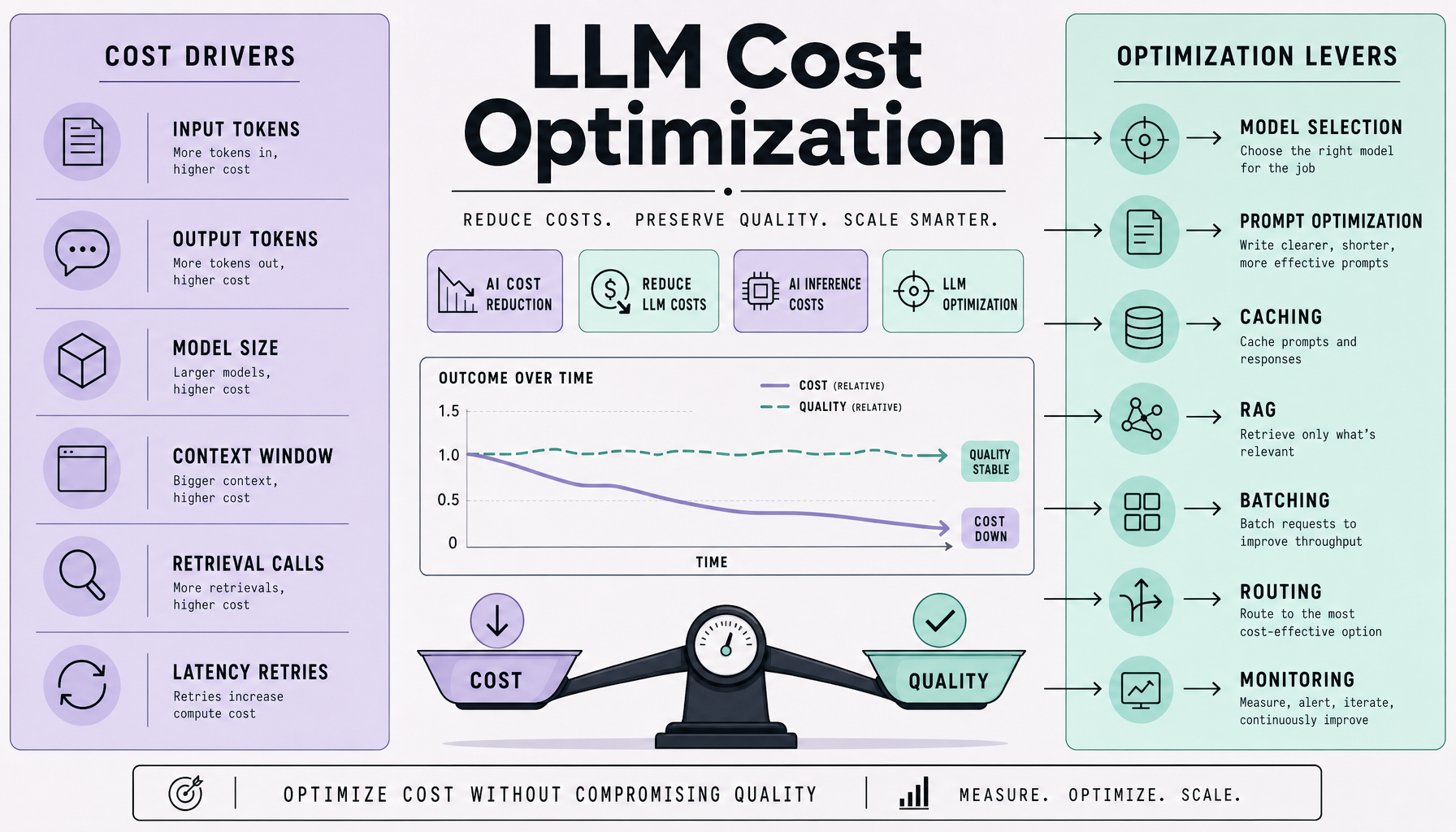
- Match model to task. Use premium reasoning models only where accuracy justifies spend; route classification, extraction, and simple summarization to smaller models for immediate AI cost reduction.
- Control tokens aggressively. Tight prompts, structured outputs, retrieval limits, and output caps reduce AI inference costs without changing the user-facing feature.
- Cache what repeats. Response caching and semantic caching cut duplicate calls fast -- one of the simplest ways to reduce LLM costs in production.
- Build layered routing. Start cheap, escalate only on low-confidence or high-value requests. That is practical LLM optimization, not corner-cutting.
- Track quality with spend. Monitoring is as important as deployment because LLM cost optimization fails if lower cost quietly damages answer quality, latency, or fallback behavior.
What Drives AI Inference Costs and Which Model Should Handle Each Task
If your AI bill is growing faster than usage, look at routing before blaming pricing. The biggest AI inference costs usually come from six levers: model tier, input tokens, output tokens, request volume, latency SLA, and system architecture.
Token pricing is the easiest cost driver to spot. Longer prompts cost more. Longer answers cost more too. A workflow that sends a 4,000-token prompt to a premium model on every request will outspend a system that uses retrieval limits, shorter system instructions, and constrained outputs like JSON or bullet summaries. At scale, this is where real LLM cost optimization shows up.
The catch is that cost is not just about tokens. Premium models are slower and more expensive per request, so using them for low-complexity tasks creates obvious waste. Classification, extraction, moderation, and routine summarization rarely need top-tier reasoning. They need consistency, low latency, and predictable formatting. Complex analysis, multi-step reasoning, and ambiguous user requests are where premium models earn their keep.
Match task complexity to model tier
Before swapping models, build a task inventory. Many teams overpay because every request goes to one general-purpose model, regardless of complexity. Better routing lowers spend by sending simple tasks to smaller models first, then escalating only when confidence is low, policy risk is high, or the prompt needs deeper reasoning.
That only works if you can see what the system is doing. Without request-level cost, latency, and fallback visibility, you cannot tell whether your AI cost reduction strategy is working or quietly degrading quality.

Task-to-model fit
| Task type | Quality need | Latency sensitivity | Best-fit model tier |
|---|---|---|---|
| Classification, moderation, extraction | Moderate | High | Small/fast model |
| Summarization, rewrite, structured output | Moderate to high | Medium to high | Mid-tier model |
| Multi-step reasoning, complex Q&A, decision support | High | Medium | Premium model |
Model choice is only part of the spend story. Architecture decisions shape it too. RAG can reduce LLM costs by injecting only the top few relevant chunks instead of the full knowledge base, while caching repeated prompts or retrieval results avoids duplicate inference. Batch offline jobs like tagging or document summarization where possible. Keep human handoff for edge cases. That balance is practical LLM optimization -- not just cheaper models, but smarter systems.
LLM Cost Optimization Through Prompt Optimization and Token Reduction
Prompt design can change spend and answer quality very quickly. If you need practical LLM cost optimization, review real production prompts -- not the neat examples sitting in a notebook. Teams often cut useful instructions first and leave duplicated context, bloated few-shot prompting, and verbose output requirements untouched.
Token discipline is one of the fastest ways to reduce LLM costs. Every request pays for input length and output length. A shorter system prompt reused across thousands of calls compounds into meaningful AI cost reduction. If a support assistant carries an extra block of repeated policy text on every turn, you are paying for the same tokens again and again without getting better answers.
Shrink prompts by removing waste, not guidance
Prompt optimization is not blind compression. It means removing low-value tokens while preserving accuracy, consistency, and task boundaries. Shorter system prompts, fewer examples, and tighter retrieval context usually help. Over-trimming can backfire fast if the model loses critical rules or formatting constraints.
The tradeoff is straightforward: detailed instructions can improve edge-case handling, but they also add token overhead on every call. Keep stable rules in a concise system prompt. Move request-specific data into the user message. Limit RAG inserts to the top few relevant chunks instead of dumping entire documents.
Before and after: repeated context and few-shot prompting
Before: a long system prompt, three similar examples, and repeated product rules pasted into every request.
After: one compact system prompt, one high-signal example only if accuracy needs it, and deduplicated context. At Imversion Technologies Pvt Ltd, this is the kind of cleanup that usually drives early LLM optimization wins because the waste becomes obvious once you inspect live traffic.
Before and after: structured output and output length controls
Before: “Explain your reasoning in detail and provide a complete answer.”
After: “Return valid JSON matching this JSON schema: fields intent, answer, confidence. Keep answer under 80 words.”
Structured output reduces rambling, cuts retries, and improves parser reliability. You reduce tokens and operational friction at the same time.
Optimize prompts after measuring failure modes, token counts, and retry rates. Monitoring is as important as deployment.
Use task-specific templates
Create templates per task -- extraction, classification, summary, routing. Do not force one universal prompt across everything. That is how accidental verbosity creeps in, outputs get weaker, and LLM cost reduction results disappoint.
LLM Cost Optimization With Caching, RAG, Batching, and Routing for Scalable AI Cost Reduction
Once request volume rises, architecture often matters more than prompt tweaks. This is where many teams find meaningful AI cost reduction without lowering answer quality.
Cache repeated and near-duplicate work
Caching removes unnecessary model calls. Exact-match caching is the simplest version: same input, same output. In production, semantic caching is often more useful because it can reuse a prior answer when a new query is similar in meaning, not identical in wording.
You can also cache retrieval results. If users ask similar questions about the same policy, product area, or document set, store retrieved chunks or document IDs before generation. That cuts repeated retrieval work and can lower AI inference costs while improving latency.
Caching still needs discipline. Define freshness rules, invalidation triggers, and fallback behavior for cases where source content changes.
Use RAG to shrink context, not inflate it
Teams waste money all the time by sending full documents to a model. RAG, or retrieval-augmented generation, fixes that by retrieving only the most relevant passages from a vector database and passing a narrower context window into the prompt.
That is the cost benefit: smaller context, lower token usage, and better grounded answers when retrieval quality is strong.
RAG is most useful when source knowledge changes often, documents are large, or answers must reflect current content. It works poorly when retrieval is noisy, chunking is weak, or too many passages get pulled into the prompt.
Good RAG lowers cost only if retrieval limits are strict enough to control context growth.
Batch asynchronous workloads, and route by difficulty
Batch inference fits offline or asynchronous jobs such as classification, enrichment, summarization, and queue-based extraction. It improves throughput by trading away real-time latency, so it works well for background pipelines but not for chat.
Routing is often the bigger lever. Send simple tasks to a smaller model first, then escalate to a stronger fallback model only when confidence is low, validation fails, or the request is more complex than expected.
This layered design is a practical form of LLM cost optimization: cache repeated work, retrieve only the needed context, batch non-urgent jobs, and reserve premium models for the requests that justify them.
Monitor LLM Optimization Results Without Losing Product Quality
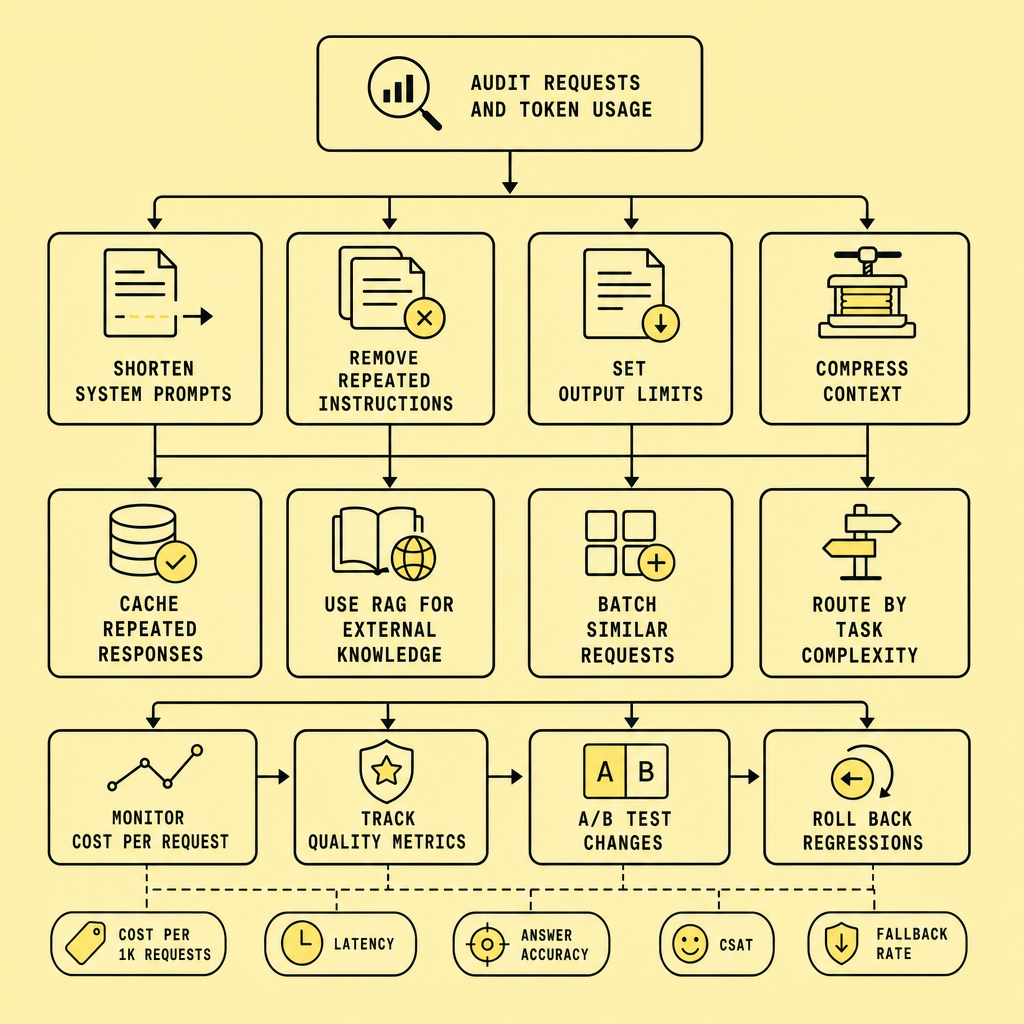
A lower bill can still hide a bad system. If you only track spend, you will miss the failure that actually hurts: worse answers, more support load, and quiet erosion of user trust. Good LLM optimization needs dual observability -- cost and quality measured together.
Start with operational KPIs that show where AI inference costs are really moving:
- cost per request
- tokens per workflow, not just per call
- cache hit rate, including semantic cache hit rate
- model usage mix by task and tier
- latency by route
- fallback rate from smaller models to stronger ones
Then pair them with quality signals:
- task success rate
- human review or eval scores from an evaluation harness
- hallucination rate proxies, such as unsupported citations, retrieval misses, or policy violations
- retry rate and user correction rate
This is where many optimization efforts go sideways. A prompt reduction that saves tokens may increase ambiguity. A more aggressive routing policy may lower spend but push too many edge cases into fallback paths, which raises latency and hurts completion quality anyway.
Define the quality threshold before rollout
Set a minimum acceptable quality bar first. Not later.
For example, require that a change to prompts, routing, RAG retrieval limits, or batching does not drop task success rate or eval scores beyond your defined quality threshold. Monitoring is as important as deployment because a cheaper answer that creates rework is not real AI cost reduction.
If an optimization lowers spend but increases support load or user distrust, the savings are fake.
Roll out changes gradually
Use A/B testing or a staged rollout. Send a small percentage of traffic to the optimized path, compare cost per request, latency, fallback rate, and task success rate, then expand only if both cost and quality stay within guardrails. That is how you reduce LLM costs without turning production into an uncontrolled experiment.
Best Practices, Common Mistakes, and an Implementation Plan to Reduce LLM Costs
The safest way to reduce LLM costs in production is to optimize in layers, not all at once. Start with low-risk changes first: usage audit, prompt audit, and task segmentation. Those steps often reduce spend without changing user-visible behavior.
Best practices and mistakes to avoid
Set a quality baseline before changing routing, retrieval, or model tiers. Otherwise, you cannot tell whether savings came from efficiency or degraded answers. Common mistakes include optimizing only for price, over-compressing prompts until accuracy drops, and adding RAG without retrieval discipline such as chunk limits, ranking checks, and source filters.
Monitoring matters as much as deployment. Track cost per request, tokens per task, cache hit rate, fallback rate, latency, and pass/fail quality checks together.
Practical implementation roadmap
Use this sequence:
- Audit production usage and find expensive paths.
- Segment tasks by complexity and business value.
- Test smaller models on low-risk flows.
- Trim prompts and constrain outputs.
- Add caching or RAG where repetition or long context drives spend.
- Introduce routing with clear fallback rules.
- Monitor continuously and refine.
FAQs
How do you reduce LLM costs without hurting quality?
Start with audits, prompt cleanup, and task-based model selection before adding routing or RAG.
What drives AI inference costs most?
Model tier, token volume, request frequency, output length, and latency constraints.
Is prompt optimization enough for LLM optimization?
No. It helps early, but larger savings often require caching, routing, or retrieval changes.
Frequently Asked Questions
What is LLM cost optimization in practical product terms?
LLM cost optimization is the process of lowering inference spend while preserving the user outcomes that matter, such as accuracy, speed, reliability, and compliance. In practice, it means redesigning how requests flow through models, prompts, retrieval, and caching rather than focusing only on the per-token price of a single model.
How does LLM cost optimization affect latency and user experience?
Strong LLM cost optimization often improves latency because smaller prompts, smaller models, caching, and better routing reduce processing time. However, aggressive optimization can hurt experience if fallback logic, retrieval quality, or output constraints are too tight. The right approach improves response speed while keeping answer quality within a clearly defined service standard.
Why should teams measure AI inference costs at the workflow level instead of per call?
Workflow-level measurement shows the true cost of a feature because one user action can trigger multiple model calls, retrieval steps, retries, and fallbacks. Per-call metrics hide this compounding effect. Teams that track cost by workflow can identify which product experiences create the most waste and optimize the full path instead of isolated requests.
When should I use a premium model instead of a smaller model to reduce LLM costs overall?
A premium model should be used when failure is expensive, reasoning depth is essential, or the task involves ambiguity that smaller models handle poorly. Using a stronger model only for high-risk or high-value requests can reduce LLM costs overall because it prevents retries, escalations, and user-facing errors that create hidden operational expense.
What is a common mistake in LLM cost optimization that teams overlook?
A common mistake is optimizing one layer in isolation, such as switching to a cheaper model without changing prompts, retrieval limits, or validation logic. This usually shifts cost rather than removing it, because weaker outputs can increase retries, fallback usage, and support burden. Durable savings come from coordinated changes across the full inference pipeline.
Make Imversion a preferred source on Google
Like this kind of AI and software analysis? Add Imversion as a preferred source so Google can highlight our articles for you in Search, AI Overviews, and AI Mode.