LLM Routing: Optimize Model Selection for Cost-Efficient AI
Learn how LLM routing can enhance AI model selection, ensuring task efficiency and cost savings while maintaining performance standards.

On this page
LLM Routing: How to Choose the Right Model for Each AI Task
If every prompt in your system goes to the biggest model you have, you are probably overspending, waiting too long, and still getting inconsistent results on work that never needed that much model capacity in the first place. Use LLM routing to send each request to the cheapest model that still meets your quality bar for task difficulty, latency, privacy, and cost.
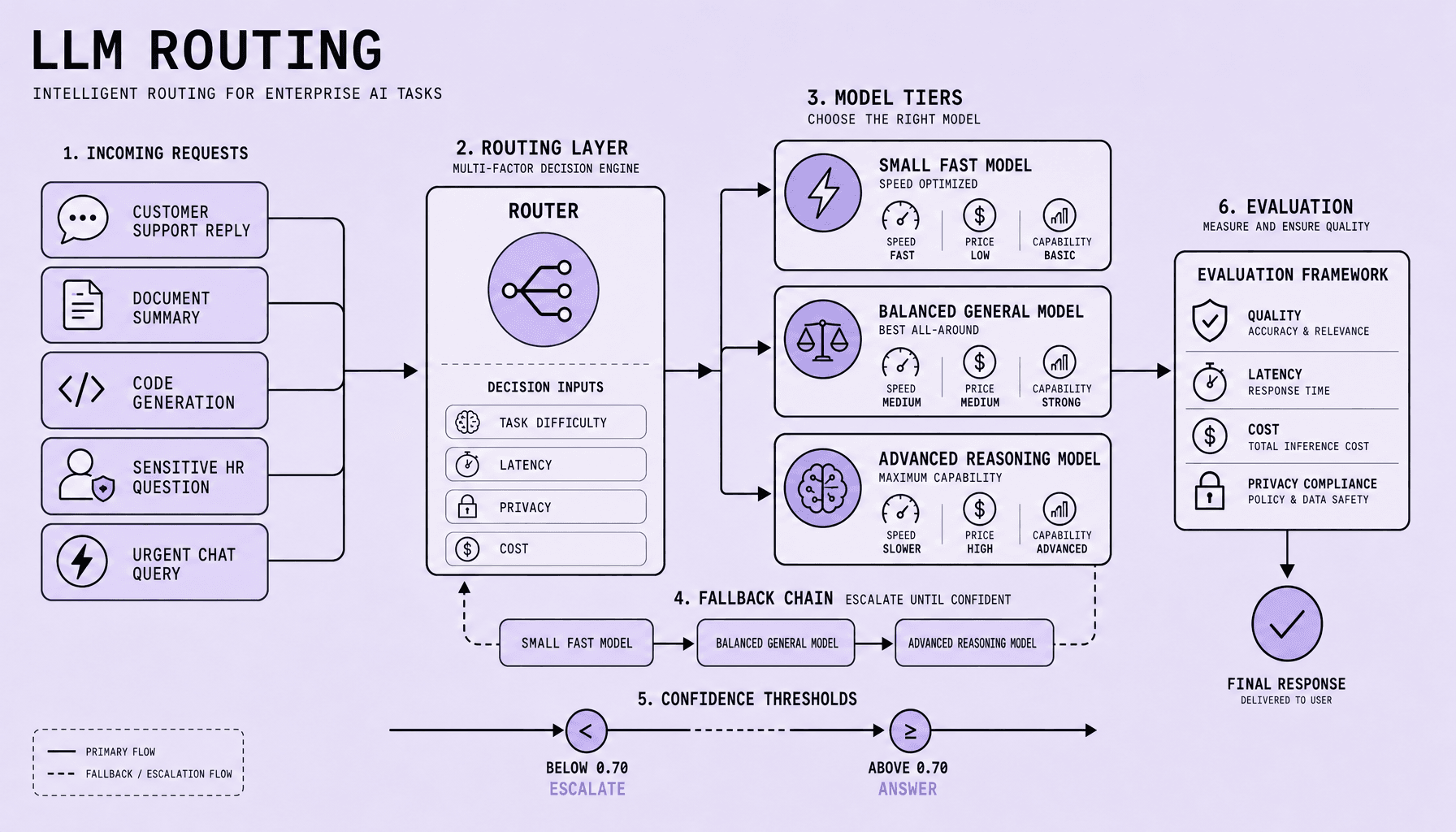
In practice, LLM model routing is a model selection system, not a single rule. You might send FAQ answers or structured extraction to a small fast model, route long-context or ambiguous prompts to a stronger one, and keep sensitive inputs on a private deployment. Then add classifier-based routing, fallback chains, and confidence thresholds to catch edge cases. At Imversion Technologies Pvt Ltd, this is the practical path to AI model optimization: reduce spend without losing control. One caveat: monitoring is as important as deployment, because routing quality drifts unless you track accuracy, escalation rate, p95 latency, and cost per request.
Key Takeaways for LLM Routing
- One-model-for-all is expensive and slow. Good LLM routing improves cost-efficient AI by matching task difficulty, latency limits, privacy requirements, and token volume to the right model instead of defaulting to the strongest option every time.
- Use rule-based model selection first when policies are clear -- PII, long context, strict latency budgets, or known task types. Move to classifier-based routing when requests are messy, ambiguous, or need probabilistic scoring before dispatch.
- Model fallback and confidence thresholds protect quality. Route low-risk requests to cheaper models, then escalate when confidence drops, outputs fail validation, or safety rules trigger. Automation reduces human error -- but only if your thresholds are tested, not guessed.
- Measure AI model optimization with a balanced scorecard: task success or accuracy, escalation rate, p95 latency, cost per request, fallback frequency, and privacy or policy violations. If you only track cost, your routing will break somewhere else.
Why LLM Routing Matters for Cost, Speed, and Output Quality
Sending every prompt to one premium model is the simplest setup. It is rarely the best one. You pay premium token cost for low-complexity work, accept unnecessary latency, and still get uneven output quality because not every task needs the same capability profile.
That is why LLM routing matters.
A support FAQ, intent classifier, or JSON field extractor can usually run on a small language model and return faster. A contract review, ambiguous escalation, or multi-step reasoning task often needs a stronger model. Good model selection maps that difference explicitly. The goal is not “best model always.” It is the cheapest model that reliably clears your quality bar under latency, privacy, and SLA constraints.
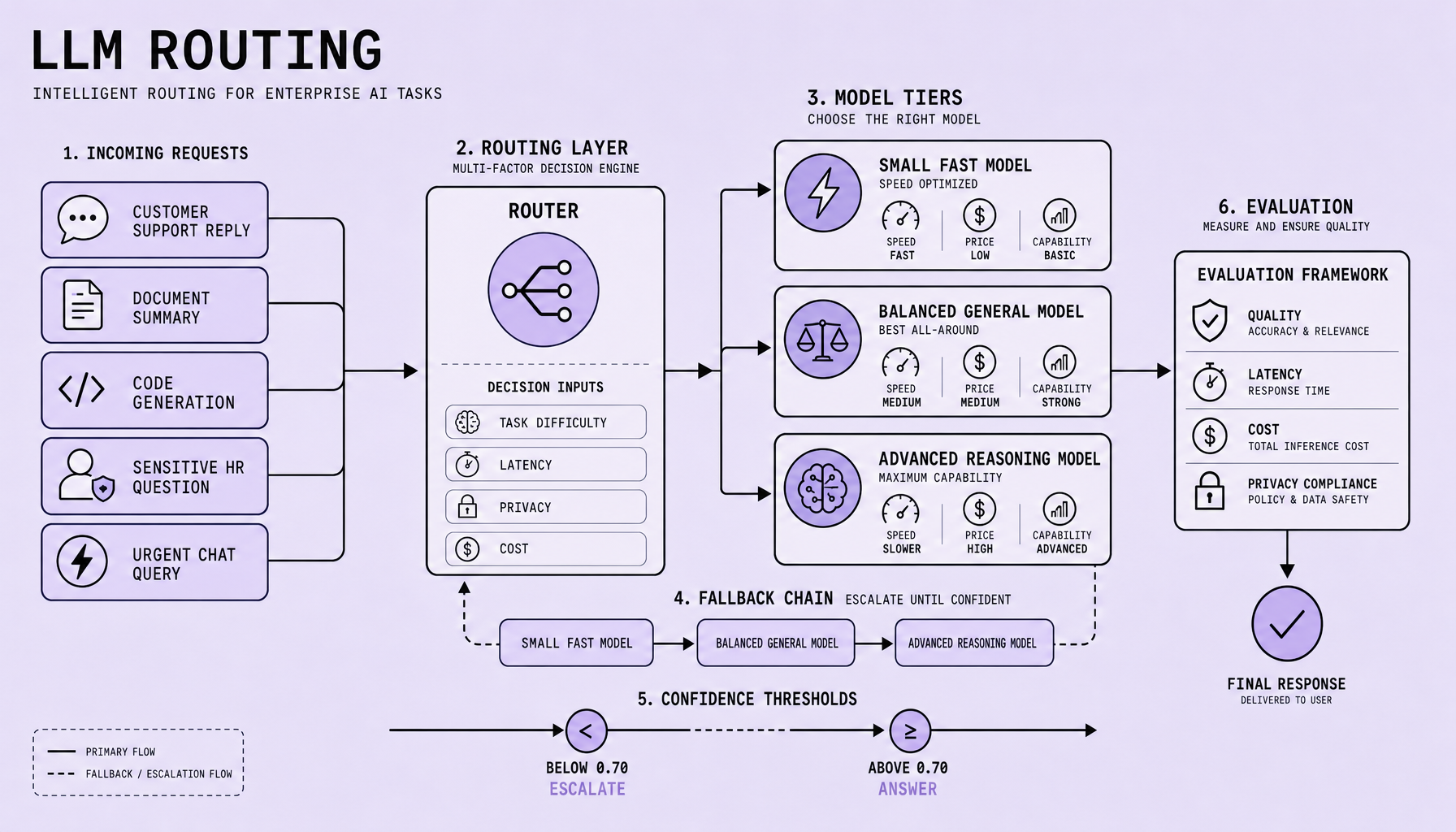
The tradeoff is straightforward: routing only creates value if your guardrails are measurable. If quality checks are weak, any savings from cost-efficient AI can disappear into hidden rework, user frustration, and more human review.
| Setup | Quality fit | Latency | Cost | Governance |
|---|---|---|---|---|
| Single premium model | Strong on hard tasks, wasteful on easy ones | Higher average latency | Highest token spend | Simple policy surface |
| Single small model | Fast on simple tasks, weak on complex ones | Low latency | Low spend | Simple, but higher failure risk |
| Routed system | Better task-to-model fit | Lower average latency when easy tasks stay small | Lower blended cost | Stronger control, more operational logic |
That tradeoff becomes obvious once you operate this in production. AI model optimization usually means defining tiers. For example: route short classification prompts to a small model, send long-context analysis to a premium model, and keep sensitive requests on a private deployment. If the first model returns low confidence or malformed structured output, trigger a model fallback to a stronger model or human handoff.
Start with a narrow routing policy before building a classifier-based router. Use observable signals such as prompt length, task type, PII flags, confidence thresholds, and p95 latency targets. Then evaluate accuracy, escalation rate, throughput, cost per request, and premium-model usage share.
Because monitoring is as important as deployment, you should treat routing as a production system -- not a prompt hack. Without explicit evaluation, model selection becomes guesswork.
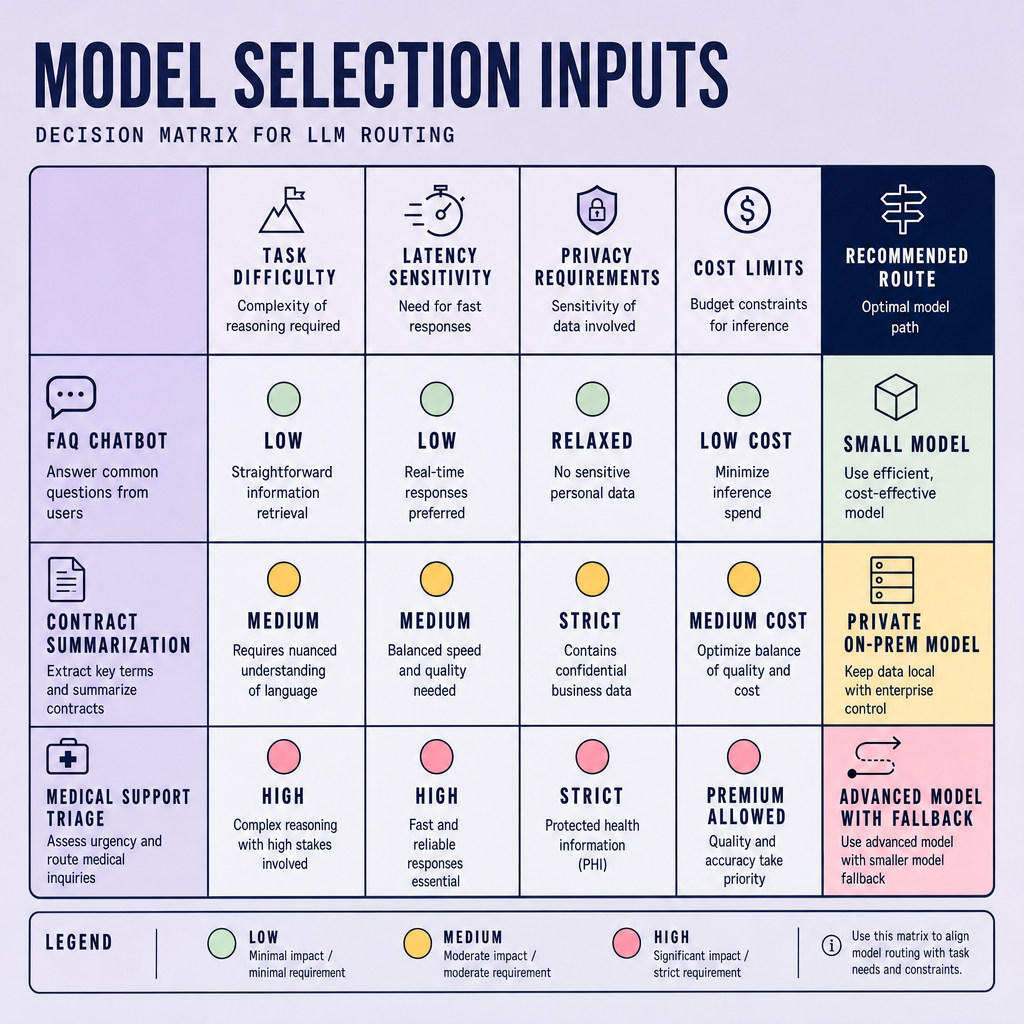
Task Difficulty, Latency, Privacy, and Cost: The Four Inputs Behind Good Model Selection
Bad routing usually fails in predictable ways: easy requests hit expensive models, sensitive requests go down the wrong path, and latency targets get missed because nobody defined what “good enough” meant for each task. Good LLM routing starts with one rule: send each request to the minimum capable model that still clears your quality bar. Not the smartest model by default. Not the cheapest model blindly. The right model selection policy balances four inputs that usually pull against each other.
Task difficulty
Difficulty should be the first filter. A FAQ answer, ticket tagging job, or structured extraction from predictable invoices often fits a smaller model. A legal review request, ambiguous policy interpretation, or multi-document reasoning task usually does not.
The common mistake is routing by team preference instead of task shape. Better signals are prompt type, expected reasoning depth, context window needs, and output format constraints. If the input is short and the output is schema-bound JSON, use a lightweight model first. If the prompt spans long contracts or asks for exception handling across multiple clauses, escalate.
A practical policy: if context exceeds a set threshold or the first-pass model returns low confidence, trigger model fallback to a stronger tier.
Latency sensitivity
Latency changes everything. Real-time inference for chat, voice assistants, or live agent support may need a p95 budget under 2 seconds. An internal batch extraction job can wait longer if it cuts cost.
Route by deadline, not just difficulty. A fast medium-quality answer may be correct for live chat. A slower high-reasoning model may be correct for offline legal review. Rate limits matter too. A great model is useless if it becomes your bottleneck during spikes.
Privacy and data residency
Privacy is a hard constraint, not a preference. If prompts contain PII, employee records, contract drafts, or regulated workflow data, route to an on-prem deployment, private endpoint, or region-specific stack that satisfies data residency rules.
Security should not be optional -- especially for internal HR queries or compliance workflows. Public API convenience is not a valid reason to weaken controls.
Start with a small number of routing signals. Too many policy variables make behavior hard to debug in production.
Cost constraints
Cost-efficient AI comes from disciplined AI model optimization, not aggressive downgrading. High-volume FAQ answering can justify a low-cost model. Token-heavy review, long context window analysis, or repeated retries can quickly erase savings.
Use cost caps per request class. Then evaluate routing quality with accuracy, escalation rate, p95 latency, and cost per request. That is how model selection stays measurable instead of subjective.
Rule-Based vs Classifier-Based LLM Routing
Most teams do better when they stop overengineering this early. Use rules first. Add classifiers when request variety starts breaking your rules.
That is the practical answer for most teams building LLM routing. Rule-based routing is the fastest path to production because the logic is explicit, testable, and easy to audit. You define a policy engine: if the task is extraction, send it to a small model; if prompt length crosses your long-context threshold, switch models; if PII detection fires, route to a private deployment; if the request comes from voice or live chat, honor a tighter latency budget. Clear inputs. Predictable model selection.
Rules work best when your tasks are stable and your constraints are hard. Compliance is the obvious example. A privacy rule should beat a probabilistic guess every time -- security should not be optional. Rules also outperform classifiers for channel-based routing, deterministic prompt size limits, and known high-risk workflows.
Classifier-based LLM model routing solves a different problem: ambiguity. A lightweight intent classifier or complexity classifier can predict whether a request is simple, multi-step, risky, or likely to need a stronger model before you pay for one. This improves AI model optimization when task labels are fuzzy. Example: a customer support prompt that looks short but actually contains policy interpretation, hidden escalation risk, or conflicting account details. A rule based only on length will miss that. A prompt router backed by a classifier often will not.
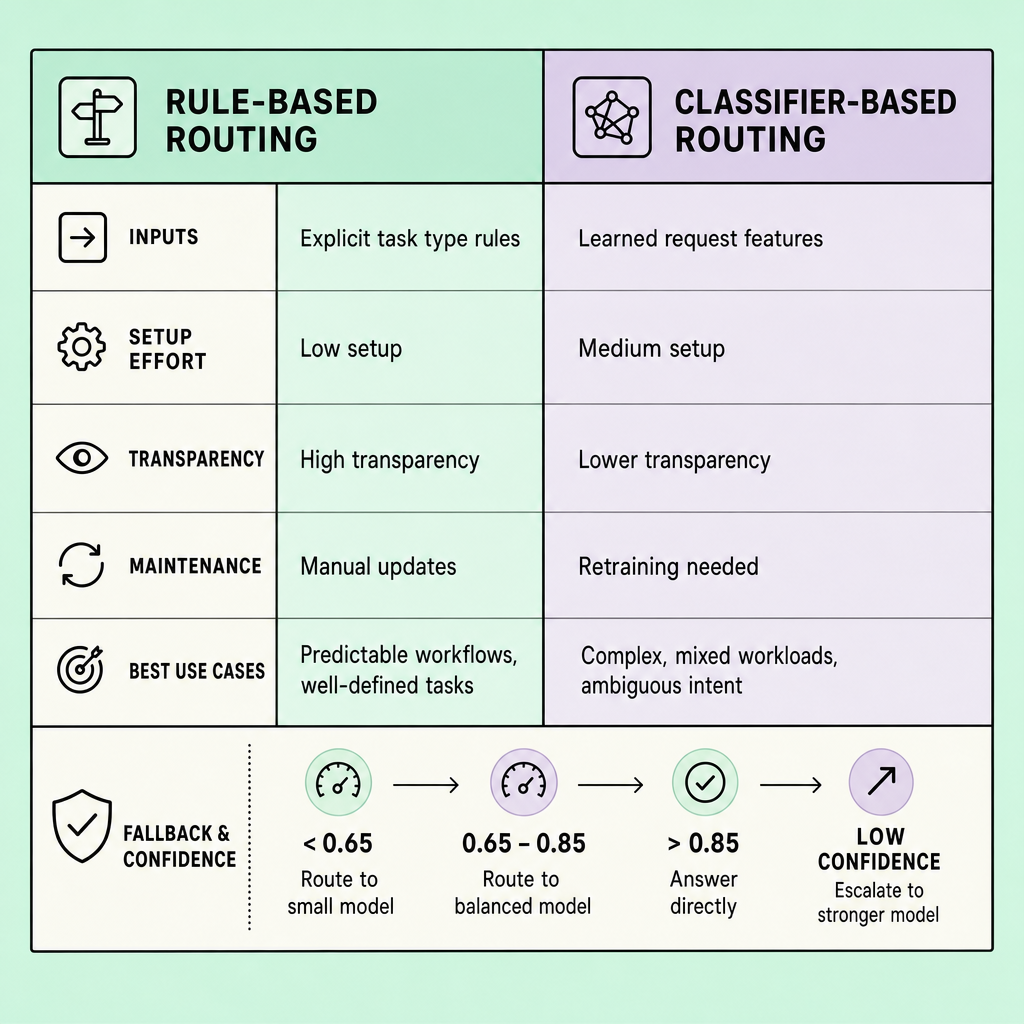
| Approach | Best fit | Main risk | Operational need |
|---|---|---|---|
| Rule-based | Stable tasks, PII detection, latency tiers | Brittle edge cases | Policy engine, tests, logs |
| Classifier-based | Mixed intents, hidden complexity, risk scoring | False routing from bad confidence | Labeled data, threshold tuning, monitoring |
| Hybrid / ensemble routing | Production systems with cost and quality targets | More moving parts | Observability, fallback chain, periodic evaluation |
Where each breaks
This is where the neat architecture diagram usually falls apart. Rules become fragile as exceptions pile up. Classifiers drift, overfit, and add routing latency. So most mature systems combine both: hard rules first, classifier second, fallback chain last. A common pattern is private-route override -> intent classifier -> confidence threshold -> primary model -> escalate on low confidence or failed output validation.
Track routing accuracy, escalation rate, p95 latency, and cost per request. Because monitoring is as important as deployment.
How Model Fallback and Confidence Thresholds Keep Routing Reliable in LLM Routing
First-pass routing is not enough. If you do not plan for weak answers, timeouts, malformed outputs, and policy-triggered reroutes, your “smart” router becomes fragile the moment traffic gets messy. You need escalation logic. Good fallback chains protect uptime, preserve output quality, and keep your cost-efficient AI plan from collapsing the first time a model times out, refuses, or produces a low-confidence answer.
A practical model fallback chain often starts small and cheap, then escalates only when needed. For example: a lightweight model handles FAQ extraction or draft responses; if the answer confidence threshold is low, route to a stronger reasoning model; if the request contains sensitive fields, reroute from a public API to a private deployment instead of escalating publicly. Different trigger. Same goal -- graceful degradation without losing control of privacy or quality.
Reliability is not only about “model down” scenarios. It is also about weak answers. A timeout retry policy might retry once on the same provider, then switch providers, then open a circuit breaker if failures spike. A quality fallback can use classifier scores, moderation results, or a model’s self-evaluation signal to decide whether to escalate or send the case to a human-in-the-loop review queue.
Use thresholds carefully.
If your confidence threshold is too low, weak outputs slip through. Too high, and you over-escalate almost everything to the expensive tier. That silently erases the savings from AI model optimization. In practice, teams should monitor escalation budgets like any other production KPI: escalation rate, timeout rate, threshold-triggered review rate, p95 latency, and cost per request.
Poorly tuned fallback chains do not fail loudly. They fail by looking “safe” while routing too much traffic to the most expensive path.
So tune thresholds against labeled eval sets, not intuition. Test per task type -- summarization, extraction, support triage, compliance review -- because one threshold rarely fits all. Monitoring is as important as deployment here: cascading latency from multi-step fallback chains can turn a fast path into a slow system, even if each individual model looks acceptable on its own.
Done right, fallback chains make model selection more dependable. Done carelessly, they become a hidden tax on quality, latency, and budget.
Frequently Asked Questions
What is LLM routing in a production AI system?
LLM routing is the decision layer that assigns each request to the most appropriate model, provider, or deployment path before generation starts. In production, it acts like policy-driven traffic control that balances quality, speed, cost, compliance, and reliability rather than treating all prompts as equal.
How does LLM routing differ from simple model switching?
Simple model switching usually means manually choosing a different model for a known use case. LLM routing is broader: it applies repeatable logic, thresholds, and fallback behavior automatically at request time. That makes it suitable for live systems where prompt complexity, privacy risk, and traffic conditions vary continuously.
Why should teams set separate routing policies for each business workflow?
Each workflow has a different failure cost, response-time expectation, and compliance profile, so one shared routing policy usually underperforms. A billing chatbot, legal summarizer, and internal HR assistant should not be judged by the same tradeoffs because the acceptable balance between accuracy, latency, privacy, and spend is different in each case.
What is a good first step for cost-efficient AI routing?
A good first step is to segment traffic into a small number of stable classes such as low-risk chat, structured extraction, and high-sensitivity reasoning. This creates a manageable routing baseline, makes evaluation easier, and prevents teams from adding complex logic before they understand their actual traffic patterns and error modes.
How often should you reevaluate model selection and fallback thresholds?
Model selection and fallback thresholds should be reevaluated on a regular schedule and whenever traffic mix, model versions, pricing, or compliance requirements change. Monthly review is a practical baseline for active systems because routing performance can drift even when the application itself appears stable.
Make Imversion a preferred source on Google
Like this kind of AI and software analysis? Add Imversion as a preferred source so Google can highlight our articles for you in Search, AI Overviews, and AI Mode.