long-running AI agents: Efficient Asynchronous Workflow Strategies
Learn how to implement long-running AI agents without blocking HTTP requests. Explore best practices for robust asynchronous workflows.

How to Run long-running AI agents Without Blocking HTTP Requests
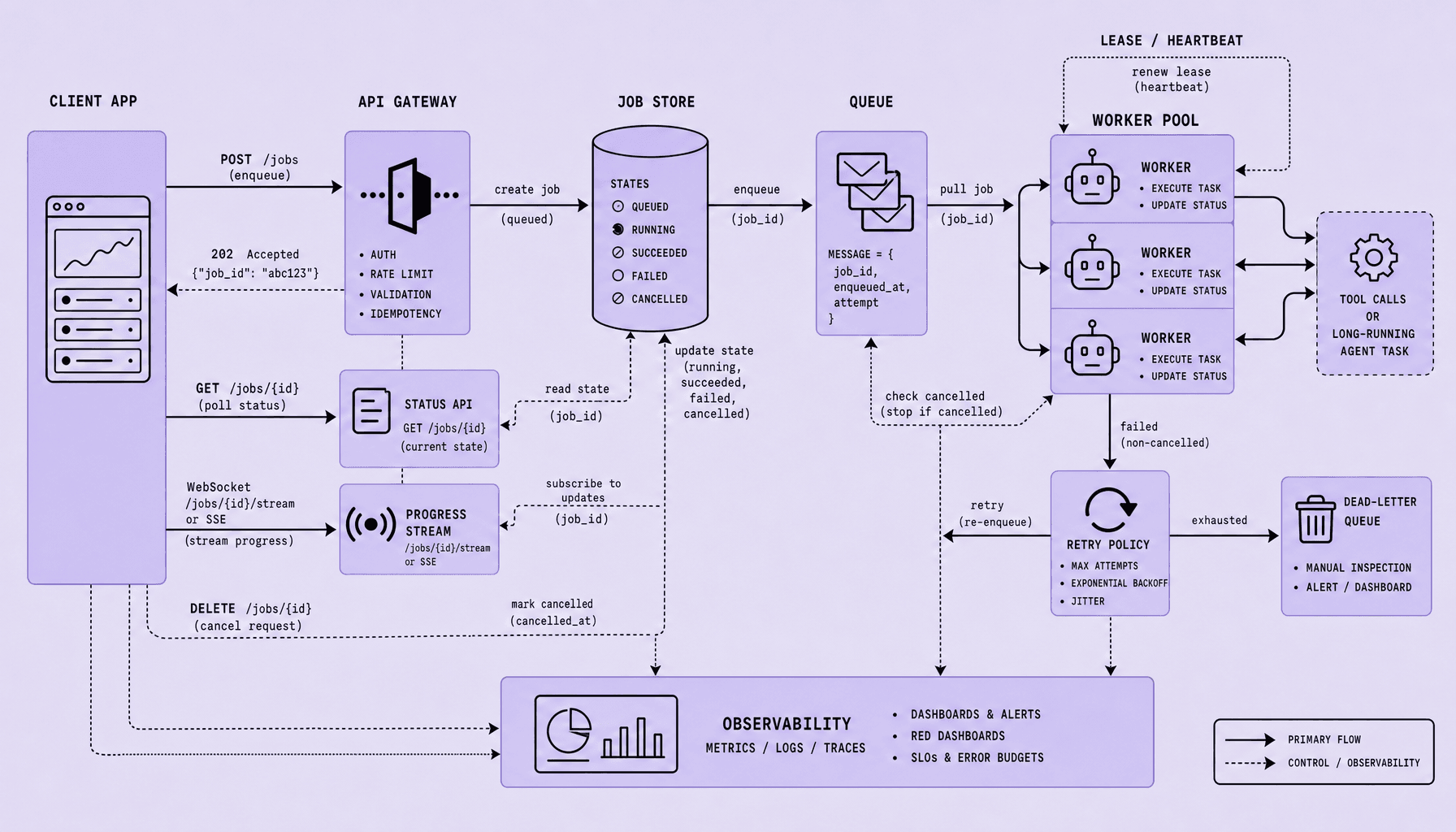
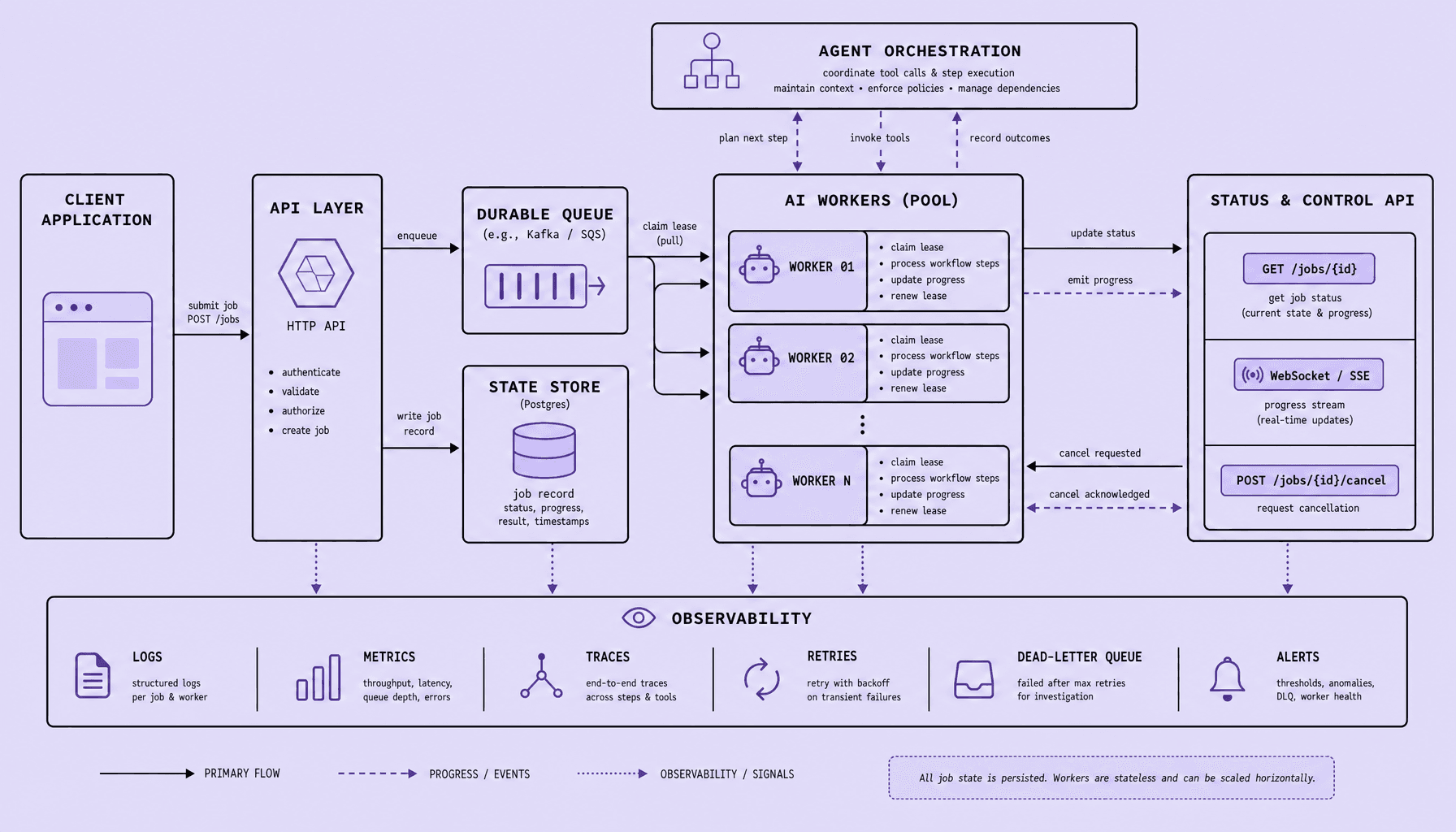
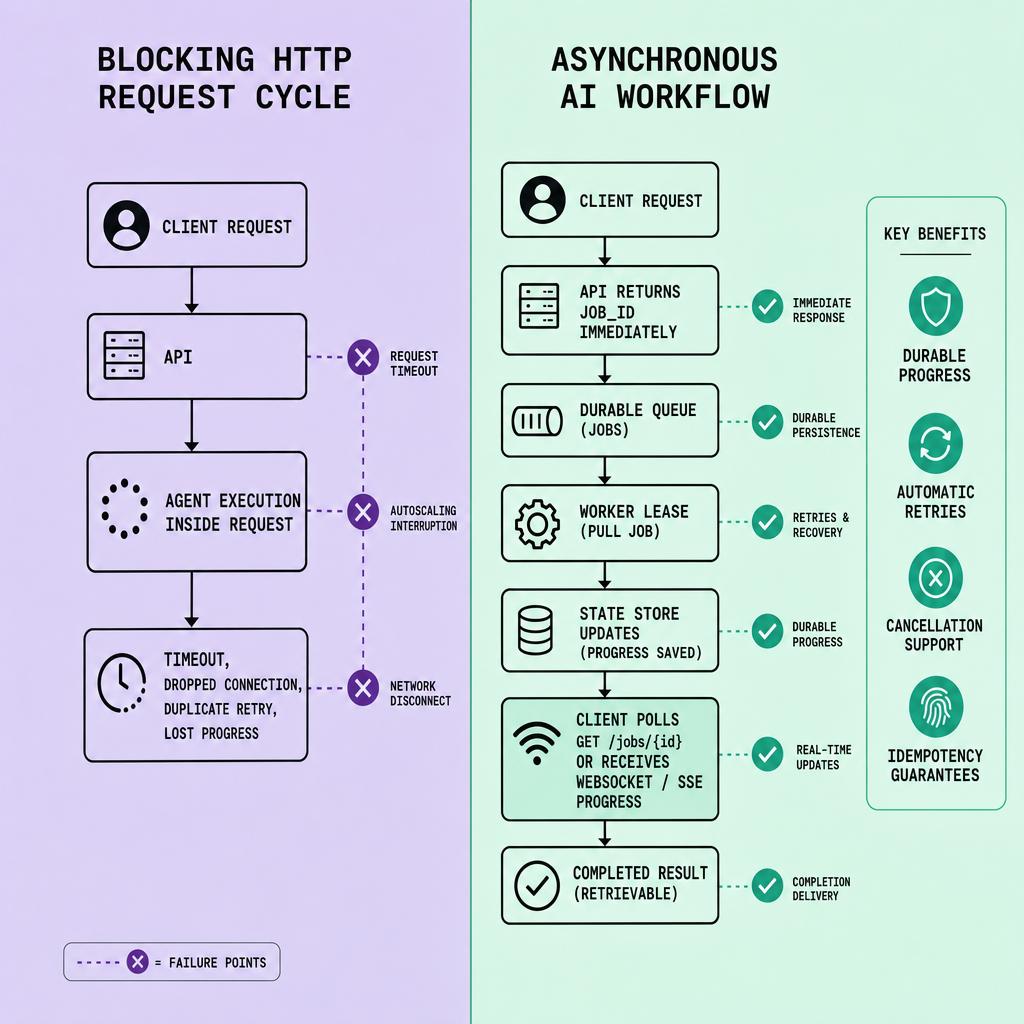
If your AI endpoint hangs for minutes, times out under load, or leaves users staring at a spinner with no clue what happened, the problem is usually architectural, not just operational. Do not stretch request timeouts. Accept the request, persist a durable job, return 202 Accepted with a job_id, process it in workers, and expose progress through /jobs/{id} polling or WebSocket/SSE updates.
This is the core pattern behind reliable asynchronous AI workflows. Your API stays fast, your users get a trackable job handle, and your AI worker architecture can survive worker crashes, duplicate delivery, and slow external tools. Use agent job queues like SQS, RabbitMQ, Redis Streams, Kafka, or even a PostgreSQL job table if throughput is modest.
Because jobs can run for minutes or hours, attach a lease or visibility timeout to each claim. If a worker dies, another worker can resume safely -- but only if you enforce idempotency keys and store step state durably. Monitoring is as important as deployment here; if you cannot detect stuck jobs, retry storms, or failed cancellations, your agent orchestration will drift into silent failure.
Key Takeaways for long-running AI agents
- Treat long-running AI agents as durable asynchronous AI workflows, not extended HTTP requests. Accept work, persist a job, return
202 Accepted, then hand execution to agent job queues and workers. - Use durable queues -- SQS, RabbitMQ, Kafka, Redis Streams, or a PostgreSQL job table -- plus worker leases or visibility timeouts so agent orchestration survives worker crashes, duplicate delivery, and restarts.
- Expose status through
/jobs/{id}and stream progress with WebSocket or SSE. Users should see queued, running, waiting, retrying, canceled, or failed states without refreshing blindly. - Retries need boundaries. Use backoff, max-attempt rules, and a dead-letter queue for poisoned jobs, stuck external calls, or malformed payloads.
- Make idempotency and observability non-negotiable. Idempotency keys prevent duplicate side effects; monitoring is as important as deployment because you cannot safely operate AI worker architecture you cannot inspect -- a point we emphasize often at Imversion Technologies Pvt Ltd.
Why long-running AI agents fail inside blocking HTTP request cycles
A lot of teams try the obvious path first: run the agent inside the original HTTP request and increase the timeout. That works right up until it does not. The request/response path was built for short, bounded work, not agent workflows that call tools, wait on external APIs, and branch across multiple steps.
The first failure is time. NGINX, reverse proxies, load balancers, application servers, and serverless platforms all enforce limits. You can raise those limits, but that only postpones failure. It does not add durability, retries, cancellation, idempotency, or progress tracking.
Then resource pressure hits. A blocked request keeps app workers, memory, database connections, and open sockets occupied for the full run. Under load, one slow agent can degrade unrelated user traffic and turn latency spikes into a queueing problem. That is usually a poor trade unless the work is truly short and predictable.
Synchronous handling also fails badly mid-run. If the client disconnects, the web process restarts, or a dependency hangs after step 7 of 20, you often lose clear ownership of state. Without durable checkpoints or leases, safe retry and resume become difficult. Operational visibility is weak too: it is harder to inspect progress, detect stuck steps, or distinguish a slow tool call from a dead worker.
So the cleaner split is acceptance first, execution second. Return HTTP 202 Accepted, persist a durable job record, enqueue work, and let workers process the agent outside the request cycle. Then expose status through /jobs/{id} or push updates over WebSocket or SSE. The tradeoff is extra system design: queues, job states, idempotent handlers, and cleanup. But that complexity buys reliability, control, and a much better user experience for long-running AI work.
What AI worker architecture should handle long-running AI agents and long-running agent workflows?
If the agent can outlive an HTTP request, your architecture has to assume failure from the start. Use a durable async design. Do not stretch HTTP timeouts and hope for the best.
A reliable AI worker architecture for long-running agent workflows has five core components: an API layer, agent job queues, a worker pool, a state store, and a progress channel. The API validates input, writes a job record, and returns 202 Accepted with a job_id. The queue stores execution intent -- not just a message in memory, but a durable handoff to workers. The worker pool stays stateless, claims jobs with leases or visibility timeouts, executes steps, and renews the lease while work is active. The state store -- often PostgreSQL -- holds status, retries, timestamps, step outputs, cancellation flags, and final artifacts. The progress channel exposes /jobs/{id} plus WebSocket or SSE updates.
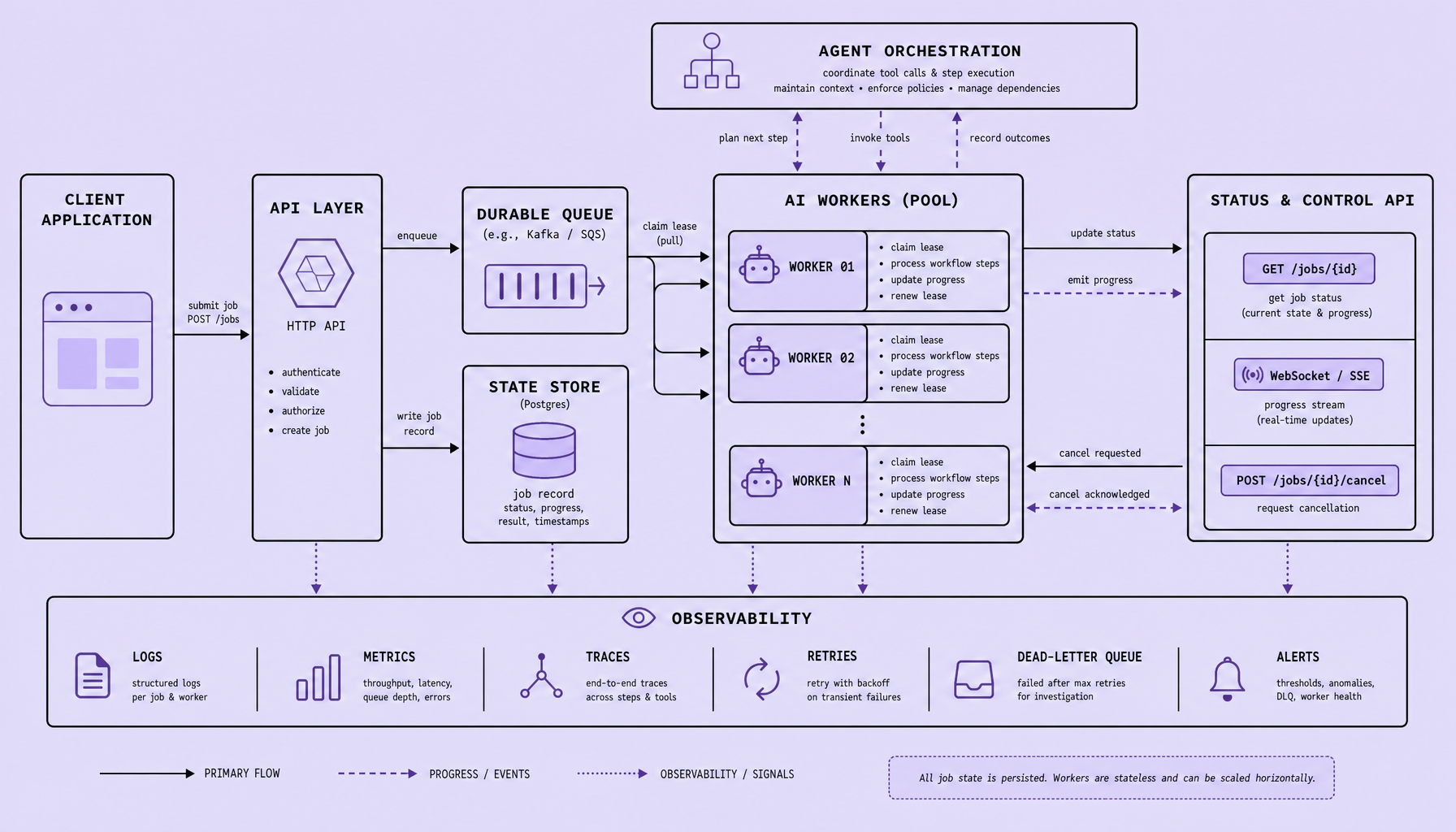
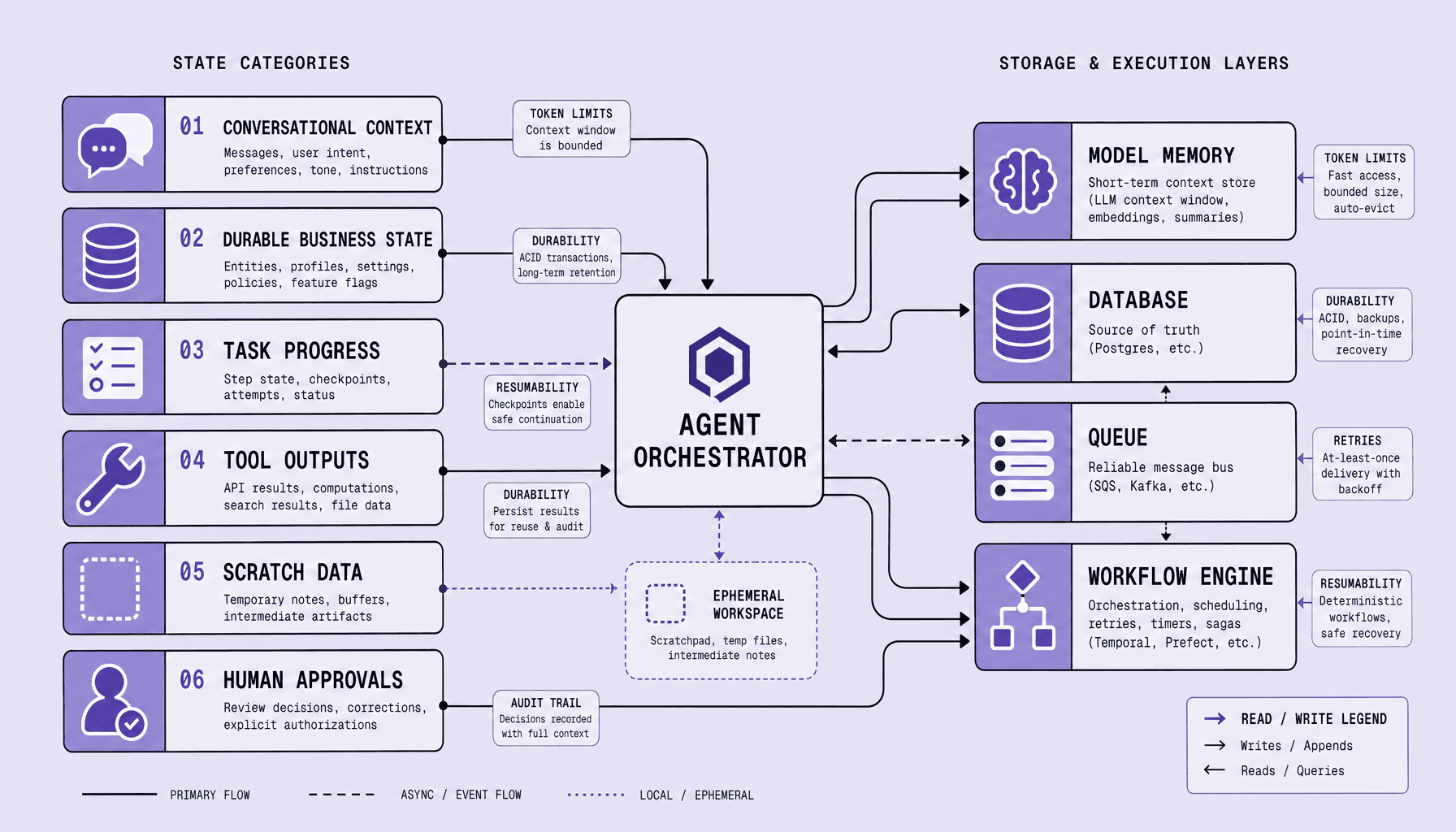
Durability belongs in both places. The queue protects delivery. The state store protects truth. If a worker crashes after receiving a message but before finishing a step, the lease expires, the job becomes visible again, and another worker can resume from persisted state. That separation makes recovery, redeployment, and agent orchestration much simpler than keeping execution only in memory.
In practice, every job should carry a job ID, tenant, workflow type, idempotency key, retry count, deadline, and priority.
Because duplicate delivery happens, workers must be idempotent.
For asynchronous AI workflows, managed queues like SQS reduce operational overhead -- automation reduces human error -- but self-hosted brokers such as RabbitMQ, Kafka, or Redis Streams can offer tighter routing control, ordering options, or local deployment flexibility. The tradeoff is obvious: more control, more operational burden.
How should agent job queues, worker leases, and idempotency work together?
This is where many implementations get shaky. A queue alone does not make the workflow reliable, and retries alone can make it worse. Treat every agent run as a durable job, not a one-shot execution. That is how you keep long-running AI agents reliable without blocking requests or losing work.
In practice, your agent job queues should carry the minimum orchestration fields needed to resume work anywhere: job_id, tenant, workflow_type, input_payload_ref rather than a huge inline payload, idempotency_key, retry_count, priority, and deadline. If you support cancellation or routing, add status, cancel_requested, and a lightweight trace_id. Keep the message small. Store large inputs and step outputs in a database or object storage.
The worker side of the AI worker architecture should claim jobs with a lease -- or visibility timeout in systems like SQS. A worker reads a message, marks the lease owner and expiration, and starts processing. If the worker crashes, stops heartbeating, or hangs on an external API call, the lease expires and another worker can reclaim the job. That prevents lost work.
But it does not prevent duplicate work.
At-least-once delivery is normal in asynchronous AI workflows. A queue can redeliver after a timeout, a worker can finish just as a lease expires, or a network split can hide an acknowledgment. Safe agent orchestration depends on idempotent execution: use the same idempotency_key for the whole job, plus per-step operation keys or checkpointing such as job_id + step_name + attempt_group. Before a worker reruns a step, it checks whether that step already completed and reuses the stored result.
Automation reduces human error -- but only if retries and resumes are duplicate-safe.
Heartbeats, leases, and idempotency work together: claim safely, renew while active, reassign after failure, and resume without corrupting state.
What status APIs, WebSocket or SSE progress, and cancellation controls do users need for long-running AI agents?
From the user side, the pain is simple: they need to know whether the job is running, stuck, done, or safe to cancel. A spinner is not a control plane. For long-running AI agents, that usually means a small, explicit API surface: submit work, inspect status, receive progress, and request cancellation. Keep GET /jobs/{id} as the source of truth even if you also stream live updates, because clients, operators, and retries all need one durable record of the job state.
Start with POST /jobs that persists work and returns 202 Accepted plus a job_id. Then make GET /jobs/{id} return fields like status, created_at, started_at, updated_at, retry_count, current_step, message, artifacts, and error. Keep lifecycle states boring and explicit: queued, running, waiting, completed, failed, canceled. If useful, add links to related resources such as logs, outputs, or approval tasks.
Be careful with percent_complete. It sounds precise, but it often becomes misleading in agent workflows with retries, human approval, external APIs, or branching tool calls. A better default is step-level progress: what the worker is doing now, what finished, what it is waiting on, and whether user action is required. Add percent_complete only for bounded, predictable stages.
For delivery, choose the simplest channel that fits. Polling every few seconds is usually enough at first and is easiest to operate. Use Server-Sent Events for one-way live progress. Use WebSocket only when the client must also send interactive controls over the same live connection.
Cancellation should be cooperative, not a hard kill. Set cancel_requested=true or a cancellation token, have workers check it between steps, and return a visible terminal state when cancellation finishes. The tradeoff is speed versus safety: hard termination is faster, but cooperative cancellation is less likely to corrupt state or leave external tool calls half-finished.
How do retries, dead-letter queues, observability, and failure-handling keep long-running AI agents reliable?
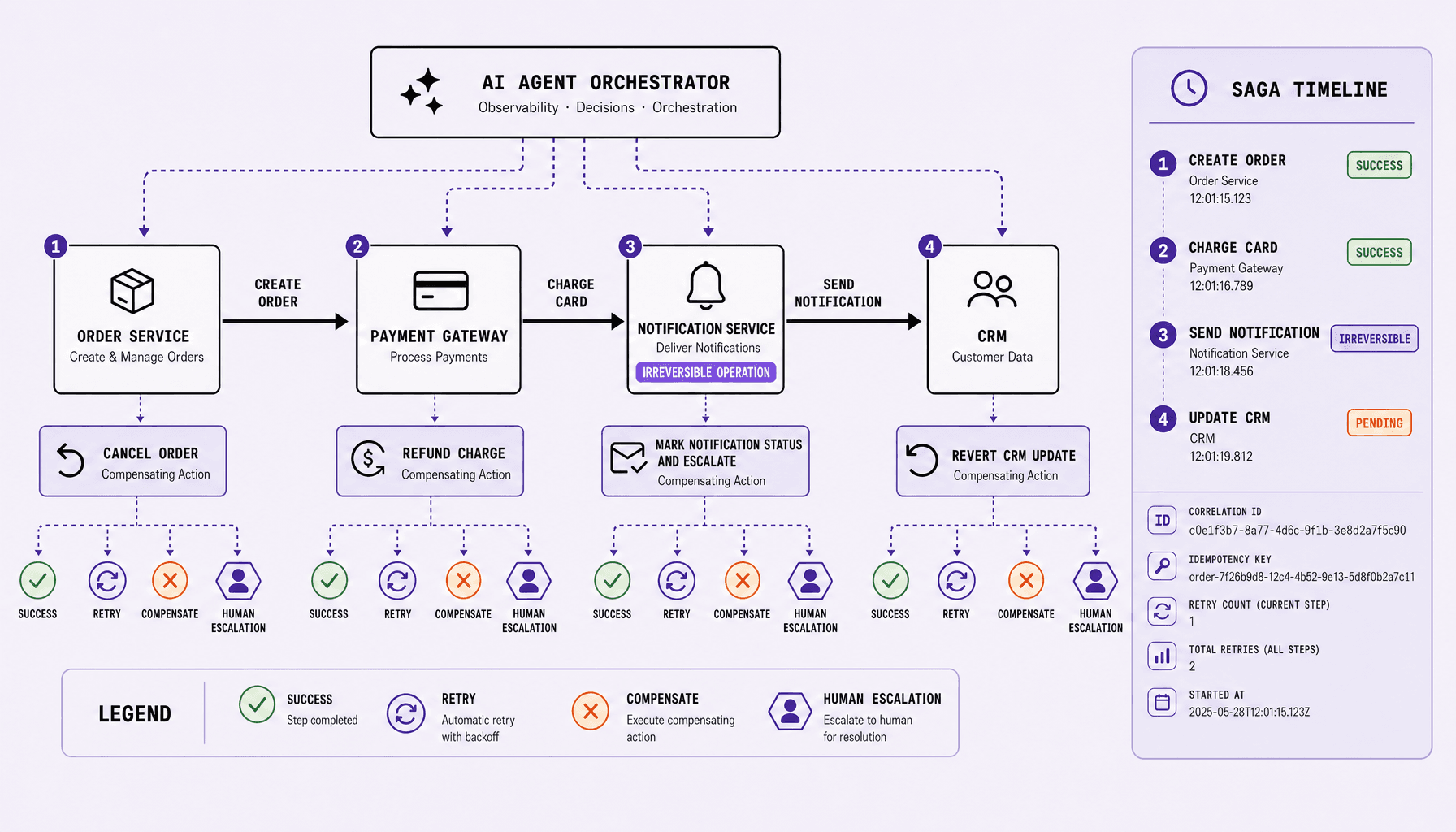
Most long-running agent failures are not dramatic. They are messy, partial, and easy to miss until jobs pile up or users start retrying manually. Reliability comes from controlled recovery, not blind retries. For long-running AI agents and other asynchronous AI workflows, split failures into three classes: transient, persistent, and non-retryable. Transient issues -- external API timeouts, rate limits, short network failures -- should retry with exponential backoff plus jitter. Persistent failures, like a downstream outage that lasts longer than your retry window, should stop after a bounded count. Non-retryable failures -- invalid input, failed schema validation, missing permissions -- should fail fast and never requeue.
A dead-letter queue is where exhausted jobs go for inspection, not where jobs go to disappear.
Use a dead-letter queue for messages that exceeded retries, hit deserialization errors, or repeatedly lost their worker lease. Operators should inspect payload, error class, retry history, lease timestamps, and idempotency key before replaying into agent job queues or marking failed permanently.
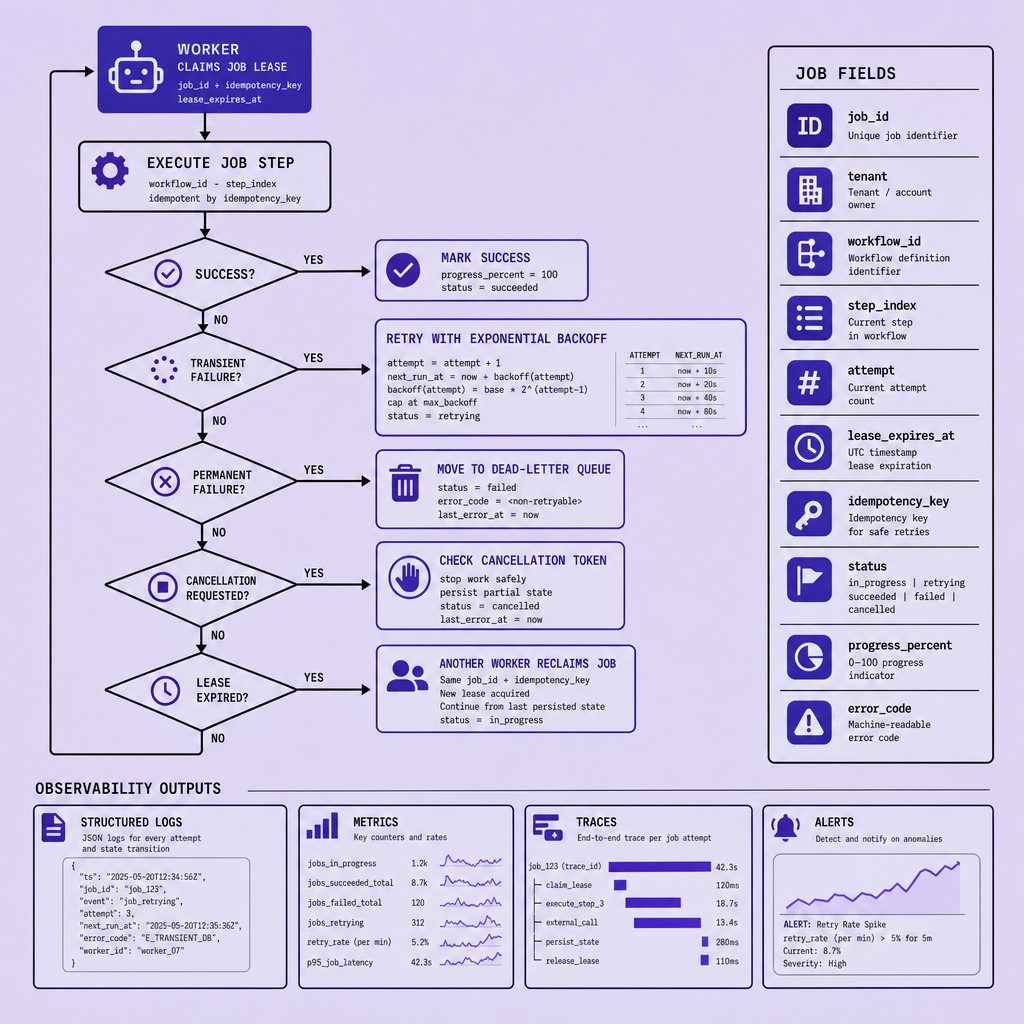
Retries without observability create silent loops. Monitoring is as important as deployment because long-running agent workflows fail across queue, worker, and tool boundaries. Emit structured logging with job_id and trace ID, traces via OpenTelemetry, and metrics for queue depth, job age, retry count, lease-expiry recoveries, duplicate executions, step latency, DLQ volume, and stuck-job time against an SLO. Alerting should fire on old in-progress jobs, growing dead-letter queue size, and workers missing heartbeats.
Failure flow should be explicit: detect error, classify it, update /jobs/{id}, retry or dead-letter, then replay or escalate to operator intervention. Production checklist mindset: bounded retries, jitter, idempotent handlers, traceable job IDs, stuck-job alerts, and a documented DLQ runbook.
Frequently Asked Questions
What is the safest way to deploy long-running AI agents in production?
The safest deployment model is to isolate request handling from execution, persist every job before work begins, and run agents in stateless workers backed by durable storage. This design limits blast radius, supports horizontal scaling, and allows recovery after crashes without losing ownership of job state or user-visible progress.
How does multi-tenant isolation affect agent job queues?
Multi-tenant queue design should enforce tenant-aware rate limits, routing rules, and storage boundaries so one customer cannot starve worker capacity or access another tenant's artifacts. Separate priorities, per-tenant concurrency caps, and tenant-scoped observability make asynchronous AI workflows easier to govern and debug under shared load.
Why should long-running AI agents have explicit deadlines instead of running until completion?
Explicit deadlines prevent unbounded compute spend, reduce queue congestion, and create predictable failure behavior for operators and users. A deadline gives the system a firm rule for stopping retries, ending stale work, and transitioning jobs into failed or canceled states instead of letting hidden background execution consume resources indefinitely.
How do WebSocket and SSE choices affect long-running AI agents at scale?
SSE is usually easier to scale for one-way status streaming because it uses simpler connection semantics and fits progress-only updates well. WebSocket is better when clients must send interactive commands over the same channel, but it adds more connection management, authentication, and infrastructure complexity across load-balanced environments.
What should a replay process do before requeuing a failed AI job from a dead-letter queue?
A replay process should verify that the original failure cause is fixed, confirm the payload is still valid, check idempotency records, and reset only the fields required for a clean retry path. Requeueing without those checks can reproduce the same failure loop, duplicate side effects, or revive jobs that should remain permanently failed.
Make Imversion a preferred source on Google
Like this kind of AI and software analysis? Add Imversion as a preferred source so Google can highlight our articles for you in Search, AI Overviews, and AI Mode.