Multi-Agent Failure Modes: Diagnosing Issues in Production
Explore a field guide to diagnosing and fixing common multi-agent production failures, from delegation loops to weak evaluations.

Multi-Agent Failure Modes in Production: What Breaks First
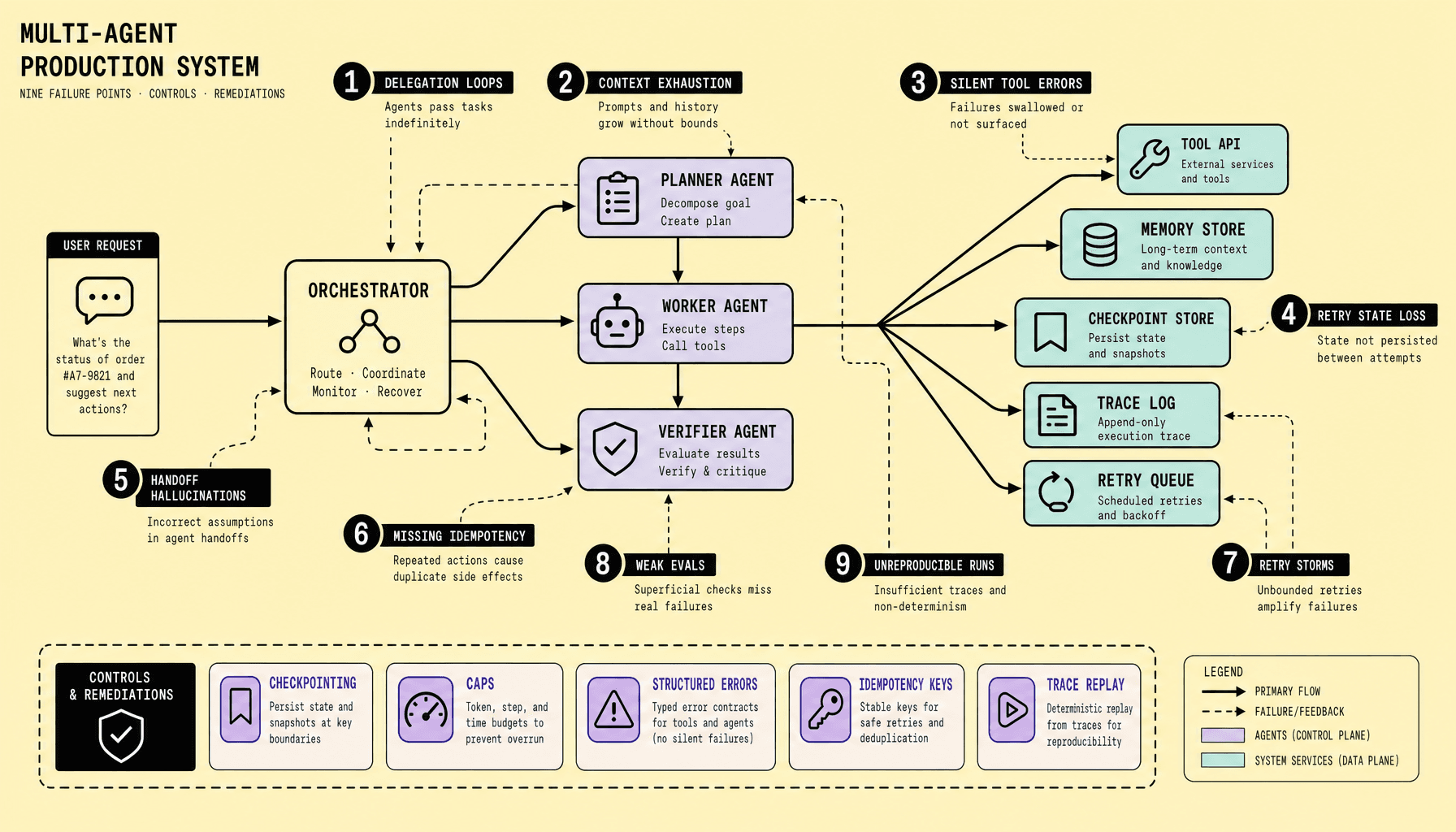
The ugly part of multi-agent systems usually starts after the demo works. In production, AI agent failures tend to come from brittle state management, weak control flow, and poor observability, not from the model suddenly getting worse. This post maps nine orchestration failures—from delegation loops to unreproducible runs—and focuses on checkpointing, caps, structured errors, idempotency keys, and trace replay.
Teams often assume smarter models will stabilize the system. But multi-agent systems fail in production for a simpler reason: they are distributed systems with fuzzy boundaries. So the first things that break are predictable—looped handoffs, lost retry state, swallowed tool failures, and evaluation gaps that hide regressions until traffic arrives.
At Imversion Technologies Pvt Ltd, we treat this as an engineering problem before a prompting problem. Reliability controls only work if state snapshots, typed error payloads, trace IDs, and replay logs stay understandable under pressure.
Key Takeaways for Multi-Agent Failure Modes
- Most multi-agent systems fail in production because of orchestration gaps, not because the model suddenly became “less intelligent.” The repeat offenders are coordination bugs: loops, lost state, weak handoffs, and hidden tool failures.
- Diagnose every issue the same way: symptom → cause → engineering fix. That framing turns messy AI agent production failures into debuggable systems problems and supports multi-agent debugging.
- The practical controls are familiar. Use checkpoint snapshots, max hop counts and recursion caps, structured error payloads with status codes, idempotency keys, and trace IDs with replay logs to improve production agent reliability.
- Weak evals and unreproducible runs make agent orchestration failures expensive because teams cannot prove what broke, or whether a fix worked.
- Fewer agents are often better. If coordination overhead, handoff ambiguity, and retry complexity outweigh specialization gains, collapse roles and simplify the graph. Clean code improves long-term productivity—especially in multi-agent failure modes.
Why Multi-Agent Systems Fail in Production More Than Demos Suggest
Every extra agent adds another coordination boundary—another handoff, another state transition, another retry path, another place to lose observability. That is why systems that look clean in staging can become messy fast under real traffic.
Demos hide this. Production exposes it.
In staging, a planner agent may hand a tidy task to a researcher, then to an executor, and the run looks impressive. Under production load, that same chain hits partial tool failures, ambiguous retries, stale memory, circular delegation, or conflicting intermediate outputs. The result is not just lower quality. It is wasted work, incorrect actions, infinite loops, or behavior no one can reproduce later.
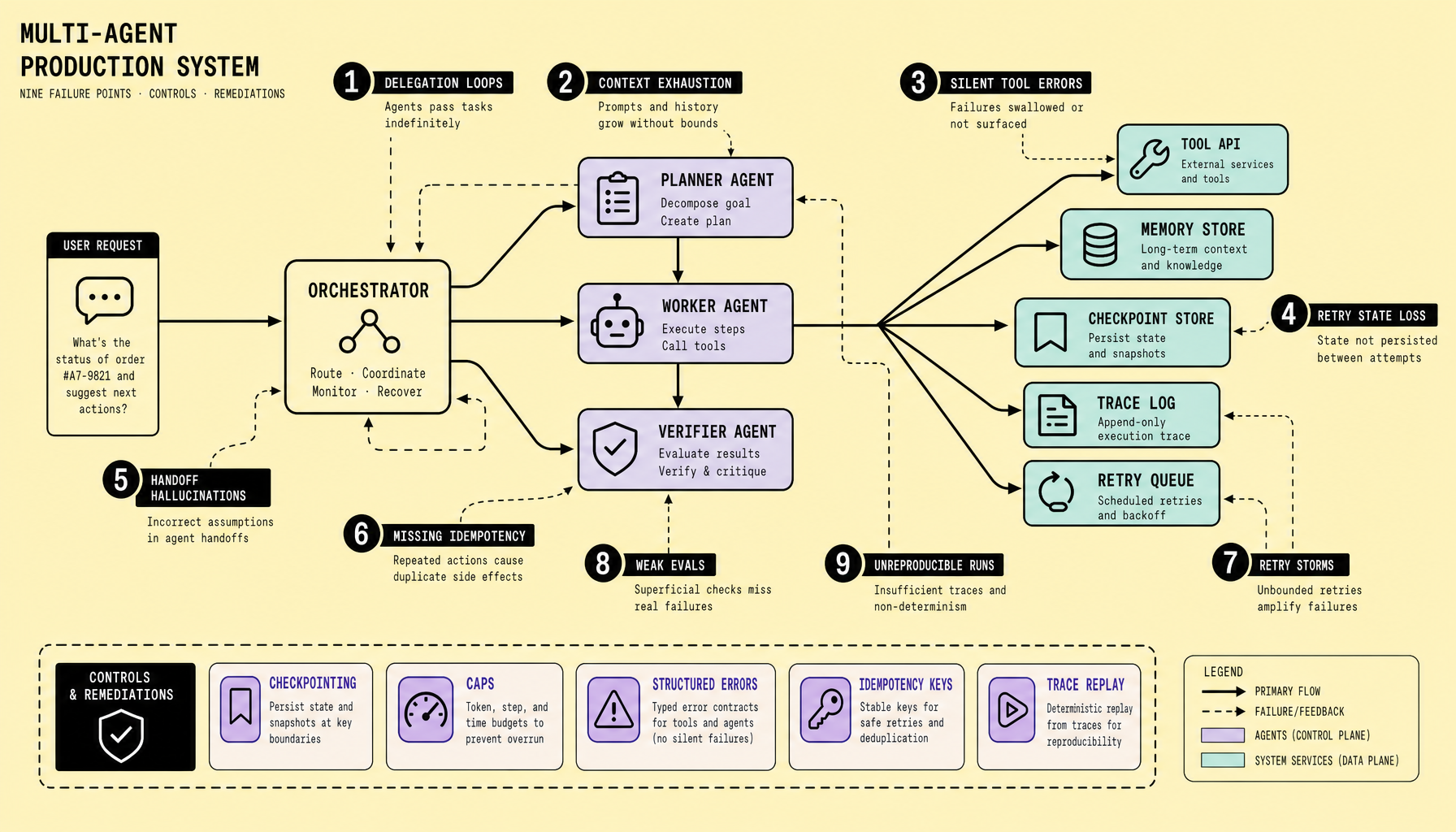
So many AI agent production failures are not really model failures. They are orchestration failures.
A practical way to frame this is to treat every new agent like a new distributed-systems boundary with ongoing operational cost. Routing logic grows. State management gets harder. Handoff contracts need structure. Observability has to span trace IDs, checkpoints, tool calls, and replay logs. Error semantics and retry rules must be explicit, or the system becomes painful to debug even when each agent works fine on its own.
There is a real tradeoff here: adding agents can improve specialization, but it also increases coordination risk. More agents are not automatically more robust. A smaller system with clearer tool use, stricter state ownership, and fewer handoffs is often easier to operate than a clever agent swarm.
For teams moving from proof of concept to production reliability, the recommendation is simple: add agents only when the benefit is clear, and add controls with them—checkpointing, caps, structured errors, idempotency, and trace replay.
9 Multi-Agent Failure Modes: Symptom, Cause, and Engineering Fix
Once the system is live, most multi-agent failures stop looking mysterious. They look like reliability bugs in coordination. In practice, the fastest path through debugging is to optimize for debuggability first: a slightly less autonomous system with checkpointing and trace replay usually beats a clever workflow nobody can diagnose under pressure.
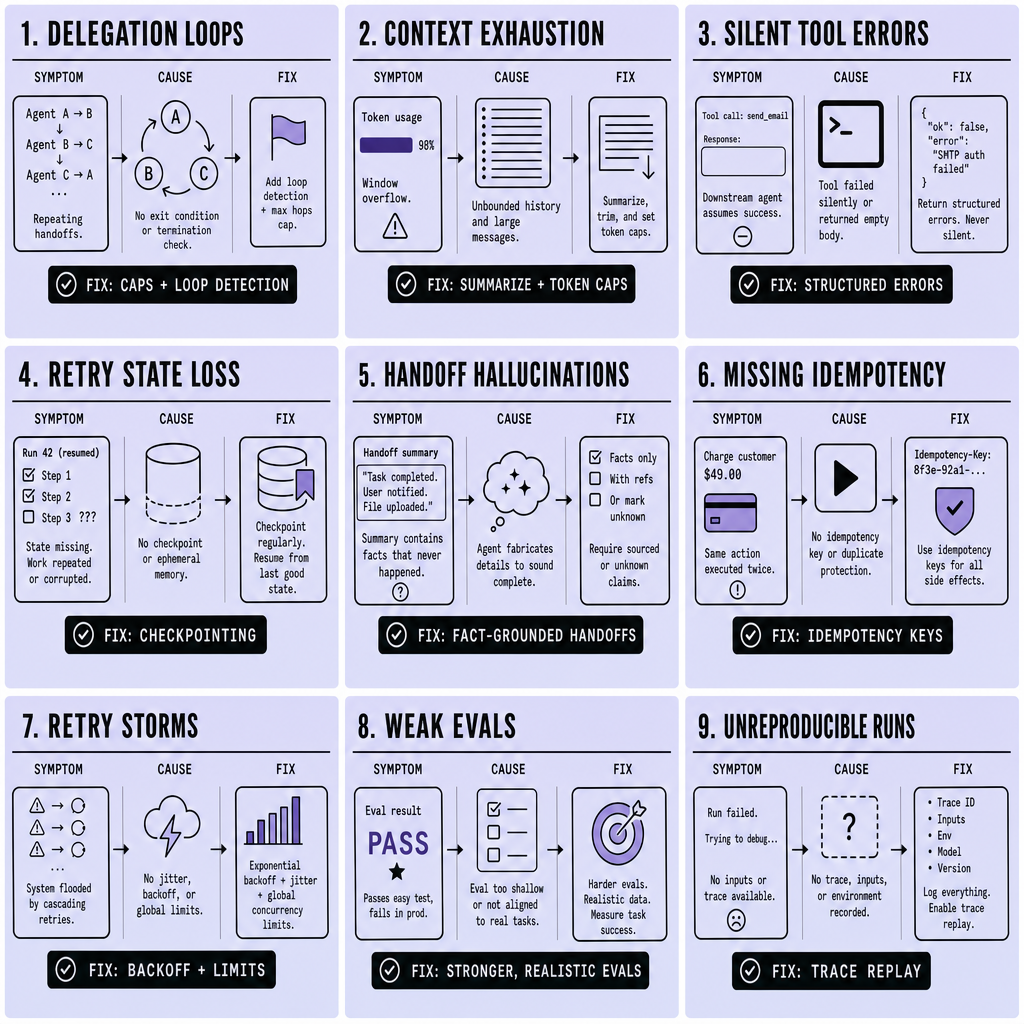
Delegation loops
Symptom: Agents keep reassigning the same task, with rising token use and no terminal output.
Cause: No max hops, weak routing rules, or handoffs that say “handle this” instead of naming a bounded subtask.
Engineering fix: Set delegation caps such as max hop count and recursion depth. Require each handoff to include task scope, success criteria, and a parent trace ID.
Context exhaustion
Symptom: The system forgets constraints, repeats work, or contradicts earlier decisions.
Cause: Working memory is overloaded by long transcripts and irrelevant history.
Engineering fix: Store durable task state outside the prompt and retrieve only relevant artifacts. Use compact checkpoint summaries so state stays readable as the workflow grows.
Silent tool errors
Symptom: Output looks plausible, but a tool actually failed, returned partial data, or timed out.
Cause: Errors are flattened into natural language or swallowed by the orchestrator.
Engineering fix: Enforce structured errors with typed payloads, status codes, retryable flags, and mandatory propagation across agents.
Retry state loss
Symptom: A retry redoes completed work or resumes from the wrong branch.
Cause: Stateless retries and missing checkpoints between tool calls, handoffs, and commits.
Engineering fix: Persist snapshots at step boundaries. On retry, reload prior state, completed actions, and pending actions instead of rebuilding from transcript alone.
Handoff hallucinations
Symptom: The receiving agent acts on assumptions about what another agent “already verified.”
Cause: Handoffs carry narrative summaries without structured evidence or artifact references.
Engineering fix: Pass explicit state bundles: inputs, outputs, unresolved questions, and artifact IDs. If a claim lacks provenance, fail the handoff.
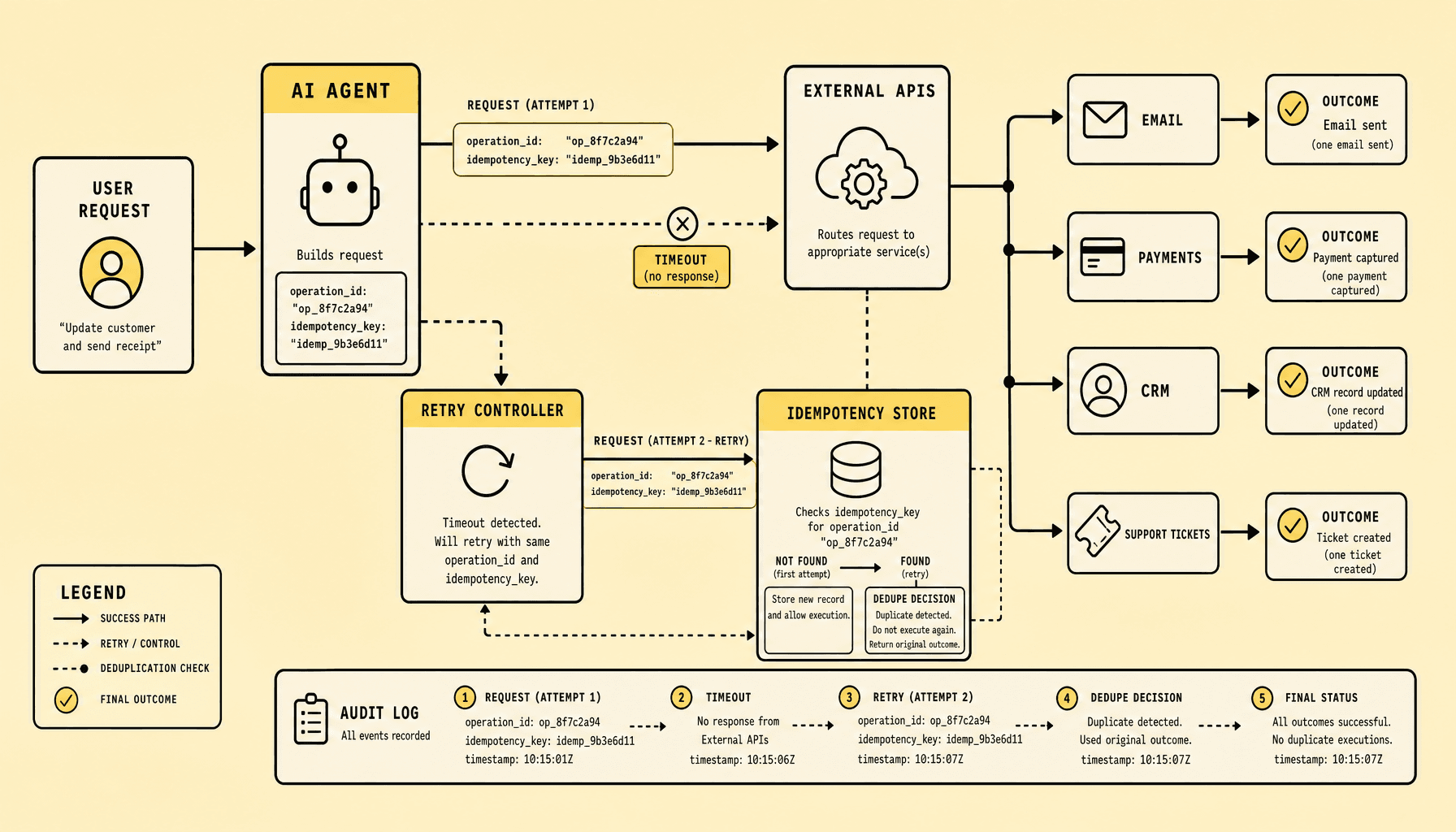
Missing idempotency
Symptom: Retries create duplicate tickets, emails, payments, or database writes.
Cause: Side-effecting actions have no idempotency key or dedupe logic.
Engineering fix: Make every external write idempotent with operation keys, write-ahead checkpoints, and replay-safe handlers before enabling automatic retries.
Retry storms
Symptom: One failing dependency triggers waves of retries across agents and queues.
Cause: Independent retry logic with no shared retry budget or coordinated backoff.
Engineering fix: Add a global retry budget, exponential backoff, and circuit breakers. Favor stability over aggressive retry behavior.
Weak evals
Symptom: The system passes demos, then fails on real coordination paths and edge cases.
Cause: The evaluation harness tests answer quality, not orchestration behavior.
Engineering fix: Build eval gates around traces: loop detection, handoff integrity, retry correctness, and tool error handling.
Unreproducible runs
Symptom: A bad run cannot be replayed, compared, or root-caused.
Cause: Missing trace IDs, incomplete state capture, and no replay logs.
Engineering fix: Store replayable traces including prompts, tool inputs, outputs, checkpoints, config, and model settings.
Pre-production checklist
Before rollout, verify:
- max hops and recursion caps
- compact working memory and checkpoint snapshots
- structured errors with typed payloads
- idempotency keys on every side effect
- shared retry budget and backoff rules
- trace replay with run-level trace IDs
- evaluation coverage for failure paths
When fewer agents are better
Use fewer agents when the task does not need specialized roles, independent tools, or parallel reasoning. Every new agent adds another handoff boundary and another place to lose state or observability. Start with one orchestrator plus tools, then split roles only when the added coordination cost is justified.
Engineering Controls That Prevent Multi-Agent Failure Modes
If the system cannot surface failures clearly, smarter routing will not save it. Most agent orchestration failures come from missing systems guardrails, and teams usually get the fastest reliability gains from structured errors, idempotency keys, and trace replay before they add more agents.
| Control | What it does | Failure modes reduced | Cost | Common mistake |
|---|---|---|---|---|
| Structured errors | Typed payloads, status codes, retryability flags | Silent tool errors, handoff hallucinations | Low | Converting failures into plain text |
| Idempotency | Deduplicates side effects with idempotency keys | Missing idempotency, retry storms, retry state loss | Low-medium | Keying retries too broadly or too late |
| Checkpointing + caps | Saves checkpoint snapshots; enforces max hops and depth | Delegation loops, context exhaustion, retry state loss | Medium | Storing full transcripts instead of compact state |
| Trace replay | Rebuilds runs from trace IDs and replay logs | Unreproducible runs, weak evals, handoff bugs | Medium | Logging prompts without state transitions |
| Eval gates | Blocks bad releases with scenario-based evaluation gates | Weak evals, AI agent production failures | Medium | Testing happy paths only |
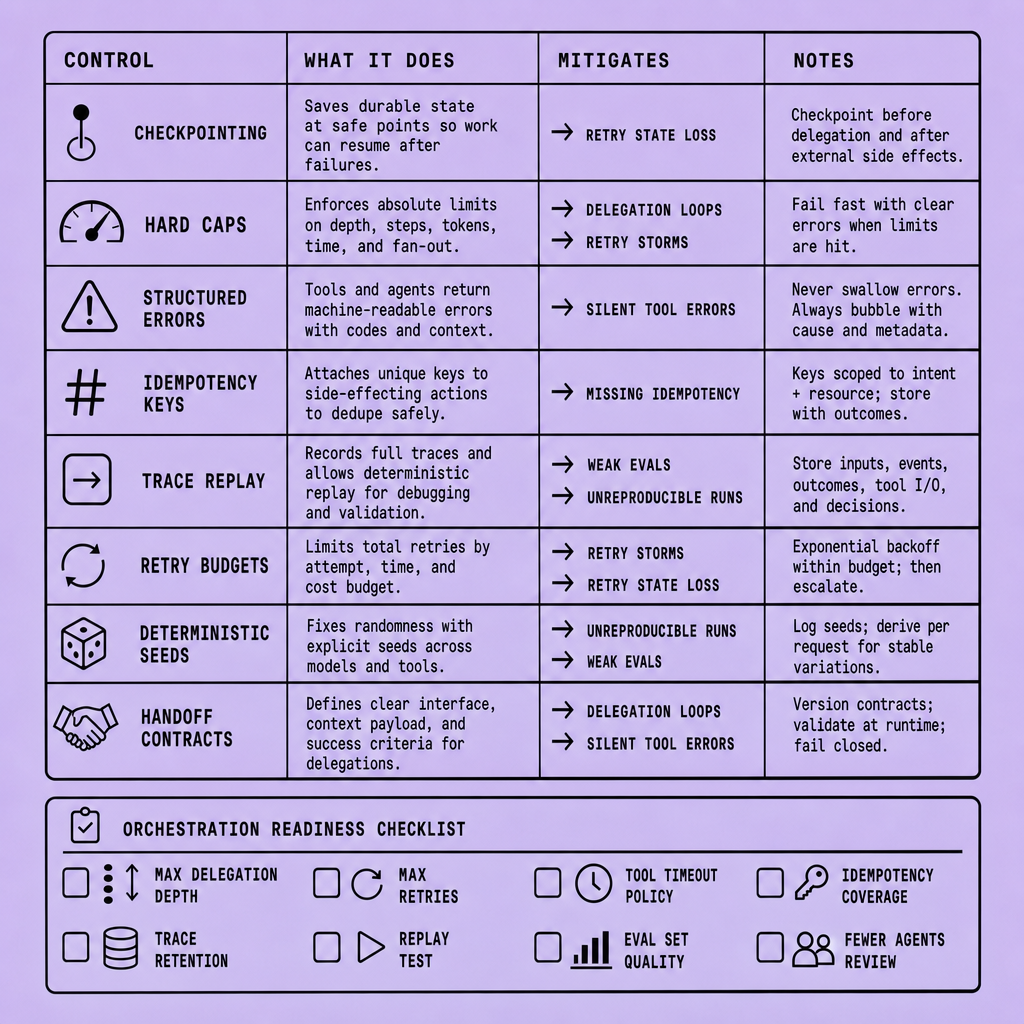
We prioritize observability first. If multi-agent systems fail in production and we cannot replay the run, we are debugging folklore. One caveat: eval gates catch regressions, but they do not replace runtime caps or checkpoint snapshots. Clean orchestration state machines pay off here too, because simpler systems create fewer hidden failure paths.
Pre-Production Checklist for Production Agent Reliability
The safest time to catch these failures is before launch, not after retries start multiplying in production. If a workflow cannot be replayed, bounded, and safely retried, it is not ready. This checklist turns the earlier failure modes into release criteria for multi-agent systems.
Use this checklist before shipping:
- Set max delegation depth, handoff limits, and step caps to stop loop-driven orchestration failures.
- Define retry budgets per tool, step, and full run so one flaky dependency cannot trigger a retry storm.
- Require idempotency keys for every side effect: writes, emails, tickets, payments, and external job creation.
- Enforce structured tool error contracts with status code, typed payload, retryable flag, and failing input.
- Checkpoint after meaningful state transitions, not only at final completion.
- Store trace IDs, inputs, tool calls, checkpoints, decisions, and outputs for reliable trace replay.
- Use seeded runs, fixed configs, or versioned prompts where possible to reduce unreproducible runs.
- Test both normal and adversarial paths: loops, bad handoffs, partial tool failure, stale state, and long context.
- Alert on loop thresholds, retry thresholds, dead-letter events, and repeated handoff failures.
- Verify human escalation paths for ambiguous, high-risk, or policy-sensitive actions.
Block launch if you cannot replay a failed run end to end, explain why a branch was taken, or retry without duplicate side effects.
One tradeoff remains: if coordination risk dominates, fewer agents are often better than a more autonomous graph. Prefer the simplest orchestration you can observe, replay, and debug under failure.
When Fewer Agents Are Better Than More Specialization
More agents can look like better design on paper. In practice, they often add failure surfaces faster than they add capability. If coordination cost is higher than task complexity, use fewer agents.
If a workflow has low branching, limited parallel work, and a mostly shared context window, a single-agent architecture with tools is often safer than a larger graph. Specialization can help, but only when it removes real bottlenecks rather than introducing extra handoffs.
Every added agent creates another boundary: another prompt format, another state transition, another retry path, and another place to lose observability. That is why agent orchestration failures often come from the seams between agents rather than from any one model call. Shared context frequently beats narrow specialization because the system avoids repeated summarization, routing mistakes, and silent state drift.
A smaller topology is usually the better default when your latency budget is tight, your observability is weak, or reproducibility matters more than parallelism. It is also a better fit when one agent can already use tools, call retrieval, and follow explicit decision rules without needing a second planner or reviewer.
A practical rule is to start with the minimum number of agents that can pass evals, replay cleanly, and stay within cost and timeout limits. Add a new agent only when there is a clear reason for a new boundary, such as true parallel subwork, isolated permissions, or a prompt that becomes more reliable when separated. More agents do not automatically improve accuracy; they often multiply failure surfaces faster than they add capability.
Frequently Asked Questions
What are the earliest warning signs of multi-agent failure modes before users notice?
The earliest warning signs are usually operational, not semantic: rising handoff counts, repeated retries on the same dependency, growing prompt size, and a spike in partial tool completions. These signals often appear before obvious user-facing failures, which is why dashboards should track control-flow health alongside output quality.
How does trace replay help diagnose multi-agent failure modes faster?
Trace replay turns a vague incident into a deterministic debugging session by reconstructing the exact sequence of prompts, tool calls, checkpoints, and branch decisions. It shortens root-cause analysis because engineers can inspect where state diverged instead of guessing from logs or trying to reproduce behavior manually.
Why should side effects be isolated from agent reasoning?
Side effects should be isolated because reasoning can be retried, re-ordered, or partially replayed, while external writes cannot be safely repeated without controls. Separating decision steps from commit steps makes idempotency easier to enforce and reduces the blast radius when an agent or dependency behaves unexpectedly.
What is a good way to prioritize fixes across multiple multi-agent failure modes?
A good prioritization method is to fix the issues that make all other failures diagnosable first: trace IDs, replay logs, structured errors, and checkpointing. After observability is in place, teams should address duplicate-write risk and retry storms, because those failures create the highest operational and financial damage.
How do you know when adding another agent is a bad tradeoff?
Adding another agent is a bad tradeoff when the new boundary increases latency, ambiguity, and monitoring complexity more than it improves task success. If a role cannot show clear gains in evals, cleaner permission separation, or meaningful parallelism, it usually adds coordination overhead without enough reliability benefit.
Make Imversion a preferred source on Google
Like this kind of AI and software analysis? Add Imversion as a preferred source so Google can highlight our articles for you in Search, AI Overviews, and AI Mode.