Secure Enterprise RAG: Enforcing User-Level Access Control Best Practi
Learn how secure enterprise RAG can enhance retrieval security with user-level access control, ACL filtering, and effective compliance strategies.

On this page
What Secure Enterprise RAG Requires to Enforce User-Level Access Control
Most RAG security failures do not start with the model. They start one step earlier, where retrieval pulls data it never should have seen. If your secure RAG pipeline cannot prove that access checks happen before retrieval results are assembled, it is not enterprise RAG in any meaningful sense.
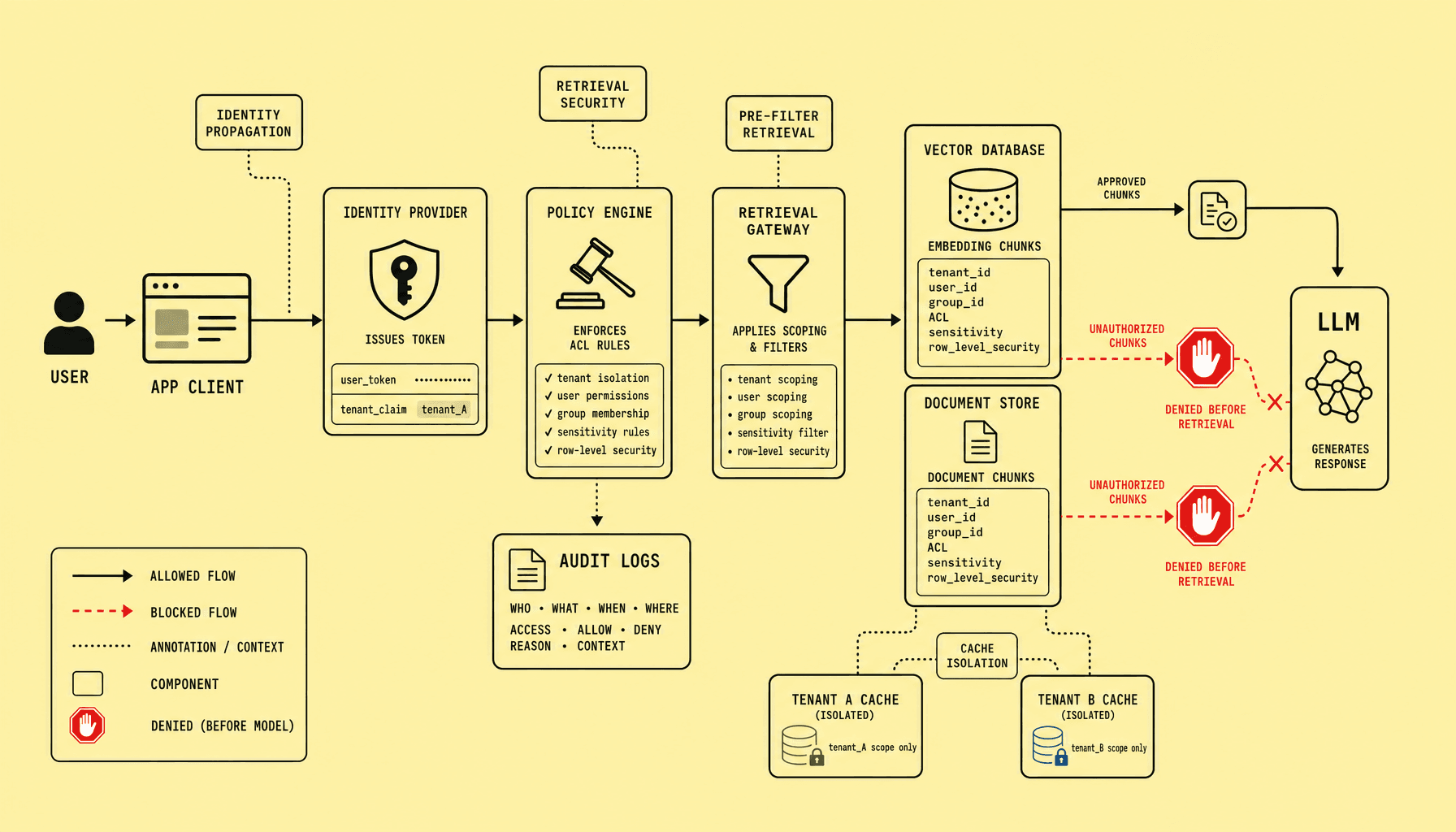
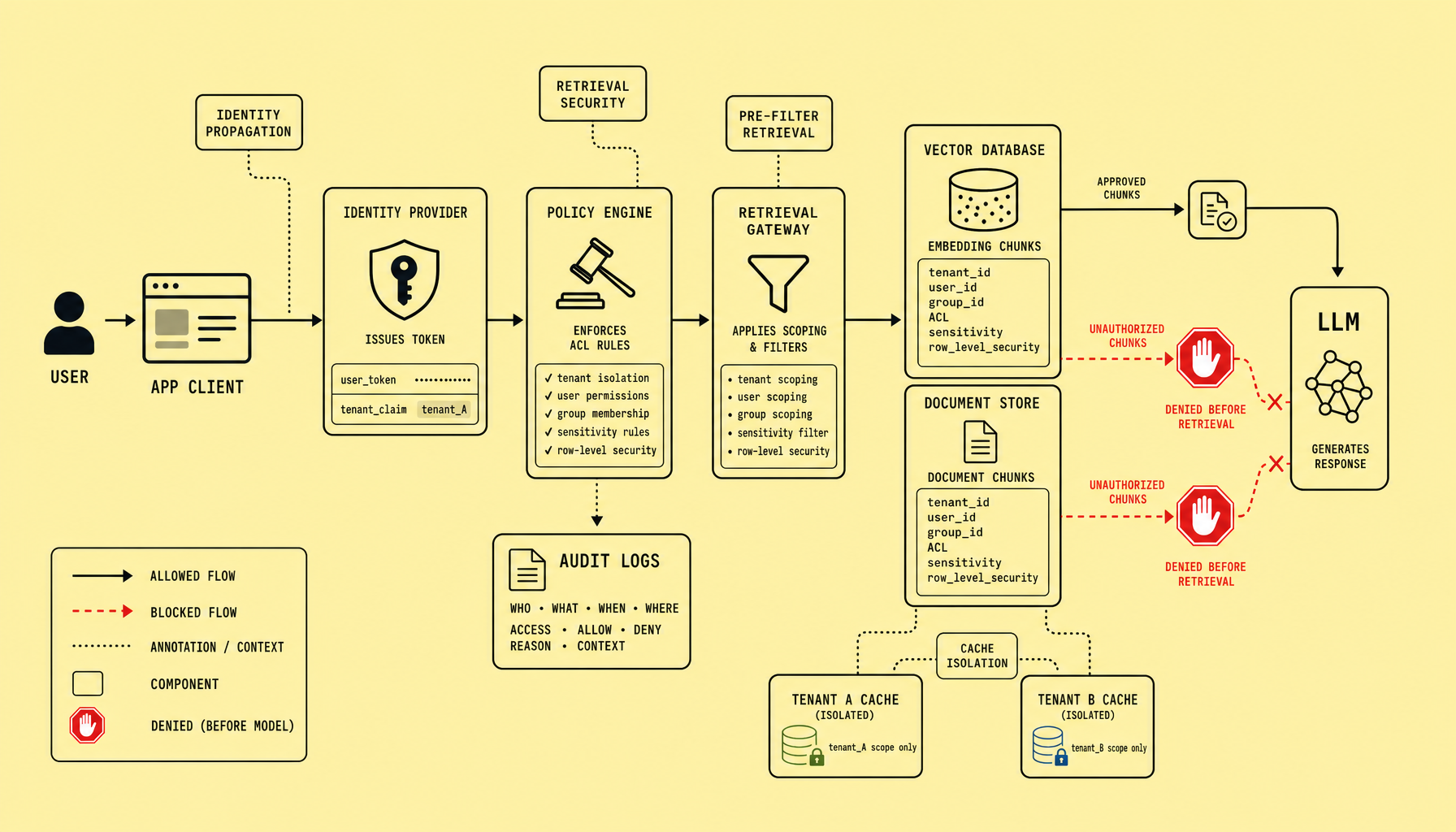
The minimum control set is straightforward: propagate user and tenant identity into retrieval, index chunks with metadata like tenant_id, user_id, group_id, and classification, enforce row-level security or equivalent ACL filtering at the search tier, isolate caches by tenant and permission context, and log every retrieval decision. Pre-filter retrieval should be your default -- post-filtering is weaker because unauthorized chunks can still affect ranking, traces, or intermediate caches. Security should not be optional. At Imversion Technologies Pvt Ltd, I’d treat prompt assembly tracing and adversarial access tests as required proof, not nice-to-have validation.
Key Takeaways for Secure Enterprise RAG
- In secure enterprise RAG, containment beats recall: pre-filter retrieval is safer than post-filtering because unauthorized chunks never enter ranking, cache paths, logs, or prompt assembly.
- Tenant and user scoping work by attaching metadata like
tenant_id,user_id,group_id, and classification labels to every chunk, then propagating identity claims into retrieval for ACL filtering. - Row-level security and cache isolation are non-negotiable in enterprise RAG -- shared caches without identity-aware keys can leak cross-tenant results fast.
- To prove retrieval security, trace prompt assembly, log access decisions, run adversarial queries, and validate an access matrix showing unauthorized chunks never reach the model.
- Monitoring is as important as deployment, because secure RAG failures usually appear in edge paths -- retries, fallbacks, and debug tooling.
Why Secure Enterprise RAG Fails Without Retrieval Security
Teams often secure the app and assume the job is done. That is where enterprise RAG starts to break. SSO, gated UIs, and authenticated APIs confirm who the user is. They do not, by themselves, control what the retriever can pull. If identity and permissions do not propagate into search, re-ranking, prompt assembly, logs, and caches, an authenticated system can still expose unauthorized data.
Authentication at the app layer is not authorization in retrieval
Application authentication answers who are you. Retrieval authorization answers what can you retrieve right now. In secure RAG, both controls must hold.
One of the more common failure modes is broad similarity search over shared indexes with filtering applied too late. In that design, the user may be valid while the retrieval step is not. A safer default is pre-filtered retrieval: attach fields such as tenant_id, user_id, group_id, classification, and policy version to each chunk, then enforce access rules before results are returned.
There is a tradeoff. Pre-filtering can reduce recall or add implementation complexity, especially in large shared indexes. I would still take that over post-filtering, where unauthorized chunks may already have influenced ranking, traces, or cache state before removal.
Where leakage actually happens
Leakage usually comes from stacked weaknesses, not one bug.
A shared vector index can return cross-tenant results if metadata filters are weak or missing. A cache can leak context when keys omit tenant_id, user scope, or permission version. Re-rankers can also cause trouble: if unauthorized chunks are allowed into candidate sets, they can shape which authorized chunks are ultimately selected.
Then there is the less obvious path. Logs and observability pipelines need the same scrutiny. If debugging captures raw prompts, retrieved passages, or trace spans without scope controls, sensitive content may leak even when the final answer looks correct.
If an unauthorized chunk can affect retrieval, ranking, prompt assembly, logging, or caching, the design is incomplete.
What you must be able to prove
You need evidence that unauthorized chunks never reach the model pipeline. At minimum, verify identity propagation on every request, authorization before ranking, cache isolation by tenant and permission scope, and tests that confirm denied content does not appear in prompts, traces, or logs.
Start with strict pre-filter retrieval and scoped caching, then measure the recall impact for approved users. If relevance drops, tune indexing and chunking before relaxing security boundaries. Without proof that retrieval enforces access before model context is built, the system is not enterprise-ready.
Tenant Scoping, Row-Level Security, and Identity Propagation in Secure Enterprise RAG
The critical decision is simple: enforce authorization before retrieval, or accept that the system is not secure enough for production.
Teams often ship the assistant first and add filters later. In multi-tenant AI, that fails quickly: unauthorized chunks can influence ranking, enter caches, show up in traces, or reach prompt assembly. For secure RAG, containment comes first.
Represent permissions as explicit metadata
Store authorization as queryable metadata, not policy text buried in content. A practical schema includes:
tenant_iddocument_idchunk_idowner_user_idallowed_user_idsallowed_group_idsorgroup_idlabelssuch asfinance,hr,legalpolicy_tagssuch asconfidential,export_controlledclassificationsource_systemingested_at
This supports ACL filtering and attribute-based access control while keeping policies testable and auditable.
Propagate identity from the app into retrieval
Your application already knows who the caller is. Pass that identity into retrieval as trusted context. A typical flow is: the user authenticates, the app validates the session or token, extracts JWT claims, and sends a retrieval request with tenant_id, user_id, group membership, and policy attributes.
Do not let the model invent identity.
The search tier—vector, hybrid, or keyword—should receive those claims as filter inputs, not as prompt text. That makes retrieval rules enforceable.
Enforce row-level security consistently in secure enterprise RAG
Row-level security means each candidate record is checked against caller attributes before it can be ranked or returned. For example:
tenant_id = current_tenant AND allowed_group_ids CONTAINS any(user_groups) AND policy_tags NOT IN blocked_tags
Apply the same authorization fields and rule logic across ingestion, indexing, retrieval, cache keys, and audit logs. If one stage writes group_id and another expects groups, you have created a bypass.
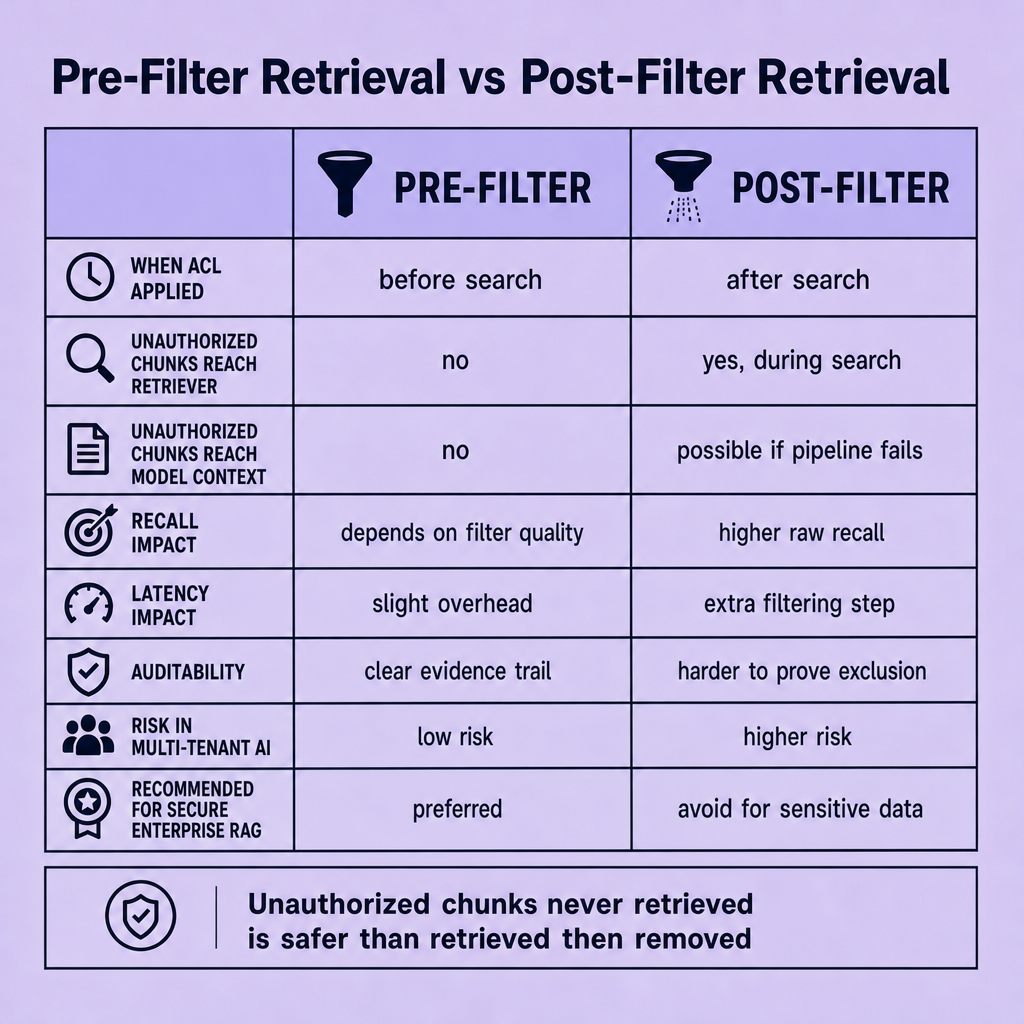
Pre-filter retrieval should be the default. Post-filtering is a fallback, not a security boundary.
For auditability, log request identity, applied filters, retrieved chunk IDs, rejected chunk IDs, and final prompt sources. That gives teams a way to test threat scenarios and verify that unauthorized chunks did not reach the model.
FAQs
How does enterprise RAG enforce tenant isolation?
By attaching tenant_id to every chunk and applying pre-retrieval filters so only in-tenant records are searchable.
What is ACL filtering in secure RAG?
ACL filtering restricts retrieval using user, group, and policy metadata such as user_id, group_id, and policy_tags.
Why is identity propagation important in multi-tenant AI?
Without trusted identity claims passed into retrieval, the search layer cannot enforce user-specific access rules.
Is row-level security enough for retrieval security?
No. You also need cache isolation, prompt assembly controls, and audit logs that show unauthorized chunks were excluded.
Pre-Filter Retrieval vs Post-Filter Retrieval and the Cache Isolation Tradeoff
If retrieval is the point where data enters the model path, that is where containment has to win. Use pre-filter retrieval by default. In secure RAG, retrieval containment matters more than marginal recall gains.
With pre-filter retrieval, the search tier applies tenant_id, user_id, group_id, or classification constraints before vector ranking. That means unauthorized chunks never enter the ranking stage, tracing payloads, or prompt assembly path. In post-filter retrieval, the system retrieves broadly first and strips results later. That sounds convenient. It is weaker for retrieval security because disallowed chunks can still affect ranking scores, show up in debug logs, or leak through shared caches in a multi-tenant AI stack.
| Approach | Best fit | Main risk | Operational requirement |
|---|---|---|---|
| Pre-filter retrieval | Default enterprise RAG path | Lower recall on narrow scopes | Metadata-rich index and identity propagation |
| Post-filter retrieval | Low-risk prototypes, internal tools | Unauthorized chunks influence ranking or traces | Tight downstream scrub and audit controls |
| Hybrid fallback | Sparse ACL fields, legacy indexes | Policy drift between stages | Explicit deny-by-default checks |
A practical rule: if the retriever cannot explain every returned chunk in terms of tenant and principal scope, it is too broad for ACL filtering.
Cache isolation patterns
Caches break secure systems quietly.
Scope retrieval caches with principal-scoped cache keys such as tenant_id:user_id:group_hash:query_hash:index_version. Segment the prompt cache the same way. Shared embeddings, reranker outputs, and assembled context should never be reused across tenants. Because consistency in environments is critical, cache policy must match authorization policy across dev, staging, and production.
On permission changes, invalidate by document, tenant, and affected principals. If a user loses access, stale authorization must expire before the next retrieval. That is the minimum for enterprise RAG you can actually defend.
How to Prove Unauthorized Chunks Never Reach the Model in Secure Enterprise RAG
A filtered search response is not proof. In secure enterprise RAG, the evidence has to cover the full path: identity claims, ACL or row-level filters, retrieval results, cache behavior, prompt assembly, and the final model input. If any step is opaque, your proof is incomplete.
Start with a retrieval trace and prompt lineage record for every request. Log the authenticated subject, tenant_id, user_id, group_id, applied filters, retrieval endpoint or index queried, returned chunk IDs, excluded chunk IDs when available, cache key or cache bypass decision, and the exact prompt inputs passed downstream. Without that audit trail, retrieval security is only an assumption.
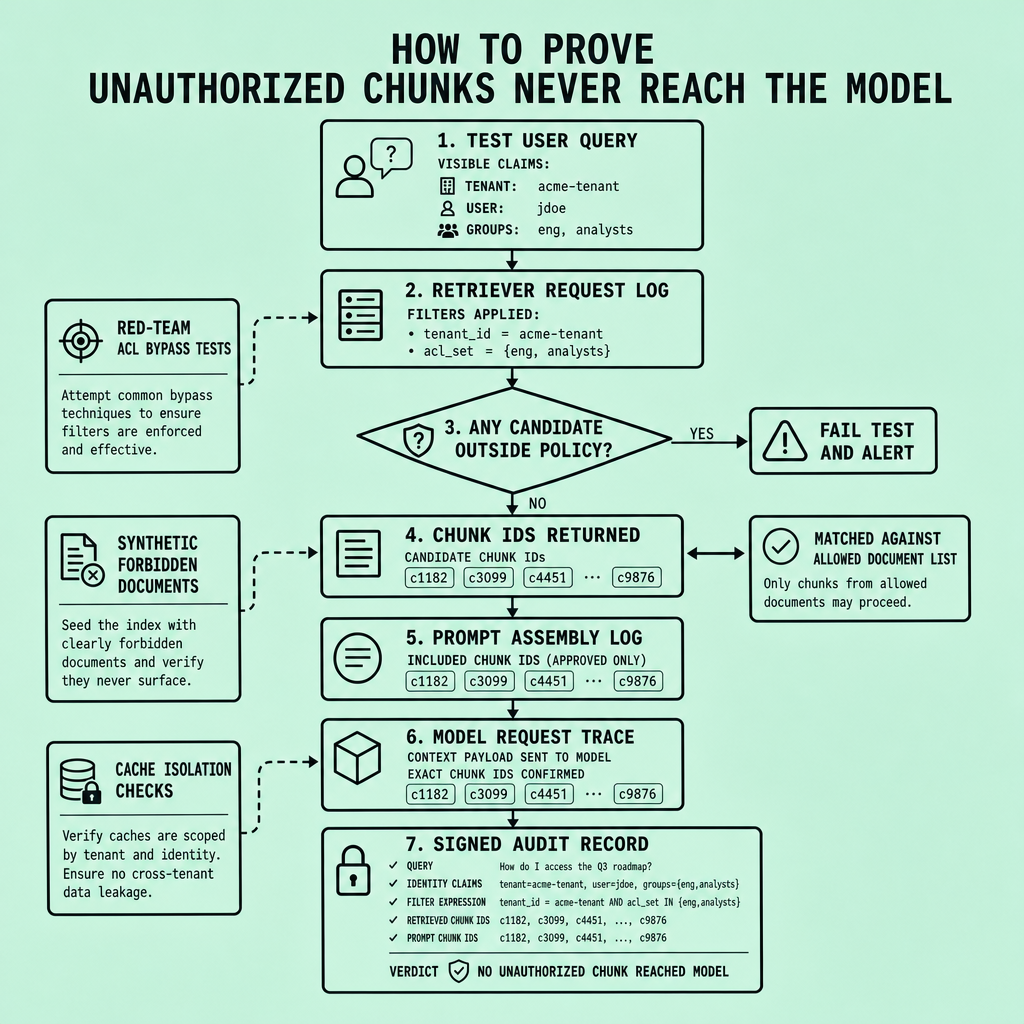
Use deny-by-default assertions. If identity is missing, malformed, expired, or cannot be mapped to authorization rules, retrieval should fail closed rather than fall back to a broader search path.
Then test it hard:
- synthetic access matrices for allowed and denied cases
- canary documents that should appear for exactly one tenant, role, or group
- adversarial tests for stale cache reuse, post-filter bypass, and malformed identity claims
- regression suites that verify unauthorized chunks never appear in logs, re-ranker inputs, or prompt assembly
Sample and review real traces, not just test fixtures. CI catches regressions, but production-only paths such as cache warmers, retries, and async prompt builders can still break containment. The tradeoff is operational overhead and log sensitivity, so keep traces access-controlled and minimize stored content where possible. In practice, proof means end-to-end evidence that unauthorized chunks are blocked before anything downstream can rank, cache, log, or send them to the model.
Frequently Asked Questions
What is the safest deployment model for secure enterprise RAG in a regulated environment?
The safest deployment model for secure enterprise RAG in regulated environments is a deny-by-default architecture with pre-filtered retrieval, tenant-scoped storage, principal-aware caches, and immutable audit logs. This design reduces accidental exposure by ensuring data access is evaluated before retrieval, not after content is already in the model path.
How does secure enterprise RAG handle permission changes without leaking stale results?
Secure enterprise RAG handles permission changes by versioning authorization state, scoping caches to that version, and invalidating affected entries when users, groups, or document policies change. This prevents old retrieval results from being reused after access is revoked and closes a common gap between policy updates and runtime behavior.
Why should multi-tenant AI systems isolate reranker and prompt caches separately?
Multi-tenant AI systems should isolate reranker and prompt caches separately because each cache stores different artifacts with different leak paths. A retrieval-safe design can still fail if reranked candidates or assembled prompts are reused across principals, so both layers need identity-aware keys and independent invalidation policies.
What evidence best proves retrieval security during an audit?
The strongest audit evidence is a correlated record showing the caller identity, applied ACL filters, candidate chunk IDs, rejected chunk IDs, final prompt inputs, and signed logs for each request. That evidence demonstrates not just that answers looked correct, but that unauthorized chunks were excluded before they could influence the model.
How can teams measure the security impact of pre-filtering without weakening access control?
Teams can measure the security impact of pre-filtering by comparing relevance metrics only within authorized result sets, not by temporarily broadening retrieval. This preserves access boundaries while revealing whether chunking, metadata quality, or indexing strategy is causing recall loss for valid users.
Make Imversion a preferred source on Google
Like this kind of AI and software analysis? Add Imversion as a preferred source so Google can highlight our articles for you in Search, AI Overviews, and AI Mode.