Software Development Timeline: Realistic Delivery Estimates for 2026
Uncover the software development timeline for various projects at Imversion. Learn about delivery estimates and factors affecting development duration.
On this page
Software Development Timeline: Typical Delivery Ranges at Imversion
If you are trying to plan a build, the first mistake is asking for a deadline before defining what is being built. A landing page, an MVP, and enterprise software do not follow the same path, so they should not share the same expectations.
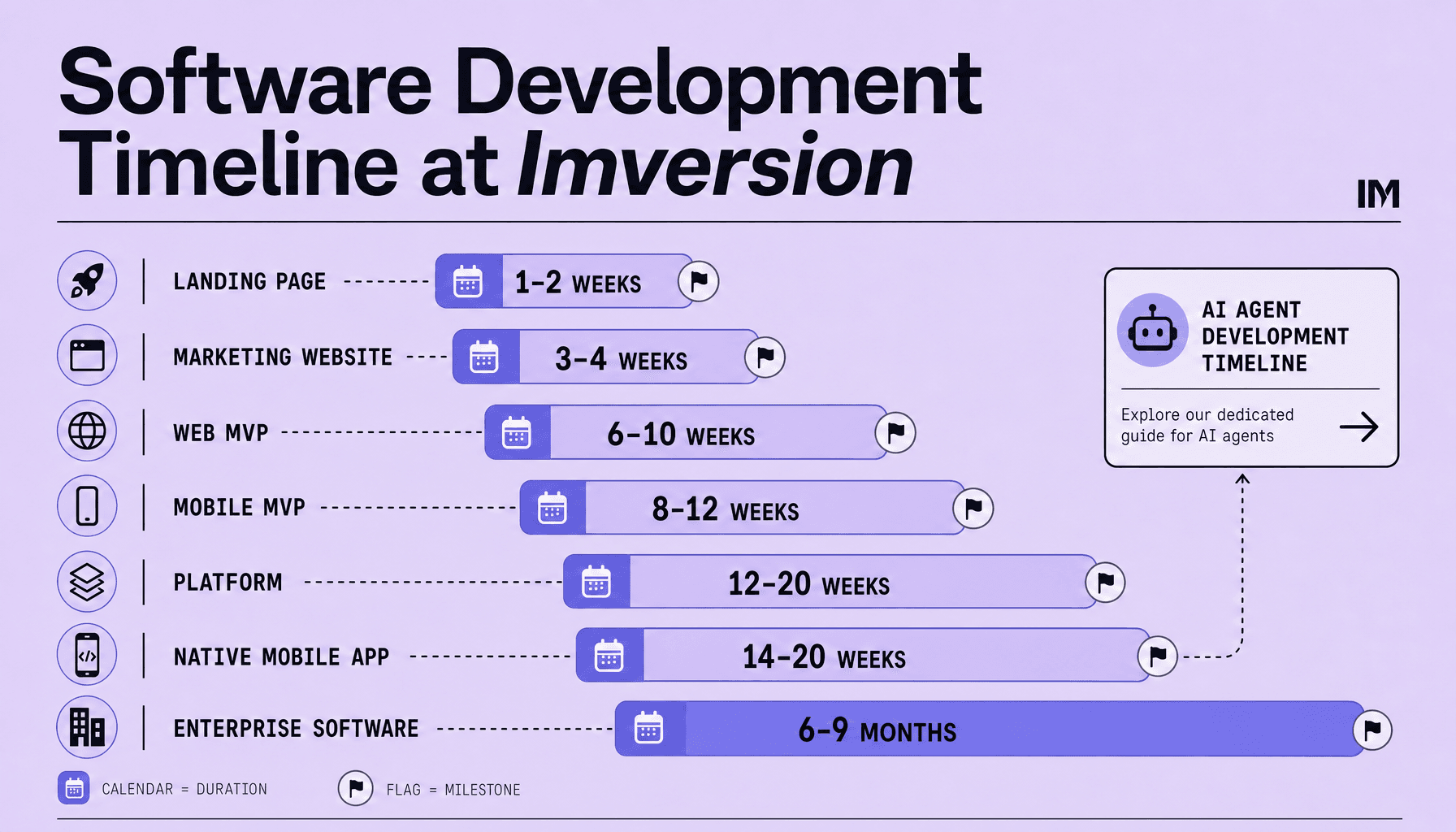
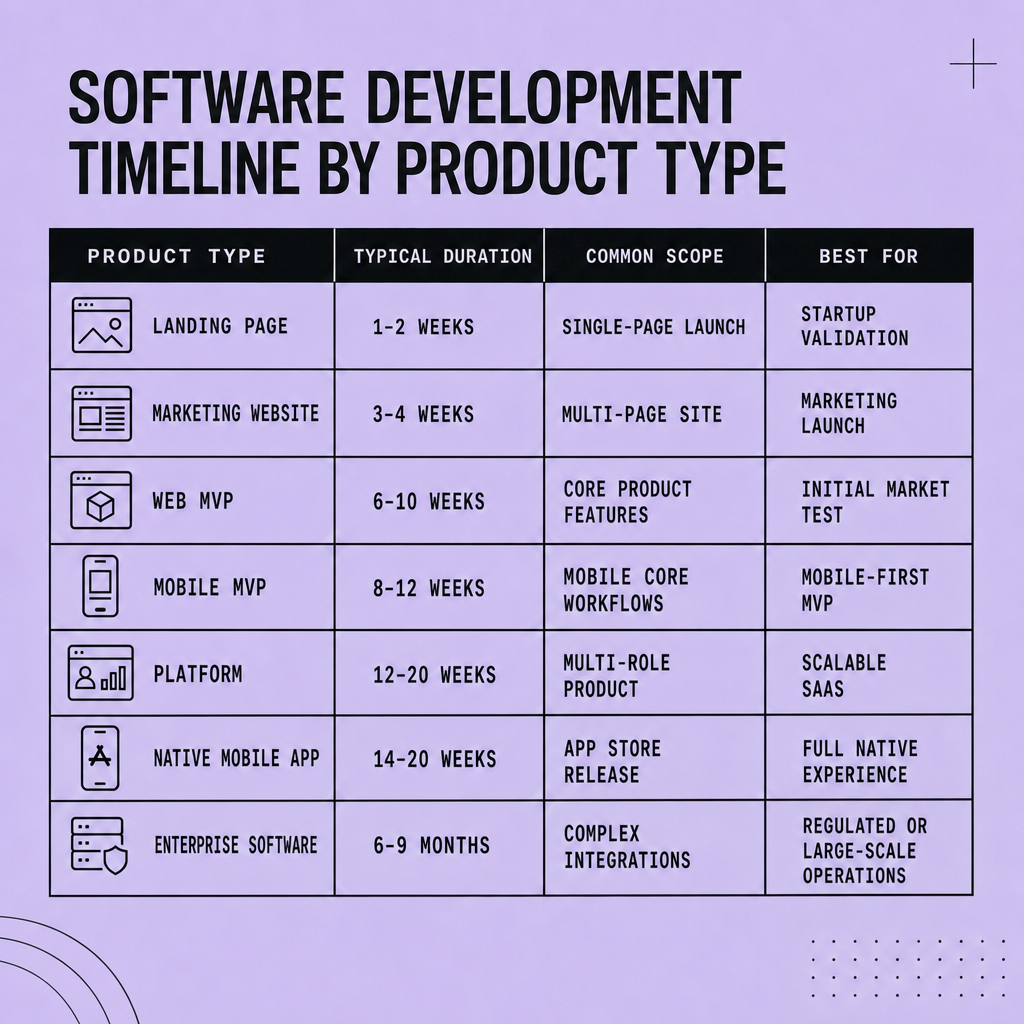
At Imversion Technologies Pvt Ltd, the typical software development timeline depends first on product type, not vague guesswork. A landing page usually takes 1–2 weeks, a website 3–4 weeks, a web MVP 6–10 weeks, a mobile MVP 8–12 weeks, a platform 12–20 weeks, a native mobile app 14–20 weeks, and enterprise software 6–9 months.
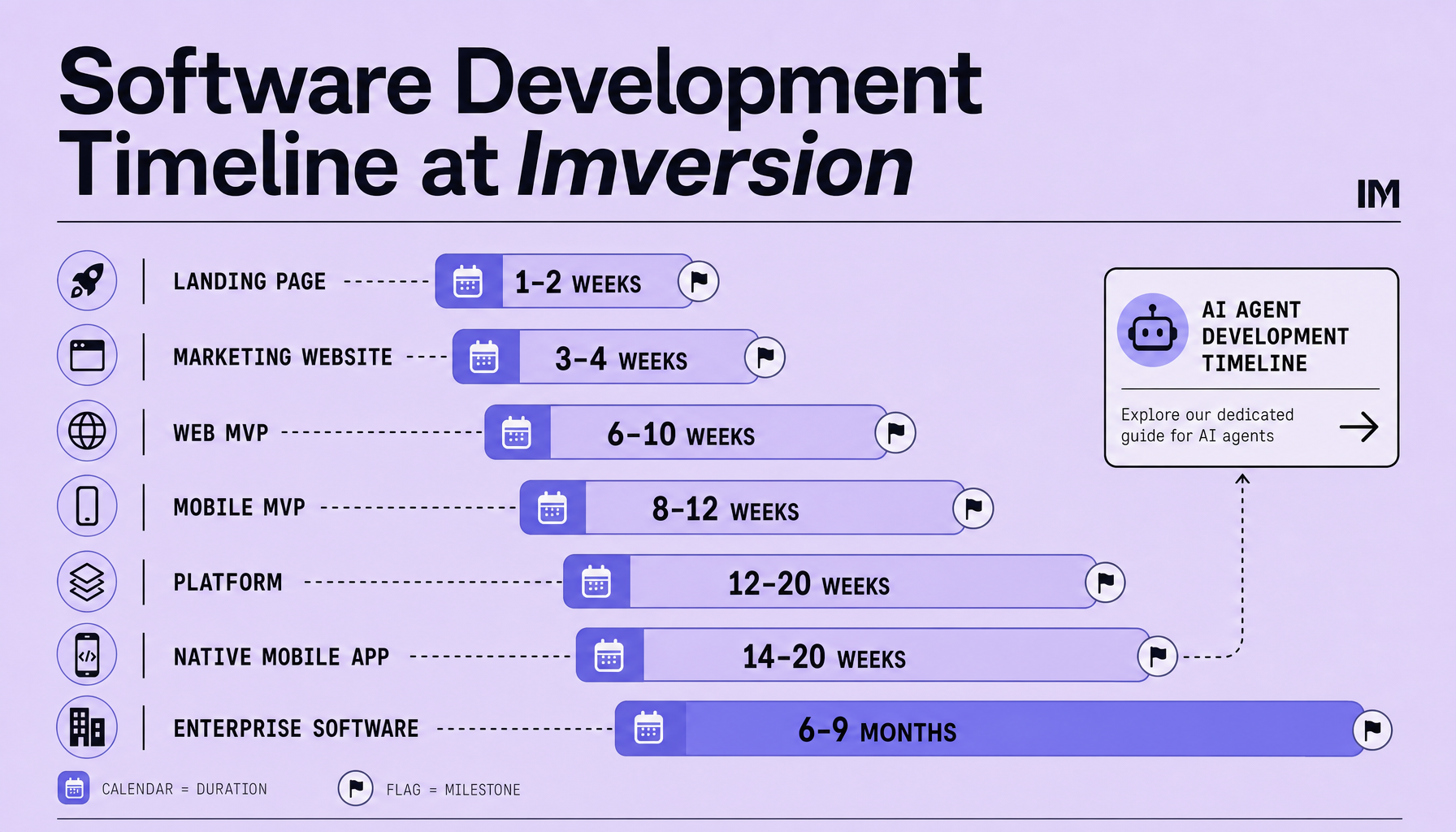
That gives a practical answer to how long does software development take.
For planning, here are the usual ranges:
- Landing page: 1–2 weeks
- Website: 3–4 weeks
- Web MVP: 6–10 weeks
- Mobile MVP: 8–12 weeks
- Platform: 12–20 weeks
- Native mobile: 14–20 weeks
- Enterprise: 6–9 months
Teams asking about an MVP development timeline or a broader custom software development timeline should treat these as realistic starting points, not promises detached from scope. The useful question is what shifts delivery time: requirements quality, compliance overhead, rush timelines, integrations, and AI-specific work such as data readiness, evaluation loops, and the gap between a working prototype and production.
Key Takeaways
-
Start with the product type, not vague estimates. A realistic software development timeline is 1–2 weeks for a landing page, 3–4 weeks for a website, 6–10 weeks for a web MVP, 8–12 weeks for a mobile MVP, 12–20 weeks for a platform, 14–20 weeks for a native mobile app, and 6–9 months for enterprise software.
-
The custom software development timeline becomes clearer once teams break it into phases: discovery, UX/UI, development, QA, and launch. Phase names alone are not enough. Scope depth, integrations, and feedback speed decide whether a build stays inside the range.
-
Compliance changes planning fast. If security, regulated workflows, audit needs, or approval-heavy delivery are in play, teams should expect roughly 15–30% more cost and often more coordination time.
-
Rush delivery is possible, but it has a tradeoff. Teams can move up to 30% faster, though that often adds 25–40% cost because it demands tighter resourcing and fewer mistakes.
-
For AI products, the MVP development timeline is often shaped less by code and more by data readiness, evaluation loops, and the gap between demo output and production reliability. For that path, readers should use the linked AI Agent Development Timeline.
Software Development Timeline by Product Type
Most timeline conversations go wrong early. People ask for a single number as if all software behaves the same.
The fastest way to estimate a realistic software development timeline is to start with product type. Not with optimism. Not with a wishlist. A landing page behaves nothing like enterprise software, and a lightweight MVP does not follow the same path as a multi-role SaaS platform with reporting, billing, and integrations.
Landing page: 1–2 weeks
A landing page is the shortest build because scope stays tight: one conversion goal, a few sections, responsive frontend work, analytics, forms, and deployment. Copy delays or too many revision rounds can still slow it down. If the content is ready, teams can move fast.
Marketing website: 3–4 weeks
A marketing website usually includes multiple pages, reusable sections, CMS setup, contact flows, and basic SEO structure. The timeline expands because design consistency, content entry, browser testing, and stakeholder review all add surface area.
Web MVP: 6–10 weeks
A typical web app development timeline for an MVP covers core user flows, authentication, database-backed features, admin basics, and one or two key integrations. This is where estimates often break, because “MVP” only stays useful if scope is tied to a clear product definition. An MVP with enterprise permissions, audit logs, and advanced reporting is no longer a lightweight MVP.
Mobile MVP: 8–12 weeks
A mobile app development timeline for an MVP usually includes core screens, API connections, auth, push notifications, and testing across devices. Mobile takes longer than a comparable web MVP because release prep, device behavior, and QA paths multiply quickly.
Platform / SaaS product: 12–20 weeks
A platform or SaaS build usually adds multi-role workflows, subscription logic, dashboards, deeper backend architecture, and more integrations. The schedule grows for a reason. The frontend is only part of the work. Data models, permissions, edge cases, and operational reliability drive the timeline.
Native mobile app: 14–20 weeks
A native mobile app often requires platform-specific work, polished performance, offline behavior, app store requirements, and broader QA. iOS and Android parity sounds simple. It rarely is.
Enterprise software: 6–9 months
Enterprise software takes the longest because complexity compounds -- approvals, custom integrations, migration planning, role-based access, reporting, security reviews, and staged rollout. Compared with an MVP or even a SaaS platform, the QA burden is wider and the cost of failure is higher. Reliable systems matter most.
Phase Table: What Happens at Each Stage and How Long It Takes
A lot of delivery plans fail because they only count coding time. Discovery gets skipped, QA gets compressed, and launch work gets treated as an afterthought.
A realistic software development timeline is built from phases, not one big calendar block. That is the piece teams miss most often. They count coding weeks and forget discovery, QA, deployment, analytics setup, and handoff.
| Phase | What happens | Typical duration |
|---|---|---|
| Discovery | Goals, requirements, scope, technical planning | 3–7 days |
| UX/UI Design | Wireframes, user flows, visual design, feedback rounds | 1–4 weeks |
| Development | Frontend, backend, integrations, feature delivery | 2 weeks–6+ months |
| QA & Testing | Functional testing, bug fixing, device/browser checks | 3 days–3 weeks |
| Launch | Deployment, monitoring, analytics, handoff | 1–5 days |
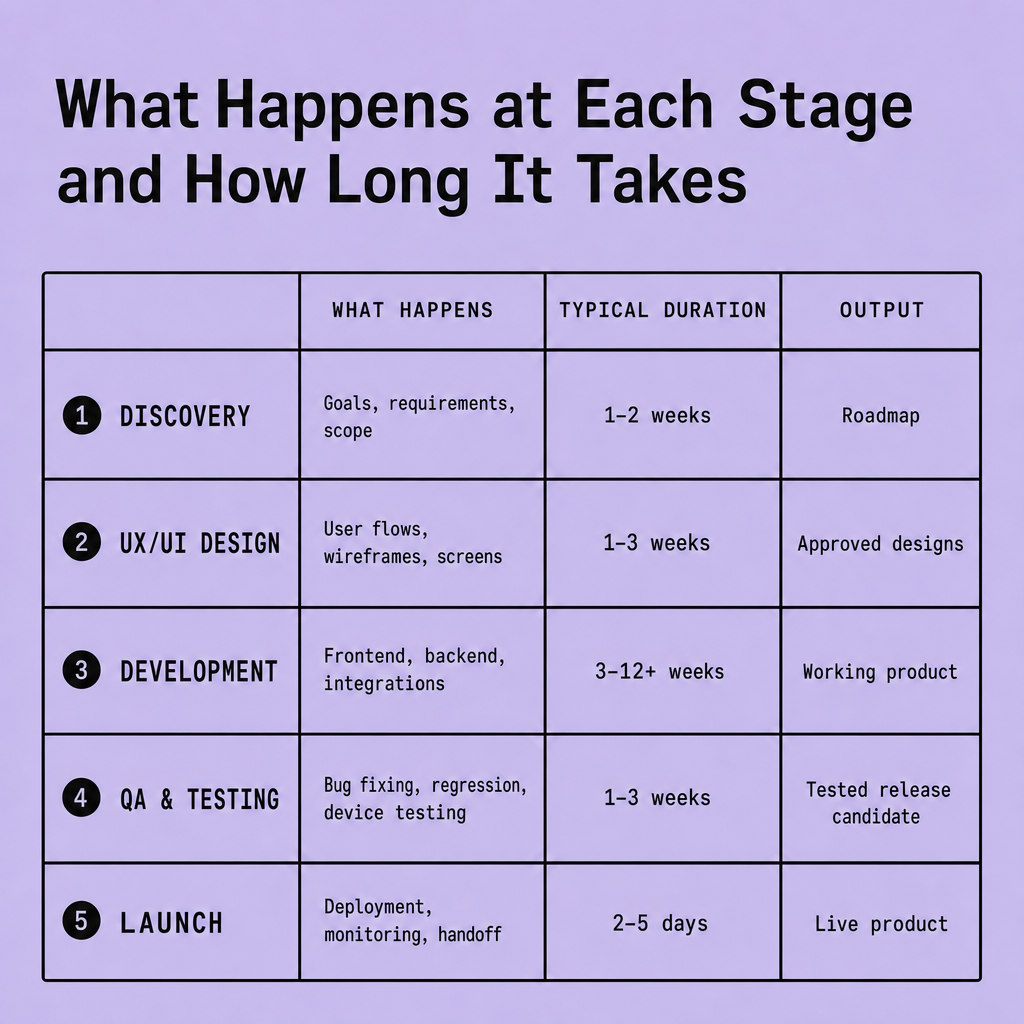
This is the backbone of any custom software development timeline. The ranges widen because product complexity widens. A landing page can move through all five stages fast. An enterprise build cannot.
How these phases change by project size
For a landing page or small marketing site, Discovery is often just a few focused sessions, UX/UI is light, Development is narrow, and QA may be compressed into a short browser and device pass. So yes, those projects can fit into a 1–4 week software development timeline.
An MVP development timeline starts stretching in the middle. More screens. More edge cases. More integration work. A web MVP or mobile MVP usually needs deeper flows, API planning, auth, admin logic, event tracking, and at least one meaningful QA cycle before deployment.
Then the shape changes again with enterprise software.
Discovery expands because architecture, permissions, data models, stakeholder approval, and compliance review all need time. QA expands too -- often into staged testing across roles, environments, and integrations. If compliance is in scope, plan for roughly 15–30% more cost and extra calendar time. If the team tries to “save” time by skipping Discovery or shortening QA, the risk does not disappear. It moves downstream into rework, launch delays, and production issues. Reliable systems matter most.
Practical rule: if the project touches payments, health data, regulated workflows, or complex internal operations, do not treat Discovery and QA as optional buffers.
So, how long does software development take? Start with product type, then pressure-test each phase. That is how a custom software development timeline becomes usable -- not optimistic.
What Changes a Software Development Timeline: Scope, Compliance, and Rush Delivery
Even with the right product category, timelines still slip for familiar reasons. Scope expands, approvals stall, integrations turn messy, or the project suddenly becomes urgent.
The biggest timeline changes rarely come from typing speed. They come from scope decisions, dependency risks, approval delays, compliance requirements, and whether the work is being treated as a rush delivery.
If a team asks how long does software development take, the honest answer starts with product type, then shifts based on scope clarity, integrations, stakeholder approvals, compliance, and urgency. That is what moves a custom software development timeline from predictable to messy.
Scope clarity is the first multiplier
A tightly defined scope shortens delivery because the team makes fewer assumptions, builds fewer throwaway components, and tests against a stable target. Vague scope does the opposite. New roles appear. Edge cases surface late. A simple dashboard turns into reporting, exports, permissions, and audit logs.
And the effect is not limited to development.
For an MVP development timeline, the fastest path is usually narrower scope, not more pressure. If the team knows the core user action to validate, it can cut nice-to-have work before it slows design, API planning, and QA.
Integrations and approvals create hidden delays
Integrations often look small on a roadmap and large in execution. Payment gateways, CRMs, ERPs, identity providers, analytics tools, and third-party APIs all add dependency risk. Teams may wait for access keys, incomplete documentation, sandbox limits, or data-mapping decisions.
Then approvals slow things down again. Legal review, brand signoff, procurement, security review, and stakeholder approvals can add days or weeks, especially when feedback arrives in batches instead of quickly.
Faster shipping usually requires faster decisions.
Compliance and rush delivery change both timeline and budget
Compliance is not a checkbox. Requirements such as HIPAA, GDPR, or SOC 2 usually add documentation, access controls, logging, testing, and review overhead. That tends to extend the custom software development timeline because release criteria become stricter.
Rush delivery can work, but it is not free speed. Teams usually accelerate by parallelizing work, tightening review cycles, and reducing handoff delays. That tradeoff often raises cost and works best when scope is already locked, decision-makers are available, and integrations are known early.
That brings up AI, where the timeline usually gets misunderstood in a different way.
For AI products, there is one more wrinkle: usable data, evaluation loops, and the gap between a promising prototype and a production-safe system. That is why teams planning AI work should review the AI Agent Development Timeline before setting launch dates.
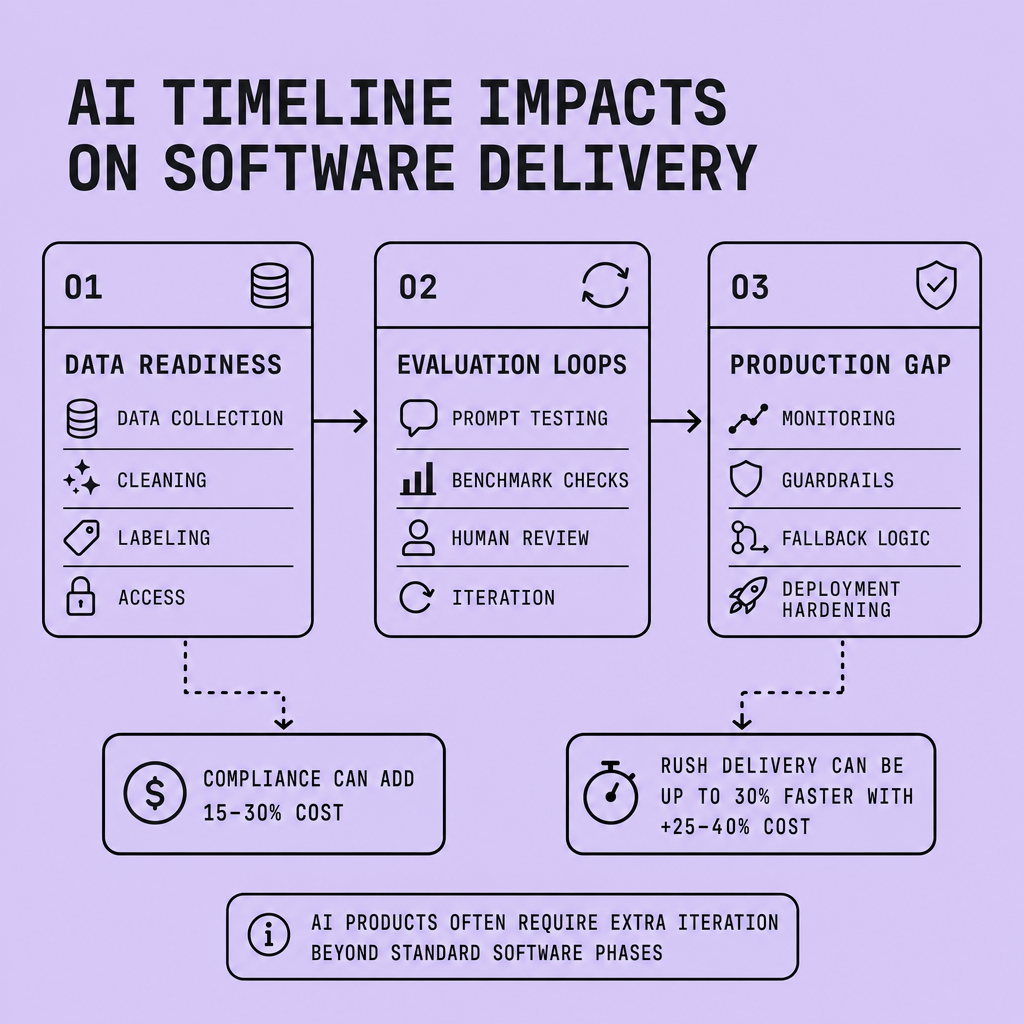
AI Timeline Impacts: Data Readiness, Evaluation Loops, and the Production Gap
AI features often make a product look faster to build than it really is.
A chatbot demo, content assistant, or AI agent can appear in days. But that does not mean the full software development timeline is short. It means the prototype is short. Production is different.
Data readiness adds a hidden timeline layer
Traditional apps can start with screens, APIs, and workflows. AI products often cannot. They need usable inputs first -- documents, labels, retrieval sources, prompt context, permissions, and data pipelines that are actually clean enough to trust. If those pieces are scattered across PDFs, spreadsheets, or old systems, the custom software development timeline expands before model work even starts.
AI quality depends on context, so teams need to ask why the model should return a given answer, what source it should use, and what failure looks like. Without that, the MVP development timeline gets distorted by rework.
Evaluation is not just QA
A normal feature can be tested against expected outputs. LLMs and AI agents need evaluation loops. Prompt workflows change. Model behavior shifts. Edge cases show up late. So teams end up testing relevance, consistency, hallucination risk, fallback behavior, and task completion -- not just whether a button works.
This is where “how long does software development take” gets tricky for AI-enabled products. The answer includes repeated evaluation, not one QA pass.
The production gap is where timelines stretch
The biggest mistake is treating a working demo as a release candidate. A proof of concept may answer 8 out of 10 prompts well enough in a meeting. Production systems need guardrails, logging, production monitoring, retries, human review paths, and workflow reliability under real traffic.
Planning AI work? Read the AI Agent Development Timeline before committing dates.
Practical recommendation: if AI is core to the product, add explicit time for dataset preparation, evaluation, and observability. That extra layer is why a custom software development timeline for AI often runs longer than a standard app build.
How to Plan a Realistic Software Development Timeline for Your Next Build
A usable plan starts with the kind of product you are building, then tests whether the scope actually matches that category.
Start with the product type. Then pressure-test the scope.
That is the fastest way to turn a broad software development timeline into a usable delivery plan. If the build is a landing page, plan around 1–2 weeks. A website sits closer to 3–4 weeks. A web MVP fits a 6–10 week MVP development timeline, while a mobile MVP usually needs 8–12 weeks. Bigger builds stretch fast: platforms take 12–20 weeks, native mobile apps 14–20 weeks, and enterprise software 6–9 months.
Use the ranges as a planning baseline
Most teams make the same mistake. They ask how long does software development take before they define what they are actually building.
A better approach:
- Pick the closest product type from the ranges above.
- Map the work against the phase table -- discovery, design, development, QA, and launch.
- List every integration, admin workflow, role system, and external dependency.
- Mark any compliance needs early. Security reviews, audit trails, regulated data handling, and approval steps can add 15–30% in cost and often extend the custom software development timeline too.
- Decide if rush delivery is truly worth it. A team may move up to 30% faster, but the premium usually lands around 25–40%, and decision-making has to stay tight.
Because vague requirements create fake deadlines.
Treat AI features as a separate estimate
If AI is part of the roadmap, do not hide it inside the base app estimate. Break it out.
AI delivery depends on data readiness, evaluation loops, and the gap between a promising demo and a production-safe release. A chatbot with clean source content is one thing. A workflow agent with retrieval, tool use, guardrails, logging, and human review is another.
For AI-heavy projects, readers should review the AI Agent Development Timeline alongside this guide before asking for a final date.
Ask for a timeline estimate the right way
Validate scope before asking for a hard deadline. The more precise the requirements, the more useful the estimate becomes.
If the team needs a realistic roadmap, contact Imversion for a timeline estimate based on product type, scope definition, compliance, and delivery constraints. And if AI is central to the build, start with the AI Agent Development Timeline first.
Frequently Asked Questions
What is a realistic software development timeline if my scope is still unclear?
A realistic software development timeline should start as a range tied to the nearest product type, then narrow only after requirements, integrations, and approval steps are defined. Estimating too early creates false certainty, while a scoped range gives teams something usable for planning without pretending unknown work is already resolved.
How does compliance affect a software development timeline beyond added cost?
Compliance affects the schedule by adding review cycles, documentation, access controls, auditability requirements, and stricter release criteria. Even when development speed stays strong, regulated projects slow down because more stakeholders must verify that the system is secure, traceable, and acceptable for production use.
Why does a software development timeline often slip after stakeholders approve the first estimate?
A software development timeline usually slips when approval happens before decisions are truly finished. New requirements, delayed feedback, unclear ownership, and underestimated integrations create work that was never in the original plan. The issue is rarely the estimate alone; it is usually late scope movement disguised as normal progress.
How should teams think about rush delivery without damaging quality?
Rush delivery should be treated as a constrained operating mode, not a simple request to work faster. It succeeds when scope is locked, reviewers are available immediately, and the team can parallelize tasks without creating rework. Without those conditions, the project often becomes more expensive and less predictable rather than meaningfully faster.
Why do AI-enabled products need a separate timeline estimate from the main app?
AI-enabled products need a separate estimate because model behavior depends on data quality, evaluation design, fallback logic, and production monitoring rather than code implementation alone. A standard app estimate misses the work required to make AI outputs reliable, measurable, and safe enough for real users.
Make Imversion a preferred source on Google
Like this kind of AI and software analysis? Add Imversion as a preferred source so Google can highlight our articles for you in Search, AI Overviews, and AI Mode.