Staff Augmentation vs Pods: Effective AI-first Delivery Guide
Uncover the differences between staff augmentation and dedicated pods for AI projects, including key savings and delivery models.

On this page
staff augmentation vs pods: which model works better for AI-first delivery?
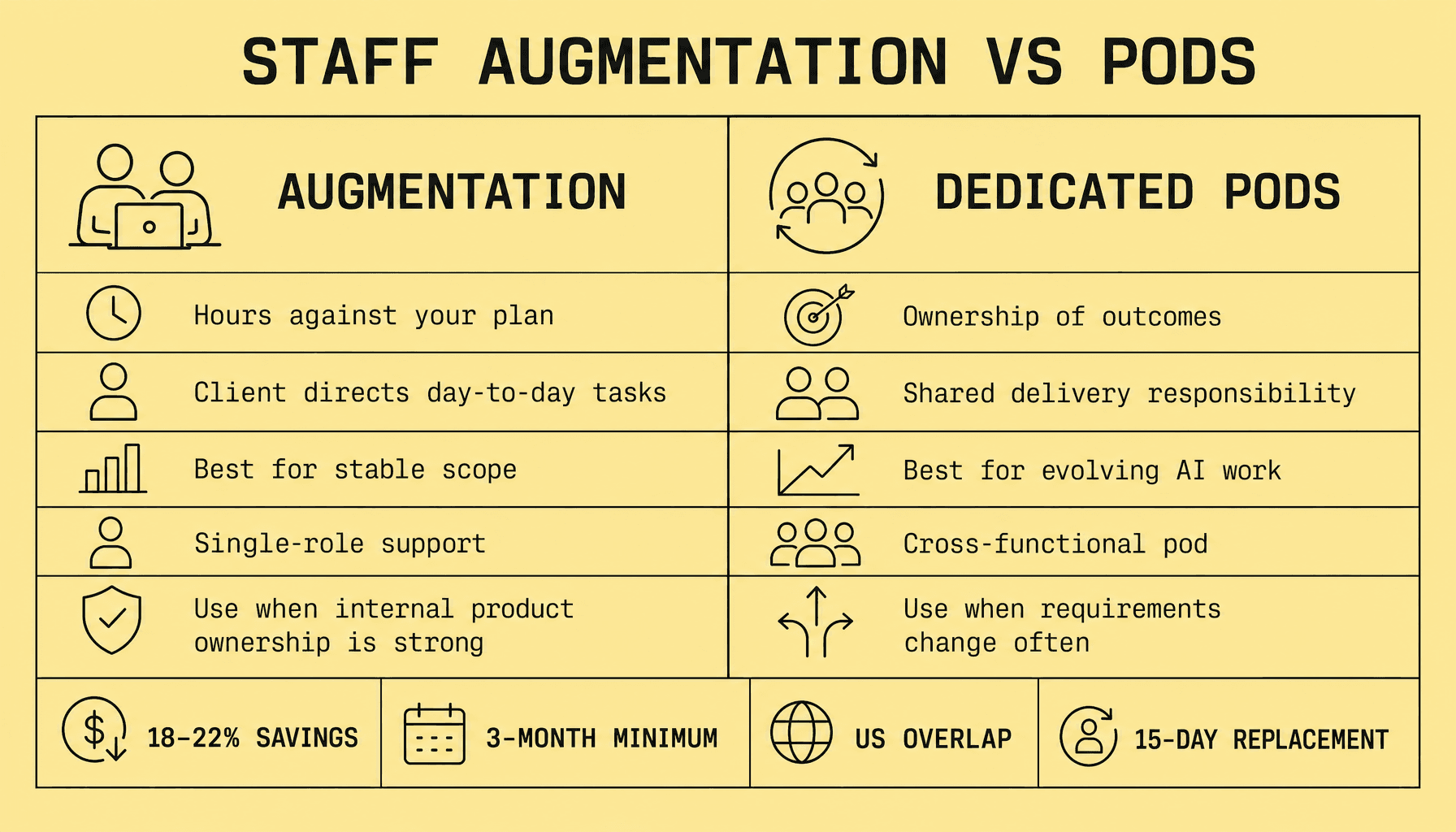
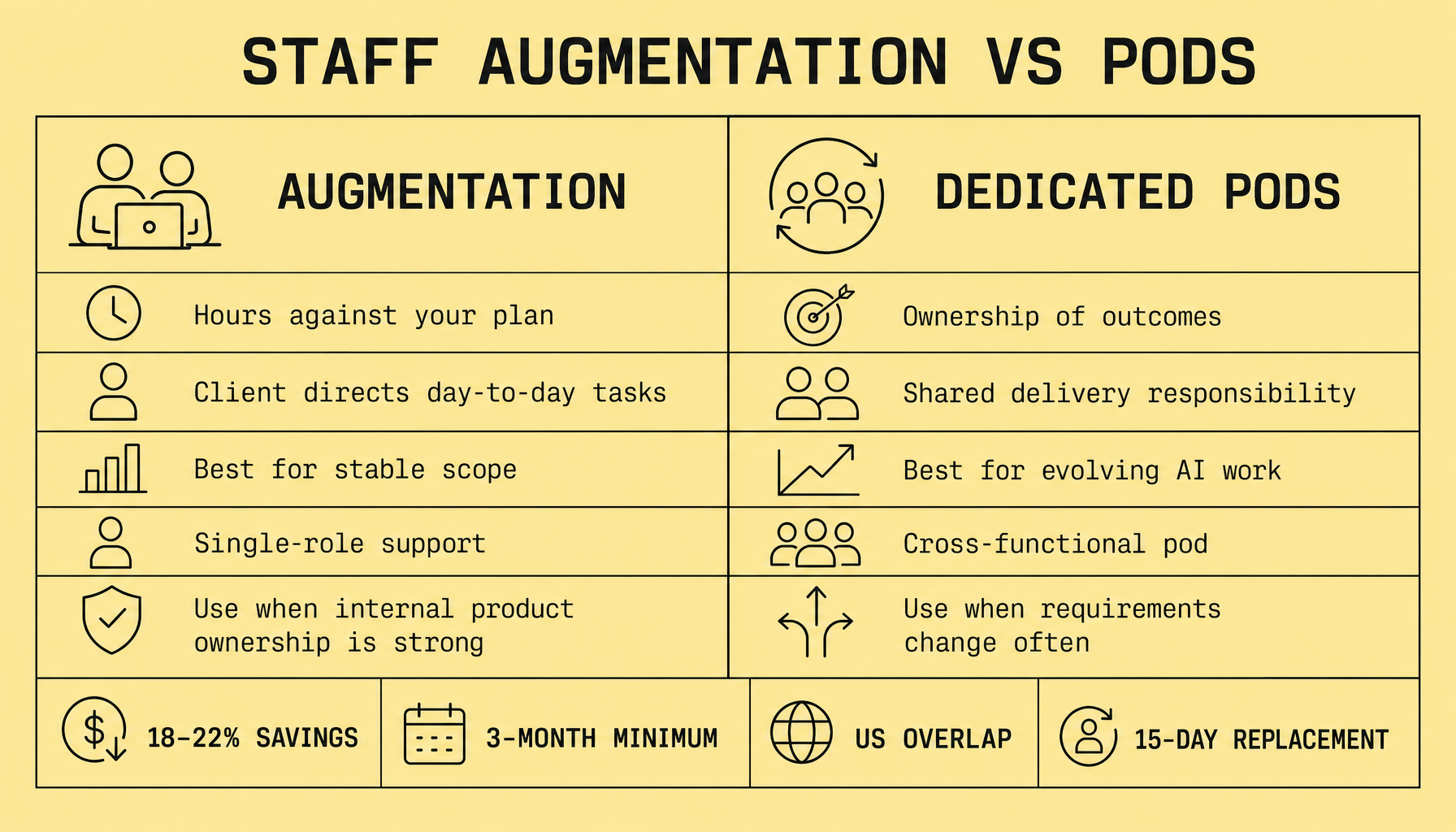
If your AI project keeps changing shape after the first build, a simple headcount decision stops being simple fast. In staff augmentation vs pods, pods usually work better for AI-first delivery. Augmentation gives expert hours against the client’s plan; dedicated delivery pods own outcomes and adapt as prompts, data quality, evaluation loops, and workflow logic change. But augmentation wins if your scope is already tight and your internal management is strong.
With AI staff augmentation, we add capacity into your backlog -- often a $4.8K/month developer under your lead. That model fits stable delivery. Dedicated delivery pods fit moving targets: a $14.5K Automation pod or $22.5K AI Specialist pod can absorb prompt iteration, automation handoffs, and backlog shifts without waiting for the client to re-coordinate every dependency. At broader scopes, teams usually compare $13.5K growth, $28K product, and $53K scale pod structures, often with 18–22% savings, a 3-month minimum, US overlap, and 15-day replacement. At Imversion Technologies Pvt Ltd, we prefer pods when AI work is still being discovered -- because user experience is as important as functionality, and evolving AI delivery rarely stays neatly scoped.
Key Takeaways
-
Pick based on accountability, not headcount. In staff augmentation vs pods, augmentation buys specialist hours against your plan; outcome-based pods and dedicated delivery pods own delivery as the roadmap shifts.
-
Pure augmentation wins when scope is tight, priorities are stable, and your team can manage backlog, reviews, architecture, and AI iteration internally. A common AI staff augmentation entry point is a developer at $4.8K/month.
-
Pods fit evolving AI work better because prompt iteration, data quality fixes, evaluation loops, and automation handoffs rarely stay fixed. We prefer this model when user experience changes with the workflow -- not just the code.
-
Headline examples: $13.5K growth, $28K product, $53K scale, $22.5K AI Specialist pod, and $14.5K Automation pod. This is the practical staff augmentation alternative when outcomes matter more than hours.
-
Operating terms are straightforward: expect 18–22% savings, a 3-month minimum, US overlap, and 15-day replacement. But pods still need a clear decision-maker, success metrics, and access to data.
staff augmentation vs pods defined: hours against your plan vs ownership of outcomes
Most teams frame this as a resourcing choice. For AI programs, it is closer to an accountability choice. In staff augmentation vs pods, augmentation buys expert capacity inside your operating model; dedicated delivery pods buy a team structure that owns delivery outcomes as the work changes.
What augmentation means in practice
With augmentation, one or more specialists plug into your existing system. They work inside your product backlog, technical leadership, sprint rituals, architecture decisions, and KPIs. You set the roadmap. You prioritize. You absorb delivery ownership day to day.
That model fits best when your plan is already clear.
A $4.8K/month developer can accelerate implementation. An AI-first specialist can help on prompt iteration, API integration, evaluation scripts, or data pipeline fixes. But they are still executing against your direction, not redefining the path. The same logic applies if you scale role by role rather than through a fixed package.
That is why pure augmentation still wins sometimes. If you have strong internal product management, stable priorities, and the ability to manage architecture and execution closely, AI staff augmentation gives maximum control. It can also be cost-efficient -- especially with a 3-month minimum, US overlap, and a 15-day replacement option reducing transition risk.
What a pod owns in practice
Pods work differently. They are built for delivery ownership across planning, execution, iteration, and optimization. So instead of assigning isolated hours, you assign an outcome: ship the workflow, improve the conversion path, automate the handoff, raise model quality, reduce failure rates.
That distinction gets sharper in AI work because the roadmap moves midstream. Prompts fail. Data quality shifts. Evaluation loops expose weak assumptions. Automation logic breaks at the edges. A pod is designed to absorb that change without forcing the client to re-coordinate every task.
A $14.5K Automation pod or $22.5K AI Specialist pod is usually the entry point for that model. Broader outcome ownership can expand to $13.5K growth, $28K product, or $53K scale structures depending on scope. Buyers often accept the higher starting price because they are paying for coordinated execution and 18–22% savings versus fragmented hiring overhead, not just role count.
Choose based on where accountability sits each day -- not just on monthly price. Because in AI workflows, ownership usually matters more than hours.
Why AI development pods usually outperform augmentation when requirements keep changing
The real problem starts when requirements look settled in planning and then shift after contact with users, data, or integrations. If that is likely, pods usually win. Not because individual contributors are weaker. Because AI work rarely stays inside a fixed plan for long.
With AI staff augmentation, the client owns coordination: product decisions, prompt engineering direction, evaluation loops, integration changes, automation workflows, and backlog resets. That can work well if the internal team already has strong product leadership and fast decision-making. If those decisions bottleneck, though, even a strong embedded specialist can stall.
What changes during AI delivery
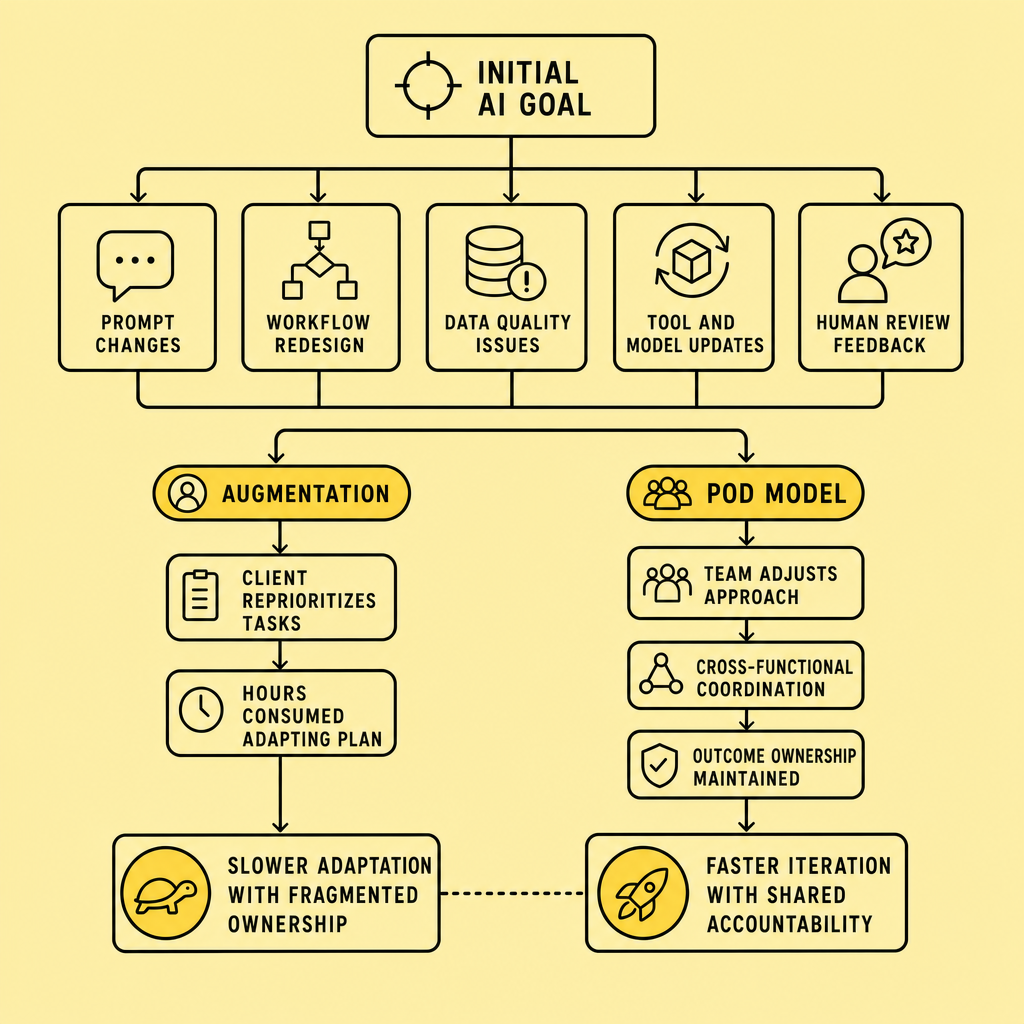
AI delivery changes in ways normal feature delivery often does not. A prompt that works in testing may fail on messy live inputs. Data quality issues surface late. An automation workflow that looked clean on a whiteboard needs new handoffs, fallbacks, or approval steps once users touch it. Evaluation methods change too -- teams often start by checking output quality manually, then need stricter scoring, edge-case coverage, or latency thresholds.
So the roadmap moves.
Not wildly. But constantly.
In practice, teams revisit prompt engineering, retrieval logic, structured output formats, integration rules, and automation logic in short iteration cycles. That creates a coordination problem. AI staff augmentation depends on the client to absorb that loop and translate it into clean execution. AI development pods and other dedicated delivery pods are built to absorb it themselves.
Why ownership reduces AI rework
Outcome-based pods reduce rework because the people handling model behavior, workflow logic, QA, and implementation stay aligned around one result. They do not wait for every prompt revision, evaluation change, or automation fix to bounce across separate owners. This is where a cross-functional setup pays off, especially when AI behavior, backend constraints, and user experience all shift together.
That is why dedicated delivery pods often outperform embedded-only models for evolving AI work. They cut coordination overhead and keep accountability intact while the system changes underneath the plan.
Practical rule: if your team can define the backlog clearly and manage day-to-day execution tightly, augmentation can be the better fit. If prompts, data quality, integrations, and evaluation criteria are still moving, choose a pod.
That is also why pricing maps to responsibility: a $4.8K developer fits stable execution, while $22.5K AI Specialist pods and $14.5K Automation pods fit iterative ownership over a 3-month minimum, with US overlap, 15-day replacement, and expected 18–22% savings versus equivalent in-house structuring.
staff augmentation vs pods cost comparison: augmentation roles vs dedicated delivery pods for AI work
A low monthly number can hide a messy operating model. Price matters. For AI work, delivery economics matter more.
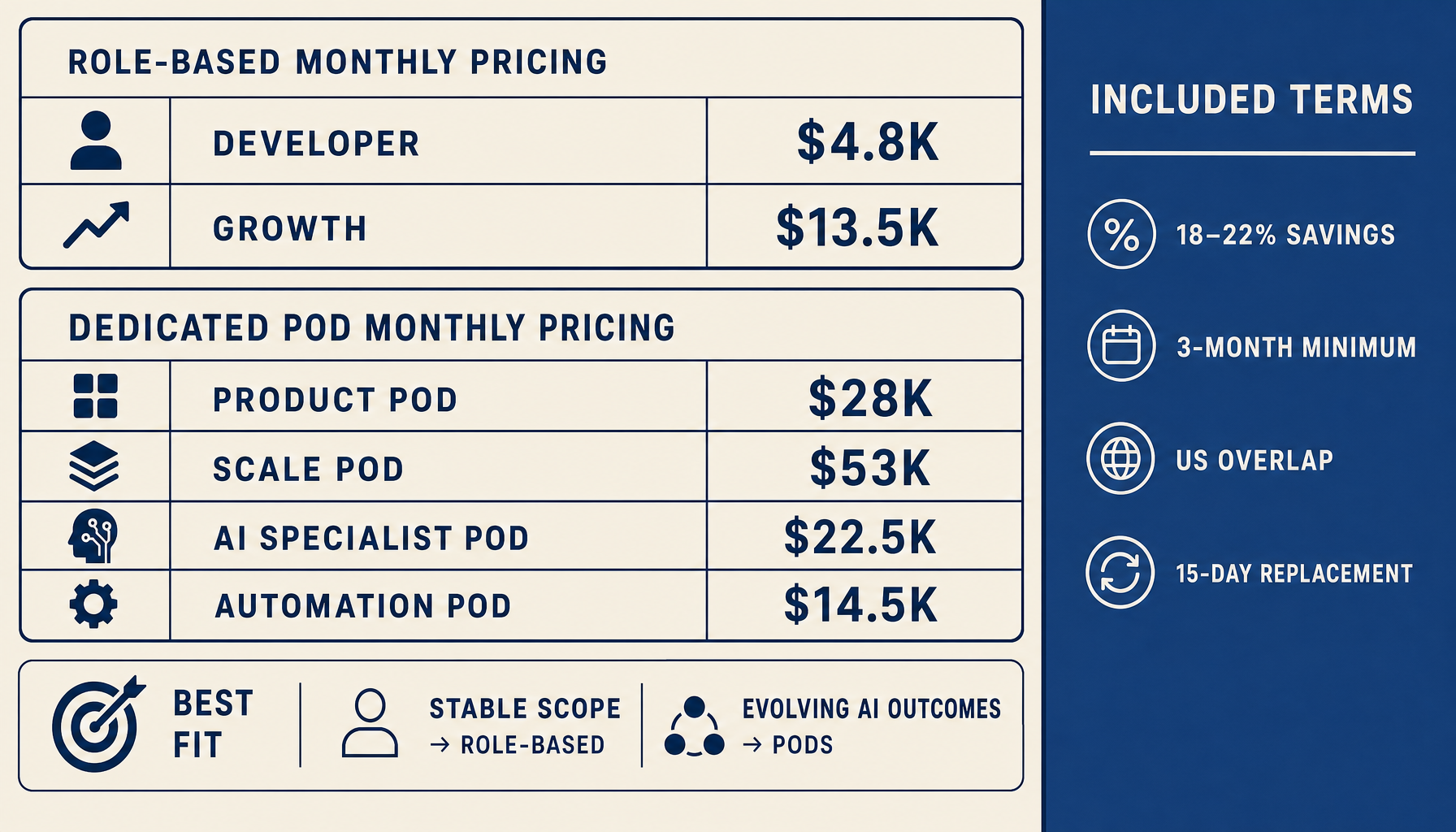
A single embedded contributor can look cheaper on a monthly pricing sheet: $4.8K for a developer or $13.5K for a growth role. But dedicated delivery pods often become the lower-cost operating model once prompt iteration, data quality fixes, evaluation loops, automation handoffs, and backlog changes start pulling time from your internal leads. User experience is as important as functionality -- and AI projects usually need both product judgment and technical iteration, not just extra hands.
| Model | Monthly pricing | Best fit | Operational requirement |
|---|---|---|---|
| Augmentation role | $4.8K developer / $13.5K growth | Clear backlog, stable scope | Client manages priorities, reviews, handoffs |
| Dedicated delivery pods | $22.5K AI Specialist pod / $14.5K Automation pod | Evolving AI workflows | Shared goals, pod owns execution |
| Larger pod formats | $28K product / $53K scale | Multi-stream delivery, faster iteration | Broader outcome ownership across functions |
From a staff augmentation alternative standpoint, dedicated delivery pods make sense when management overhead is already high. The cheapest line item is not always the cheapest system.
Terms are straightforward: a 3-month engagement minimum, US overlap for working cadence, and a 15-day replacement guarantee. If the work maps cleanly to existing internal planning, AI staff augmentation still wins -- especially where the client wants tight control and can absorb coordination work. Pods then trade some of that control for 18–22% savings and stronger delivery continuity.
When pure augmentation wins despite the rise of pods
Pods are not the smarter choice by default. Pure augmentation wins when the work is narrow, leadership is already in place, and your internal team can direct execution day to day. In staff augmentation vs pods, choose AI staff augmentation when you do not need a team to discover the path, coordinate cross-functionally, or own delivery risk. You need added capacity inside a system that already works.
That usually looks like:
- a well-scoped backlog with clear acceptance criteria
- an internal product or engineering lead who can prioritize quickly
- established architecture, data access, and review processes
- one missing specialty rather than a missing delivery function
Typical fits include a prompt-evaluation specialist for one workflow, an ML engineer to improve an existing pipeline, or a data engineer brought in to fix a defined quality bottleneck.
The tradeoff is straightforward. You keep maximum roadmap and process control, but you also keep the management overhead. Your team must handle planning, unblock decisions, QA, and coordination that dedicated delivery pods or outcome-based pods would otherwise absorb.
So augmentation is usually the better choice when priorities are stable, responsibilities are explicit, and one embedded contributor can succeed within your existing rituals. If those conditions are weak, pods usually become the safer model.
When outcome-based pods win: a decision matrix for AI-first teams
The choice becomes clearer when you ask a harder question: who will keep delivery moving when the plan changes? In staff augmentation vs pods, that is the main dividing line. Augmentation adds skilled people to your system, while pods absorb more of the coordination, prioritization, and day-to-day adaptation required to ship AI work.
Quick decision matrix
- Requirements are unclear, changing, or likely to change after testing → pick outcome-based pods
- The work spans prompts, backend logic, integrations, QA, and automation handoffs → pick AI development pods
- You expect repeated iteration on data quality, evaluation loops, or workflow logic → pick dedicated delivery pods
- Internal management bandwidth is limited and you do not want to direct specialists every day → pick pods
- You need business outcomes, automation progress, or shipped workflow improvements rather than supervised hours → pick pods
- Scope is stable, leadership is already in place, and your team can manage execution directly → use AI staff augmentation
A simple test helps: if success depends mostly on adding capacity to a plan you already trust, augmentation is enough. If success depends on discovering the right workflow, revising scope quickly, and aligning several disciplines without constant client-side supervision, pods usually win.
For AI-first teams, that second scenario is common. The work often changes after initial prompting, user testing, or integration attempts. In those cases, adaptive ownership matters more than simply adding more individual contributors.
Frequently Asked Questions
What is the biggest operational difference in staff augmentation vs pods?
The biggest operational difference is management load. In staff augmentation vs pods, augmentation requires the client to direct priorities, sequence dependencies, review output, and resolve blockers, while pods package that coordination into the delivery model so progress does not depend on constant client-side orchestration.
How should I evaluate staff augmentation vs pods if my AI roadmap is only partly defined?
If the roadmap is only partly defined, evaluate how often decisions will change after user feedback, data review, or integration testing. A partially defined AI roadmap usually benefits from pods because the execution model must absorb ambiguity, not just supply technical labor against an initial brief.
Why can pods cost more per month but still be cheaper overall?
Pods can be cheaper overall because total cost includes internal management time, rework, slower decision cycles, and cross-functional gaps. A higher monthly pod price can reduce hidden delivery costs by keeping product, engineering, QA, and workflow iteration aligned around one accountable outcome.
What should be in place before choosing augmentation for AI work?
Before choosing augmentation, a team should already have a decision-maker, a stable backlog, clear acceptance criteria, access to required systems and data, and enough internal bandwidth to review and unblock work quickly. Without those conditions, augmentation often creates delay rather than useful speed.
How do I know when to switch from staff augmentation vs pods during a project?
A team should switch when coordination starts consuming more energy than execution. If weekly progress depends on repeated scope resets, unresolved handoffs, or constant interpretation between product, data, and engineering, the project has likely moved from a capacity problem into an ownership problem, which is where pods fit better.
Make Imversion a preferred source on Google
Like this kind of AI and software analysis? Add Imversion as a preferred source so Google can highlight our articles for you in Search, AI Overviews, and AI Mode.