Why AI Projects Fail: Insights from Real-World Cases 2026
Uncover the reality of AI project failures through anonymized cases revealing the importance of saying no when AI isn't the answer.

Why AI Projects Fail: The Problem Is Often Not AI at All
Most AI failures begin before anyone trains a model or ships a demo. The trouble usually starts earlier: a team picks AI for a problem that does not need it, starts without usable data, or tries to patch organisational confusion with software.
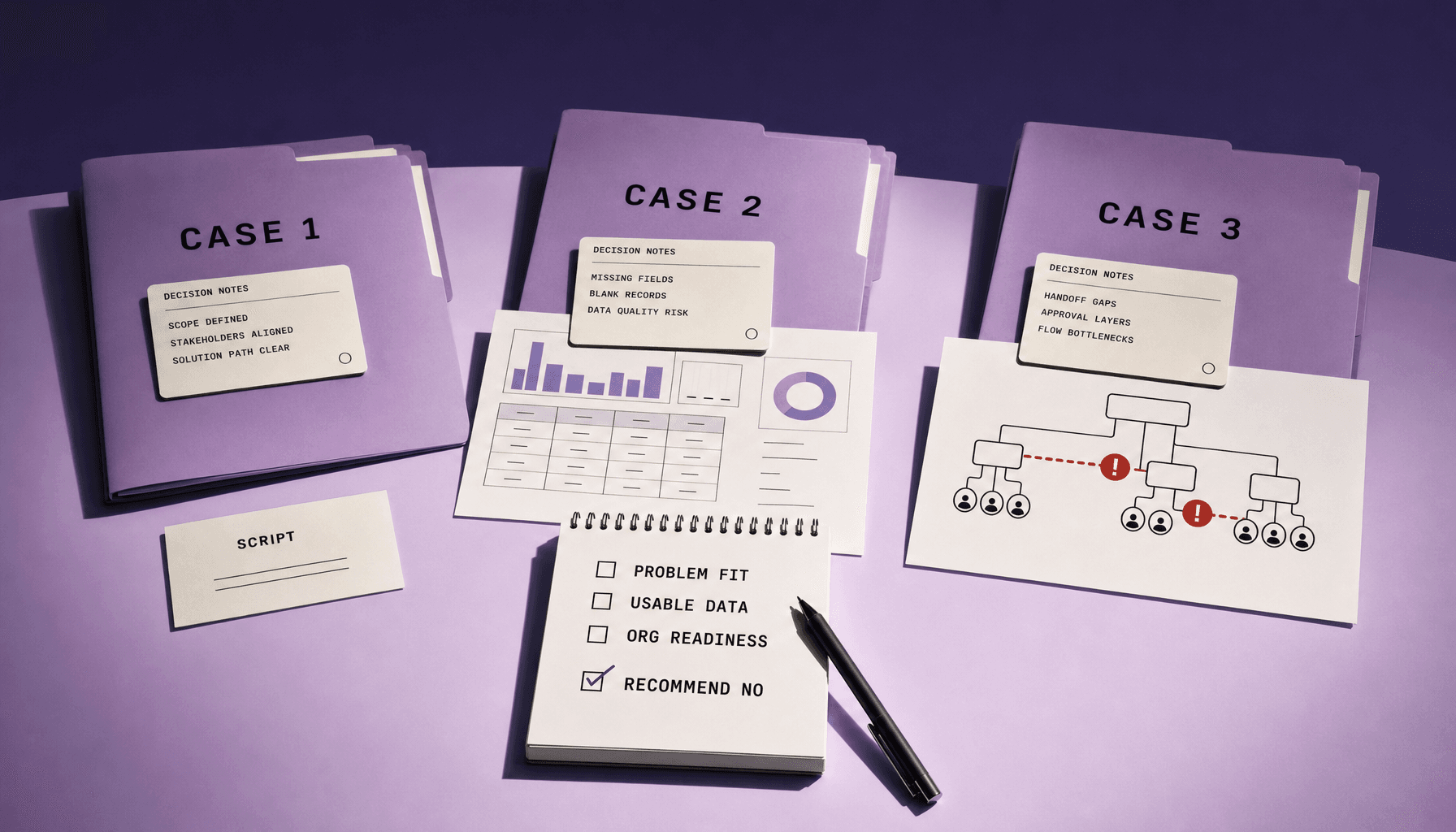
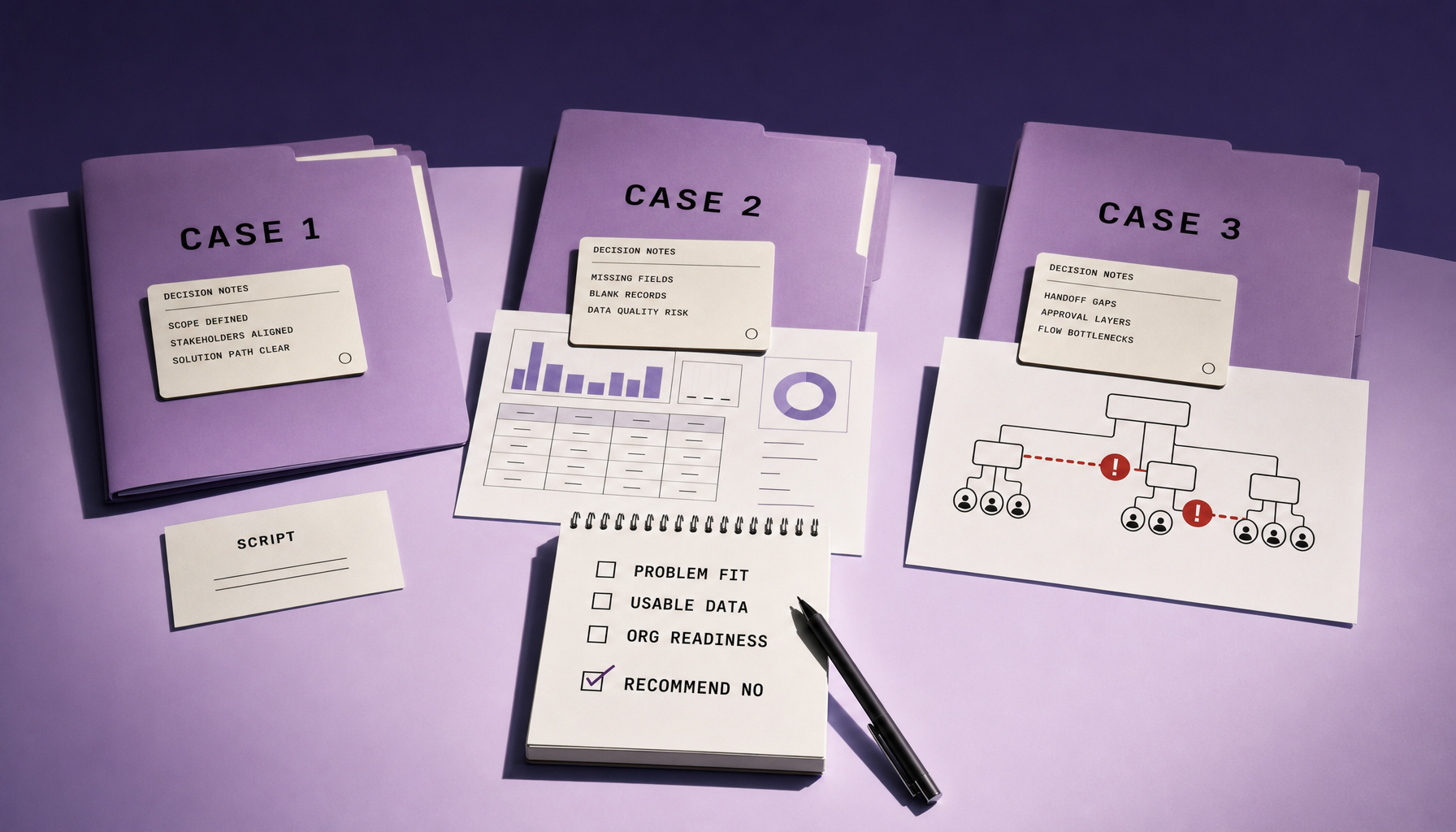
At Imversion Technologies Pvt Ltd, this tends to appear in three familiar patterns. One request asked for an AI agent, but the workflow had fixed inputs, fixed rules, and standard outputs. A script was the better answer. Another looked like a prediction problem, but the records were incomplete, inconsistent, and not meaningfully labelled -- poor AI project readiness, plain and simple. A third looked technical on the surface. It was not. Ownership was unclear, the process kept changing, and no system would stay reliable under that condition. So knowing when to say no to AI is part of the job. Clarity beats complexity, and an AI agent project failure often starts before any model exists.
Key Takeaways
- Saying no is part of the job. A request for an AI agent can hide a fixed, rules-based workflow better handled by a script with validation, logging, and monitoring -- a common pattern behind AI agent project failure.
- One clear lesson in why AI projects fail: teams start with model ideas before checking AI project readiness. If records are incomplete, inconsistent, or unlabeled, the right move is data cleanup first, not prompt tuning later.
- Some AI requests are misdiagnosed management problems. If ownership, process rules, or decision rights are unclear, no model will make the system reliable.
- Understanding the why behind the request matters more than matching the buzzword. A practical test: ask whether the work needs reasoning, usable data, and stable operators before deciding when to say no to AI.
Why Saying No Is Part of Why AI Projects Fail Less Often
By the time a project fails, most of the expensive mistakes have already happened.
Sometimes the most responsible AI recommendation is no.
Not no forever. No to the wrong shape of solution, at the wrong time, for the wrong problem. People asking why AI projects fail are often looking too late in the process -- after the demo, after the pilot, after the budget is already committed. But many AI implementation mistakes start earlier, during scoping. That is where professional refusal matters.
A serious evaluation should test three things: fit to problem, fit to data, and fit to organisation. If one fails, the project usually becomes more expensive, harder to test, and less reliable in production. Understanding why the request exists matters because the request itself is often a poor diagnosis.
| Decision lens | Better choice | Best fit | Main risk if ignored |
|---|---|---|---|
| Agent build vs script | Scripted workflow automation | Fixed rules, structured inputs, predictable outputs | AI agent project failure through unnecessary complexity |
| Model-first vs data-first | Data readiness first | Consistent records, labels, ownership, usable history | Weak outputs from poor data quality |
| Technical fix vs organisational fix | Process and change management | Unclear ownership, policy gaps, broken approvals | Shipping software that cannot be adopted |
The three anonymised cases in this article follow that pattern.
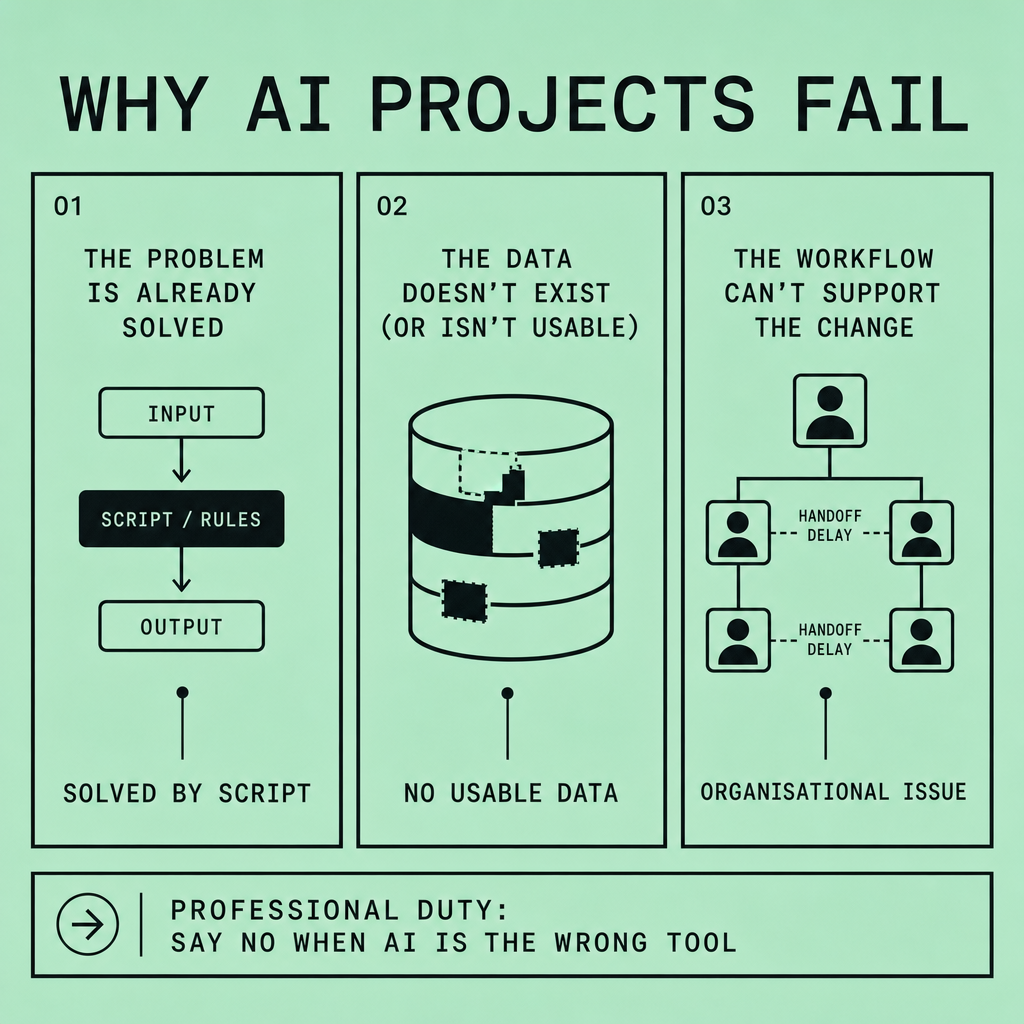
One request asked for AI agents to run a repetitive internal workflow across tools. The real task was deterministic: collect fields, apply rules, trigger actions, produce a standard result. A script was the cleaner answer. Cheaper. Easier to validate. Easier to monitor.
Another proposed AI system aimed to generate predictions from internal records. The model was not the blocker. The data was -- incomplete fields, inconsistent formats, missing labels, unclear definitions. In that case, when to say no to AI was simple: before a team turns bad inputs into expensive confusion.
The third looked technical on paper but was not. The issue sat in approvals, ownership, and process design. No model fixes that.
Saying no to AI is not caution theatre. It is risk control.
That is the practical standard: use AI where it has a defensible fit, refuse it where workflow automation, data repair, or change management will do the job better. Time is human. Selling systems that waste it is the opposite of the job.
Case 1: The AI Agent Project Failure That Was Better Solved by a Script
Plenty of “agent” requests are really automation requests with better marketing. This was one of them.
The short answer: this was not an agent problem. It was a workflow problem dressed up in agent language -- a common pattern in AI agent project failure, and a clear example of when to say no to AI.
The request
The request was for an AI agent that could work across multiple internal tools, take instructions in natural language, make decisions, and complete a repetitive business process end to end.
On paper, that sounds sensible. Teams often use “agent” as shorthand for “please automate this messy thing.”
But the requested autonomy was broader than the task required. Once the workflow was mapped, the steps were stable: gather structured inputs from known fields, apply fixed business rules, trigger a defined sequence of actions, and produce a standard output. No open-ended reasoning. No ambiguous judgment. No need for an agent to choose its own path.
The real problem
The real issue was misclassification.
This was deterministic automation, not agentic work. The inputs were structured. The rules were known. The expected output was consistent. That points to rule-based automation and workflow orchestration, not AI agents.
The right question was not “Which model should be used?” It was “Where does uncertainty actually enter the workflow?” In this case, it barely did.
That distinction matters. Agent systems add planning loops, tool-use logic, prompt handling, failure recovery, and extra monitoring. Useful in the right context. Wasteful here.
The recommendation
The recommendation was simple: replace the proposed agent with a scripted workflow.
A script or service could validate inputs, execute the rule chain, call the required systems in order, and log every step for monitoring and audit. It would also be easier to test, maintain, and run reliably in production.
The tradeoff is straightforward: scripts are less flexible if the process changes constantly. But for stable workflows, predictability beats faux autonomy.
If a process can be expressed as fixed rules over structured inputs, start with automation before considering an agent.
The outcome
The AI build did not proceed in the requested form. A simpler automation path was pursued instead.
That was the correct decision. Not because AI agents are useless, but because forcing them into a bad fit creates brittle systems, weak validation, and avoidable AI implementation mistakes.
Case 2: Why AI Projects Fail When There Is No Usable Data
A bad model can sometimes be improved. Bad underlying records are harder to negotiate with.
The short answer: a prediction system cannot succeed if the records it depends on are incomplete, inconsistent, or poorly labelled. In cases like this, the constraint is not model choice. It is whether the data describes the underlying process clearly enough for a system to learn from it.
The request
The proposed system was meant to use internal records to generate predictions or recommendations such as likely outcomes, next-best actions, or prioritised follow-ups.
On the surface, that sounds like a normal AI brief. But prediction only works when historical data reflects a reasonably stable and interpretable process. Here, the records came from multiple teams using different definitions, formats, and entry habits. Some important fields were missing. Others were buried in free text. The intended outcomes were not labelled in a way a model could reliably learn from.
So the problem was low data readiness, not missing model sophistication.
The real problem
The data was unusable for prediction in four ways: completeness, consistency, labels, and governance.
- Completeness: key records were partial, so the system would learn from gaps as much as from signal.
- Consistency: the same event or status meant different things across teams, making features unstable.
- Labels: if past outcomes are not clearly marked, supervised learning has nothing dependable to optimise against.
- Governance: without ownership, shared definitions, update rules, and auditability, data problems keep recurring.
This is a common AI implementation mistake. Teams focus on the visible layer -- model choice, prompts, or pipelines -- and underweight the substrate those systems depend on.
A project can look sophisticated in a roadmap and still fail for a basic reason: the system cannot learn from records that do not describe reality in a consistent way.
The recommendation
The practical recommendation was to pause the AI build and sequence the work differently: define shared labels, standardise schemas, instrument missing fields, assign data ownership, and clean historical records where practical.
That approach is slower at the beginning, but it gives the project a realistic chance of succeeding later.
A lightweight baseline can also run in parallel: rules, reporting, or a simple heuristic. That helps test whether the intended recommendations are operationally useful before investing in a full model pipeline.
The outcome
The proposed AI system did not move forward in its original form.
That was the right decision. When the data cannot support a reliable decision system, saying no to the AI build is often the most responsible step.
Case 3: Why AI Projects Fail When the Real Problem Is Organisational, Not Technical
Some requests sound technical only because the organisation has not described its own process clearly. That is a dangerous place to insert AI.
The short answer: this was a coordination problem first, and a software problem second. The request sounded like an AI orchestration issue, but the real blocker was an unstable operating model. Without shared rules, ownership, and decision criteria, an AI layer would not have removed confusion. It would have scaled it.
The request
The request was for an AI layer that could route work, reduce handoff delays, and help teams make faster decisions across a shared internal process. On paper, that sounded reasonable: too many messages, too many status checks, too many exceptions. The proposed fix was a system that could interpret updates, assign next steps, and keep work moving.
But that framing hid the actual issue.
The workflow did not have stable rules. Different teams used different criteria. Ownership changed by situation rather than design. Some approvals were mandatory in one case and ignored in another. An agent placed on top of that would not remove ambiguity. It would inherit it.
The real problem
What looked like a technical gap was an operating model problem.
There was no single owner for the process design. Stakeholder alignment was weak. The same task meant different things to different parts of the organisation. A common AI implementation mistake is treating inconsistent process rules as if they were missing software features.
This is one reason why AI projects fail. Not because a model cannot classify a message or summarise a note, but because the system has no clear source of truth about who decides, who approves, and what “done” means. Software can accelerate a clear process. It can also amplify a confused one.
The recommendation
The recommendation was to pause the build and fix the operating rules first. Define ownership. Standardise handoffs. Agree on exception handling. Document the minimum workflow that everyone would actually follow.
Only after that should software be considered. Even then, simple workflow tooling or rules-based automation would likely be the better first step. Adding AI too early would create more to monitor, debug, and govern without removing the bottleneck.
A useful test for when to say no to AI: if the team cannot explain the process clearly without the system, the system will not clarify it for them.
The outcome
The AI build did not proceed in the requested form.
That was the right call. A technical implementation at that stage would have produced activity, not resolution. The more responsible path was organisational: settle ownership, align stakeholders, then decide whether any software -- AI or otherwise -- was still needed.
A Simple Decision Framework for When to Say No to AI
A lot of wasted effort can be avoided with three questions asked early enough.
Start with three questions. If any answer is no, stop the AI build there.
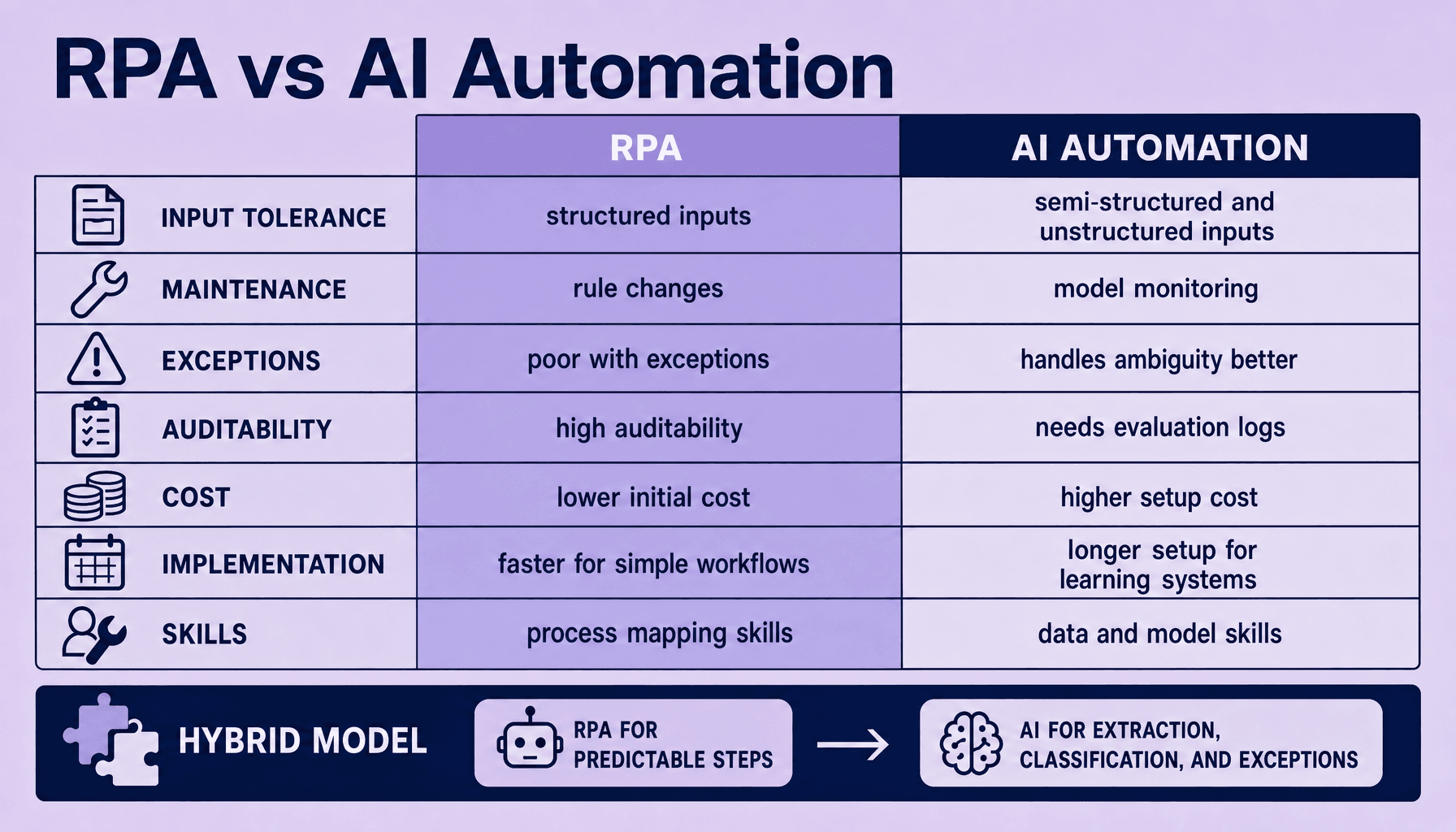
First: is the task deterministic? If inputs are structured, rules are fixed, and outputs can be specified in advance, an agent is usually the wrong tool. That is one of the most common bad use cases for AI agents. Use a script, a workflow engine, or an API integration instead. Cheaper. Easier to test. Easier to monitor.
Second: is the data usable? This is the core of AI project readiness. If records are incomplete, inconsistent, or missing labels tied to the decision you want the model to make, the work before AI is data cleanup, schema alignment, and instrumentation. Not prompt design. Not model selection.
Third: is the process stable and owned? If teams do not agree on handoffs, exceptions, approval rules, or who is responsible for outputs, the system will fail even if the model works. That is how technical feasibility gets confused with workflow stability.
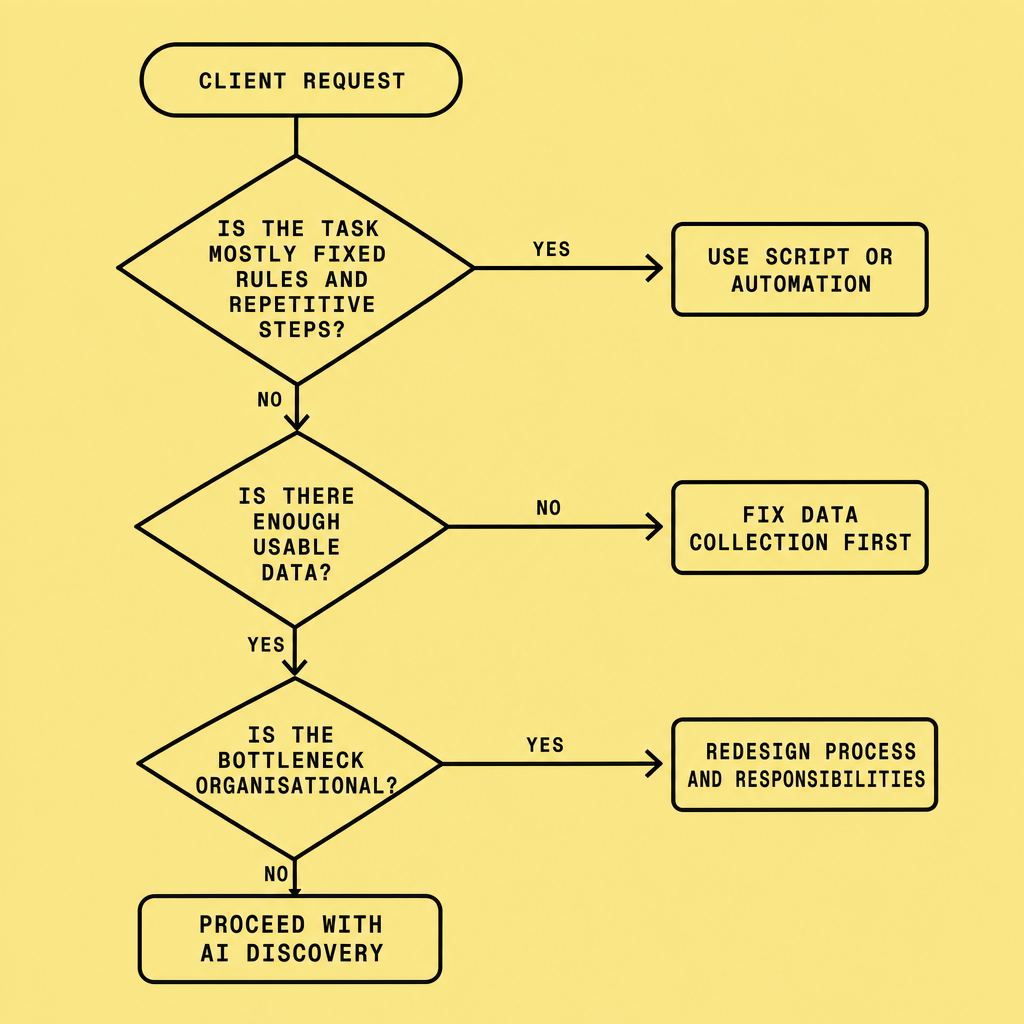
A practical rule: build AI only after the task, data, and ownership model can survive contact with production.
So the framework is simple: deterministic task, use automation; weak data, fix the data; unstable process, fix the operation. Knowing when to say no to AI preserves time, budget, and trust. And time is human -- selling systems that waste it is the opposite of the job.
The Opposite of the Job Is Selling Systems That Waste Human Time
The cost of a bad AI decision is rarely just technical debt. It is burned time, weaker trust, and teams stuck maintaining systems that never should have been built.
This is the plain conclusion: saying no is part of responsible AI work.
The pattern behind why AI projects fail is often visible early -- a rules-based workflow dressed up as an agent, a model request without usable records, or a technical brief hiding an organisational gap. In each case, the duty is the same: explain what the problem actually is, define AI project readiness, and say no when the request points to avoidable AI agent project failure.
Because time is human.
And systems that burn hours through brittle handoffs, poor data, or unnecessary complexity should not be sold as progress. A script, a data cleanup plan, or a clearer operating model may be less exciting. But selling systems that waste human time is the opposite of the job.

Frequently Asked Questions
How can a team tell early why AI projects fail before spending on a pilot?
Teams can usually predict failure early by checking for three preconditions: a problem that truly requires probabilistic reasoning, data that is usable and governed, and a process with clear ownership. If any of those are missing, the pilot is likely to measure confusion rather than value.
Why AI projects fail even when the demo looks impressive?
A strong demo can hide weak production readiness because demos often use curated inputs, manual oversight, and simplified assumptions. Projects fail later when they meet real exceptions, inconsistent records, changing workflows, and unclear accountability that were never resolved during scoping.
What should happen before building an AI agent for internal operations?
A team should first map the workflow, list decision points, identify where uncertainty actually exists, and separate fixed rules from judgment calls. That exercise often shows that standard automation, better interfaces, or process cleanup will solve the problem with less cost and less operational risk.
Why AI projects fail when data exists but still is not usable?
Data can exist in large volumes and still be unusable if it lacks consistent definitions, trustworthy labels, complete histories, or stable collection rules. AI systems depend more on the quality and meaning of records than on their raw quantity, so abundance does not equal readiness.
Why should saying no to an AI request be treated as professional responsibility?
Saying no is a professional duty because technical teams are responsible for preventing avoidable waste, not just delivering requested builds. Refusing a poor-fit AI system protects time, budget, and trust by steering work toward the simplest solution that can operate reliably in the real environment.
Make Imversion a preferred source on Google
Like this kind of AI and software analysis? Add Imversion as a preferred source so Google can highlight our articles for you in Search, AI Overviews, and AI Mode.