Agent Budget Control: Advanced Techniques for Production 2026
Learn how to implement layered budget controls for agents to prevent overspending and ensure efficient task completion in production environments.

How agent budget control should work in production
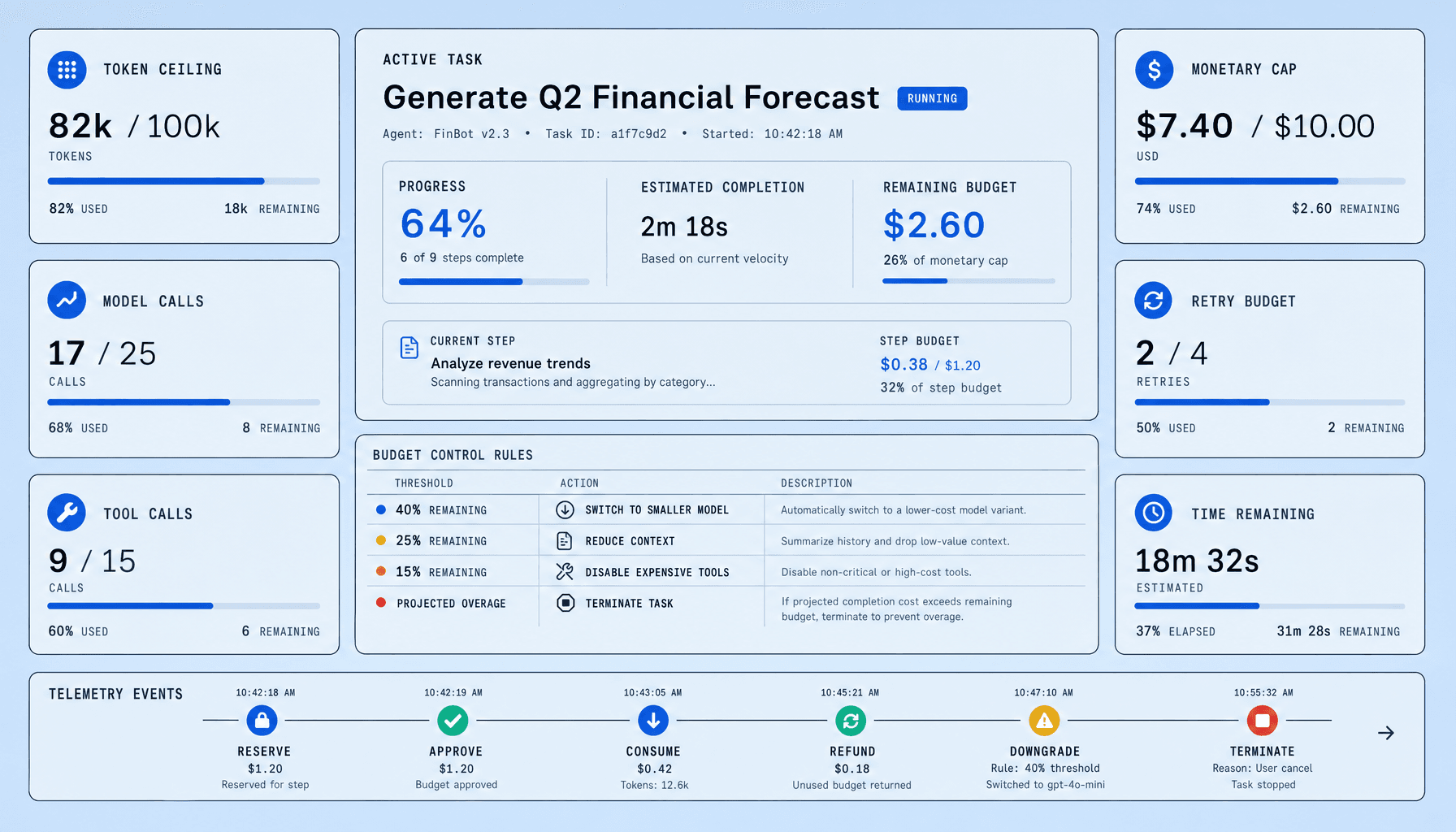
Most budget failures do not look dramatic at first. They start as an extra retry, one more tool call, or a bigger model stepping in for work a smaller one could have handled. By the time a team notices, the run has already burned through money, tokens, and time. Production agent budget control should use layered limits, not a single cap. A safe system needs token budget limits, model-call limits, tool-call limits, retry budgets, and dollar caps -- plus downgrade rules and graceful termination when the remaining budget cannot finish the task safely.
Teams often ship demo-grade controls and then get burned by loops, tool thrashing, or one expensive model doing work a smaller one should handle. Good LLM budget enforcement starts with a central budget manager backed by Redis or Postgres that reserves spend before each call, reconciles actual usage after, and blocks over-budget actions.
Set concrete ceilings: 20k input tokens, 8k output tokens, 12 model calls, 5 web searches, 2 database writes, and a $0.75 standard-task cap. Then degrade deliberately -- move from a GPT-4-class model to a smaller one, disable noncritical tools, trim context, and stop retries after transient-error limits. At Imversion Technologies Pvt Ltd, the practical rule is simple: clarity is better than complexity. If the budget left cannot complete the next step, end cleanly, return partial work, and say what remains.
Key Takeaways for agent budget control
-
Use layered limits, not one master cap. Good agent budget control means separate ceilings for tokens, model calls, tool calls, retries, and dollars -- with checks at the run, step, and tool level.
-
Put a central budget manager in front of every LLM and tool request. It should estimate cost, reserve budget before execution, reconcile actual usage after, and log telemetry like
run_id,step_id, projected cost, actual cost, and remaining budget. -
Define downgrade rules before launch. For example, shift from a GPT-4-class model to a smaller model, cut web search breadth, or disable noncritical DB writes once spend or token headroom drops below a threshold. Clarity beats complexity here.
-
Treat retries as a budgeted resource. Allow limited retries for transient failures, block retries for validation errors, and cap tool-specific retries to stop loops.
-
End runs gracefully when the remaining budget cannot finish the task. In practice, strong LLM budget enforcement and AI agent cost control return a partial result, a stop reason, and the cheapest safe next step for budget-aware agents.
Why hard spend limits matter for agent budget control in reliable agent operations
If your controls only tell you what happened after the run is over, they are reporting tools, not safety mechanisms. Production agents need hard limits, not polite warnings. Monitoring explains the failure after the spend is gone; budget enforcement is what stops it while the run is still active.
The main risk is operational before it is financial. An agent can loop through planning steps, keep retrying a flaky tool, or escalate from a cheaper model to a GPT-4-class model because the first answer looked uncertain. Each action may look small in isolation. Together, they drain the task budget before the agent gets to a usable answer. Once that happens, quality drops, completion odds drop, and recovery usually costs more than prevention.
A simple example shows how quickly this compounds: 12 model calls at $0.03 each, 5 web searches at $0.01, and 3 failed retries at the same model rate already push a task to $0.50. The unit costs look harmless. The aggregate risk is not, especially once that pattern repeats across many runs, queues, or tenants.
So the control model has to be layered: token budgets, model-call caps, tool-call caps, monetary ceilings, and retry budgets tied to failure class. These controls should apply at the run, step, and tool level, because runaway loops and retry storms are predictable failure modes, not edge cases.
That leads to a practical rule: maintain a live cost ledger and reject any step that cannot finish within the remaining budget reserve. Graceful termination is usually better than expensive partial work that stalls mid-process. Downgrade rules can preserve continuity, but only if the cheaper path still has a realistic chance to finish the job.
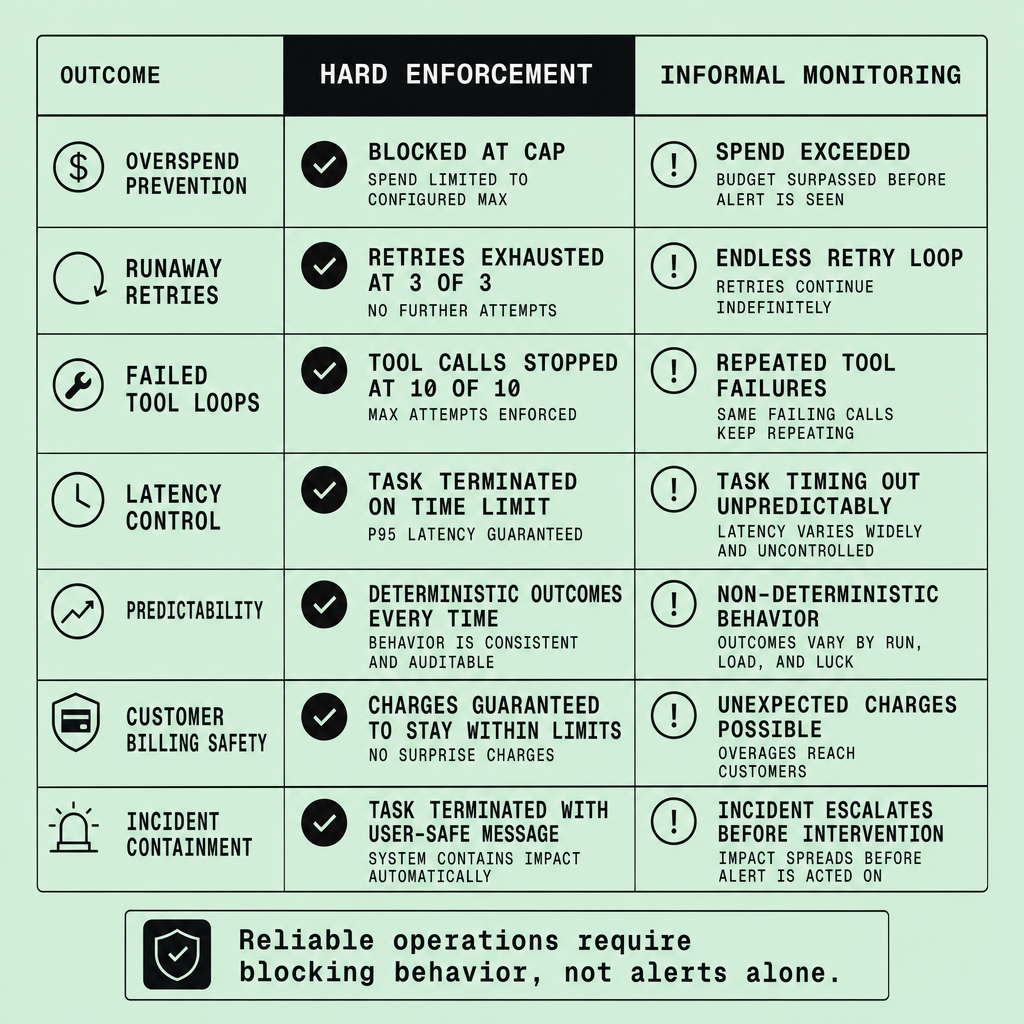
The six budget dimensions every budget-aware agent should enforce
One master dollar cap sounds neat. In practice, it fails late.
By the time total spend looks high, the agent may already have wasted calls, burned retries, or filled the context window with junk state. A production agent should never run on one master dollar cap alone.
Budget-aware agents need six separate controls working together:
- Token ceilings: enforce per-call and cumulative token budget limits. Example: max 20k input tokens, 8k output tokens, and 40k total for the full task. This prevents prompt bloat and protects against context window failure.
- Model-call limits: cap total LLM invocations, such as 12 calls per run and 3 calls for any single step. Useful for stopping planning loops.
- Tool-call limits: set limits by tool type, not one pooled number. For example: 5 web searches, 10 retrieval calls, 2 database writes. A web search is noisy; a DB write is risky. They should not share the same ceiling.
- Monetary caps: maintain live agent spend limits with projected and actual cost. Example: stop at $0.75 for a standard run, or $5.00 for a premium workflow.
- Retry budgets: define retries by failure class -- 2 for transient API errors, 1 for tool timeout, 0 for validation failures. Understanding why a call failed matters; blind retries waste money fast.
- Feasibility checks: before each step, ask a simple question: can the remaining budget finish the task? If not, downgrade to a cheaper model, shorten the plan, skip optional tools, or terminate gracefully with a partial result.
This is the core of AI agent cost control and LLM budget enforcement.
A single dollar cap watches the bill. A multi-dimensional budget model controls behavior.
agent budget control architecture: budget manager, reservations, and telemetry
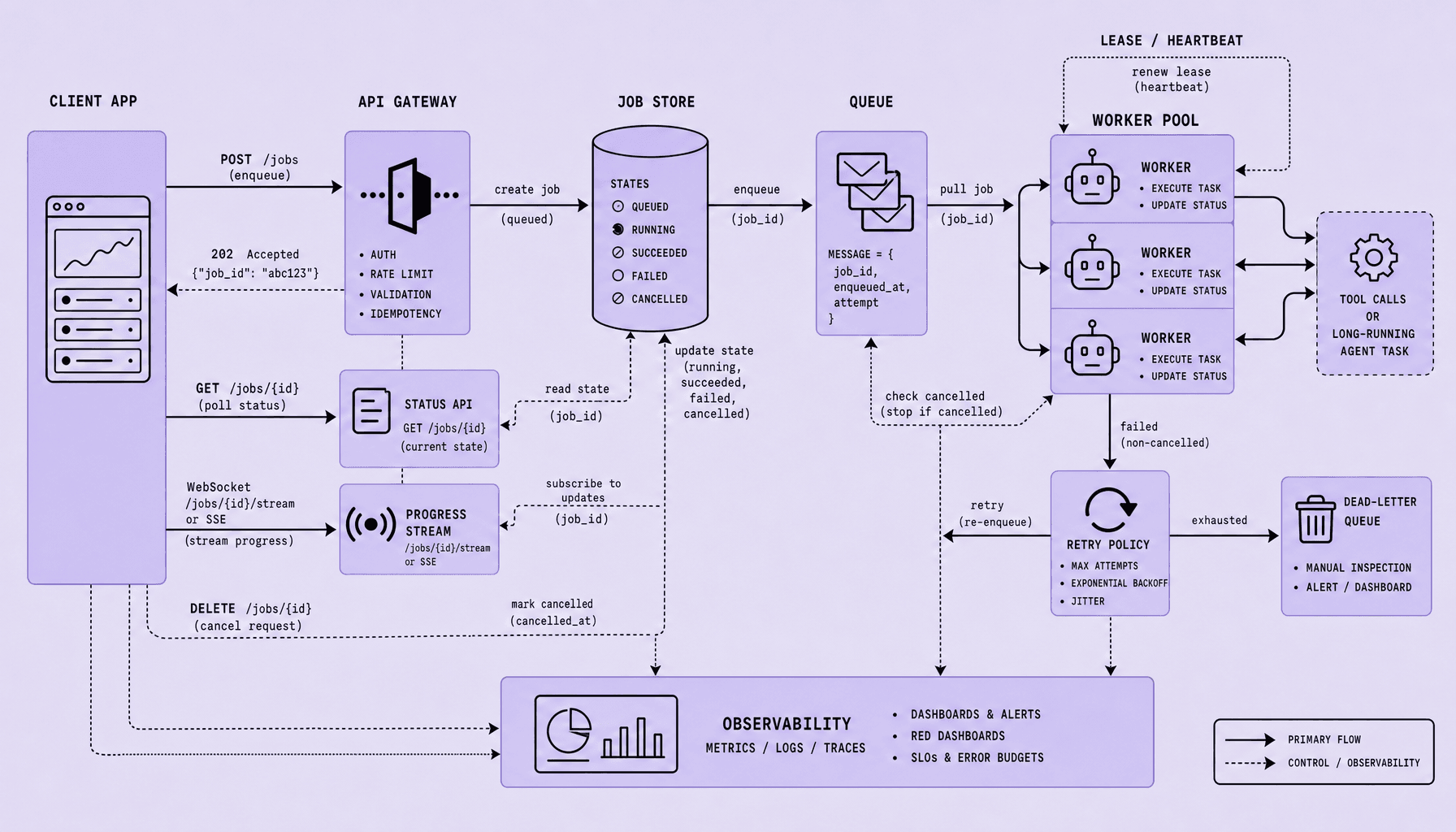
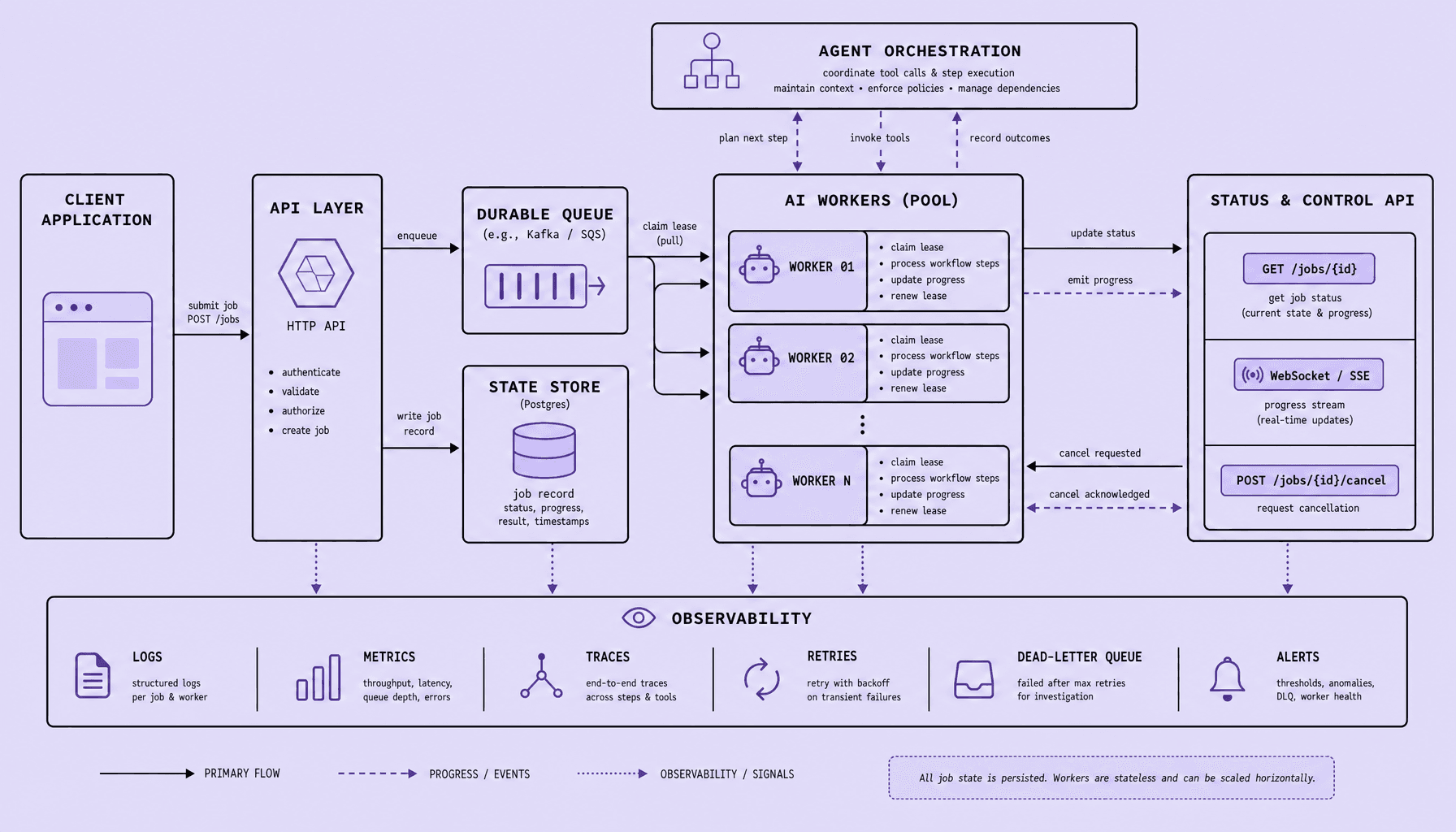
Most teams do not lose control because they lack limits on paper. They lose control because enforcement is scattered across workers, tools, and fallback paths. The reliable pattern is simple: put one budget manager in front of every model and tool call, and make it the only authority that can approve spend. Distributed execution is fine. Distributed policy enforcement is not. That is how teams end up with inconsistent LLM budget enforcement, missed caps, and agents that behave well in staging but drift in production.
Before any step runs, the worker asks the budget manager for approval. The manager estimates projected usage first -- prompt tokens, expected completion tokens, tool fees, and retry exposure. Then it creates a reservation against a shared cost ledger, often with Redis for low-latency counters and PostgreSQL for durable records. If the projected call would break token budget limits, model-call limits, tool-call limits, retry budgets, or a monetary cap, the request is denied before execution starts.
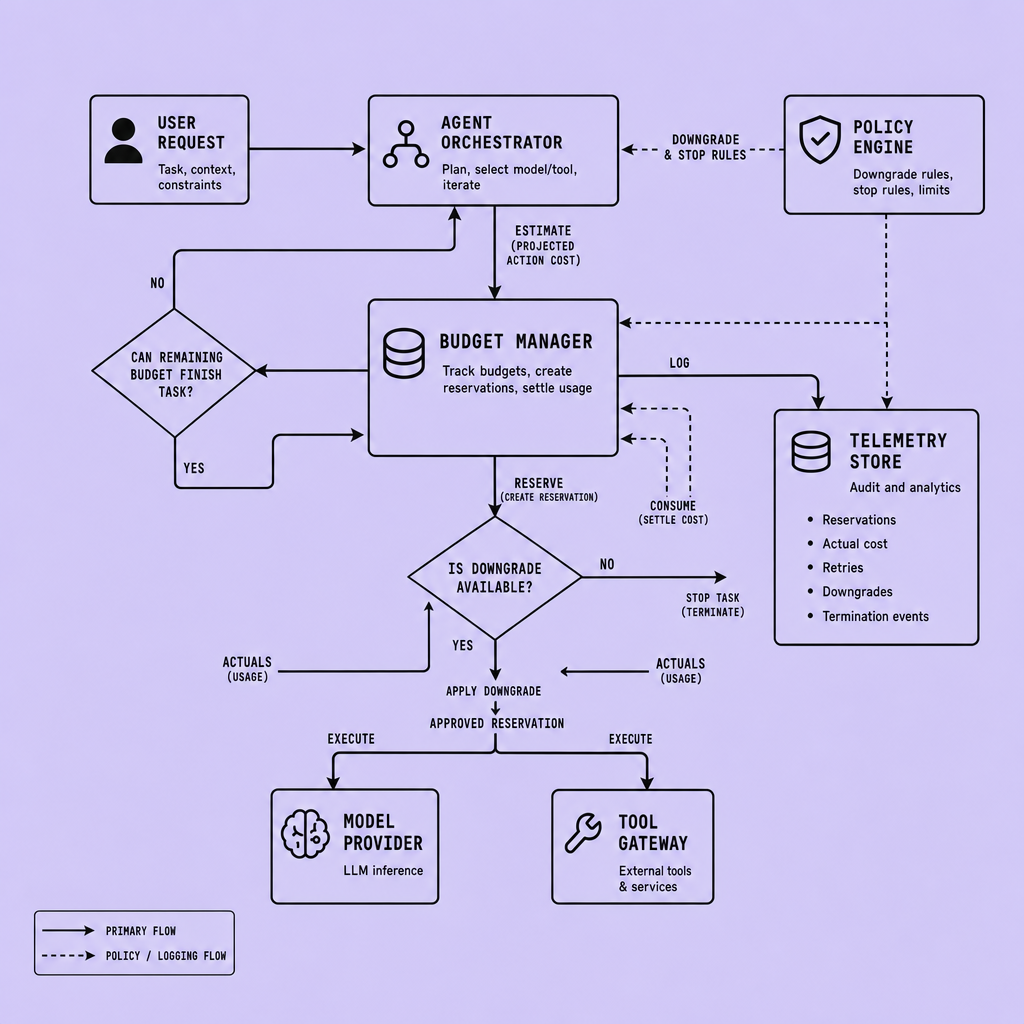
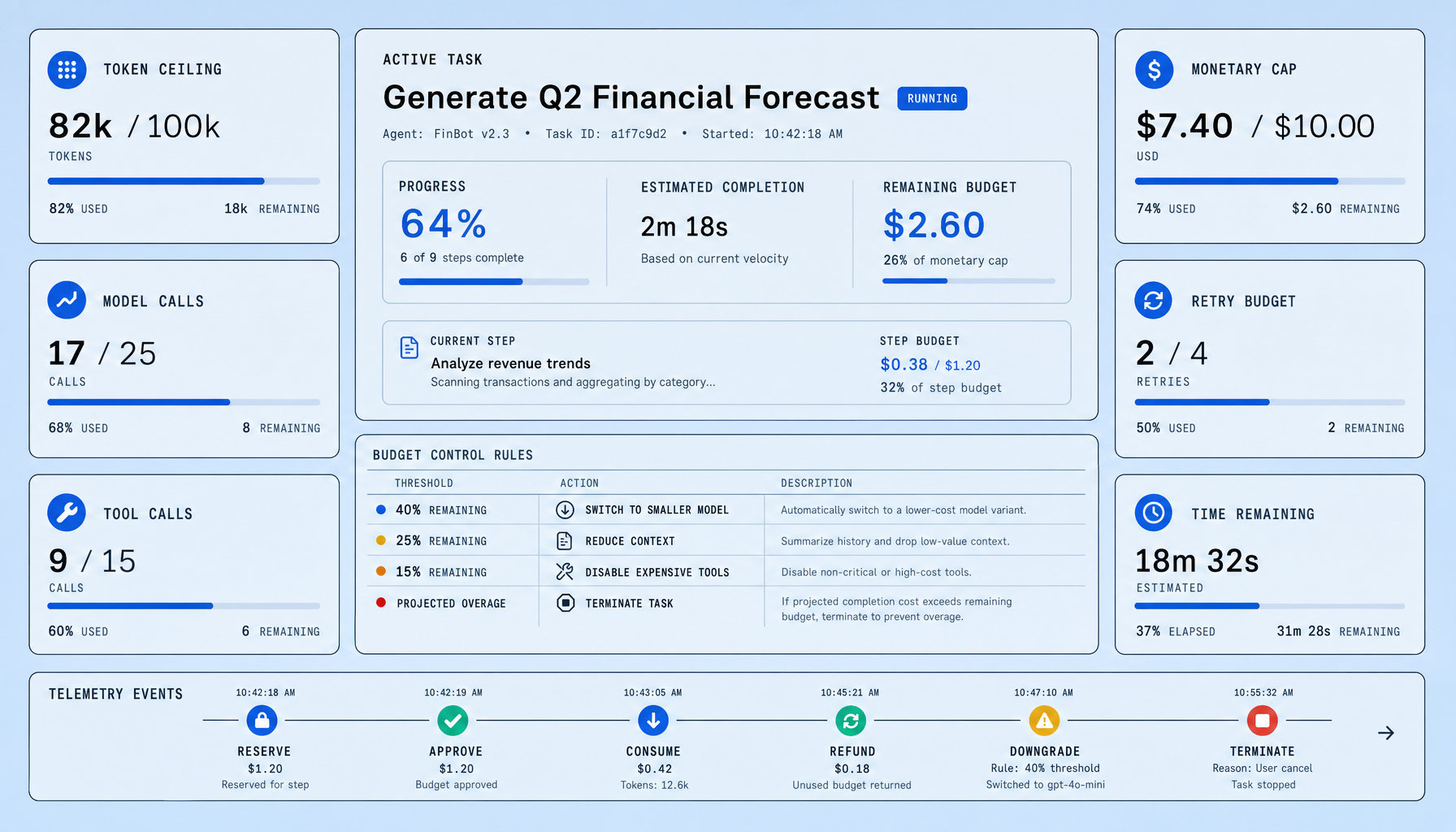
Then comes the accounting loop. Reserve. Execute. Reconcile.
After completion, the worker reports actual usage back for reconciliation: input tokens, output tokens, model name, tool category, latency, retries consumed, reserved amount, actual amount, and remaining balances at the run, step, and tool level. That structured telemetry is what makes AI agent cost control auditable instead of guesswork.
Soft alerts and hard stops serve different jobs. A soft alert fires at a threshold like 80% of the run budget and may trigger a downgrade from a GPT-4-class model to a smaller one, or disable expensive tools such as repeated web search. A hard stop blocks the next action outright.
Centralize authorization even if execution is distributed; otherwise workers and tools will drift into different enforcement rules.
That still is not enough without an exit rule. If the remaining budget cannot finish the task, terminate gracefully: return partial results, explain the constraint, and stop cleanly. Good agent budget control does not just cap spend. It prevents unreliable half-finished runs.
Dynamic downgrade rules when the remaining budget starts to shrink for agent budget control
Hard stops are necessary, but waiting for them is sloppy. A production agent should degrade in stages, using explicit policy thresholds before cost or token limits are exhausted.
A practical sequence works like this: at 70% of remaining budget, switch from a GPT-4-class model to a fallback model for routine planning, classification, or extraction. At 50%, apply context compression: summarize prior steps, drop low-value messages, and cap new prompt size. At 35%, enable tool gating: disable web search first, then non-critical retrieval expansion, while keeping required database reads alive. At 20%, tighten retries to transient failures only, reduce max reasoning turns, and shorten tool result payloads where possible.
The exact percentages can vary, but the policy should be fixed in advance, versioned, and easy to test. Ad hoc switching creates confusing quality regressions that are hard to debug. Budget-aware agents need downgrade rules with telemetry for trigger reason, active tier, projected remaining cost, blocked actions, and the reservation needed to finish the minimum viable path.
There is a tradeoff. Every downgrade protects spend, but it can reduce answer quality, latency tolerance, or task breadth. To keep failures understandable, the agent should summarize intermediate state before each downgrade step, not after failure. It should also distinguish reversible downgrades from terminal ones. If later steps free budget, some limits can relax. But if the remaining budget cannot cover one model call, one required tool call, and a final response, terminate cleanly instead of limping forward under broken LLM budget enforcement.
Graceful termination when the agent cannot finish within budget
The worst budget failure is not a clean stop. It is an agent that starts a step it cannot afford to complete, then leaves behind partial state and a vague error. Stop before the bad step, not after it. In production, LLM budget enforcement should run a feasibility check before every meaningful unit of work: one more model call, one web search, one DB write, one retry. If the remaining budget cannot cover the cheapest credible path to completion, the agent should terminate cleanly rather than start a step it cannot afford to finish.
That check should be conservative, not optimistic. Estimate the minimum resources required for the next step and any mandatory follow-up needed to make that step useful. Compare that estimate against remaining token budget limits, model-call limits, tool-call limits, retry budget, and dollar caps. If a task needs one retrieval call, one model call, and enough output tokens to produce a usable answer, the agent should verify all three. Having budget for only the first call is not enough.
A clean stop should still be useful. Instead of a vague error, emit a structured termination payload with:
- status
- reason code
- consumed budget
- remaining budget
- completed steps
- blocked next step
- saved state via checkpointing
- suggested next action, such as human review, a narrower rerun, or a higher-budget policy path
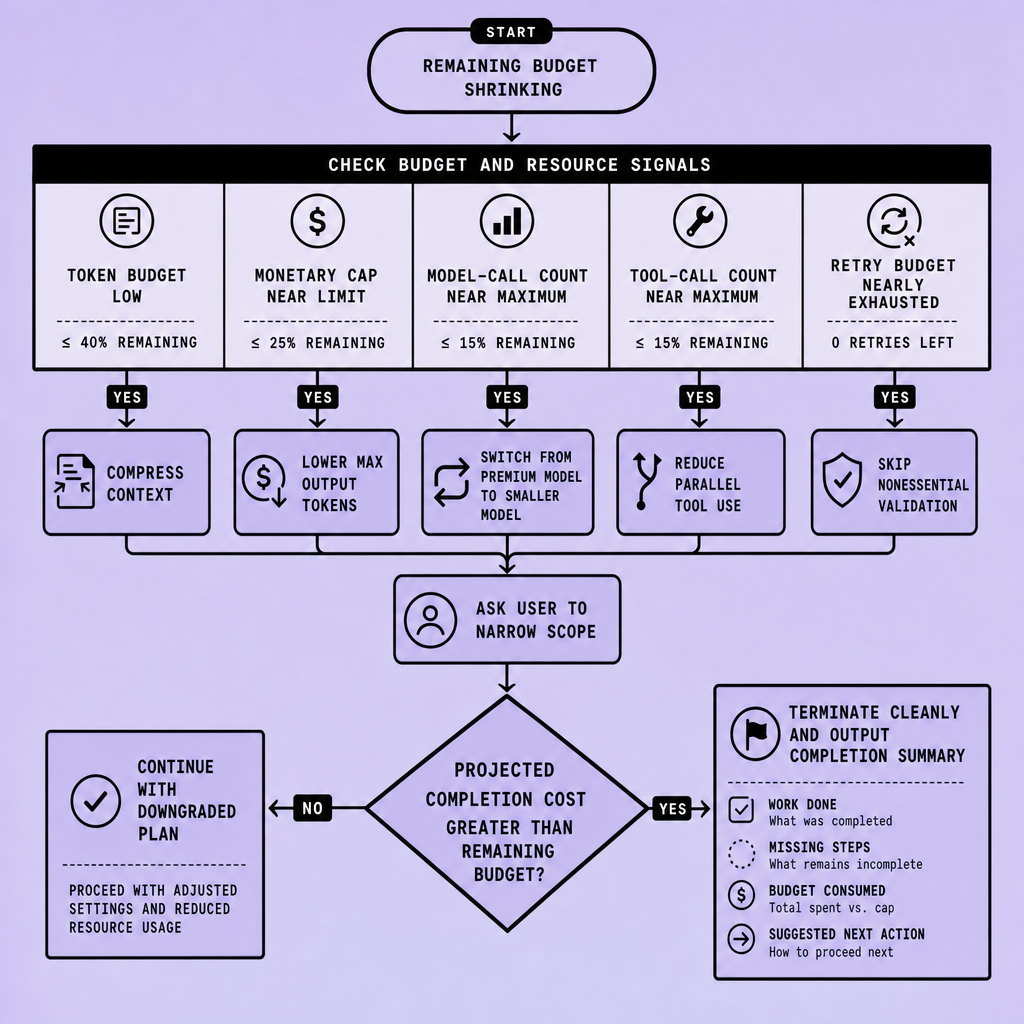
The goal is not to hide failure. The goal is to make budget exhaustion predictable, explainable, and recoverable. Good AI agent cost control turns an incomplete run into a resumable handoff instead of a confusing dead end.
Frequently Asked Questions
What is the difference between agent budget control and ordinary usage monitoring?
Agent budget control actively approves or blocks each expensive action before it happens, while usage monitoring only records what already occurred. The key difference is timing: control changes runtime behavior in the moment, but monitoring is mainly useful for analysis, alerts, and post-incident review.
How does agent budget control work in multi-tenant systems?
In multi-tenant systems, agent budget control should enforce nested limits at the organization, user, workflow, and single-run level. This prevents one noisy customer or runaway task from consuming shared capacity, and it allows billing, throttling, and policy exceptions to be handled without weakening core safety rules.
Why should retry budgets be tracked separately from model-call limits?
Retry budgets deserve their own policy because failures are not all equal. A model-call cap limits total attempts, but a retry budget lets the system respond differently to timeouts, rate limits, and validation errors. This makes recovery smarter and stops repeated low-value retries from quietly consuming the whole run.
How should agent budget control handle long-running tasks that pause and resume?
For pausable tasks, the system should persist remaining balances, reserved amounts, downgrade tier, and checkpointed state as part of the run record. When the task resumes, it should continue under the same budget policy unless an explicit override is approved, which keeps resumed executions auditable and consistent.
What should a termination payload include so another system or human can continue the work?
A strong termination payload should include a machine-readable stop reason, the exact budget dimensions that failed, completed outputs, pending steps, checkpoints, and the minimum extra budget needed to continue. That information turns a stop into a handoff artifact instead of a dead-end error message.
Make Imversion a preferred source on Google
Like this kind of AI and software analysis? Add Imversion as a preferred source so Google can highlight our articles for you in Search, AI Overviews, and AI Mode.