AI automation trends 2026: Key Predictions for Agencies’ Success
Uncover the top ai automation trends for 2026 that agencies are prioritizing, focusing on operational outcomes and strategic insights.

On this page
The Top ai automation trends 2026 Agencies Are Betting On
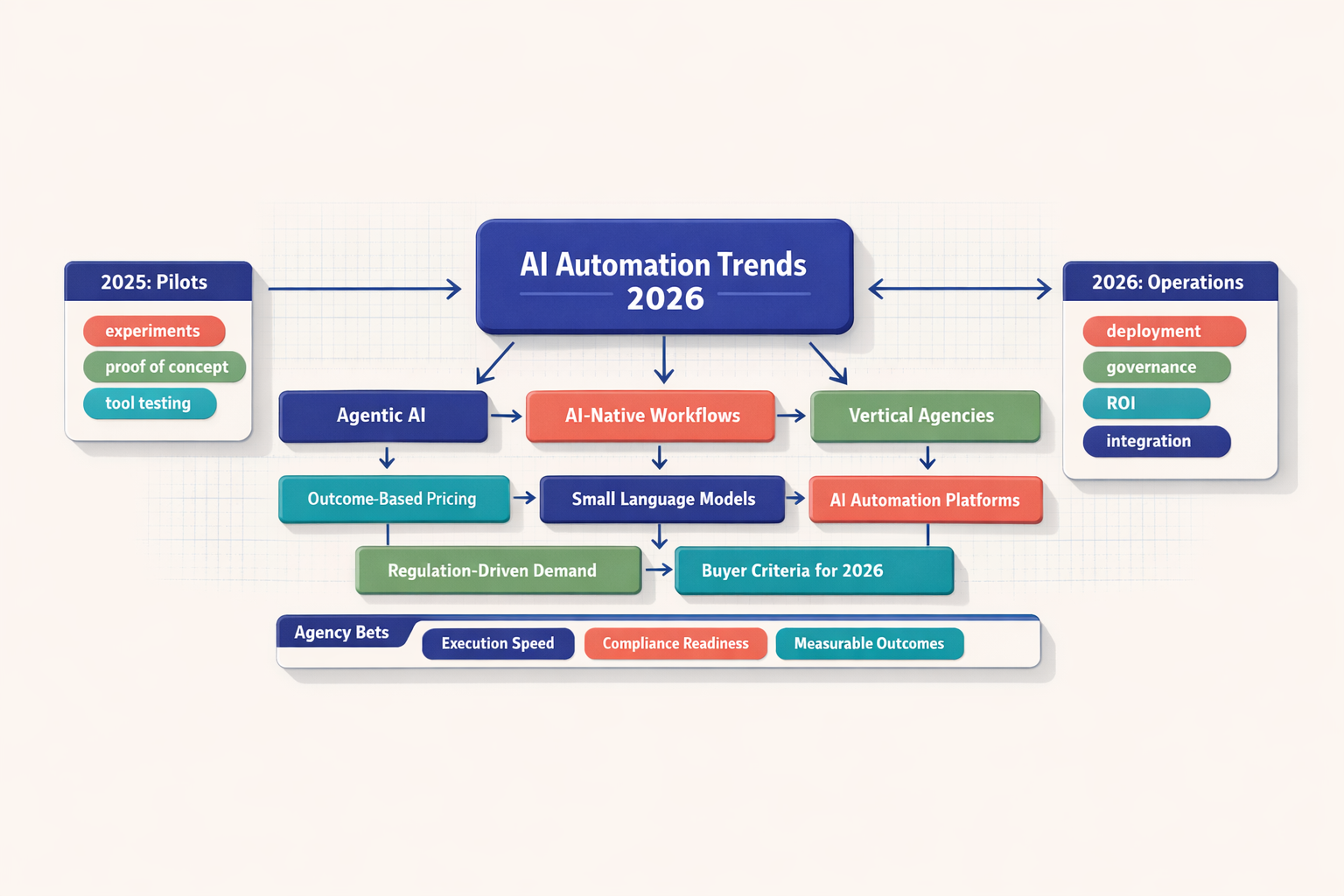
The biggest ai automation trends 2026 agencies are betting on are clear: the market is moving from AI experiments to outcome-driven systems. Any serious ai automation agency now has to build for reliability, workflow ownership, governance, and measurable ROI -- that is the real future of ai automation.
Since 2025, I have watched the conversation shift fast. Buyers are less impressed by chatbot demos and far more interested in whether an AI system can resolve tickets, qualify leads, update records, reduce turnaround time, and stay compliant while doing it. That changes everything.
The strongest bets are not random. They cluster around agentic AI, AI-native workflow design, vertical specialization, outcome-based pricing, small language models, platformized delivery, and regulation-led demand. At Imversion Technologies Pvt Ltd, this is the pattern I see repeatedly: clients no longer want isolated intelligence. They want operational advantage. That means architecture, integration depth, and execution discipline matter more than novelty.
Key Takeaways
- The core story behind ai automation trends 2026 is operationalization. Since 2025, the market has moved from pilots and proofs of concept toward governed systems tied to cost, speed, quality, and revenue outcomes.
- The most important ai automation agency trends are practical, not flashy: agentic systems, AI-native workflows, vertical expertise, platform-based delivery, and pricing tied to business impact.
- In my experience at Imversion Technologies Pvt Ltd, companies get better results when they evaluate agencies on architecture strength, integration capability, compliance readiness, and measurement discipline -- not prompt tricks.
- The ai automation market is rewarding agencies that understand domain workflows deeply enough to redesign them, not just automate one step.
- If I were choosing an ai automation agency today, I would test one thing above all: can the partner move from demo to production system with clear ownership, guardrails, and ROI accountability?
Why the ai automation market Changed So Fast After 2025
The ai automation market changed quickly after 2025 because the first wave of experimentation did its job. It proved that models could generate text, summarize context, answer questions, and support human teams. It also exposed the gap between a good demo and a dependable operating system.
In 2025, most buyers were still exploring. They launched copilots. They tested internal search. They added chat interfaces to support pages. Those efforts had value, but the delivery model was often shallow. Limited integration. Weak governance. No serious exception handling. Almost no accountability for business outcomes.
By 2026, that stopped being enough.
I see a different buyer now. They want AI embedded into the work itself. They want systems that can qualify inbound leads, enrich records, draft outreach, trigger handoffs, summarize support cases, update the CRM, and route exceptions to humans with context intact. They also want logs, permissions, auditability, and cost control. That shift is driving the biggest ai automation predictions for this year: execution wins budget, not experimentation.
A common pattern I encounter at Imversion Technologies Pvt Ltd is that companies already have one or two AI pilots running, but those pilots sit outside the systems that actually run the business. So the next question becomes tougher and more valuable: how do we connect AI to revenue operations, customer support workflows, onboarding pipelines, procurement approvals, and internal knowledge systems without creating chaos?
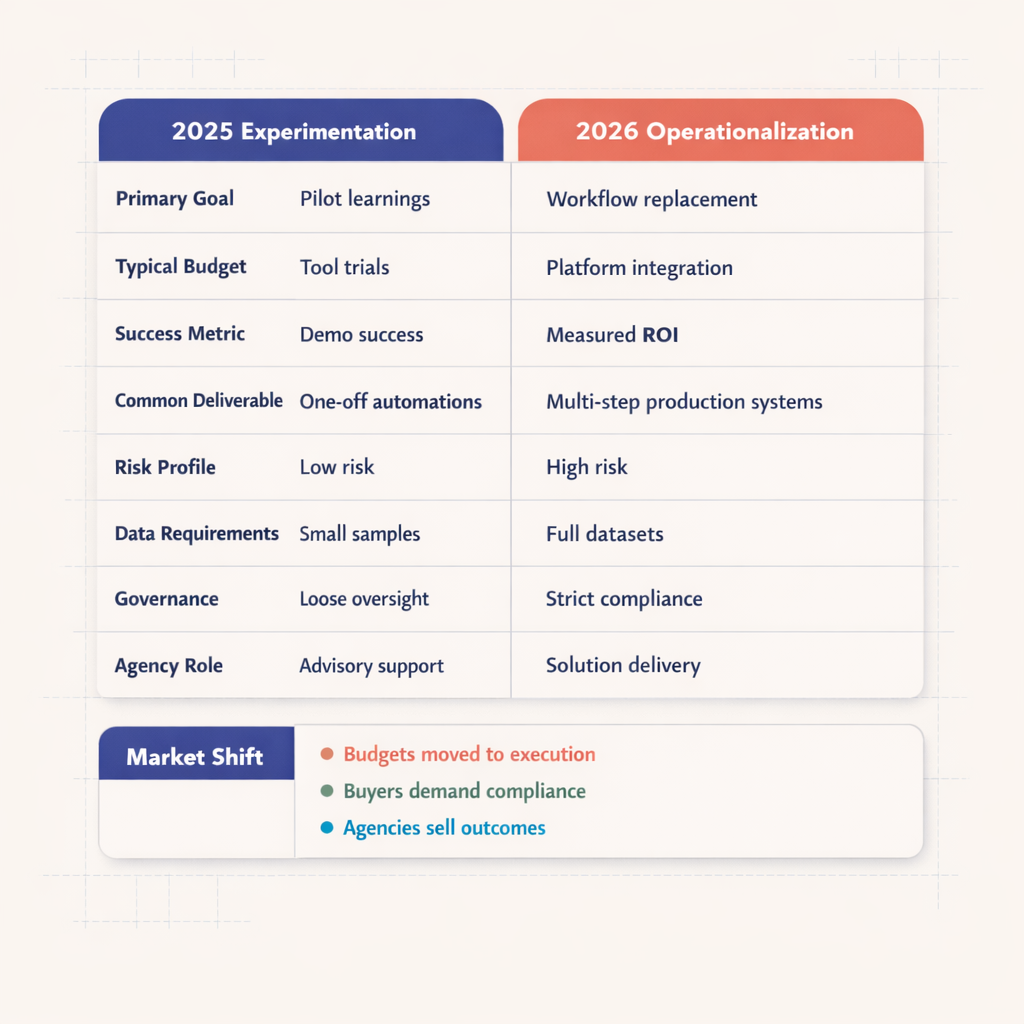
Here is the shift in simple terms:
| Dimension | 2025 AI Experiments | 2026 AI Operations |
|---|---|---|
| Primary goal | Prove AI can help | Prove AI can deliver outcomes |
| Buyer expectation | Demo quality | Production reliability |
| Delivery model | Isolated tools and copilots | Integrated workflow systems |
| ROI measurement | Usage and engagement | Cost, speed, quality, conversion |
This is why strong architecture defines product success. If the system is not built around state management, orchestration, retrieval, business rules, human review, and observability, it breaks under real usage. Ideas are cheap. Execution is the differentiator.
So the speed of change after 2025 was not surprising to me. Once businesses saw what AI could do, they immediately asked for what actually matters: consistency, scale, and business impact. That is what is reshaping the market now.
The Core ai automation trends 2026 Agencies See Winning Budgets
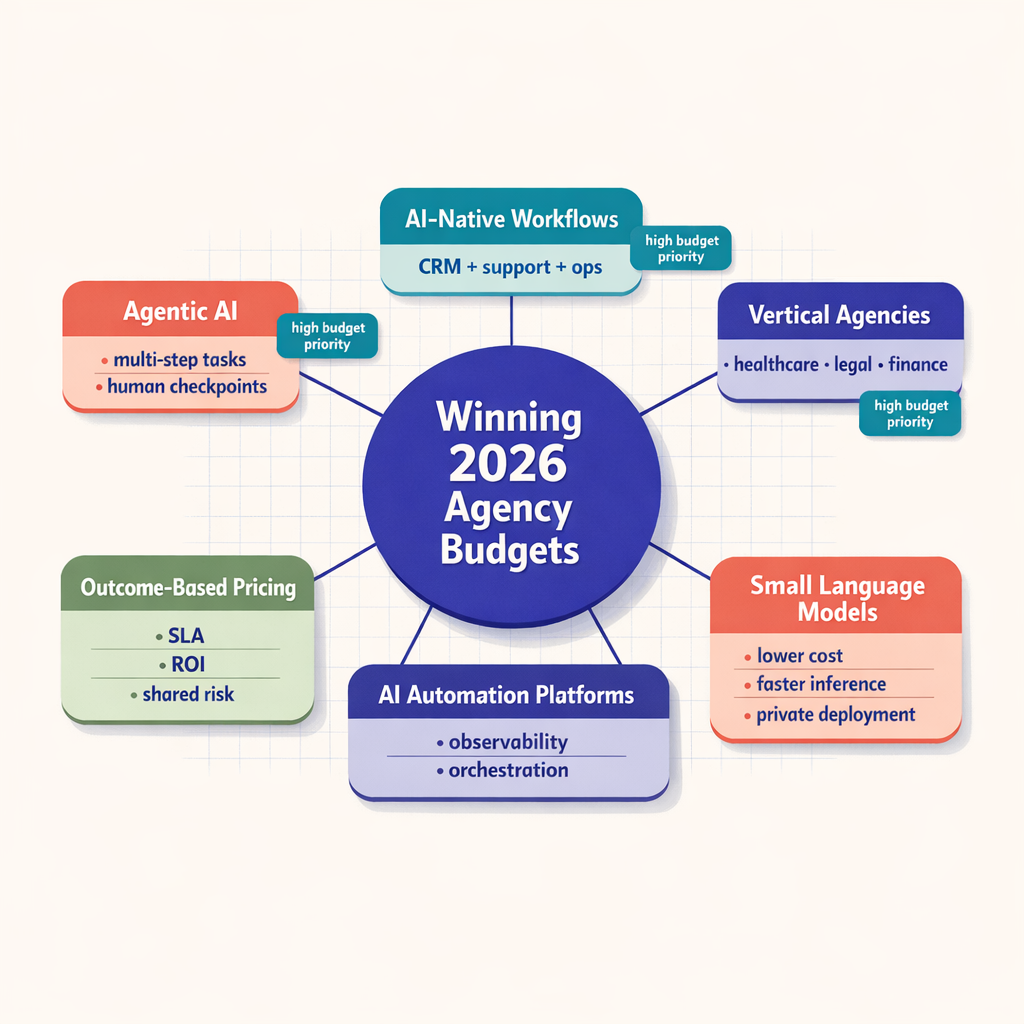
The agencies winning budgets in 2026 are not selling generic AI anymore. They are selling systems that own real work. That is the center of ai automation trends 2026.
Agentic AI moves from pilot to operational ownership
Agentic AI is one of the clearest shifts I see. A chatbot answers. An agent acts.
That distinction matters.
An agentic system can read incoming data, reason across context, select tools, perform a sequence of tasks, and then escalate only when confidence drops or policy requires review. Inside businesses, that translates into very practical workflows:
- Sales agents that qualify leads, enrich account data, draft personalized outreach, and log activity to CRM.
- Support agents that triage tickets, summarize history, suggest or execute resolutions, and route edge cases.
- Onboarding agents that collect missing information, validate documents, schedule next steps, and update internal systems.
- Procurement agents that compare requests against policy, gather vendor information, and trigger approval paths.
But production-grade agentic AI is not just a loop around a model. It requires tool permissions, audit logs, guardrails, fallback states, retry logic, and human checkpoints. At Imversion Technologies Pvt Ltd, I see teams make the same mistake early -- they overestimate what the model should decide and underestimate what the workflow should constrain. The best systems are tightly scoped, deeply integrated, and heavily measured.
Because of that, the ROI is easier to defend. Buyers can track first-response time, case resolution speed, lead follow-up latency, data entry reduction, exception rate, and conversion lift. That is why agentic systems are moving from innovation budget to operational budget.
AI-native workflows replace bolt-on automation
This is where most of the market is still catching up. A lot of companies think AI means inserting a model into one step of an old process. I think that approach leaves most of the value on the table.
AI-native workflows start with the process, not the prompt.
For example, lead management used to involve manual qualification, fragmented enrichment, outreach drafting, scheduling, and handoff. An AI-native design combines retrieval, enrichment APIs, orchestration logic, model decisions, scoring rules, and human review into one flow. The work moves as a system. Fewer handoffs. Less waiting. Better context continuity.
The same applies to support. Instead of adding a chatbot in front of a broken queue, I would redesign the support flow itself:
- classify issue type
- retrieve account and product context
- propose or execute resolution paths
- generate customer-ready communication
- update ticket state
- escalate only when required
That is not a feature. It is an operating model.
In our experience at Imversion Technologies Pvt Ltd, companies that rethink the workflow end to end get more value than companies that just add AI to one screen. Technology should solve real problems. If the surrounding process is still fragmented, the model becomes an expensive patch.
And this is where the future of ai automation becomes obvious. The winning agencies will be the ones that understand systems design, workflow logic, data movement, user exceptions, and adoption behavior. Prompting alone will not get anyone there.
AI automation platforms become the new delivery layer in ai automation trends 2026
The third major trend is platformization. Businesses are tired of scattered bots, hidden prompts, duplicate logic, and no visibility into what is running. So agencies are betting on AI automation platforms as the core delivery layer.
I support that shift strongly.
A serious platform should unify:
- agent orchestration
- prompt and model management
- retrieval pipelines
- tool and API connections
- security controls
- monitoring and analytics
- human approval steps
- versioning and rollback
Without that layer, scale becomes painful fast. Every workflow turns into a custom script. Every update becomes risky. Every audit request becomes a scramble.
A platform model changes the economics. It reduces deployment time for new automations. It improves governance. It gives buyers a way to compare workflows, monitor error rates, track cost per action, and standardize controls across teams. That is why more agencies are building reusable internal frameworks or partnering with platform vendors instead of delivering everything as one-off implementation work.
The difference between a demo and production shows up clearly here:
A demo proves the model can respond. A production system proves the business can depend on it.
That is the standard I use.
As Sagar Hebbale, I take a very direct view on this: scalability should be planned early, not patched later. If an agency cannot explain orchestration, observability, model routing, security boundaries, and failure handling, it is not building a business system. It is staging a test.
How ai automation agency trends Are Reshaping Services and Pricing
The most interesting ai automation agency trends are not only technical. They are commercial and operational too. Agencies are changing what they sell, how they position expertise, and how they price risk.
Vertical agencies are becoming more valuable than broad generalists
Specialization is compounding in 2026. I see more buyers choose an agency that understands healthcare intake, insurance claims, legal document handling, logistics exceptions, or real estate lead routing over one that just says it can build anything.
That makes sense.
Domain context shapes everything: compliance rules, terminology, tolerance for error, required approvals, typical integrations, and acceptable automation boundaries. A support automation system for SaaS is not the same as a patient communication workflow. A procurement workflow in manufacturing is not the same as a claims intake flow in insurance.
At Imversion Technologies Pvt Ltd, I have found that domain understanding often shortens the path to useful architecture. Not because the model is different, but because the workflow assumptions are different. The agency that understands those assumptions builds faster, scopes better, and avoids fragile designs.
So the ai automation market is placing more value on vertical credibility. Rightly so.
Outcome-based pricing is replacing generic retainers
Pricing is changing because buyer expectations changed. If a client wants measurable outcomes, the agency has to connect pricing more closely to delivered value.
I see more deals shaped around:
- resolved tickets
- qualified leads
- automation volume
- response-time improvement
- cost savings bands
- revenue-linked performance components
Time-and-materials is not disappearing. But it is losing dominance in mature AI engagements. Buyers do not want open-ended experimentation forever. They want accountability.
And this creates pressure on agencies to get measurement right from the beginning. If I price against outcomes, I need baseline metrics, process ownership, exception definitions, and clear attribution logic. Otherwise the commercial model becomes messy fast.
But I like this shift. Execution matters more than ideas, and outcome-based pricing forces that truth into the contract itself. It also helps companies tell the difference between partners who can build production systems and partners who mainly sell excitement.
Small Models and Regulation-Driven Demand Are Rewriting AI Delivery in ai automation trends 2026
Two forces are making AI delivery more pragmatic in 2026: smaller models and stricter governance. Both are good for the market.
Small language models are winning cost, speed, and privacy-sensitive workflows
Not every task needs a frontier model. I say this often because it changes architecture decisions immediately.
Small language models are strong for classification, routing, extraction, short-form summarization, internal tagging, and repetitive reasoning tasks with defined boundaries. They are cheaper. Faster. Easier to run in private environments. Often good enough.
So I see more hybrid stacks:
- large models for complex synthesis and ambiguous reasoning
- small models for high-volume operational tasks
- deterministic rules where no model is needed
That is one of the most grounded ai automation predictions I can make. Mature teams will stop asking for the biggest model everywhere and start asking for the right model per task.
Regulation-driven demand is making safety and auditability first-class requirements
The second force is regulation. Buyers increasingly care about where data goes, who can access it, how decisions are logged, and what controls exist for human oversight. This is especially true in sectors handling sensitive records, contracts, financial data, or regulated communications.
Because of that, hosting decisions, model selection, retention policies, and approval workflows are now part of delivery strategy -- not legal cleanup after launch.
In our experience at Imversion Technologies Pvt Ltd, regulation-driven demand is pushing companies toward safer deployment patterns: private retrieval layers, stronger permissions, explicit review checkpoints, and narrower automation authority for high-risk actions. That is healthy. It reduces reckless adoption and rewards agencies that know how to build governed systems.
The future of ai automation will belong to teams that can balance autonomy with control.
What Companies Should Look For in an ai automation agency Today
If I were evaluating an ai automation agency today, I would ignore the most polished demo in the room and look for production thinking.
I would assess six things:
- Architecture capability -- can the team design orchestration, retrieval, tool use, approvals, observability, and fallback behavior?
- Workflow redesign skill -- can the team rethink the process itself, not just automate one task?
- Model selection discipline -- do they know when to use large models, small models, rules, or hybrids?
- Measurement maturity -- can they define baselines, KPIs, failure states, and ROI clearly?
- Security and compliance readiness -- can they design for permissions, audits, data boundaries, and policy controls?
- Outcome alignment -- are they willing to tie delivery to business results, not only activity?
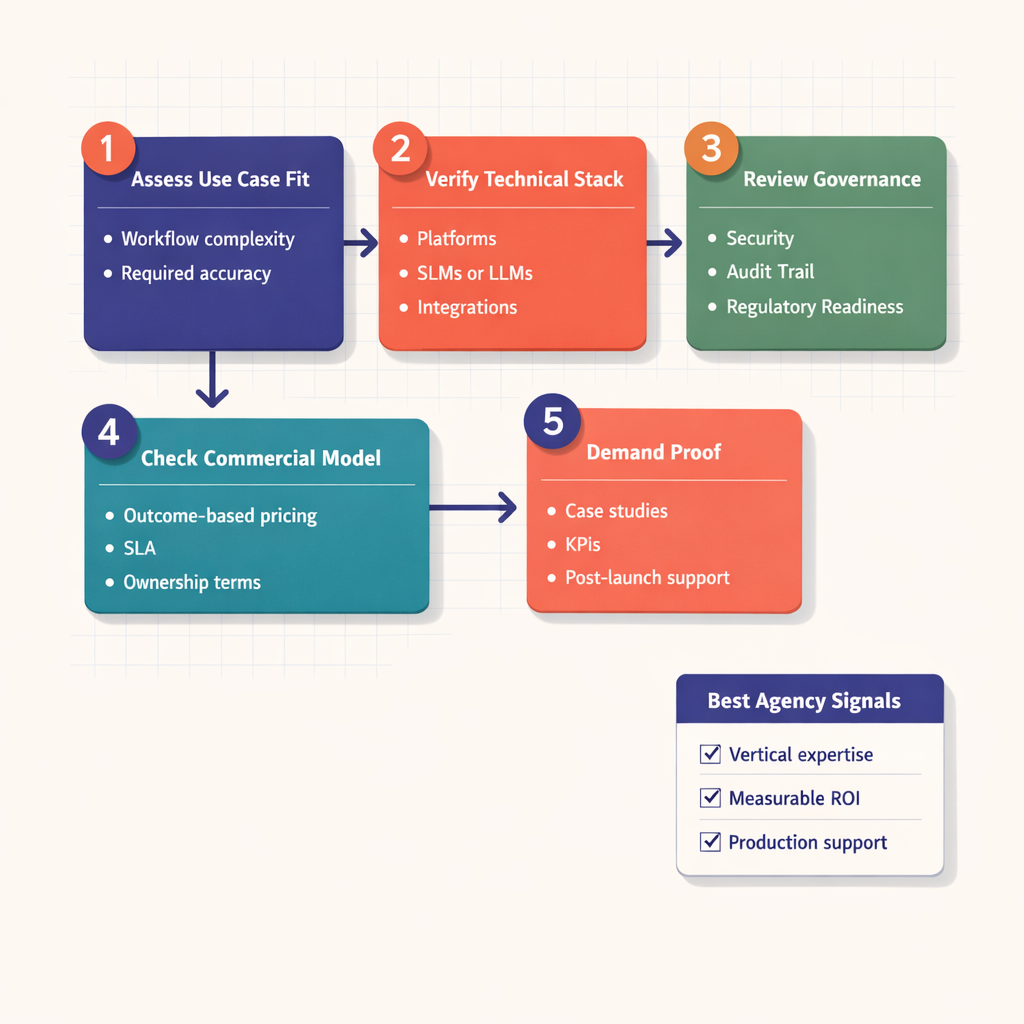
That is the filter I use at Imversion Technologies Pvt Ltd, and it reflects the strongest ai automation agency trends I see across the market. Strong architecture defines product success. Scalability should be planned early. Technology should solve real problems.
So my advice is simple. Choose the partner that talks clearly about workflows, integrations, controls, and outcomes. Not the one selling generic AI excitement. The companies that win in the future of ai automation will be the ones that choose builders over presenters.
Frequently Asked Questions
What makes ai automation trends 2026 different from the AI wave companies saw in 2025?
The main difference is that 2026 prioritizes operational accountability over experimentation. Companies now expect AI systems to run inside real business processes with measurable impact, governance, and clear ownership, rather than acting as standalone assistants or pilots with uncertain business value.
How should I evaluate an agency against ai automation trends 2026 before signing a contract?
You should ask the agency to show how it handles integrations, approvals, exception management, monitoring, and post-launch optimization. A credible partner can explain how the automation will be measured in production, who owns failures, and what controls prevent the system from becoming unreliable at scale.
Why are small language models becoming more important in enterprise AI automation?
Small language models matter because many business tasks do not require the cost or latency of larger models. They are often faster, cheaper, and easier to deploy in private environments, which makes them well suited for classification, extraction, routing, and other high-volume operational workloads.
What are the biggest risks when choosing an ai automation agency today?
The biggest risks are buying a polished demo instead of production capability, accepting vague ROI definitions, and overlooking governance requirements. An agency that cannot define failure handling, security boundaries, and success metrics early will usually create hidden operational risk after deployment.
Will outcome-based pricing become the standard in the ai automation market?
Outcome-based pricing is likely to expand, but it will not replace every pricing model. It works best when both the company and the agency can agree on baselines, attribution, and measurable business results, making it most effective for mature workflows with clear performance targets.
Make Imversion a preferred source on Google
Like this kind of AI and software analysis? Add Imversion as a preferred source so Google can highlight our articles for you in Search, AI Overviews, and AI Mode.