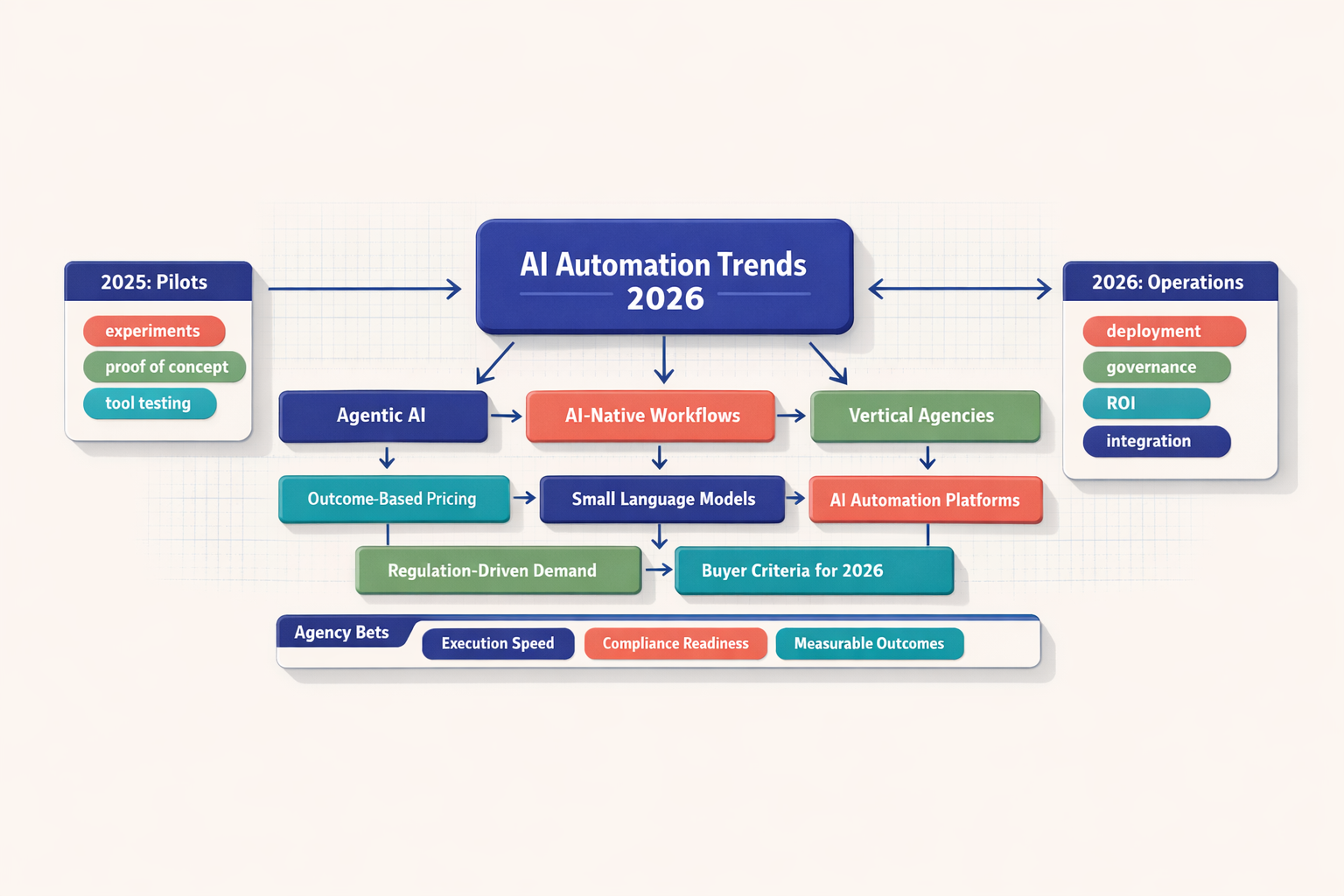
AI Automation Consulting: Strategy First for Effective Execution
Confused about AI automation consulting vs a full-service agency? Learn how to choose the right approach for effective strategies and execution.

On this page
AI Automation Consulting vs Full-Service Agency: Which Do You Need?
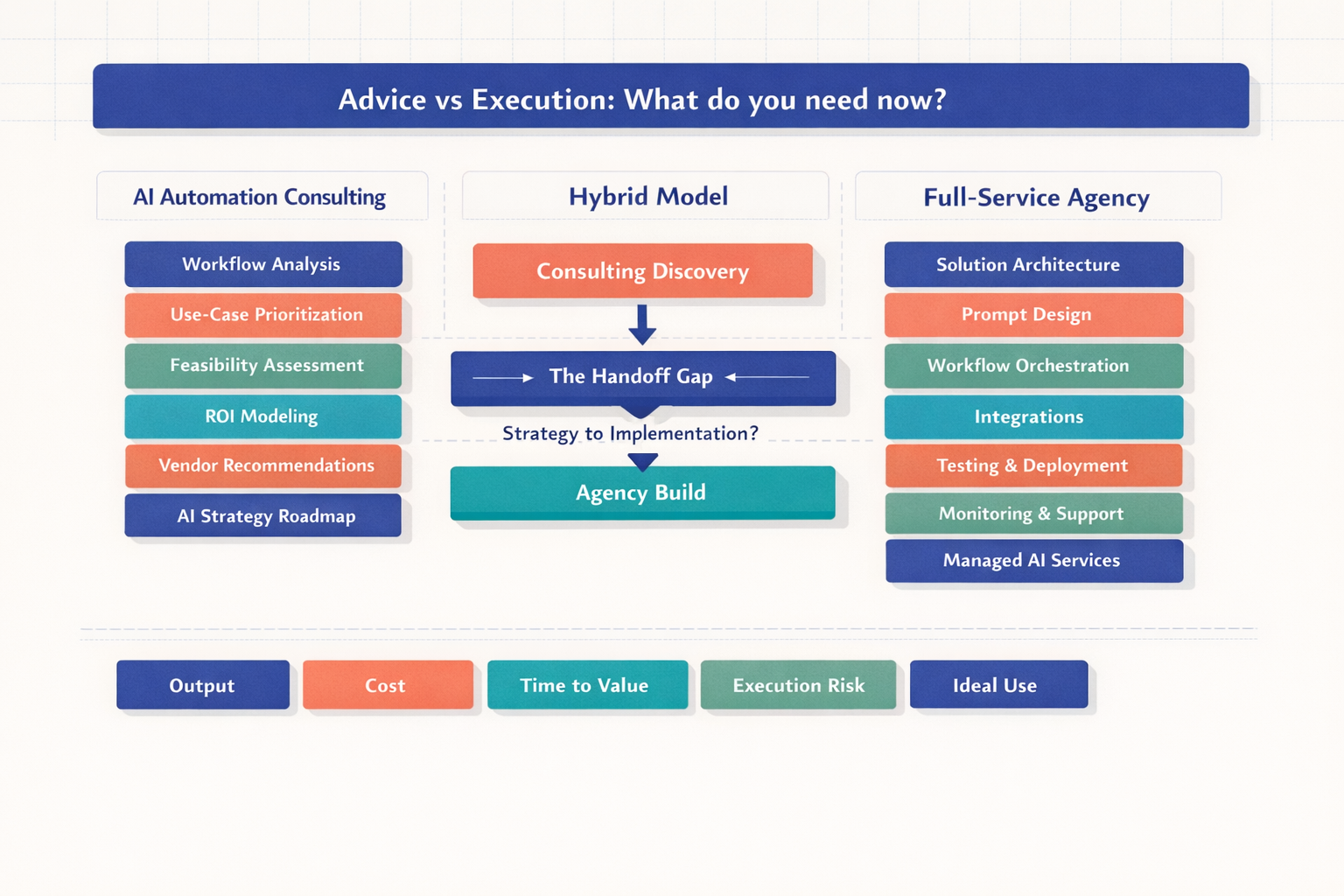
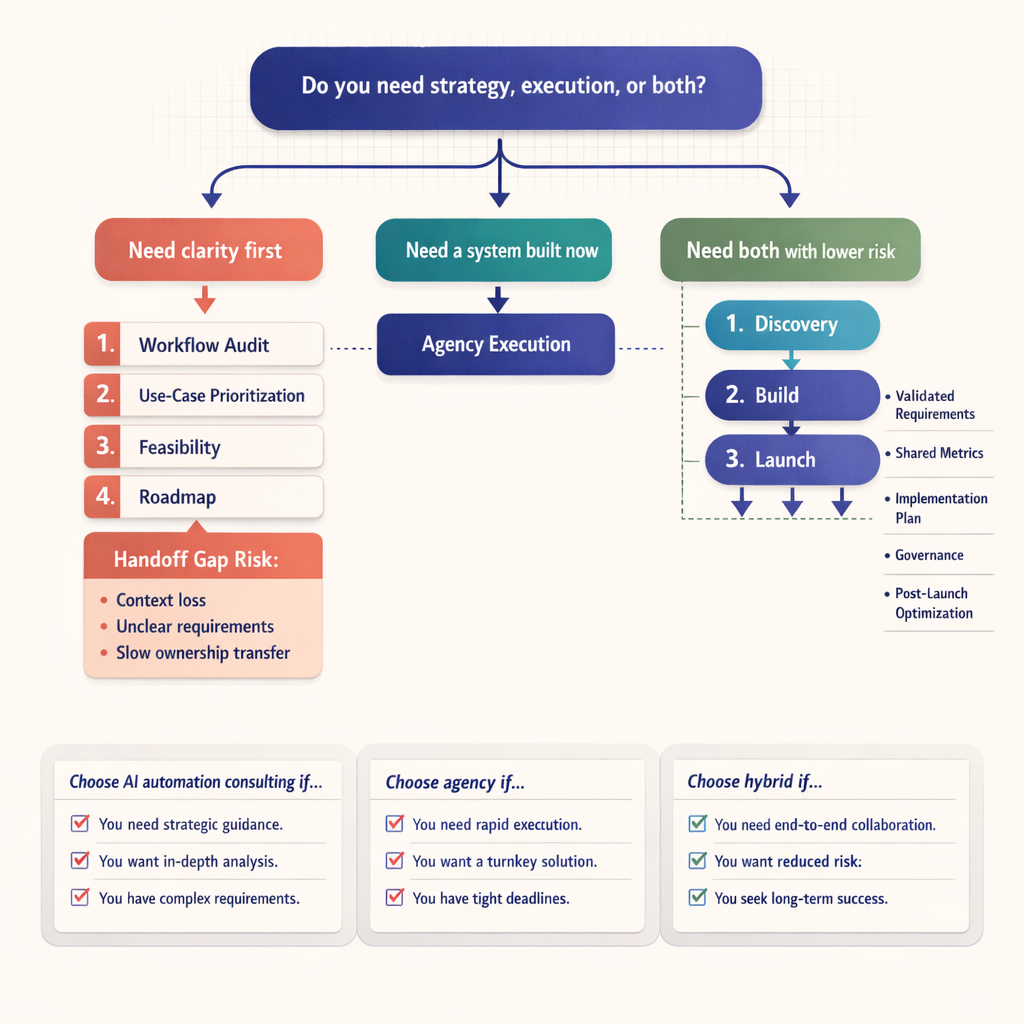
If you need clarity first, ai automation consulting is the right starting point. If you already know what to build and need delivery, a full-service ai agency is the better fit. In most serious programs, the real answer to ai automation consulting vs agency is both -- in the right sequence.
I see companies confuse strategy with implementation all the time. They hire advisors when they need operators. Or they hire builders before they have defined the business case, the integration scope, the governance constraints, and the KPIs that matter.
That mismatch gets expensive.
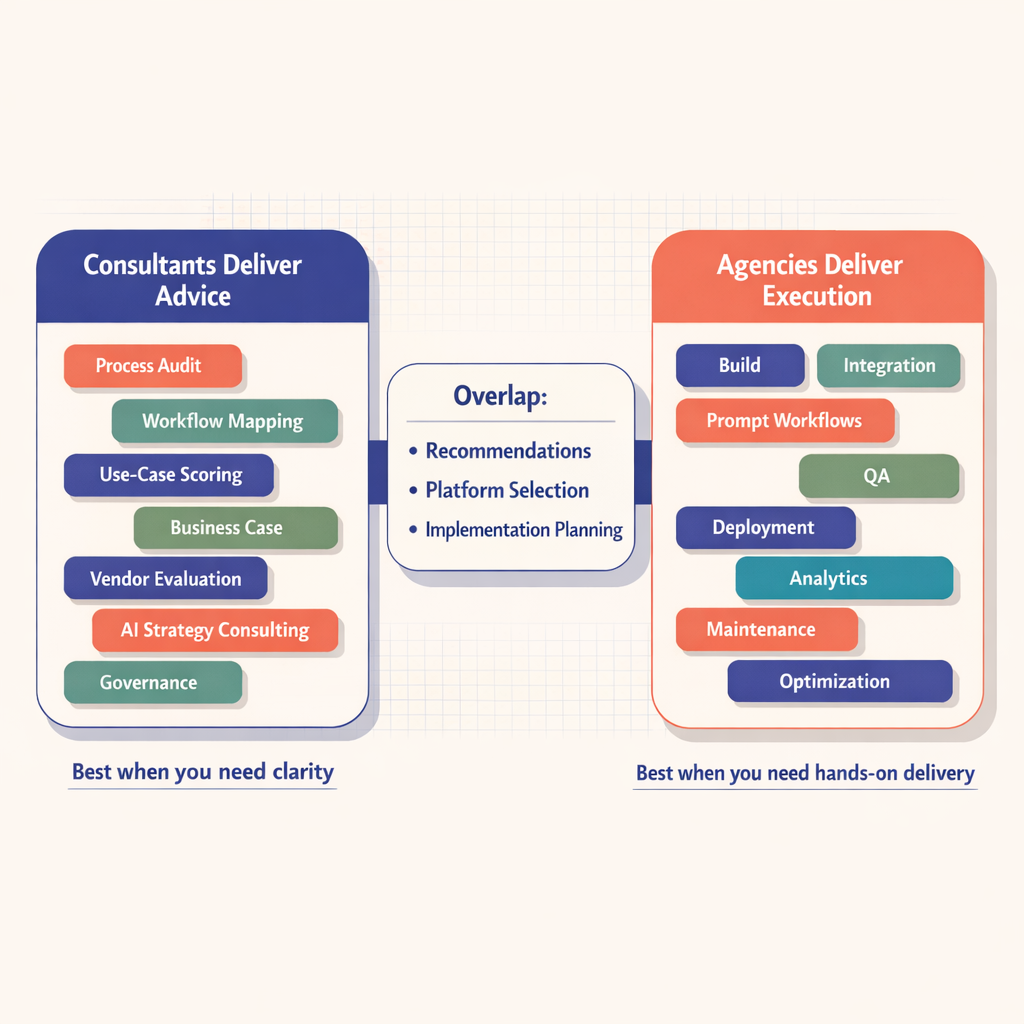
My view is simple. Use consulting when the core problem is diagnosis, prioritization, and roadmap design. Use an agency when the core problem is execution -- architecture, integrations, deployment, testing, optimization, and adoption. If your workflows are cross-functional, your data is messy, or your stakeholders are not aligned, start with strategy and move quickly into build. At Imversion Technologies Pvt Ltd, I have seen that strong architecture defines product success, but execution decides whether the strategy produces value at all.
Key Takeaways
- ai automation consulting is best for deciding what to automate, why it matters, what is feasible, and what should happen first. It is guidance, prioritization, and risk reduction.
- ai consulting services and ai strategy consulting are often the most cost-effective choice when the company has multiple possible use cases, unclear ROI, or internal disagreement on priorities.
- A full-service ai agency is best when the company already has a defined use case and needs hands-on solution design, integrations, deployment, monitoring, and ongoing optimization.
- The biggest hidden risk in ai automation consulting vs agency decisions is the handoff gap -- where a sound roadmap fails because the implementation team inherits incomplete specs, unrealistic assumptions, or weak ownership.
- The fastest time to value often comes from a hybrid path: consulting-led discovery followed by agency execution, especially for complex workflows, regulated environments, and multi-system automation programs.
What AI Automation Consulting Actually Delivers
What does an ai automation consulting firm really do?
An ai automation consulting firm helps me answer four practical questions: what should be automated, why now, in what order, and under what constraints. That is the real job. Not slides for their own sake. Decision clarity.
When I approach ai automation consulting, I start with workflow analysis. I map where time is lost, where handoffs break, where humans repeat low-value tasks, and where AI can improve speed or accuracy without creating operational chaos. Then I prioritize use cases. Support ticket triage may beat an internal copilot if the support queue is drowning and response quality is inconsistent. Invoice processing may beat lead scoring if finance is spending days on manual extraction and approvals.
That prioritization matters.
Good ai consulting services also test feasibility before anyone spends serious money. I look at system readiness, data quality, access permissions, integration constraints, model risk, and governance obligations. A use case can look attractive in a workshop and still be a terrible first deployment if the source data is fragmented across email, PDFs, shared drives, and legacy systems.
At Imversion Technologies Pvt Ltd, a common pattern I see is leadership teams jumping to tools before defining outcomes. So I push for concrete deliverables:
- workflow audits
- use-case scoring frameworks
- ROI models
- data readiness assessments
- governance and compliance reviews
- vendor shortlists
- KPI definitions
- phased roadmaps with pilot timelines
That is where ai strategy consulting becomes valuable. It turns broad ambition into a sequenced plan.
What outputs should I expect from consulting?
I expect documents that are implementation-aware, not abstract. That includes architecture assumptions, integration scope, security requirements, baseline metrics, and ownership mapping.
For example, if I review a support operation, the result should not be “use AI for support.” It should be a structured plan: automate ticket classification first, add knowledge retrieval second, route high-risk cases to humans, define KPIs such as average handling time and cost per ticket, and set the pilot boundary. If I assess sales operations, I might prioritize CRM enrichment, inbound lead qualification, and meeting summarization -- in that order -- based on readiness and impact.
Sagar Hebbale is how I sign my work, but the principle stays the same across every engagement: technology should solve real problems. Not fashionable ones.
What a Full-Service AI Agency Builds and Manages
What does a full-service ai agency actually execute?
A full-service ai agency turns approved ideas into working systems. It owns architecture, workflow logic, prompt design, integration, QA, deployment, monitoring, and optimization. Advice becomes software. That shift is significant.
Once the use case is clear, I move into execution mode. That means designing the end-to-end solution architecture, selecting services and orchestration patterns, connecting CRMs, ERPs, helpdesks, document stores, or communication tools, and building the operational flow around the model -- not just the model itself. The hard part is rarely the prompt alone. It is the system around it.
At Imversion Technologies Pvt Ltd, I focus heavily on production-grade implementation because scalability should be planned early. A support automation workflow, for example, needs more than response generation. It needs access control, escalation logic, auditability, feedback loops, fallback handling, and observability. An internal knowledge assistant needs retrieval design, permission-aware search, source ranking, and usage analytics. A document processing pipeline needs OCR quality checks, structured extraction validation, exception queues, and downstream ERP integration.
And then there is deployment. Real deployment.
A build team should handle testing across edge cases, environment setup, security implementation, release workflows, user acceptance support, and post-launch tuning. If the automation touches customer data or regulated processes, the implementation team also needs to account for compliance, retention rules, model boundaries, and human review points.
Typical systems I see agencies build include:
- AI support automation for triage, drafting, and escalation
- Lead routing and qualification tied to CRM workflows
- Invoice and document processing with approval logic
- CRM enrichment from emails, calls, and external sources
- Internal copilots for policy, product, or operations knowledge
In my experience at Imversion Technologies Pvt Ltd, execution quality separates demos from operational outcomes. Ideas are cheap. Working systems are not. That is why I tell teams not to confuse a strategy deck with a shipped capability.
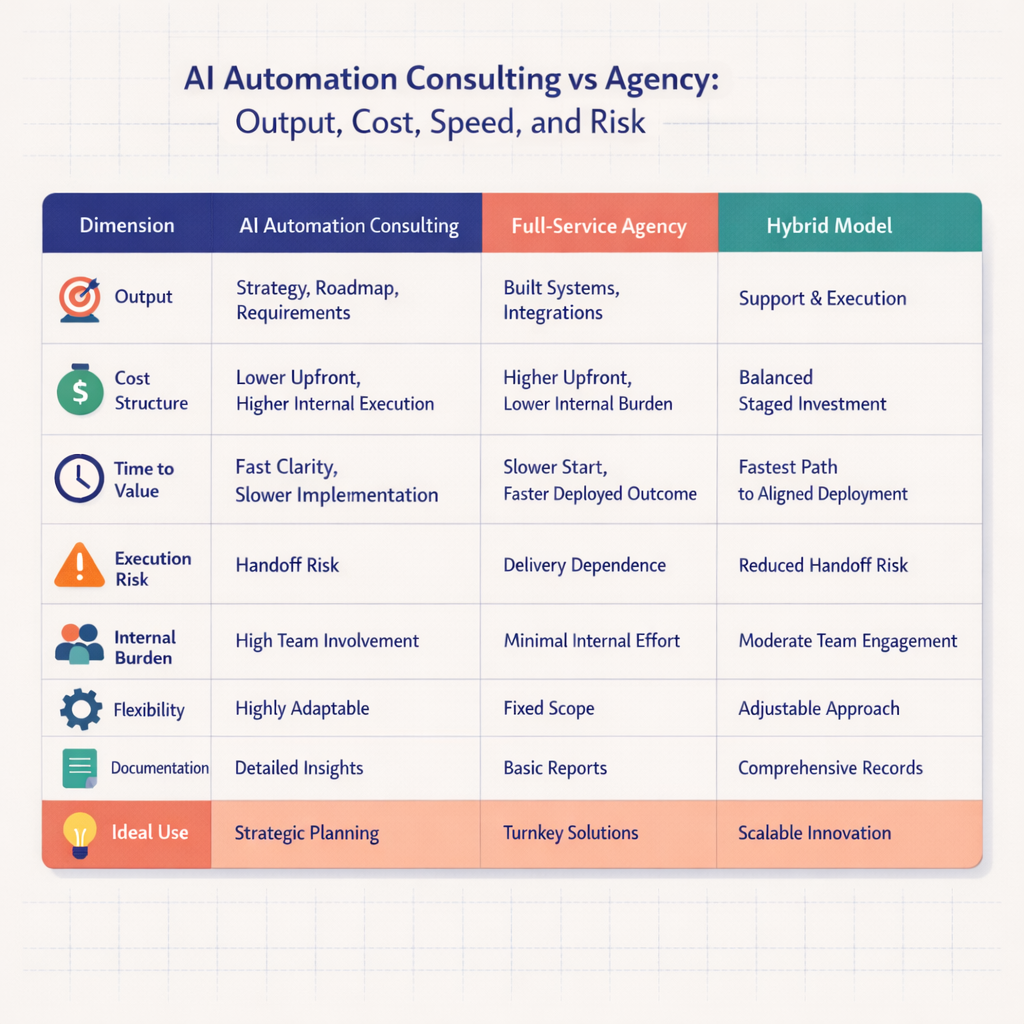
AI Automation Consulting vs Agency: Output, Cost, Speed, and Risk
Which model gives me the right outcome?
If I need decisions, I choose consulting. If I need delivery, I choose an agency. If I need both and the workflow is business-critical, I stage them together.
Here is the comparison I use with leadership teams.
| Dimension | AI Automation Consulting | Full-Service AI Agency | Best Fit |
|---|---|---|---|
| Primary output | Roadmaps, ROI models, use-case priorities, vendor guidance | Live systems, integrations, deployment, maintenance | Depends on clarity vs execution need |
| Pricing model | Fixed-scope advisory or strategy retainer | Project build fee, monthly support, or managed delivery | Budget depends on ownership model |
| Time to value | Slower direct impact, faster strategic clarity | Faster operational impact if scope is already clear | Agency wins when use case is defined |
| Internal team dependency | Higher -- internal team or vendor must execute | Lower -- external team carries build burden | Consulting fits capable internal teams |
| Strategic risk | Lower -- better prioritization and governance | Can be high if building the wrong thing fast | Consulting reduces wrong-bet risk |
| Execution risk | Higher if no builder is aligned early | Lower if agency has strong engineering discipline | Agency reduces delivery burden |
| Accountability | Shared across stakeholders | More centralized around build partner | Agency often improves delivery ownership |
| Flexibility | High in planning stage | High in implementation tactics, lower after scope lock | Hybrid gives best balance |
The trade-offs are straightforward, but not simplistic. ai automation consulting vs agency is not a debate about which is better in absolute terms. It is about where uncertainty lives. If uncertainty sits in business prioritization, process design, ROI assumptions, or governance, consulting is the right spend. If uncertainty sits in architecture, integrations, shipping capacity, or post-launch operations, the agency model is stronger.
According to industry reports, a large share of AI pilots fail to reach production -- often estimated above 70%. I find that believable. Not because models are weak, but because companies skip process design, data readiness, and operational ownership. According to broader digital transformation benchmarks, integration complexity is one of the most common delay drivers. Again, believable. Most value comes from connecting systems, not from a model in isolation. And according to enterprise software studies, change management can influence adoption outcomes as much as technical quality. I see that often.
So cost should not be judged by proposal price alone.
A consulting engagement may cost less than a full build, but it becomes expensive if the roadmap sits idle. A full-service ai agency may cost more upfront, yet it can be cheaper overall if it compresses deployment timelines, reduces internal burden, and prevents rework. In some organizations, going straight to build is justified -- usually when the use case is narrow, the systems are known, the KPI is obvious, and the organization already has alignment. Think lead qualification inside an existing CRM or email summarization with minimal compliance exposure.
But if the workflow spans multiple systems, departments, or approval layers, I prefer paying for strategy first. At Imversion Technologies Pvt Ltd, I have seen teams save months by defining integration scope, exception handling, and pilot success criteria before development starts.
Execution matters more than ideas. But bad ideas executed quickly still fail.
The Handoff Gap: Why Good AI Strategy Can Still Fail in Execution
Why does the strategy-to-build transition break?
Because documents do not build systems. People do. And if the assumptions inside the strategy are not translated into implementation-ready specs, the delivery team fills the gaps on its own.
This is the handoff gap, and it is one of the most underestimated risks in ai automation consulting. I have seen strong strategic thinking lose momentum because ownership becomes fuzzy after discovery. The consultant defines a roadmap, then exits. The internal team or build partner inherits slides, not operating detail.
The problems show up fast:
- requirements that are too high-level
- vendor choices that looked good on paper but clash with real infrastructure
- unrealistic assumptions about data quality
- no clear exception-handling flow
- no shared KPI baseline
- weak user adoption planning
That is where ai strategy consulting can fail, even if the diagnosis was right. This is why I insist that ai consulting services should produce implementation-ready outputs -- user journeys, system touchpoints, security assumptions, pilot scope, success metrics, fallback rules, and ownership mapping.
At Imversion Technologies Pvt Ltd, a pattern I encounter is that teams underestimate change management. They think the workflow is the product. It is not. The operating behavior around the workflow matters just as much. If agents do not trust support suggestions, if finance teams cannot review extraction exceptions cleanly, or if sales ignores lead scores, the system underperforms no matter how elegant the architecture is.
I reduce handoff risk in four ways:
- define shared KPIs before build starts
- create staged pilots with explicit boundaries
- document integration and data assumptions in detail
- align consultant and agency teams early -- ideally before final scope lock
That coordination sounds simple. It is not. But it saves real money.
Why the Hybrid Model Often Wins: AI Automation Consulting Discovery, Then Agency Build
The hybrid model works because it matches how serious AI programs actually succeed. First I create clarity. Then I build.
In this approach, ai automation consulting handles discovery, workflow analysis, prioritization, feasibility, ROI modeling, governance review, and roadmap design. The output should include a use-case matrix, KPI framework, integration map, vendor shortlist, pilot plan, risk register, and implementation sequence. Then the full-service ai agency takes that package into architecture, development, integrations, testing, deployment, and optimization.
This is often the best model for mid-market and enterprise teams. Why? Because they rarely suffer from just one problem. They need alignment and capacity. They need better decisions and faster execution. They need structure before scale.
An ai automation consulting firm can de-risk the plan. A delivery team can make it real.
In my experience, the hybrid approach is especially effective when workflows cross CRM, ERP, helpdesk, and internal knowledge systems; when compliance matters; when multiple stakeholders need sign-off; or when the first deployment must establish a reusable platform, not just a one-off automation. At Imversion Technologies Pvt Ltd, I prefer this sequence for exactly that reason -- strong architecture first, operational execution immediately after.
Because continuity matters.
A Simple Decision Framework for Choosing AI Automation Consulting
I use a simple decision sequence.
How clear is the use case?
If I cannot clearly define the workflow, users, data sources, integration points, and success KPI, I start with ai automation consulting. If I can define all of that already, I may be ready for an agency-first build.
Do I have internal capacity to execute?
If my internal product and engineering teams can own implementation once the roadmap is done, consulting may be enough. If not, the agency model becomes more attractive.
How urgent is the result?
If speed matters more than broad exploration, and the use case is narrow and approved, go to build faster. If the budget is meaningful and the wrong decision would be costly, invest in ai strategy consulting first.
Use this checklist and score each item from 1 to 5:
- use-case clarity
- internal technical capacity
- urgency
- budget tolerance for discovery
- integration complexity
- accountability required
Then decide:
- Consultant first -- low clarity, high uncertainty, multiple candidate use cases
- Agency first -- high clarity, urgent delivery, limited internal build bandwidth
- Hybrid -- medium-to-high complexity, cross-system automation, executive visibility, need for both strategy and execution
My advice is direct. If your biggest constraint is knowing what to do, start with consulting. If your biggest constraint is getting it done, hire builders. If both constraints are real -- and they often are -- choose the hybrid path and move with discipline.
Frequently Asked Questions
What is ai automation consulting best used for in a company that is just starting with AI?
AI automation consulting is best used to identify where AI can create measurable value before any build begins. It helps a company assess workflows, rank use cases, estimate ROI, define governance needs, and avoid committing budget to tools or automations that do not fit the operating reality.
How does ai automation consulting differ from general digital transformation advice?
AI automation consulting is narrower and more execution-linked than broad transformation advice. It focuses specifically on workflow automation, model usage, system integration, data readiness, risk controls, and adoption planning, with the goal of producing a practical sequence of AI initiatives rather than a high-level innovation narrative.
When should I hire a full-service agency instead of a consultant?
You should hire a full-service agency when the use case is already approved, the workflow is understood, and your main challenge is delivering a working system. An agency is the better choice when speed, technical execution, integration work, deployment discipline, and ongoing optimization matter more than additional strategic discovery.
Why do ai consulting services sometimes fail to create business value?
AI consulting services fail to create business value when the output stops at recommendations and never becomes operational change. The typical causes are weak ownership, poor handoff to builders, unrealistic assumptions about data or process maturity, and no clear KPI baseline to prove whether the rollout is succeeding.
Is the hybrid model usually better for complex AI programs?
Yes, the hybrid model is usually better for complex AI programs because it separates decision quality from delivery quality without losing continuity. Consulting reduces strategic mistakes early, while an agency converts the approved plan into production systems, which is especially useful when multiple teams, systems, and compliance requirements are involved.
Make Imversion a preferred source on Google
Like this kind of AI and software analysis? Add Imversion as a preferred source so Google can highlight our articles for you in Search, AI Overviews, and AI Mode.