AI Automation Agency vs In-House: Strategic Insights for 2023
Unpacking the ai automation agency vs in-house debate: learn the pros and cons of each approach to make informed AI decisions.


On this page
AI Automation Agency vs In-House: Which Option Makes More Sense?
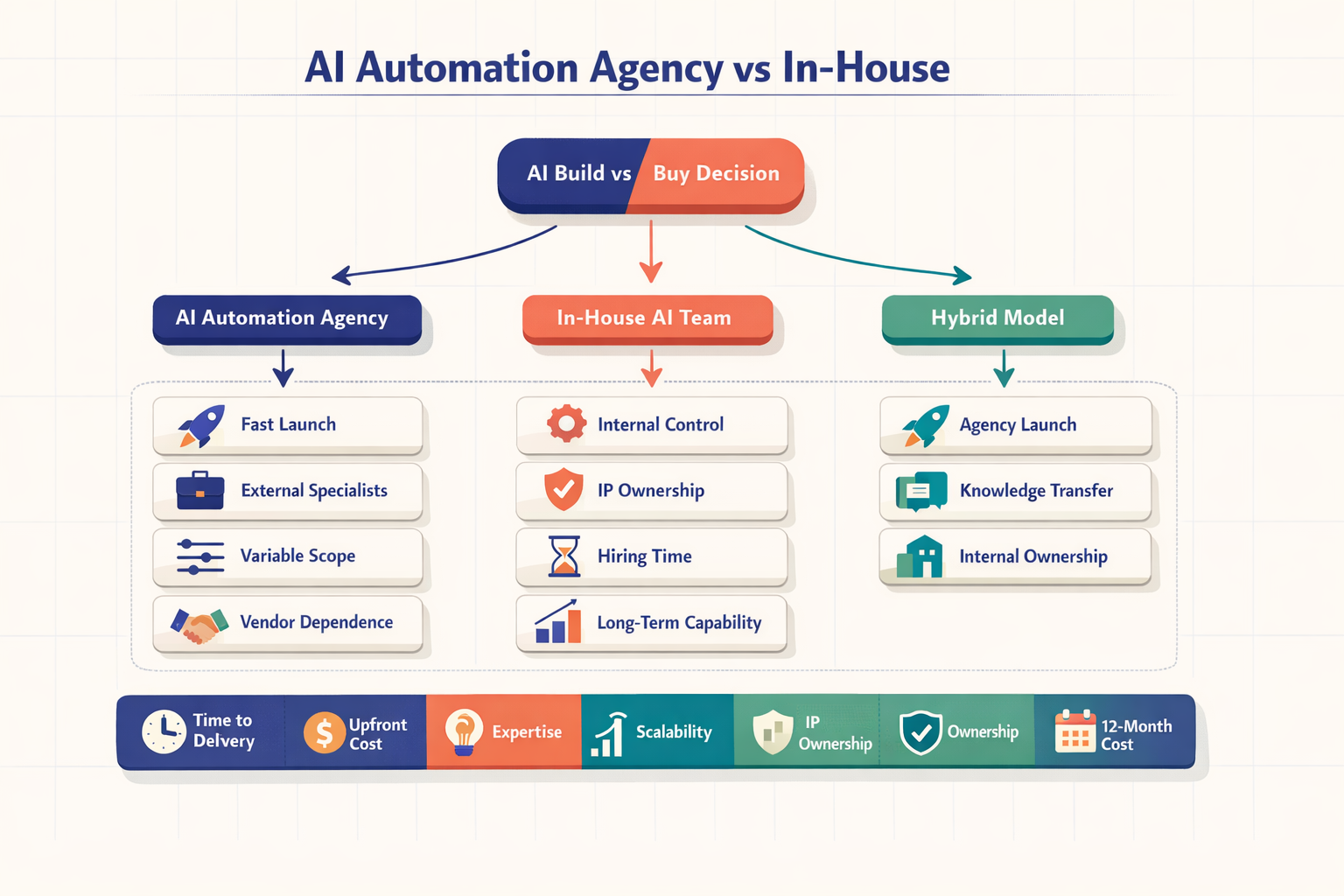
For most companies, the ai automation agency vs in-house choice comes down to speed versus control. Agencies usually win the first 90 days. In-house teams usually win if AI becomes a core long-term capability.
That is the honest version of the build vs buy ai automation debate. If we need a pilot fast, need broad specialist coverage, or do not yet have internal AI operators, an agency often makes more sense. If AI sits close to product differentiation, compliance, or proprietary workflows, building internally often pays off over time. The real ai build vs buy decision is not ideological. It is operational.
At Imversion Technologies Pvt Ltd, we look at this from both the frontend and backend side because AI automation is never just a model question. It touches user experience, workflow design, integrations, security review, monitoring, and who will maintain the system six months after launch. A chatbot that answers quickly but fails inside the CRM is not useful. A smart document pipeline with weak review controls is not production-ready. Functionality matters. Usability does too.
A common pattern we encounter is that leadership teams frame this as a talent question first. We think that is incomplete. The better starting point is business context:
- How urgent is the rollout?
- How strategic is AI to the company?
- How sensitive is the data?
- How much iteration will the workflow need after launch?
- Who will own prompts, orchestration logic, and integrations over time?
At Imversion Technologies Pvt Ltd, we have learned that clean code improves long-term productivity, and the same principle applies here. The right delivery model is the one our team can sustain, improve, and trust.
Key Takeaways
- In the ai automation agency vs in-house comparison, agencies usually deliver faster because they bring ready-made processes, cross-functional specialists, and implementation experience across LLM orchestration, RAG, workflow automation, and integrations.
- If the question is hire ai team vs agency, internal teams usually win on control, institutional knowledge, and long-term ownership -- but only after hiring, onboarding, and operating costs are absorbed.
- Long-term economics shift over time. Agencies often have lower upfront cost for pilots, while internal teams can become cheaper if AI work is continuous and strategically central.
- A hybrid model is often the smartest path: use an agency to launch, then transition architecture, optimization, and roadmap ownership internally.
- We should make the decision based on urgency, strategic importance, budget tolerance, data sensitivity, and expected AI workload -- not hype.
AI Automation Agency vs In-House Comparison Matrix: Speed, Cost, Expertise, and Control
A side-by-side ai automation agency comparison
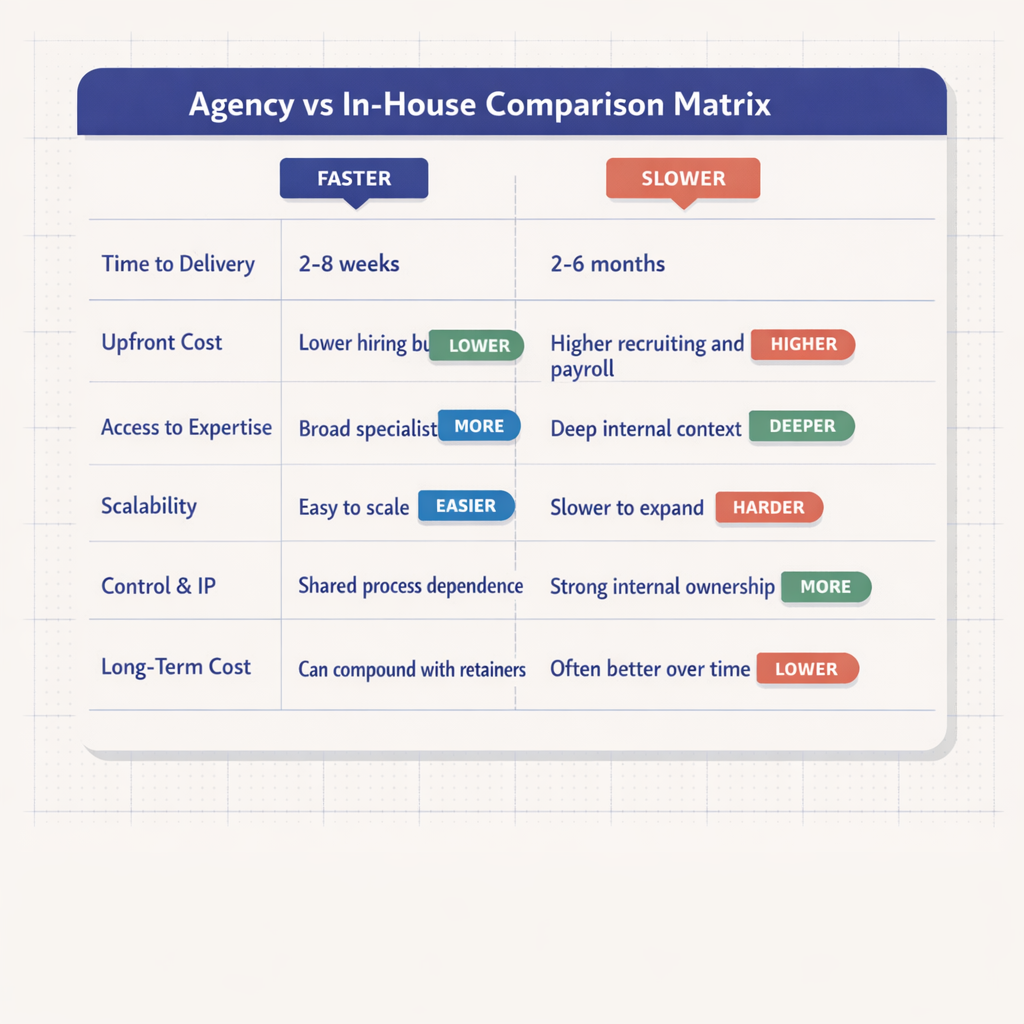
The core ai automation agency comparison is straightforward on paper. Real life is messier. Still, a matrix gives us a solid starting point for the ai automation agency vs in-house decision.
| Factor | AI Automation Agency | In-House AI Team |
|---|---|---|
| Time to delivery | Faster. MVPs often ship in 3-8 weeks for focused automation use cases. | Slower early on. Hiring and setup can take 2-6 months before useful delivery starts. |
| Upfront cost | Lower initial spend for a scoped pilot or short engagement. | Higher initial spend due to salaries, recruiting, onboarding, tooling, and management overhead. |
| Expertise breadth | Broad coverage across LLM apps, RAG, vector databases, workflow tools, CRM/ERP integrations, observability, and security review. | Usually narrower at the start unless we hire several specialists at once. |
| Scalability of team | Easier to ramp up or down based on project stages. | Scaling means more recruiting, coordination, and training. |
| IP ownership | Depends on contract terms, code transfer rules, and reusable components. | Usually simpler and clearer because the work is built internally. |
| Long-term cost | Efficient for defined projects, but can become expensive if every iteration stays external. | Often better over multiple years if AI becomes a permanent operating layer. |
What the matrix gets right -- and what it hides
Time to delivery is where agencies usually win, clearly. They already have patterns for model selection, prompt design, evaluation, fallback logic, guardrails, and deployment. They know how to connect LLM orchestration with Slack, HubSpot, Salesforce, Zendesk, SharePoint, internal APIs, and approval workflows. That matters. A lot.
But speed can hide dependency risk.
If an external team builds fast and the internal team cannot maintain the orchestration layer, retrievers, vector indexes, or model monitoring pipeline, the first launch feels great and the second quarter feels painful. At Imversion Technologies Pvt Ltd, we often tell teams to judge speed together with maintainability. Clean architecture beats flashy demos.
How cost shifts across the project lifecycle in ai automation agency vs in-house
Upfront cost favors agencies in most in-house ai vs outsource scenarios. A pilot for support triage, document extraction, or lead qualification might be far cheaper through an agency than hiring an AI engineer, automation developer, and product lead before any value is proven.
Long-term cost is different. If the company expects constant iteration -- prompt tuning, retrieval improvements, policy updates, new integrations, analytics, and model swaps -- internal capability compounds. Our team at Imversion Technologies Pvt Ltd has seen this pattern often: recurring AI work changes the economics.
Why expertise is not just about model knowledge
We should avoid reducing expertise to “do we have an ML engineer?” Production AI automation needs more than that:
- LLM orchestration and prompt management
- RAG pipeline design
- Vector database setup and retrieval tuning
- Workflow automation logic
- CRM, ERP, and document system integrations
- Security review and access controls
- Frontend UX for approvals, exceptions, and transparency
- Model monitoring, logging, and fallback handling
This is why agencies can look stronger in the early in-house ai vs outsource comparison. They bring the whole stack. But if AI is central enough, assembling that stack internally becomes a strategic asset.
When an AI Automation Agency Wins the Build vs Buy AI Automation Decision
Agencies win when speed and setup friction matter most
In the build vs buy ai automation decision, agencies win when the business needs useful output fast. Not perfect. Useful. If we have a 30- to 60-day window to ship a customer support assistant, a document-processing workflow, a lead qualification pipeline, or an internal knowledge assistant, external execution usually reduces risk.
Why? Agencies already have templates, review loops, integration patterns, and deployment checklists. They can stand up LLM orchestration, retrieval layers, workflow steps, permissions, and logging without building the entire operating model from scratch.
At Imversion Technologies Pvt Ltd, we have observed that teams often underestimate setup work. The model itself is only part of the job. The real work sits around it -- API design, exception handling, audit trails, role-based access, UI review states, and performance monitoring.
Best-fit scenarios for agency delivery
An agency is often the stronger option when:
- We need a pilot before hiring.
- We lack internal AI product and engineering leadership.
- The workflow spans many systems -- CRM, ERP, ticketing, email, document storage, chat tools.
- The use case is operational rather than core IP.
- We need cross-functional specialists immediately.
Examples include:
- Customer support automation with ticket classification, draft replies, and escalation rules
- Lead qualification workflows that enrich records and route prospects to the right queue
- Document processing for invoices, contracts, claims, or compliance forms
- Internal knowledge assistants using RAG across policies, docs, and team knowledge bases
And there is another practical point. Agencies absorb some delivery uncertainty. If we choose the right partner, we are not hiring five roles to find out whether one workflow is valuable.
Why agencies reduce early execution risk
The hire ai team vs agency question is often framed as cost versus control. We think it is also about execution reliability. If the company has never run prompt evaluations, retrieval testing, hallucination checks, or model fallback logic, an experienced agency can prevent expensive rework.
This matters on both the backend and frontend. A good automation flow needs stable integrations, but it also needs a sane user experience -- review queues, confidence indicators, approval states, and error recovery. At Imversion Technologies Pvt Ltd, we care about that balance because user experience is as important as functionality.
When an In-House AI Team Wins on Strategy, IP, and Long-Term Economics in ai automation agency vs in-house
Internal teams win when AI becomes part of the company’s core capability
If AI directly shapes the product, competitive edge, or operational intelligence of the business, internal teams usually win. This is where hire ai team vs agency becomes a strategic call, not a procurement choice.
When the workflows depend on nuanced institutional knowledge, constant iteration, or proprietary decision logic, an internal team can move with far tighter alignment. They understand the data quirks. They know which exceptions matter. They sit closer to product, compliance, operations, and support.
That proximity compounds.
A pattern we see often is that the first version of an AI system looks like automation, but the second and third versions become business logic. Once that happens, internal ownership grows more valuable.
Where in-house teams have a real advantage in ai automation agency vs in-house
Internal teams are often the better choice when:
- AI is core to the product roadmap
- The system handles highly sensitive or regulated data
- Domain logic is hard to explain through external documentation
- The company expects years of iteration and optimization
- IP ownership and internal know-how matter as much as delivery speed
This applies to recommendation systems, fraud workflows, private internal copilots tied to confidential data, pricing logic, underwriting support, and proprietary research tools. In these cases, the in-house ai vs outsource decision tilts toward internal control.
Our team at Imversion Technologies Pvt Ltd believes full stack understanding improves problem solving here. AI systems are not isolated services. They affect interfaces, internal dashboards, event pipelines, permission models, and reporting layers. Internal teams can align all of that more tightly over time.
The hidden burden of building internally
Still, we should be honest about the tradeoff. Internal ownership is powerful, but building the team is slow and expensive. We may need some mix of:
- AI or ML engineer
- Automation engineer
- Backend developer
- Product manager or AI ops lead
- DevOps or platform support
- Security and compliance review
And managing these roles takes real effort. Recruiting alone can stretch for months. Then comes onboarding. Then process design. Then evaluation discipline. The ai build vs buy decision should include this operational burden, not just salary math.
At Imversion Technologies Pvt Ltd, we have seen that team collaboration leads to better solutions, but collaboration only works when the company has enough internal capacity to support it. Otherwise, internal teams get blocked before they become effective.
The Hybrid Model: Use an Agency to Launch, Then Build In-House Ownership
The middle path that often makes the most sense
The smartest answer in many ai automation agency vs in-house decisions is not either-or. It is staged ownership.
We can use an agency to handle architecture, MVP delivery, integrations, and early experimentation. Then we transition maintenance, optimization, analytics, and roadmap control to an internal team. This approach works well when the company wants speed now and capability later.
Because that is often the real goal.
At Imversion Technologies Pvt Ltd, we recommend this model when leadership is confident AI matters, but internal staffing is not ready yet. It lowers time-to-value without locking the company into permanent external dependence.
What must be defined before the project starts
Hybrid only works if handoff is designed upfront. We should define:
- Code ownership and repository access
- Documentation standards
- Prompt and workflow versioning
- Architecture diagrams and integration maps
- Training sessions for the internal team
- Support windows after launch
- Monitoring dashboards and alerting ownership
If these are vague, transition becomes messy. If they are explicit, in-house ai vs outsource stops being a false choice and becomes a phased operating model.
Our team at Imversion Technologies Pvt Ltd prefers this route for practical reasons. It respects urgency. It preserves control. And it keeps clean code, documentation, and maintainability in scope from day one.
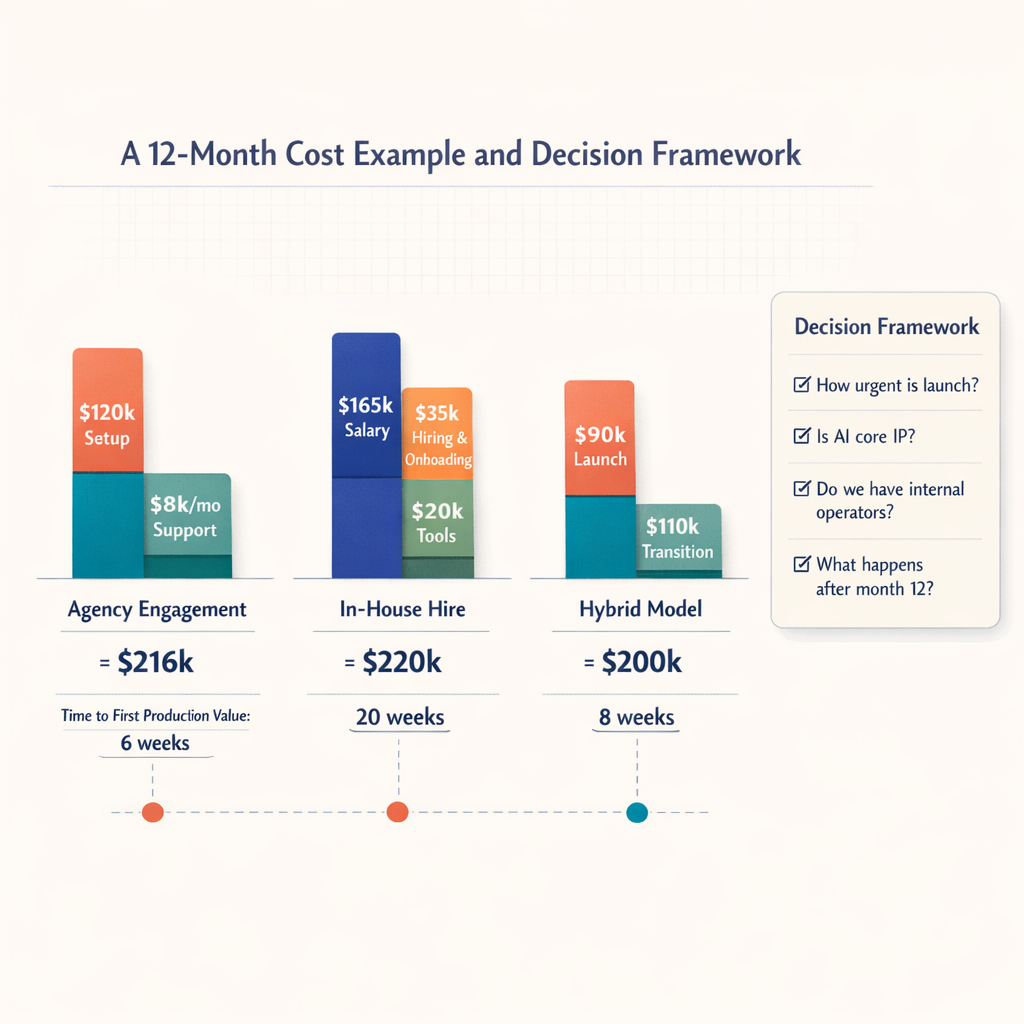
A 12-Month Cost Example and Decision Framework for Choosing the Right AI Delivery Model
A realistic one-year cost example
A simple ai automation agency comparison becomes clearer when we model 12 months.
Suppose we want two production workflows: a document-processing pipeline with human review, and an internal knowledge assistant using RAG, SSO, and role-based access.
In-house path:
- AI engineer: $140,000-$190,000 salary
- Automation/backend engineer: $110,000-$155,000
- Product manager or AI ops lead: $100,000-$150,000
- Benefits and employer load: roughly 20%-30%
- Recruiting and onboarding costs: $15,000-$40,000
- Tooling and cloud: $2,500-$12,000 per month depending on model usage, vector database, observability, and automation tools
- Management overhead and security review: variable, but real
That puts a lean internal team near $420,000-$650,000 for year one.
Agency path:
- Discovery and architecture phase: $15,000-$40,000
- MVP build for two workflows: $45,000-$140,000
- Monthly support or optimization retainer: $5,000-$20,000
- Cloud and tooling: $2,500-$12,000 per month
That puts a typical agency-led year between roughly $90,000 and $360,000, depending on complexity and support depth.
Short term, agencies usually look cheaper. Over multiple years, if the workload keeps expanding, the math can flip.
A simple decision framework we can actually use
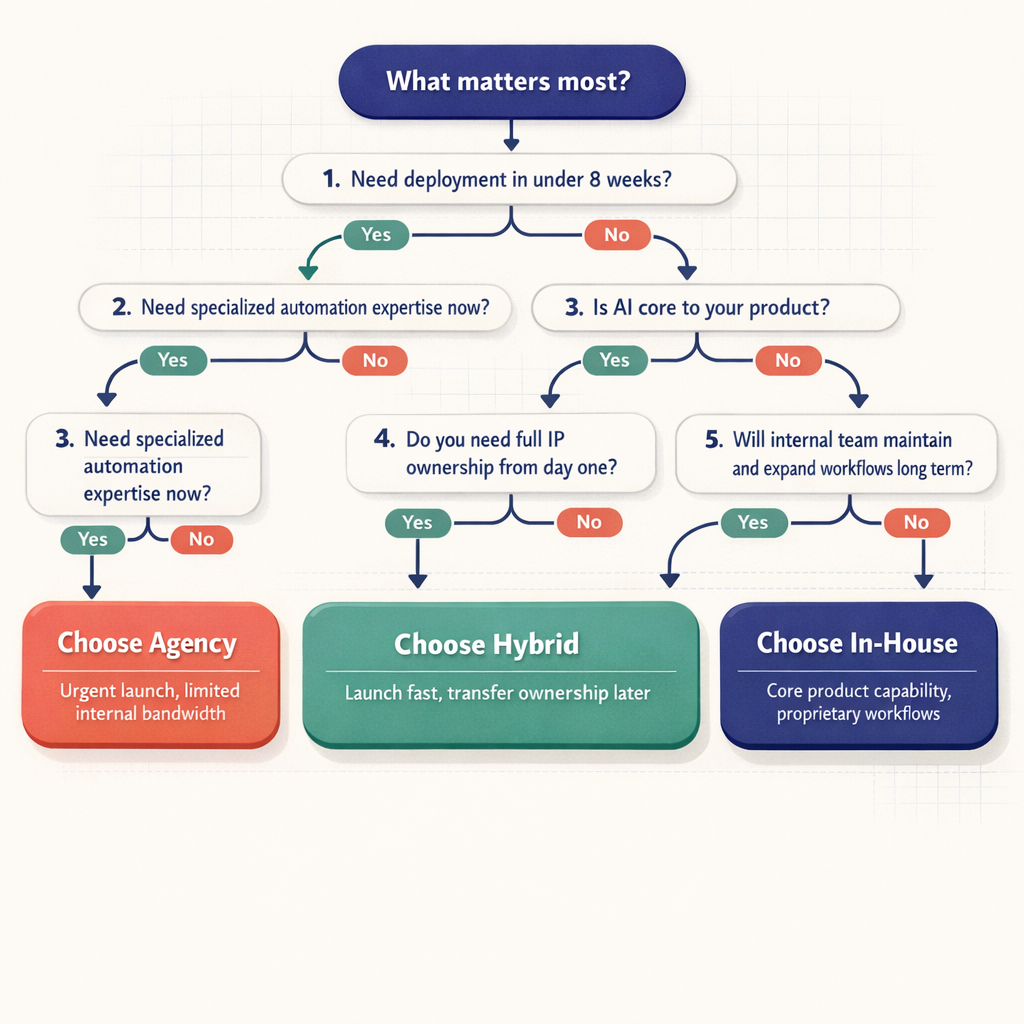
For the build vs buy ai automation choice, we can score five questions from 1 to 5:
- Urgency: Do we need value in under 90 days?
- Strategic importance: Will AI become core to product or operations?
- Data sensitivity: Are security, compliance, or internal policy constraints strict?
- Budget tolerance: Can we absorb year-one hiring cost before value is proven?
- Ongoing workload: Will we need constant iteration across many workflows?
Use the score this way:
- High urgency, low internal capability, moderate strategic value: agency
- Moderate urgency, high strategic value, heavy ongoing workload: in-house
- High urgency and high strategic value together: hybrid
That is the practical ai build vs buy decision framework we would use ourselves.
There is no universal winner in ai automation agency vs in-house. The right answer depends on what we need now, what we must own later, and whether we are building a project or a capability. From our perspective at Imversion Technologies Pvt Ltd, the best outcomes come from clear tradeoffs, strong collaboration, and delivery models that match the business -- not the trend.
Frequently Asked Questions
How does ai automation agency vs in-house affect vendor lock-in risk?
The lock-in risk usually depends less on who builds the system and more on how the handoff is structured. Teams reduce lock-in by requiring repository access, documentation, environment parity, clear model and prompt versioning, and ownership terms for code, workflows, and integration logic from the start.
What is the biggest mistake companies make in the ai automation agency vs in-house decision?
The most common mistake is comparing only delivery cost instead of total operating readiness. A cheaper path can become more expensive if it lacks monitoring, exception handling, retraining processes, or internal ownership, because those gaps create delays, rework, and reliability problems after launch.
Why should a company choose a hybrid model instead of a full agency or full internal team?
A hybrid model is best when the company needs immediate execution but also expects AI to become strategically important. It captures agency speed for early delivery while building internal ownership for governance, iteration, and long-term economics, which reduces both launch delay and long-run dependence.
How should I evaluate an agency before choosing build vs buy ai automation?
A strong evaluation should focus on production capability, not just demos. Ask how the agency handles security reviews, retrieval quality, human-in-the-loop workflows, logging, rollback plans, maintenance, and knowledge transfer, because these details determine whether the system remains usable after the initial release.
When does hiring an internal AI team too early create problems?
Hiring too early creates problems when the company has no validated use case, no internal AI product owner, and no clear workflow priority. In that situation, expensive hires often spend months defining scope, fixing data access issues, and waiting on alignment before they can generate measurable business value.
Make Imversion a preferred source on Google
Like this kind of AI and software analysis? Add Imversion as a preferred source so Google can highlight our articles for you in Search, AI Overviews, and AI Mode.