AI Pilot Failure: The Hidden Costs of Stalled Production
Explore the hidden costs of AI pilot failures, understand critical decisions, and discover how to avoid budget blowouts.

AI Pilot Failure Is Usually an Execution Cost Problem, Not a Model Problem
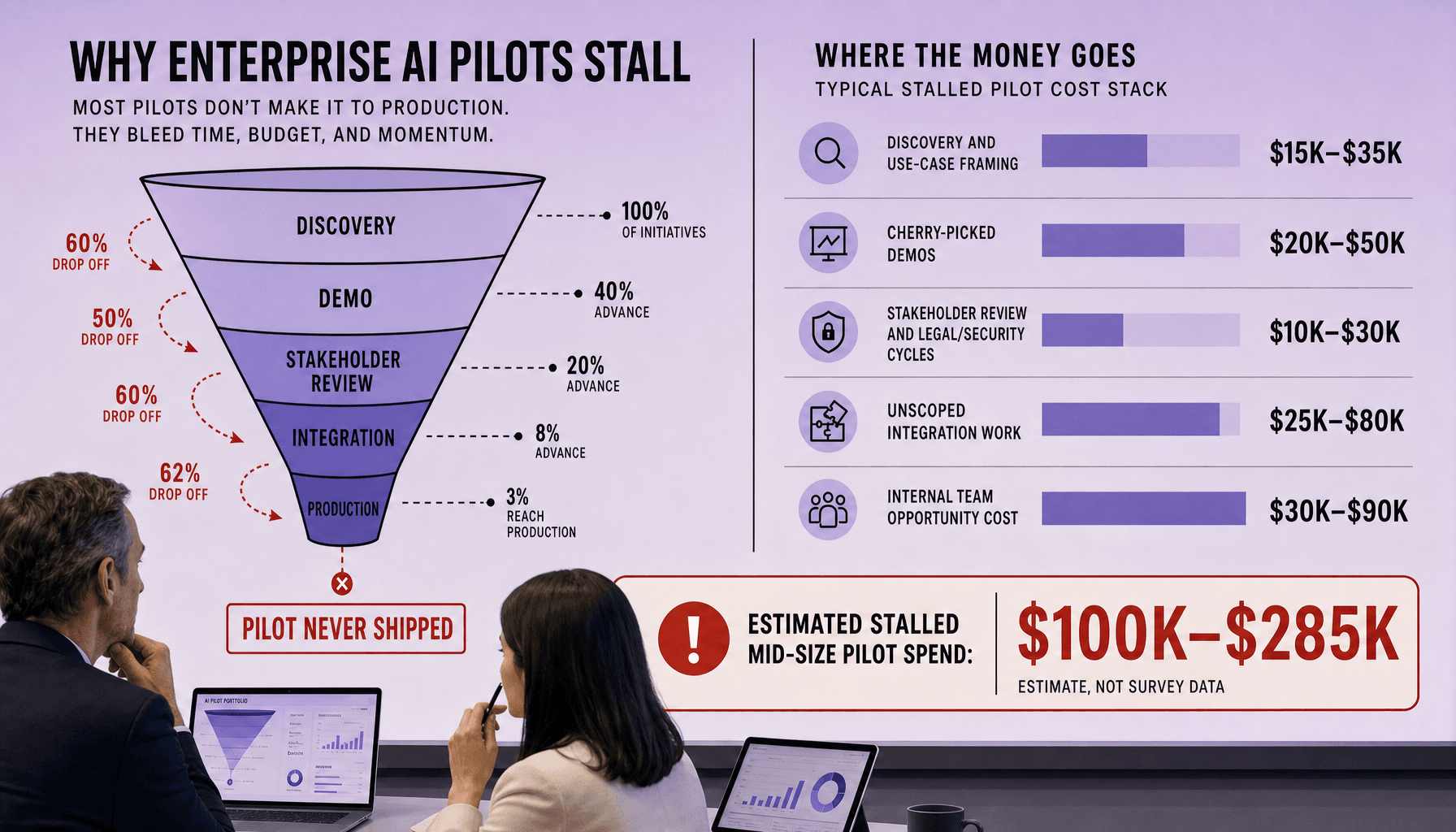
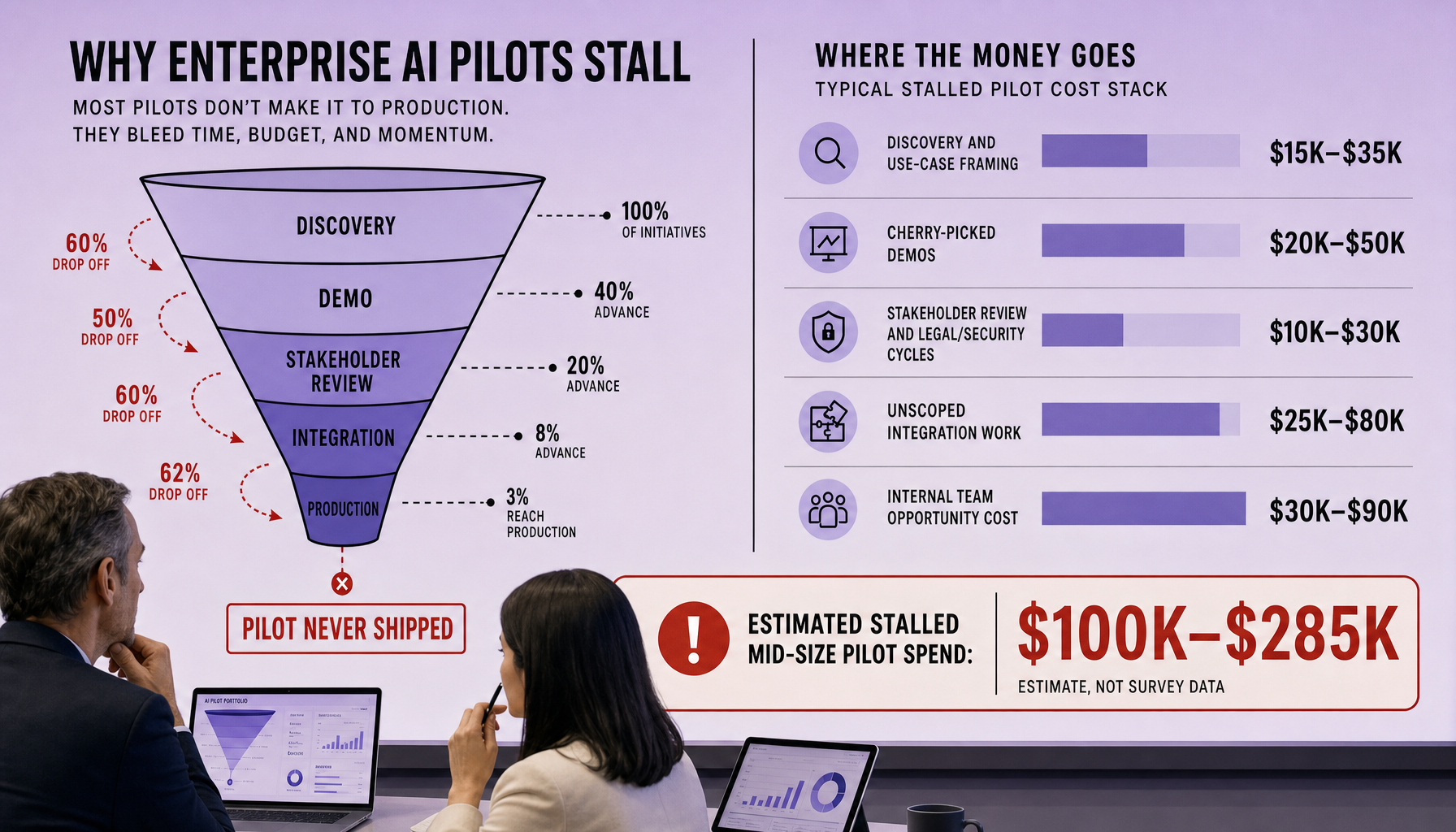
A strong demo can hide a weak delivery plan. That is why most AI pilot failure is not about the model underperforming. It is about execution drift -- and stalled mid-size pilots can plausibly consume an estimated $75,000-$250,000 before shipping. That range is an estimate based on common delivery patterns, not survey data.
The hidden bill usually builds in familiar stages: discovery and use-case framing at $10,000-$30,000, cherry-picked demos and prototype iteration at $15,000-$50,000, stakeholder review cycles at $10,000-$25,000, unscoped integration at $20,000-$80,000, and internal-team opportunity cost on top. And that is before production hardening, permissions, workflow changes, exception handling, or security review are fully resolved.
Executives often blame the model because the demo looked strong. But enterprise AI pilots usually stall earlier -- unclear success metrics, weak data reality checks, and integration nobody owned from day one. At Imversion Technologies Pvt Ltd, the practical view is simple: clarity beats complexity, especially in early pilot design. A useful caveat: if a team cannot name the production owner, target workflow, and evaluation method in week one, AI implementation costs will rise long before the system is ready for AI pilots to production.
Key Takeaways on AI Pilot Failure
- Expect the hidden bill to be real: a stalled mid-size pilot can plausibly cost $75,000-$250,000 -- an estimate, not survey data -- before anyone decides it will not move from demo to deployment.
- The biggest waste rarely comes from model testing alone. It comes from discovery drag, cherry-picked prototype iteration, stakeholder review loops, unscoped integration, and internal-team opportunity cost.
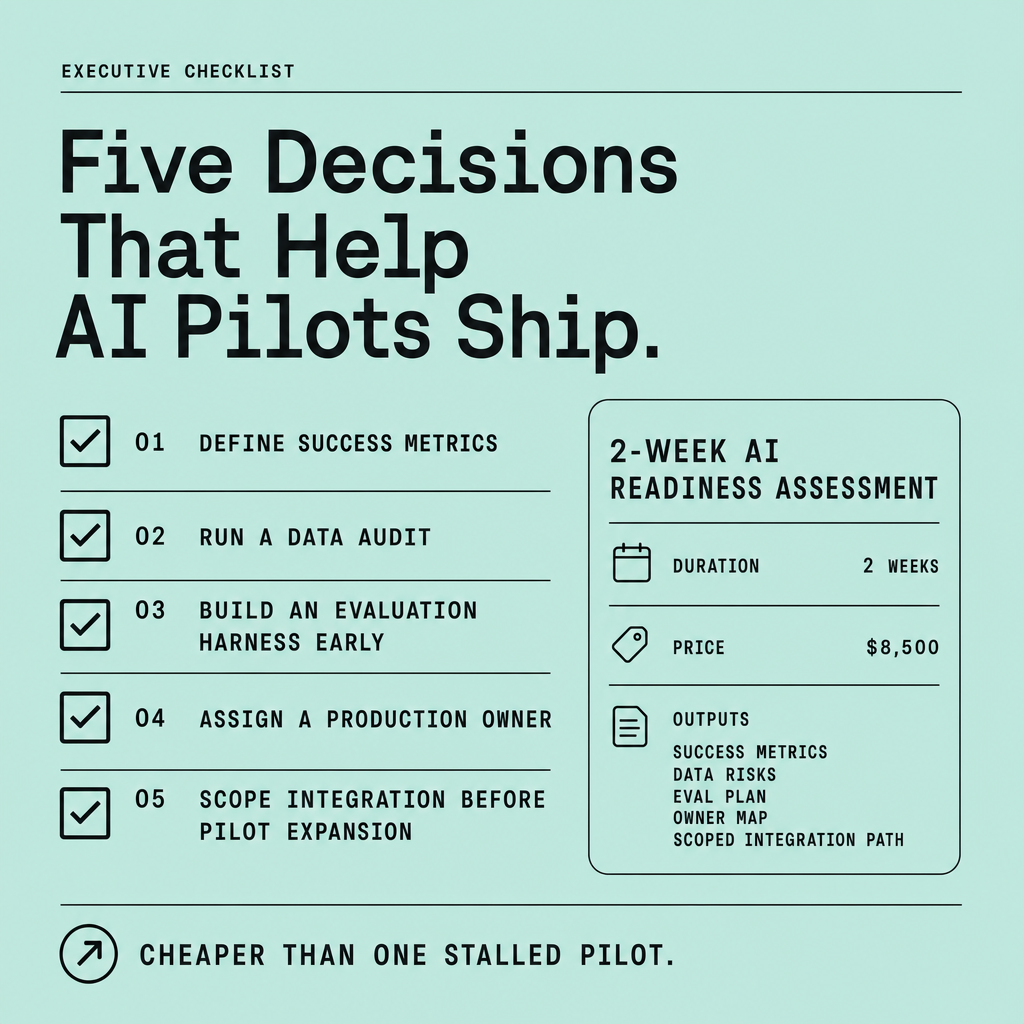
- Executives improve the odds of moving AI pilots to production with five decisions: define success metrics, run a data audit, build an early evaluation harness, assign a production owner, and scope integration upfront.
- For enterprise AI pilots, clarity beats complexity. A 2-week AI readiness assessment at $8,500 is prevention -- cheap compared with months of avoidable pilot drift and AI pilot failure.
The Hidden Price Tag Behind AI Pilot Failure
By the time a company calls a pilot a failure, the money is usually already gone. It disappears quietly -- through workshops, demo revisions, review cycles, integration drift, and the steady pull on internal teams.
Here is the practical estimate: $75,000-$250,000 for a stalled mid-size pilot. This is a directional estimate, not survey data. Still, it matches a common pattern in enterprise AI pilots: budget is not blown in one dramatic mistake, but through accumulated work that never becomes a production system.
A typical cost anatomy looks like this:
-
Discovery and use-case framing: $10,000-$30,000
Early enthusiasm creates motion fast. Teams run workshops, define requirements, involve legal or security review, and try to align business goals with technical validation. Necessary work. But if success metrics stay vague, discovery expands without producing a tight decision. -
Cherry-picked demos and prototype iteration: $15,000-$50,000
This is where many enterprise AI pilots look strongest and become most misleading. A prototype works on curated inputs, polished prompts, and hand-selected examples. Then real data shows up. Workflow exceptions appear. Accuracy drops. Teams revise, tune, and demo again. -
Stakeholder review cycles: $10,000-$25,000
Product, IT, compliance, operations, and leadership all want confidence before rollout. Reasonable. But each review adds meetings, revisions, and stakeholder alignment work. The pilot rarely dies in one moment. It slows through repeated approvals and unresolved questions. -
Unscoped integration work: $20,000-$80,000
This is the budget killer. The model output has to connect to permissions, security review, APIs, business rules, and exception handling. If nobody scoped those dependencies early, AI implementation costs jump before the pilot ever reaches users. -
Internal-team opportunity cost: $20,000-$65,000
Engineers, analysts, product leads, and operations managers spend weeks supporting a pilot that may never ship. That delayed roadmap work is still a cost. Reliable systems matter most -- and production ownership has to be assigned early, not after the demo.
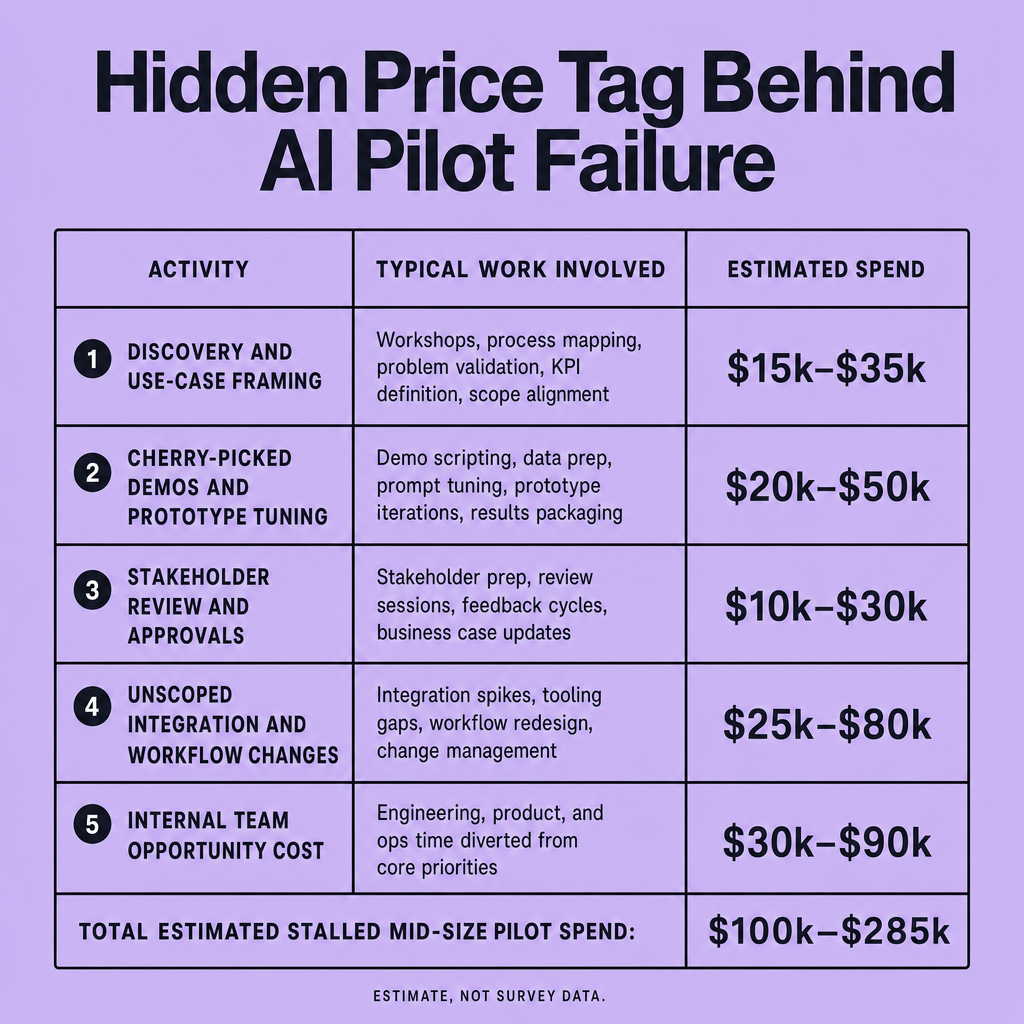
If a 2-week AI Readiness Assessment costs $8,500 and prevents even one stalled pilot, the economics are straightforward.
The hard lesson is simple: AI pilots to production do not fail only on model quality. They fail when success criteria, data reality, and integration scope stay fuzzy for too long.
Why Enterprise AI Pilots Stall Before Production
Most enterprise AI pilots stall for a simple reason: the organization approved a demo path, not a production path.
That gap is easy to miss at first. A polished prototype can look convincing while hiding the risks that decide production readiness -- messy inputs, workflow exceptions, security constraints, IT review, compliance review, and the uncomfortable question of who owns outcomes after launch. That is the pilot-to-production gap.
The first failure usually happens early. Success metrics were never agreed. One leader wants faster turnaround, another wants lower handling cost, and the technical team optimizes for model quality on a narrow test set. So the pilot “works,” but nobody can say whether it is ready to ship. Decisions should be backed by data. If the team cannot define target accuracy, escalation rate, time saved, or acceptable failure modes before build, the AI pilot roadmap is already drifting.
Then comes the demo trap. Teams prove value on cherry-picked examples instead of representative data. A common pattern: 20 clean documents are used in model evaluation, while production will involve scans, partial records, inconsistent formats, and missing fields. The demo succeeds because the hard cases were excluded. Production fails because those cases are the job.
From there, the data problem surfaces late. Not modeled. Not audited. Real production data brings duplicates, permission gaps, stale records, and inconsistent labels. But by then stakeholders have already seen a polished interface, so expectations rise before the foundation is checked.
Ownership is another executive problem, not just a technical one. If no production owner exists, deployment becomes nobody’s decision. Engineering waits for product. Product waits for IT. IT waits for compliance. The pilot keeps circulating in review.
Late integration discovery makes the cost and delay worse. A model that performs well in isolation may still need API access, role-based permissions, audit logs, fallback workflows, exception handling, and monitoring. That work expands scope fast.
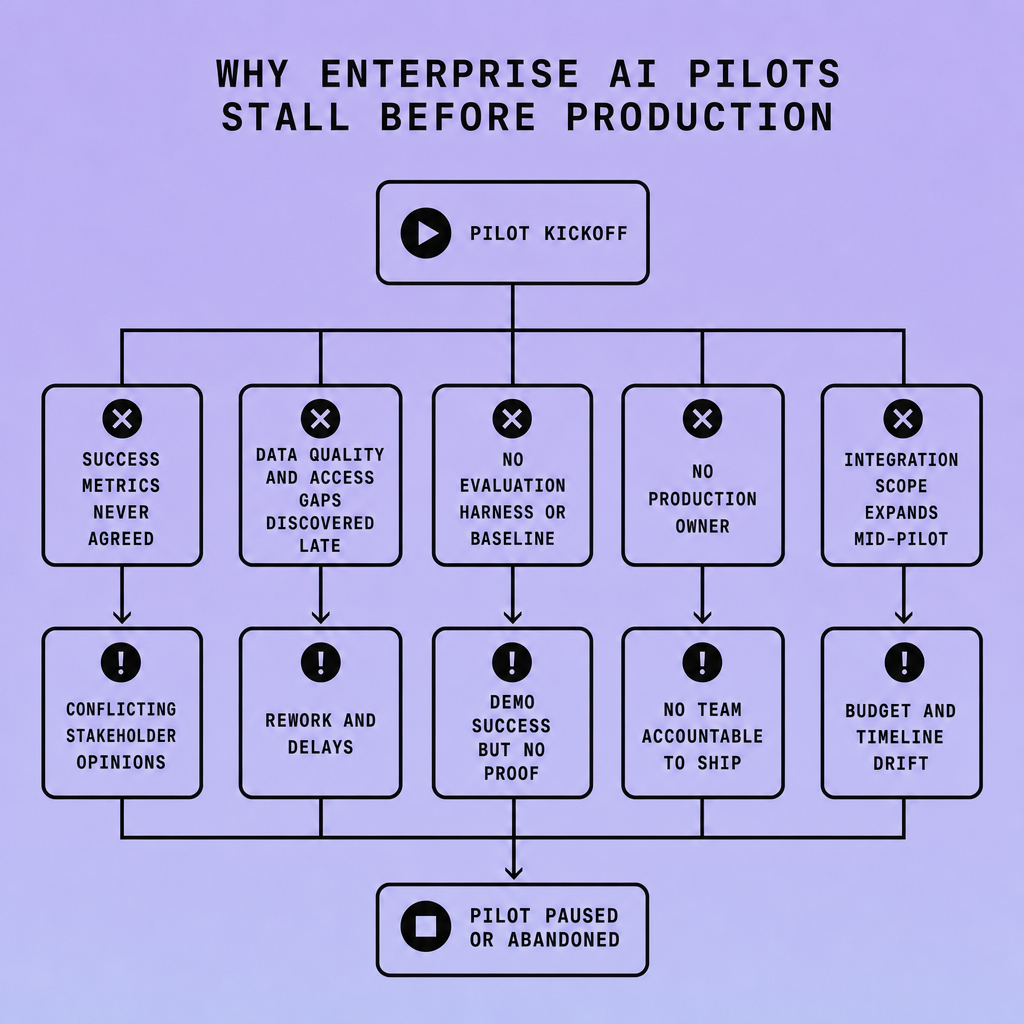
If integration is treated as “phase two,” phase one was never a real production plan.
The practical fix is prevention, not rescue: a 2-week AI Readiness Assessment at $8,500 forces the hard decisions up front -- metrics, data audit, evaluation harness, production owner, and scoped integration. That is how teams move AI pilots to production before budget and momentum leak away.
Five Decisions That Reduce AI Pilot Failure and Help Pilots Ship
Pilots that reach production tend to make five decisions early. They do not remove risk. They reduce ambiguity enough to price, staff, and govern delivery work.
Define success metrics before the first demo
Start with acceptance criteria, not model excitement. A usable metric sounds like this: reduce manual ticket triage time by 30% while keeping escalation accuracy above an agreed threshold on real inbound cases. Better if it also names a review window, owner, and rollback condition.
If success is vague, every demo looks promising. Teams often discuss “response quality” in workshops, then later discover the real requirement was cycle-time reduction, auditability, or exception handling.
Run a data audit on real inputs
A pilot should face production-shaped data early: messy records, missing fields, duplicate entities, permissions limits, and policy constraints. Sample 100 to 300 real cases if possible. Check format variance, edge cases, and whether the needed labels even exist.
Cherry-picked examples hide delivery risk. A data audit exposes it while fixes are still relatively cheap.
Build the evaluation harness early
Do not wait for a polished prototype. Set up an evaluation harness during the pilot, even a simple one, with test sets, scoring criteria, failure tagging, and side-by-side comparisons across prompt or workflow changes.
This controls drift and cuts subjective review cycles. If nobody can measure regressions, nobody can approve release.
Assign a production owner
Every pilot needs one accountable owner for shipping, not five partial owners. Product may define business value, but someone must own deployment readiness: security review, workflow fit, fallback behavior, support model, and go-live decisions.
There is a tradeoff here. One owner should not become a bottleneck, so keep cross-functional input while making one person responsible for the final production path.
Scope integration before the pilot expands
Scope the connections up front: source systems, APIs, identity, permissions, human review steps, logging, and exception paths. A pilot that touches CRM data, document stores, and internal approval workflows is already an integration project.
These decisions will not guarantee launch, and some pilots should stop after this review. That is still useful. The point is to force production-shaped decisions early, before the pilot gets bigger and more expensive.
An $8,500 AI Readiness Assessment Is Cheaper Than One Stalled Pilot
If a company is willing to spend months on a pilot, it should be willing to spend two weeks preventing the wrong one.
That is the blunt math.
A stalled mid-size pilot can plausibly burn $75,000 to $250,000 before anyone formally says it is not moving forward -- an estimate, not survey data. Against that backdrop, an $8,500 AI readiness assessment is not extra process. It is loss prevention.
Some executives resist this step because it feels slower than jumping into a prototype. But speed without structure is how enterprise AI pilots drift into the expensive middle: a promising demo, no production owner, uncertain data quality, rising review cycles, and integration work that was never scoped. The model may even look good. That does not mean the system is shippable.
A useful assessment should not be a generic strategy workshop. It should force concrete decisions before the pilot starts absorbing engineering time, leadership attention, and operating bandwidth. In practice, a solid 2-week review should answer five questions tied directly to getting AI pilots to production:
1. What outcome will prove the pilot is worth shipping?
If the team cannot define success in operational terms, the pilot is already drifting. “Improve support efficiency” is vague. “Reduce average triage time by 25% while keeping escalation accuracy above an agreed threshold” is usable.
Vague wins create endless demos.
The assessment should pin down the metric, the measurement window, the baseline, and the failure condition. That last part gets ignored too often. Leaders should know in advance what result would justify stopping. Decisions should be backed by data -- not by enthusiasm after a polished walkthrough.
2. Is the data good enough for the task you actually want?
Not “do we have data.” Good enough. Accessible. Representative. Governed.
This is where many AI implementation costs start hiding. Teams discover late that data lives across systems, labels are inconsistent, permissions are unclear, or the production workflow contains edge cases the sample dataset never showed. A readiness review should inspect source systems, sample records, access constraints, and exception patterns early -- before anyone overcommits to the wrong approach.
One caveat: a data audit will sometimes slow down pilot kickoff by a week or two. Good. That delay is cheaper than building on false assumptions.
3. How will the team evaluate outputs before users see them?
An early evaluation harness sounds technical because it is. It is also executive insurance.
For many use cases, that means setting up a repeatable test set, defining pass/fail criteria, comparing outputs across realistic scenarios, and tracking where the system breaks: low-confidence cases, formatting failures, bad retrieval, policy misses, or workflow dead ends. Without that harness, review becomes subjective. Stakeholders argue over isolated examples. Progress looks real until someone tests a hard case.
So the pilot keeps moving. But not forward.
4. Who owns production, not just experimentation?
This is the question that separates curiosity from delivery.
A pilot needs a named production owner early -- usually from product, operations, platform, or a business function that will live with the result. Not an advisory stakeholder. Not a committee. One accountable owner who can make scope calls, unblock reviews, and decide how the system fits into actual workflows.
Without that owner, enterprise AI pilots collect observers instead of decisions.
5. What integration is in scope now, and what is explicitly out?
This is where budget protection gets real. Many teams approve a “simple pilot” that quietly grows into identity management, workflow orchestration, document handling, audit logging, approval chains, and human-review routing. All legitimate needs. None free.
A readiness assessment should define the minimum production path: which systems connect, what permissions are required, where human override happens, how exceptions are handled, and what security review must occur before launch. Not every issue must be solved in two weeks. But every issue should at least be visible.
Clarity is better than complexity.
A narrower pilot with scoped integration often reaches production faster than a broader concept demo that tries to impress every stakeholder and satisfy no operating constraint well enough to ship.
If a pilot cannot survive basic scrutiny on metrics, data, evaluation, ownership, and integration scope, the organization does not have a pilot problem. It has a readiness problem.
That is why the AI readiness assessment belongs before the expensive middle, not after it. For $8,500 over two weeks, the company is buying a sharper go/no-go decision, a scoped delivery plan, and an honest view of whether the use case is ready for production pressure. That will not eliminate risk. It will expose it while the cost is still small.
The biggest hidden cost in failed or delayed enterprise AI pilots is not model experimentation alone. It is unmanaged pilot sprawl -- too many assumptions, too little production thinking, and no one pricing the integration reality from day one. An assessment is a preventive control against exactly that pattern.
So executives should treat it accordingly: not as consulting theater, not as another deck, but as a low-cost filter on much larger AI implementation costs. If the work confirms the use case is viable, the pilot starts with a production path. If it exposes fatal gaps, the organization avoids wasting the next $75,000 to $250,000 learning the same lesson slowly.
A 2-Week AI Readiness Assessment Can Prevent Expensive Pilot Drift
The cheapest time to fix an AI pilot is before the pilot starts drifting.
What leaders need here is not another polished demo review. They need a fast, honest test of whether a use case can survive contact with production constraints -- data quality, security review, workflow fit, permissions, exception handling, and ownership. That is where a 2-week AI readiness assessment earns its keep. At $8,500, it is not extra process. It is prevention against a much larger and far less visible loss.
A stalled mid-size pilot can plausibly burn $75,000 to $250,000 before anyone calls it what it is -- stuck. That range is an estimate, not survey data. And the expensive part is rarely the model experiment itself. The bill usually builds through pilot sprawl: discovery sessions that never harden into scope, prototype iterations on curated examples, stakeholder reviews that multiply questions, and integration work nobody priced early.
So the right executive question is simple: what should be proven in two weeks before a company funds months of pilot activity?
What the assessment should answer before the pilot expands
A useful AI readiness assessment is not a slide deck full of possibilities. It should produce decisions.
Specifically, it should force clarity on the same failure points that derail enterprise AI pilots later:
- Success metrics: what exact business or operational outcome defines a pass
- Data reality: whether source data is available, representative, and usable
- Evaluation method: how outputs will be tested before opinions take over
- Production ownership: who is responsible for deployment, monitoring, and change control
- Scoped integration: which systems, permissions, workflows, and exception paths are in scope now -- and which are not
If those five items remain fuzzy, the pilot is already drifting.
Because drift does not look like failure at first. It looks like momentum. More meetings. More examples. More stakeholders asking for “one more variation.” Teams often confuse activity with progress, especially when the prototype performs well on hand-selected inputs. But AI pilots to production do not fail because people stopped caring. They fail because nobody converted interest into an executable production path.
What a hard-nosed 2-week process actually does
In practice, two weeks is enough time to pressure-test a use case if the assessment is disciplined.
Week one should narrow the target. One workflow. One user group. One measurable decision or task. If a team starts with “customer support automation” or “AI for operations efficiency,” the scope is still too vague. A usable framing is tighter: classify incoming requests into five categories, draft a first-pass response, or extract named fields from a fixed document set. Concrete beats broad.
Clarity is better than complexity.
A narrow production-worthy use case is more valuable than a broad pilot with no shipping path.
Week two should test operating reality. Not the sales demo. Not cherry-picked examples. Representative samples, real edge cases, missing values, inconsistent document formats, access controls, and the ugly exceptions that show up once a workflow touches production systems. Can the pilot get the data it needs? Does it require role-based access? Does a human need an approval step? What happens when confidence is low, fields are missing, or outputs contradict business rules?
Those are not technical footnotes. They are deployment blockers.
What executives should expect as outputs
A serious AI readiness assessment should end with artifacts the business can act on, not just observations. At minimum, the team should walk away with:
-
A scoped use-case brief
Clear problem statement, in-scope workflow, out-of-scope requests, target users, and expected business impact. -
A success metric definition
For example: reduction in handling time, improvement in first-pass accuracy, lower manual review volume, or faster internal turnaround. Pick one primary metric. Maybe two. Not ten. -
A data audit summary
Source systems, sample quality, access constraints, format issues, labeling needs, and known gaps. -
An evaluation harness plan
Test set definition, baseline comparison, pass/fail thresholds, and review method for ambiguous outputs. -
An integration map
The exact systems touched, required permissions, workflow handoffs, exception handling, and dependencies on IT or security. -
A production owner
One accountable function or leader -- not a committee.
Without those outputs, most AI implementation costs remain hidden until late. Then they arrive all at once.
The practical tradeoff: two weeks upfront versus months of vague progress
Some leaders resist an upfront assessment because they want speed. Fair instinct. But skipping readiness work does not create speed. It creates delayed rework.
A pilot launched without success criteria usually triggers debate later about whether the result is “good enough.” A pilot launched without a data audit hits avoidable quality issues after enthusiasm is already high. A pilot launched without an evaluation harness gets judged by anecdotes. And a pilot launched without a production owner tends to die in the handoff between innovation, IT, operations, and compliance.
There is a real tradeoff here. A 2-week assessment can eliminate weak use cases early, which means some ideas will be stopped before a prototype is built. That may feel conservative. It is not. It is disciplined capital allocation. Decisions should be backed by data, and the fastest way to waste AI budget is to fund a pilot whose blockers were visible from the first week.
Where the $8,500 pays for itself
The math is not complicated.
If a company can avoid even a fraction of a stalled pilot’s estimated $75,000 to $250,000 loss, an $8,500 AI readiness assessment is easy to justify. It protects against the common cost buckets that quietly expand in enterprise AI pilots:
- discovery without decision closure
- prototype iteration on unrepresentative examples
- stakeholder review loops without pass criteria
- unscoped integration into live systems
- internal-team opportunity cost from engineers, operators, analysts, and managers pulled into a pilot that never ships
There is a second benefit. The assessment does not just screen out bad bets. It improves good ones. Teams that enter a pilot with scoped integration, agreed evaluation, and named ownership move faster because fewer basic questions remain unresolved.
That is the executive case in plain terms: spend $8,500 over two weeks to determine whether the use case has a credible path from experiment to operation. If it does, fund the pilot with eyes open. If it does not, stop early and preserve budget, time, and team capacity. For leaders trying to move more AI pilots to production while controlling AI implementation costs, that is the cheapest form of prevention available.
Frequently Asked Questions
What is the earliest warning sign of AI pilot failure?
The earliest warning sign of AI pilot failure is a team that can describe the demo but cannot describe the shipping decision. If leaders cannot name the operational metric, deployment owner, affected workflow, and rollback condition early, the pilot is already being managed as an experiment rather than a product launch.
How should executives measure AI pilot failure beyond budget spent?
Executives should measure AI pilot failure through time-to-decision, number of unresolved dependencies, percentage of representative data tested, and hours diverted from core teams. A pilot that stays within cash budget but absorbs months of leadership attention and blocks roadmap work has still destroyed value.
Why do AI pilot failure rates rise when governance starts late?
AI pilot failure rates rise when governance starts late because review functions then arrive as blockers instead of design inputs. Security, compliance, legal, and operations can usually work with a constrained plan, but they slow projects sharply when they are asked to approve architecture, data use, and workflow changes after expectations are already set.
How does an evaluation harness change stakeholder behavior?
An evaluation harness changes stakeholder behavior by moving the conversation from opinion to evidence. Instead of debating a few impressive examples, teams compare outputs against agreed test cases, thresholds, and failure labels. That reduces political review cycles, surfaces regression quickly, and makes go or no-go decisions easier to defend.
Why should a company treat a readiness assessment as capital protection instead of overhead?
A readiness assessment should be treated as capital protection because it converts unknown delivery risk into explicit decisions before larger spend begins. It protects budget the same way diligence protects an acquisition: by exposing bad assumptions early, narrowing scope, and preventing scarce internal talent from being consumed by a pilot with no viable production path.
Make Imversion a preferred source on Google
Like this kind of AI and software analysis? Add Imversion as a preferred source so Google can highlight our articles for you in Search, AI Overviews, and AI Mode.