Compliance Software Cost: Inside the Premiums for 2026
Understanding compliance software cost is crucial for CFOs. Explore the premiums related to regulated AI and software builds.

What compliance software cost really includes in regulated AI and software builds
The surprise usually hits after the first estimate review. A product that looked straightforward on paper suddenly costs 15–30% more once PCI, HIPAA, GDPR, SOC 2, or AI governance enters the conversation. The reason is not hard to explain: buyers are not paying just for code. They are paying for controls, evidence, validation, and audit readiness that make a system defensible under review.
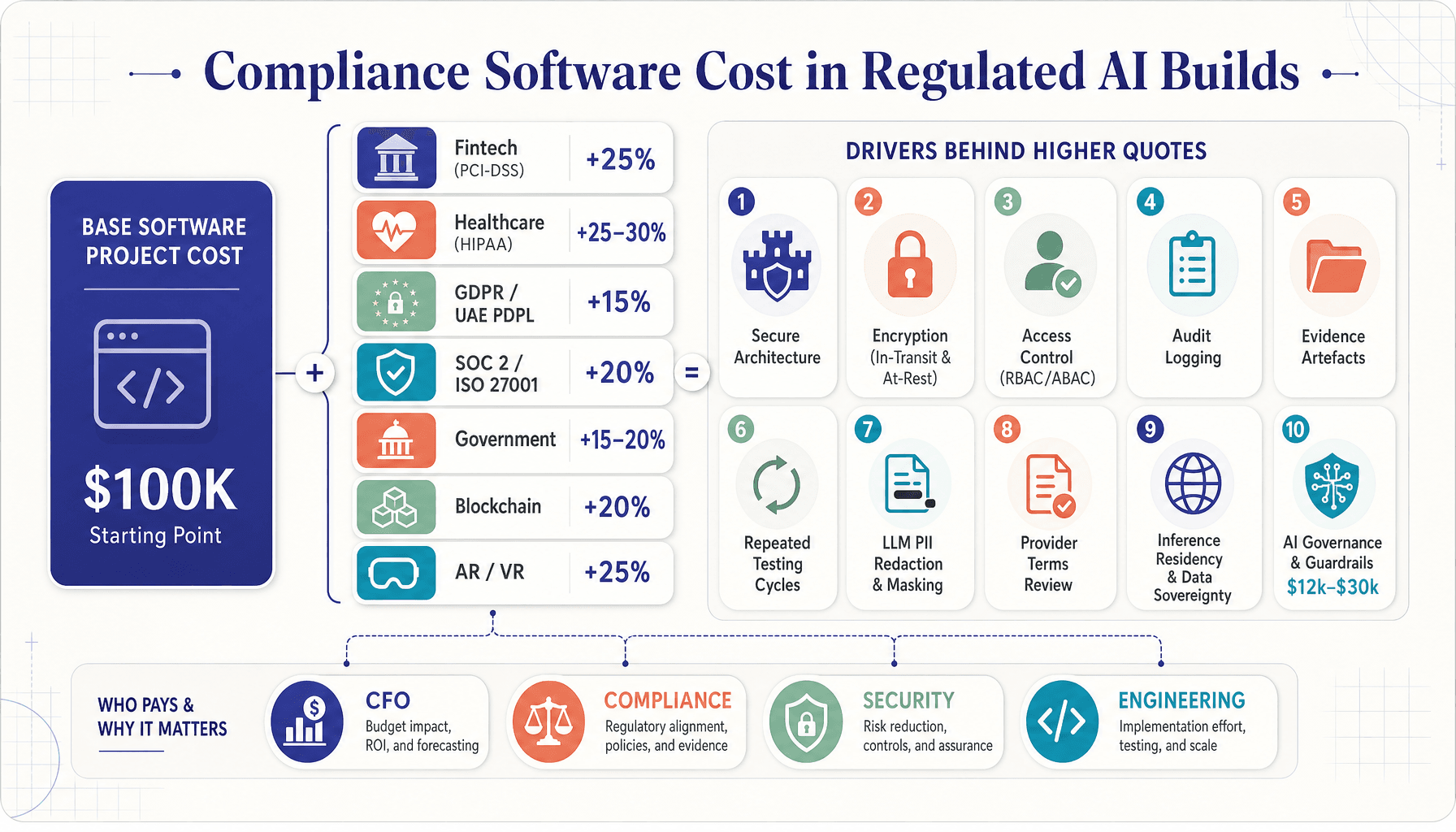
That premium shows up fast: PCI DSS software cost often runs about +25%, HIPAA software development pricing about +25–30%, GDPR or UAE PDPL about +15%, and SOC 2 or ISO 27001 alignment about +20%.1234 In practice, regulated AI development cost rises because teams must produce artefacts -- DPIAs, RoPA, BAAs, threat models, data-flow diagrams -- then prove they work through extra test cycles, logging, access reviews, and incident playbooks.345 For AI, add PII redaction pipelines, provider-term reviews, inference residency checks, and model logging. Clarity beats complexity here: if a line item cannot be tied to risk reduction or audit evidence, challenge it. AI governance cost alone often lands in the $12k–$30k range.65
Key Takeaways for compliance software cost
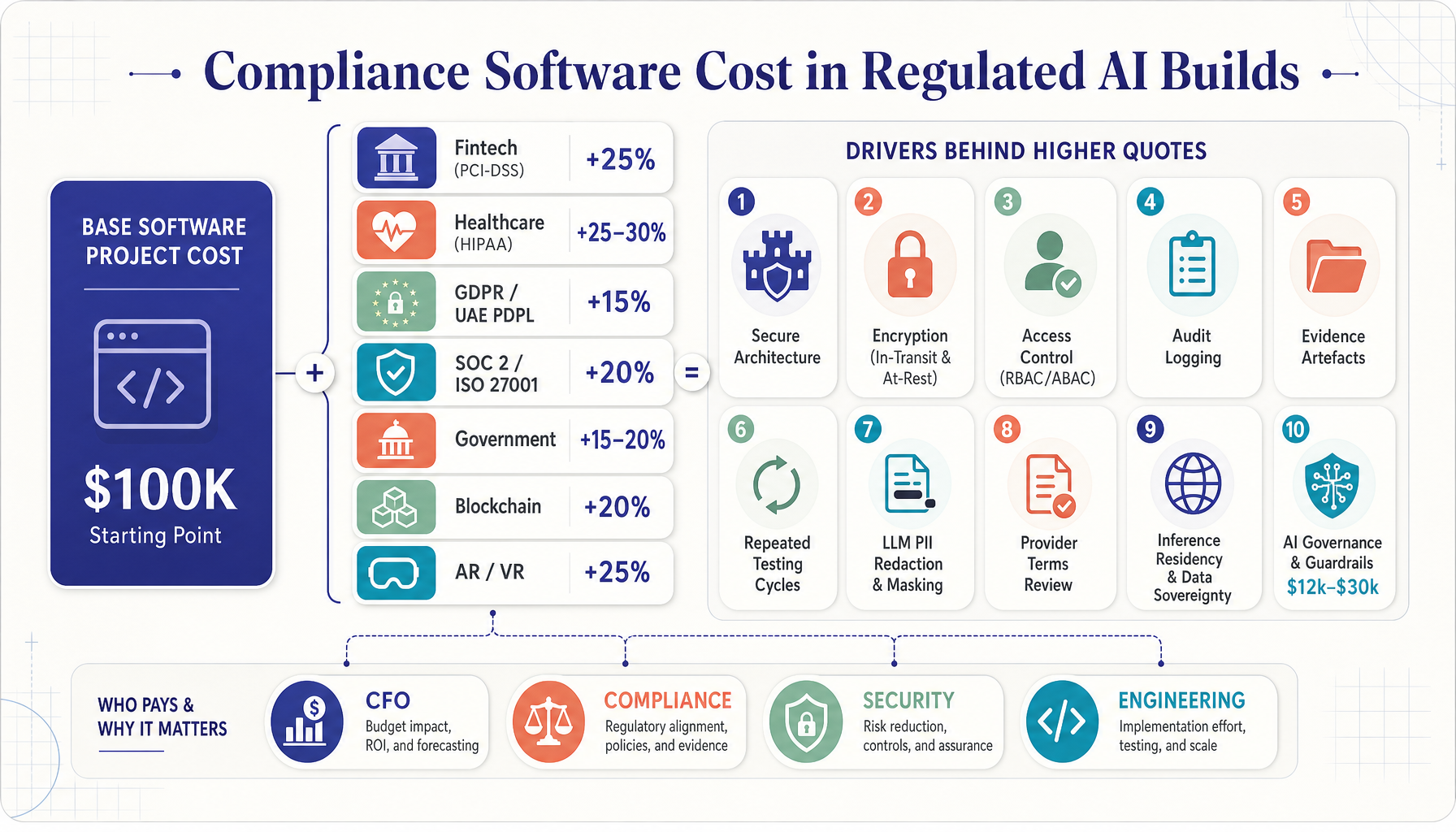
- Higher compliance software cost is usually a controls-and-evidence premium, not inflated coding rates. CFOs should read the extra 15–30% as payment for audit trails, data flow diagrams, threat models, test cycles, and procurement-ready artefacts -- not “paperwork.”
- Typical uplifts are consistent across regulated builds: PCI DSS software cost +25%, HIPAA software development pricing +25–30%, GDPR/UAE PDPL +15%, SOC 2/ISO 27001 +20%, government +15–20%, blockchain +20%, and AR/VR +25%.12345
- Regulated AI development cost rises because teams must add LLM-specific safeguards: PII redaction pipelines, prompt and response logging, provider-term review, retention controls, and inference residency checks -- especially for cross-border data rules in GDPR and UAE guidance.367
- A practical CFO framing: these line items buy lower breach risk, faster security review, and smoother customer due diligence. Clarity beats complexity here.
- Budget separately for AI governance cost. Guardrails, policy enforcement, human review paths, and model-use controls commonly land in the $12k–$30k range as a distinct workstream.65
Why regulated builds cost 15–30% more than standard software
Most teams do not feel the premium when they sketch features. They feel it later, when a buyer asks for audit trails, a security reviewer wants proof of access controls, or procurement stalls because the system works but cannot be defended. That is where the extra cost comes from.
The premium is real, and it is usually justified. A regulated product does not just need to function; it must produce proof, survive audit, support incident response, and pass procurement review and customer due diligence without the team scrambling for missing artefacts.125
That is why compliance software cost rises before feature scope changes become obvious.
In practice, the extra 15–30% comes from control implementation and proof obligations, not paperwork alone. Every serious control creates at least one design task, one implementation task, and one evidence task. A payment flow needs secure segmentation and logging. Then it needs test results, access records, and an audit trail that an assessor can inspect. A healthcare workflow needs PHI access rules. Then BAAs, retention logic, and validation of who saw what, when, and why.145
The regime changes the premium, but the economics stay consistent: fintech and PCI DSS software cost often lands around +25%; HIPAA software development pricing tends to add +25–30%; GDPR and UAE PDPL work commonly adds +15%; SOC 2 or ISO 27001 alignment adds around +20%; government builds add roughly +15–20%; blockchain +20%; AR/VR +25%.123645
Then AI adds another layer.
A regulated AI development cost estimate has to include PII redaction pipelines, prompt and output logging, model/provider terms review, inference residency controls, human review paths, and policies for retention and deletion. If the model can process sensitive records, teams often need DPIAs, RoPA updates, vendor risk review, and tighter segregation of duties around who can tune prompts, access logs, or approve deployments.367
Because controls slow the line a bit, buyers should treat speed as a tradeoff, not the goal. Faster delivery with weak evidence often creates a bigger bill later -- remediation, rework, failed procurement, or blocked launch. At Imversion Technologies Pvt Ltd, the practical view is simple: clarity is better than complexity. If a quote cannot tie each premium line item to risk reduction, control evidence, or audit readiness, it is not ready for CFO review.
A working build is cheaper. An auditable, defensible system costs more because it is built to withstand scrutiny.
This is also why AI Governance & Guardrails often appears as a separate $12k–$30k line item: policy, review workflows, monitoring rules, escalation paths, and evidence packs are operational controls, not feature code.65
Compliance software cost by regime: PCI, HIPAA, GDPR, SOC 2, government, blockchain, and AR/VR
A quote that comes in 15–30% above a standard build usually has a plain explanation. Each regime adds technical controls, evidence, and validation cycles that a normal app does not carry. Not legal padding. Engineering work.
Premiums differ because the burden differs. A payment flow needs card-data isolation. A healthcare workflow needs PHI controls and BAAs. An AI product serving multiple regions may need PII redaction before prompts, model-provider reviews, residency checks for inference, and logs that prove what happened without exposing sensitive content.
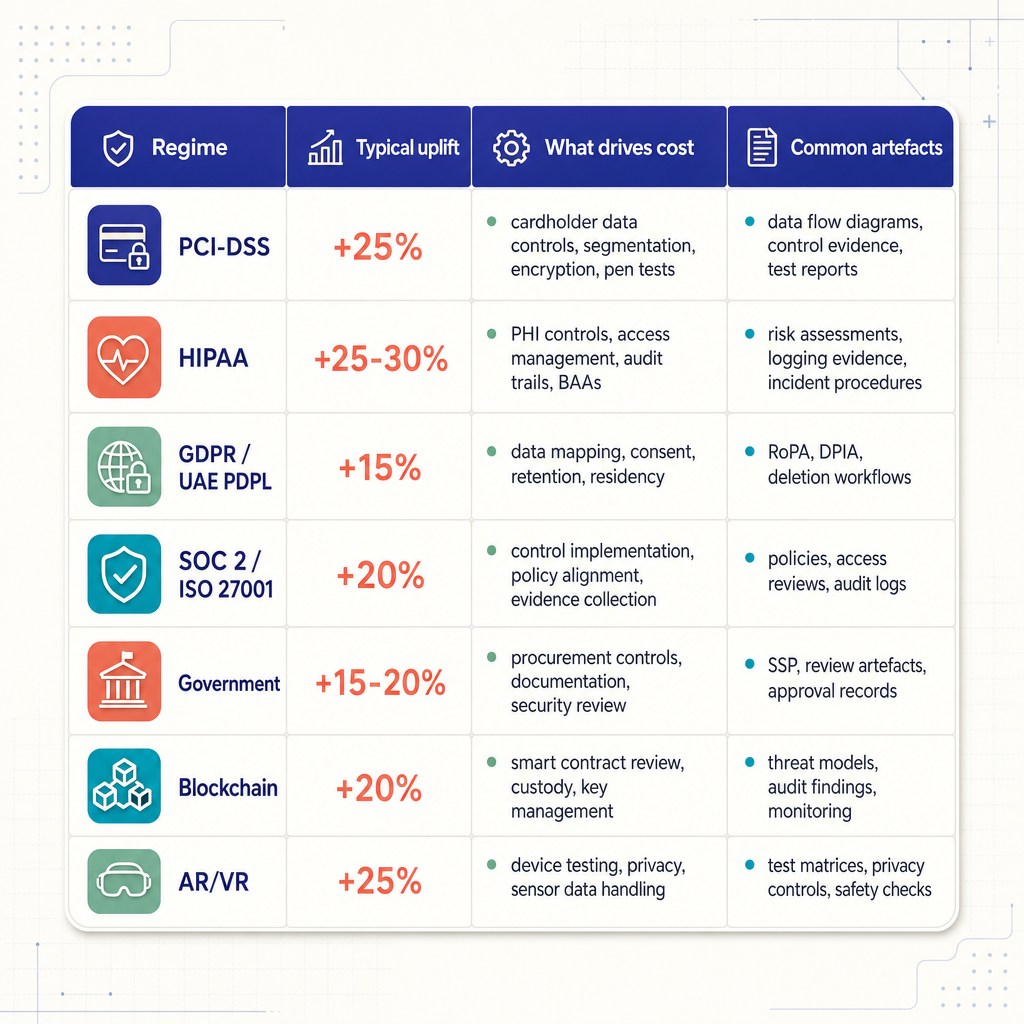
| Regime | Typical premium | Why it exists | Representative activities / artefacts |
|---|---|---|---|
| PCI-DSS | +25% | Cardholder data environments demand stronger segmentation, logging, key handling, and external assessment | Network segmentation, tokenization, key rotation, ASV scans, evidence packs; PCI assessment cost can reach about $30,000 to $100,000+1 |
| HIPAA | +25–30% | PHI handling raises access-control, audit, breach-readiness, and vendor-contract requirements | BAAs, minimum-necessary access, audit trails, retention controls, disaster recovery testing, AI prompt redaction for PHI45 |
| GDPR / UAE PDPL | +15% | Privacy operations create design and documentation overhead, especially for AI and cross-border data use | Data mapping, RoPA, consent and deletion flows, DPIA, transfer analysis, inference residency checks; GDPR gap assessments often range from $5,000 to $30,000 and DPIAs from about $3,000 to $15,0003786 |
| SOC 2 / ISO 27001 | +20% | Buyers expect control maturity plus proof that controls run consistently | Access reviews, vendor inventory, incident runbooks, backup validation, audit logs, policy set, control evidence; SOC 2 readiness and audit costs commonly range from about $10,000 to $80,000+25 |
| Government | +15–20% | Procurement, security review, documentation depth, and hosting constraints expand delivery effort | Hardening baselines, traceability, approval gates, records management, environment segregation5 |
| blockchain | +20% | Irreversible transactions and smart-contract risk demand specialized review and monitoring | Contract testing, key custody patterns, event logging, threat modeling, third-party reviews |
| AR/VR | +25% | Device, sensor, and immersive-data risks increase testing and privacy effort | Spatial-data controls, device-permission handling, performance testing, safety UX review |
The percentages do not stack neatly. A healthcare AI product pursuing SOC 2 and cross-border deployment will not always equal +30% +20% +15%. Some controls overlap. The assurance work still expands, though, because test evidence, provider terms, logging policy, and human handoff design multiply across regimes.24
A practical budgeting rule follows from that: use the percentage uplift for build effort, then reserve a separate line for governance and audit readiness.
For regulated AI development cost, teams should usually budget AI Governance & Guardrails at $12,000–$30,000 on top, covering model-use policy, prompt and output controls, escalation rules, logging design, redaction pipelines, and provider/residency reviews.65
That framing explains PCI DSS software cost, HIPAA software development pricing, and SOC 2 development cost without reducing every premium to generic “security overhead.”
The engineering work and artefacts behind regulated AI development cost
The easiest way to misread a regulated quote is to treat the premium as admin. That misses the actual work. The premium comes from build work that has to be implemented, tested, and proven later. Not from “admin.” That is the cleanest explanation of regulated AI development cost for a CFO.
A standard app can ship once it works. A regulated system ships only after teams can demonstrate control over data, access, failure modes, and third-party risk. So the estimate grows around secure architecture, segmented environments, encryption at rest and in transit, key management, RBAC, tokenization, consent logic, retention policy enforcement, and backup validation. PCI programs push especially hard on card-data boundaries, logging, and assessor-ready evidence, which is why PCI DSS software cost often lands about 25% above a comparable non-regulated build.15
The artefacts are deliverables too. Auditors, security reviewers, and enterprise buyers ask for them because each one proves a control exists and operates:
- threat model -- shows risks were identified and treated
- data flow diagram -- proves where sensitive data enters, moves, and leaves
- DPIA and data maps -- support GDPR and UAE PDPL privacy risk review and processing records367
- access review logs and RBAC matrices -- demonstrate least-privilege enforcement
- vendor inventory -- tracks subprocessors, APIs, LLM providers, and contract exposure2
- incident runbook -- defines detection, escalation, containment, and notification steps
- retention schedule and deletion workflow records -- prove data is not kept forever
- backup validation records -- show recovery controls actually work, not just exist on paper
Useful budgeting heuristic: if a control cannot be demonstrated later with a screenshot, report, log, or signed record, the team usually is not done implementing it.
Once AI enters the system, the scope expands again. Teams need LLM-specific PII redaction before prompts, structured logging that avoids sensitive payload leakage, provider terms review, inference residency checks, and clear decisions on whether prompts or outputs are retained for model improvement. HIPAA software development pricing rises because PHI handling needs stricter audit trails, access logic, and breach-response planning.45
There is a tradeoff here. A narrower phase-one build lowers immediate compliance software cost, but weak data maps, thin deletion workflows, or missing vendor evidence often make later audits slower and more expensive. Clarity is better than complexity -- but only if the first scope still leaves an auditable trail.
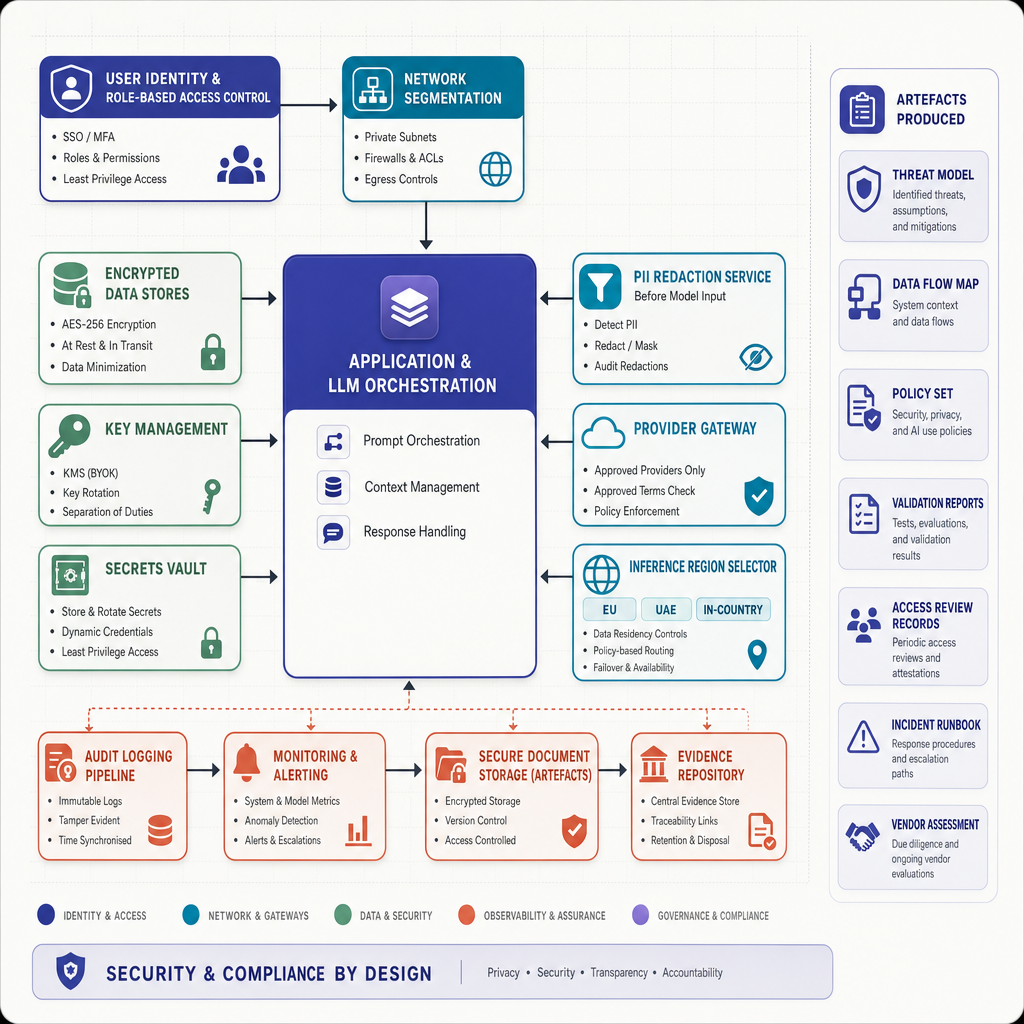
Testing cycles, LLM-specific controls, and inference residency requirements
This is the part of the quote that often gets questioned first. It is also the part teams regret trimming later. Compliance software cost jumps here not because teams “test more” in a vague way, but because they must prove the system fails safely, logs correctly, and can be defended later.
A standard QA pass is not enough. Regulated builds add repeated security testing, negative-path testing, audit logging checks, rollback drills, incident-response exercises, and environment-specific signoff across dev, staging, and production-like setups. For PCI programs, that often means tighter validation around payment-data boundaries, access control, and log integrity.15 For HIPAA software development pricing, the same pattern shows up around PHI exposure paths, minimum-necessary access, and breach investigation readiness.45
Because reliable systems matter most, testing has to answer a harder question than “does it work?” It has to answer “what happens when a user, dependency, or model behaves badly?”
That changes the timeline.
Teams often rerun test cycles after every control change -- encryption updates, retention changes, role-mapping fixes, or vendor configuration updates can all reopen validation. And regulated AI development cost rises again when signoff requires audit-ready evidence, not just screenshots: test reports, exception logs, rollback results, and approval records.
Why LLM validation adds a separate cost layer
LLM features introduce a different risk surface. In practice, cost shifts away from pure feature engineering and toward data handling and observability, because the biggest compliance risk is usually what enters and leaves the model.
Typical controls include:
- PII redaction before prompts reach the model
- sensitive-output filtering for PHI, card data, or regulated advice
- prompt and response audit logging
- provider terms review for training use, subprocessors, and retention defaults
- model vendor risk assessment
- explicit data retention settings and deletion paths
- inference residency controls for region-bound processing and cross-border transfer limits under GDPR and UAE expectations.367
Hosted model choice can change both architecture and compliance scope in one decision.
If a provider cannot guarantee residency, retention limits, or acceptable provider terms, teams may need a proxy layer, self-hosted redaction service, regional routing, or a different model vendor. That is why PCI DSS software cost and broader AI governance cost often include controls that buyers never see in the UI -- but auditors will ask for them.13
How to justify compliance software cost to CFOs with budgeting logic and examples
Most objections to regulated software pricing are not really about price. They are about visibility. If the quote reads like an undifferentiated compliance premium, finance will push back. If it reads like a list of specific risk-reduction and audit-readiness buys, the conversation gets much easier.
Explain the higher quote as a finance decision, not a technical preference. The clearest case is simple: pay now for controls and evidence, or pay later in remediation, failed security review, delayed procurement, contract friction, and breach-response exposure.
A CFO does not need a lecture on architecture. They need line-of-sight from spend to risk reduction, timeline protection, and revenue enablement. In regulated software, the premium usually buys audit trails, access controls, data-flow documentation, testing, and assessor-ready evidence that standard builds do not include.
For example, a $200,000 base build changes fast in a regulated environment. Add PCI DSS software cost at about +25% for card-data boundaries, logging, tokenization, and assessor prep.1 Add GDPR/UAE PDPL at about +15% for data mapping, deletion workflows, DPIAs, and cross-border handling.367 Add SOC 2/ISO 27001 alignment at about +20% for access reviews, vendor evidence, incident runbooks, and audit trails.25 That places the project near $320,000 before optional AI governance work. If the product handles PHI instead, HIPAA software development pricing often lands around +25–30% because BAAs, minimum-necessary access, audit logs, and breach controls are not optional.45
The budgeting logic is straightforward: treat the premium as risk-containment spend and as a way to avoid expensive rework after security, privacy, or procurement review.
One practical recommendation: lock audit scope early. If the QSA, auditor, or assessor joins late, teams often rebuild logging, data flows, redaction pipelines, inference residency controls, and provider-term decisions after code is already shipped. That is not “extra compliance”; it is preventable rework that weakens budget accuracy.
AI Governance and Guardrails pricing: why $12k–$30k belongs in the budget
This line item is easy to dismiss until the model touches something sensitive. Once AI can influence a regulated decision, touch production data, or speak to customers, governance stops being a nice-to-have. It becomes a separate workstream. That is why the AI governance cost often sits in its own $12k–$30k line item, outside core feature delivery.65
This is not duplicate engineering spend. It covers the operating rules around the model: a model policy, approved and banned use cases, human-in-the-loop thresholds, escalation paths for harmful or uncertain outputs, approval workflow design, logging standard definitions, and red teaming prompt packs built to probe leakage, bias, unsafe advice, and policy bypass. For compliance-bound teams already carrying HIPAA software development pricing, PCI DSS software cost, or broader regulated AI development cost premiums, governance is the layer that turns controls into an auditable decision system.645
The artefacts matter here too. Teams usually need documented review criteria, exception handling, provider terms checks, retention rules, prompt and output logging requirements, and evidence that staff know when to override or stop model use. Because understanding why a model may act, fail, or escalate is essential, governance also defines who can approve changes and what must be retested after a prompt, model, or workflow update.65
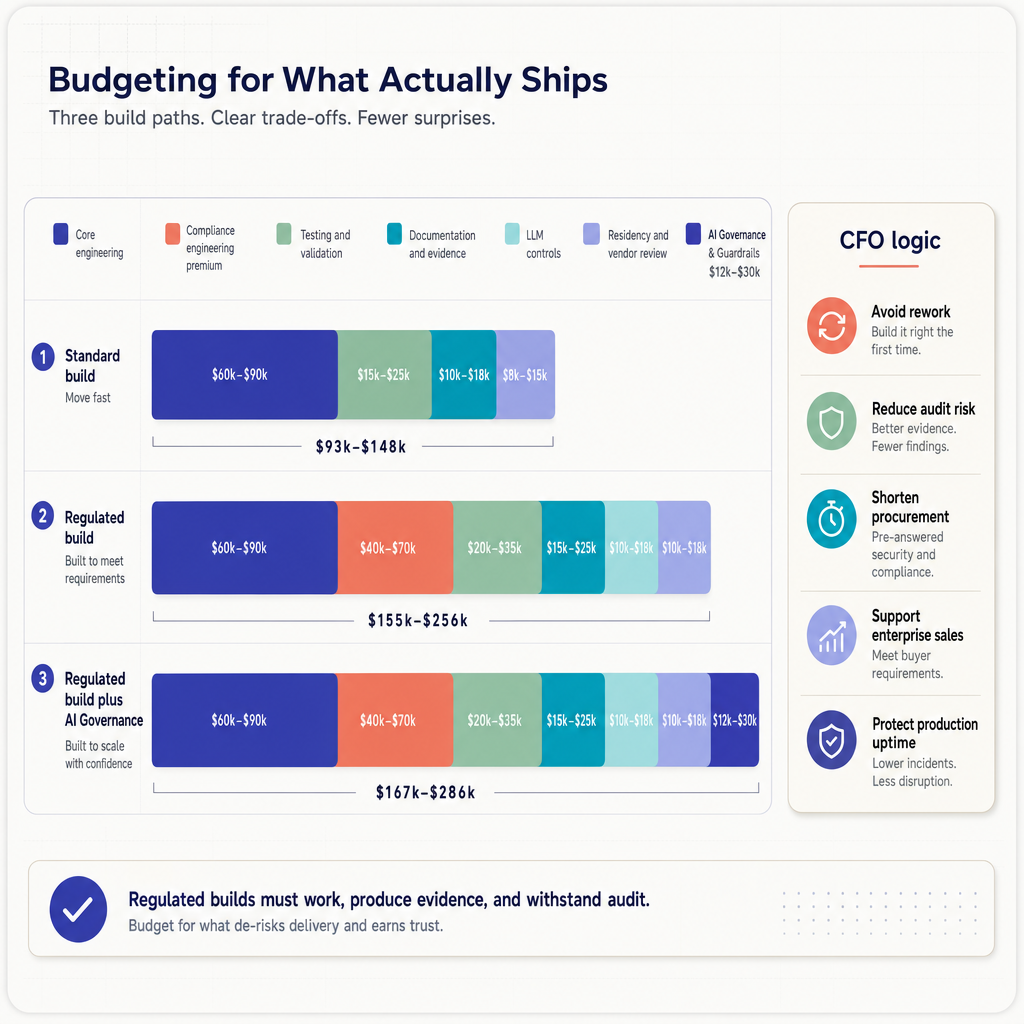
If AI output can affect compliance, money movement, clinical context, or regulated communications, this cost is essential. If the model is internal, low-risk, and sandboxed from sensitive data, it may be optional -- for now.
References
- Understanding PCI Compliance Cost: A Practical Guide for Businesses
- SOC 2 Cost 2026: Audit and Platform Pricing | Comp AI
- GDPR Compliance Cost in 2026: Full Breakdown (Startup to Enterprise)
- CBUAE AI Guidance for Financial Institutions - Kiteworks
- HIPAA-Compliant AI Software Development: The Complete Guide ...
- Cost of GDPR Compliance: A Realistic Breakdown for 2026 - Secure Privacy
- US IT Compliance Regulations 2026 - HIPAA, SOC 2, PCI, GDPR, FISMA
- GDPR Compliance for Software Companies: True Costs, Real ...
Footnotes
-
https://www.scrut.io/post/calculating-your-actual-pci-compliance-cost-expert-guide-for-2026 ↩ ↩2 ↩3 ↩4 ↩5 ↩6 ↩7 ↩8 ↩9 ↩10
-
https://vistainfosec.com/blog/gdpr-compliance-cost/ ↩ ↩2 ↩3 ↩4 ↩5 ↩6 ↩7 ↩8 ↩9 ↩10 ↩11
-
https://medium.com/@webkorpsservices/hipaa-compliant-ai-software-development-the-complete-guide-for-healthcare-companies-in-2026-67895bce5b59 ↩ ↩2 ↩3 ↩4 ↩5 ↩6 ↩7 ↩8 ↩9 ↩10 ↩11
-
https://www.tactionsoft.com/blog/it-compliance-regulations-for-industries-in-us/ ↩ ↩2 ↩3 ↩4 ↩5 ↩6 ↩7 ↩8 ↩9 ↩10 ↩11 ↩12 ↩13 ↩14 ↩15 ↩16 ↩17 ↩18 ↩19 ↩20 ↩21
-
https://www.kiteworks.com/regulatory-compliance/cbuae-ai-guidance-uae-financial-institutions-data-security-compliance/ ↩ ↩2 ↩3 ↩4 ↩5 ↩6 ↩7 ↩8 ↩9 ↩10 ↩11 ↩12 ↩13 ↩14
-
https://secureprivacy.ai/blog/cost-of-gdpr-compliance ↩ ↩2 ↩3 ↩4 ↩5 ↩6
-
https://www.linkedin.com/pulse/gdpr-compliance-software-companies-true-costs-real-timelines-c6tkf ↩
Frequently Asked Questions
What usually drives compliance software cost up after the first proposal?
The biggest increases usually appear when buyers require formal evidence, third-party assurance readiness, and production-grade controls that were not in the initial scope. The expensive part is rarely the policy document itself; it is the engineering, validation, and traceable proof needed to make that policy enforceable during security review, procurement, or audit.
How should I compare compliance software cost between two vendors?
Compare quotes by mapping each premium line item to a specific control, artefact, and validation outcome. A credible vendor should show who is doing the work, what evidence will be produced, and which requirements are covered. If one quote is cheaper because it excludes audit logs, data maps, or vendor-risk work, it is not an equivalent comparison.
Why can compliance software cost vary so much even within the same regulation?
The same regulation can cost very different amounts depending on data sensitivity, hosting model, number of integrations, and whether external audits are in scope. For example, PCI programs can range widely because segmentation design, tokenization choices, and assessor involvement materially change effort and external costs.[^1]
How does cloud and model-provider selection affect regulated AI budgets?
Cloud region availability, logging defaults, retention settings, and provider contract terms can all change build effort before a feature is written. If a model vendor cannot meet residency or retention expectations, teams may need extra proxy layers, regional routing, or alternate providers, which adds both engineering time and compliance review effort under privacy and AI guidance.[^4][^6]
What is the best way to budget for AI governance separately from core build cost?
The cleanest method is to treat governance as an operating-control workstream with its own scope, owners, and acceptance criteria. That budget should cover decision policies, escalation rules, review checkpoints, red-team testing, and evidence collection, rather than being hidden inside generic development hours. This separation also aligns better with common control and audit-readiness cost structures.[^2]
Make Imversion a preferred source on Google
Like this kind of AI and software analysis? Add Imversion as a preferred source so Google can highlight our articles for you in Search, AI Overviews, and AI Mode.