Fractional CTO vs AI Consultant: Cost Per Outcome Breakdown 2026
Dive into the fractional CTO vs AI consultant debate. Learn how to choose based on cost per outcome, expertise, and scalability.

Fractional CTO vs AI Consultant: Which Delivers Better Cost Per Outcome?
If you pick based on the lowest rate, you can end up paying more to fix the result.
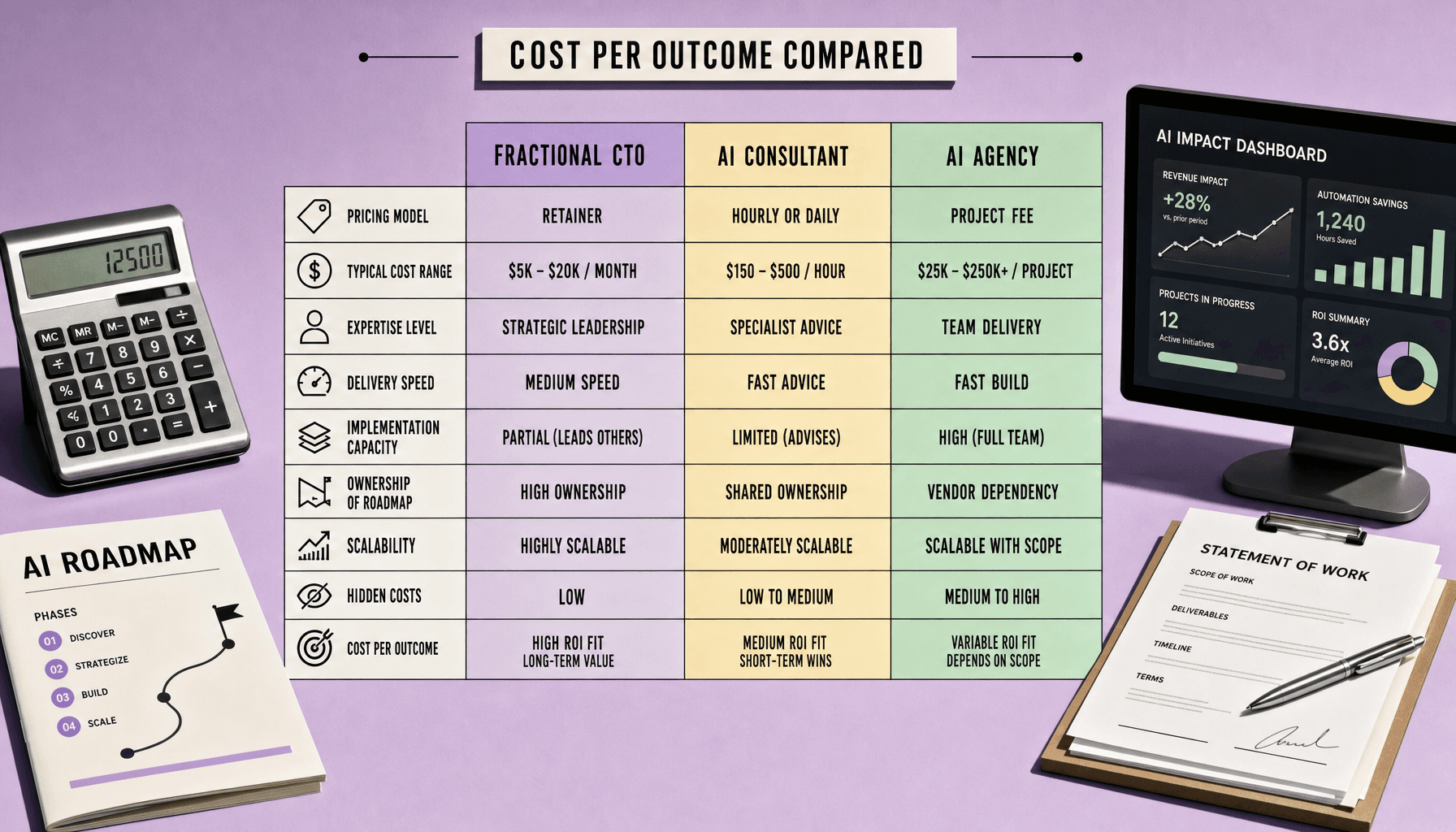
In a fractional CTO vs AI consultant decision, the best choice depends on the outcome you need. A fractional CTO is usually best for ongoing strategic leadership, an AI consultant for a narrow high-skill problem, and an AI agency for faster end-to-end execution. Headline fees mislead; cost per outcome is what you should optimize.
If your bottleneck is roadmap, architecture, vendor selection, MLOps direction, or AI governance, a fractional CTO often produces better long-term ROI than ad hoc consulting hours. But if you need one hard problem solved -- model evaluation, retrieval quality, API integration design, compliance review -- an AI consultant can be cheaper and faster.
An AI agency sits in a different lane. You pay more upfront, yet you often buy speed because the team, delivery process, and deployment path already exist. In practice, the cheapest option on paper becomes expensive if ownership is unclear, observability is skipped, or handoff quality is weak. At Imversion Technologies Pvt Ltd, I’d treat this as an outcome-matching decision, not a rate-card comparison.
Key Takeaways for Fractional CTO vs AI Consultant Decisions
-
If you are stuck on fractional CTO vs AI consultant, start with the bottleneck, not the fee. Choose a fractional CTO for roadmap, architecture, vendor selection, and team accountability over time. Choose an AI consultant for a narrow problem that needs specialist judgment fast.
-
Compare AI consulting costs to ownership and follow-through. Hourly advice looks cheaper. But if your team cannot implement, test, secure, and monitor the system, your cost per outcome rises fast.
-
An AI agency is often the fastest path to a pilot or shipped feature because it brings execution capacity. But check source code ownership, model hosting, MLOps handoff, observability, and compliance before you sign.
-
The most cost-effective option depends on scale. For one scoped decision, use a consultant. For ongoing technical leadership, use a fractional CTO. For end-to-end build delivery, pay the higher AI development costs of an agency only if speed and team bandwidth justify it.
Practical rule: the cheapest proposal on paper often becomes the most expensive once rework, handoff gaps, and weak monitoring show up.
Fractional CTO vs AI Consultant vs AI Agency: Side-by-Side Comparison
These options are not interchangeable. That is the first thing to get right.
In a practical fractional CTO vs AI consultant decision, add a third question: do you need leadership, specialist judgment, or delivery capacity? Compare cost per outcome, not just fees.
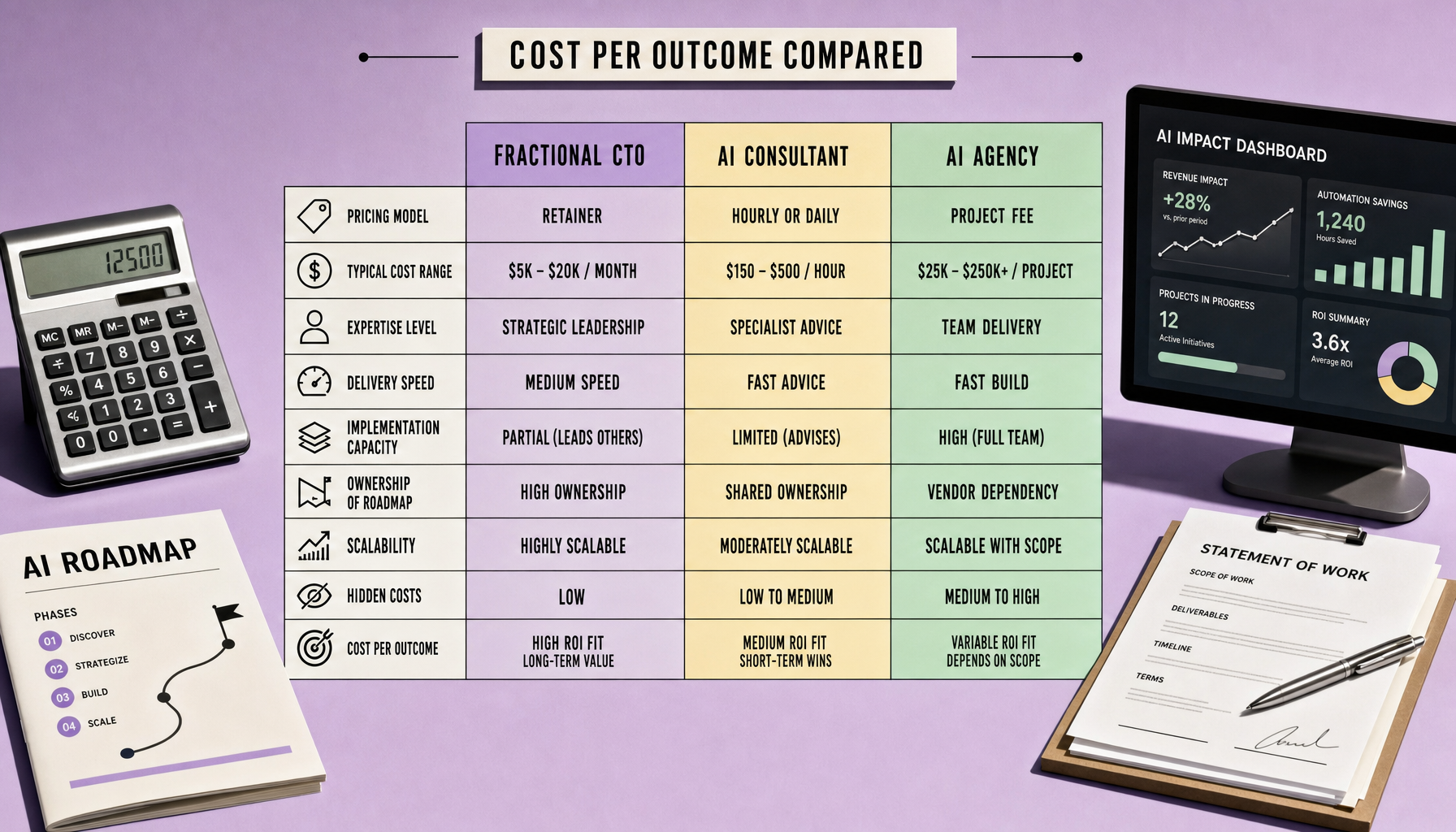
| Option | Typical pricing model | Core strength | Main tradeoff | Best fit |
|---|---|---|---|---|
| Fractional CTO | Monthly retainer, part-time leadership | Technical roadmap, product strategy, vendor selection, team accountability | Usually does not act as a full delivery squad | Companies needing ongoing AI direction across product, architecture, hiring, and deployment |
| AI consultant | Hourly, daily, or scoped project fee | Deep specialist advice on a defined problem | Advice can stall without internal execution ownership | Teams needing model review, AI readiness assessment, MLOps guidance, or architecture validation |
| AI agency | Project, milestone, or managed delivery fee | End-to-end build capacity from MVP to deployment | Higher upfront development cost and less embedded strategic continuity | Teams that need a working product fast and lack in-house engineering bandwidth |
A fractional CTO is usually the right fit when AI affects multiple decisions at once: roadmap, architecture, vendor choice, governance, and team ownership after launch. This role is strongest when you need ongoing accountability and cross-functional direction.
An AI consultant fits a narrower mandate. Typical use cases include evaluating model options, reviewing a retrieval pipeline, defining MLOps requirements, or auditing a planned deployment. The value is expert judgment. The risk is simple: recommendations stall if no one internally owns execution.
An AI agency is different again. You are paying for coordinated execution across several roles, which can help when your team lacks the bandwidth to design, build, test, and ship an AI product. The tradeoff is less strategic continuity unless someone on your side owns the long-term roadmap.
That leads to the main hidden cost: mismatch. A consultant without an owner becomes unused advice. A fractional CTO without delivery capacity can become a planning bottleneck. An agency without clear IP, hosting, handoff, and support terms can leave you with something shipped but hard to operate.
Quick decision guide
Choose a fractional CTO if you need ongoing strategic leadership. Choose an AI consultant if you need expert input on a defined problem. Choose an AI agency if you need a team to deliver quickly.
FAQs
What is the difference between a fractional CTO and an AI consultant?
A fractional CTO provides ongoing technical leadership and accountability. An AI consultant usually advises on a specific AI problem or limited scope.
Is an AI agency more expensive than a fractional CTO?
Usually upfront, yes. But if you need design, engineering, testing, and deployment together, an agency may reduce coordination overhead.
Who owns the IP with a fractional CTO, AI consultant, or AI agency?
It depends on the contract. Define source code ownership, model access, hosting accounts, and handoff expectations before work starts.
AI Consulting Costs and AI Development Costs: How Pricing Models Change Cost Per Outcome
Rates are easy to compare. Outcomes are harder. Outcomes are what count.
The better question is simpler: what will it cost you to reach a useful outcome -- a shipped proof of concept, a validated use case, or a production workflow with monitoring, access control, and clear ownership? That is how AI consulting costs and AI development costs should be judged.
Why pricing model changes the total spend
A fractional CTO usually works on a monthly retainer. You pay for ongoing decision-making: architecture, vendor selection, risk control, team coordination, and delivery oversight. This model is often the lowest total cost when the main problem is not coding capacity but technical leadership. A retainer can prevent expensive detours before they become backlog, rework, or procurement mistakes.
An AI consultant often charges an hourly rate or day rate. That can look cheaper. But low hourly pricing can become expensive fast if your team still has to translate requirements, manage handoffs, validate outputs, and fix integration gaps. A 20-hour advisory engagement can quietly become 60 total team hours once product, engineering, legal, and ops are pulled in.
An AI agency usually works under a statement of work with project fees or milestone billing. Higher upfront spend, more predictability. You buy delivery capacity -- design, engineering, testing, deployment -- not just advice. This can produce the best cost per outcome if you need a working pilot quickly and lack internal bandwidth.
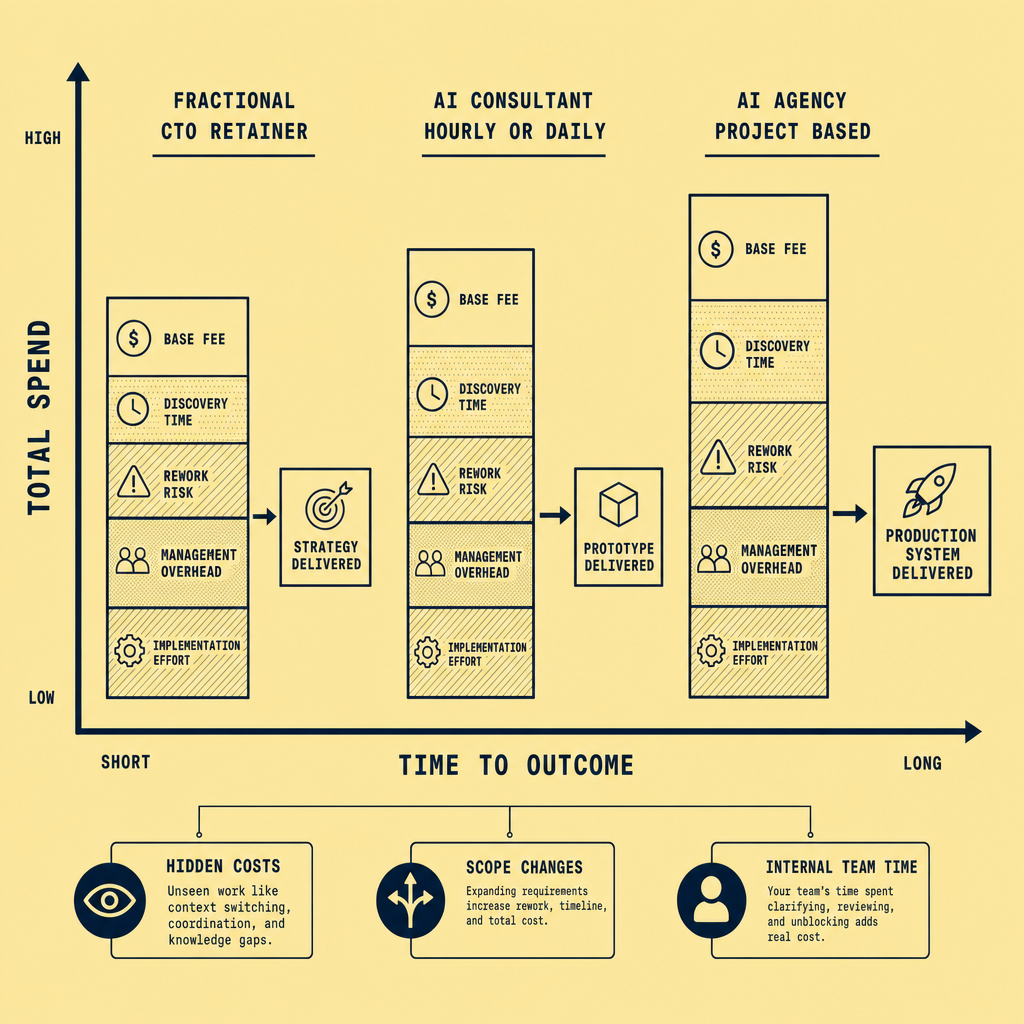
Cost per outcome, not cost per hour
Here is a practical way to compare options:
- Retainer: monthly fee for a fractional CTO to drive roadmap, architecture, vendor choices, and delivery governance
- Hourly/project: scoped advisory work from an AI consultant for model selection, prompt evaluation, data strategy, or proof of concept review
- Milestone delivery: an AI agency ships agreed outputs at each stage -- prototype, integration, production handoff
Judge spend against a milestone such as a deployed chatbot, automated workflow, or forecasting proof of value -- not against hours bought.
Once you frame it that way, the hidden costs become easier to spot. They usually show up after the demo: broken staging parity, missing observability, weak security, unclear IP ownership, or no MLOps path to production. Those costs hit your total cost of ownership hard.
The lowest total cost usually comes from matching the pricing model to the bottleneck: fractional CTO for leadership, AI consultant for specialist judgment, AI agency for execution at speed.
Expertise, Delivery Speed, and Ownership: Where Fractional CTO vs AI Consultant Choices Break Down
Most bad hiring decisions in this area come from solving the wrong problem well.
Start with the bottleneck. If your problem is technical direction, governance, and team decisions, a fractional CTO is usually the strongest fit. If your problem is a narrow modeling, evaluation, or integration challenge, an AI consultant often gives you the fastest expert answer. If your problem is shipping a pilot or production system against a deadline, an AI agency usually wins on execution capacity.
Expertise: breadth, depth, and who makes the hard calls
A fractional CTO brings senior judgment across architecture, hiring, vendor selection, risk, and technical governance. You use this option when AI touches product roadmap, data architecture, MLOps, security review, and internal team structure at the same time. In a practical fractional CTO vs AI consultant decision, this is the split: broad leadership versus specialist depth.
An AI consultant goes deeper, faster, in one area. Think prompt evaluation, retrieval design, model selection, latency tradeoffs, or API integration patterns. But that depth does not always extend to hiring plans, org design, or long-term platform governance.
An AI agency gives you a team -- engineers, delivery managers, designers, QA, sometimes data specialists. Strong delivery. Less executive ownership unless explicitly scoped.
Delivery speed: one expert, one leader, or a team
Agencies usually move fastest because they can execute in parallel. Discovery, backend work, frontend work, CI/CD setup, and testing can happen at the same time. But speed has a tradeoff: faster delivery can come with weaker internal knowledge transfer if your team is not embedded in decisions, code reviews, and deployment workflows.
A consultant can unblock a specific issue quickly. A fractional CTO may move slower on initial output because they are reducing rework first -- architecture, sequencing, hiring, and vendor choices. Automation reduces human error, but only after somebody designs the workflow correctly.
Ownership: treat it as an operational requirement
Delivery is only half the job. If ownership is vague, you inherit risk.
Do not leave ownership buried in the contract.
Check IP ownership before kickoff: source code repository access, cloud account control, CI/CD pipelines, model artifacts, documentation, and vendor relationships.
With a fractional CTO, ownership usually stays in your business by design. With an AI consultant, ownership is often clean but narrower in scope. With an AI agency, you need explicit handoff terms for source code repository access, cloud account permissions, infrastructure as code, model deployment workflows, documentation, and admin control over third-party tools. Miss this, and your low initial AI development costs can turn into expensive lock-in later.
When to Choose Each Option, Hidden Costs to Watch, and ROI Decision Criteria
Most teams do not overspend because they picked the most expensive option. They overspend because they picked the wrong one.
Choose based on the constraint you need removed. A fractional CTO is usually the best fit for ongoing technical leadership and decision-making. An AI consultant is usually best for a defined expert problem. An AI agency is usually best when you need a team to design, build, integrate, and support delivery. The wrong match can look cheaper at first and cost more later through delay, rework, or weak ownership.
When each option fits best
A fractional CTO fits when you need roadmap decisions, architecture guidance, vendor selection, hiring input, and governance without adding a full-time executive. This is the better choice when scope is still changing and no one internally owns technical direction.
An AI consultant fits a narrower brief, such as model evaluation, retrieval quality review, prompt pipeline design, MLOps advice, cloud cost control, or compliance review. Use this path when your team can execute but needs specialist judgment to avoid mistakes or unblock decisions.
An AI agency fits broader delivery needs. If you need implementation across product design, engineering, integration, deployment, and post-launch support, an agency can make sense because the delivery capacity is already assembled.
Hidden costs that change total spend
Before you decide, look past the proposal and check the work around the work.
Watch for these cost drivers:
- Internal management and approval time
- Handoffs between strategy and implementation
- Team retraining on new tools or workflows
- Vendor lock-in in hosting, data pipelines, or orchestration
- Unclear ownership of code, prompts, datasets, or infrastructure
- Ongoing maintenance, monitoring, and incident response
Hiring by title alone is a mistake. Ask whether you lack strategic direction, specialist expertise, or execution bandwidth.
ROI logic and common mistakes
Use a simple ROI lens: time-to-value, labor saved, quality improvement, and maintenance burden. Compare the expected gain against both the external fee and the internal effort required to support the solution after launch.
Common mistakes are consistent: buying strategy without a delivery path, buying delivery without an internal owner, or choosing the lowest rate while ignoring rework and slow coordination.
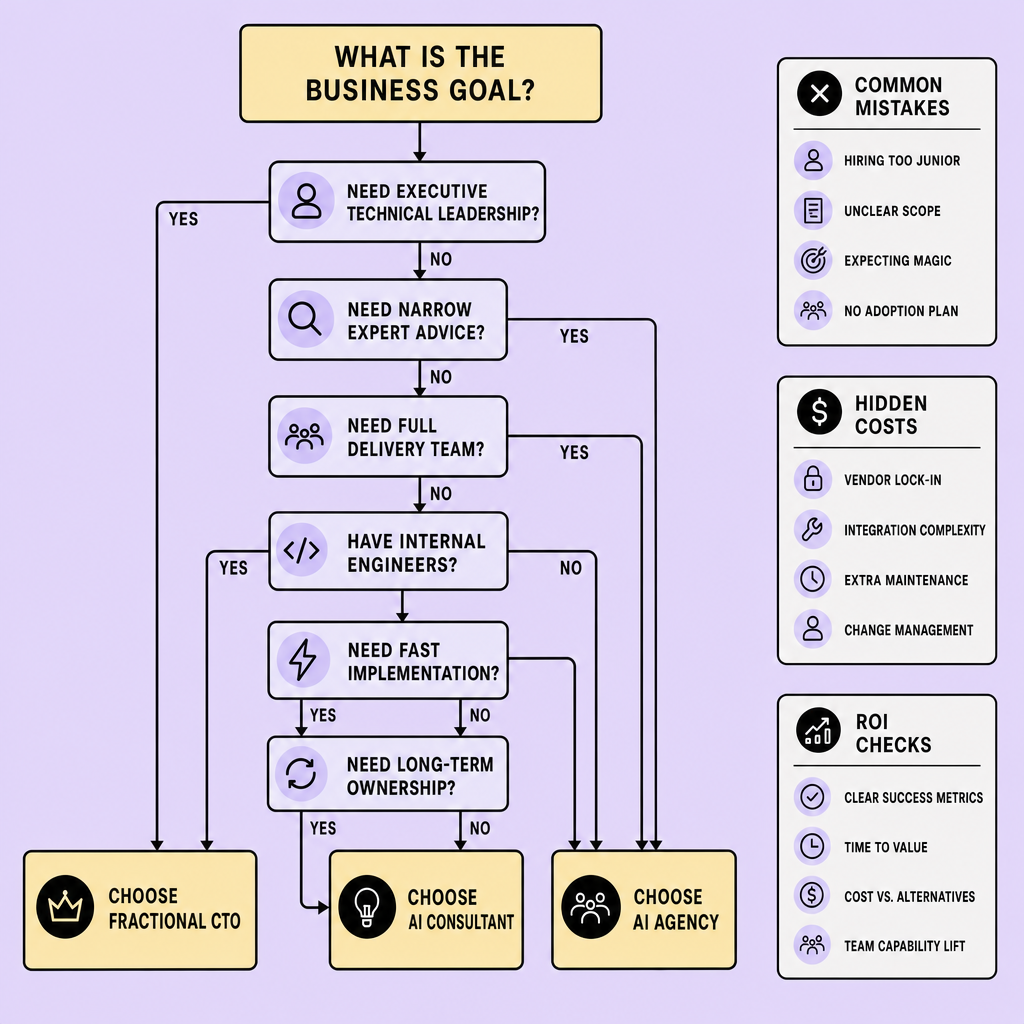
Quick decision checklist
Choose a fractional CTO if strategy, sequencing, and accountability are missing. Choose an AI consultant if the problem is narrow and your team can ship. Choose an AI agency if scope is broad, urgency is high, and you need a full delivery function.
Frequently Asked Questions
How do I decide on fractional CTO vs AI consultant for a startup with no in-house AI lead?
If your startup lacks a technical owner who can set priorities, evaluate vendors, and manage tradeoffs across product and engineering, a fractional CTO is usually the better choice. An AI consultant is better when leadership already exists and the team only needs specialist input on one well-defined AI problem.
What hidden contract terms matter most in a fractional CTO vs AI consultant engagement?
The most important terms are decision authority, deliverables, access rights, confidentiality, IP ownership, and post-engagement support. In a fractional CTO vs AI consultant agreement, unclear terms create cost later because teams lose time renegotiating ownership, rebuilding documentation, or reversing decisions made without clear accountability.
Why can AI consulting costs look low but total spend still end up high?
AI consulting costs often exclude internal implementation effort, stakeholder reviews, data cleanup, security checks, and production hardening. A low advisory fee can produce a high total spend if your team must absorb execution risk afterward. Total cost matters more than the consultant’s hourly rate when measuring business outcome.
When are AI development costs from an agency actually worth paying?
AI development costs from an agency are usually worth it when speed, cross-functional execution, and delivery certainty matter more than minimizing upfront fees. If you need design, engineering, testing, deployment, and launch support together, an agency can reduce delays and coordination overhead enough to improve total ROI.
What should I measure to compare ROI across a fractional CTO, AI consultant, and AI agency?
Measure ROI using time to production, internal hours consumed, defect or rework rates, adoption by end users, and ongoing maintenance burden. This shows which option delivers the lowest cost per outcome, not just the lowest invoice. A cheaper option is only better if it reaches a durable result with less total effort.
Make Imversion a preferred source on Google
Like this kind of AI and software analysis? Add Imversion as a preferred source so Google can highlight our articles for you in Search, AI Overviews, and AI Mode.