MCP Implementation Cost: Essential Insights for 2026
Explore the real costs behind MCP implementation, covering development, hosting, and security. Get valuable insights to optimize your budget.

What MCP Implementation Cost Actually Looks Like
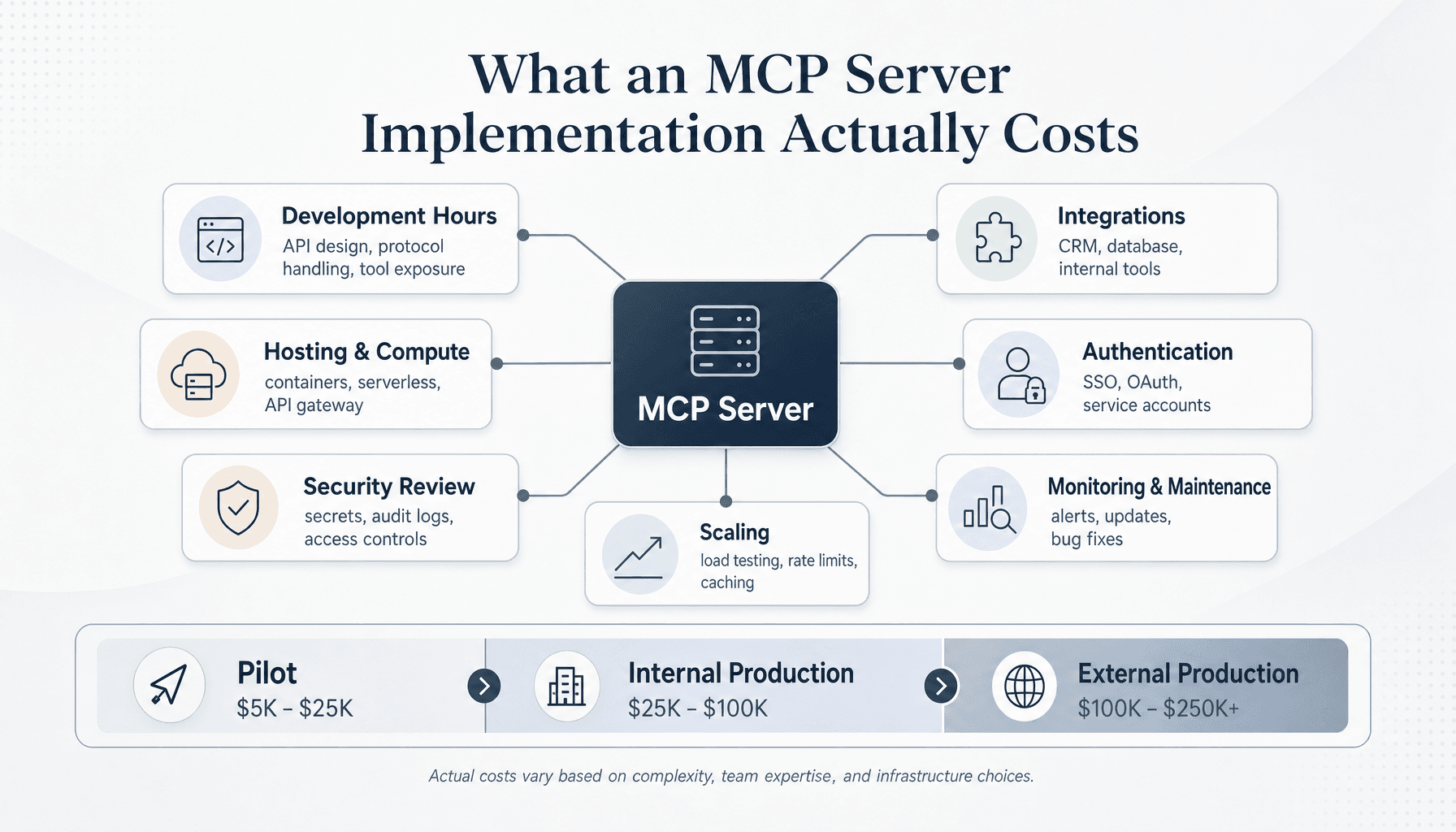
If you budget an MCP server like a simple API project, you will almost certainly underprice it. The short answer: MCP implementation cost usually starts around $10,000–$30,000 for a basic internal MCP server, then climbs fast once you add production requirements. A production-ready or enterprise Model Context Protocol deployment often lands in the $50,000–$100,000+ range.
MCP Implementation Cost: Key Takeaways
- The protocol is rarely the expensive part. Your MCP implementation cost usually rises because the MCP server needs real MCP development work around integrations, testing, and deployment.
- Production requirements drive spend fast -- authentication, logging, observability, CI/CD, and rollback plans change a simple Model Context Protocol build into full AI infrastructure.
- Security should not be optional. Add OAuth, RBAC, secrets management, and audit trails early, or your MCP server cost will spike later during rework.
- Phase the rollout. Start with a narrow pilot, then add scale, hosting, and maintenance once usage patterns are clear.
Why MCP Server Costs Vary So Much Between a Pilot and Production
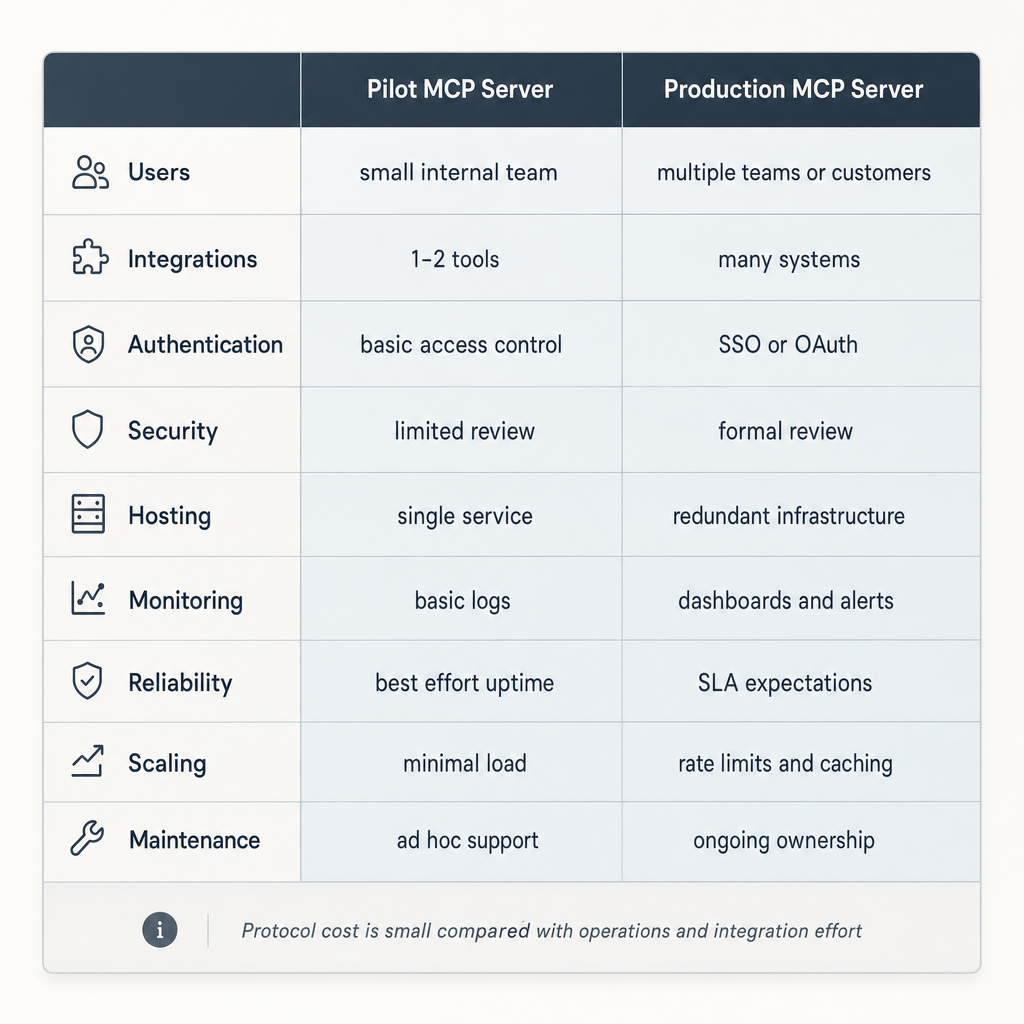
Most teams do not get surprised by the protocol. They get surprised by everything around it. A pilot can prove that an MCP server exposes tools or context for one narrow workflow; production has to survive bad inputs, auth edge cases, deployment mistakes, and real users who do not behave like test data.
A small internal MCP server can look simple: connect one model workflow to one data source, return structured context, and support a limited set of tools. In that shape, the work may fit into a 2–6 week build and land around $10,000–$30,000. That can be enough to validate usefulness, but it does not represent the full cost of operating the system.
Production shifts the question from “can this work?” to “can this keep working?” The work often expands to protocol compliance, schema validation, error handling, authentication, RBAC, retry logic, logging, observability, CI/CD, and rollback planning. The protocol may be lightweight. The surrounding system is not.
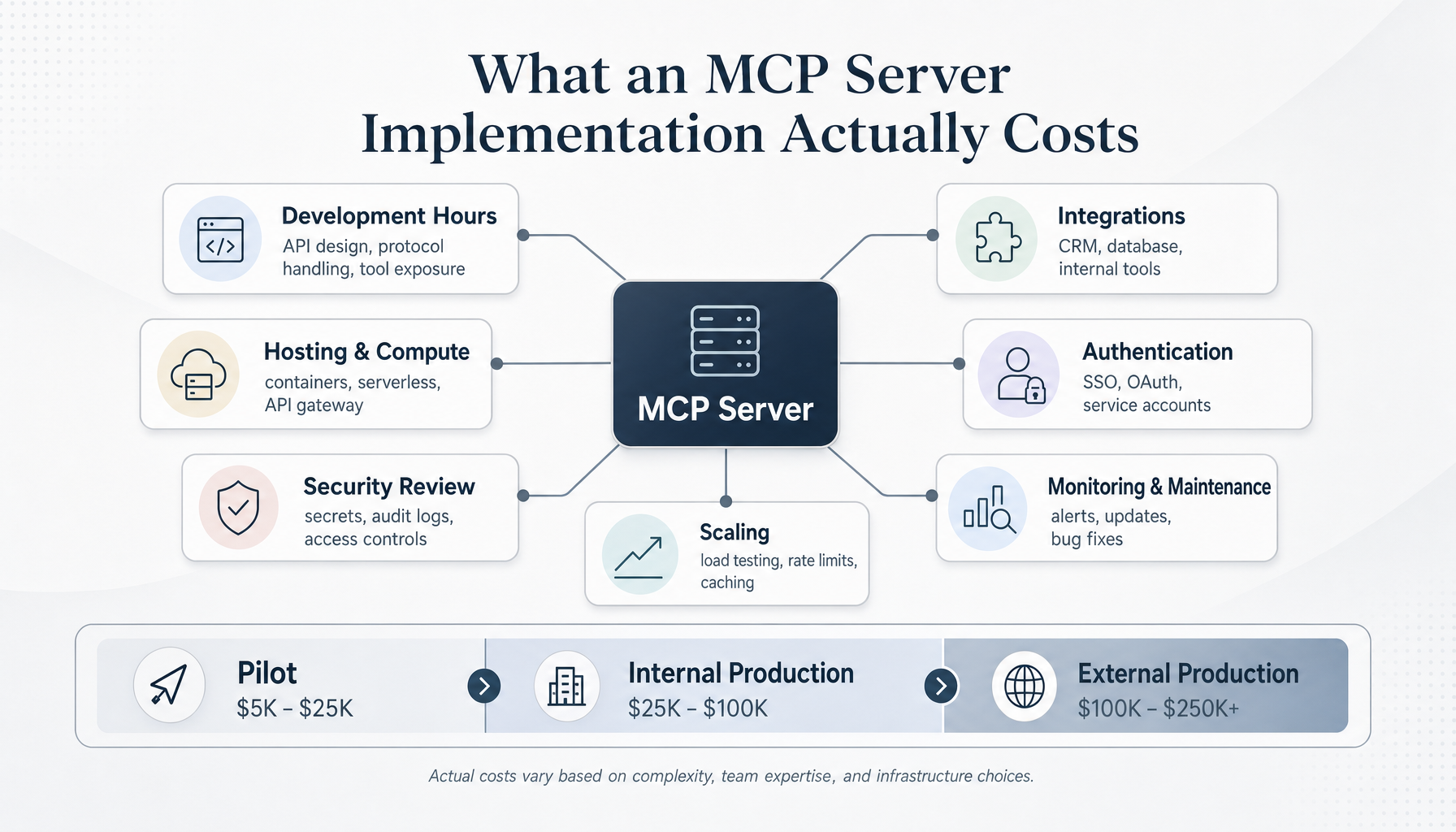
A pilot often runs with one engineer, one environment, limited users, and controlled inputs. A production MCP server usually needs more:
- OAuth or token-based authentication
- access control and RBAC across tools or data domains
- containerized deployment
- CI/CD pipelines for safer releases
- observability for logs, traces, and alerts
- stronger handling for timeouts, bad payloads, and upstream failures
Hosting costs rise with that shift. A pilot might run on a small container or serverless setup. Production environments often add an API gateway, secrets management, load balancing, staging, backup policies, and active monitoring. Those items may be invisible in an early prototype, but they become hard to avoid once the server supports external users, sensitive systems, or multiple teams.
So the jump to $50,000+ should not feel strange. For more complex enterprise implementations, crossing $100,000 is also not unusual. The main driver is maturity stage, not just the number of tools exposed.
FAQs
What does an MCP server actually do?
It exposes tools, data, or actions through the Model Context Protocol so AI systems can request structured context and interact with backend systems predictably.
Why is MCP implementation cost higher than a normal API estimate?
Because production MCP development includes protocol handling, schema validation, authentication, observability, testing, and deployment automation — not just endpoint creation.
How much does a basic MCP server cost?
A lightweight internal build often takes 2–6 weeks and may cost roughly $10,000–$30,000.
How much does a production MCP server cost?
Production-ready implementations often start at $50,000+, and enterprise deployments can go beyond $100,000 as integrations, security, and scaling increase.
How can you reduce MCP server costs without cutting corners?
Start with a narrow pilot, limit integrations, reuse existing identity systems, automate CI/CD early, and harden only the parts needed for real exposure and risk.
MCP Implementation Cost in Development Hours, Team Effort, and Integrations
This is where estimates usually go wrong. If you scope an MCP server by looking only at the protocol layer, the budget will look clean on paper and break in execution.
Most of the work sits around integration, testing, security, and deployment. The largest MCP implementation cost usually comes from engineering labor for API design, tool exposure, data-source integration, authentication, documentation, and environment setup. The protocol itself may be straightforward; production delivery usually is not.
For a narrow pilot, one senior engineer can often build an internal server in 2–6 weeks, often around $10,000–$30,000 when scope stays tight: a few tools, one or two data sources, basic protocol handling, and limited access. Production changes that quickly.
A production MCP server often needs:
- backend engineering for protocol compliance, schema validation, and API design
- DevOps support for containers, CI/CD, deployment automation, and environment setup
- QA for regression coverage and failure-path testing
- security input for OAuth, RBAC, secrets handling, and permission mapping
Integration count is one of the fastest ways cost expands. One clean tool integration is manageable. Several integrations across internal APIs, databases, file systems, and third-party services create more risk: schema mismatches, auth edge cases, rate limits, retries, and inconsistent error behavior.
A common budgeting mistake is counting coding hours but not integration debugging, test hardening, and deployment reliability work.
That is usually where estimates drift. In practice, the biggest cost drivers are:
- protocol compliance and API design
- tool and data-source integration
- observability, logging, and error handling
- access control and permission mapping
- testing, documentation, and CI/CD
For many production builds, costs move past $50,000, and more complex implementations can exceed $100,000 once security, scaling, and maintenance readiness are included.
What roles increase cost the most?
Backend and integration engineering usually drive the most hours first. DevOps and security add more effort once you need stable hosting, authentication, and controlled access.
How does integration count affect MCP implementation cost?
Each new integration adds more than connector code. It also adds auth flows, field mapping, retries, testing, monitoring, and maintenance burden.
How long does MCP development usually take?
A focused pilot can take 2–6 weeks with one senior engineer. A production-ready build usually takes longer because testing, security, deployment, and observability expand the scope beyond core protocol work.
Hosting, AI Infrastructure, Authentication, and Security Costs for an MCP Server
A lot of teams assume hosting will stay cheap because the pilot was cheap. That is true only for the earliest stage. A lightweight MCP server may run for $50-$300 per month, but production costs rise once you add secure access, monitoring, backups, and higher uptime expectations.
Core infrastructure usually includes compute, storage, bandwidth, and a container or serverless runtime. Once you move into production, more line items show up: API gateway, load balancer, caching, background jobs, backups, and separate dev, staging, and production environments. These are not technical vanity items. They reduce release risk and make debugging manageable.
Security shifts the cost profile even faster. A basic token check is inexpensive, but OAuth, RBAC, tenant isolation, service-to-service auth, session handling, and key rotation add engineering work and operational overhead. Secrets management belongs in the initial budget, not as a patch after launch.
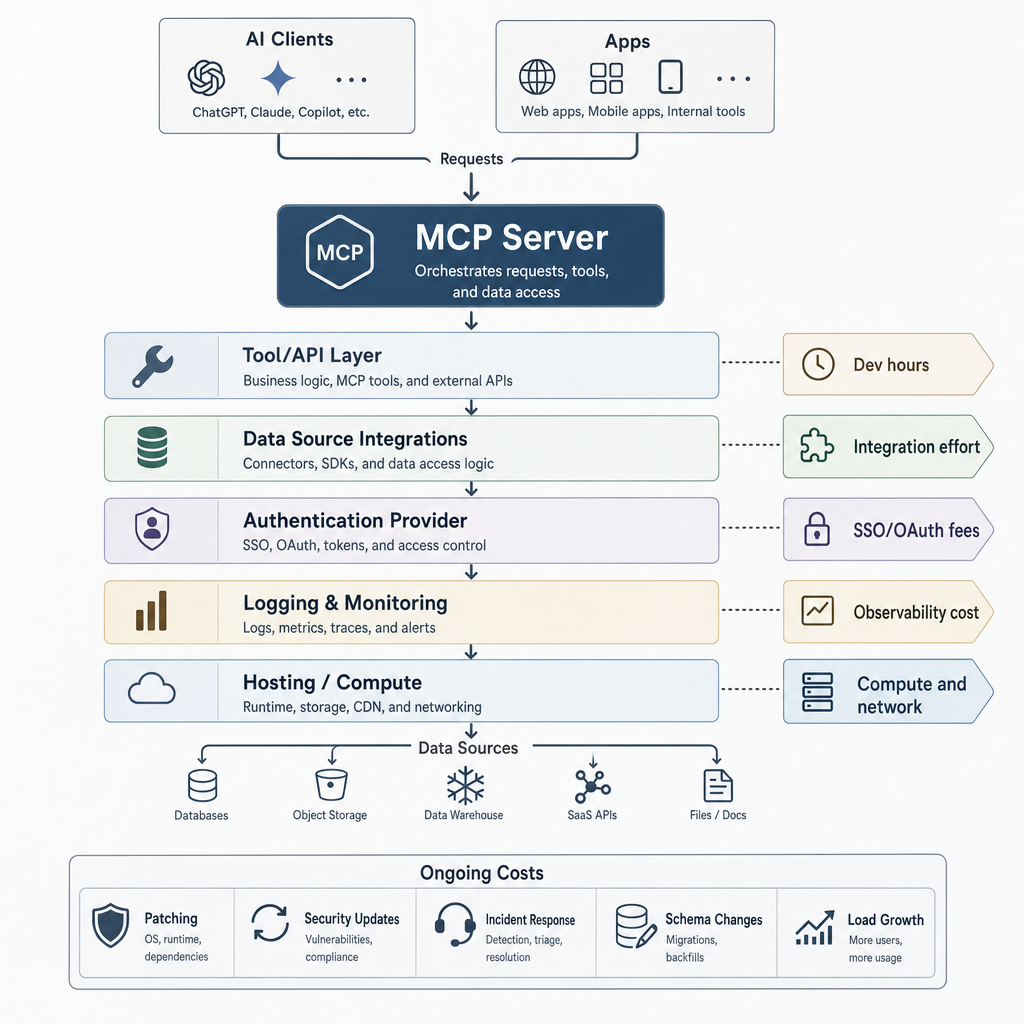
Treat authentication, secrets, monitoring, and backups as core budget items. Adding them after launch is usually more disruptive and more expensive.
Then there is operational visibility. Logging, monitoring, and observability support incident response, performance tracking, and troubleshooting. Alerting, dashboards, and tracing may not feel urgent during a pilot, but they become important very quickly once real users depend on the service.
If you also need compliance-oriented controls, expect more spend for audit logs, access reviews, retention policies, encryption requirements, and documentation.
Low-cost hosting can be enough to validate an idea. If you need reliable uptime, secure integrations, and predictable scaling, budget for the full operating platform rather than only the MCP server code.
Common infrastructure cost line items to include
- Containers or serverless runtime
- API gateway and load balancer
- Logging, monitoring, and observability tools
- Secrets management and key rotation
- OAuth, RBAC, and authorization logic
- Backups, failover, and recovery planning
- Compliance controls and audit logging
5 SEO-focused FAQs
How much does MCP server hosting cost per month?
A lightweight MCP server may cost about $50-$300 per month, but production traffic and security controls push that higher.
Why does MCP implementation cost rise after launch?
Because recurring costs expand beyond hosting to include monitoring, authentication, backups, scaling, and operations.
What AI infrastructure should be included in an MCP server budget?
Include compute, storage, runtime, API gateway, load balancer, logging, monitoring, secrets management, and backups.
Does an MCP server need OAuth and RBAC?
If multiple users, tools, or teams access it, usually yes. They help control access and reduce security risk.
What is the biggest cost mistake in MCP development?
Budgeting only for code and basic hosting, while missing security, observability, and production operations.
MCP Implementation Cost Breakdown Examples, Common Mistakes, and Cost Optimization
If the budget still looks too low, the missing pieces are probably outside the protocol itself. Most MCP implementation cost sits in the surrounding system: authentication, integrations, observability, deployment, and maintenance. An MCP server may be inexpensive to prototype, but production is where costs rise.
Example cost ranges by implementation stage
| Scenario | Development | Hosting / AI infrastructure | Security / authentication | Integrations | Maintenance |
|---|---|---|---|---|---|
| Small internal pilot | $10,000–$30,000 | $50–$300/month | Minimal SSO or basic OAuth setup | 1–3 internal tools or data sources | Light support, bug fixes |
| Mid-stage production deployment | $50,000+ | Higher due to containers, gateway, logging, backups | OAuth, RBAC, audit logging, secret management | Multiple business systems, API hardening | Ongoing monitoring, patching, incident response |
| Mature enterprise implementation | $100,000+ | Multi-environment, scaling, load balancing, stronger uptime controls | Fine-grained permissions, compliance controls, reviews | Broad internal and external integrations | Dedicated maintenance, security updates, performance tuning |
A small pilot may take one experienced engineer for a few weeks if scope is narrow. Production changes the work quickly: CI/CD, environment promotion, logging, retries, schema validation, safe failure handling, and support for evolving upstream systems.
Common mistakes that distort MCP server cost
1. Budgeting it like a thin API wrapper.
Protocol handling may be manageable, but permissions, tool contracts, timeout behavior, and data reliability add real effort.
2. Ignoring maintenance.
MCP servers need dependency updates, bug fixes, integration adjustments, and operational review after launch.
3. Underestimating authorization design.
Authentication is only part of the problem. Teams still need clear rules for who can use which tools and data in which context.
4. Overbuilding for scale too early.
Load balancers, multi-region plans, or oversized clusters can add cost before usage justifies them.
How to optimize costs without creating future rework
The safest way to control cost is to narrow scope early. Start with a phased rollout: one workflow, a narrow tool set, and a small user group. That limits integration risk and makes effort easier to estimate.
Reuse existing security systems where possible, including SSO, OAuth, RBAC, and secret storage. Building custom identity and access patterns too early adds cost and review overhead.
Set up basic observability from the start: structured logs, health checks, alerts, and a simple dashboard. That is usually cheaper than debugging production issues without visibility.
Then size infrastructure to actual demand. Small containers or serverless setups can work well early on; scale only after traffic, latency, and reliability needs are clear.
FAQs
What is a typical MCP implementation cost?
A small internal build often falls around $10,000-$30,000, while a production MCP server commonly starts at $50,000+.
Why does MCP server cost increase so much after a prototype?
Because production needs authentication, integrations, monitoring, deployment automation, and maintenance, not just protocol support.
What affects MCP development cost the most?
Integration complexity, permission design, testing, observability, and security controls usually drive more cost than the protocol itself.
How can teams reduce AI infrastructure spend for an MCP server?
Use phased rollout, narrow tool scope, existing auth systems, standard logging, and infrastructure sized to real traffic.
Is maintenance part of MCP server budgeting?
Yes. Ongoing maintenance, patching, incident response, and integration updates should be part of the original cost breakdown.
Frequently Asked Questions
What is included in MCP implementation cost beyond initial development?
MCP implementation cost usually includes post-build work such as infrastructure monitoring, credential rotation, regression testing, incident response, and integration upkeep. These recurring tasks often matter more than the first launch because they determine whether the MCP server stays reliable as tools, users, and upstream systems change.
How does MCP implementation cost change when a server moves from internal use to customer-facing use?
A customer-facing MCP server costs more because it needs stronger uptime targets, safer release processes, abuse protection, tenant-aware access controls, and clearer operational ownership. External usage raises the standard for security, observability, support, and reliability, which expands both engineering effort and monthly AI infrastructure spend.
Why should teams estimate MCP server costs by integration risk instead of feature count?
Integration risk is a better budgeting lens because each connected system brings its own authentication rules, schema quirks, failure modes, and maintenance burden. Two features can look similar in scope, yet one may cost far more if it depends on brittle APIs, strict permissions, or unstable upstream data.
What is the best way to lower MCP implementation cost without reducing quality?
The best cost-control approach is to reduce uncertainty early. Teams can do that by limiting the first MCP server to one workflow, reusing existing identity and hosting systems, defining strict tool contracts, and measuring real usage before investing in heavier scaling or custom platform work.
How much team effort does a production MCP server usually require after launch?
A production MCP server rarely stays hands-off after launch. Even if one engineer built the first version, ongoing operation often requires shared effort across backend, DevOps, and security roles to handle updates, monitor health, review access changes, and maintain stable integrations as the environment evolves.
Make Imversion a preferred source on Google
Like this kind of AI and software analysis? Add Imversion as a preferred source so Google can highlight our articles for you in Search, AI Overviews, and AI Mode.