Small Language Models: Choosing Hybrid AI for Optimal Efficiency
Compare small language models and frontier models across various AI tasks to find the best fit for efficiency and performance.

On this page
Small language models vs frontier models: which one should you choose?
If you send every AI task to the biggest model available, you usually pay for it twice: once in cost, and again in latency, operational complexity, or privacy risk. Small language models usually fit narrow, high-volume, privacy-sensitive tasks, while frontier models fit ambiguous, reasoning-heavy work. In practice, a hybrid AI architecture often gives you the best tradeoff across cost, latency, and quality.
If your job is invoice classification, support-ticket routing, or contract field extraction, small language models and domain-specific AI models are usually the right AI model selection. They are easier to host on CPU or a small GPU, simpler to control, and better for tighter LLM deployment constraints -- especially on-prem, where security should not be optional. But for open-ended summarization, RAG over messy sources, or agent workflows that must plan across tools, frontier models usually justify their overhead. At Imversion Technologies Pvt Ltd, I’d treat single-model strategies as the exception, not the default.
Key Takeaways
- Choose by task, not model hype. For invoice classification, support-ticket routing, and contract entity extraction, small language models or domain-specific AI models usually win on speed, simpler LLM deployment, and lower hosting cost.
- Use frontier models where ambiguity is expensive. They are better suited to nuanced summarization, complex RAG answers, and agent workflows that require multi-step reasoning, broader world knowledge, or better tool-use decisions.
- Privacy changes the architecture fast. If data cannot leave your environment, local or on-prem deployment of small language models is often the safer path -- and security should not be optional.
- Most teams should not force a single-model stack. A hybrid AI architecture can route simple requests to smaller models and escalate harder cases to frontier models, balancing latency, cost, and quality.
- Fine-tuning is not always the first move. Start with prompt design, retrieval quality, and evaluation per task, then fine-tune only where the error pattern is stable enough to justify the operational burden.
What separates small language models, frontier models, and domain-specific AI models
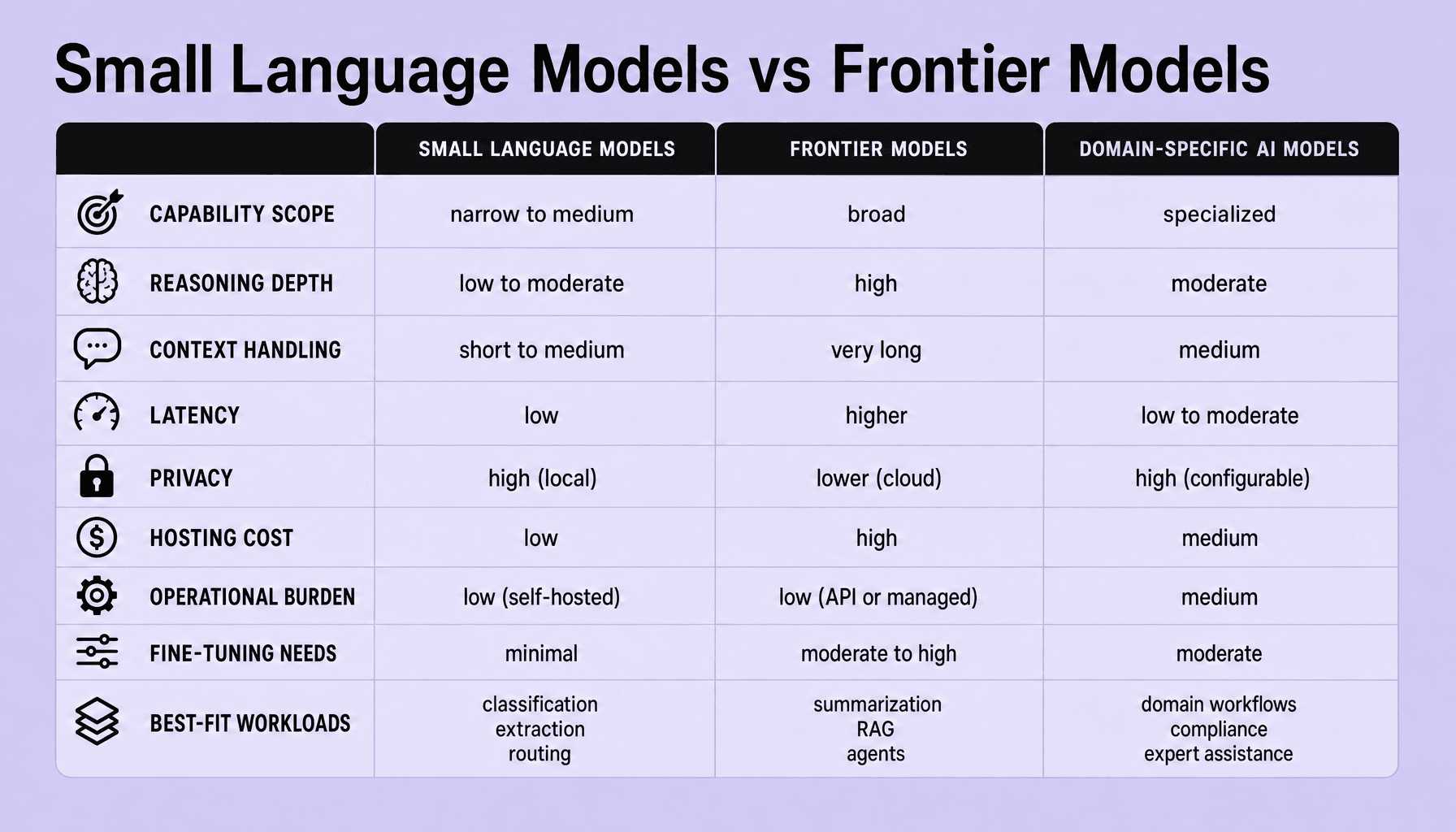
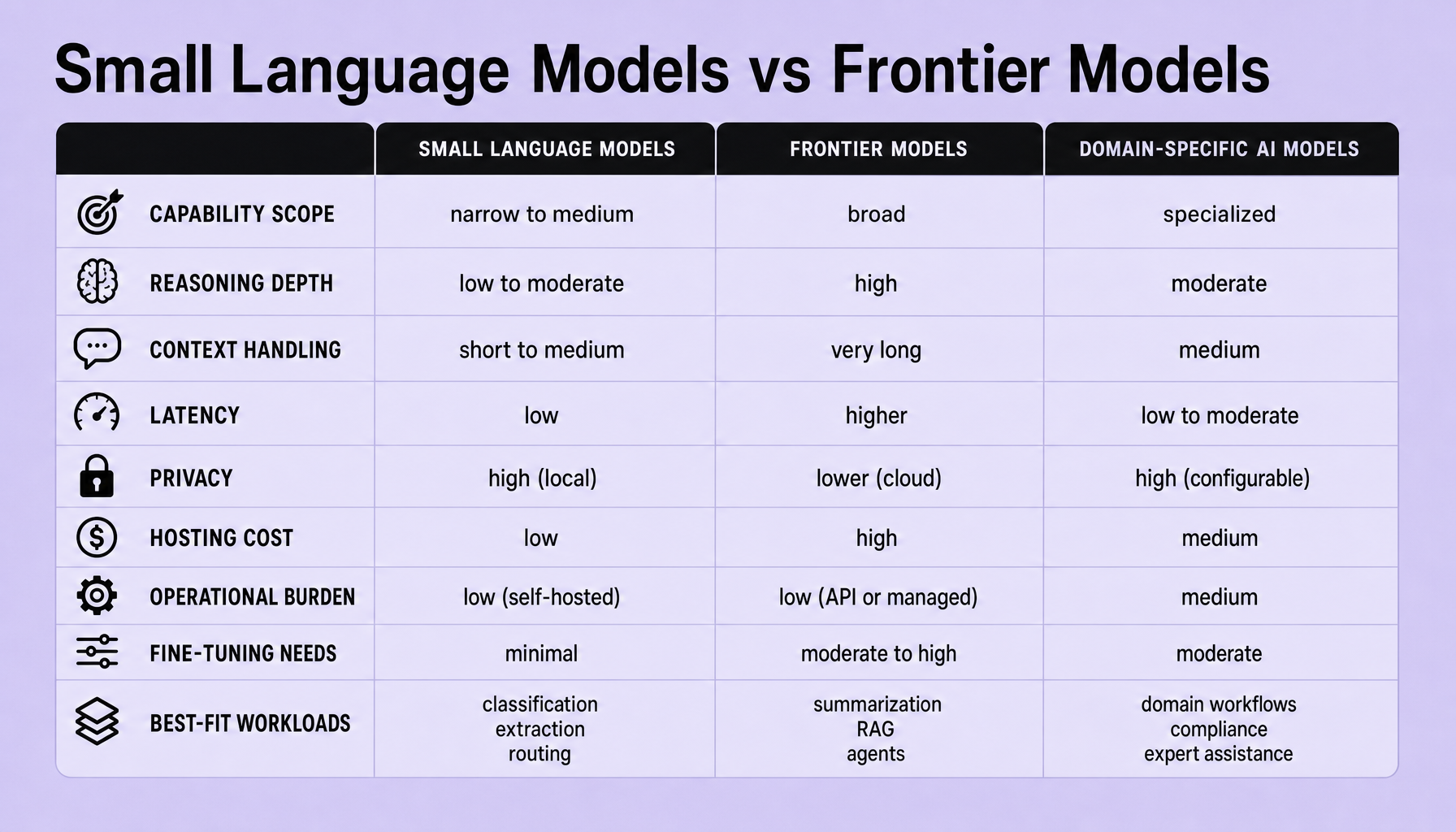
Teams get tripped up here because the labels sound clearer than they are. Parameter count alone does not tell you what will survive production. What matters is breadth, reasoning depth, context handling, and how hard the model is to run safely and cheaply.
Small language models fit narrow or moderately complex tasks where speed, cost, and control matter more than broad reasoning. Think invoice classification, support-ticket routing, lightweight summarization, or contract field extraction. With quantization, they are often practical for on-prem deployment or CPU-friendly serving, which makes privacy and latency easier to manage.
Frontier models sit at the other end of the trade-off. They are broad, general-purpose systems that handle ambiguity, multi-step reasoning, longer context windows, and messier instructions better than compact models. That is why they tend to perform better in RAG pipelines with mixed-quality retrieval, cross-document summarization, and agent workflows that must plan, call tools, and recover from partial failure. But you pay for that flexibility: higher API spend or GPU cost, stricter evaluation needs, and more operational complexity.
Domain-specific AI models sit between those extremes, or beside them. They are tuned for a constrained problem space such as legal extraction, medical coding, internal taxonomy mapping, or claims triage. In practice, they often beat general models on consistency for that domain, but only if task boundaries are stable and training data is clean. This category becomes especially attractive when regulated data cannot leave your environment.
| Model category | Best fit | Main strength | Main trade-off | Typical deployment |
|---|---|---|---|---|
| Small language models | Classification, extraction, routing | Low latency, lower hosting cost | Weaker on ambiguity and long reasoning chains | On-prem deployment, edge, small GPU or CPU |
| Frontier models | Summarization, RAG, agents | Strong reasoning and broad knowledge | Higher cost, privacy exposure, more ops burden | API-hosted models or large GPU clusters |
| Domain-specific AI models | Repetitive domain workflows | High consistency in a narrow scope | Requires fine-tuning, curation, ongoing evaluation | Private serving, hybrid stack |
That leads to a practical rule: use the smallest model that can reliably handle the task, then escalate only where ambiguity, long context, or tool use justifies it. Once you make that call honestly, the rest of your LLM deployment choices become easier. For most teams, it points to a hybrid AI architecture rather than one model everywhere.
Small language models vs frontier models by task: classification, extraction, routing, summarization, RAG, and agents
A flashy demo is not a deployment strategy. A model that looks impressive in a benchmark or chatbot interaction can still be the wrong production choice for ticket triage if it adds latency, privacy exposure, and hosting cost without measurable quality gains.
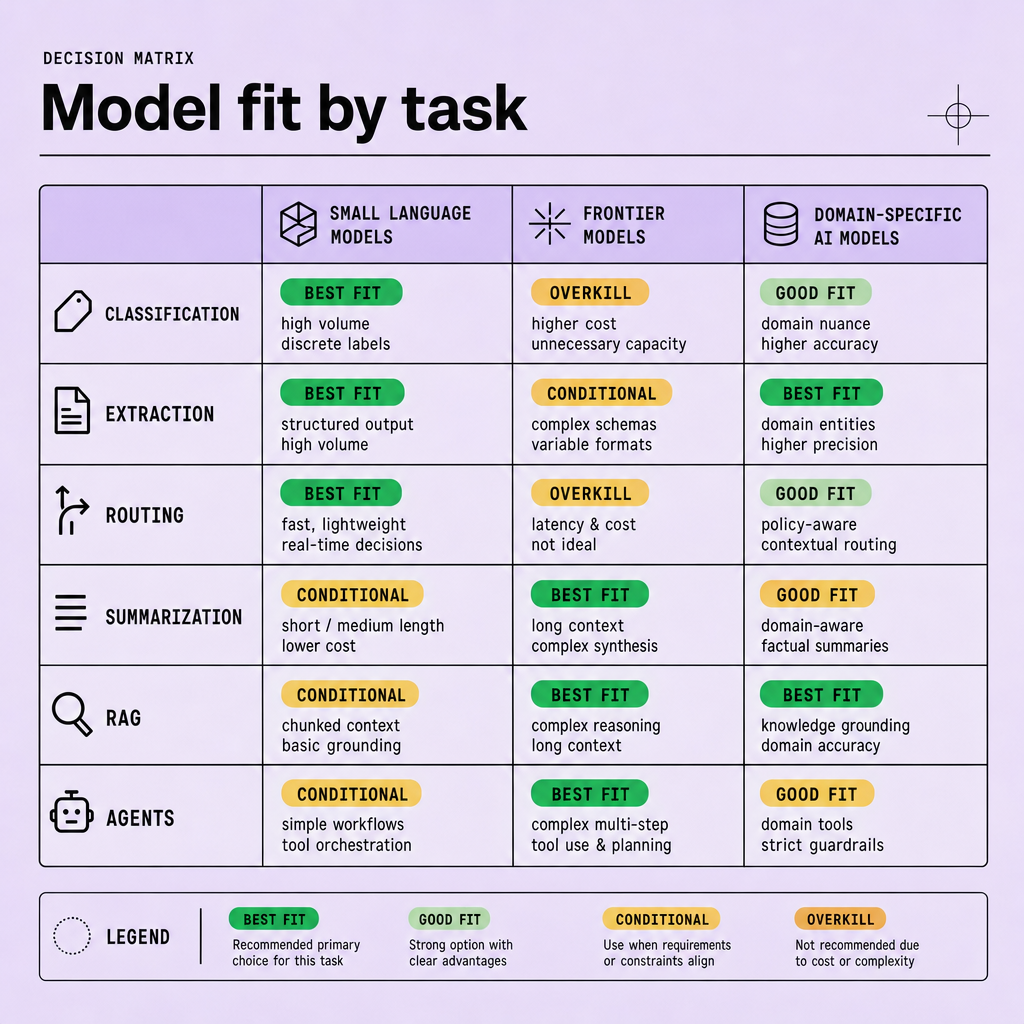
For bounded tasks, small language models and domain-specific AI models usually win. Classification, information extraction, and routing work best when labels, schemas, and escalation rules are stable. Think invoice classification, support-ticket routing, or contract field extraction. In those cases, you care more about predictable outputs, fast inference, local hosting, and light fine-tuning than broad reasoning.
Once the task gets messy, the trade-off changes. For open-ended tasks, frontier models usually justify the spend. Summarization, RAG answer generation, and AI agents deal with ambiguity, missing context, multi-step reasoning, and harder failure modes. They also cost more to run, respond more slowly, and create more operational overhead -- especially if you need guardrails, evaluation loops, and fallback logic.
| Task | Best fit | Why | Main risk | Human handoff |
|---|---|---|---|---|
| Classification / routing | Small language models | Low latency, low hosting cost, easy fine-tuning | Label drift, edge cases | Low for low-risk queues |
| Information extraction | Domain-specific AI models or small models | Structured outputs, privacy-friendly on-prem deployment | Schema mismatch, OCR noise | Medium for legal/financial fields |
| Summarization / RAG / agents | Frontier models | Better synthesis, ambiguity handling, multi-step reasoning | Hallucination, cost, slower response | High for sensitive or high-impact actions |
How to make the call
Start with task shape. If the task has a fixed schema, clear labels, and a narrow vocabulary, start small. Quantized local models are often enough, and consistency across environments becomes critical once you move from test prompts to production inference.
If the task requires judgment across long documents, weak retrieval, or tool use, use frontier models. Summarization quality usually improves with stronger language control. RAG pipelines benefit because the generator must reconcile retrieved chunks, reject bad evidence, and answer cleanly. Agents need even more -- planning, retry logic, and safe tool calling.
The practical recommendation
This is where teams overcomplicate things. Most should not make AI model selection as a one-model decision.
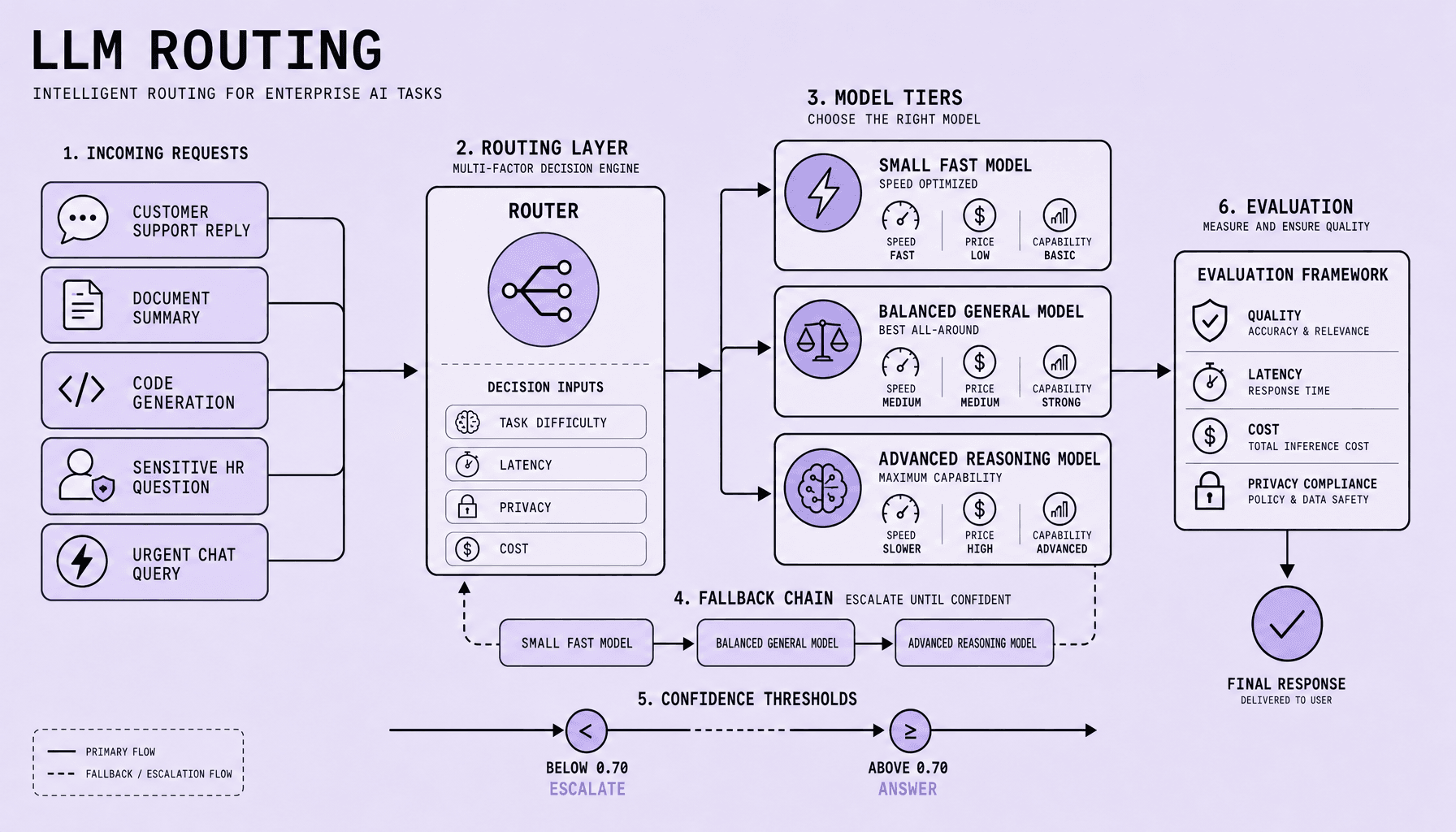
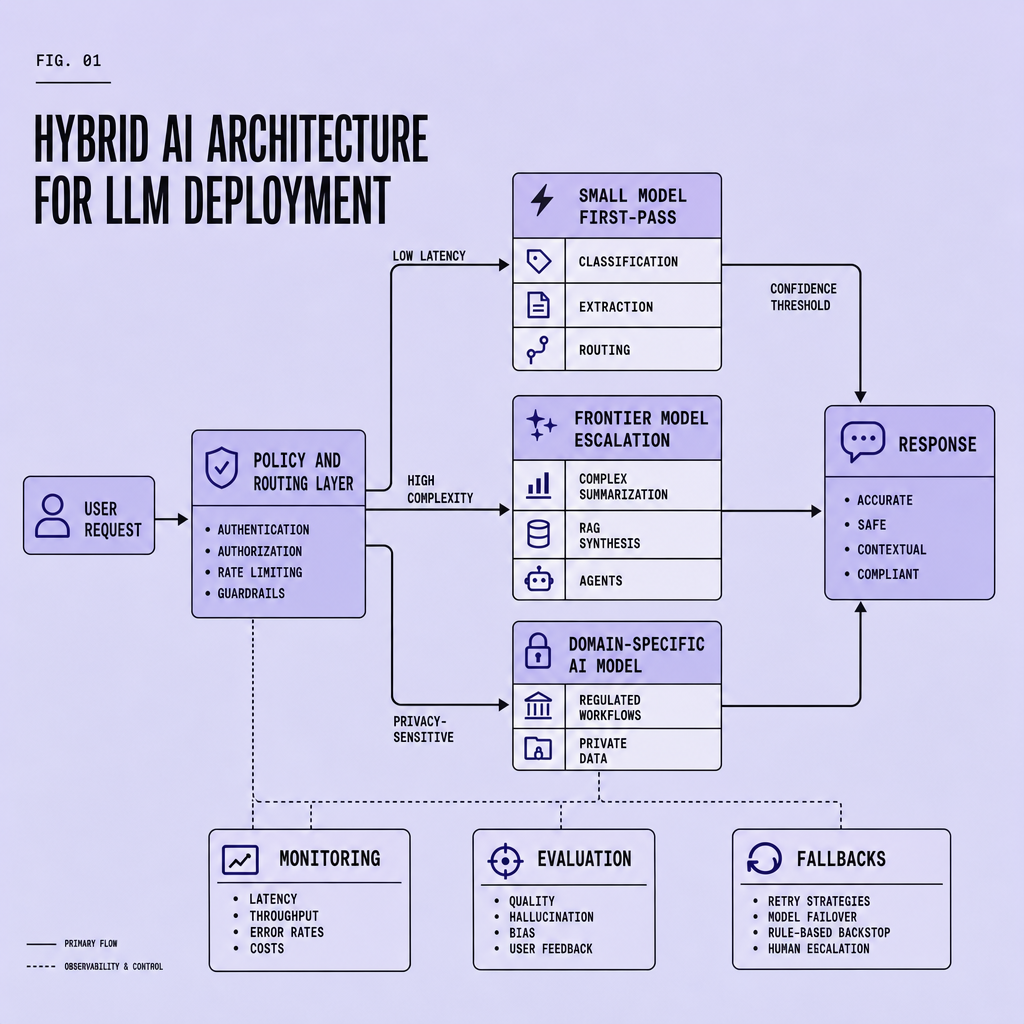
Use a hybrid AI architecture: small language models for classification, extraction, and routing; frontier models for escalation, final synthesis, and agentic workflows. That pattern reduces average cost and latency while preserving frontier capability only where it pays back.
Hybrid AI architecture patterns for real-world LLM deployment with small language models
Once request difficulty starts to vary, a single-model stack becomes expensive or brittle. Most production teams should not send every prompt to the biggest model. A practical hybrid AI architecture uses small language models for the cheap, repeatable work and reserves frontier models for ambiguity, long-form synthesis, or multi-step reasoning.
Small-model gate, frontier escalation
This is the most common pattern in LLM deployment. A local or low-cost model handles first-pass classification, extraction, or routing. If confidence is low, required fields are missing, or the policy score crosses a threshold, the request moves through an API escalation path to a frontier model. You cut cost and latency because only the hard cases pay the premium.
Local preprocessing, remote synthesis
Privacy-sensitive workflows need a stricter path. Keep contract entity extraction, PII redaction, or ticket labeling on-prem inference. Then send only sanitized structure -- not raw records -- to frontier models for summarization or response drafting. Security should not be optional. This pattern gives you stronger privacy control without giving up language quality.
RAG with selective reasoning
Not every retrieval result deserves a frontier-model pass. Use a small model or rules-based routing layer for retrieval, chunk filtering, and citation assembly. Call frontier models only when retrieved evidence is conflicting, sparse, or requires synthesis across documents. Be explicit about the routing, because hidden escalation makes observability, debugging, and cost control much harder.
Agent guardrails
Agent workflows can go wrong in expensive ways, fast. They work best with narrow guardrails: tool allowlists, budget caps, retry limits, and human approval for irreversible actions. Hybrid systems are strongest when routing rules stay visible and measurable.
AI model selection checklist: latency, privacy, cost, quality, and maintenance for small language models
Teams often start with model rankings and work backward. That is how stacks get overbuilt. Good AI model selection means choosing the simplest setup that reliably clears your quality bar, then escalating only when better reasoning materially changes outcomes.
Use this checklist before you commit:
- Latency and throughput: If you need high request volume, tight SLA targets, fast user response times, or CPU/on-prem deployment, start with small language models or domain-specific AI models.
- Privacy and data handling: If prompts may contain PII, customer records, or regulated data, prefer local hosting, strict access controls, redaction, or a hybrid path that filters requests before sending anything to a frontier model.
- Quality threshold: If the task is ambiguous, multi-step, or sensitive to nuanced reasoning—such as complex summarization, difficult RAG queries, or agent workflows—test frontier models first and compare them against smaller options.
- Cost profile: Judge cost at the workflow level, not per-token alone. Include retries, fallbacks, orchestration, human review, and hosting overhead.
- Maintenance burden: If your team lacks evaluation pipelines, prompt versioning, monitoring, and fine-tuning support, avoid overly customized stacks that will be hard to operate.
- Task structure: If requests are repetitive and well-bounded—invoice classification, ticket routing, entity extraction, policy checks—small models usually win on cost, speed, and maintenance.
A practical rule is simple: default to small models, escalate to frontier models for measurable reasoning gains, and use a hybrid architecture when request difficulty varies. The right choice is the one that meets your accuracy, privacy, and operational targets with the least complexity.
Choosing the right AI model without overbuilding your stack
Choose by workload, not hype. If the job is narrow, repeatable, and sensitive -- like invoice classification or contract entity extraction -- small language models or domain-specific AI models usually win. Use frontier models where reasoning, ambiguity, or agent orchestration changes outcomes. For most teams, a hybrid AI architecture is the safest production path: keep routine traffic cheap and fast, then escalate only the hard cases.
Frequently Asked Questions
What are small language models best used for in production?
Small language models are best for narrow, repeatable tasks with clear inputs and outputs, such as classification, extraction, tagging, routing, and policy checks. They are especially effective when low latency, predictable cost, local hosting, or stricter privacy controls matter more than broad reasoning ability.
How do I know when frontier models are worth the extra cost?
Frontier models are worth the extra cost when stronger reasoning materially improves business outcomes. That usually means tasks with ambiguity, long context, inconsistent source material, multi-step tool use, or high-quality synthesis requirements where a weaker model would increase retries, human review, or failure risk.
Should small language models be fine-tuned or just prompted?
Small language models should usually be prompted and evaluated first, then fine-tuned only after you see stable, repeated error patterns. Fine-tuning makes sense when task formats are consistent, labeled data is available, and the expected gain outweighs added training, versioning, and maintenance overhead.
What is a good hybrid AI architecture for enterprise teams?
A good hybrid AI architecture sends simple, high-volume requests to smaller or domain-specific models first, applies policy and confidence checks, and escalates only difficult cases to frontier models. This design improves cost control, observability, and privacy while preserving access to stronger reasoning when it is actually needed.
Why should domain-specific AI models be considered instead of general models?
Domain-specific AI models should be considered when vocabulary, schemas, and decision rules are specialized enough that consistency matters more than general knowledge. In regulated or repetitive workflows, they can reduce output drift, simplify validation, and make it easier to enforce business rules than a broad general-purpose model.
Make Imversion a preferred source on Google
Like this kind of AI and software analysis? Add Imversion as a preferred source so Google can highlight our articles for you in Search, AI Overviews, and AI Mode.