I
Imversion TeamPublished on March 23, 2026
20 min read
Transforming Supply Chain Logistics with AI: Future Trends & Use Cases
Explore how AI is revolutionizing supply chain logistics by enhancing automation, forecasting, and efficiency.
Explore how AI is revolutionizing supply chain logistics by enhancing automation, forecasting, and efficiency.
Hero image representing AI in supply chain logistics
As we progress further into the 21st century, AI supply chain logistics is emerging as a transformative force poised to revolutionize business operations. Driven by artificial intelligence (AI), modern supply chains are evolving beyond mere cogs in a machine; they are becoming intelligent systems capable of autonomous decision-making, precise demand forecasting, route optimization, and risk management.
The profound synergy between AI and logistics extends far beyond possibility, ushering in realities characterized by increased efficiency, profitability, and resilience. To understand this monumental shift, envision traditional supply chain logistics as a game of chess, where each move is calculated with precision but is still vulnerable to human error. Now, consider an AI-powered logistics system. The outcome is a mistake-free, productivity-optimized environment that delivers optimal inventory levels, streamlined warehouse operations, and cost-effective procedures.
However, much like an iceberg, the visible surface only hints at the expansive capabilities of AI in logistics and supply chain management. From warehouse automation to algorithm-based analytics supplanting traditional approaches, the potential benefits of AI are extensive.
This blog will thoroughly explore the intricacies of AI in logistics. Our exploration will encompass:
Additionally, we will address the challenges businesses face in transitioning to AI-powered logistics and provide insights into the ROI implications of this transformation.
Let us fasten our seatbelts and prepare for an enlightening journey into the realm of AI in supply chain logistics—where efficiency converges with value, theory meets application, and the future intertwines with the present.
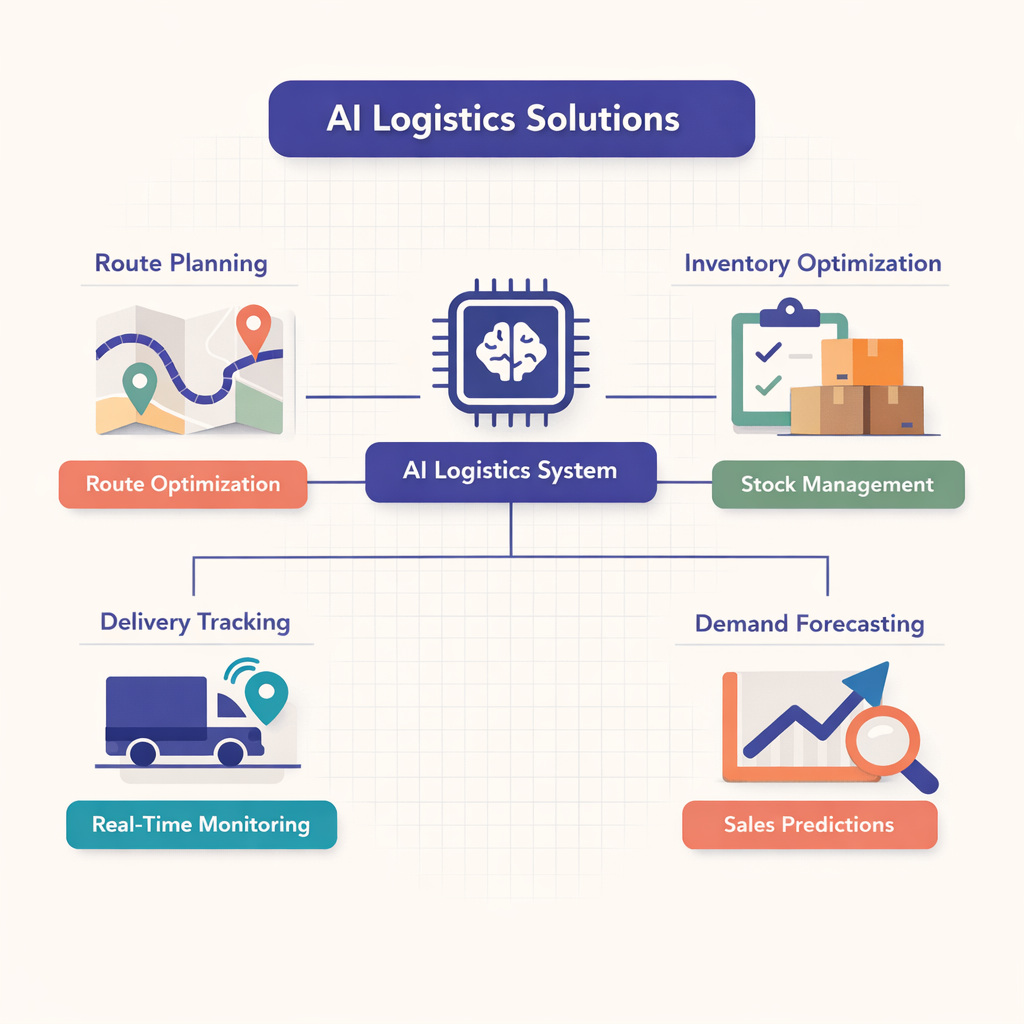 Diagram illustrating different AI logistics use cases
In light of the technological revolution in the logistics industry driven by artificial intelligence (AI), let's delve deeper into specific real-world applications and the benefits they bring.
Let’s explore five significant use cases of AI in logistics:
Demand Forecasting AI: One of the most successful applications of AI in logistics is demand forecasting. By utilizing machine learning algorithms to process historical sales data and current market trends, AI can accurately predict future demand. Incorporating predictive analysis into procurement helps businesses prevent overstocking or understocking, optimize inventory levels, manage supply chain risks effectively, and enhance customer satisfaction.
Inventory Optimization AI: AI plays a dual role in inventory optimization. Firstly, it maintains a balance between available inventory and predicted demand, minimizing storage costs while maximizing turnover. Secondly, AI-driven analytics deliver actionable insights that empower businesses to refine their procurement processes and enhance decision-making capabilities.
Route Planning AI: AI solutions significantly transform route planning within supply chain logistics. Beyond mapping the shortest routes, AI analytics take into account real-time factors, including current traffic conditions and vehicle capabilities, to deliver optimized routes. This intelligent planning saves fuel, reduces carbon emissions, and improves delivery efficiency.
Warehouse Automation AI: Warehouse operations benefit immensely from AI-powered automation. AI-driven robots reduce human error in picking, packing, and shipping processes, thus increasing efficiency, accuracy, and productivity. As a result, businesses can fulfill more orders in less time, thereby enhancing throughput.
Risk Management AI: In an unpredictable world, AI algorithms enable businesses to prepare for unforeseen obstacles, from supply chain disruptions to delivery delays. By analyzing vast amounts of data, AI can predict potential risks, allowing businesses to strategize proactively and mitigate adverse impacts.
Implementing AI in supply chain and logistics offers numerous benefits. It not only improves efficiency and productivity but also delivers a substantial return on investment (ROI) by reducing operational costs, enhancing customer satisfaction, and facilitating intelligent, data-driven decision-making.
While AI presents considerable opportunities, challenges such as the need for skilled personnel, the requirement for high-quality data, and privacy concerns can hinder its adoption. However, by constructively addressing these challenges, we can anticipate that AI will profoundly influence supply chain logistics by 2026, fostering more advanced applications and initiating the next wave of innovation in the industry.
In summary, the integration of AI in logistics redefines traditional operations, introducing transformative possibilities such as precise demand forecasting, optimized inventory and route planning, and sophisticated risk management. As we progress into the future, the industry's ability to adapt to these changes will likely determine its competitive edge and sustainability.
What are the key uses of AI in logistics?
What are the benefits of applying AI to logistics operations?
What are the challenges in implementing AI in logistics?
In the era of rapidly advancing technologies, Artificial Intelligence (AI) has undeniably established its presence in the logistics industry, facilitating a broad range of activities from demand forecasting to warehouse automation. A particularly significant application area for AI in logistics is route planning.
Route planning can be complex, involving multiple variables such as traffic, road conditions, and delivery deadlines. By deploying AI-based algorithms, supply chain firms can efficiently plan delivery routes in real-time, factoring in these variables. This results in optimal routes, shorter delivery times, and reduced fuel costs. Essentially, AI’s capacity to predict and adapt to various potential disruptions in route planning offers a robust solution to historical logistic challenges.
Major companies are already reaping the benefits of AI in this area. For instance, Amazon's routing algorithm enables its delivery vehicles to identify the most efficient routes to multiple destinations, thereby increasing productivity and reducing operational costs.
The incorporation of warehouse automation AI also significantly contributes to effective route planning. By synchronizing warehouse activities—from stock retrieval to packaging—it ensures smoother and faster dispatches, essentially laying the groundwork for efficient route planning.
However, implementing AI in route planning does pose challenges. Concerns regarding the robustness of AI models in exceptional scenarios, data protection, and the initial costs associated with AI deployment remain prevalent. As with other AI logistics use cases, ongoing research, development, and adaptation will be critical to overcoming these hurdles.
As AI continues to secure its role in supply chain logistics, one of its most notable impacts is seen in inventory optimization. AI is increasingly becoming an invaluable asset in managing and balancing stock levels amidst complexity. Several advantages underscore the growing adoption of AI in inventory management.
First, AI-powered demand forecasting models have significantly enhanced the precision and accuracy of inventory predictions. By analyzing extensive historical sales data and identifying patterns, AI can provide reliable forecasts of future demand. This intelligence enables companies to plan their supply chains and inventory more effectively, consequently reducing instances of overstock or stockouts.
Second, the use of warehouse automation AI has markedly improved efficiency, accuracy, and productivity in storage facilities. AI-guided robots can swiftly navigate expansive warehouse spaces, retrieving and moving goods efficiently, thus saving time and minimizing error rates. Additionally, these robots can operate around the clock, increasing warehouse operational hours.
Companies such as DHL, UPS, and IBM have reportedly reaped significant benefits from adopting AI for inventory optimization. They have experienced heightened efficiency levels, lower operational costs, and reduced supply chain risks.
The exploration of Artificial Intelligence (AI) benefits has increasingly focused on optimizing warehouse management, leading to the emergence of warehouse automation AI. These advancements signify a new era in the logistics industry, enhancing efficiency, accuracy, and productivity within warehouses.
AI's integration into warehouse automation has made considerable strides in streamlining various operational processes. Key areas affected include:
As a result, organizations have witnessed a notable increase in operational efficiency, reduced error rates, and improved customer satisfaction.
A prime example of warehouse automation AI in action is the use of AI-powered robots for tasks such as stacking, packing, and transporting goods. This automation provides a hands-free alternative to manual labor, minimizing the need for human involvement and consequently reducing human error. Notably, Amazon has implemented robots extensively to enhance its warehouse operations, resulting in greater efficiency and increased throughput.
AI has also transformed demand forecasting within warehouse operations. By leveraging machine learning algorithms to analyze historical sales data and current market trends, AI can predict future demand with impressive accuracy. This capability enables warehouses to prepare their inventory proactively, ensuring a smoother supply chain process while minimizing the risk of overstock and stockouts.
Moreover, AI plays a crucial role in implementing risk management strategies in warehouses. By analyzing data patterns and trends, AI can estimate potential risks and recommend mitigating actions. This predictive capability helps prevent supply chain disruptions, ensuring that businesses remain productive and profitable.
Looking ahead to 2026, the role of AI in logistics is expected to expand significantly. From autonomous vehicles for transportation to AI-powered drones for delivery and inspection, the warehouse automation landscape is poised for a substantial transformation driven by AI applications.
However, it is important to acknowledge that integrating AI into warehouse operations is not without its challenges, which include:
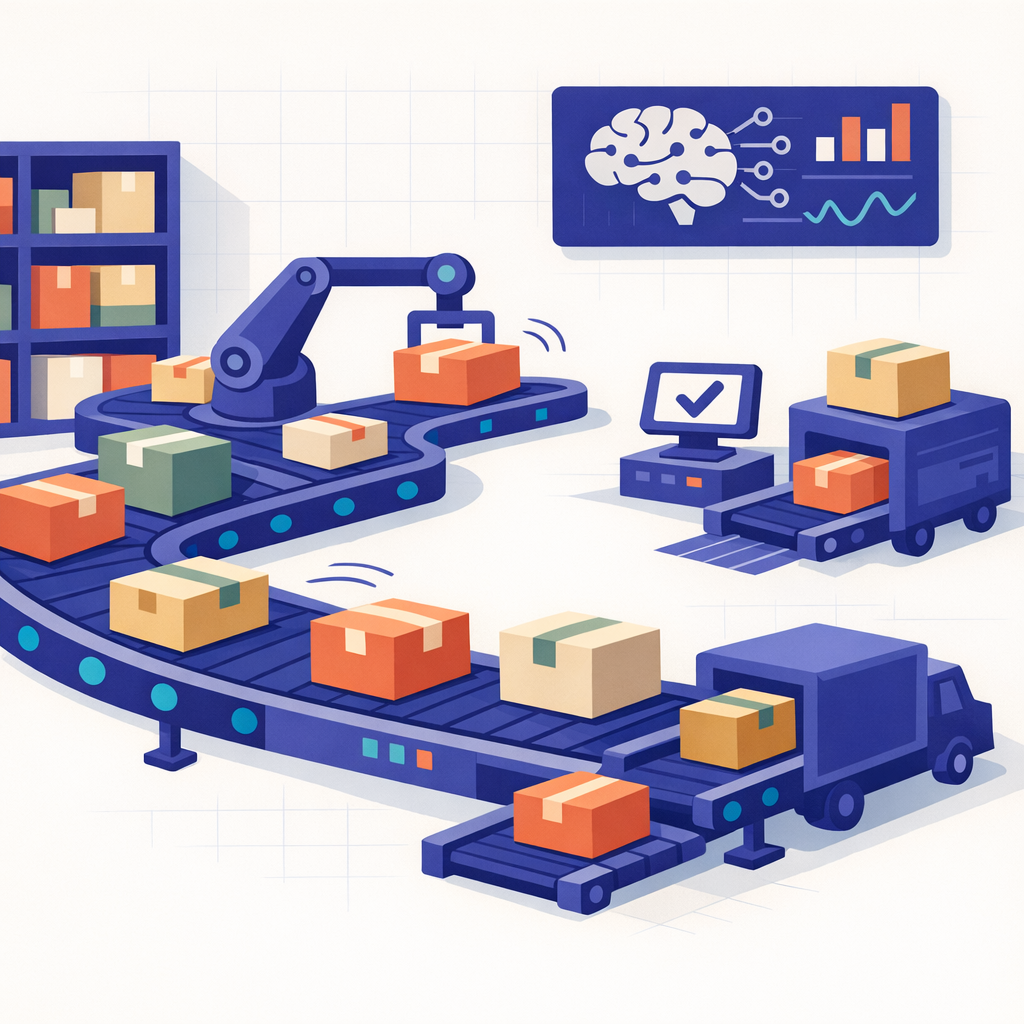 Conceptual representation of Warehouse Automation powered by AI
In the realm of supply chain logistics, one of the most powerful applications of artificial intelligence (AI) is its ability to forecast demand. AI-driven demand forecasting models leverage machine learning to analyze historical sales data and current trends, enabling accurate predictions of future demand. Notably, AI's exceptional precision offers significant benefits for businesses across various industries.
The primary advantage of demand forecasting AI is its capacity to enhance accuracy compared to traditional forecasting methods. Machine learning algorithms meticulously analyze and learn from extensive historical data to predict future trends. This unprecedented level of precision yields substantial value for businesses.
The strategic role of AI in demand forecasting is to ensure adequate supply aligns with calculated demand. This balance minimizes the risks of overstocking or running out of inventory, thereby establishing an optimal inventory management cycle. Utilizing AI in demand forecasting enables businesses to promptly meet customer needs, leading to increased customer satisfaction and higher retention levels.
AI-powered demand forecasting has proven instrumental across various sectors, including retail, healthcare, and manufacturing. For instance, major industry leaders like UPS, DHL, and IBM have harnessed AI-driven demand forecasts to significantly enhance their supply chain risk management.
AI's contributions extend beyond predicting future demand; it also plays a crucial role in warehouse automation. This integration significantly enhances the efficiency and productivity of warehouse operations. Rather than displacing the human workforce, AI maximizes the potential of automated systems to improve various warehouse processes. Tasks such as product picking, sorting, and placement are now executed with increased speed and accuracy.
By 2026, AI's influence on the global supply chain is expected to deepen further, facilitating algorithm-based analytics and autonomous decision-making. Demand forecasting AI models will likely evolve and adapt, delivering even more precise predictions and optimizing supply chain operations. As a result of these advancements, companies can anticipate higher returns on their investments in AI technology, alongside more efficient and streamlined logistical operations.
AI in demand forecasting embodies the future of supply chain logistics, promoting optimized inventory management, enhanced efficiency, and the benefit of accurate future predictions. As AI technology continues to progress, it is poised to revolutionize the management of future logistics and supply chains.
The transformative potential of Artificial Intelligence (AI) is set to reshape supply chain logistics by 2026. The sector is anticipated to undergo a significant metamorphosis in areas such as demand forecasting, inventory optimization, and warehouse automation, driven by the integration and enhancement of AI technologies.
As companies increasingly adopt AI capabilities, demand forecasting is poised for a profound transformation by 2026. AI's ability to predict future demands with unmatched precision provides businesses with a critical advantage in effectively planning their supply chain logistics. This emphasis on AI-driven demand forecasting will refine inventory management, reducing the risk of both excess inventory and stock shortages.
Inventory optimization is expected to make substantial progress with the integration of AI. By aligning available inventory with predicted demand, companies can minimize the costly pitfalls of overstock and stockouts. This equilibrium allows businesses to promptly meet customer demand, enhancing satisfaction and loyalty—essential factors in an increasingly competitive market.
By 2026, warehouse automation powered by AI is likely to replace many traditional logistics methods. AI-driven robots in warehouses diminish the likelihood of human error, thereby improving efficiency and productivity. Moreover, AI promises increased accuracy in warehouse processes, spanning picking, packaging, and inventory tracking.
The application of AI in risk management and data integration equips businesses to effectively mitigate supply chain risks. AI enables organizations to analyze extensive data sets, providing insights into potential risks and facilitating proactive decision-making.
While the ROI from AI in supply chain logistics is promising, transitioning to AI-enhanced processes is not without challenges. Businesses may encounter integration issues, the necessity for employee training, data privacy concerns, and substantial initial investment costs. Nevertheless, the long-term advantages of AI-driven supply chain logistics—improved efficiency, cost savings, risk mitigation, and increased competitiveness—far outweigh these initial obstacles.
In summary, the supply chain AI landscape in 2026 envisions a sector transformed. The future portends a shift toward even more intelligent, efficient, and automated processes, offering unprecedented growth potential for businesses willing to embrace and adapt to these changes. It's evident that AI in logistics is not merely a future consideration; it is a present reality poised for an even more transformative tomorrow.
Implementing AI in supply chain logistics often presents significant challenges for businesses, particularly those struggling to keep pace with the rapid advancements in this field. Nevertheless, once successfully integrated, AI's remarkable ability to optimize various logistics operations and deliver substantial return on investment (ROI) far outweighs these initial hurdles.
| Challenge | Description |
|---|---|
| Data Integration | One of the foremost challenges of AI implementation is integrating data from multiple sources. Given the diverse stakeholders in a supply chain, each with proprietary systems and data formats, harmonizing this information becomes a significant obstacle in applying AI to logistics. |
| Technical Capacity | The effective implementation of AI in supply chain logistics is contingent upon a business's technical capacity, including the availability of skilled personnel and appropriate infrastructure. |
| High Implementation Costs | The costs associated with implementing and maintaining AI tools can be substantial. This poses a particular challenge for small and medium-sized enterprises, which may lack the necessary resources. |
Despite these challenges, the potential ROI from implementing AI across various facets of supply chain logistics—such as demand forecasting and warehouse automation—makes it a compelling investment.
Demand Forecasting: AI-driven demand forecasting models can yield significant cost savings by minimizing stockouts and excess inventory. These models also offer high accuracy in predicting future demand, enhancing the efficiency of supply chain operations.
Warehouse Automation: AI-enabled robots and autonomous vehicles can greatly boost efficiency and productivity within warehouses, leading to increased ROI. Their ability to reduce human error and operate continuously, unlike human workers, further amplifies this benefit.
Inventory Optimization: AI can streamline procurement and storage processes, maintaining an optimal balance between available inventory and anticipated demand. The resultant cost savings from reduced storage needs and improved inventory turnover provide yet another compelling argument for investing in AI.
Remember, "The adoption and integration of AI are set to reshape the future of supply chain logistics, offering extensive opportunities for development and growth."
What are the core applications of AI in supply chain logistics?
Core applications of AI in supply chain logistics include demand forecasting, inventory optimization, route planning, warehouse automation, and risk management.
How can AI support risk management in supply chain logistics?
AI assists in managing risks within supply chains by predicting potential disruptions and proposing alternative strategies or contingency plans.
Can AI be used in small to medium-sized logistics businesses?
Absolutely. Although the initial implementation of AI can be challenging and costly, the significant ROI and potential for enhanced operational efficiency make it advantageous for businesses of all sizes.
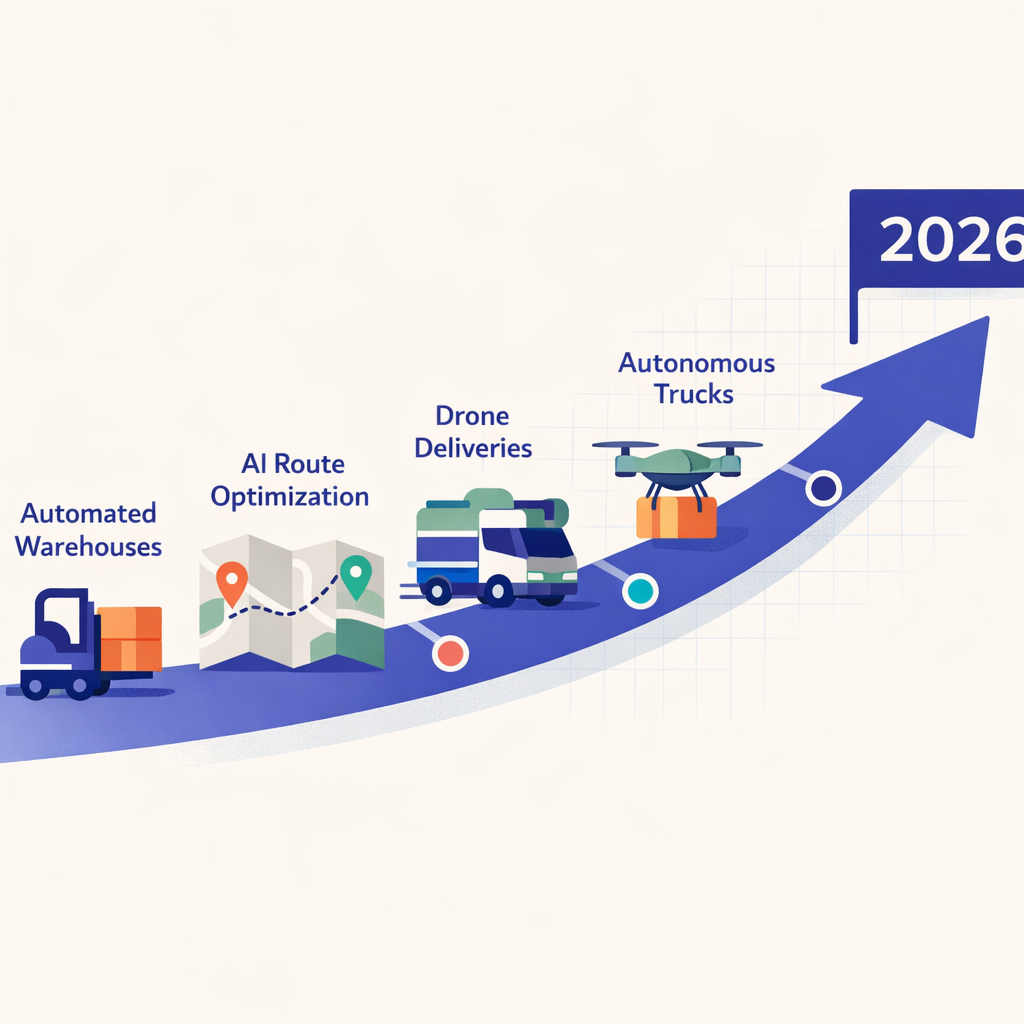 Timeline illustration depicting the future projections for AI in supply chain logistics by 2026
Artificial Intelligence is no longer a distant possibility; it has firmly established itself in the present. Whether applied in logistics or used to facilitate demand forecasting, AI technology has emerged as a transformative force that enhances operational efficiency, mitigates risks, and significantly improves return on investment (ROI). As we advance toward 2026, the role of AI in supply chain logistics is set to expand and evolve further.
To conclude our discussion on this transformative technology, let’s address some frequently asked questions.
AI enhances demand forecasting within supply chain logistics by leveraging machine learning (ML) algorithms to analyze historical sales data alongside current trends. This enables AI to predict future demand and consumption patterns with a high degree of accuracy.
For example, AI-driven demand forecasting can assist businesses in anticipating sales during specific periods, such as:
These enhanced forecasting capabilities help reduce instances of overstocking or understocking, thereby mitigating potential losses.
AI in warehouse automation plays a vital role in optimizing the procurement and storage of goods, ensuring a balance between inventory availability and projected demand. By implementing AI-powered robots and equipment, warehousing functions can be managed more effectively, minimizing human errors while improving efficiency and productivity.
This automation provides businesses with benefits such as:
The integration of AI in supply chain and logistics can substantially enhance return on investment (ROI). By driving efficiency and productivity throughout the entire supply chain—from demand forecasting to inventory management and from route planning to warehouse automation—AI creates significant value.
As we move toward a more interconnected and automated future, the ongoing integration of AI in supply chain logistics is not just probable; it is inevitable. By recognizing and harnessing the potential of AI, businesses can truly transform their supply chain operations and maintain a competitive edge in the marketplace.