Agent Control Plane: Centralized Governance for AI Agents in 2026
Explore the importance of an agent control plane when managing numerous AI agents and ensure better governance and control.

What an agent control plane changes when AI agents scale
The failure usually does not start with a bad prompt. It starts the day someone asks a basic operational question and no one can answer it: which agents are running, what can they access, what are they costing, and who can shut them down right now? Once teams run dozens or hundreds of agents, an agent control plane stops being optional. The problem shifts from prompt tuning to governance, security, observability, and operational control through one centralized layer.
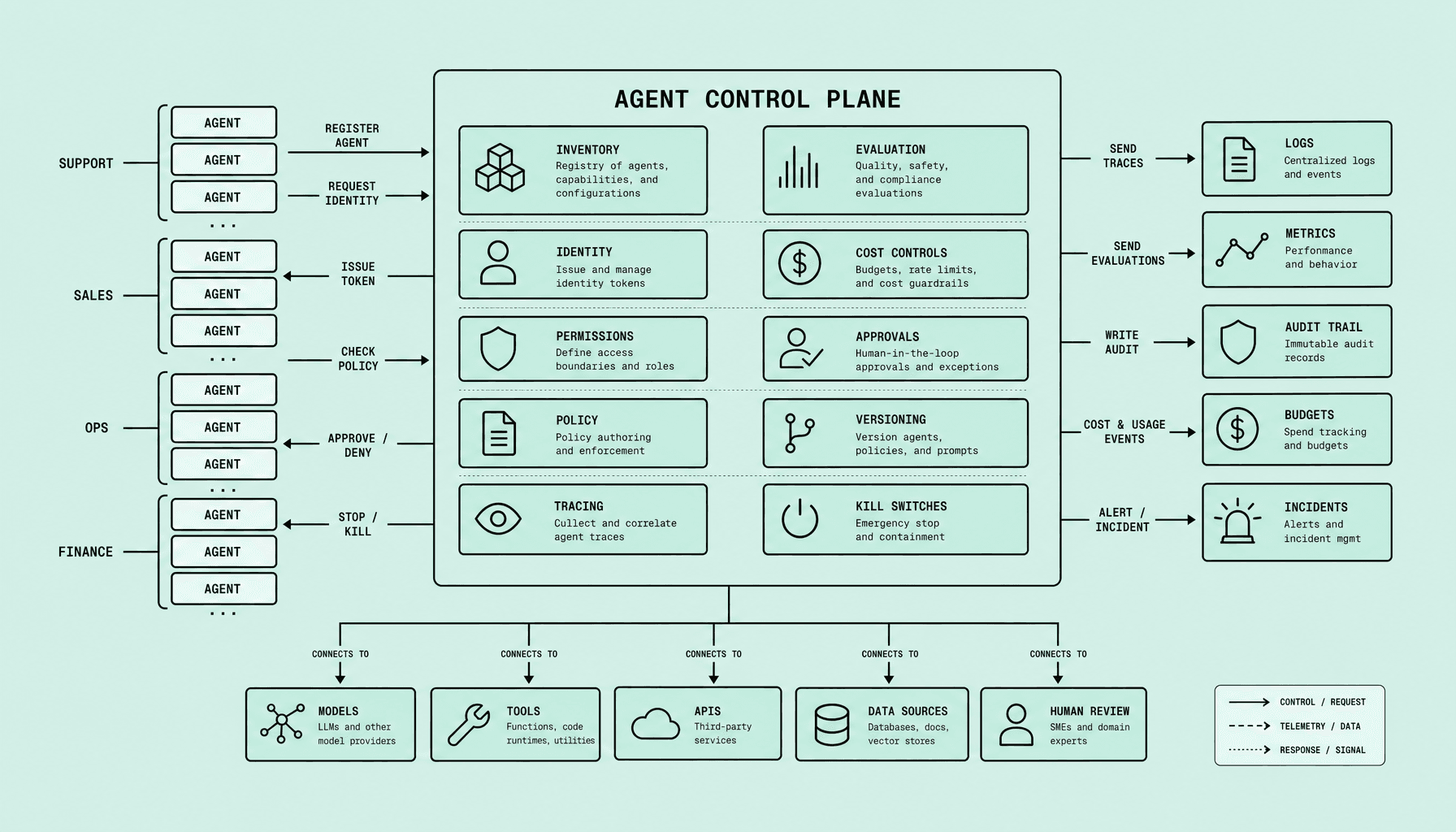
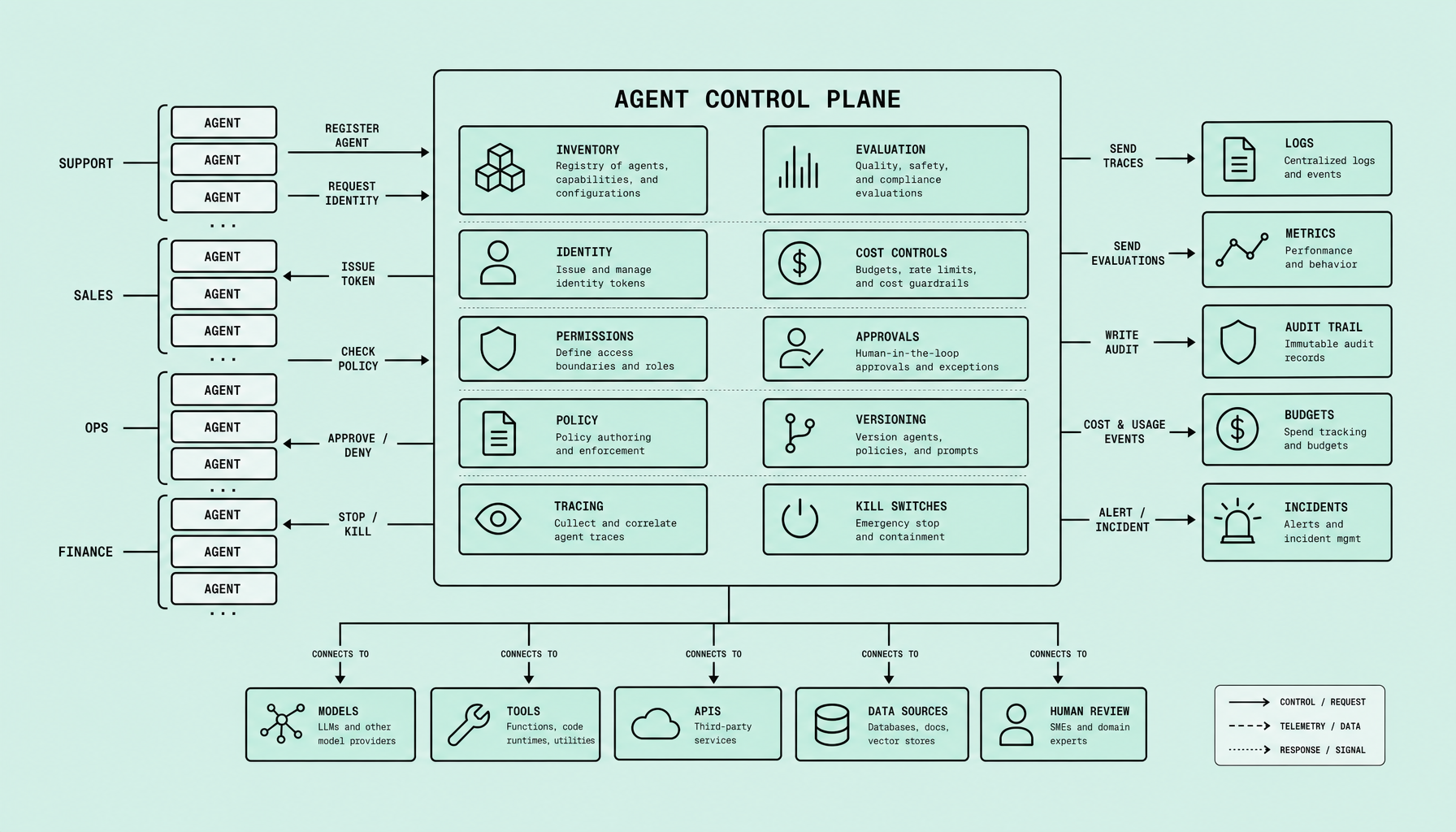
A workable AI agent control plane tracks inventory, assigns machine identity, enforces RBAC or ABAC permissions, applies policy, captures traces, runs evaluations, sets token and cost budgets, routes approvals, versions prompts and tools, and exposes kill switches. But the trigger is simple: if no one can answer which agents exist, what they can access, what they cost, or how to stop them fast, ad hoc scripts have already failed. In practice, a control plane for AI agents becomes worth building once agents touch CRM, ERP, ticketing, or internal APIs. Reliable systems need clear ownership and short-lived credentials first, then audit logs, policy engines, and approval workflows.
Key Takeaways for Building an agent control plane
-
Once agents spread across CRM, ERP, ticketing, and internal APIs, the risk changes fast. The problem is no longer one smart workflow. It is fleet operations -- inventory, ownership, identity, audit logs, and incident response.
-
The core of an AI agent control plane is boring on purpose: registered inventory, distinct machine identity, RBAC or ABAC, policy enforcement, distributed tracing, evaluation harnesses, version registries, approval workflows, token budgets, and kill switches. Clarity is better than complexity -- especially in AI agent governance.
-
A control plane for AI agents becomes worth building when teams cannot answer simple questions: which agents exist, who owns them, what they can access, what they cost, and how to stop them safely.
-
Build first if needs are narrow and integrations are predictable. Buy if governance breadth matters more than custom behavior. In practice, many teams -- including ones with operating constraints like Imversion Technologies Pvt Ltd -- land on a hybrid AI agent governance model.
What breaks first when a few agents become a multi-agent architecture
The first thing that breaks is visibility.
With three agents, a team can still keep most of the system in its head. With thirty, that falls apart quickly. No one can answer basic questions with confidence: which agents exist, who owns them, what tools they can call, which model version they run, or what happens if one starts taking the wrong action in a production system.
Then the local workarounds start failing. One team copies an internal research agent and tweaks the prompt. Another gives its support agent broad access to CRM and ticketing because shipping is urgent. A third wires an agent to an ERP approval path with a shared API key. Those are reasonable shortcuts at small scale. In a multi-agent architecture, they turn into dangerous patterns.
That is the point where AI agent governance stops sounding theoretical and starts showing up as operational risk.
What starts to sprawl
What spreads first looks less like prompt engineering and more like microservices and shadow IT. Agents multiply. Ownership blurs. Permissions drift. Handoffs get brittle because one agent depends on another agent’s output shape, tool contract, or undocumented policy assumption. Once several teams deploy independently, duplicated agents start appearing -- same job, different prompts, different access, different failure modes.
Costs climb the same way: quietly, then all at once. One agent retries too aggressively. Another sends long contexts to a premium model. A third fans out across tools and triggers downstream work. Without token budgets, rate limits, and per-agent cost tracking, model spend becomes hard to explain and even harder to control.
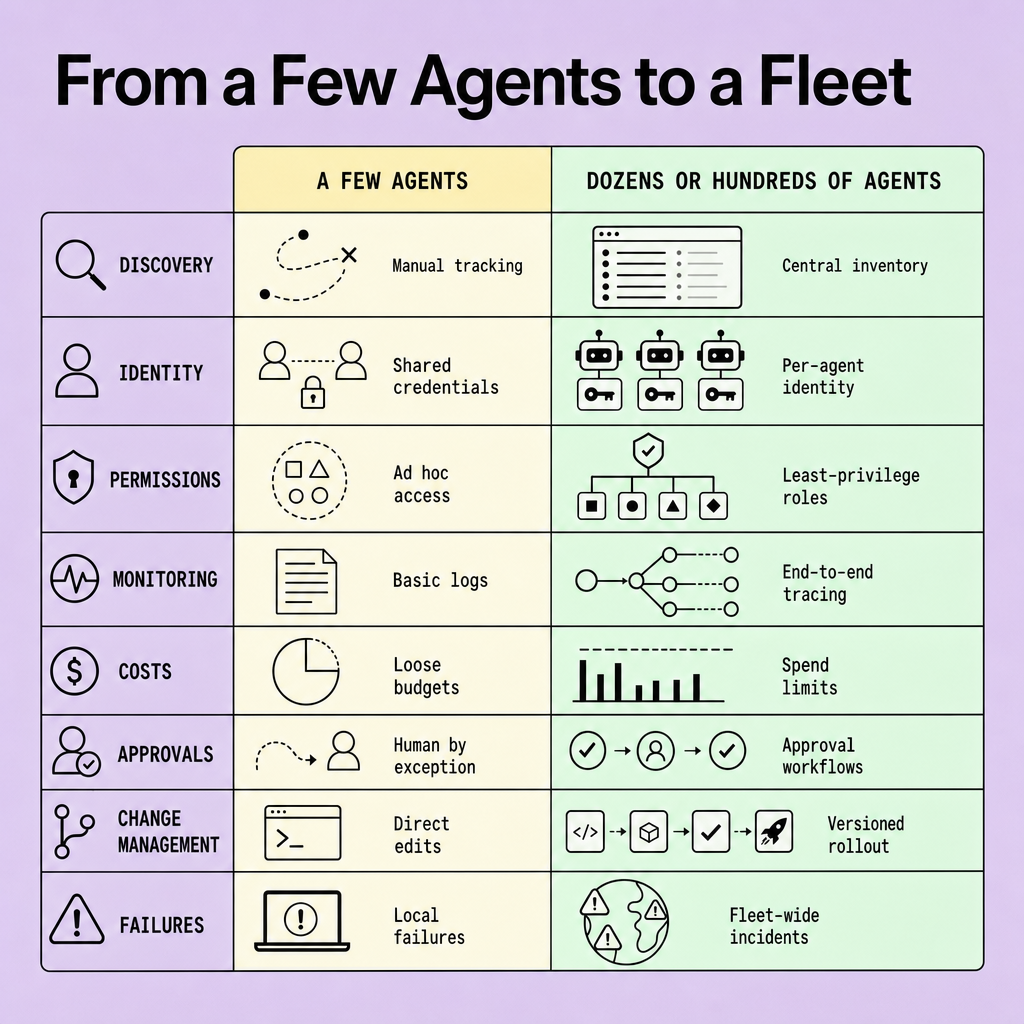
What the missing layer actually is
This is the gap the control plane has to close. It should hold inventory, machine identity, permissions, policy enforcement, tracing, evaluation results, cost controls, approvals, versioning, and kill switches in one place. RBAC or ABAC. Short-lived credentials. Audit logs. Distributed traces across agent-to-agent calls. Version registries tied to rollback paths.
Because clarity is better than complexity, the trigger for building an AI agent control plane is simple: build it when multiple teams deploy agents that can touch shared data or take actions in production systems. Before that point, scripts and dashboards can work. After that, they start becoming part of the problem.
What an agent control plane actually does
An agent fleet becomes hard to operate long before it becomes technically impressive. The hard part is rarely raw capability. It is the lack of a single place to answer basic but critical questions: what is running, who owns it, what it can access, what it costs, which version is live, and how to shut it down fast.
That is the job of an agent control plane.
Control plane, not runtime
The control plane for AI agents sits above execution. It does not handle every prompt, tool call, or model response on the hot path. That is the data plane -- the runtime where agents execute tasks, call tools, read context, and return outputs.
The AI agent control plane manages the rules around that runtime. It keeps the system of record. It issues identity. It applies permissions. It stores policy. It collects traces, evaluation results, and audit logs. It enforces budgets. It handles approval workflows. It also provides versioning and kill switches when an agent starts behaving badly.
Short version: runtime does the work; the control plane decides how that work is allowed to happen.
More than orchestration
Teams often confuse an agent orchestration platform with an agent control plane. The overlap is real. They are still not the same thing.
Orchestration routes work: agent A hands off to agent B, a tool call is retried, a workflow waits for input. Useful, yes. But orchestration alone does not provide centralized governance. Without that layer, there is still no reliable inventory, no consistent RBAC or ABAC model, no short-lived credentials, no approval chain for risky actions, and no fleet-wide shutdown mechanism.
And a dashboard is not enough either.
A dashboard shows status. An AI agent control plane enforces policy.
What belongs in the control plane
Once ad hoc operations stop working, the control plane becomes the centralized management layer for:
- inventory and ownership metadata
- machine identity and least-privilege access
- policy engines for tool use, data access, and action limits
- tracing, audit logs, and evaluation harnesses
- token and cost budgets
- version registries, rollout controls, and rollback
- human approvals for sensitive actions
- kill switches by agent, environment, or capability
Clarity beats complexity here. Build a control plane when ad hoc scripts stop giving reliable answers -- usually the moment agents touch production systems like CRM, ERP, ticketing, or internal APIs.
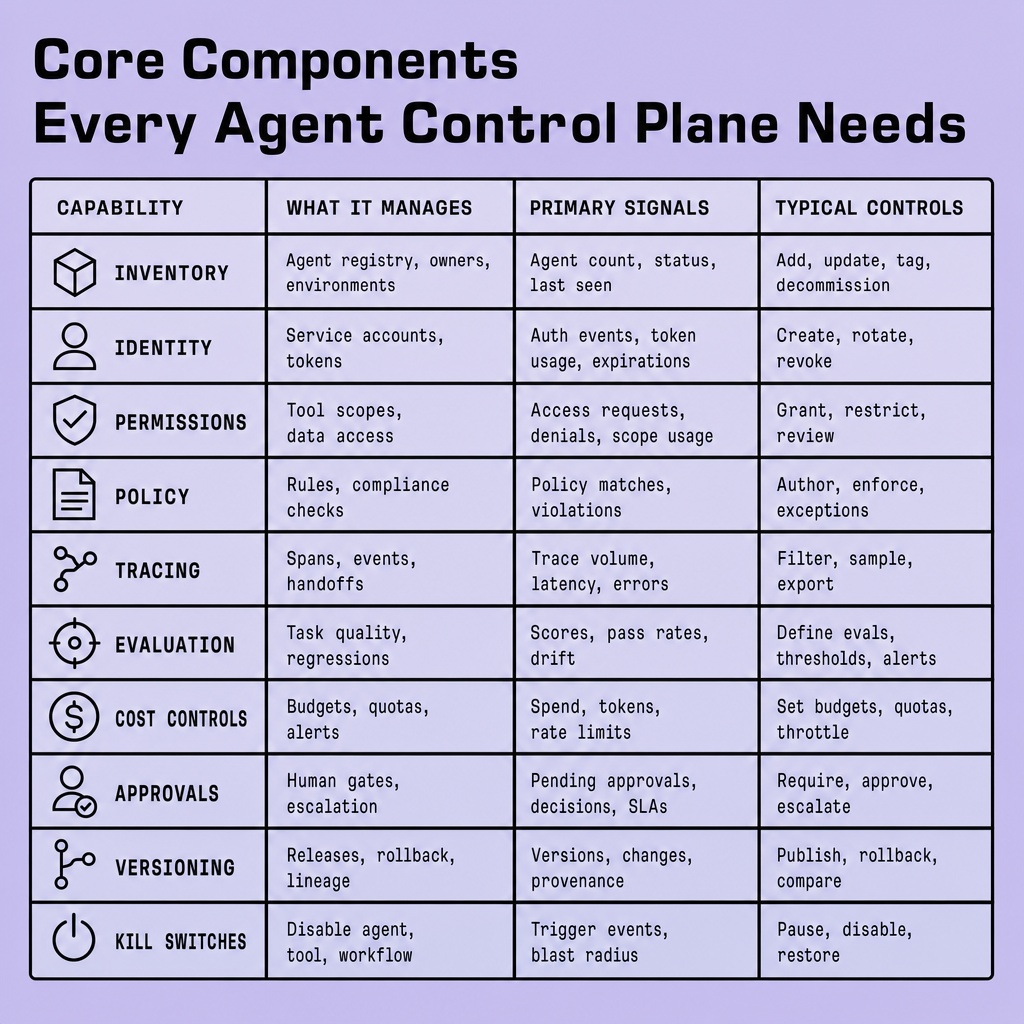
Core components every agent control plane needs
A practical agent control plane is not one feature. It is a set of guardrails and operating records that keeps a growing agent fleet understandable, governable, and stoppable.
Inventory
Start with inventory. Teams should be able to name every agent, its owner, purpose, model, tools, connected systems, risk tier, and lifecycle state. Without that baseline, everything else in the control plane rests on weak ground.
Identity
Every agent needs its own machine identity, not a shared API key buried in code. Distinct identities improve attribution. They also make revocation possible when one agent misbehaves or gets replaced.
Permissions
Permissions define what each agent may read, write, and trigger. Use least-privilege scopes, with RBAC for simpler environments or ABAC when access depends on data sensitivity, department, or runtime context.
Policy
Policy is the enforcement layer. A policy engine checks whether an agent can call a tool, use a model, access sensitive data, or act without review. That reduces the chance that local shortcuts become system-wide governance problems.
Tracing
Tracing and durable audit logs show what happened across prompts, tool calls, API requests, and downstream actions. Without that chain, root-cause analysis becomes guesswork, especially when one agent triggers another.
Evaluation
An evaluation harness tests behavior before and after changes. Regression evals help catch quality drops, tool misuse, and prompt updates that break production paths.
Cost controls
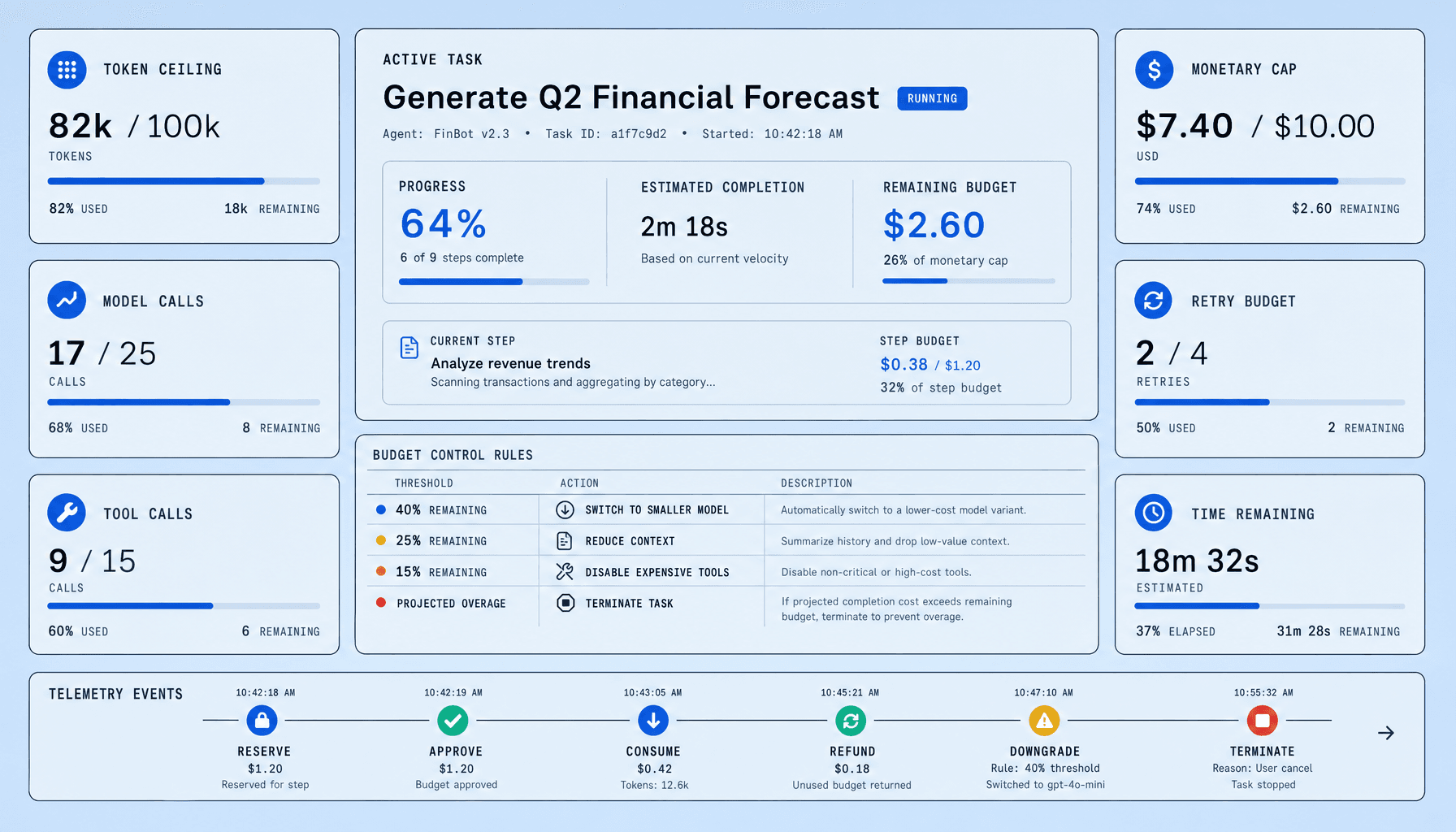
Agents spend money in small increments until they do not. Token budgets, model routing rules, rate limits, and budget caps help contain runaway cost from loops, retries, or oversized context windows.
Approvals
Some actions need humans in the loop. Approval workflows for high-risk tasks such as refunds, contract changes, account closure, or production writes add a check where confidence alone is not enough.
Versioning
Prompts, tools, policies, and model settings all change. Versioning gives teams a clean rollback path and reduces “works on my branch” operations during incidents.
Kill switches
A kill switch is mandatory. Per-agent, per-tool, and fleet-wide stop controls let operators disable execution quickly when reliability or safety is at risk.
Build inventory and identity before advanced analytics. Tracing and evaluation are much less useful if no one can first say which agents exist or what they are allowed to access.
A reference architecture for an AI agent control plane
The right design is boring in one specific way: every agent action should pass through the same governed path. If controls live in side dashboards, teams will skip them when delivery pressure rises. So the control plane for AI agents has to sit inside the lifecycle, not beside it.
The core layers
A workable AI agent control plane starts with an agent registry. This is the inventory and system of record: owner, purpose, model, tools, connected systems, risk tier, deployment state, and current version. No registry, no fleet management. Just guesses.
Next comes identity. Each agent gets its own machine identity through an identity provider, with short-lived credentials instead of shared API keys. Permissions should combine RBAC and ABAC -- role for broad access, attributes for context like environment, data sensitivity, or action type.
Policy sits in two places: a policy decision point and one or more enforcement points. That pattern is proven in service mesh and policy-as-code systems because it separates rules from execution. The decision point answers “may this agent do this now?” The enforcement point blocks, redacts, rate-limits, or requires escalation.
Then the runtime path needs visibility. An OpenTelemetry-style telemetry pipeline should capture traces, tool calls, prompts, model responses, costs, approval events, and failures. But telemetry is not just for dashboards. Feed those traces into an evaluation service that scores behavior, policy drift, and task quality over time.
The request flow
A typical flow in an agent orchestration platform looks like this:
- Register the agent and publish its version in a version registry.
- Authenticate the agent through the identity provider.
- Authorize each tool call through policy and enforcement.
- Check token and spend limits in a budget manager.
- Route sensitive actions into an approval workflow.
- Execute, trace, and log every step.
- Run post-execution evaluation.
- If behavior regresses, trigger rollback or a kill switch.
The strongest control plane for AI agents makes governance part of execution, not an optional review step.
When it becomes worth building
A formal control plane becomes worth building when ownership gets blurry, agents touch production systems, or costs and permissions can no longer be reviewed manually. Centralization does add friction. But once failure stops being isolated and starts becoming systemic, that friction is a better trade than blind spots.
When an agent control plane becomes worth building and when to buy instead
Teams usually get this wrong in one of two ways: they overbuild too early, or they wait until the sprawl is already expensive. The trigger is not agent count alone. It is operational risk plus organizational complexity.
A few agents owned by one team, handling low-risk internal tasks, can work with lightweight governance: clear ownership, basic audit logs, manual approvals, and cost tracking. The tipping point comes when several teams deploy agents into shared systems like CRM, ERP, ticketing, or internal APIs. At that point, ad hoc scripts and local dashboards stop scaling.
A control plane becomes justified when several of these signals appear at once:
- multiple teams ship agents independently
- agents access regulated data or production actions
- cross-agent dependencies can chain failures
- incidents become hard to trace or stop
- spend rises without clear per-agent budgets
- approvals, policy checks, and rollbacks become release blockers
Frame the decision around failure modes: can the organization answer which agents exist, who owns them, what credentials they use, what policies gate them, and how to shut them down now?
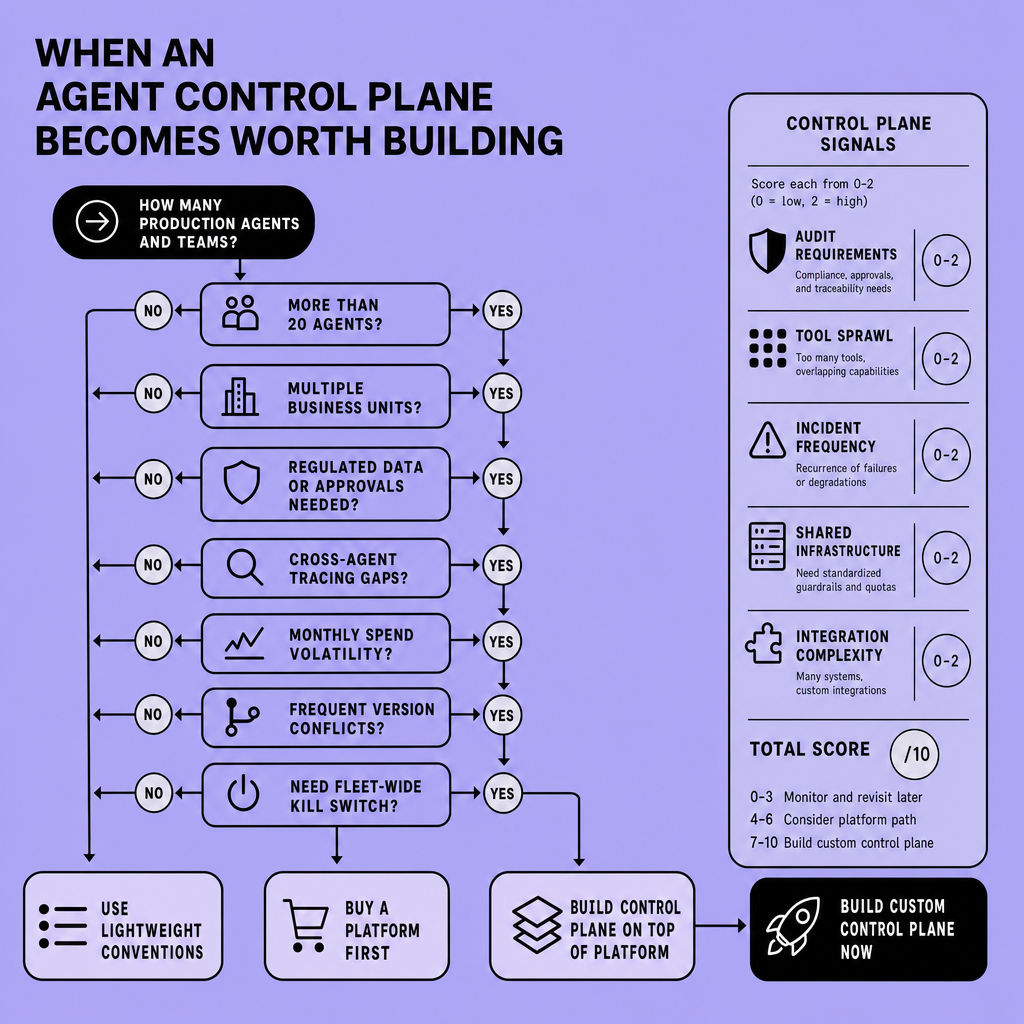
Build versus buy
Most teams should not build a bespoke control plane on day one. Buy or assemble first. An agent orchestration platform plus surrounding tooling for identity, tracing, policy, and evaluation usually gets a team to safer production faster. A custom build becomes rational when governance rules are unusually specific, integrations are deep, and an internal platform team can absorb the maintenance burden.
| Approach | Best fit | Main risk | Human handoff |
|---|---|---|---|
| Buy an agent orchestration platform | Fast-moving teams, common workflows | Limited customization | Usually built in |
| Assemble adjacent tooling stack | Teams needing flexibility without full platform build | Integration overhead | Must be designed explicitly |
| Build in-house | High-control environments, regulated data, deep shared systems | Ongoing maintenance burden | Fully custom |
Practical recommendation: buy for speed, build for differentiation, and assemble only if the team can own the glue code long term.
Frequently Asked Questions
What is the difference between an agent control plane and an API gateway?
An API gateway mainly governs network requests, routing, authentication, and rate limits at service boundaries. An agent control plane operates at a higher semantic level: it tracks agent identity, tool permissions, approvals, version history, evaluation outcomes, and emergency stop controls across the full agent lifecycle.
How does an agent control plane help during an incident?
An agent control plane shortens incident response by giving operators one place to identify the affected agent, inspect its recent traces, revoke its credentials, pause specific tools, roll back its version, and apply a kill switch. That reduces guesswork and limits blast radius while teams investigate root cause.
Why should teams separate agent runtime from governance?
Separating runtime from governance keeps execution fast while allowing policy, auditing, and approvals to evolve independently. That design lowers operational risk because teams can change access rules, budget thresholds, or review requirements without rewriting the core task logic of every deployed agent.
When does an agent control plane need dedicated platform ownership?
An agent control plane needs dedicated platform ownership when it becomes shared infrastructure across multiple teams, regulated workflows, or critical production systems. At that point, reliability, schema consistency, policy changes, and integrations require roadmap discipline, on-call responsibility, and clear service-level expectations.
What metrics matter most once an agent fleet is under control?
The most useful fleet metrics are not only uptime and latency. Teams should track policy denial rates, approval queue time, credential age, rollback frequency, per-agent cost variance, evaluation pass rates, and mean time to disable unsafe behavior. Those measures show whether governance is actually working in production.
Make Imversion a preferred source on Google
Like this kind of AI and software analysis? Add Imversion as a preferred source so Google can highlight our articles for you in Search, AI Overviews, and AI Mode.