AI Agent Audit Trail: Essential Logs for Effective Incident Response
An effective AI agent audit trail captures essential logs without compromising sensitive data. Discover how to optimize your incident response.

What an AI Agent Audit Trail Must Include at Minimum
When something goes wrong with an AI agent, basic app logs usually collapse at the exact moment you need them. They may tell you a request succeeded. They do not tell you who set the action in motion, which agent version made the decision, what tool it called, what data it touched, or whether anyone approved it first.
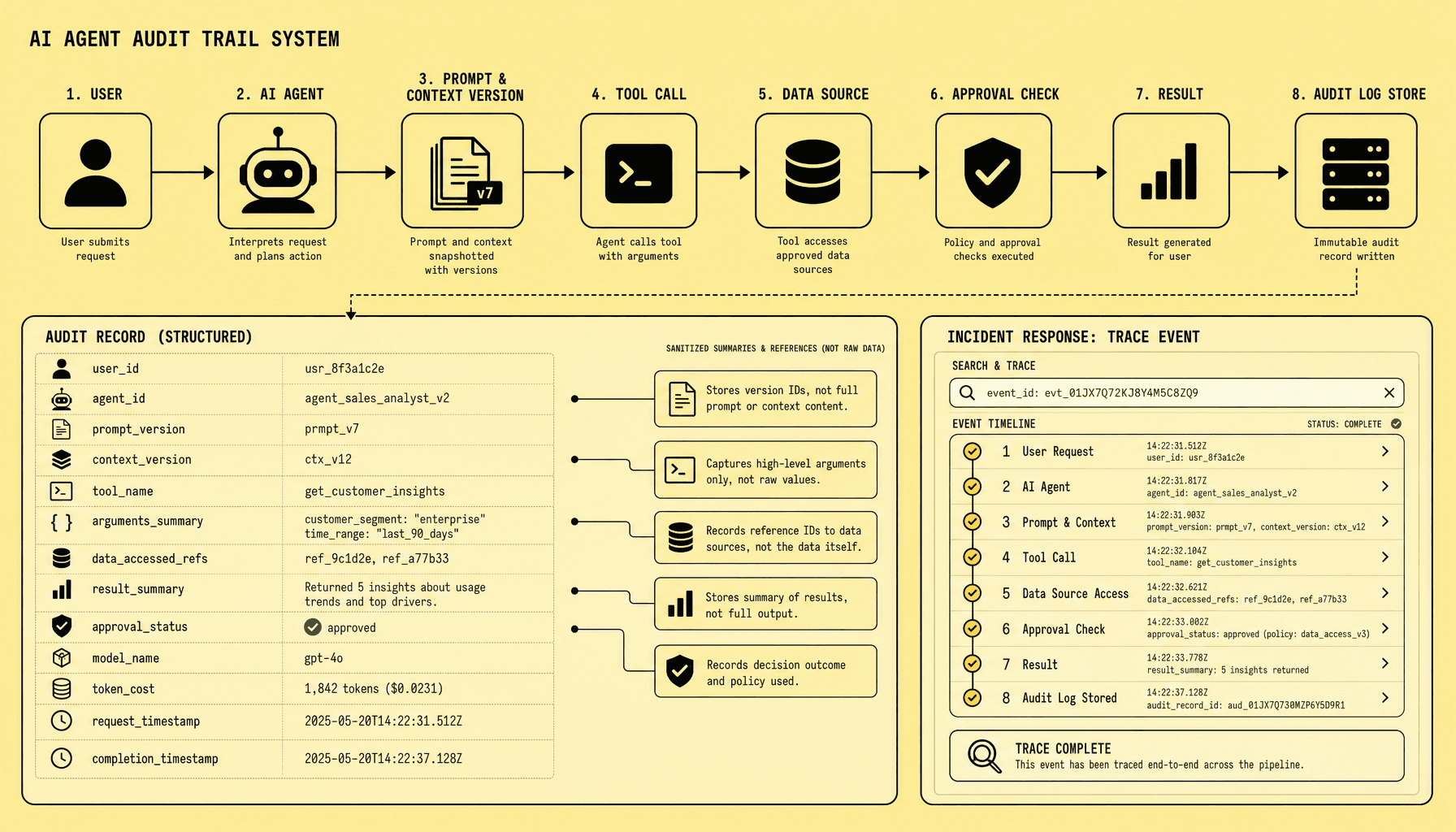
A minimum AI agent audit trail should record who initiated the action, which agent acted, the prompt/context version, tool call, sanitized arguments, data-access references, result, approval state, model, cost, and timestamps. But it should avoid raw sensitive content unless there is a strict, documented reason to keep it.
In practice, the best AI audit trail is structured, sparse, and explainable. Log user_id, agent_id, prompt_version_hash, tool_name, redacted arguments, data_refs like record IDs or table names, result_status, approval_state, model_name, token_cost, and start/end timestamps. An agent activity audit log should also capture environment or policy version if behavior changes across staging and production.
Incident response depends on reconstruction, not surveillance, so teams should store references instead of full prompts, documents, or outputs wherever possible. Clarity beats complexity here -- a useful AI agent logging design helps security, compliance, and engineering answer what happened fast, without creating a second breach surface in the logs.
Key Takeaways for Building an AI Agent Audit Trail
-
Start small, but not vague. A useful AI agent audit trail captures the minimum record: user identity, agent identity, prompt or context version ID, tool call, sanitized arguments, data-access references, result, approval state, model, cost, and timestamps.
-
Log references, not raw payloads. For AI agent logging, store prompt hashes, workflow version IDs, record IDs, and object IDs instead of full prompts, secrets, customer data, or model outputs. Redaction-first wins.
-
Incident response depends on structure. An agent activity audit log should let a team reconstruct who did what, with which tool, against which data source, and under whose approval -- without replaying every sensitive token the agent saw.
-
Full transcript capture creates a second security problem. In practice, AI audit trail design works better when logs keep summaries, response codes, and object references, then pull deeper data only from controlled systems if an investigation requires it.
-
At Imversion Technologies Pvt Ltd, the bias is clear: reliable systems matter most. So AI agent logging should optimize for accountability and containment, not exhaustive surveillance.
Why AI Agent Logging Needs More Than Basic App Logs
If an agent sends the wrong email, queries the wrong customer record, or triggers a tool chain nobody expected, a 200 OK in the request log is close to useless.
Basic request logs are too thin for agentic systems.
A normal app log can tell a team that POST /tasks/run happened, from which IP, and whether it returned 200. Useful, yes. But not enough if an agent decided to query crm.lookup_customer, draft an email, touch a document store, and then trigger sql.read_only_query based on a prompt template that changed last week. That chain matters.
AI agent logging has to answer a harder question: who caused what action, through which agent, under which instructions, with what approval state, and at what cost. Standard logs were not designed for that.
Agents act through chains, not single requests
What makes agents difficult to audit is simple: they do not behave like a single request-response hop.
Autonomous and semi-autonomous flows create a decision trail, not one event. An incident response team needs more than endpoint telemetry. They need an agent activity audit log that links user identity, agent identity, prompt or workflow version hash, tool calls, sanitized arguments, data-access references, model, timestamps, and outcome across a sequence.
Because understanding why is essential, the log has to preserve enough context to reconstruct the action path without becoming a full transcript archive.
That is the balance.
Frameworks such as SOC 2, ISO 27001, and the NIST AI RMF all push teams toward accountability, evidence retention, and controlled access. Not model mysticism. Plain operational discipline. If an agent modifies a record or reaches sensitive systems, teams need chain of custody, approval evidence, and proof that least privilege was enforced.
Raw transcripts feel safe -- until they create a second problem
The common overreaction is to log everything.
Teams often react by logging full prompts, full outputs, and full tool payloads. At first, that feels safer. In practice, it usually makes LLM audit logging noisier, investigations slower, and storage riskier because the logs start collecting secrets, personal data, and irrelevant model chatter.
A better approach is structured minimum logging.
Store references, hashes, IDs, summaries, and approval states by default. Escalate to fuller capture only for high-risk workflows or short retention debugging windows.
So the goal of an agent activity audit log is not to save every token an agent saw or generated. It is to make incident response, debugging, compliance evidence, change tracking, and cost visibility possible with the smallest reliable record. Clarity beats bulk. And reliable systems matter most.
Minimum Audit Record Fields for an AI Agent Audit Trail
Most audit trail debates go off course because teams ask, “What can we log?” The better question is, “What would an investigator need in the first ten minutes?”
The minimum record should answer an investigator’s first questions fast: who initiated the action, what agent and version acted, what tool ran, what data was touched, what changed, whether a human approved it, and when it happened. Anything less weakens the AI agent audit trail. Anything more, without restraint, turns the log into a second data leak.
Mandatory fields
Every agent activity audit log should include these core fields:
- User identity:
user_id,service_account,tenant_id, auth method, and session or request reference. Use stable internal IDs, not names or email addresses, unless there is a clear operational need. - Agent identity: agent name,
workflow_version, deployment environment, and policy profile. If the same agent behaves differently across staging and production, the log must show that. - Prompt/context version: a
prompt_hash, system prompt version, retrieval policy version, and context template reference. Version IDs beat full prompt capture in most cases because they preserve provenance without copying sensitive instructions or user content into logs. - Tool call: the exact
tool invocation, such ascrm.lookup_customerorsql.read_only_query. - Arguments: sanitized parameters only. Keep field names and safe values, but mask secrets, tokens, passwords, free-form personal data, and raw document chunks.
- Data accessed: record IDs, document IDs, table names, bucket paths, object keys, or API endpoints. Log references. Not the full data payload.
- Result: success or failure, response code, object created or modified, and a short sanitized summary.
- Approval:
approval_state, approver ID if one exists, approval method, and policy exception reference. - Model:
model_id, provider, model version or snapshot, and generation settings if they materially affect behavior. - Cost: token usage,
token_cost, API cost estimate, or internal billing unit. - Timestamps: request start, tool start, tool end, approval time, and completion time.
Because understanding why is essential, version references matter almost as much as identities. If a bad action happened, teams need to reconstruct the decision path -- not just the final API call.
Optional enrichments
Once the minimum record is solid, a few extra fields can make investigations smoother without bloating the log.
Useful, but not mandatory: trace_id, correlation ID, policy tags, retention class, redaction status, and incident linkage.
Store summaries and references by default. Escalate to raw prompt or output capture only under defined exceptions, tighter retention, and stronger access controls.
That balance makes AI agent logging useful for incident response, while keeping AI agent compliance logging from becoming a liability.
A Field-by-Field AI Agent Audit Trail Log Schema You Can Implement
A schema falls apart fast if different services interpret the same field differently. The point is not just to log events. It is to make them joinable, comparable, and defensible later.
For an AI agent audit trail, the schema should mirror the minimum questions investigators ask: who initiated the action, which agent and version acted, what tool or model step ran, what data was touched, what happened, whether approval was required, and when it occurred.
Use one event per actionable step: one tool call, one approval decision, one retrieval action, or one model-generated action. Keep the same envelope across all event types so responders can join records without guessing what fields mean.
A practical schema looks like this:
{
  "event_id": "evt_01J9XZ7K8A",
  "event_type": "agent.tool_call",
  "timestamp": "2026-09-24T10:15:32Z",
  "trace_id": "trc_7f3c1b",
  "correlation_id": "req_a91d22",
  "user": {
    "id": "usr_2841",
    "tenant_id": "tnt_44",
    "auth_method": "sso"
  },
  "agent": {
    "id": "support-agent",
    "version": "2.3.1",
    "environment": "prod",
    "policy_profile": "customer-readonly-v2"
  },
  "context": {
    "prompt_version": "sys_prompt_v18",
    "prompt_hash": "sha256:ab12...",
    "workflow_version": "refund-flow-v4"
  },
  "tool": {
    "name": "crm.lookup_customer",
    "arguments": {
      "customer_email": "m***@redacted.invalid",
      "include_orders": true
    }
  },
  "data_accessed": [
    {"system": "crm", "record_ref": "cust_8821"},
    {"system": "orders", "record_ref": "ord_*"}
  ],
  "result": {
    "status": "success",
    "code": "200",
    "summary": "customer record returned"
  },
  "approval": {
    "state": "not_required",
    "approver_id": null
  },
  "model": {
    "provider": "openai",
    "name": "gpt-4.1",
    "temperature": 0
  },
  "cost": {
    "input_tokens": 842,
    "output_tokens": 116,
    "estimated_usd": 0.0124
  },
  "retention": {
    "policy": "audit-90d"
  }
}
Treat the fields as a baseline, not a license to log everything. event_id, trace_id, and correlation_id should stay stable in meaning across services. So should identifiers like user.id, agent.id, and tool.name.
A few implementation rules keep the log useful:
- Log references, versions, and summaries, not raw payloads.
- Sanitize tool arguments before storage.
- Record
data_accessedas system names and record references. - Use
result.status,result.code, and a short summary instead of full outputs. - Capture approval state even when no approval was required.
Exclude anything you would regret duplicating: access tokens, raw prompt text with secrets, private customer content, and unrestricted model output.
That is the point of the schema: enough structure to reconstruct what the agent did, without turning the audit trail into a second copy of sensitive data.
How to Keep AI Agent Audit Trails Useful Without Storing Sensitive Data
A lot of logging failures come from a false sense of safety. Teams assume more data means better visibility. Then the log store becomes the easiest place to leak customer data, tokens, or regulated content.
The safest default is simple: make the log prove access and action, not preserve a second copy of the data. Teams get into trouble when AI agent logging turns into transcript hoarding -- raw prompts, full outputs, API tokens, customer records, and regulated content all piled into one searchable store. Useful for debugging. Dangerous for everything else.
A better pattern is redaction-first design.
Store references, metadata, and sanitized summaries in the AI audit trail: user_id, agent_version, prompt_template_version, tool_name, allowed argument fields, record_id, result_status, approval_state, model_id, cost, and timestamps. For a tool call like crm.lookup_customer, log the customer record ID and the lookup outcome, not the customer profile itself. For sql.read_only_query, log the query template ID, table names, and row-count summary -- not the raw result set.
What to keep, mask, hash, or omit
This needs policy, not guesswork.
Use allowlists for fields that are safe to log. Everything else should be dropped by default.
- Mask direct identifiers and PII: email, phone, address, account number
- Hash stable identifiers when correlation is needed: session IDs, document fingerprints, prompt/version references
- Tokenize sensitive business identifiers if analysts may need later lookup through a controlled system
- Omit secrets entirely: API keys, OAuth tokens, passwords, cookies, database credentials
Because clarity is better than complexity, logging rules should be explicit and testable. A messy “log most things and redact later” approach fails under pressure.
Keep incident response useful
Redaction only works if investigators can still do their job.
Investigators usually need to answer who acted, what tool ran, what data source was touched, what changed, and whether approval existed. They rarely need the full payload in the log store itself.
So pair the agent activity audit log with strict retrieval paths: RBAC, case-based access approval, short retention policy windows, and environment-specific controls. Production logs should be tighter than staging. Sampling should never bypass redaction. And AI agent compliance logging should restrict raw-content capture to narrow cases such as fraud review, safety incidents, or regulated investigations -- behind stronger access controls, separate storage, and documented justification.
A strong default is data minimization: references plus controlled retrieval usually beat storing duplicate sensitive content in logs.
That tradeoff is the point. Reliable systems matter most.
Using the AI Agent Audit Trail for Incident Response and Day-to-Day Operations
An audit trail is not there to satisfy a checklist. Its real test is whether it helps on a bad Tuesday afternoon, when an agent does something odd and people need answers quickly.
A minimum AI agent audit trail earns its keep during messy, ordinary operations, not just formal audits. During incident response, the goal is usually straightforward: reconstruct what happened fast enough to contain damage, decide whether the action was authorized, and identify what to fix. If an unauthorized email goes out, the agent activity audit log should show the initiating user ID, agent version, send_email tool call, sanitized arguments, approval state, result, and timestamp. If a database row changes incorrectly, teams need the tool name, record ID or reference, result, trace ID, and prompt or context version hash to reconstruct the path without storing the row itself.
The same records help with routine operations. Cost spikes become easier to investigate when AI agent logging includes model, agent version, run status, and per-run cost. Recurring failures are easier to triage when API, queue, model, and tool events share one trace ID. Approval workflows also close the loop for high-risk actions by recording who approved, when, and for which action.
A grounded operating recommendation: standardize early on one event schema, one redaction policy, and one retention rule across every agent activity audit log and AI audit trail. The tradeoff is that stricter redaction and shorter retention reduce investigative detail later, so keep references, hashes, and identifiers that let responders verify access and sequence without turning the log into a second copy of sensitive data.
Frequently Asked Questions
What is AI agent audit trail?
AI agent audit trail is a key concept in Define a minimum audit record for agent actions: user identity, agent identity, prompt/context version, tool call, arguments, data accessed, result, approval, model, cost, and timestamps. Show how to make logs useful for incident response without storing excessive sensitive data.. It provides a structured approach to building reliable solutions in this space.
Why should I use AI agent audit trail?
Using AI agent audit trail offers significant advantages including better performance, improved maintainability, and stronger type safety compared to alternatives.
How do I get started with AI agent audit trail?
Getting started with AI agent audit trail involves setting up your development environment, understanding the core concepts, and following the official documentation for a step-by-step guide.
Make Imversion a preferred source on Google
Like this kind of AI and software analysis? Add Imversion as a preferred source so Google can highlight our articles for you in Search, AI Overviews, and AI Mode.