AI Credentials Management: Best Practices for Production Agents
Learn how to secure your production agents with effective AI credentials management, avoiding common pitfalls and optimizing access control.

How AI credentials management should work for production agents
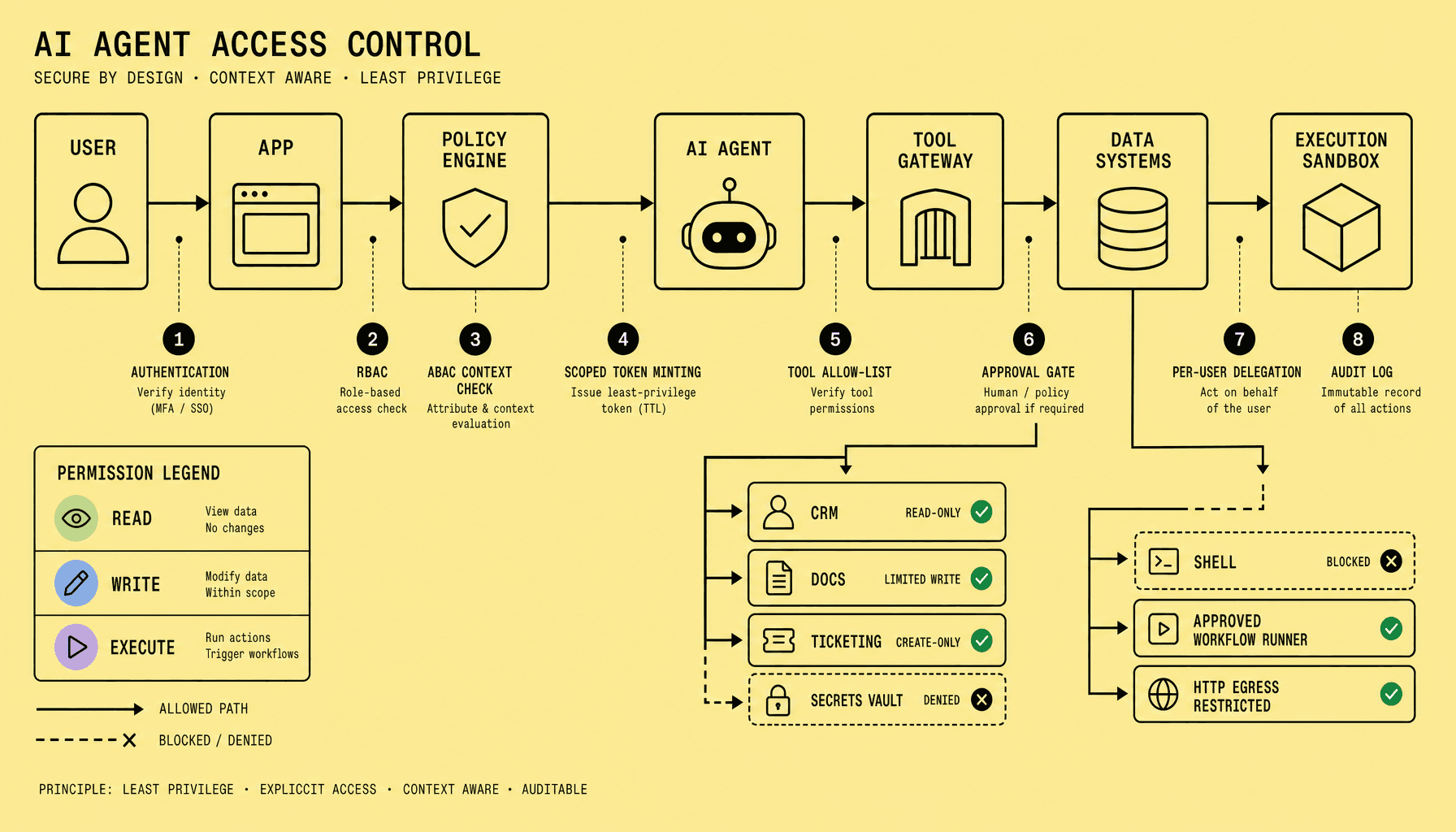
If your production agent can reach Salesforce, PostgreSQL, Slack, Stripe, and internal APIs with one broad secret, you do not have a convenience shortcut. You have a breach path waiting for one bad log line, one exposed pod, or one sloppy rotation cycle. Production-grade AI credentials management should avoid embedded secrets, keep environment-variable use to a minimum, and prefer vault-backed, short-lived access with strict AI access control. For AI agent security, give each agent only the narrow permissions it needs, make every credential fetch auditable, and design for fast rotation.
A production agent should not carry long-lived CRM, database, SaaS API, or internal service secrets as standing access. Use a secret manager such as HashiCorp Vault, AWS Secrets Manager, Azure Key Vault, or GCP Secret Manager, then issue scoped, temporary credentials -- OAuth 2.0 token exchange for Salesforce or Slack, IAM roles for cloud resources, and mTLS or service identity for internal APIs. At Imversion Technologies Pvt Ltd, this is the practical baseline: security should not be optional. Environment variables can still bootstrap identity in controlled cases, but they should not become your primary AI credentials management model for agentic AI security.
Key Takeaways for AI credentials management
- Treat production agents as high-risk operators, not ordinary apps. Strong AI credentials management for CRM, database, SaaS API, and internal service access means tighter AI access control than a typical backend.
- Avoid embedded secrets. Limit environment variables to low-risk development. For real agentic AI security, prefer vault-backed retrieval from HashiCorp Vault, AWS Secrets Manager, Azure Key Vault, or GCP Secret Manager.
- Default to short-lived credentials and OAuth 2.0 token exchange over long-lived API keys. Security should not be optional -- static secrets linger, spread, and get missed during rotation.
- Scope every token to one tool, one action set, and one environment. Separate Salesforce read access from PostgreSQL write access, Stripe calls, and internal mTLS service auth.
- Common failures are predictable: broad tokens in Kubernetes env vars, secrets exposed in CI/CD logs, prompt traces capturing credentials, and rotation plans that exist on paper only.
Why production agents need a different security model for AI credentials management
A production agent is not just another backend service with a neat request-response boundary. It plans, chains tools, retries, and keeps running. That changes the risk model fast.
A traditional app usually has a narrower execution graph: one backend, a known database, a few service accounts. An agent can touch Salesforce, PostgreSQL, Slack, Stripe, and internal APIs in a single workflow. Give that agent one broad token through an environment variable and you create a hidden dependency with a huge blast radius. One leak. Many systems exposed.
That shortcut is common in prototypes because it feels efficient. Drop secrets into .env, pass them into Kubernetes, ship the demo. Production is where the bill arrives. Agents can surface credentials through prompt logs, debug traces, tool output, CI/CD logs, crash dumps, and even container images if secrets are baked into build layers or startup scripts. Embedded secrets are worse -- they spread into repositories, reviews, and deployment artifacts.
The security problem is not just where the secret sits. It is how an autonomous system uses it.
Because agents run long-lived workflows, broad static credentials weaken incident containment. A leaked CRM token may expose customer data. A shared database password may outlive the session that needed it. An internal service key may let the agent move laterally across systems. Short-lived credentials and token exchange shrink that window. Vault-backed access through HashiCorp Vault, AWS Secrets Manager, Azure Key Vault, or GCP Secret Manager gives you policy, audit logs, and rotation support in one place.
In practice, if an agent can call multiple tools, each tool should get its own scoped access path -- not a shared master secret.
Use environment variables for local development if you must. Not for production trust boundaries. Production-grade AI credentials management depends on policy-driven access, per-tool scoping, and revocation you can enforce without redeploying the agent. That is the core of AI access control for autonomous systems.
Credential types production agents use across CRM, databases, SaaS APIs, and internal services
Most teams get an agent working by giving it one broad secret. Fast start, bad pattern. Strong AI agent credential management starts by mapping credentials to tasks, not to the agent as a whole.
CRM credentials
CRM access is usually where the risk becomes obvious. For Salesforce or HubSpot, agents often need lookup, search, note creation, ticket updates, or contact enrichment. That means customer and revenue data, so treat access as sensitive by default.
Use OAuth scopes that match the job: read contacts, append notes, or update a case. Avoid org-wide admin tokens, bulk export access, or delete permissions unless a workflow truly requires them. A CRM lookup path should not inherit database write access or internal admin permissions. Separate tool identity from agent identity.
Database credentials
Databases raise the stakes quickly. PostgreSQL and MySQL need extra caution because the data is often broader, less filtered, and easier to damage with one bad write. Production agents usually need read-only access to a reporting replica, a narrow schema, or a stored procedure interface, not full table access.
Avoid shared superuser accounts, broad write grants, and long-lived passwords in environment variables. Prefer short-lived credentials issued through a vault or IAM-backed path where possible, with rotation and auditability. For AI agent security, read-only access is safer than write-capable access unless the task is tightly bounded and validated.
SaaS API tokens
SaaS integrations look harmless until the scopes are wrong. For APIs like Slack or Stripe, agents often send messages, fetch event context, create support artifacts, or reconcile payments. Here, over-scoped tokens are the common failure point.
Use provider-native scoped tokens, OAuth scopes, or token exchange flows. Avoid master API keys that can read everything, issue refunds, or change billing settings if the agent only needs status checks or notifications. Environment variables may still appear in deployment, but they should reference retrieval paths, not hold the only secret.
Internal service credentials
Internal services are often where agent security fails hardest. Agents may call search, pricing, order, or admin services, and those paths can expose privileged business logic.
Prefer IAM roles, mTLS, and short-lived service tokens. Avoid static shared secrets, bypass headers, and internal admin endpoints. Monitoring matters here because misuse can look like normal service traffic.
Practical rule: a CRM-writing agent can have CRM write scope without getting direct PostgreSQL write access or unrestricted internal service credentials. That is AI access control applied correctly.
AI credentials management methods compared: embedded secrets, environment variables, vaults, short-lived credentials, token exchange, and rotation
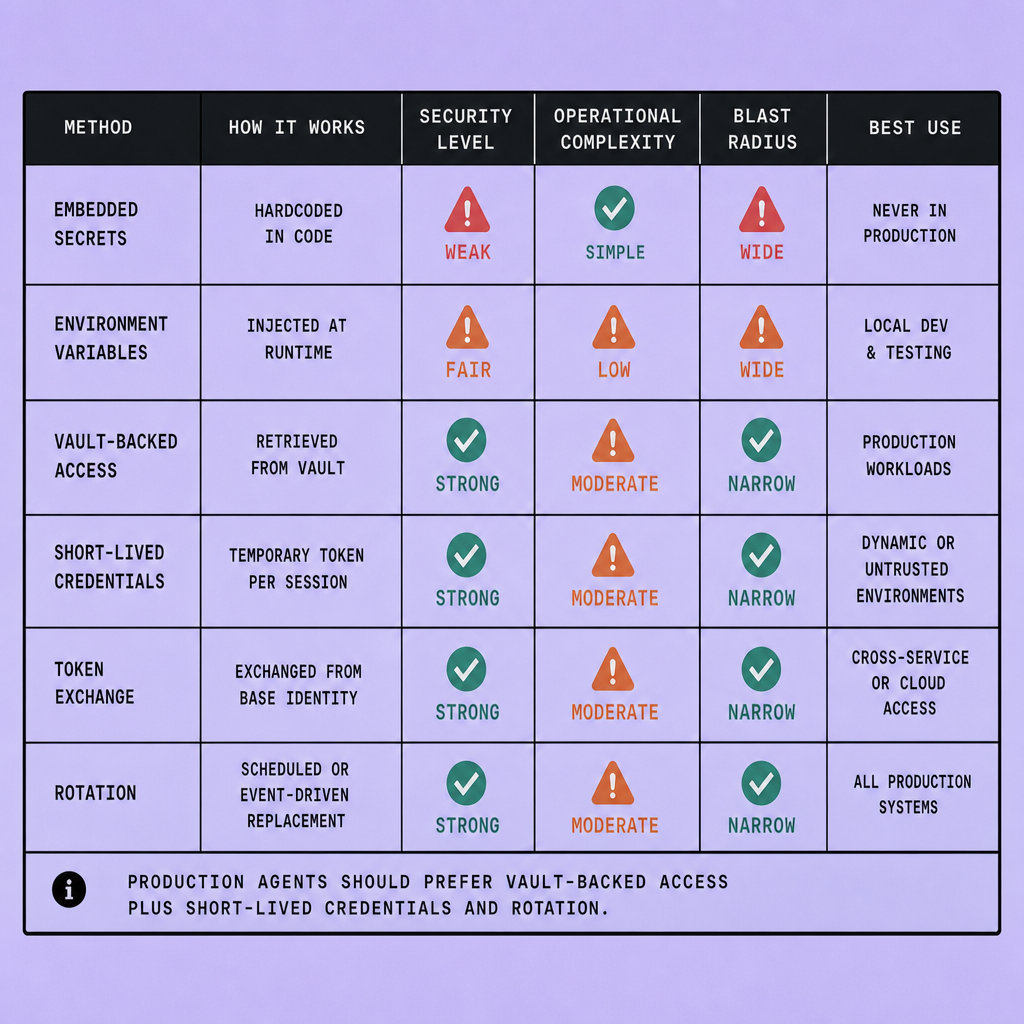
Most teams do not start with the safest model. They start with whatever gets the agent talking to tools by the end of the day. That is exactly why this layer needs deliberate design. For production AI agents, the safest practical pattern is vault-backed access combined with short-lived credentials or token exchange. Avoid embedded secrets. Environment variables are only a step up, not a finish line.
Teams often start with a Salesforce token, a PostgreSQL password, a Stripe key, or an internal API secret in code or .env. Fast, but risky. Static secrets can spread into repos, prompt logs, container images, CI/CD output, and crash dumps, weakening AI agent security immediately.
Environment variables improve AI credentials management by keeping secrets out of source code, but they still usually mean long-lived credentials, weak policy boundaries, and poor containment during an incident. If an agent pod, worker host, or debug session is exposed, the secret is still there.
Method comparison
| Method | Security strength | Auditability / rotation | Complexity | Best fit |
|---|---|---|---|---|
| Embedded secrets | Very weak | Poor / manual | Low | Never for production |
| Environment variables | Limited | Limited / manual or external | Low | Local dev, low-risk testing |
| Vault-backed secrets | Strong | Strong / centralized | Medium | CRM, DB, SaaS API access |
| Short-lived credentials | Very strong | Strong / built-in expiry | Medium | Production agent runtime access |
| Token exchange | Very strong | Strong / policy-driven | High | Internal services, delegated SaaS access |
Where each method fits
A vault gives you control, not immunity. Vault systems such as HashiCorp Vault, AWS Secrets Manager, Azure Key Vault, and GCP Secret Manager provide centralized secrets management, access policy, audit trails, and cleaner rotation. Good baseline, but a stored long-lived secret is still a stored long-lived secret.
Short-lived credentials are stronger because they expire quickly and reduce blast radius. Use temporary cloud credentials, database leases, or short-TTL API tokens where supported. For internal services, prefer OAuth 2.0 token exchange, JWT-based service identity, or mTLS-backed service auth over shared API keys.
Rotation still matters, but treat it as an operational control, not the core authentication model. Automate rotation to reduce human error, especially for CRM tokens, database users, SaaS secrets, and internal service credentials.
Best production pattern: agent identity -> policy check -> token exchange or short-lived secret issuance -> scoped call to the exact tool.
Reference architecture for AI credentials management with least-privilege AI access control
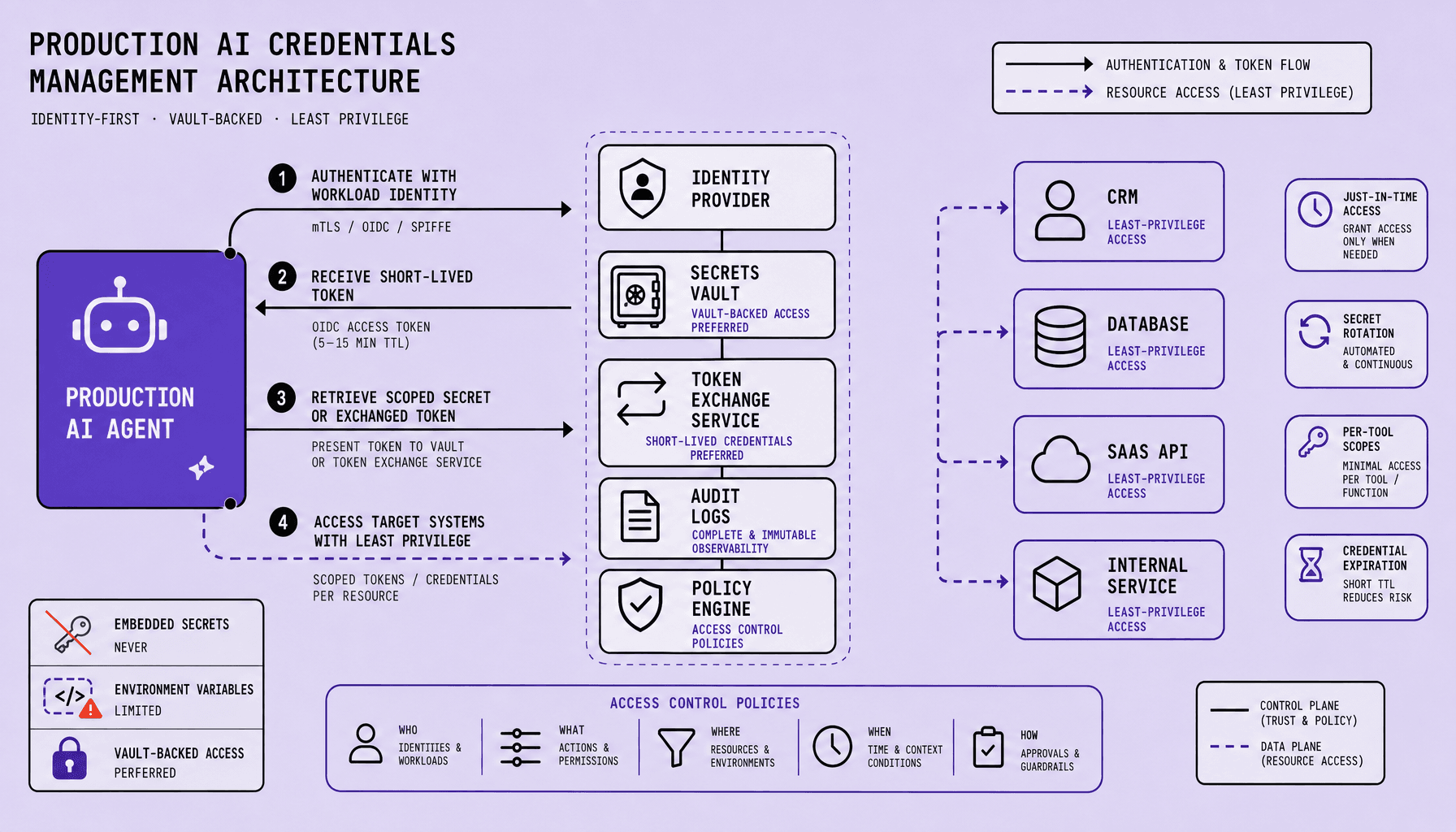
This is where teams usually feel the tension: speed versus containment. Shared keys are easy to wire up. They are also hard to defend once agents start operating across systems. A secure production pattern is simple in principle: the agent should authenticate as a workload, receive task-limited access just in time, and never hold a broad secret longer than the action requires.
Teams often start with environment variables or a shared API key because it gets the agent running fast. Under real production pressure, that model breaks -- prompt logs, CI/CD output, crash dumps, and over-scoped tokens all become credential spill paths. Strong AI credentials management replaces static trust with policy-driven, short-lived access.
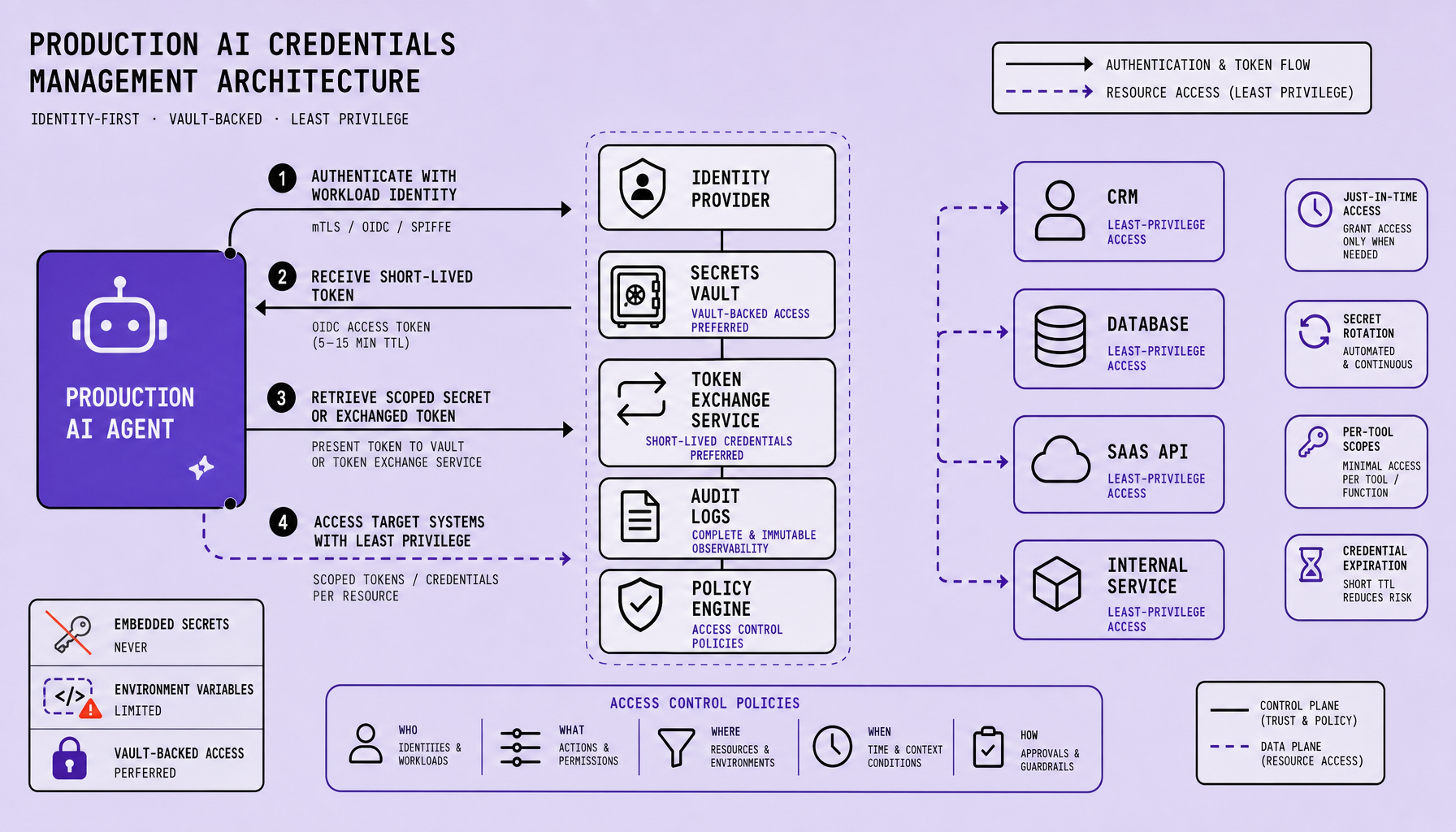
Reference flow: from agent runtime to target systems
A practical reference architecture looks like this:
- The agent runs in a controlled runtime such as Kubernetes, ECS, or a VM with workload identity enabled.
- The runtime authenticates to an identity provider using OIDC or a cloud-native IAM role.
- That identity is exchanged with a vault or token broker -- HashiCorp Vault, AWS Secrets Manager plus STS, Azure Key Vault with managed identity, or GCP Secret Manager with service account impersonation.
- The vault or broker enforces Vault policy, RBAC, and task context before issuing short-lived credentials.
- The agent uses those credentials only for the current tool call:
- CRM access, such as Salesforce, gets a scoped OAuth token
- PostgreSQL gets a short-lived database user or auth token
- SaaS APIs such as Stripe or Slack get delegated, limited tokens
- Internal services use service mesh identity, mTLS, and service-to-service IAM
- Every issuance and call writes to an audit trail.
Put the policy checks in multiple places. IAM at the workload edge. Vault policy at secret issuance. Network segmentation or a service mesh between the agent and internal services. That layered model is what makes agentic AI security hold up in practice.
If your agent can keep a long-lived admin credential in memory, your AI access control model is too broad.
Least-privilege rules that actually work
Least privilege only works when it is specific. Use separate identities per workflow or tool, not one identity for the whole agent. Default CRM and database access to read-only. Require an approval gate for write actions, bulk exports, or destructive operations. Scope access by task, tenant, environment, and time window.
And audit everything.
For AI agent security, monitoring is as important as deployment -- because a perfectly deployed agent with weak visibility can still abuse valid credentials without anyone noticing.
Failure checklist and common mistakes in AI agent credential management
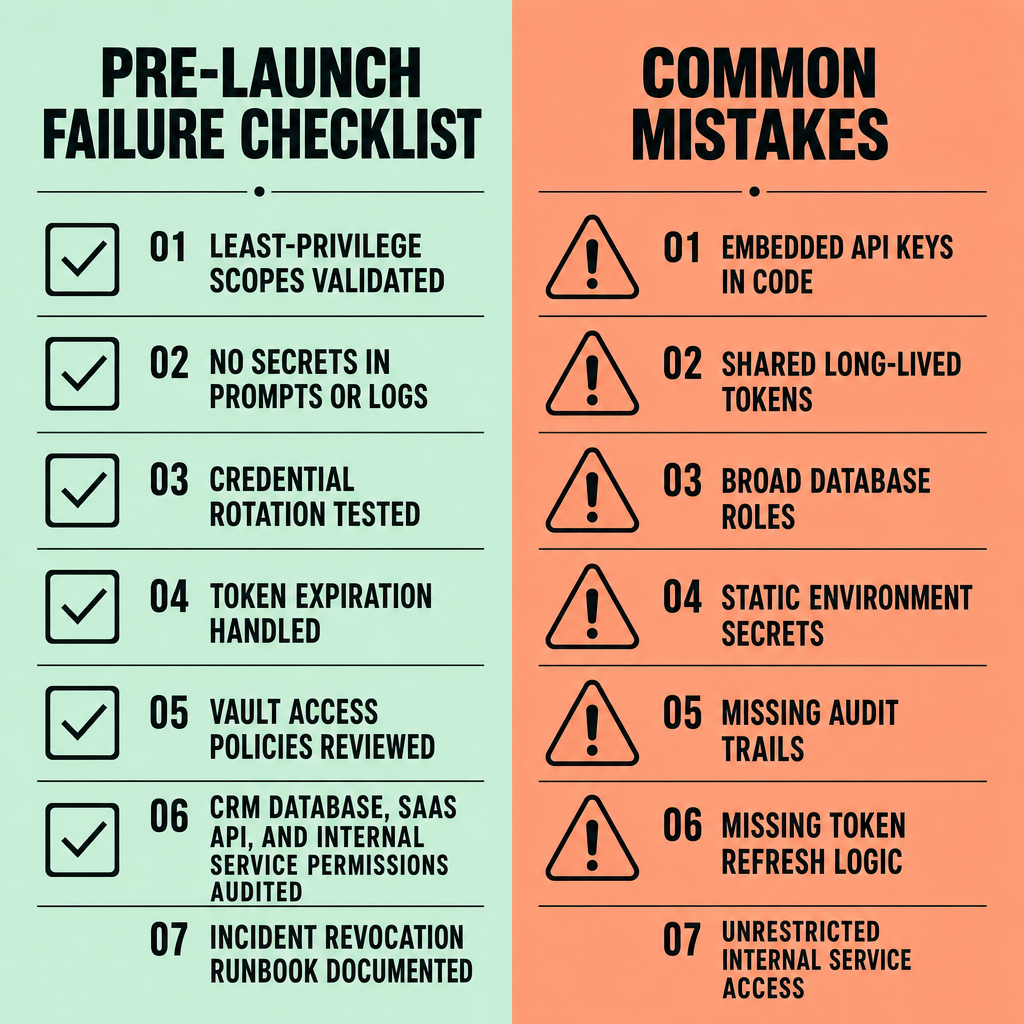
Most credential failures are not exotic. They are ordinary shortcuts left in place too long. Before you ship, run a deployment review, not a trust exercise. Agent credential failures usually come from one missing control inside an otherwise reasonable design.
Use this checklist:
- No hardcoded secrets in code, prompts, container images, notebooks, or CI logs.
- No single broad service account for Salesforce, PostgreSQL, Stripe, Slack, or internal APIs.
- Each tool call maps to the minimum permissions needed for that task.
- Rotation exists, has an owner, and is tested, not just documented.
- Audit logging is enabled for secret reads, token exchange, and privileged tool calls.
- Dev and prod are separated across vault paths, IAM roles, and Kubernetes workloads.
- Secret scanning runs in Git and CI.
- Failed access attempts are logged and reviewed, not silently ignored.
- Emergency revocation is documented so a leaked credential can be cut off fast.
Common mistakes are predictable: storing secrets in prompts, relying on long-lived environment variables, skipping audit logs, reusing dev credentials in production, or giving one agent a credential that grants more access than any single task requires. Another frequent error is treating the vault itself as the finish line. A vault helps, but if the agent can always retrieve the same powerful secret, the risk is only moved, not reduced.
The practical tradeoff is complexity. Short-lived credentials, token exchange, and narrow roles take more setup than a shared API key. But they limit blast radius, make revocation easier, and give investigators something to trace when behavior goes wrong. If you cannot implement full just-in-time access yet, a reasonable interim step is per-agent identities, strict scope reduction, shorter credential lifetimes, and verified logging.
Frequently Asked Questions
What is the safest default for AI credentials management in production agents?
The safest default is workload identity plus vault-backed issuance of short-lived, scoped credentials for each tool call. This model avoids persistent secrets on the agent, supports strong auditability, and limits the blast radius if a token is exposed during runtime, logging, or debugging.
How does AI credentials management differ for CRM access versus database access?
CRM access is usually best controlled through narrowly scoped OAuth permissions tied to specific actions, while database access should favor read-only roles, replica access, or temporary users with tight schema limits. Databases typically need stricter write controls because mistakes can corrupt large volumes of internal data quickly.
Why should AI credentials management avoid putting secrets in environment variables?
Environment variables reduce source-code exposure, but they still leave secrets available to the runtime, operators, and many debugging paths. In production, they are hard to scope per action and often remain static too long, which makes compromise, lateral movement, and incomplete rotation more likely.
How often should production agents rotate credentials?
Production agents should rotate long-lived fallback credentials on a fixed schedule and issue runtime credentials with very short time-to-live values, often minutes rather than days. The best design reduces dependence on rotation frequency by using expiring tokens, because automatic expiry closes risk windows faster than manual credential replacement.
What should happen when an agent fails to get a credential or token?
A production agent should fail closed, record the denial with enough context for investigation, and avoid retry loops that repeatedly request elevated access. The system should return a controlled error, preserve audit evidence, and trigger alerting when failed credential requests suggest misconfiguration, abuse, or policy drift.
Make Imversion a preferred source on Google
Like this kind of AI and software analysis? Add Imversion as a preferred source so Google can highlight our articles for you in Search, AI Overviews, and AI Mode.