AI Agent Development Cost: Essential Guide for 2026
Unlock the secrets of AI agent development cost. Compare quotes, understand pricing tiers, and learn the key drivers behind each cost element.

AI Agent Development Cost: What Founders Should Budget
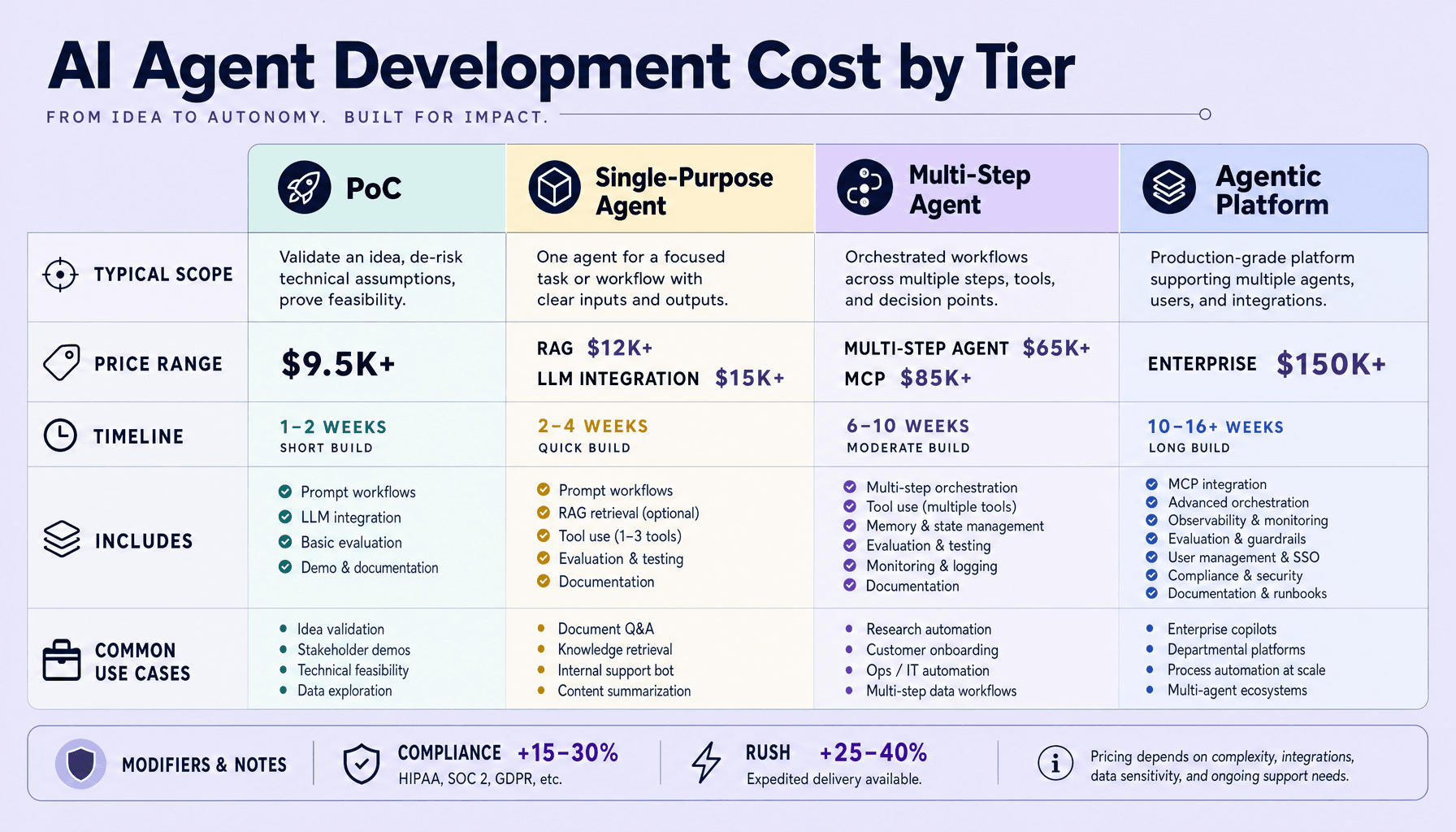
If you are comparing AI agent quotes and seeing numbers that seem disconnected from reality, the problem usually is not pricing inconsistency. It is scope mismatch. Realistic AI agent development cost starts at $9.5K+ for a PoC, $12K+ for RAG, $15K+ for LLM integration, $65K+ for a multi-step agent, $85K+ for MCP-based systems, and $150K+ for enterprise platforms.123 Scope changes everything -- especially compliance, integrations, and evaluation rigor.
Founders get wildly different AI agent pricing because vendors often quote a demo while buyers assume production. In practice, the cost to build an AI agent rises less from the model itself and more from workflow logic, retrieval quality, guardrails, API connectors, and test coverage.45 Compliance-heavy builds commonly add 15–30%, and rush delivery can add 25–40%.13 Our view at Imversion Technologies Pvt Ltd: user experience is as important as functionality, so budget for a usable workflow, not just a model response. This AI agent cost guide should help you compare quotes on equal terms.
Key Takeaways on AI Agent Development Cost
- Expect wide ranges because “agent” can mean a demo or a production workflow. A practical AI agent cost guide starts at $9.5K+ for a PoC, $12K+ for RAG, $15K+ for LLM integration, $65K+ for a multi-step agent, $85K+ for MCP-based systems, and $150K+ for enterprise platforms.123
- The biggest pricing jump comes from build tier -- PoC, single-purpose agent, multi-step agent, or full agentic platform -- and each tier expands workflow depth, reliability needs, and delivery time.135
- The main cost drivers are tools, data, evaluation, compliance, and integrations. In practice, model fees are only one line item in the cost to build an AI agent.
- Compliance can add 15-30%, and rush delivery can add 25-40% to AI agent pricing.12
- Be careful with cheap quotes. If evaluation harnesses, guardrails, audit logs, SSO, or API connector work are missing, the quote likely covers a demo -- not a dependable system. We take a firm view here: user experience is as important as functionality, especially once real users depend on the agent.
AI Agent Development Cost by Tier: PoC to Agentic Platform
This is where most quote comparisons go wrong. Two vendors can both say “AI agent,” while one is pricing a demo and the other is pricing a monitored, integrated, production workflow. Read this part of the AI agent cost guide as a maturity ladder, not a feature wishlist.15
| Tier | Typical use case | Expected deliverables | Price range | Timeline |
|---|---|---|---|---|
| PoC / prototype | Validate one narrow task | Prompt flow, single model hookup, basic UI, light testing | $9.5K+ | 1–3 weeks |
| Single-purpose agent | One reliable business function | Structured outputs, guardrails, analytics, 1–2 integrations | $15K–$40K+ | 3–6 weeks |
| Multi-step agent | Cross-system workflow automation | Planning/execution loop, tool use, memory, evals, retries, handoff | $65K+ | 6–12 weeks |
| Agentic platform | Enterprise-grade multi-agent operations | MCP, admin console, SSO, audit logs, policy controls, observability | $150K+ | 3–9+ months |
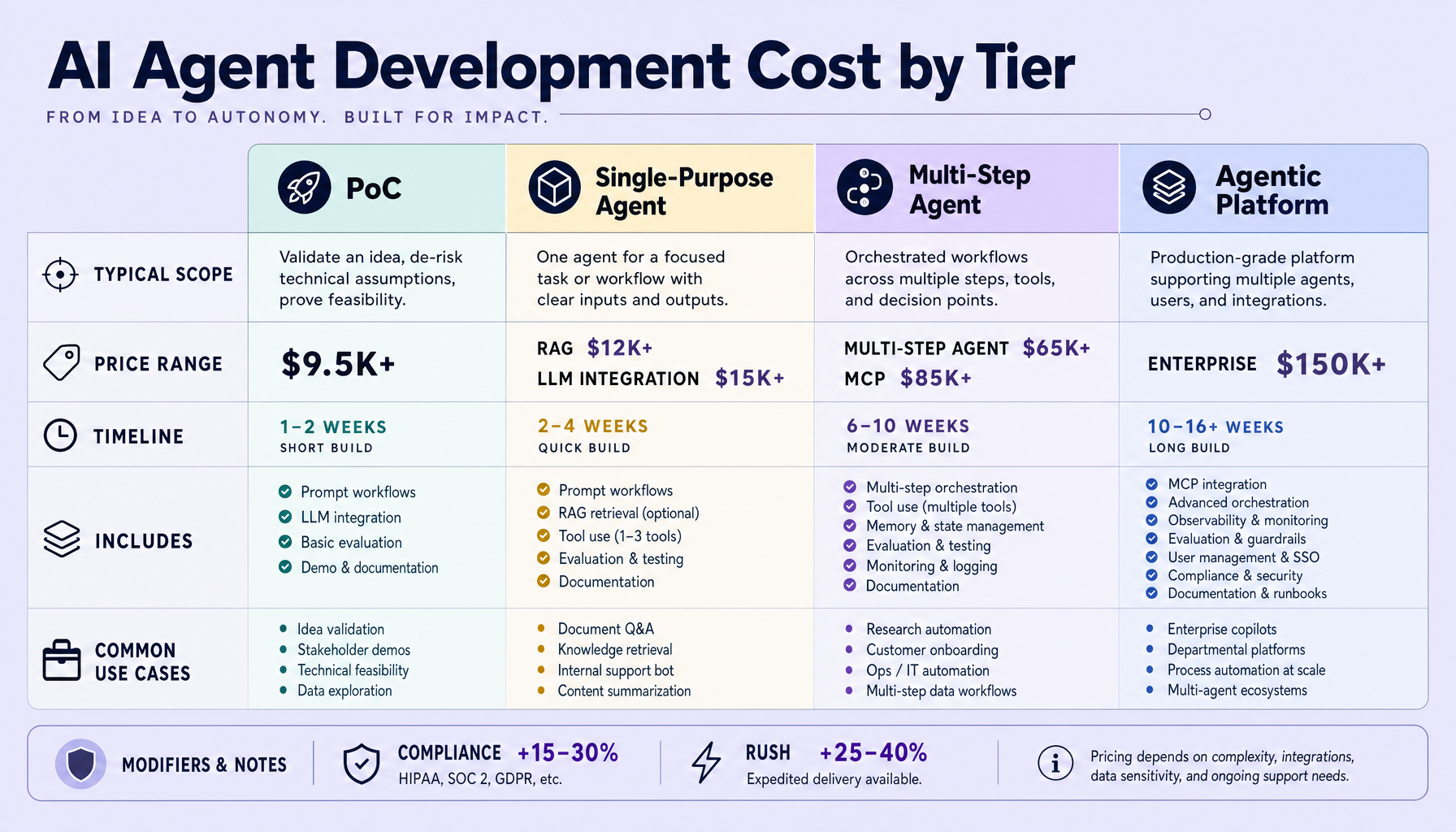
PoC and single-purpose agent
A PoC starts at $9.5K+ and usually buys validation, not durability: one use case, one model connection, basic prompts, and a thin interface.12 If retrieval is part of the brief, RAG changes the floor to about $12K+ because chunking, indexing, document quality, and retrieval testing all add work.14 If the main job is embedding model behavior into an existing app or workflow, LLM integration typically starts around $15K+.13
That is the low end. The moment you need a system people can depend on daily, the work changes.
A production single-purpose agent is different. It handles one business job repeatedly -- support triage, contract Q&A, lead research -- with schema validation, fallback logic, usage analytics, and at least minimal operational controls.
Multi-step agent and agentic platform
Costs climb fast here, and for good reason. Multi-step agent development pricing starts around $65K+ because the system is no longer answering once; it is planning, retrieving, calling tools, checking outputs, and recovering from failure across steps.45 This is where evaluation harnesses, resilience, and human handoff stop being optional.
We view clean code as a cost control measure, not a style preference -- once an agent spans prompts, APIs, queues, and evaluation logic, messy implementation makes every iteration slower.
An MCP-based build usually begins around $85K+, especially if you need secure tool orchestration across internal systems. Enterprise AI agent cost starts at $150K+ when you add admin controls, SSO, audit logs, role-based access, deeper integrations, and compliance overhead.13 Compliance can add 15–30%, and rush delivery often adds 25–40%.12
Cheap quotes often stop at the demo layer and exclude evaluation, integration hardening, observability, and admin controls.
How Long AI Agents Take to Build at Each Pricing Tier
Founders often ask for a faster timeline first and only later discover what was cut to make that timeline possible. Schedules stretch because each tier adds more orchestration, more systems to touch, and a larger evaluation surface. That is why the cost to build an AI agent and the schedule tend to rise together, not separately.13
A PoC at $9.5K+ usually takes 1–3 weeks. Discovery is short. Prompt and workflow design stay narrow. Integration is often limited to one model and a lightweight UI, evaluation is manual or sample-based, and launch hardening is minimal. If retrieval is involved, RAG at $12K+ often needs extra time for chunking, indexing, and source-quality checks.14
A single-purpose agent typically lands in 3–6 weeks. Here, teams add one or two APIs, structured outputs, guardrails, and basic evaluation. If it is really an LLM feature embedded into a product, LLM integration from $15K+ is a realistic floor.13
A multi-step agent at $65K+ usually takes 6–12 weeks.23 Discovery gets deeper. Workflow design now covers branching logic, retries, tool calling, and failure states. Evaluation becomes a real workstream, because long-term productivity only improves if the agent is testable under production-like conditions.
An MCP-based or enterprise platform at $85K+ to $150K+ often needs 3–9+ months.23 The reasons are familiar: more integrations, SSO, audit logs, role controls, compliance review, and production reliability work. Rush builds can compress schedules, but they usually add 25–40% in cost and still ship with narrower scope; compliance-heavy programs can add 15–30% on top.12
The 5 Biggest Drivers of AI Agent Development Cost
A lot of buyers fixate on model API spend because it is the easiest number to picture. It is rarely the number that controls the budget. In practice, AI agent development cost moves more on workflow complexity, data quality, evaluation rigor, compliance controls, and integration reliability than on tokens alone.43
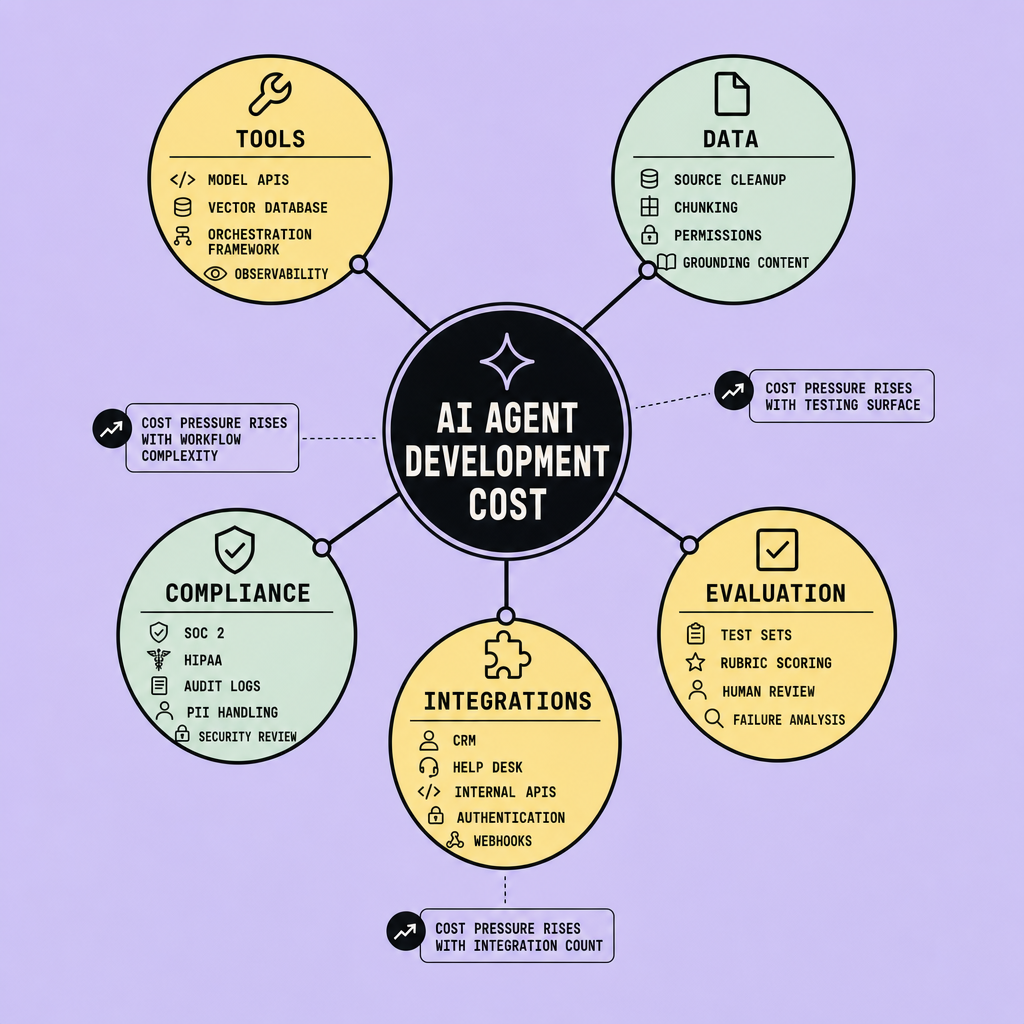
Tools
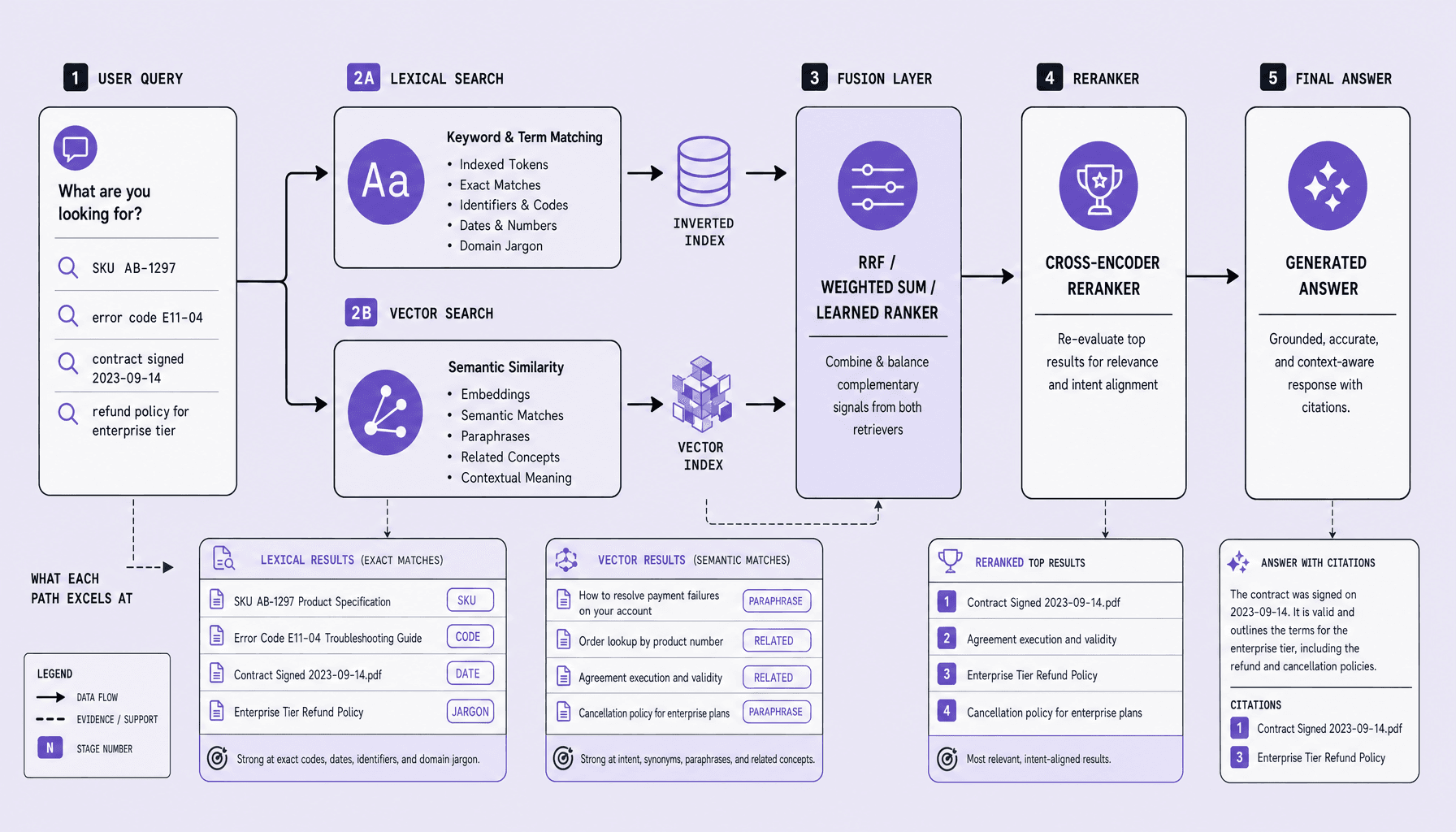
Tooling cost rises once an agent needs orchestration, a vector database for RAG, observability, fallback logic, and guardrails. A lean build might use one LLM, basic prompt routing, and a single retriever. A production-ready build adds tracing, caching, rate-limit handling, retries, and separate environments.
Operational tooling is easy to miss. Monitoring, prompt/version management, and failure recovery are not optional once the agent touches live workflows.4
Data
Data is where many cheap quotes break.
A lean implementation may index a clean document set for RAG and stop there. A robust one requires chunking strategy, metadata design, deduplication, access control, refresh jobs, and source-of-truth rules. If the data is messy, scattered, or stale, costs rise because engineers end up fixing pipelines before the agent can perform reliably.
Bad retrieval can make even a strong model look broken.
Evaluation
Evaluation is one of the most underestimated line items. A demo can be tested manually with a few happy-path prompts. Production needs an evaluation harness, regression tests, scenario coverage, latency checks, and reviews for hallucinations, tool misuse, and edge cases.14
Lean: manual QA plus spot checks.
Robust: automated evals, score thresholds, and release gates.
If a quote includes no explicit evaluation work, compare it to a prototype quote, not a production quote.
Compliance
Compliance can add roughly 15–30% to delivery cost, especially where PII, regulated data, SSO, audit logs, retention rules, and approval workflows are involved.13 Lean builds may rely on basic access control. Robust builds add redaction, policy guardrails, auditability, and vendor reviews.
Integrations
Integrations are where “simple” projects stop being simple. CRM, ERP, ticketing, email, internal APIs, MCP servers, and auth layers all add failure modes.25 A lean agent may call one or two stable APIs. A robust one handles schema drift, retries, permissions, webhooks, and human-in-the-loop escalation.
Integration effort is best priced by complexity, not count alone. One “simple” connector can cost more than the model layer if reliability requirements are high.
What a $65K Multi-Step Agent Budget Looks Like
By this stage, the vague one-line quote becomes dangerous. A real $65K multi-step agent budget should look itemized, not mysterious. If a quote hides testing, integrations, or deployment inside one vague number, it is not a reliable AI agent cost guide or a useful reference for AI agent development pricing.
A plausible allocation looks like this:
- Discovery and requirements: $6K
- Workflow design and orchestration logic: $10K
- Model integration and prompt/system behavior: $9K
- Retrieval/data layer -- indexing, chunking, permissions, grounding: $8K
- Evaluations, guardrails, and observability: $9K
- Frontend and admin UX: $7K
- Business system integrations and API connectors: $10K
- Deployment, CI/CD, environment setup, and handoff: $6K
Total: $65K
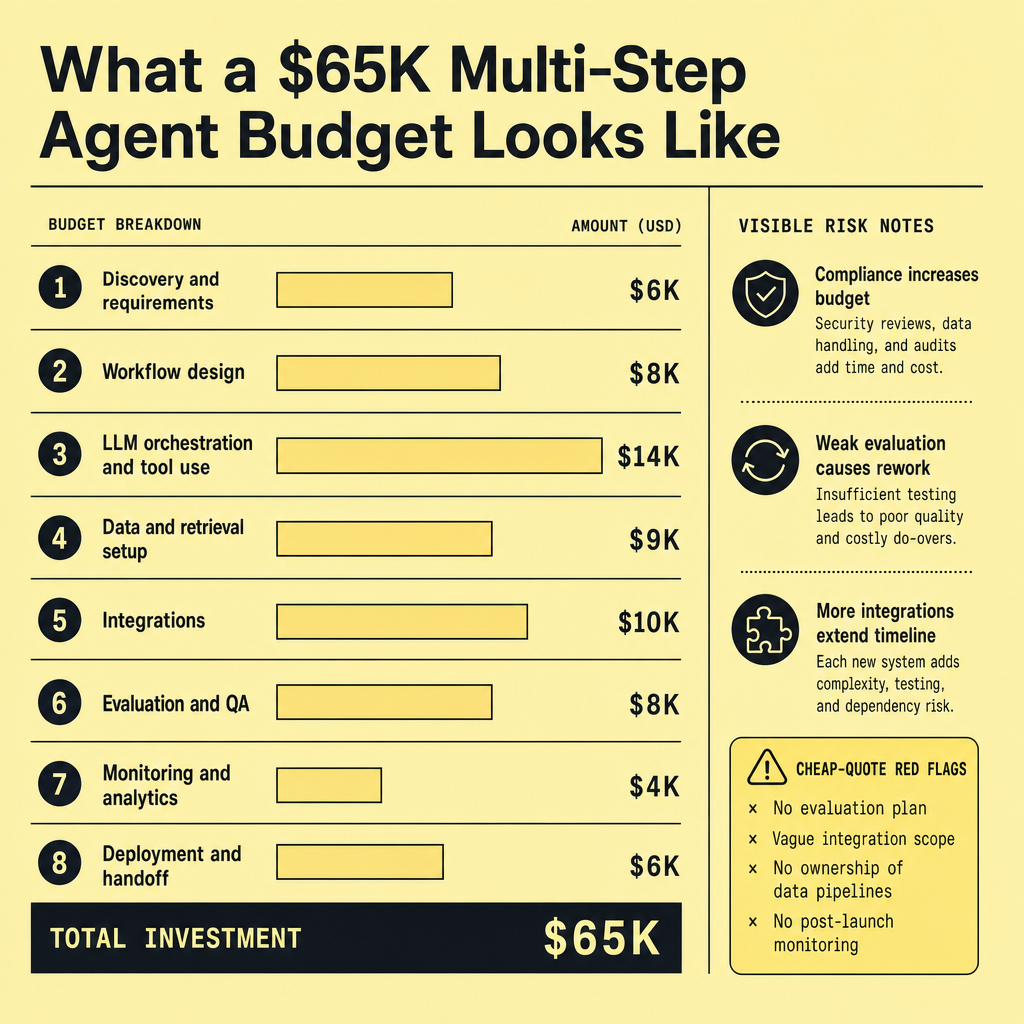
This is the point in AI agent pricing where the model is only one line item. The larger cost to build an AI agent usually comes from workflow state management, tool calling, retrieval reliability, admin UX, testing, and production deployment. Put plainly, the expensive part is making the system dependable across multiple steps, not just connecting to an LLM once.
That is also why quotes at this tier should show evaluation and operations work explicitly. Teams usually need a way to review outputs, trace failures, manage prompts or policies, and monitor how the agent behaves after launch. Without that layer, a “multi-step agent” is often closer to a prototype than a production workflow.435
Expect these line items to shift by product context. A CRM-heavy workflow may spend more on integrations, while a regulated workflow may spend more on evaluations, auditability, and approval controls.43
Compliance typically adds 15–30%, taking a $65K build to roughly $74.75K–$84.5K. Rush delivery often adds 25–40%, pushing the same scope to about $81.25K–$91K.123
For enterprise AI agent cost planning, that kind of premium is usually a function of added scope, controls, or delivery pressure rather than a mysterious markup.
Cheap-Quote Red Flags and a Buyer Checklist for AI Agent Pricing
A low quote can look efficient right up until launch prep starts. Then the missing work shows up: evaluation, security, observability, admin controls, messy integration handling. If two vendors quote wildly different numbers for the same “agent,” one may be pricing a demo rather than a production system. That is one of the easiest ways to misread AI agent pricing and underestimate the real cost to build an AI agent.43
Cheap quotes usually fail in the omissions.
Red flags in low AI agent quotes
Watch for proposals that skip the hard parts:
- No evaluation plan. If there are no evaluation metrics, test datasets, hallucination checks, or acceptance criteria, the vendor has not defined how quality will be measured.14
- Vague integration scope. “Connect to CRM” is not scope. Buyers should see which APIs, how many systems, what auth method, what rate limits, and what failure handling.
- No security review or compliance scope. If the quote ignores SSO, audit logs, role-based access, data retention, or regulated-data handling, expect cost to surface later.36
- Undefined ownership of prompts, workflows, and data. Buyers should know who owns prompt libraries, evaluation harnesses, retrieval pipelines, and conversation logs from day one.
- Unrealistic timeline promises. A vendor quoting enterprise-grade behavior in PoC timing is usually excluding testing, governance, or deployment hardening.25
- No post-launch support assumptions. If there is no mention of SLAs, bug-fix windows, model drift checks, or usage monitoring, the quote is incomplete.
Missing conversational design, fallback behavior, and human-handoff logic are also red flags. An agent can “work” technically and still fail users.
Compare proposals by deliverables and acceptance criteria, not sticker price. Low bids often become expensive once missing production requirements are added back in.
Buyer checklist for comparing proposals
Use this checklist when reviewing AI agent quotes:
- Defined deliverables by tier: PoC, RAG, LLM integration, multi-step workflow, or platform
- Named acceptance criteria and evaluation metrics
- Clear integration scope: systems, APIs, auth, retries, ownership
- Documented security review and compliance assumptions
- Explicit ownership of prompts, data pipelines, logs, and IP
- Deployment plan: environments, monitoring, guardrails, rollback
- Post-launch support terms, SLAs, and model update process
- Itemized exclusions, change-order rules, and rush assumptions
A practical test is simple: if a quote cannot explain what is being built, how it will be measured, and how it will run after launch, it is not a reliable AI agent cost guide.13
References
- AI Agent Development Cost in 2026: Full Pricing Guide
- AI Agent Development Cost $5K to $180K+ (2026)
- Cost to Build an AI Agent: A Complete Breakdown Guide
- The Complete AI Agent Development Cost Guide for 2026
- AI Agent Development: Costs, Tiers, and When You Actually ...
- A Cost Analysis of AI Agents in the Enterprise
- How to Build & Sell AI Agents: Ultimate Beginner's Guide
- How Much Does It Cost to Build an AI Agent?
Footnotes
-
AI Agent Development Cost in 2026: Full Pricing Guide ↩ ↩2 ↩3 ↩4 ↩5 ↩6 ↩7 ↩8 ↩9 ↩10 ↩11 ↩12 ↩13 ↩14 ↩15 ↩16 ↩17 ↩18 ↩19 ↩20
-
AI Agent Development Cost $5K to $180K+ (2026) ↩ ↩2 ↩3 ↩4 ↩5 ↩6 ↩7 ↩8 ↩9 ↩10 ↩11
-
The Complete AI Agent Development Cost Guide for 2026 ↩ ↩2 ↩3 ↩4 ↩5 ↩6 ↩7 ↩8 ↩9 ↩10 ↩11 ↩12 ↩13 ↩14 ↩15 ↩16 ↩17 ↩18
-
Cost to Build an AI Agent: A Complete Breakdown Guide ↩ ↩2 ↩3 ↩4 ↩5 ↩6 ↩7 ↩8 ↩9 ↩10 ↩11
-
AI Agent Development: Costs, Tiers, and When You Actually ... ↩ ↩2 ↩3 ↩4 ↩5 ↩6 ↩7
Frequently Asked Questions
What is usually missing from a low AI agent development cost quote?
Low quotes often exclude the work that makes an agent dependable in production: evaluation datasets, regression tests, observability, admin controls, security review, and post-launch support. The cheapest proposal is frequently a prototype price presented as a deployment price, which is why scope verification matters more than headline budget alone.[^1][^4]
How does AI agent development cost change after launch?
Post-launch cost typically shifts from feature building to operations: model monitoring, prompt updates, retrieval refreshes, bug fixes, API change handling, and periodic evaluation reruns. A well-built agent is not a one-time asset; it behaves more like a software product that needs maintenance to preserve quality, safety, and business accuracy.
Why should founders ask for acceptance criteria before approving an AI agent budget?
Acceptance criteria convert a vague AI deliverable into a measurable software outcome. They define what success means for accuracy, latency, integration reliability, fallback behavior, and user handoff, which prevents disputes later and makes vendor quotes directly comparable even when architectures differ.
How can I reduce AI agent development cost without undermining the project?
The safest way to lower cost is to narrow scope, not remove reliability essentials. Limit the first release to one workflow, one or two integrations, a smaller document set, and clear escalation rules, while keeping evaluation, logging, and ownership terms intact. That approach protects delivery quality better than cutting testing or security.[^2][^3]
Why does procurement or security review slow enterprise agent projects so much?
Enterprise reviews add time because they examine data flow, vendor risk, identity controls, retention policy, auditability, and operational ownership across multiple teams. Even when the agent itself is technically ready, security and procurement gates can delay launch if requirements such as SSO, audit logs, or regulated-data handling were not planned early.[^4][^8]
Make Imversion a preferred source on Google
Like this kind of AI and software analysis? Add Imversion as a preferred source so Google can highlight our articles for you in Search, AI Overviews, and AI Mode.