RAG vs long context: Cost-Effective Solutions for 2026
Uncover the essential differences between RAG vs long context for enterprise knowledge systems and choose the right approach for your needs.

RAG vs long context: which one fits enterprise knowledge systems?
Most teams hit the same problem early: the model can answer well only if it sees the right evidence. That sounds obvious, but it is exactly where RAG vs long context becomes a real architecture decision, not a model preference. If the right documents are already known and fit the token budget, long context LLMs are often the simpler option. But for most enterprise knowledge systems with large, changing, permission-sensitive content, retrieval based systems are the better default.
A practical rule helps. If a team is answering from a fixed set of documents -- say one policy packet, one contract set, or a short product spec -- long context is simpler. If the corpus looks more like SharePoint, Confluence, Google Drive, or a support repository, enterprise RAG scales better on cost, freshness, citations, and access control. The decision should follow the workload: known small context, use long context; large living corpus, use retrieval. This is the pattern teams at places like Imversion Technologies Pvt Ltd should evaluate first.
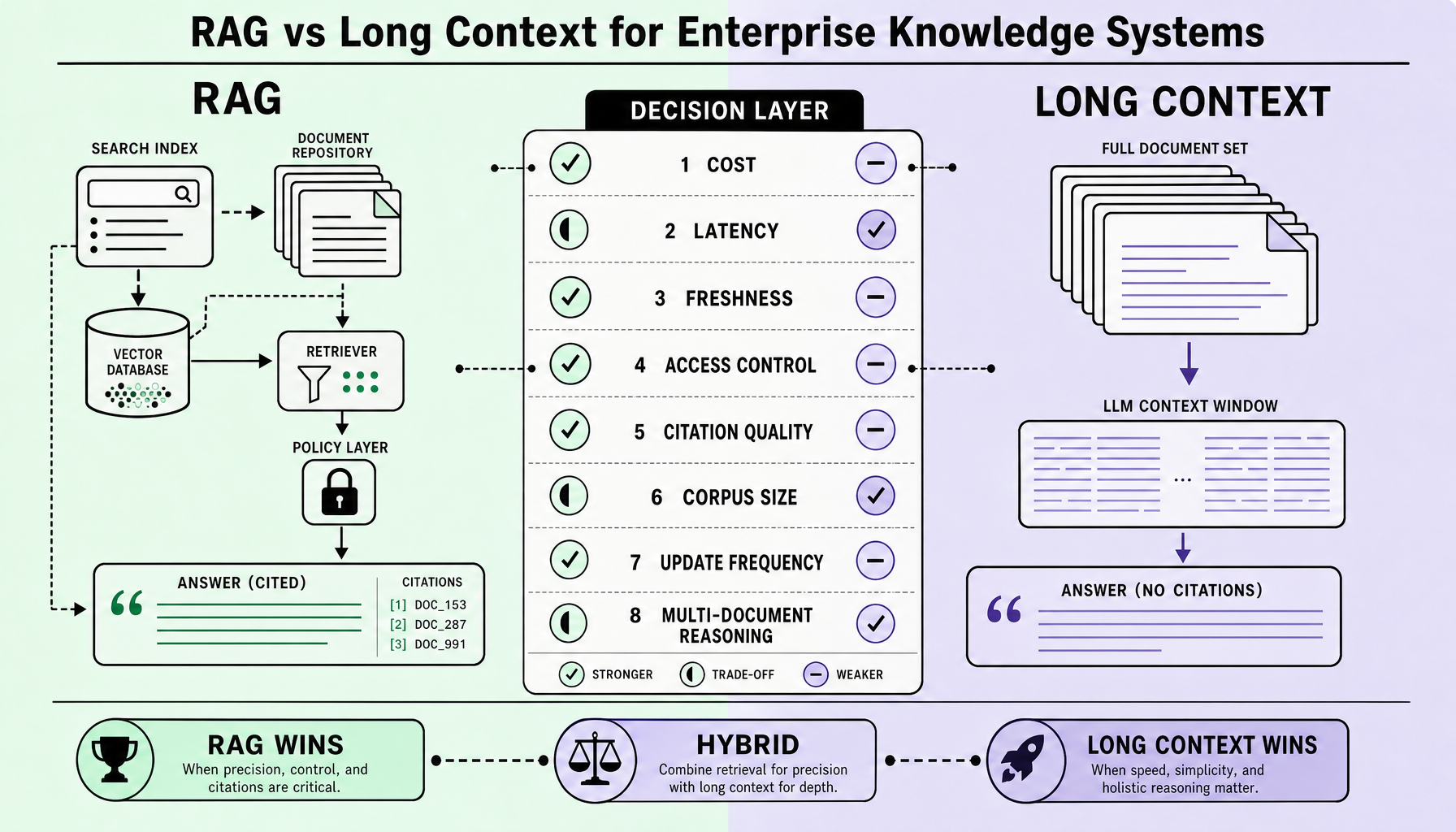
Key Takeaways for RAG vs long context decisions
-
For most RAG vs long context choices, the deciding factor is not model size. It is operating shape. If the right documents are already known and small enough to fit comfortably, long context LLMs are simpler and useful for deep, bounded analysis.
-
Choose enterprise RAG when the corpus looks like SharePoint, Confluence, Google Drive, policy manuals, or support repositories -- large, messy, updated often, and permission-sensitive. It usually wins on freshness, access control, citation quality, and token cost at scale.
-
Long prompts can reduce retrieval complexity. But they raise token spend and often response time. A practical RAG decision guide should compare total system cost, retrieval latency, and answer quality under real workloads -- because these choices should be backed by data.
-
Use long context for known-document synthesis and multi-document reasoning across a curated set. Use enterprise RAG for open-ended enterprise search, governed access, and evidence-linked answers. Hybrid patterns often fit best.
What changes architecturally between RAG vs long context systems: long context LLMs and retrieval based systems
The architecture changes at the very first step: how evidence reaches the model.
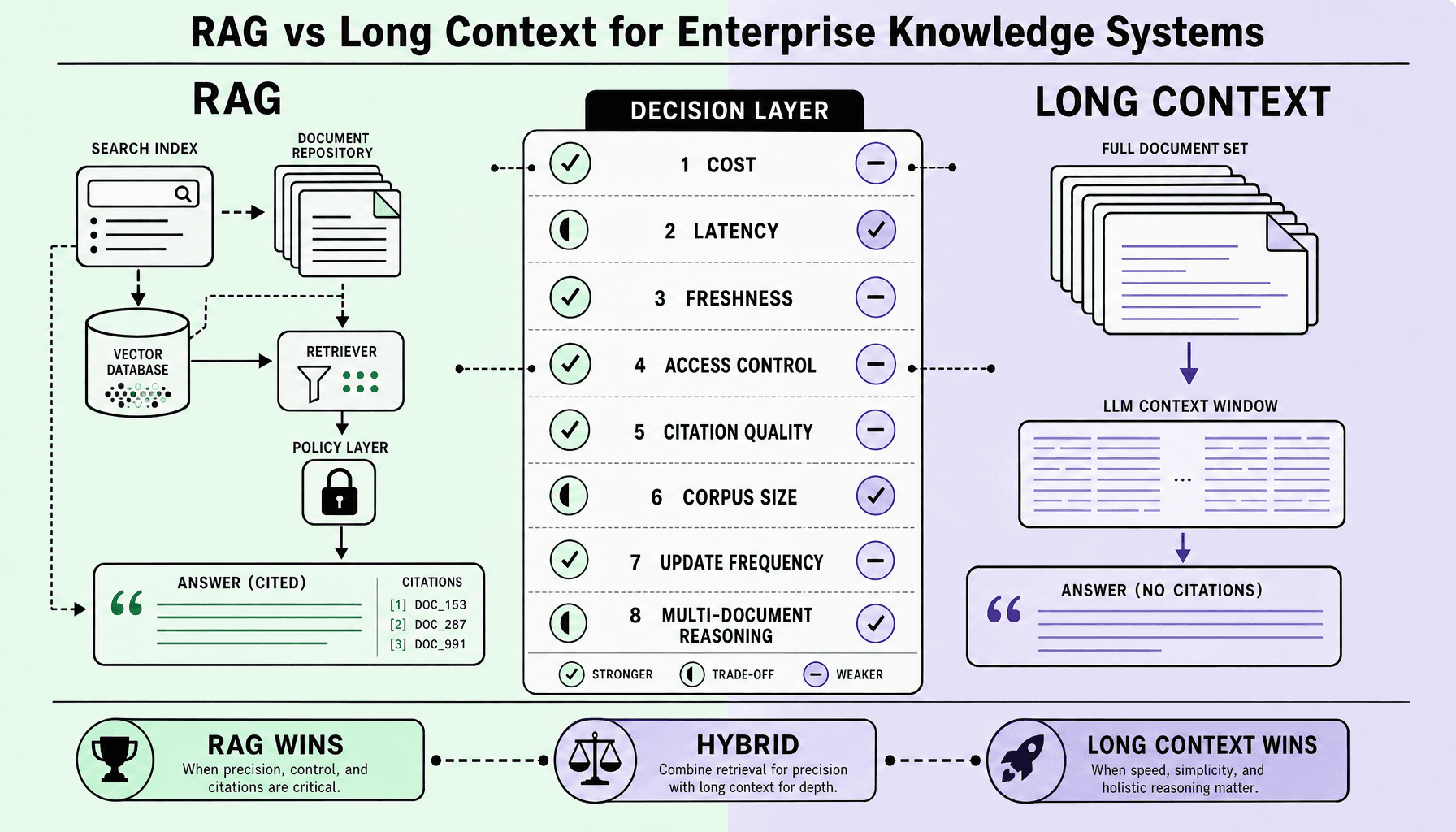
With long context LLMs, teams place the documents directly into the prompt -- policy PDFs, product specs, support articles, meeting notes, whatever is already known. The model reads that full bundle inside its context window and answers from what it was given. Simple path. Fewer moving parts. That only holds if the right documents are identified upfront and fit comfortably within the token budget.
Retrieval based systems work differently. They treat the problem as search first, generation second. A user asks a question, the system queries an index, runs vector search or hybrid search, often applies reranking, and then does prompt assembly with the top passages before the model writes the answer. That is the core of enterprise RAG.
This is where teams often misread the tradeoff. A bigger context window does not automatically create a better knowledge system. Retrieval solves a discovery problem that more tokens alone do not remove.
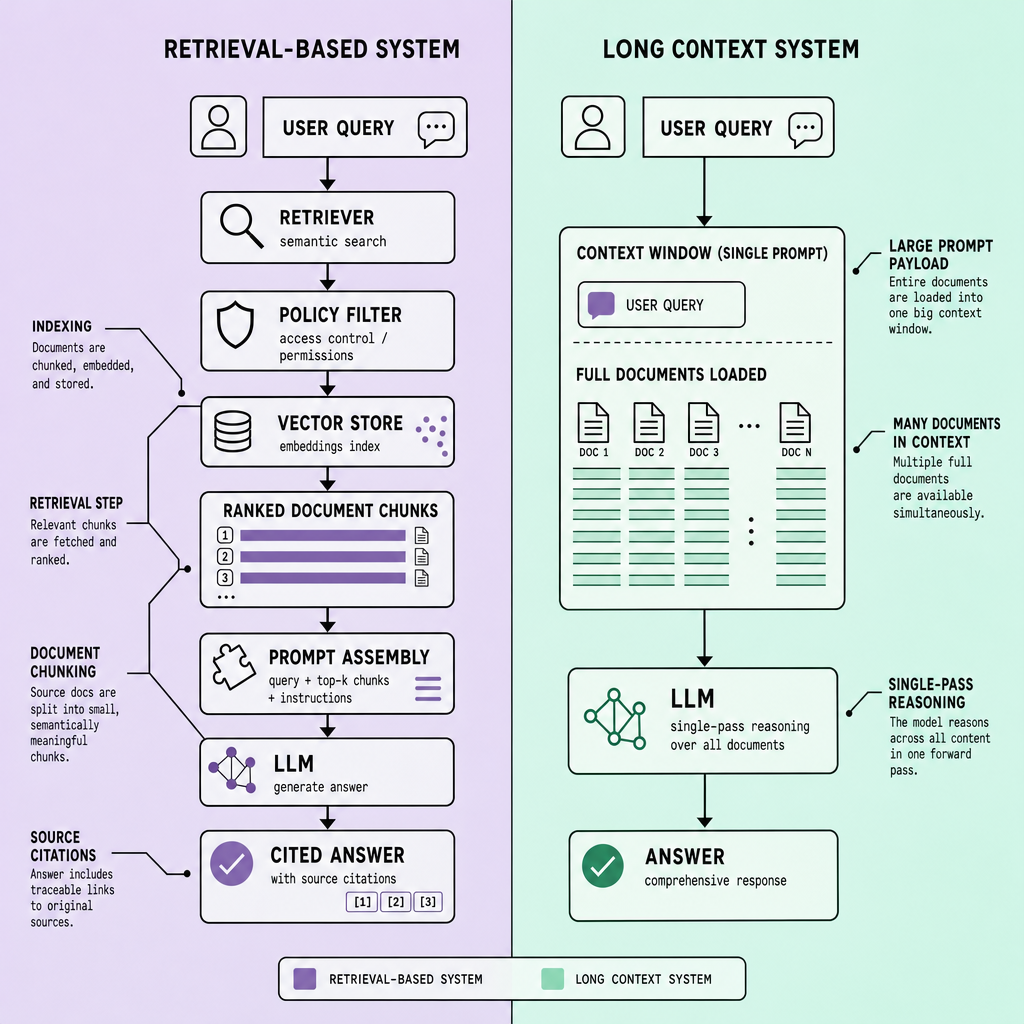
What the pipeline looks like
A long-context design is usually:
user query → selected documents → single prompt → model response
An enterprise RAG design is usually:
user query → retrieval-augmented generation pipeline → search index → ranked passages → prompt assembly → model response
That difference shifts system responsibilities. Long context LLMs push complexity into prompt construction and token spend. Retrieval based systems push complexity into indexing, chunking, access control, ranking, and citation mapping.
Why enterprises feel this difference fast
The difference shows up quickly under real workloads.
If a team is analyzing a known contract pack, board deck, or a fixed set of incident reports, long context LLMs are often the cleaner choice. The evidence set is known in advance. No search layer needed.
A SharePoint, Confluence, or Google Drive-style corpus changes the equation. Thousands of files. Mixed permissions. Frequent updates. Search quality starts to matter more than raw context size. Sending 20 relevant passages is usually more robust than stuffing hundreds of pages into a prompt and hoping the model pays attention to the right parts.
Practical rule: use long context for known-document workflows; use enterprise RAG when the corpus is large, dynamic, or access-controlled.
So the real system-design difference is not just prompt length. It is whether the architecture assumes known evidence or must find evidence reliably before generation.
RAG vs long context comparison matrix for enterprise knowledge workloads
Most teams should not treat this as a model race. They should treat it as an operating-constraints decision. In RAG vs long context, the better option depends on corpus size, document churn, permission boundaries, and how much evidence must be shown back to users.
| Dimension | Long context LLMs | RAG / enterprise RAG | Better fit |
|---|---|---|---|
| Cost | Input cost rises with prompt length; sending many pages on every query gets expensive fast | Sends only retrieved passages, but adds indexing, embedding, and search infrastructure | RAG for repeated knowledge queries at scale |
| Latency | Long prompts usually increase response time because the model must process more tokens | Adds retrieval time, but often stays faster overall than massive prompts | RAG for interactive assistants; long context for small known sets |
| Freshness | Updated docs must be manually included at inference time | Newly indexed content can appear in answers without rebuilding prompts | RAG for policy, support, and product docs |
| Access control | Harder to enforce if prompts are assembled loosely across mixed sources | Retrieval can filter by ACLs from SharePoint, Confluence, or Drive-style sources | RAG for governed enterprise knowledge systems |
| Citation quality | Can cite well if source chunks are structured in prompt, but prompts get noisy at size | Usually better citation precision because passages are selected explicitly | RAG for auditability and user trust |
| Corpus size & updates | Works best when relevant files are already known and limited | Handles large, changing repositories with vector or hybrid search | RAG for broad enterprise corpora |
| Multi-document reasoning | Strong when all relevant documents are already known and small enough to include together | Stronger at finding candidate evidence across large corpora, weaker if retrieval misses a key document | Long context for bounded analysis; RAG for discovery |
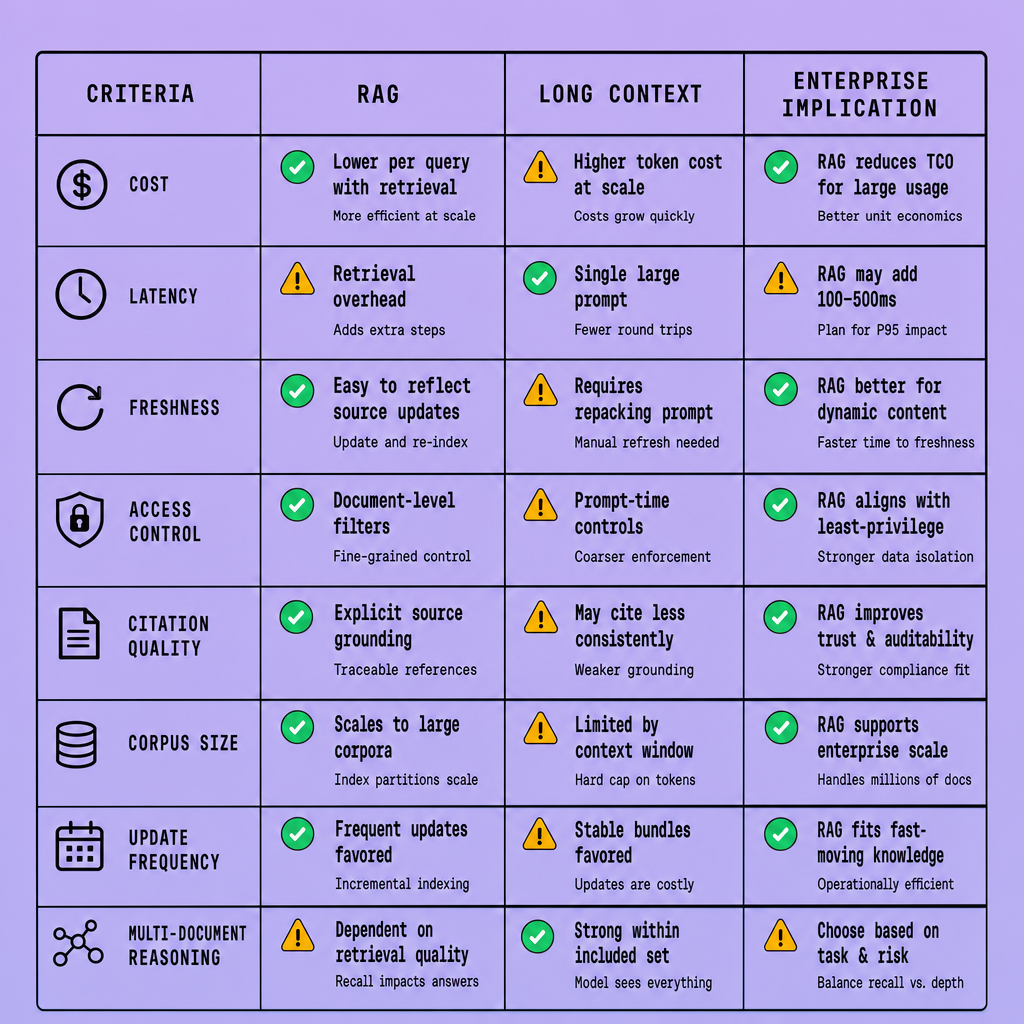
How to read the matrix
The pattern is simple. Long context LLMs fit bounded tasks: board packets, contract sets, a known incident timeline, or a small policy bundle. When the right files are already known and fit comfortably in the context window, putting them directly in the prompt can be the cleanest path.
Enterprise knowledge work is often different.
Support repositories, HR policies, and product documentation change constantly. Permissions vary by team, and users ask open-ended questions. In that shape, retrieval is usually the better fit because it reduces token load, keeps latency more predictable, and makes it easier to pull in newer evidence through indexing.
The practical way to decide is to test against your workload shape: average document size, update frequency, permission complexity, and citation expectations. One caveat matters here: multi-document reasoning may favor long context when the relevant files are known upfront and fit the token budget. If finding the right evidence is part of the task, enterprise RAG is usually the safer default.
How to choose: the decision criteria that separate enterprise RAG from long context
Start with the corpus, not the model.
Teams often begin by asking whether long context LLMs can hold enough text. That is the wrong first question. A better RAG decision guide starts with document behavior: if the knowledge base is large, updated often, and permissioned, enterprise RAG should be the default until proven otherwise.
1. Corpus characteristics
If the working set is small and known in advance -- say a handful of policy PDFs or a fixed product spec pack -- long context can be the simpler choice. Put the documents in the prompt, keep the architecture lean, move fast.
If the corpus looks like SharePoint, Confluence, Google Drive, support articles, release notes, and internal wikis spread across teams, retrieval wins quickly. This becomes more obvious with document churn. Long prompts get expensive, stale, and hard to control. A vector or hybrid search layer can keep the prompt small while pulling current evidence.
A practical threshold works like this: small-known-set favors long context; large-dynamic-corpus favors retrieval.
2. Governance requirements
This is where many long-context-first designs break.
If different users should see different documents, a knowledge assistant needs authorization filters before generation, not after. RAG systems can enforce governance at retrieval time with metadata filters, ACL-aware indexing, and source-level controls. Long context workflows can do this only if the application already knows the exact allowed document set for that user on every query.
That is why permission-sensitive enterprise knowledge usually points to enterprise RAG.
3. Performance targets
Cost and latency are not side details. They decide whether a system is viable. Long context LLMs charge you in tokens every time; retrieval pipelines charge you in infrastructure and tuning. For repeated enterprise traffic, sending fewer tokens is often the better operating model.
If the same answer quality can be achieved with 10 retrieved passages instead of a 200-page prompt, pay for retrieval, not excess context.
4. Reasoning demands
Use long context when success depends on reading a bounded packet end to end. Use RAG when the challenge is finding the right evidence first. Use a hybrid architecture when both are true: retrieve the right sources, then give the model enough room for multi-document reasoning, comparison, and synthesis.
One rule should stay fixed: understanding why the system failed -- retrieval miss, ranking error, or reasoning gap -- matters more than chasing the biggest context window.
Enterprise use cases where long context wins, where RAG wins, and where both belong
Most teams should not force one architecture onto every workflow. Use long context when the evidence set is already known and bounded, use RAG when the system must search a large changing corpus, and combine both when retrieval finds the right evidence but cross-document reasoning still matters.
Long context wins: due-diligence review on a known document pack
Use long context LLMs when the evidence set is already known, bounded, and stable for the duration of the task. A due-diligence analyst reviewing a document pack -- contracts, policy schedules, board notes, and side letters for one transaction -- is a clear example.
Here, retrieval can get in the way. The task is not “find one answer in SharePoint.” It is compare clauses across many files, spot inconsistencies, and reason across the full set. Multi-document reasoning matters more than corpus-scale search. Teams can load the full pack, or a curated subset, into one prompt flow.
Citation quality can still be acceptable if the system preserves file names, section headers, and page anchors in the prompt. But access control is only as strong as the upstream process that assembled the pack, and freshness depends on that pack being current.
RAG wins: policy assistant and support knowledge search
For a policy assistant over Confluence and SharePoint, or support documentation spread across product docs, runbooks, and help articles, enterprise RAG is usually the better fit.
The reason is operating shape: the corpus is large, changes often, and has permission boundaries by team, role, or region. Sending all of that to the model every time is slow and expensive.
A retrieval layer -- often hybrid search over keywords plus vectors -- can pull the few passages that matter, apply document-level access control before generation, and return cleaner source attribution. For many enterprise knowledge systems, that is more useful than sending giant prompts.
Both belong: guided support resolution
Hybrid designs are common for good reason.
A support agent might ask for the right troubleshooting path for a specific product issue. Enterprise RAG retrieves the latest support documentation, release notes, and known-issue articles. Then the model uses a moderate long-context window to reason across those retrieved sources together, compare steps, resolve contradictions, and produce a single answer with citations.
If the corpus is broad and changing, retrieve first. If the case file is known and bounded, expand context. Many enterprises need both in the same stack.
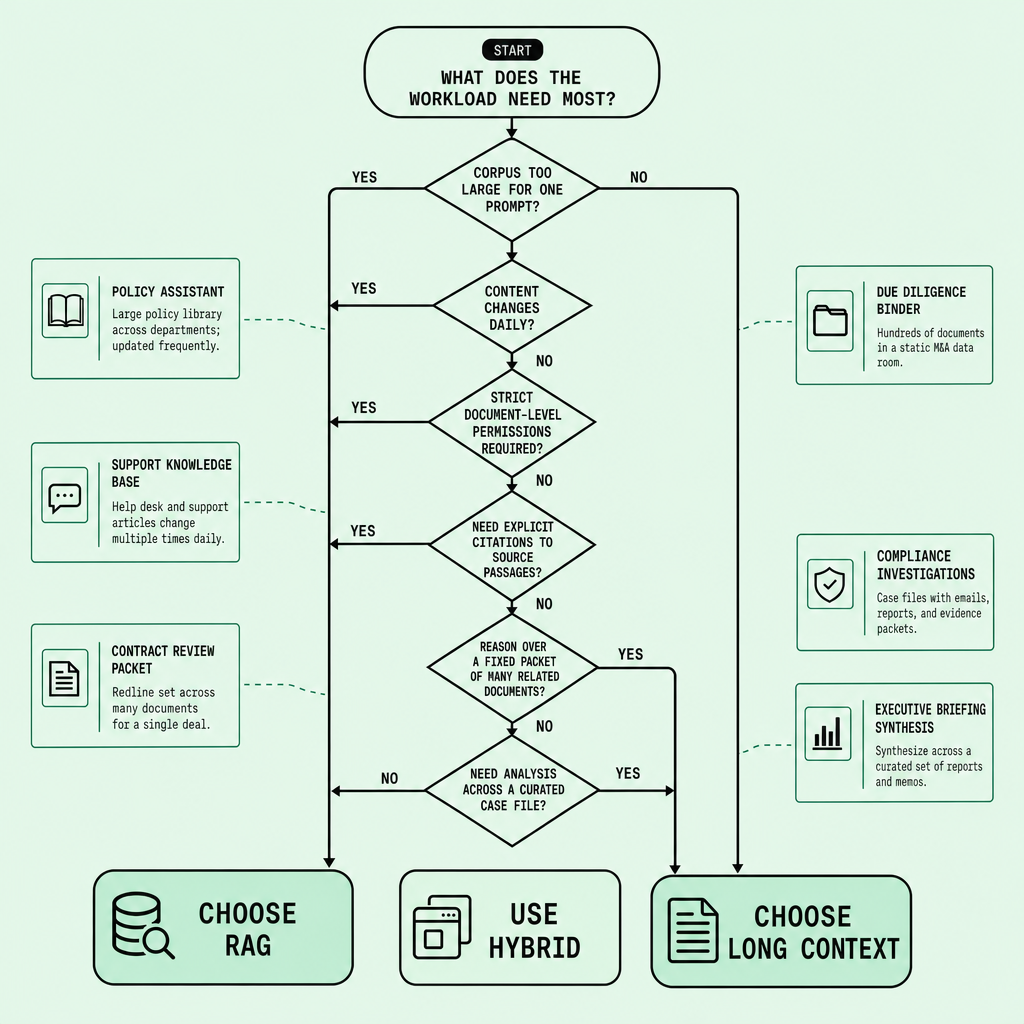
A practical conclusion for RAG vs long context architecture choices
Choose retrieval by default.
For most RAG vs long context decisions, enterprise RAG is the safer pattern for enterprise knowledge systems because it controls token cost, keeps content fresh, respects document permissions, and produces tighter citations from SharePoint, Confluence, Google Drive, policy repositories, and support docs. Big windows help. But they do not replace search.
Use long context LLMs when the evidence set is already known, bounded, and stable -- like a fixed contract pack, a case file, or a small review bundle where multi-document reasoning matters more than corpus search.
A practical rule: if teams must ask “what documents should this answer use?”, build retrieval first. Because understanding why the answer used those documents is essential. Then add long context where bounded workflows benefit from simpler prompting.
Frequently Asked Questions
What is the biggest operational difference in RAG vs long context for enterprise teams?
The biggest operational difference is where complexity lives. Long context pushes cost and performance pressure into every query because the model must read more tokens each time, while RAG pushes complexity into indexing, retrieval quality, and governance controls. That makes long context easier to start, but RAG easier to operate at scale across large knowledge estates.
How does RAG vs long context affect evaluation and testing?
RAG vs long context changes what teams must measure. Long-context systems should be tested for prompt overflow, reasoning consistency, and sensitivity to document ordering. RAG systems should be tested for retrieval recall, ranking quality, permission enforcement, and citation grounding. The best evaluation suite separates search errors from reasoning errors so teams can fix the right layer.
Why should enterprises consider a hybrid design instead of choosing only one approach?
Enterprises should consider a hybrid design because many workflows require both discovery and synthesis. Retrieval can find the latest, authorized evidence from a large corpus, and a moderate context window can then support comparison, summarization, and cross-document reasoning over that evidence. Hybrid designs reduce token waste without forcing the model to reason from incomplete context.
When does RAG vs long context change compliance and audit readiness?
RAG vs long context matters for compliance when an organization must prove what information the model used and whether the user was allowed to see it. RAG usually improves audit readiness because retrieval logs, document filters, and source mapping create a clearer evidence trail. Long context can still be compliant, but only when document selection is tightly controlled upstream.
How should a team pilot RAG vs long context before committing to architecture?
A team should pilot both approaches on the same set of realistic enterprise tasks and compare answer accuracy, citation usefulness, response time, operating cost, and failure modes. The pilot should include permission-sensitive queries and newly updated documents. A short benchmark built around actual user questions usually reveals the right architecture faster than theoretical model comparisons.
Make Imversion a preferred source on Google
Like this kind of AI and software analysis? Add Imversion as a preferred source so Google can highlight our articles for you in Search, AI Overviews, and AI Mode.