Context Engineering: Optimizing AI Agent Performance for 2026
Learn how context engineering shapes AI agents' performance, addressing issues of reliability and cost. Discover effective strategies for implementation.

What Context Engineering Means in Modern AI Agents
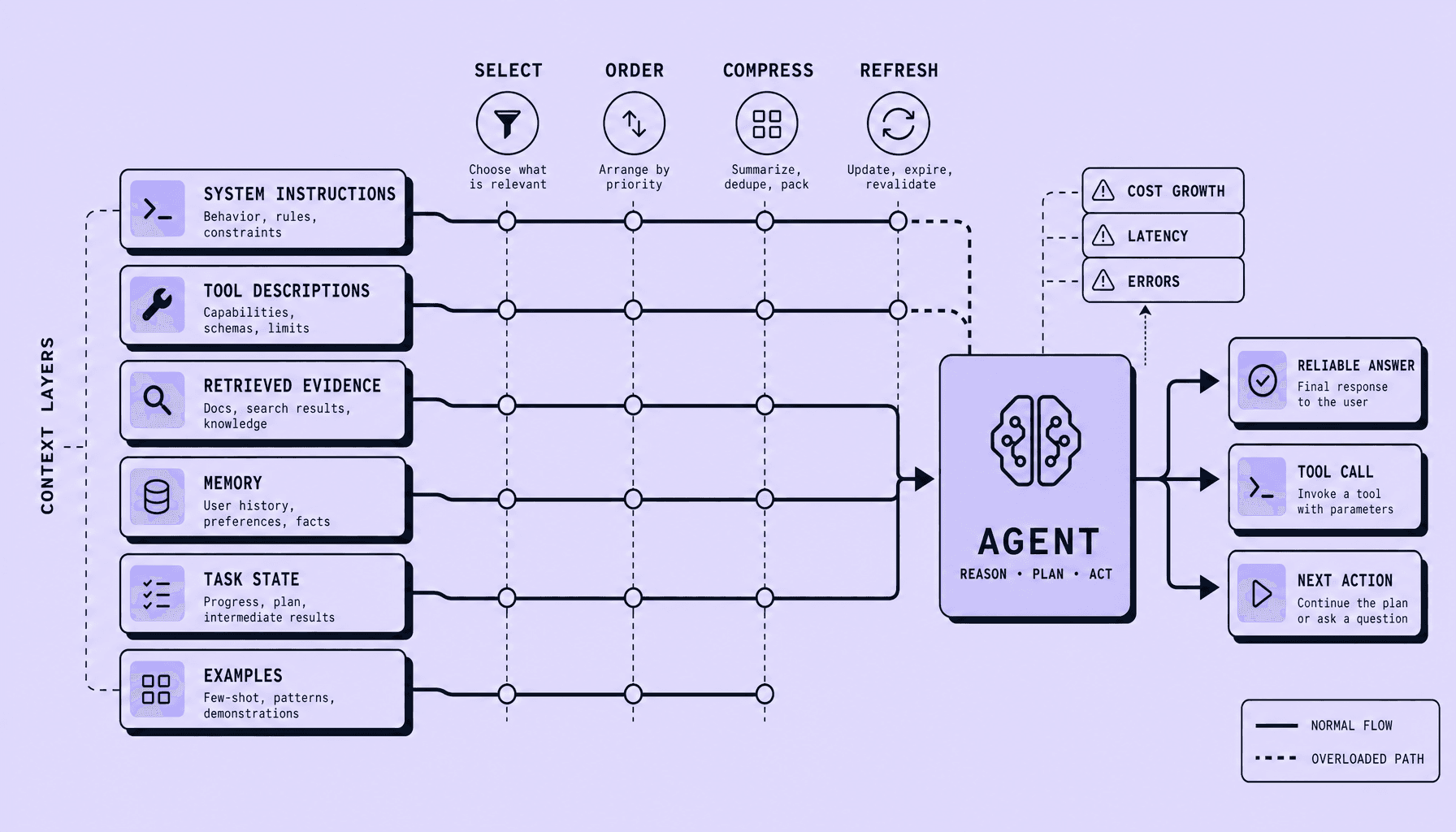
Most AI agents do not break because the model is weak. They break because the agent is looking at the wrong thing, at the wrong time, in the wrong form. Context engineering is the operating discipline that decides what an AI agent sees, when it sees it, and how that information is shaped. In practice, context engineering for agents is deliberate selection, ordering, compression, and refresh -- because bad context makes agents slow, expensive, and unreliable.
That context is not just a prompt. It is a managed input system. System instructions set role and constraints. Tool descriptions define available actions and the rules around API calls, search, code execution, or database access. Retrieved evidence grounds the current task, while memory carries forward stable facts, preferences, and prior decisions. Task state tracks what the agent has already done. Examples show the expected pattern.
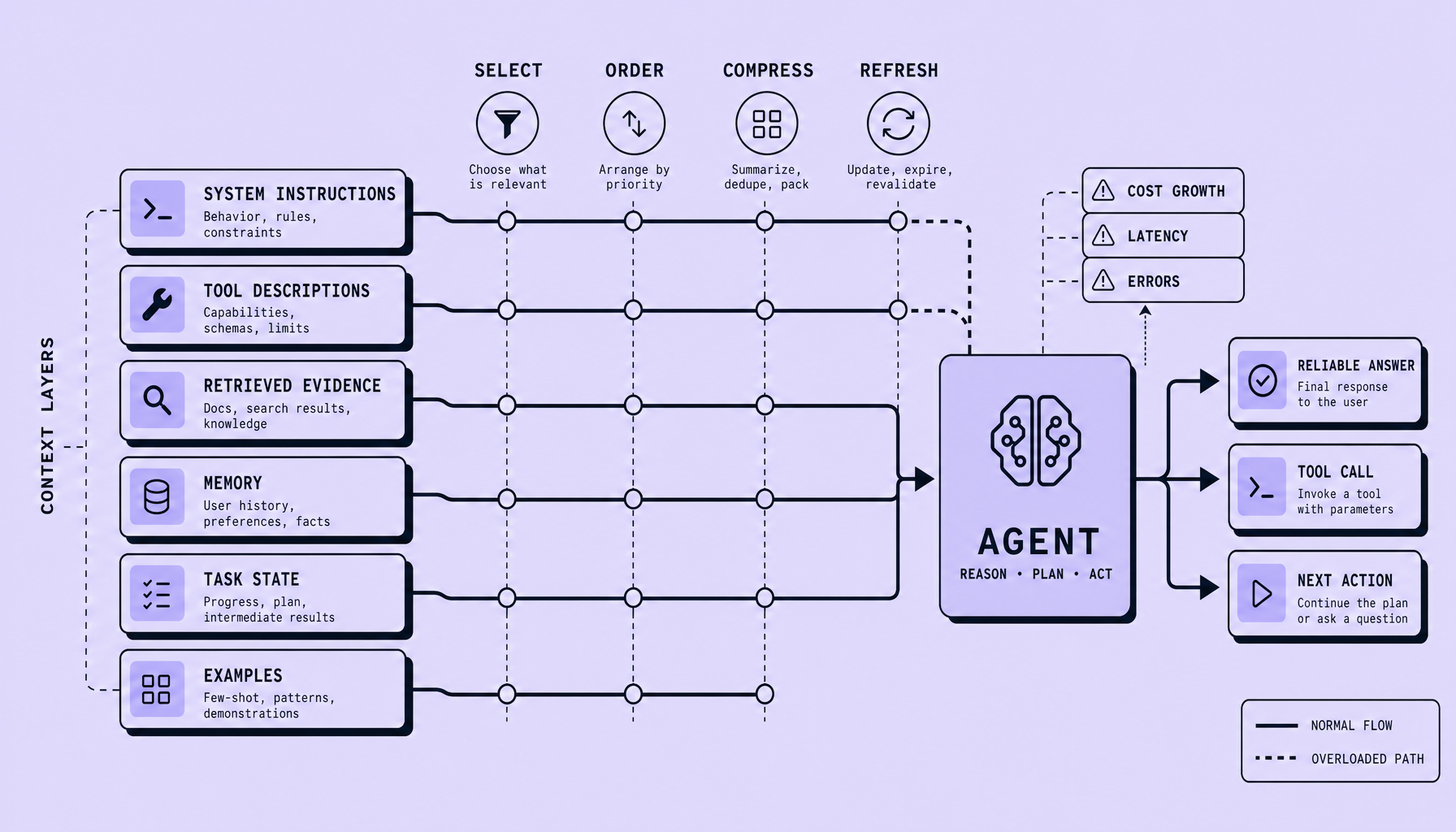
Miss one layer, and behavior drifts.
Poor AI context engineering usually fails in predictable ways: stale retrieval, bloated token budgets, vague tool schemas, duplicated memory, or examples that conflict with policy. Teams often treat LLM context management like prompt decoration. Production agents need stricter discipline. Clarity is better than complexity -- especially once latency, token cost, and failure recovery start compounding. At Imversion Technologies Pvt Ltd, that framing fits how reliable systems should be built.
Key Takeaways for Context Engineering
-
Context engineering is an operational discipline, not prompt decoration. For skimmers: strong LLM context management depends on four moves -- selection, ordering, compression, and refresh -- so the model sees the right information at the right time, not a bloated transcript.
-
The main context layers are practical and distinct: system instructions, tool descriptions, retrieved evidence, memory, task state, and examples. Mix them carelessly and agents drift. Separate them well and behavior gets easier to control.
-
In context engineering for agents, order changes outcomes. Put stable rules first, then tool schemas and constraints, then task-specific evidence, then working state. Understanding why a piece of context is present is what prevents random prompt growth.
-
Poor AI context engineering creates two production failures fast: higher token cost and lower reliability. Too much context raises latency and spend; stale or irrelevant context causes missed tools, weak grounding, and inconsistent answers.
-
A practical recommendation: treat LLM context management like a pipeline. Set token budgets, trim noisy retrieval, summarize long histories, and refresh memory only when it remains relevant to the current task.
The Four Operations Behind Effective Context Engineering
Teams usually do not fail because the agent lacks information. They fail because the agent sees too much, too early, in the wrong order, and long after it stopped being relevant.
That is the core of context engineering for agents.
Selection: decide what belongs
Selection is the first filter. System instructions, tool descriptions, retrieved evidence, memory, task state, and a few strong examples may all be useful -- but not all at once, and not for every turn. A support triage agent does not need the full product handbook if the task is only to classify urgency. A coding agent does not need long-term user preferences when it is debugging a failing API call.
Because the context window is finite, every token competes with something else. Send everything, and the model pays attention badly. Context window optimization starts by asking why each item is present.
Ordering: teach priority through placement
Even good context can fail if it is arranged badly. Models do not read context like a database query planner. They infer importance from structure, position, and framing. Put stale memory above current task state, and the agent may anchor on the wrong goal. Put tool schemas after a wall of noisy retrieval, and tool use often degrades.
A practical order for agent context design is simple: stable rules first, current task second, relevant evidence third, examples last. Not always. But often enough to be a useful default.
Good prompt orchestration is not packing more into the window. It is ranking what deserves attention.
Compression: reduce tokens without deleting meaning
Once the right information is selected and ordered, the next pressure is size. Compression is not cosmetic summarization. It is loss management. A retrieved document can become a focused summary with quoted facts preserved. A long tool schema can be trimmed to required parameters and failure modes. Task state can collapse into checkpoints rather than full logs.
The tradeoff is sharp: compress too hard, and the agent loses nuance; compress too little, and cost, latency, and drift rise together. Clarity is better than complexity.
Refresh: update context as the task changes
Static context does not survive dynamic workflows. AI context engineering is runtime work. Retrieval should update after a new user constraint appears. Memory should be revised when a preference changes. Completed steps should leave the active window and move into compact state.
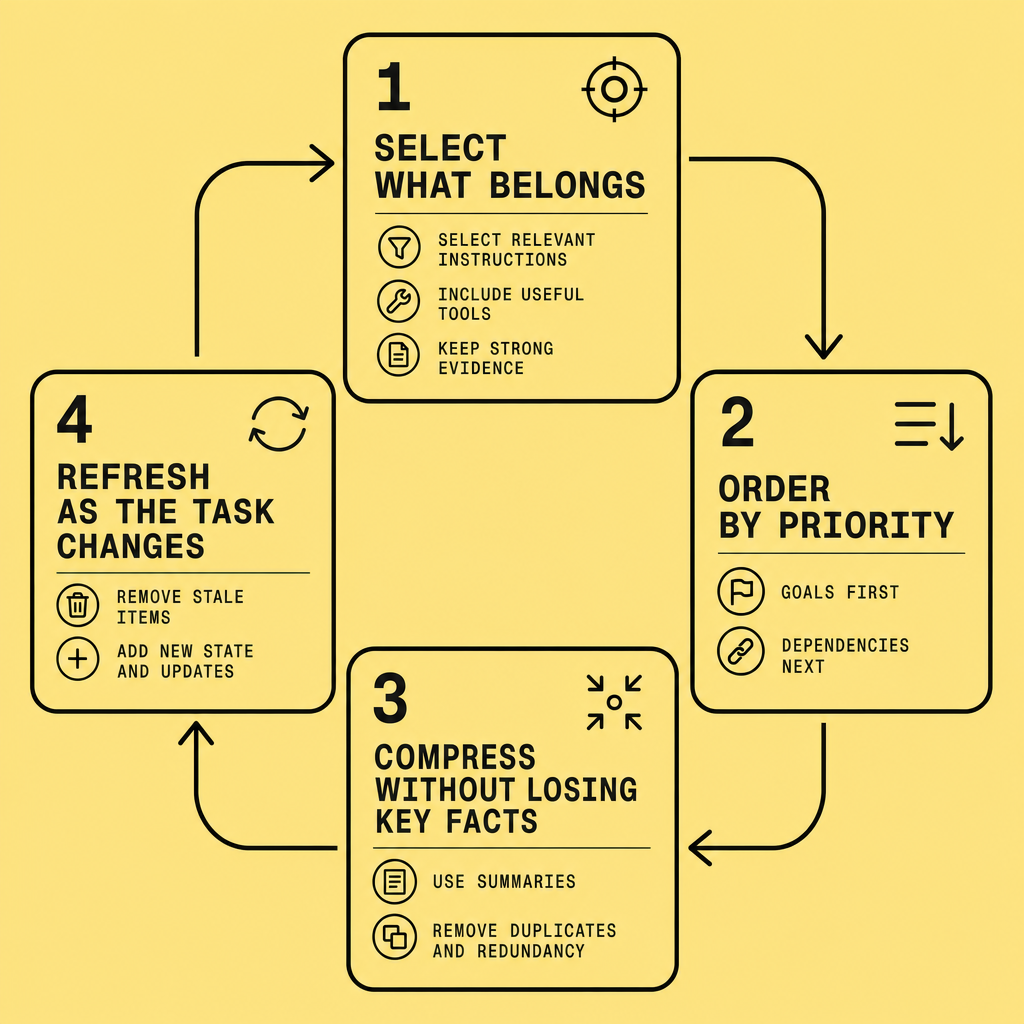
So the four operations are continuous decisions, not one-time prompt writing. That is what turns a demo into a reliable system.
The Context Layers an Agent Depends On
An agent can have a capable model and still behave poorly if its context is shaped carelessly. Too much. Too vague. Out of order. That is why AI context engineering has to separate context into layers with distinct jobs, instead of dumping everything into one oversized system prompt.
A useful test is simple: each layer should answer a different question.
System instructions
The system prompt answers who the agent is and how it should behave. Role, boundaries, priorities, refusal rules, output format. A support agent might get: answer politely, use approved policy language, ask for confirmation before account changes. This layer should stay stable. If teams stuff live facts or user history into it, drift starts fast.
Tool descriptions
The tool schema answers what the agent can do. Search the help center. Call a refund API. Query a SQL table. But the description must say when to use the tool, what inputs it needs, and what a successful result looks like. Vague tool descriptions create predictable failure: the agent either ignores the tool and guesses, or overuses it for every turn. Clarity is better than complexity here -- because the model cannot infer safe operating rules you never spelled out.
Retrieved evidence
Retrieved evidence answers what is true for this request. In retrieval-augmented generation, that may be policy snippets, database rows, product docs, or prior case notes fetched just-in-time. Good LLM context management keeps this layer tight and relevant. Flooding the window with loosely related passages raises cost and lowers precision.
Memory and task state
These two get mixed up constantly.
A memory store holds what should persist later: user preferences, durable project facts, recurring constraints. Workflow state holds what happened in this run: steps completed, failed API calls, pending questions, partial outputs. A research agent may remember a user prefers brief summaries, while task state records that source screening is done but synthesis is still pending.
Examples
Few-shot examples answer what good execution looks like. They teach pattern, not policy. Use them to show a support reply structure or a clean research summary format -- not to store facts.
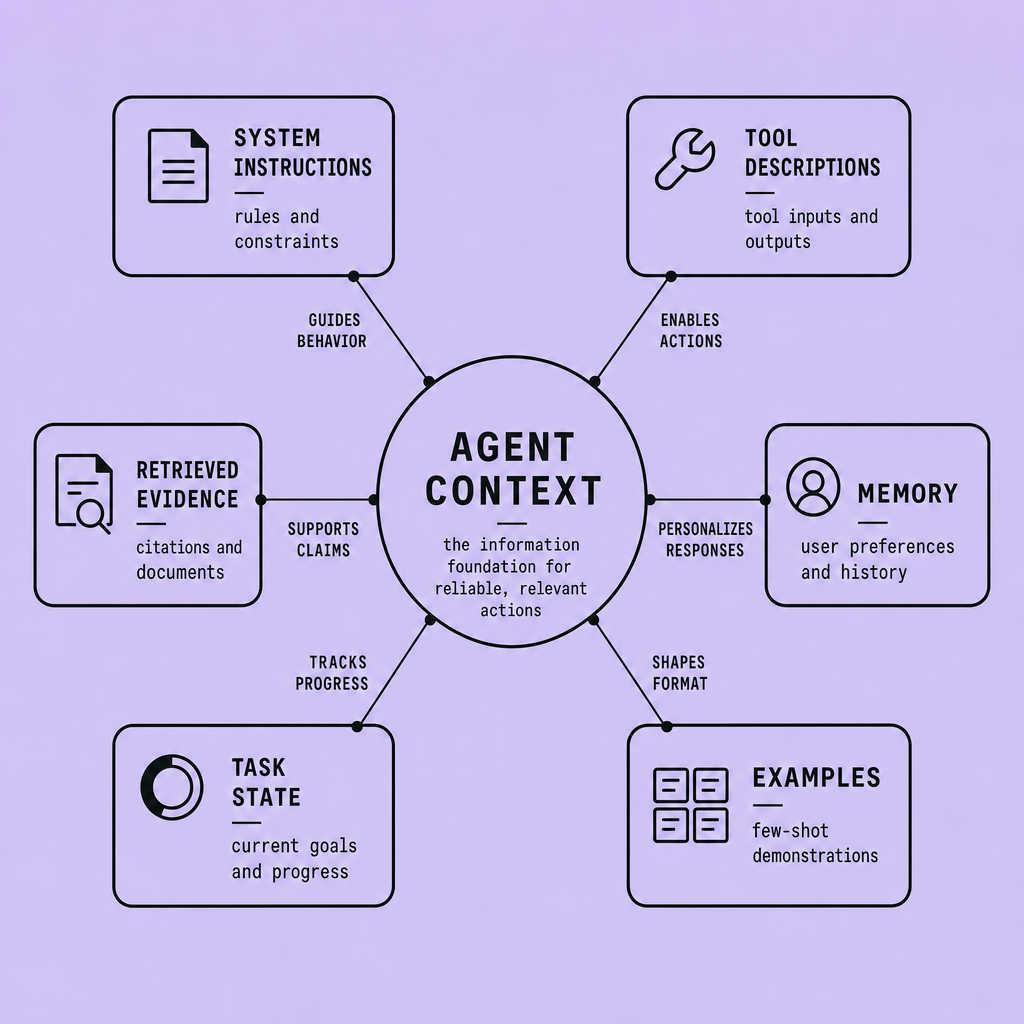
Put together, these layers explain why some agents stay controllable while others drift after a few turns. In practice, context engineering for agents works best when each layer has one responsibility, one refresh rule, and one owner. Mix roles, and the agent becomes expensive, slow, and unreliable.
Why Context Engineering Matters for Reliability, Cost, and Speed
The pain usually shows up after the demo works.
A team ships an agent, real usage starts, and the cracks appear: bloated prompts, stale memory, weak retrieval, vague tool schemas, and task state that never gets cleaned up. The result is familiar -- slower responses, higher latency, more hallucination, and tool calling that looks busy rather than useful. Context engineering for agents fixes that by deciding what the model should see, in what order, and only for as long as it helps.
Reliability comes from grounding. If an agent answers a policy question using retrieved evidence from the right document chunk, plus clear system instructions and current task state, the output is far more stable than asking the model to "figure it out" from raw memory or generic examples. But more context is not automatically better. Past a point, extra text becomes noise. And noise competes with signal inside the context window.
That tradeoff hits cost fast. Most commercial LLM APIs bill by tokens, so every repeated instruction block, oversized retrieval payload, and unnecessary conversation turn increases token pricing pressure. Larger prompts also tend to increase latency because the model has more text to process before it can respond. So context window optimization is not a neat prompt trick. It is operating discipline.
A practical pattern works well:
- keep system instructions short and strict
- give tools precise descriptions and usage boundaries
- retrieve only evidence relevant to the current step
- summarize memory instead of replaying full history
- store task state outside the prompt and inject only what is needed
Because clarity is better than complexity, strong LLM context management often beats adding a bigger model or more tools. A smaller, well-grounded agent can outperform a larger one that sees everything and understands less. In practice, AI context engineering is how teams reduce wasted tokens, cut unnecessary API calls, and make outputs more consistent under real production load.
How Poor Agent Context Design Creates Expensive Failure Modes
Bad agent context design does not just make answers weaker. It makes the whole system slower, pricier, and less predictable.
That is the trap.
Teams get an agent to work in a demo, then production exposes the cracks: prompt bloat, stale memory, retrieval noise, instruction conflict, weak state tracking, and examples that teach the wrong behavior. In practice, strong AI context engineering is less about stuffing more text into the window and more about deciding what earns its place.
Prompt bloat is the easiest failure to spot. A giant system prompt, long tool schemas, full chat history, and oversized retrieved chunks all compete for attention. The result is wasted tokens, higher latency, and weaker relevance because the model has to sift through noise before it can act. More context is not automatically better. Clarity is better than complexity -- especially when token budgets and response time matter.
Stale memory breaks trust fast. If a memory store keeps old preferences, outdated project facts, or resolved issues without refresh rules, the agent starts answering from yesterday’s reality. That leads to contradictory answers, repeated clarifying questions, or workflows that undo prior decisions.
Retrieval noise causes a different kind of failure. A vector database may return loosely related snippets that look plausible but do not support the task. Then the agent cites the wrong policy, summarizes the wrong ticket, or chooses the wrong API path. Poor context engineering for agents often fails here because retrieval is treated as “more documents is safer.” It is not.
Instruction conflict is even more expensive because it hides in plain sight. A system message says “be concise,” a task message says “show all reasoning,” and a tool description says “ask before execution.” Now the model has competing priorities. Incorrect tool use follows. So do inconsistent answers.
Missing task state creates loops. The agent forgets which API call already failed, which step was completed, or which question is still open. It retries work, asks for the same input twice, or skips required steps entirely.
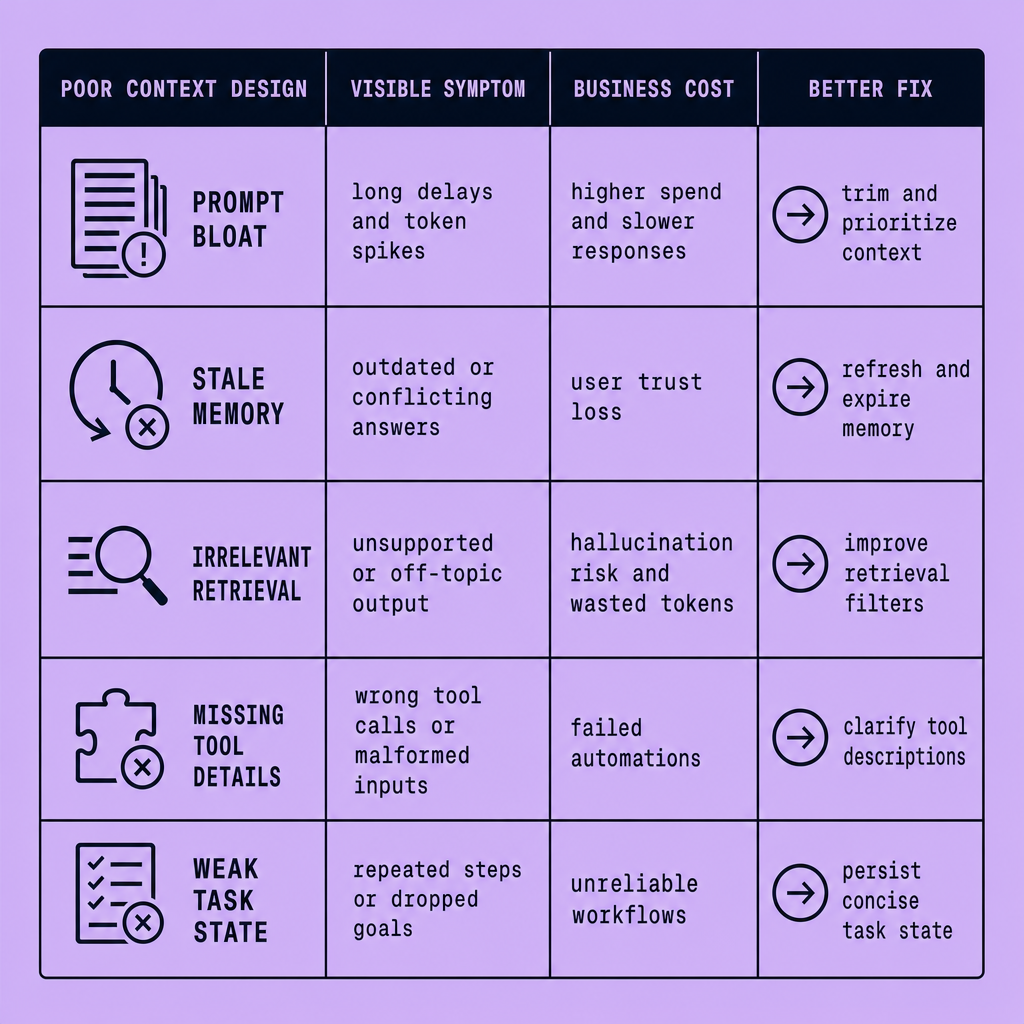
One strong diagnostic habit: inspect failed runs by layer -- instructions, tools, evidence, memory, and state. Many “model failures” are really context engineering for agents failures. Understanding why the run broke is what fixes reliability.
Practical Context Engineering Patterns That Work
The fastest way to improve an agent is usually not adding more prompt text. It is tightening what the model sees, in what order, and what gets replaced. That is the heart of context engineering.
Keep system instructions stable and minimal: one role, a few hard constraints, and a clear instruction hierarchy. Teams often pack policy, tone, edge cases, and workflow notes into one block, then wonder why behavior drifts. Clarity beats complexity because the model has fewer competing priorities.
Write tool descriptions like operating contracts. Name the tool, say what it does, define inputs and outputs, and state when not to use it. Vague tool schemas hurt reliability because the model cannot infer intent from thin descriptions.
Retrieve narrowly. Fetch the smallest evidence set that can answer the current step, not the whole knowledge base neighborhood. Then add a summarization layer before appending more raw text. Keep raw evidence when wording matters, such as policy clauses, error logs, or legal text. Summarize when the agent only needs facts, decisions, or status.
Separate persistent memory from current task state. Preferences and durable facts belong in memory. Open questions, completed actions, and failed API calls belong in task state. Different lifetimes, different jobs.
Refresh context at checkpoints: after retrieval, after tool execution, after human approval, and after plan changes.
For example, a support agent handling “Why was my refund denied?” can load stable instructions, use ticket search and billing tools, retrieve only the latest ticket and refund policy, store the API result in task state, summarize the findings, ask one clarifying question if needed, and refresh context so the next step carries only the summary, active evidence, and unresolved issue.
Frequently Asked Questions
What is context engineering in an agent workflow?
Context engineering is the disciplined design of everything an agent sees before generating a response or taking an action. It includes instructions, tools, retrieved facts, memory, examples, and task state, plus the rules that decide when each piece enters or leaves the working context.
How does context engineering differ from prompt engineering?
Prompt engineering usually focuses on wording a single interaction well, while context engineering manages the full information environment across a workflow. It deals with sequencing, budget limits, freshness, persistence, and tool-awareness, which makes it better suited for multi-step agents operating in production.
Why should teams measure context quality instead of only model quality?
Teams should measure context quality because many visible model failures are actually input failures. An excellent model will still underperform if it receives stale evidence, conflicting instructions, or missing state. Tracking context defects helps improve latency, reduce token spend, and raise answer consistency faster than model swapping alone.
How often should context engineering rules be updated?
Context engineering rules should be updated whenever task types, tools, policies, or user behavior materially change. A healthy system usually reviews them after failed runs, major product updates, and shifts in token cost or latency, rather than treating context design as a one-time setup.
What are early warning signs that an agent’s context is degrading?
Early warning signs include repeated clarifying questions, inconsistent tool use, longer prompts without better answers, contradictory references to user preferences, and retrieval results that look relevant but do not resolve the task. These patterns usually indicate that selection, refresh, or layering rules need correction.
Make Imversion a preferred source on Google
Like this kind of AI and software analysis? Add Imversion as a preferred source so Google can highlight our articles for you in Search, AI Overviews, and AI Mode.