Hybrid Retrieval: Boosting Precision in Production Searches
Explore how hybrid retrieval enhances search precision by combining lexical and vector approaches for effective query handling.

When hybrid retrieval beats pure vector search
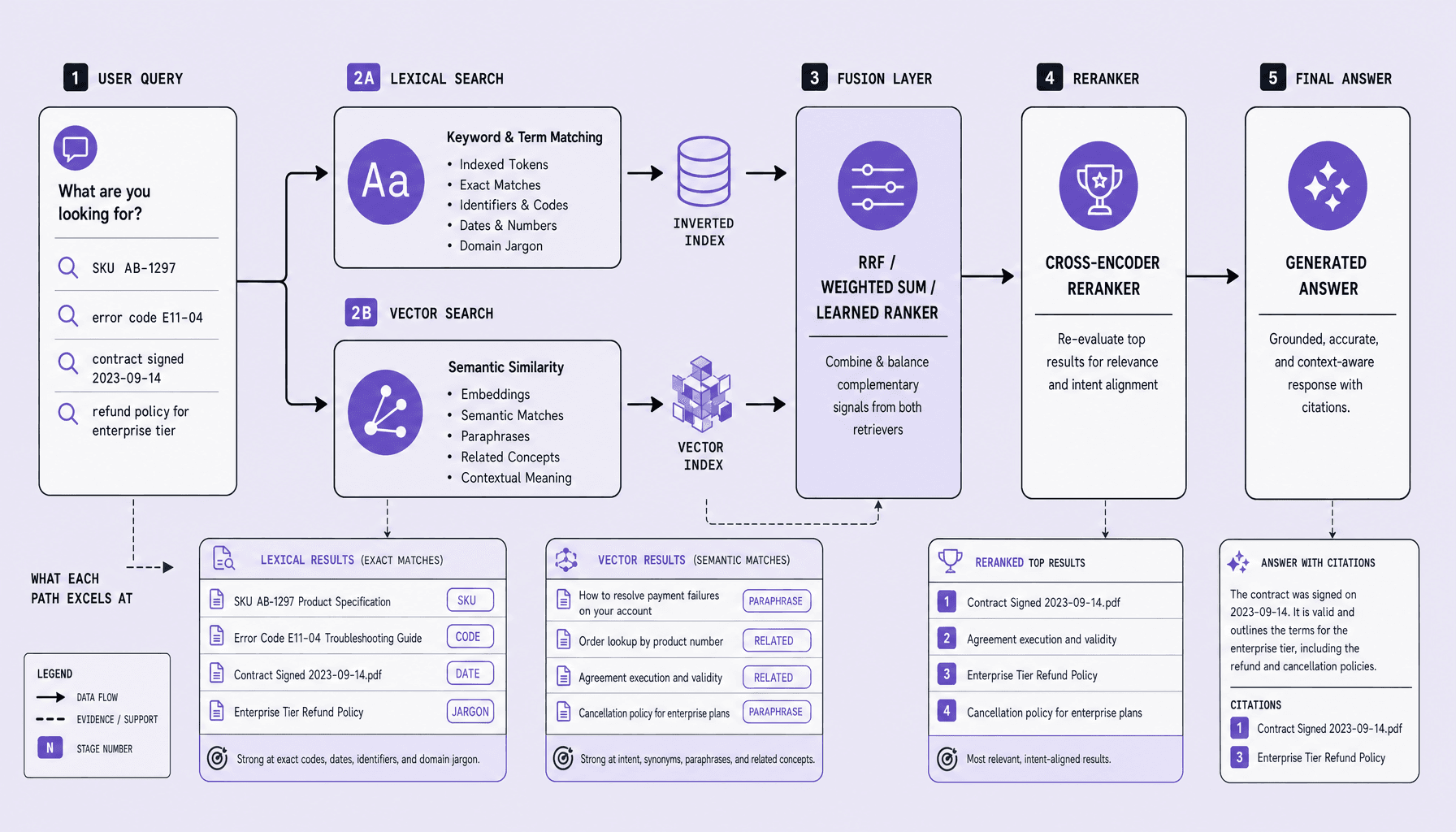
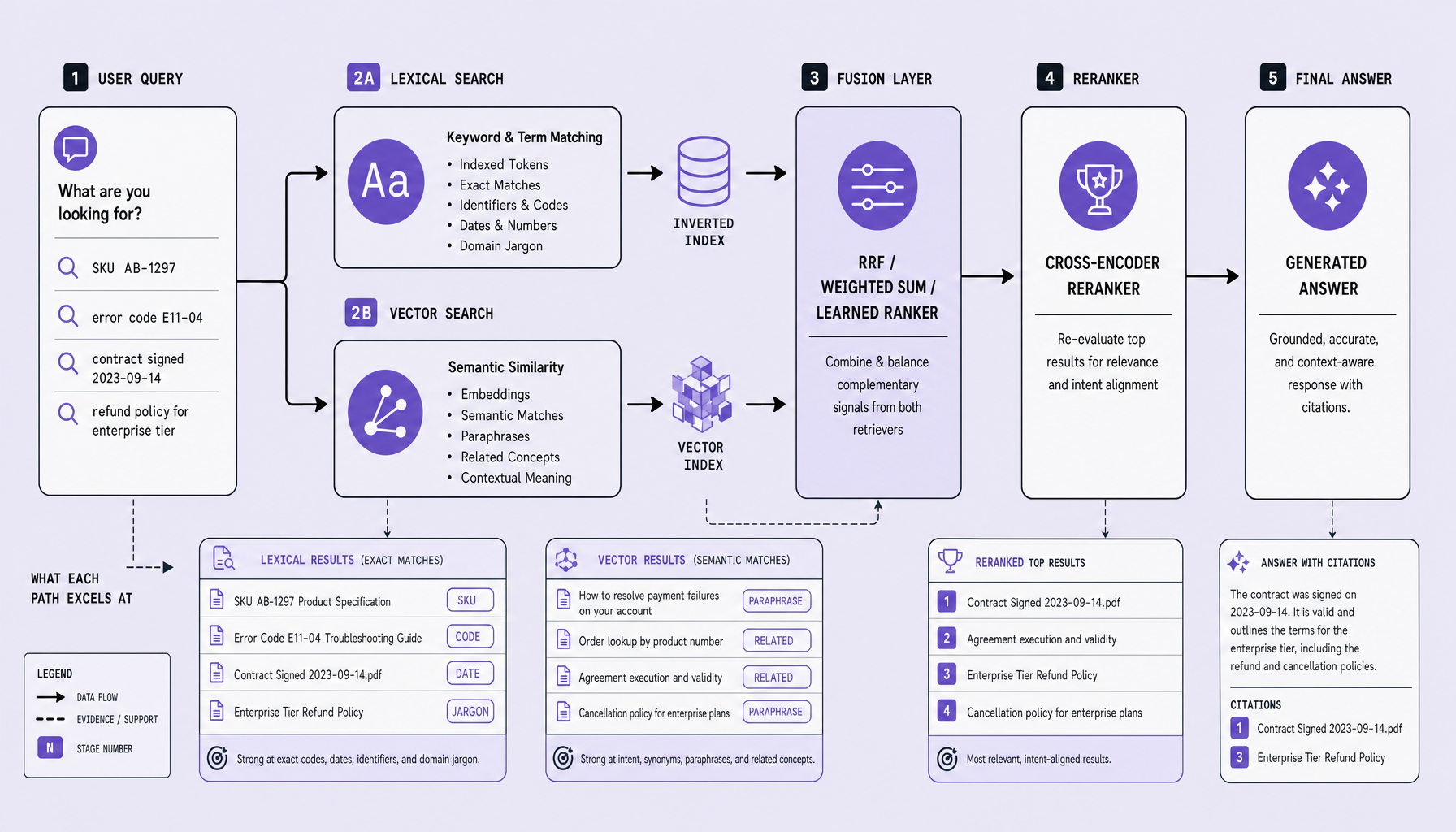
Your search can look impressive in demos and still fail on the query that matters most in production. A user types ERR_CONN_RESET, XR-220B, 17 U.S.C. § 107, or v2.4.1, and the system returns documents that feel related but miss the exact target. That is the failure mode pure semantic search runs into more often than teams expect. Hybrid retrieval works better when users search identifiers, names, codes, dates, or niche jargon, because lexical and vector search solve different retrieval problems -- one for precision, one for recall.
This is where vector search limitations show up fast. A dense model may understand “network connection failure,” yet miss ERR_CONN_RESET, XR-220B, 17 U.S.C. § 107, or v2.4.1 as exact targets. BM25 catches those strings cleanly. In practice, hybrid search runs both paths in parallel, then merges results with reciprocal rank fusion or weighted score fusion; some teams add a reranker on top. At Imversion Technologies Pvt Ltd, the practical test is simple: if your query mix includes SKU codes, legal cites, person names, dates, or internal acronyms, semantic search vs keyword search is the wrong debate. Use lexical and vector search together. Because reliable systems matter most.
Key Takeaways
-
Pure vector search is weak on exact strings. Expect misses or low ranks for SKU/model numbers, legal citations, dates, error codes, version strings, rare names, and internal acronyms -- the classic semantic search vs keyword search failure mode.
-
Lexical and vector search complement each other because they solve different retrieval jobs. BM25 rewards exact token overlap; dense vectors capture paraphrase and intent. In practice, hybrid retrieval is the safer default if coverage matters.
-
The most practical hybrid search patterns are parallel retrieval and cascaded retrieval. Run BM25 and ANN vector search together, then fuse; or use one stage for recall and a reranker for precision. Clarity is better than complexity -- start simple.
-
For fusion, teams usually get solid results from reciprocal rank fusion or weighted score fusion. Scores from lexical and vector systems are not naturally comparable, so tune on real query sets.
-
Evaluate hybrid search with exact-match query sets and mixed-intent queries. Track recall@k, MRR, and NDCG, then use a decision checklist: exact identifiers present, jargon heavy, costly misses, and whether semantic-only retrieval buries the right document.
Why semantic search misses identifiers, codes, dates, and domain jargon
This is usually the point where teams realize semantic retrieval is solving a different problem than the one their users actually have. Pure semantic retrieval misses these queries for a structural reason: dense embeddings are built to preserve meaning, not exact character sequences.
That sounds subtle. It is not.
A vector model tries to place similar concepts near each other in embedding space, so a query like ERR_CONN_RESET may land near documents about browser connection failures, timeouts, or network instability -- even if the document containing the exact string is not ranked first. The same thing happens with AB-1234, CPT 99213, 17 U.S.C. § 107, v2.4.1, Nguyen, or 2021-09-30. These queries depend on token fidelity. One character off can change the answer completely.
And embeddings tend to smooth that away.
This is one of the clearest vector search limitations in production search and RAG systems. Rare strings, punctuation-heavy codes, version numbers, legal citations, dates, transliterations, and internal jargon often carry meaning at the character level. Dense embeddings compress text into a lower-dimensional semantic representation, and ANN search retrieves neighbors based on that compressed signal. Good for paraphrases. Weak for exact strings.
That is the core of semantic search vs keyword search.
BM25 and other lexical methods work differently. They reward exact token overlap, term rarity, and field presence, so they are naturally better at retrieving CPT 99213 from a billing guide or 17 U.S.C. § 107 from a legal memo. If a user types Nguyen, lexical retrieval can preserve that exact name match instead of drifting toward vaguely similar people or topics.
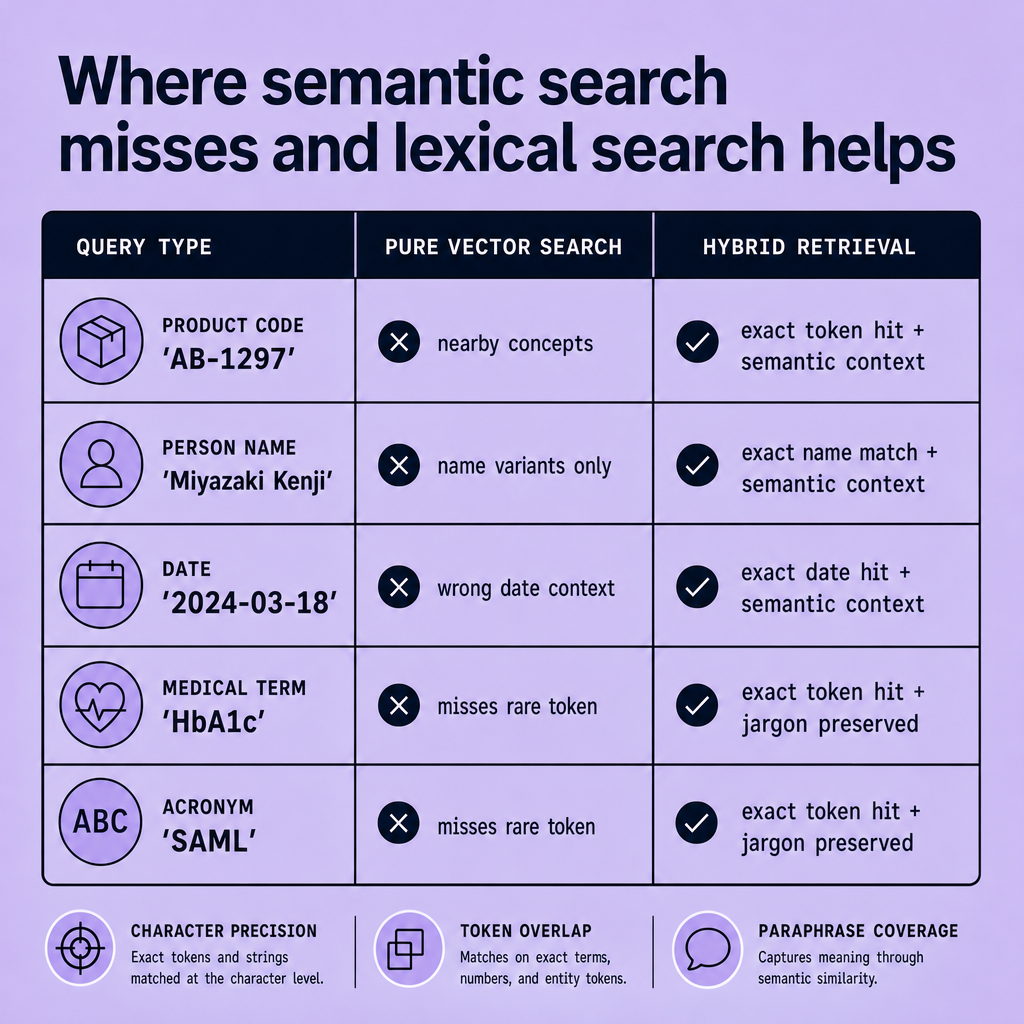
Teams often discover this only after launch because semantic demos are usually tested on natural-language questions, not identifier-heavy queries.
So the fix is not philosophical. It is architectural. Run lexical and vector search together, then fuse the results. If you understand why the system fails, this design choice stops being cosmetic and becomes deliberate. Use vectors for intent and paraphrase recall. Use lexical and vector search together for exact-match coverage. In the semantic search vs keyword search debate, production systems rarely win by choosing only one.
How hybrid retrieval and lexical and vector search improve coverage together
A search system that handles paraphrases well but misses XR-220B is still broken for the user who needs XR-220B. That is the operating tension. Hybrid search improves coverage by treating retrieval as a coverage problem first, not just a ranking problem.
BM25 and other sparse retrieval methods reward exact term overlap, term frequency, and rarity. So they are strong when the query contains identifiers, names, dates, legal citations, or internal jargon that must match literally. Dense retrieval does the opposite job well: it finds meaning across paraphrases, alternate wording, and implied intent. Put them together, and lexical and vector search cover different failure modes instead of competing for the same ones.
| Approach | Best fit | Common miss |
|---|---|---|
| BM25 / sparse retrieval | Codes, names, dates, citations, version strings | Paraphrases, indirect questions, synonym-heavy queries |
| Dense retrieval | Conceptual queries, paraphrases, intent matching | Exact identifiers, rare strings, niche acronyms |
| Hybrid retrieval | Mixed-query corpora, RAG retrieval strategies, production search | More tuning work -- fusion, latency, evaluation |
Common architecture patterns
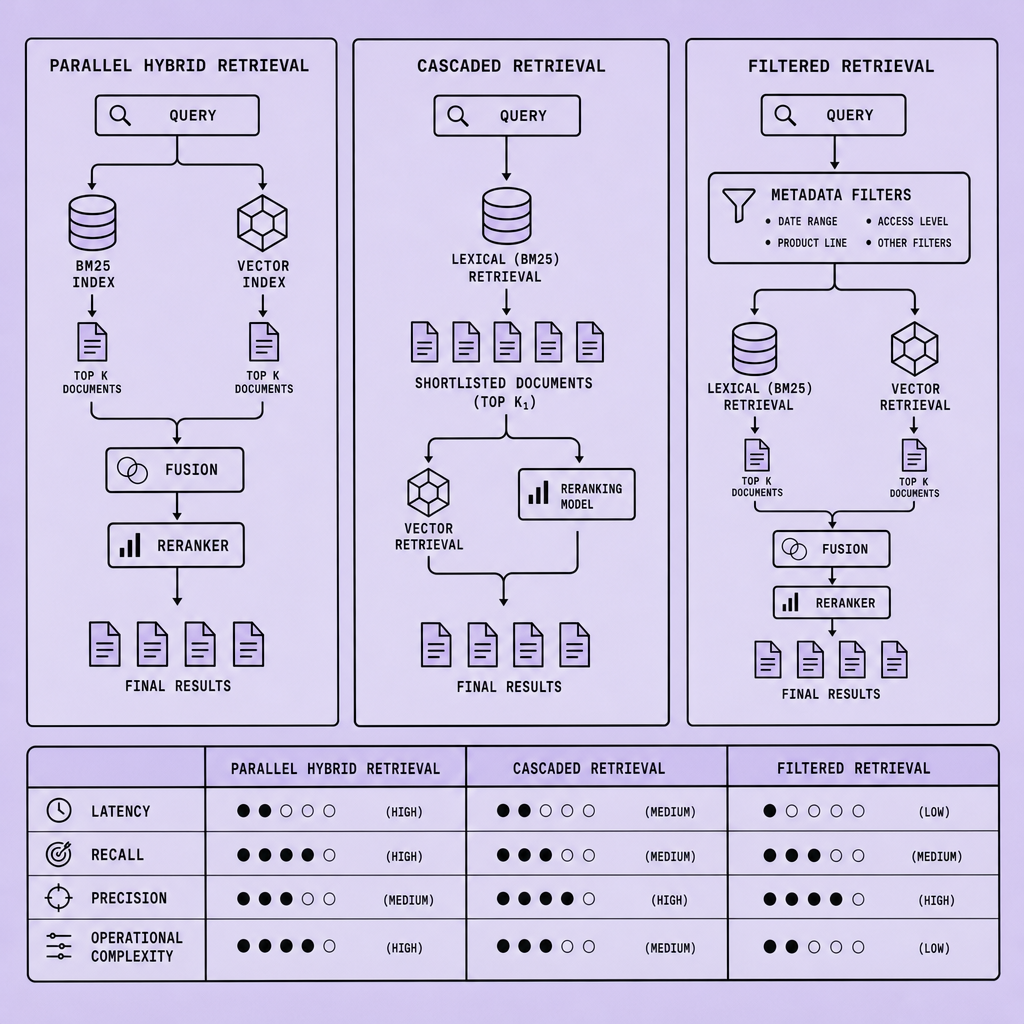
Once you accept that neither method is enough on its own, the design choices get much clearer. Teams usually use one of three patterns:
- Parallel hybrid retrieval: run BM25 and dense retrieval side by side, then fuse with reciprocal rank fusion or weighted score fusion.
- Cascaded retrieval: use lexical first for exact-match-sensitive queries, then expand with vectors if recall looks thin.
- Two-stage ranking: retrieve broadly with both systems, then rerank with a cross-encoder.
The practical default is parallel hybrid retrieval plus a reranker. It is easy to reason about. It is also easier to debug when coverage drops.
How to evaluate it
This is where many teams make the wrong call. Do not judge hybrid retrieval on average-looking queries. Test the hard classes: SKU strings, person names, legal references, dates, acronyms, and jargon. Track recall@k for coverage, MRR for first-hit quality, and NDCG for ranking quality. Split evaluation sets by query type too. A system that handles paraphrases but buries exact identifiers will still feel broken.
Decision checklist
Use hybrid search if your corpus contains structured strings, specialized terminology, or user queries with mixed intent. Trust vectors alone only when exact token fidelity is not business-critical. Measure before tuning. Decisions should be backed by data.
Architecture patterns for hybrid retrieval in production RAG systems
The temptation is to overdesign this early. Most production teams should start with parallel hybrid retrieval and add cascades, filters, or rerankers only when evaluation shows a clear gain worth the extra latency and complexity.
Parallel hybrid retrieval
This is the default pattern. Run BM25 and dense retrieval on the same query, then fuse the ranked lists with reciprocal rank fusion or weighted score fusion. It works because lexical and vector search cover different failure modes: one catches AB-1234, ERR_CONN_RESET, and names; the other catches paraphrases and implied intent.
Use it when latency is acceptable, the corpus is medium to large, and exact-match-sensitive queries hurt recall. Fusion only helps if indexing is disciplined, though. Normalize case. Preserve punctuation where codes depend on it. Store raw fields for exact matching, and separate normalized fields for broader recall.
Cascaded retrieval
If latency budgets are tighter or the corpus is very large, cascades are often a better fit. A common pattern is lexical first for fast exact hits, then vector retrieval only if lexical confidence is low or the result set is thin. The reverse can work for natural-language-heavy traffic.
Choose the first stage based on query mix, not preference. If users mostly search SKUs, legal citations, version strings, or internal acronyms, lexical-first is usually safer. The tradeoff is coverage: an aggressive first-stage gate can suppress relevant documents the second stage never sees.
Filtered retrieval
Sometimes retrieval quality is mostly a metadata problem. If documents have strong fields like product family, date, jurisdiction, tenant, or language, apply metadata filters before ANN search or BM25 ranking. This reduces noise and protects precision.
The caveat is brittleness. Missing or inconsistent tags create silent false negatives, so filtered retrieval works best when metadata quality is monitored, not assumed.
Two-stage retrieval with reranking
If top-k quality matters more than raw speed, add a reranker. Retrieve a candidate set with hybrid search, then send the merged list to a reranker. This pattern is useful for long documents, ambiguous queries, and answer-critical workflows. It often improves ordering, but it adds cost and latency.
A reliable design usually starts with parallel retrieval and fusion, then adds cascades or rerankers only if evaluation shows a clear gain worth the latency.
Operational checklist
Architecture choices are easier to debate than to measure, which is why the checklist matters. Measure pattern choice with recall@k, MRR, NDCG, and an exact-match query set built from names, codes, dates, citations, and jargon. Also define fallback behavior: if vector search times out, return lexical results; if filters overconstrain, relax them in a controlled order.
Fusion methods that make hybrid retrieval work
Merging two ranked lists sounds easy until you compare the scores. Start simple: merge lexical and vector results, but do not average raw scores and hope for the best.
That breaks fast.
BM25 scores and dense-vector similarity scores live on different scales and come from different math. BM25 depends on term frequency, document length, and token overlap. Vector scores come from cosine similarity or dot product in an embedding space. So a 12.7 from BM25 and a 0.82 from ANN search are not directly comparable. If teams skip calibration, hybrid retrieval can look worse than it is.
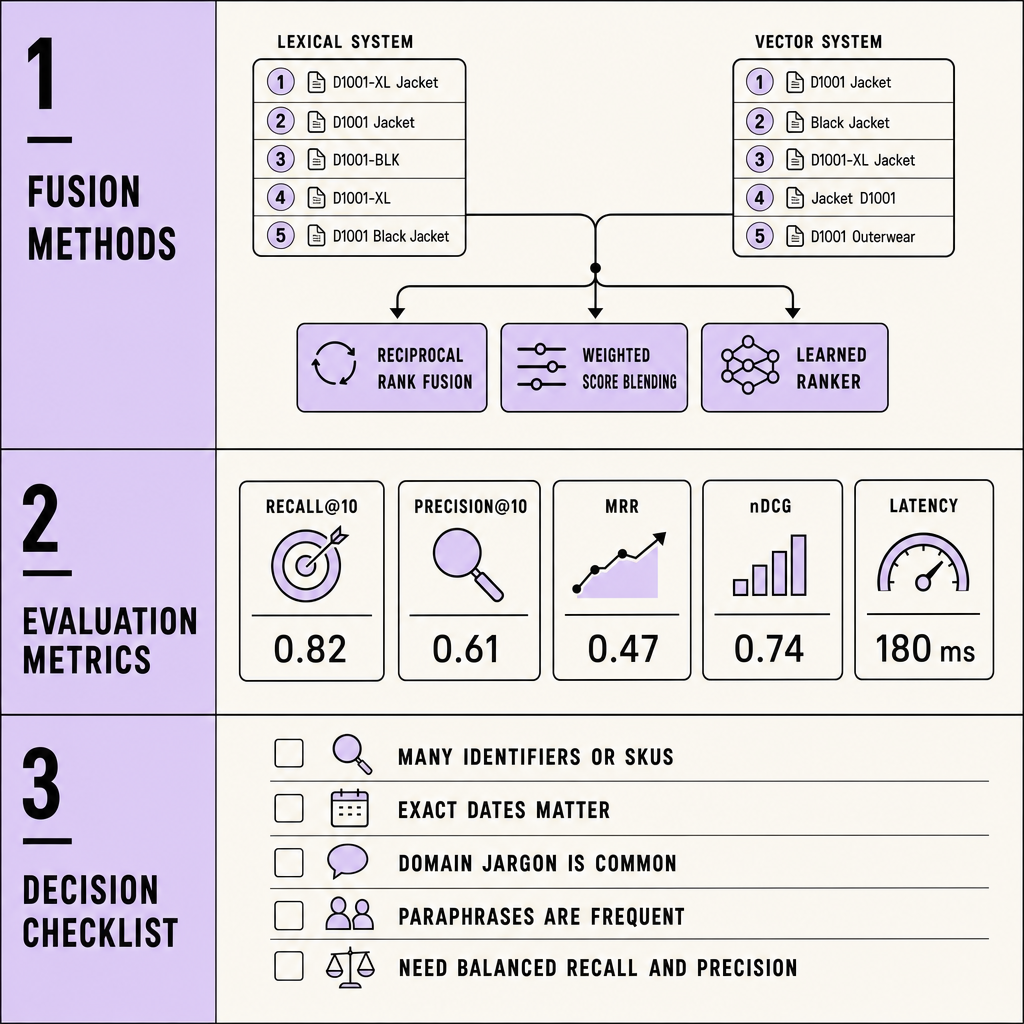
The safest default is reciprocal rank fusion. It ignores raw scores and blends ranks from both lists, which makes it robust for hybrid search when query mix is messy -- product codes, names, jargon, and paraphrases all in one stream. If BM25 finds the exact XR-220B document at rank 1 and the vector index finds a semantically related guide at rank 3, reciprocal rank fusion usually surfaces both near the top without score tuning.
Weighted score fusion can work well too, but only after calibration. Teams usually normalize first -- min-max, z-score, or percentile-based score normalization -- then apply weights. More control. More fragility. Query drift can break it.
A practical middle ground is normalized score blending for stable domains, where score distributions do not swing wildly across query types.
Then there is the quality-first pattern: rerank-after-merge. Retrieve top-k from BM25 and dense search, merge, deduplicate, then send the shortlist to a cross-encoder reranker. Best precision, usually. Higher latency and cost.
For most teams comparing semantic search vs keyword search, rank-based fusion is the better baseline; tune score blending only after evaluation on exact-match and semantic query sets.
Use recall@k, MRR, and NDCG to decide -- not intuition.
Evaluation metrics, decision checklist, and example query sets for hybrid retrieval
A retrieval system can post decent aggregate relevance and still fail on the query your users care about most. Evaluate hybrid retrieval with failure modes in mind, not one blended score. A system can score well overall and still bury the exact result for a SKU, statute, or date. That is where many RAG retrieval strategies break.
Track core ranking metrics, but tie each one to a retrieval question. recall@k asks whether the right document appears anywhere in the top k. precision@k asks how much noise users see in those top results. MRR shows how early the first relevant hit appears -- useful for single-answer lookups. NDCG helps when multiple documents are relevant and rank order matters. For vector search limitations around identifiers, add exact-match hit rate: did the exact target appear in the top k for exact-string queries?
One metric is not enough.
Segment evaluation by a clear query taxonomy. At minimum, score these buckets separately for lexical and vector search, then for hybrid search with reciprocal rank fusion or weighted score fusion:
- identifiers:
AB-1234,XR-220B,ERR_CONN_RESET - names:
Nguyen, rare surnames, transliterations - dates and versions:
2021-09-30,v2.4.1 - citations:
17 U.S.C. § 107,CPT 99213 - abbreviations and jargon: internal acronyms, gene symbols
- natural-language questions: paraphrased intent queries
Decision checklist
Adopt hybrid retrieval if the answer to any of these is yes:
- Do users search codes, names, dates, citations, or abbreviations?
- Do logs show exact-match misses or low ranks from dense retrieval?
- Do ANN indexes perform well on paraphrases but poorly on structured strings?
- Can BM25 recover misses without unacceptable latency?
- Will a reranker improve fused results enough to justify complexity?
Review this against real logs or a representative test set -- not demo queries alone.
Frequently Asked Questions
What is the biggest practical risk of relying on vector search alone?
The biggest practical risk is silent failure on exact-value queries. A system may appear relevant because it returns semantically related documents, while still missing the one document containing the exact identifier, date, statute, version, or acronym the user actually needed.
How does hybrid retrieval affect latency in real systems?
Hybrid retrieval usually increases latency because it runs multiple retrieval steps, but the increase is often manageable with parallel execution, small candidate pools, and selective reranking. In production, the tradeoff is often worthwhile because improved coverage reduces failed searches, manual retries, and downstream answer errors.
Why should I evaluate hybrid retrieval by query type instead of one overall score?
Evaluation by query type exposes failure modes that aggregate metrics hide. A single average can look healthy even when identifier lookups or rare-name searches perform poorly. Breaking results into classes such as codes, dates, jargon, and paraphrases shows whether the system is reliable across real user intents.
When should hybrid retrieval use a reranker?
Hybrid retrieval should use a reranker when the top few results must be highly accurate, such as in legal, medical, enterprise support, or answer-generation workflows. A reranker is most valuable after recall is already strong, because it improves ordering rather than recovering documents that were never retrieved.
Can hybrid retrieval help even if my corpus is already well tagged with metadata?
Yes. Metadata filters improve precision, but they do not replace retrieval methods that handle both exact strings and semantic intent. Hybrid retrieval remains useful because users still mix structured lookups with natural-language phrasing, and filters cannot recover documents missed by a single retrieval strategy.
Make Imversion a preferred source on Google
Like this kind of AI and software analysis? Add Imversion as a preferred source so Google can highlight our articles for you in Search, AI Overviews, and AI Mode.