AI Agent Operating Costs: Monthly Budgeting Insights for 2026
Explore comprehensive insights on AI agent operating costs, tackling budget elements like inference, embeddings, and maintenance to ensure financial success.

AI agent operating costs after launch: what most teams should budget monthly
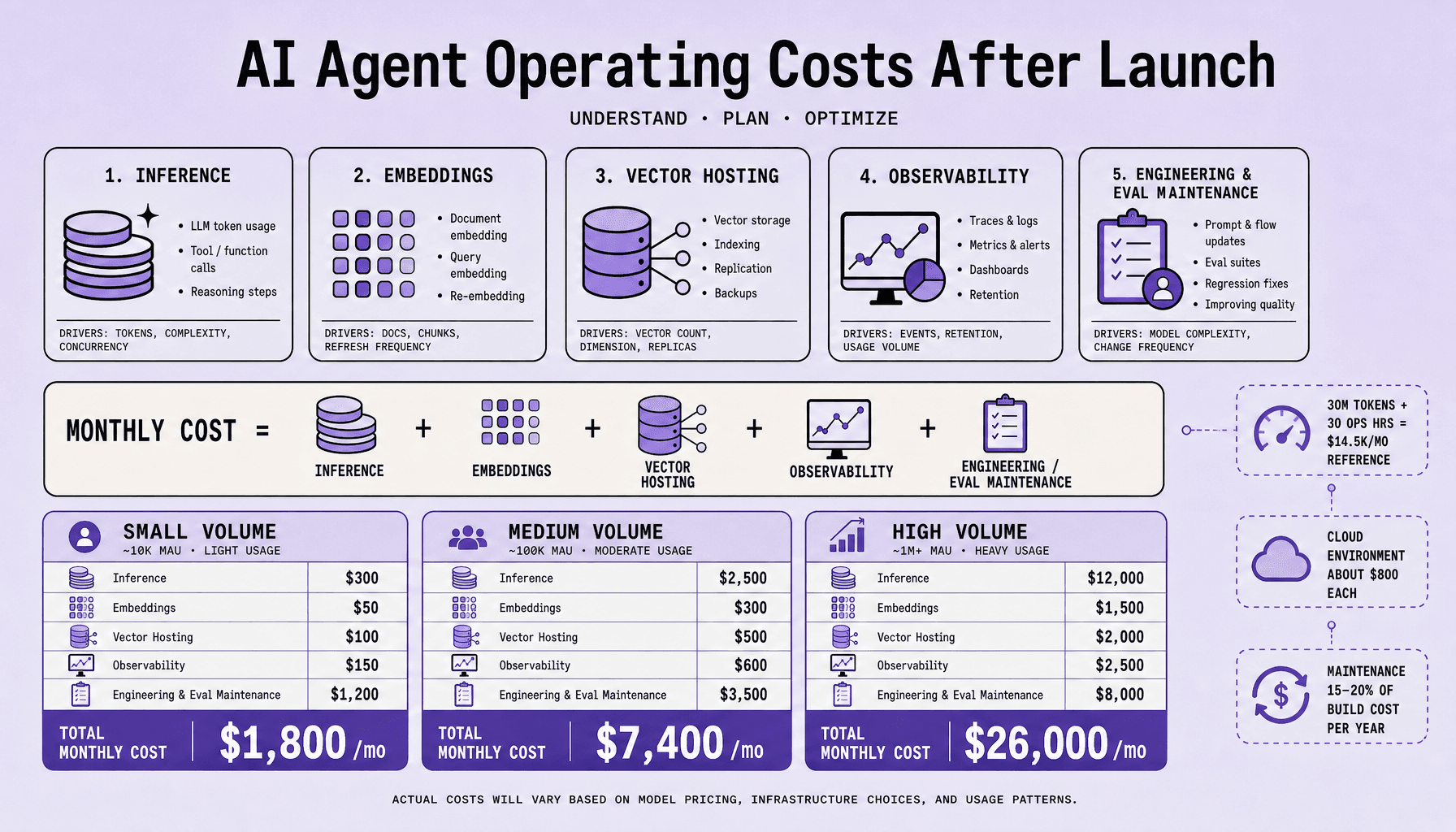
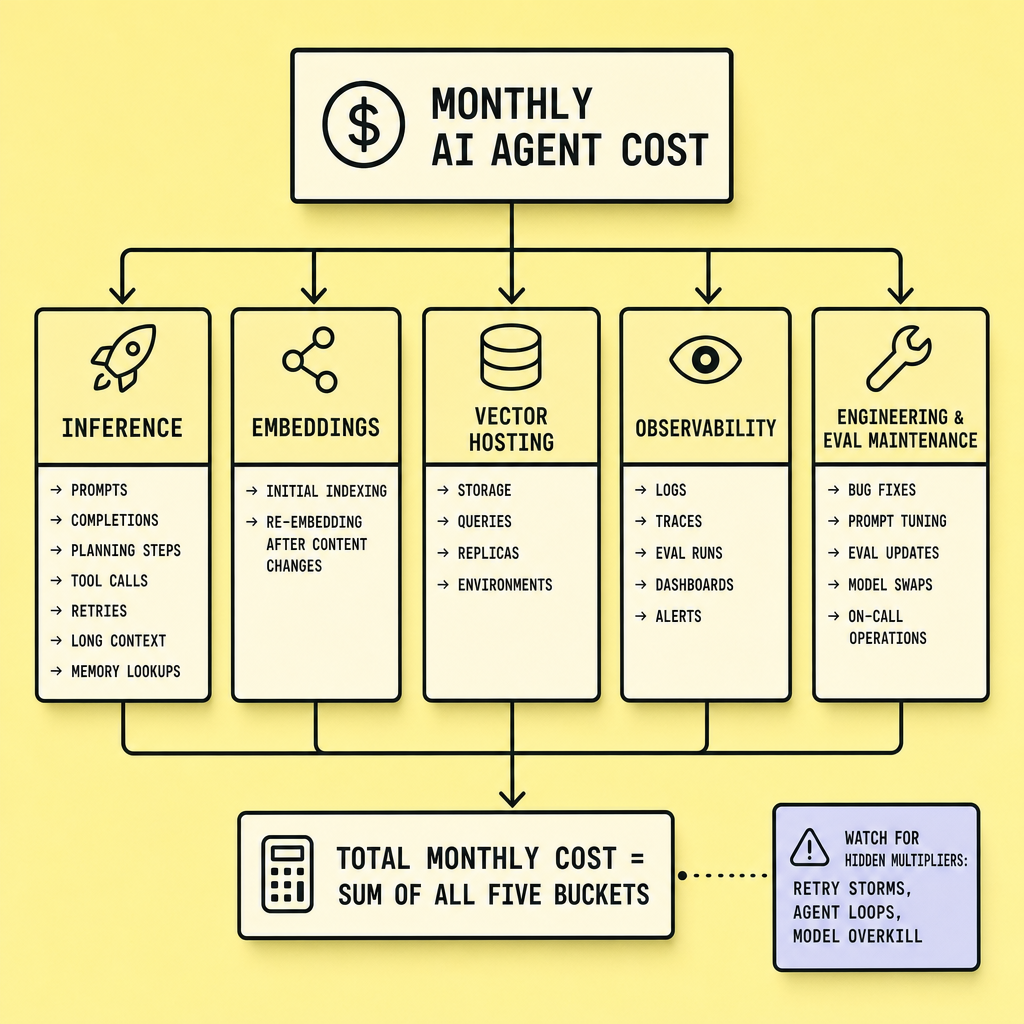
The budget pain usually starts after the launch demo goes well. Most AI agent operating costs show up once real traffic, real retries, and real maintenance kick in. Teams should budget for inference, embeddings, vector hosting, observability, cloud runtime, and engineering/eval maintenance each month12. Small setups often land in the high hundreds to low thousands monthly; higher-volume or human-in-the-loop systems can climb into five figures, especially once ops time is included23.
A practical AI agent cost breakdown usually starts with AI agent inference cost as the biggest variable, then layers in the storage and maintenance work that demos tend to hide. A useful anchor: AI Automation Pod is priced around $14.5K/month and includes 30M tokens plus 30 operator hours; cloud can run about $800 per environment, and ongoing maintenance often lands around 15–20% of build cost per year23. Retry storms, long contexts, agent loops, re-embedding, and model overkill can push the true AI agent monthly cost up fast. At Imversion Technologies Pvt Ltd, we treat clean code as a cost-control tool -- fewer loops, fewer retries, lower bills.
Key Takeaways on AI agent operating costs
- Treat AI agent operating costs as a five-part bill: inference, embeddings, vector hosting, observability, and engineering/eval maintenance -- plus cloud runtime in most real deployments.12
- Inference is usually the biggest variable line item in any AI agent cost breakdown, and it rises fast with retry storms, long contexts, agent loops, and model overkill.14
- Maintenance is not optional. A practical AI agent total cost of ownership should include ongoing support after launch, often modeled at roughly 15–20% of build cost per year, with examples like AI Automation Pod at about $14.5K/month including 30M tokens and 30 operator hours.23
- Budget by volume tier, not by demo usage: small deployments may stay in the high hundreds to low thousands monthly, medium can move into several thousand, and high-volume systems can escalate quickly if re-embedding or eval traffic spikes.25
- Use a simple monthly formula: AI agent monthly cost = inference + embeddings + vector hosting + observability + cloud + engineering/evals. Clean code helps here -- tighter orchestration reduces waste and makes cost control stick.
A simple monthly formula for AI agent total cost of ownership
Demo math is rarely enough. For most teams, the better monthly view is:
Monthly Cost = inference + embeddings + vector hosting + observability + cloud runtime + engineering/eval maintenance + operator/support time
That formula captures the real AI agent total cost of ownership because it separates usage-driven spend from the bills that keep arriving even in quiet months.
Which costs are variable vs fixed
Mostly variable: inference, embeddings, and part of observability. These rise with request volume, tokens, context window size, retries, re-embedding jobs, and agent loops.12 If an agent starts resending long histories or retrieved documents on every step, token spend climbs fast. Retry storms can distort an otherwise reasonable AI agent monthly cost in a single week.1
Mostly fixed or semi-fixed: vector hosting, cloud runtime, maintenance, and baseline support coverage. Cloud runtime often starts around $800 per environment per month, so dev, staging, and production can multiply that quickly.3 Vector databases and monitoring platforms also tend to have a base fee before usage meaningfully scales.
How to budget maintenance monthly
A practical rule is to convert annual upkeep into a monthly AI agent maintenance cost budget:
Monthly maintenance = (build cost × 15% to 20%) / 12
That 15–20% annual range is a solid benchmark for post-launch maintenance, updates, fixes, evaluation work, and model or integration adjustments.36 So if the build cost was $60,000, the maintenance budget is about $750 to $1,000 per month.36
One caveat.
Formula accuracy depends less on perfect model pricing and more on measuring actual production behavior: request patterns, average tokens per run, failed tool calls, re-embedding frequency, and operator hours. Teams often obsess over list-price tokens while missing the bigger leaks -- long contexts, model overkill, and support load.
Why operator/support time belongs in the formula
This belongs in the formula because agents create work after launch. Humans still review failures, tune prompts, rerun jobs, handle escalations, and maintain evals. One market anchor makes this clear: AI Automation Pod at about $14.5K/month includes roughly 30M tokens and 30 operator hours.2 A complete AI agent cost breakdown should never stop at model spend alone.
There is also a day-to-day engineering side to this. Maintainable orchestration logic reduces debugging time, loop bugs, and expensive rework over time.
AI agent operating costs by category: where the monthly bill actually comes from
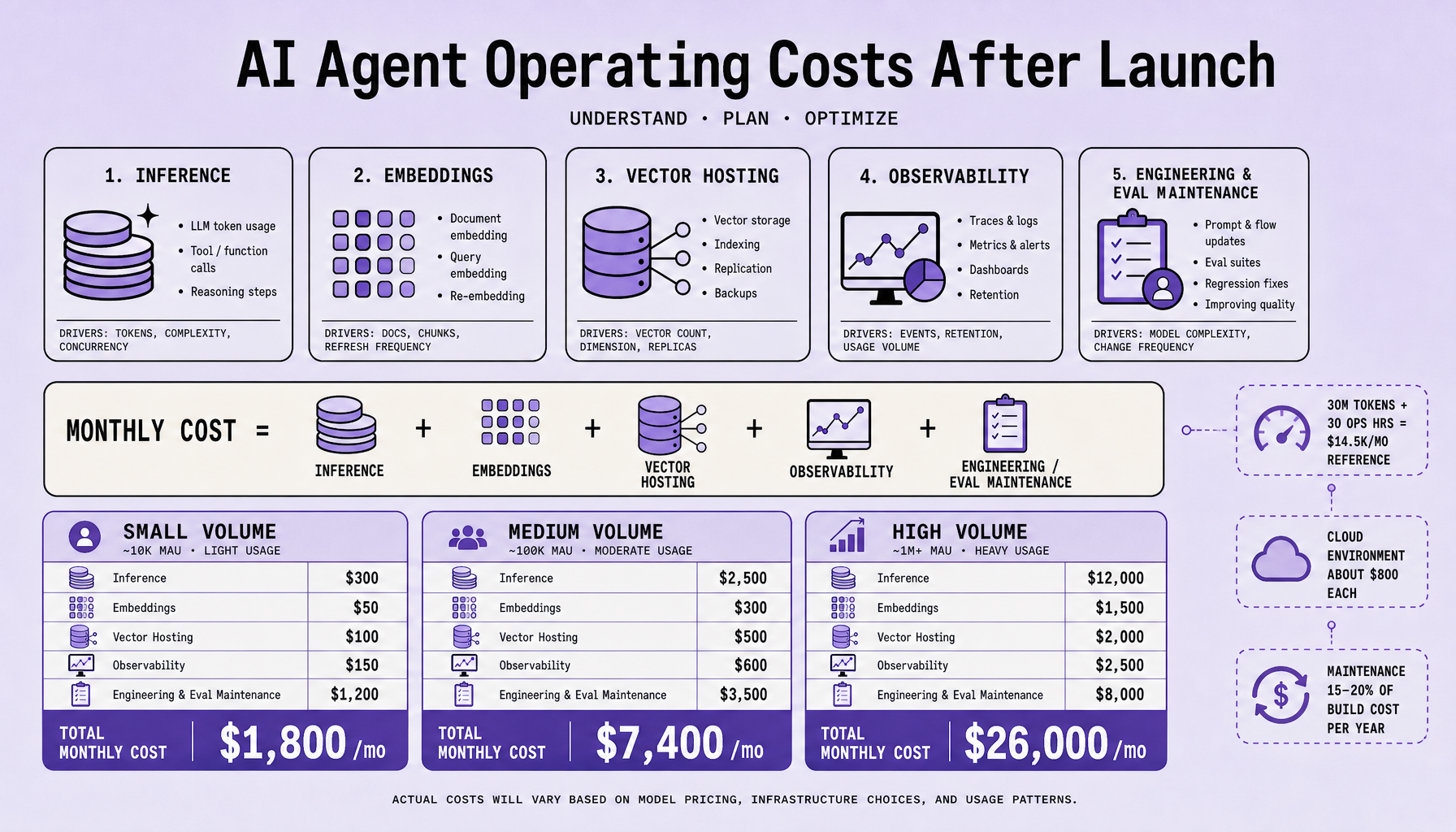
The surprise is rarely launch cost. It is production behavior. A realistic AI agent cost breakdown has five core buckets: LLM inference, embeddings, vector database hosting, observability, and engineering/eval maintenance, with cloud environment spend as a supporting line item.12
Inference is usually the most volatile category. Each run can trigger multiple model calls for planning, tool use, retries, and final output, so token spend scales with traffic and with poor control flow. Retry storms, long contexts, agent loops, and oversized models can push AI agent inference cost up quickly.14 One planning anchor from a market framework: AI Automation Pod is priced around $14.5K per month, including roughly 30M tokens and 30 operator hours.2
Embeddings often look cheap in steady state -- sometimes tens to a few hundred dollars monthly for smaller knowledge bases -- but re-embedding after chunking changes, metadata updates, or large document refreshes can create burst costs.23
Vector hosting is more stable. Spend rises with document count, index size, replicas, retention, and query load. Observability follows a similar pattern: traces, logs, prompt history, and evaluation records grow with usage and debugging depth. Teams often under-budget both until production issues force longer retention or better monitoring.14
Then there is the human-cost bucket: engineering and eval maintenance. Expect ongoing prompt tuning, regression testing, routing changes, guardrail updates, and dataset upkeep. One common benchmark is 15% to 20% of build cost per year, spread across monthly operations.3 Cloud environment cost also remains real; about $800 per environment is one planning anchor.3
| Category | What drives spend | Fixed or variable | When it spikes |
|---|---|---|---|
| Inference | Token volume, context length, retries, loops, model tier | Mostly variable | Traffic surges, bad workflows |
| Embeddings | New docs, re-indexing, chunk changes | Usually bursty | Re-embedding events |
| Vector hosting | Stored vectors, replicas, query load | Mixed | Corpus growth, HA setup |
| Observability | Trace volume, log retention, eval runs | Mixed | Incident response, deeper QA |
| Engineering/eval maintenance | Prompt updates, tests, tuning, ops hours | Semi-fixed | Model changes, quality regressions |
Optimize inference first, not embeddings. Better prompt routing, loop limits, and retry controls usually cut monthly waste before lower-impact categories do.12
Why AI agent inference cost rises fast in production
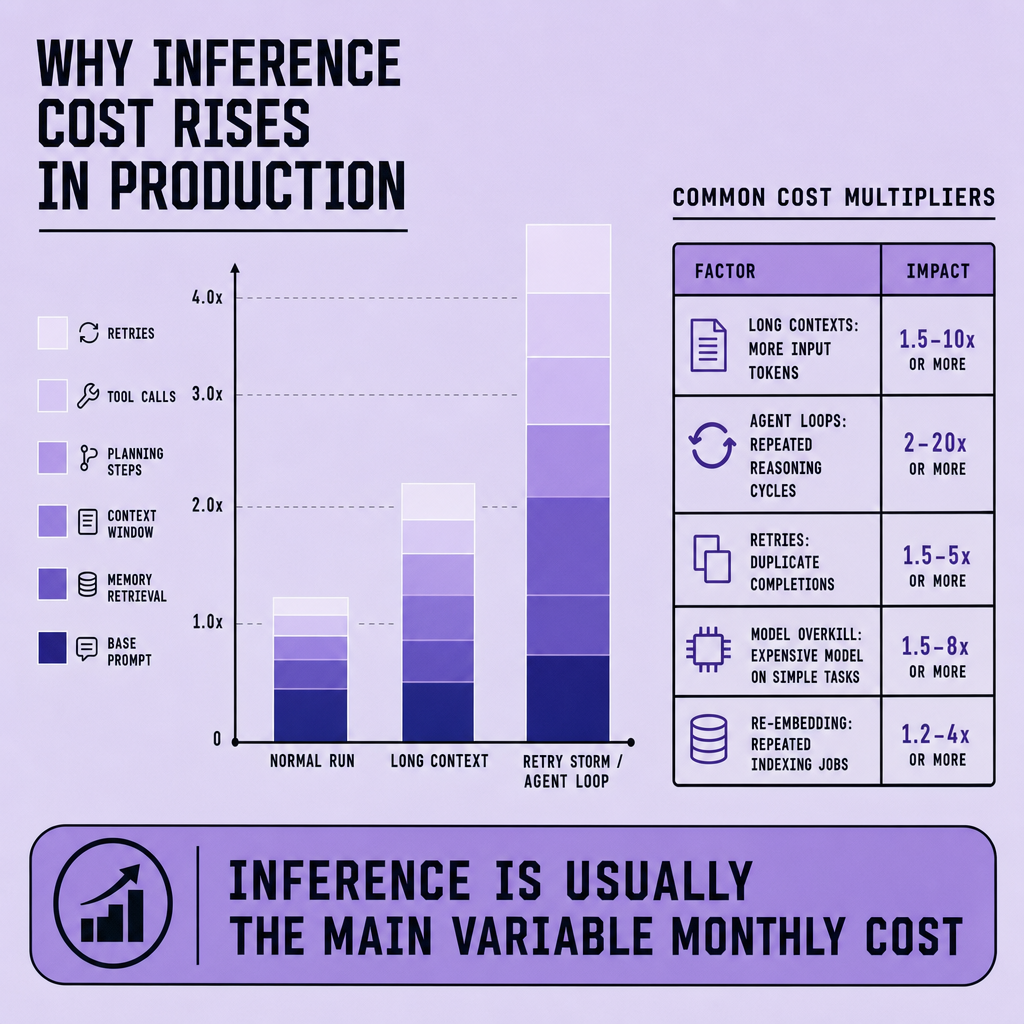
Inference costs get expensive fast because a production agent rarely makes one model call per user request. It plans, calls tools, retries failures, pulls memory, and then generates a final answer. Each step consumes tokens. In real systems, the same context often gets sent again and again, which makes AI agent inference cost the most volatile part of AI agent operating costs.12
A simple chatbot demo might look cheap. Production agents do not.
Most teams underestimate the token multiplier created by orchestration. One user task can trigger a planning pass, one or more tool calling steps, a reasoning loop to interpret tool results, and a final response. If the agent carries forward conversation history, retrieved documents, system instructions, and tool output on every step, the context window grows while traffic still looks modest from the outside.1 That is why an AI agent monthly cost can jump without a matching jump in user count.
The hidden cost drivers are predictable:
- Retry storms: aggressive retry policy settings can repeat the same failed call several times, often with the same long prompt attached.1
- Long contexts: agents frequently resend prior messages, retrieved chunks, and memory state on each inference step.
- Agent loops: weak stopping rules can keep a reasoning loop alive longer than the task deserves.12
- Model overkill: using a premium reasoning model for classification, routing, or simple extraction wastes budget.
We advise teams to treat premium-model usage as a decision quality issue, not just a pricing issue. Use the expensive model where reasoning materially changes outcomes. Route simpler steps -- intent detection, summarization, schema cleanup -- to cheaper models. User experience is as important as functionality, but paying top-tier rates for every micro-step usually does not improve either.
Packaged services are a useful market anchor, not a raw token proxy: AI Automation Pod is listed at about $14.5K per month with roughly 30M tokens and 30 operator hours included, which shows that operational support sits on top of pure inference spend.2
The practical implication for any AI agent cost breakdown is clear: cap loop depth, trim context, set sane retry limits, and segment models by task. Otherwise inference dominates the bill long before traffic looks “large.”
AI agent operating costs for embeddings, vector hosting, observability, and maintenance after launch
Demos make these costs look secondary. After launch, they often become the steady bill: embeddings, vector hosting, observability, and ongoing engineering/evaluation maintenance.12
Embeddings: usually modest, sometimes spiky
For many deployed agents, embeddings stay well below the AI agent inference cost line item in steady state. If the knowledge base is stable, monthly embedding spend may be only tens to a few hundred dollars.2 But costs rise when the corpus changes often. Re-embedding after a model switch, re-chunking to improve retrieval, or syncing a frequently updated knowledge base can turn a small bill into a noticeable one.12
The common budgeting mistake is planning for query-time retrieval but not for index rebuilds.
Vector hosting: storage plus query performance
Vector hosting is more than “database rent.” Cost depends on corpus size, index design, replicas, throughput, and latency targets. A small index with light traffic may stay modest, but larger corpora and stricter latency requirements can require more memory, more replicas, and higher-performance infrastructure.14 Cloud/runtime spend also sits underneath this stack; even a simple environment can carry a baseline around $800 per environment monthly, depending on deployment shape and supporting services.3
Treat vector hosting as an operating system cost, not a one-time setup choice.
Observability and evals: cheap compared with blind debugging
Observability includes traces, logs, prompt/version tracking, alerts, and evaluation workflows that show whether quality is drifting. This can look optional until the first retrieval failure, tool-call regression, or agent loop in production. At that point, it is often cheaper than debugging without visibility.12
Engineering and evaluation maintenance
Post-launch AI agent maintenance cost includes bug fixes, prompt tuning, guardrails, eval refreshes, model updates, and cleanup after failure modes such as retry storms or long-context bloat. A common benchmark is 15% to 20% of build cost per year, or roughly 1.25% to 1.67% of build cost per month.36 For a $60,000 build, that is about $750 to $1,000 monthly.36 For a $150,000 build, about $1,875 to $2,500.36
These non-inference costs are often what make an AI agent monthly cost stable and manageable after launch.12
Small, medium, and high-volume AI agent monthly cost estimates
Teams usually get into trouble when they ask for a single neat number. Expect ranges, not fake precision. A realistic monthly estimate should include the full operating stack: inference, embeddings, vector hosting, observability, cloud runtime, and ongoing engineering/evaluation maintenance.12 Source examples are best used as directional anchors, not fixed quotes: one practical framework cites roughly $14.5K/month around a 30M-token operating level, plus operator time, environment costs, and recurring maintenance overhead.23
| Volume tier | Assumptions | Monthly range | Main cost pressure |
|---|---|---|---|
| Small | Light token budget, 1 env, limited evals | $900–$3,500 | Maintenance floor, cloud |
| Medium | Multi-step flows, moderate routing, 1–2 envs | $3,500–$12,000 | Inference, observability |
| High | Heavy usage, larger contexts, 30M-token class ops | $12,000–$25,000+ | Retries, loops, operator time |
These ranges work best as planning baselines. Small deployments are often constrained less by model spend than by the fixed cost floor of hosting, monitoring, and maintenance. Medium deployments usually see inference rise because production agents make multiple calls, route between tools, and handle retries.12 High-volume systems can climb quickly when context windows expand, workflows loop, or human operators spend more time reviewing failures and tuning behavior.13
To control cost without hurting answer quality, focus on operational levers: shorten context where possible, route simple tasks to cheaper models, cap loops, limit retries, and re-embed only when source content changes.12
References
- The Bill Arrives: How to Manage Agentic AI Costs at Scale
- How Much Do AI Agents Cost? A Practical Cost Framework ...
- Cost to Build an AI Agent in 2026: Pricing, TCO & Hidden ...
- AI Agent Development Cost $5K to $180K+ (2026)
- The Real Cost of an AI Agent: Beyond OpenAI Tokens
- Build, Deploy & Scale AI Agents in 2026
- AI Agents: The Definitive Guide — Chapter 11: Compute ...
- The Hidden Cost of AI Agents: Why 'Free' Isn't Free
Footnotes
-
https://www.cockroachlabs.com/blog/agentic-ai-costs-at-scale/ ↩ ↩2 ↩3 ↩4 ↩5 ↩6 ↩7 ↩8 ↩9 ↩10 ↩11 ↩12 ↩13 ↩14 ↩15 ↩16 ↩17 ↩18 ↩19 ↩20 ↩21 ↩22
-
https://www.mintmcp.com/blog/ai-agent-cost ↩ ↩2 ↩3 ↩4 ↩5 ↩6 ↩7 ↩8 ↩9 ↩10 ↩11 ↩12 ↩13 ↩14 ↩15 ↩16 ↩17 ↩18 ↩19 ↩20 ↩21 ↩22 ↩23 ↩24
-
https://servicesground.com/blog/cost-of-building-ai-agents/ ↩ ↩2 ↩3 ↩4 ↩5 ↩6 ↩7 ↩8 ↩9 ↩10 ↩11 ↩12 ↩13 ↩14 ↩15
-
https://automationtransformationconsulting.com/blog/real-cost-of-an-ai-agent ↩ ↩2 ↩3 ↩4
-
AI Agent Development Cost $5K to $180K+ (2026) ↩ ↩2 ↩3 ↩4 ↩5
Frequently Asked Questions
What are the easiest AI agent operating costs to underestimate?
The most frequently underestimated costs are sandbox or staging environments, trace and log retention, evaluation traffic, and human review time. These items often look minor during launch, but they become recurring monthly expenses because teams need them for debugging, release safety, and quality control even when user traffic is stable.
How should I track AI agent operating costs month to month?
The most reliable method is to track cost per successful task, not just cost per request. That means separating failed runs, retries, escalations, and reprocessing jobs from normal completions, then watching trend lines by workflow. This approach reveals whether quality improvements are lowering total cost or simply shifting spend into support and maintenance.
Why do AI agent operating costs become unpredictable after launch?
AI agent operating costs become unpredictable when orchestration behavior is not instrumented at the step level. A stable request count can still hide extra planning calls, longer prompts, more retrieval steps, and repeated retries. That is why production teams need per-run tracing and workflow caps rather than relying on token averages alone.[^1]
How does re-embedding affect monthly budgets?
Re-embedding affects monthly budgets by creating burst spend instead of smooth spend. A team may operate cheaply for weeks, then trigger a sharp cost jump after changing chunking logic, updating metadata, replacing an embedding model, or refreshing a large corpus. Budgeting for scheduled or event-driven re-indexing prevents these spikes from looking like unexplained overruns.[^2][^3]
What is a good finance-ready way to present AI agent operating costs internally?
A finance-ready view should show a base monthly floor plus a usage-linked upside range. The floor covers cloud, vector hosting, observability, and maintenance, while the upside range covers inference, re-embedding bursts, and operator time. This framing matches how real systems behave and aligns with benchmarks such as environment costs near $800 and annual maintenance around 15–20% of build cost.[^3]
Make Imversion a preferred source on Google
Like this kind of AI and software analysis? Add Imversion as a preferred source so Google can highlight our articles for you in Search, AI Overviews, and AI Mode.