AI Deployment: Essential Questions CTOs Must Ask Before Going Live
Before your AI deployment goes live, ensure you ask the right questions. Learn about reliability, security, and performance considerations for a successful launch.

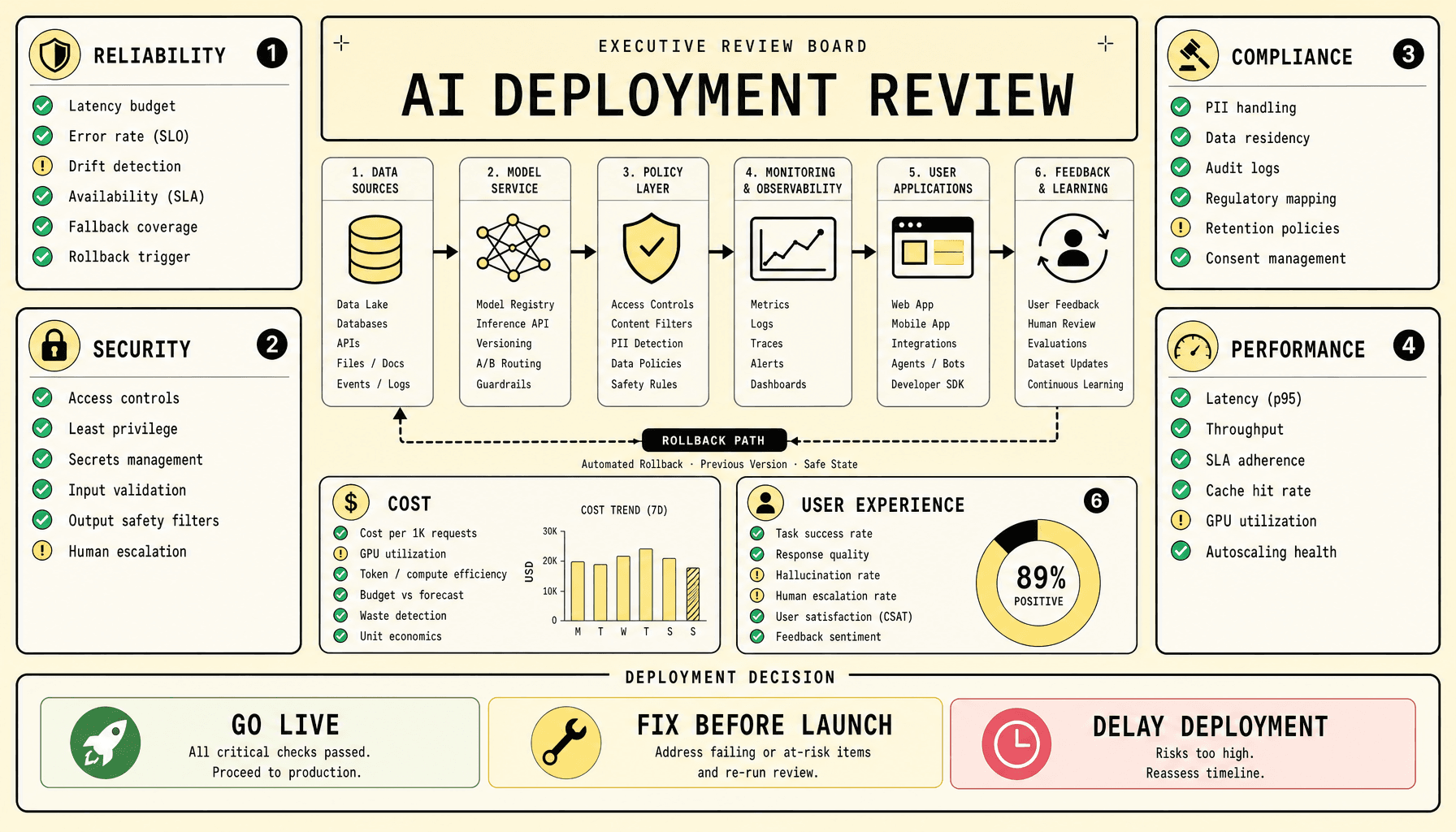
What CTOs Should Verify Before AI Deployment Goes Live
A model can look solid in testing and still create outages, bad decisions, compliance exposure, or user distrust the moment real traffic hits it. Before approving AI deployment, verify more than model quality. Your AI readiness review should confirm model validity, reliability, security, compliance, cost controls, monitoring, rollback paths, and user impact across the full production stack.
AI Deployment Key Takeaways
- Treat AI deployment as a go-live risk review, not a model handoff. Your AI deployment checklist should cover reliability, security, compliance, cost, user experience, and rollback criteria before production AI reaches users.
- AI deployment readiness depends on clear pre-launch thresholds -- think p95 latency, error rates, fallback behavior, access controls, audit logs, and approval owners for high-risk outputs.
- Common failure points are predictable: weak monitoring, no rollback plan, untested edge cases, rising inference cost, and poor UX when the model is slow, wrong, or inconsistent.
- Use staged releases, feature flags, and canary traffic. Monitoring is as important as deployment because launch day is where hidden failure modes show up.
- For enterprise AI, approval should mean operational readiness -- not just good offline accuracy.
Why AI Deployment Fails After Strong Testing
Strong testing is not enough. The usual failure point in AI deployment is the gap between a model’s offline score and its behavior inside a live system with messy inputs, real users, hard latency limits, and business consequences.
In testing, teams measure model quality on a defined dataset. In production AI, the model depends on everything around it too: request validation, upstream data formatting, retrieval quality, queue depth, network timeouts, rate limits, feature stores, and downstream application logic. Accuracy alone is not a launch criterion.
That gap is where teams get caught. Staging is often cleaner than reality, traffic is lighter, and user behavior is easier to predict. Then live traffic arrives. Edge cases show up. Input formats drift. A field that was usually populated is suddenly blank, malformed, or delayed. The model may still be “correct” in isolation while the workflow fails end to end.
Consider a support assistant in enterprise AI. It performs well in evaluation, then goes live and starts receiving long, fragmented customer messages, copied policy text, screenshots converted through OCR, and account metadata from multiple systems. If retrieval returns stale documents, or the identity service times out, or prompt assembly exceeds token limits, the user gets a bad answer even if the core model is sound. No fallback workflow. No graceful degradation. That is how trust disappears.
This is why monitoring deserves the same weight as deployment. Data drift and model drift rarely announce themselves politely. You need SLOs, SLA expectations, load testing, p95 latency targets, error budgets, and alerts tied to business impact, not just API uptime.
A practical AI deployment checklist should ask:
- What breaks under unstable inputs or partial system failure?
- What triggers rollback, feature flags, or canary shutdown?
- Which outputs require human review?
- How will you detect drift, rising cost, or degraded user experience after launch?
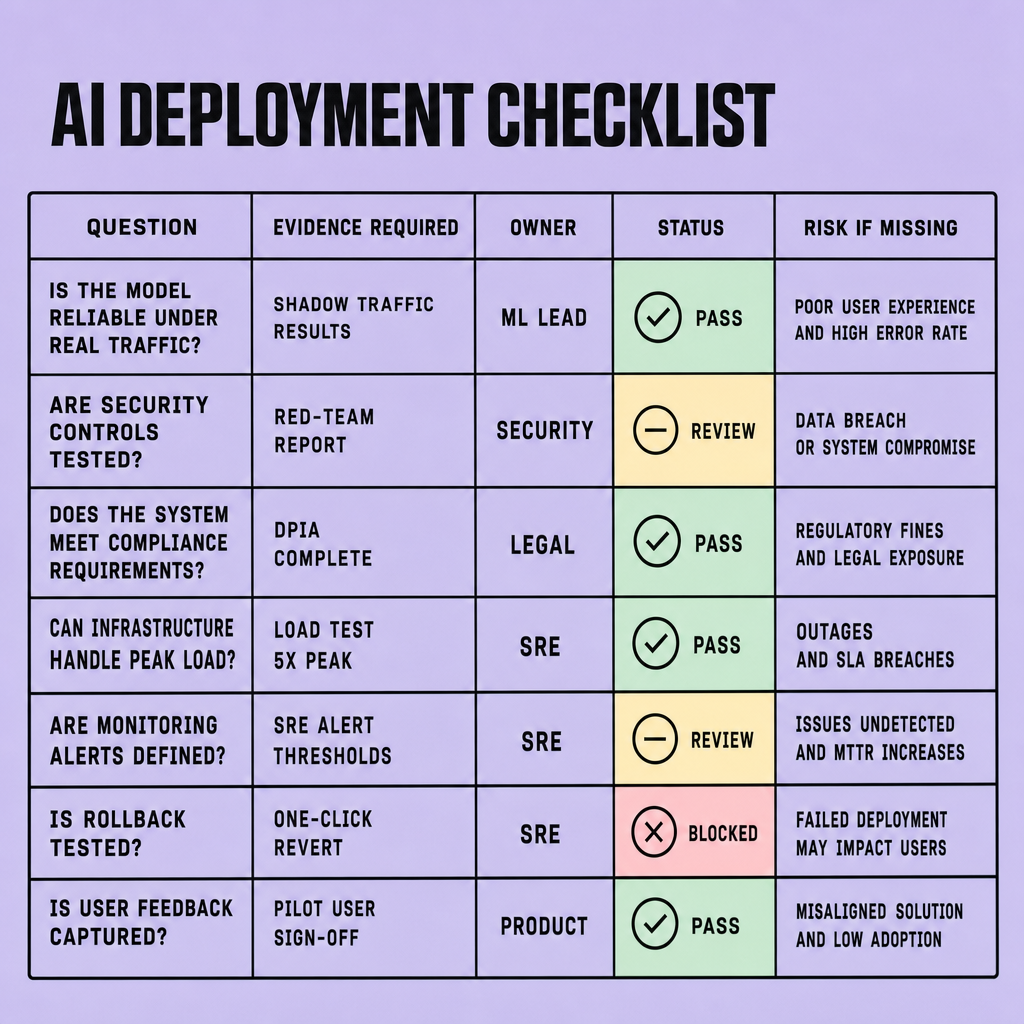
At Imversion Technologies Pvt Ltd, this is the real AI readiness test: not “Did it pass evaluation?” but “Will it stay reliable under production conditions?”
What Questions Should CTOs Ask in an AI Deployment Review?
The risk is not vague. It is usually sitting in an unresolved assumption nobody has turned into a launch gate. Approve launch only when open risks are explicit gates. In practice, that means every unresolved assumption has an owner, an acceptance threshold, and a fallback plan before traffic scales.
Is the model ready for live data?
Offline validation is not enough. Ask whether the model has been tested against recent, messy, and edge-case inputs that resemble production traffic, not just curated datasets. Review input schema handling, prompt injection resistance where relevant, and signals that would show the model is operating outside safe bounds.
Are success thresholds and go/no-go criteria defined?
If the team cannot name acceptance thresholds, the system is not ready. Require targets for p95 latency, task quality, failure rate, uptime, and human escalation rate. Define failure conditions too, such as degraded answer quality, timeout spikes, or cost per request exceeding budget.
Who owns incidents, monitoring, and rollback?
Production AI needs clear ownership. Confirm who is responsible for model behavior, infrastructure, data pipelines, and user-facing incidents. Before release, verify alerts, dashboards, audit logs, rollback criteria, and either feature flags or a canary path to reduce blast radius.
Is human review required for high-risk outputs?
Some outputs should not be fully automated. Ask where human review is mandatory: regulated workflows, financial decisions, medical-adjacent guidance, or other outputs with legal or trust risk. Keep it scoped to high-impact decisions, since review adds both safety and latency.
Are security, compliance, cost, and UX launch-ready?
A lot of launch reviews leave these for later. That is a mistake. Verify encryption in transit and at rest, access controls for prompts and logs, secrets management, and auditable system behavior. Then review cost ceilings, inference spend, fallback behavior, and the user experience when the model is uncertain or fails.
A practical AI deployment checklist turns abstract concerns into launch gates: acceptance thresholds, ownership, rollback, and staged rollout rules.
Delay full launch if any gate lacks a clear owner. Partial rollout works only when you can observe, contain, and reverse failure quickly.
FAQs
What is the most important question in an AI deployment review?
Whether the system has clear go/no-go criteria tied to reliability, security, performance, and rollback.
What should an AI deployment checklist include?
Model validation, acceptance thresholds, monitoring, ownership, security controls, cost limits, rollback plans, and user experience safeguards.
How do you measure AI deployment readiness?
By verifying the model, infrastructure, governance, and operations are ready for real traffic with documented thresholds and fallback paths.
Is Your AI Deployment Reliable, Secure, and Compliant Enough for Production?
Plenty of AI systems fail after launch for reasons that have nothing to do with benchmark quality. If the system cannot meet uptime targets, protect sensitive prompts and outputs, or satisfy the rules attached to its data, it is not ready for production.
Reliability checks before user traffic
Use reliability targets that engineering can test. Define an uptime objective, a latency SLO such as p95 or p99, and explicit error thresholds for failed generations, timeouts, and downstream failures.
Then test the full serving path under pressure: API gateway, model endpoint, vector store if used, cache, database, and any human-review queue. Teams often validate the model but miss the integration path, where production failures usually appear. Staging should also match production closely enough to expose dependency, scaling, secrets, and network issues before launch.
Security controls that must be enforced
Security is part of launch readiness, especially when prompts may contain customer data, internal documents, or regulated records. Before go-live, verify RBAC for operators and support teams, encryption in transit and at rest for prompts, outputs, embeddings, and logs, secret rotation, and logging controls that avoid unnecessary retention of sensitive content.
Do not stop at baseline controls. Test likely abuse paths as well. Prompt injection, data exfiltration, over-permissioned tools, and unsafe file handling are practical risks. Useful launch controls include scoped tool permissions, rate limits, input validation, and redaction rules.
Compliance readiness and auditability
This is another area where teams confuse policy with readiness. Policies alone do not make an AI system compliant. Controls need to be testable, observable, and owned before launch.
If the system must meet internal security controls or external regulatory requirements, verify that audit logs, retention rules, access reviews, data deletion workflows, and incident response paths work in the deployed environment. A practical checklist asks: can the team explain who accessed what, what the model returned, what data was stored, and whether that handling fits the approved data boundary?
FAQs
What should be on an AI deployment checklist for security?
Include RBAC, encryption in transit and at rest, secret management, logging controls, redaction rules, and abuse-case testing.
How do you validate reliability before production AI launch?
Set uptime and latency SLOs, then run load, concurrency, and failover tests across the full serving stack.
Why is compliance part of AI readiness?
Because production AI may handle sensitive data, which requires auditable access, retention, deletion, and incident workflows.
What are common AI deployment security mistakes?
Over-logging prompts, broad admin access, weak tool permissions, unencrypted stores, and no testing for injection or exfiltration.
Can you launch before every governance control is mature?
Only with narrow scope, documented risk acceptance, compensating controls, and clear limits on exposed data, users, and actions.
How Should CTOs Plan Cost, Monitoring, and Rollback Before AI Deployment?
A launch can be technically successful and still fail commercially or operationally within days. Spend runs away, latency climbs, quality drifts, and nobody can roll traffic back cleanly. Before launch, treat cost, monitoring, and rollback as explicit go-live gates, not post-release cleanup. A workable AI deployment plan should show how spend will be controlled, how failures and drift will be detected, and how traffic will be reduced or rerouted if the system misses its thresholds in production.
Validate cost before usage scales
Model price alone is not enough. Estimate the full serving path: token usage, embedding volume, cache hit rate, GPU utilization, autoscaling behavior, data egress, vector database load, and fallback model cost. Teams often budget for inference and miss the infrastructure around it.
Your AI deployment checklist should test scaling assumptions with realistic prompts and concurrency, especially when requests vary in context length or tool use. A chatbot, summarizer, and document agent can have very different unit economics on the same base model. Define a per-request cost ceiling and a monthly burn threshold before launch approval.
Put observability in place on day one
If you cannot see spend, latency, failures, and quality drift quickly, your AI deployment readiness is weak.
Use traces, metrics, and dashboards that cover both system behavior and model behavior. Track p95 latency, timeout rate, error rate, token usage, GPU utilization, queue depth, cache misses, fallback frequency, and cost per request. For quality, monitor refusal rate, invalid output rate, and drift signals through sampled evaluations.
Define rollback triggers before launch
Rollback should be mechanical, not debated during an incident. Set clear triggers such as sustained latency breaches, rapid error-budget burn, abnormal cost spikes, unsafe output rates, or failed downstream dependencies. Use feature flags, canary releases, versioned prompts, and safe fallbacks such as a smaller model, cached response path, rules-based flow, or human review.
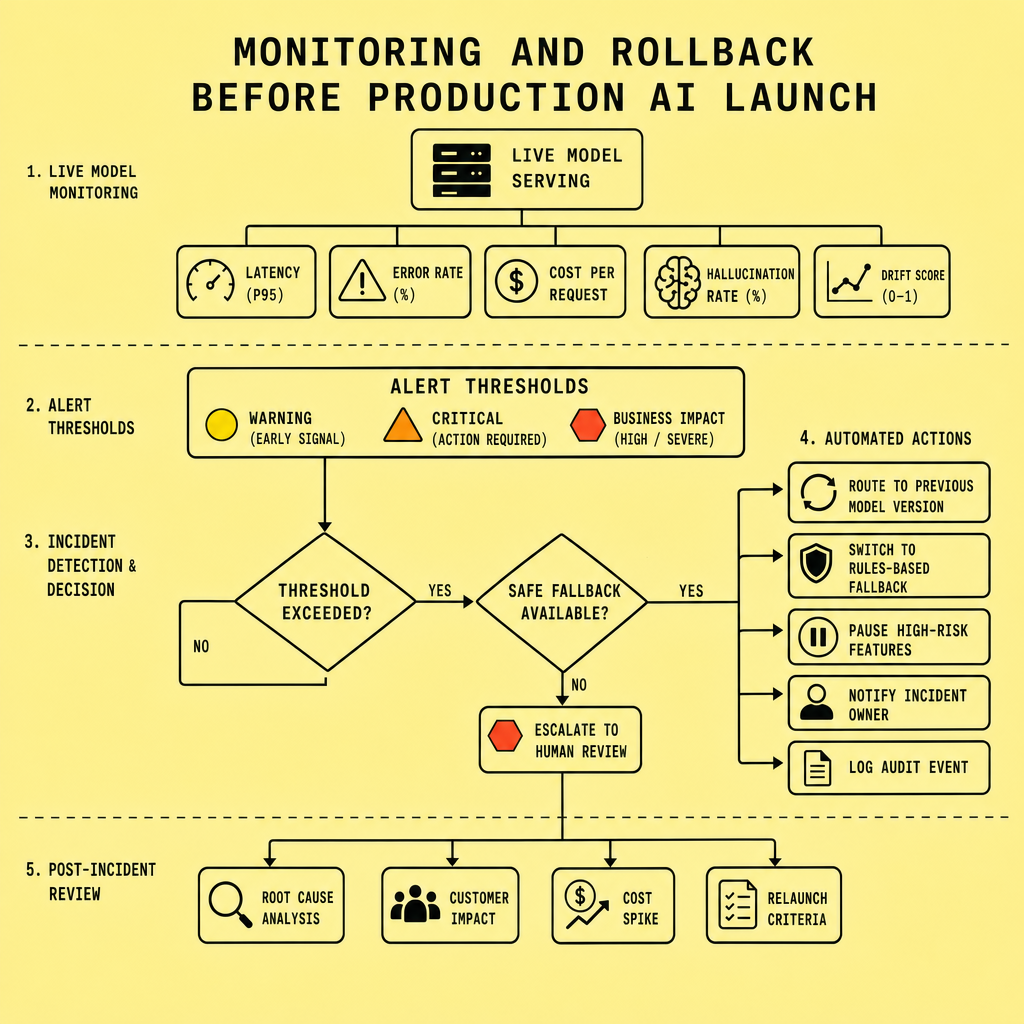
Fast rollback can reduce capability, but it protects users and limits operational risk when trust, compliance, or spend moves outside acceptable bounds.
What Final AI Deployment Readiness Checks Improve User Adoption and Reduce Mistakes?
Many AI launches stumble in the last mile. The model works, the endpoint is live, and users still do not trust it or use it correctly. Do not launch production AI until users know when to trust it, when to verify it, and how to override it without slowing critical work.
For real AI deployment readiness, the final check is the user layer, not just the model layer. Confirm that outputs are understandable, confidence or uncertainty is communicated in a usable way, and a clear human override or escalation path exists. If a support agent sees a polished answer with no limitation warning, no source context, and no escalation button, trust can collapse after the first visible mistake. Good UX guardrails reduce that risk: concise explanations, visible uncertainty, blocked or reviewed actions for high-risk cases, and a simple runbook for exceptions.
That same pattern shows up in operations. Common enterprise AI mistakes are also operational mistakes: vague success metrics, weak change management, no owner for human escalation, poor communication of limits, and releasing to users before feedback loops are live. Before launch, verify who reviews user-reported errors, how fast prompt or policy changes can be made, and what behavior should trigger a rollback to manual handling.
A practical caveat: too many warnings or approvals can hurt adoption by making the system feel noisy or slower than existing workflows. The goal is not maximum friction; it is targeted friction where mistakes are costly.
Your AI deployment checklist should end with one question: can users safely act on outputs without guessing the model’s limits? If not, your AI readiness review is not complete.
Frequently Asked Questions
What is an AI deployment checklist supposed to prove before launch?
An AI deployment checklist should prove that the system is operationally safe, not just technically functional. It should show evidence for performance thresholds, security controls, ownership, rollback capability, cost limits, auditability, and user safeguards so leadership can make a clear go or no-go decision.
How does AI deployment differ from shipping a normal software feature?
AI deployment differs because model behavior is probabilistic, input quality changes over time, and output errors can be harder to predict than standard software bugs. That means launch review must include drift detection, human escalation rules, evaluation sampling, and fallback behavior in addition to standard infrastructure and release checks.
Why should enterprise AI teams define a rollback plan before launch day?
Enterprise AI teams should define rollback in advance because incidents unfold faster than approval chains. A pre-approved rollback path reduces downtime, limits user harm, controls spend, and avoids confusion when quality, compliance, or dependency failures appear under real traffic.
What metrics best indicate production AI health after go-live?
The best production AI health metrics combine system and outcome signals. Teams should track latency, timeout rate, error rate, fallback frequency, unit cost, drift indicators, unsafe output rate, and task success measures tied to business workflows, because uptime alone does not reflect actual user impact.
What are the most common mistakes that delay AI readiness?
The most common AI readiness mistakes are unclear launch owners, weak staging realism, missing audit evidence, no limit on inference spend, and poor exception handling for users. Teams also delay readiness by treating compliance and UX as post-launch concerns instead of launch-blocking requirements.
Make Imversion a preferred source on Google
Like this kind of AI and software analysis? Add Imversion as a preferred source so Google can highlight our articles for you in Search, AI Overviews, and AI Mode.