AI outbound personalization: Real Insights vs Spam Tactics 2026
Is AI outbound personalization a useful system or a spam machine? Learn how to enhance sales outreach without compromising quality.

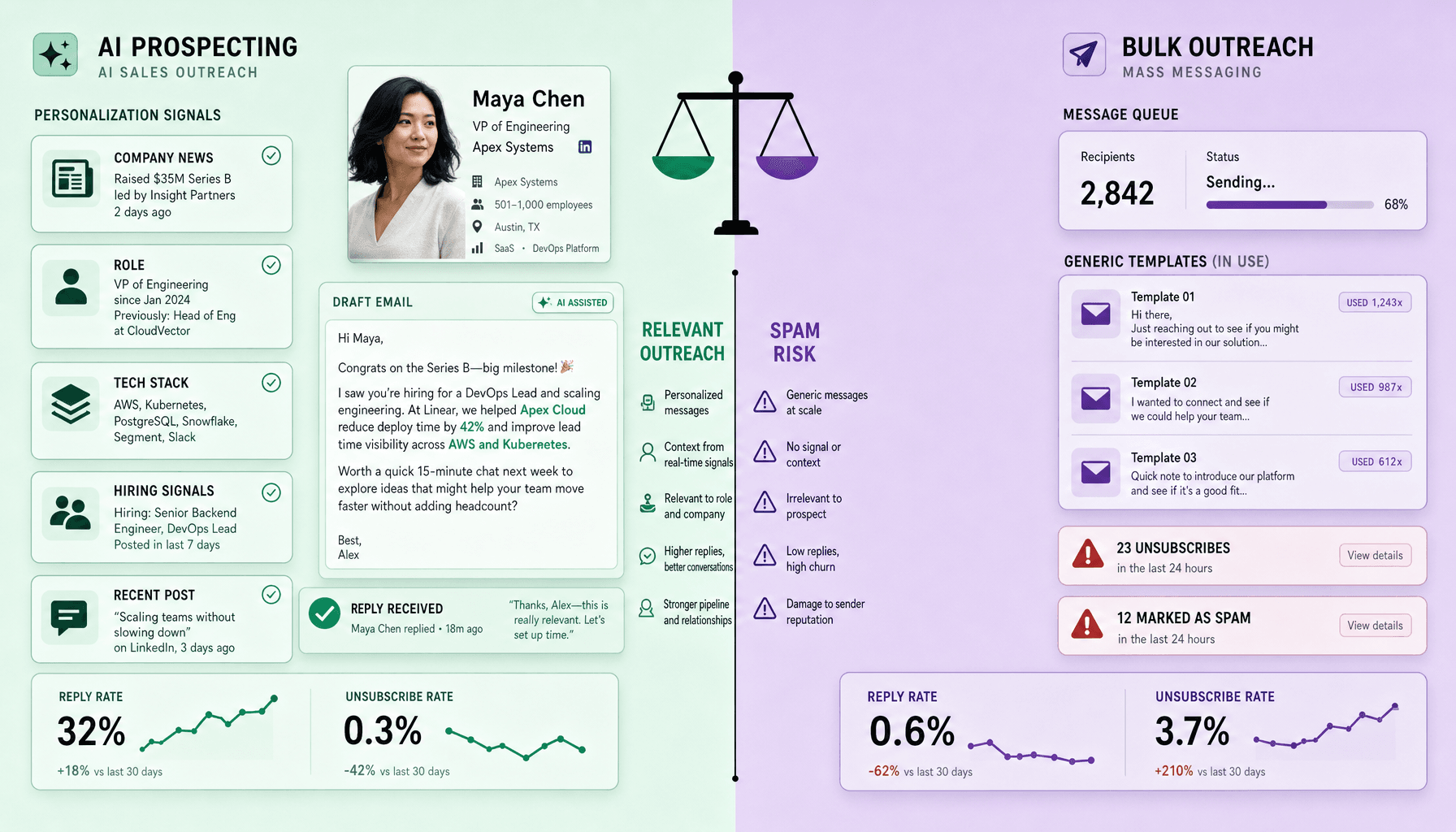
Is AI outbound personalization a useful system or a spam machine?
Most teams do not have an AI personalization problem. They have a relevance problem at scale.
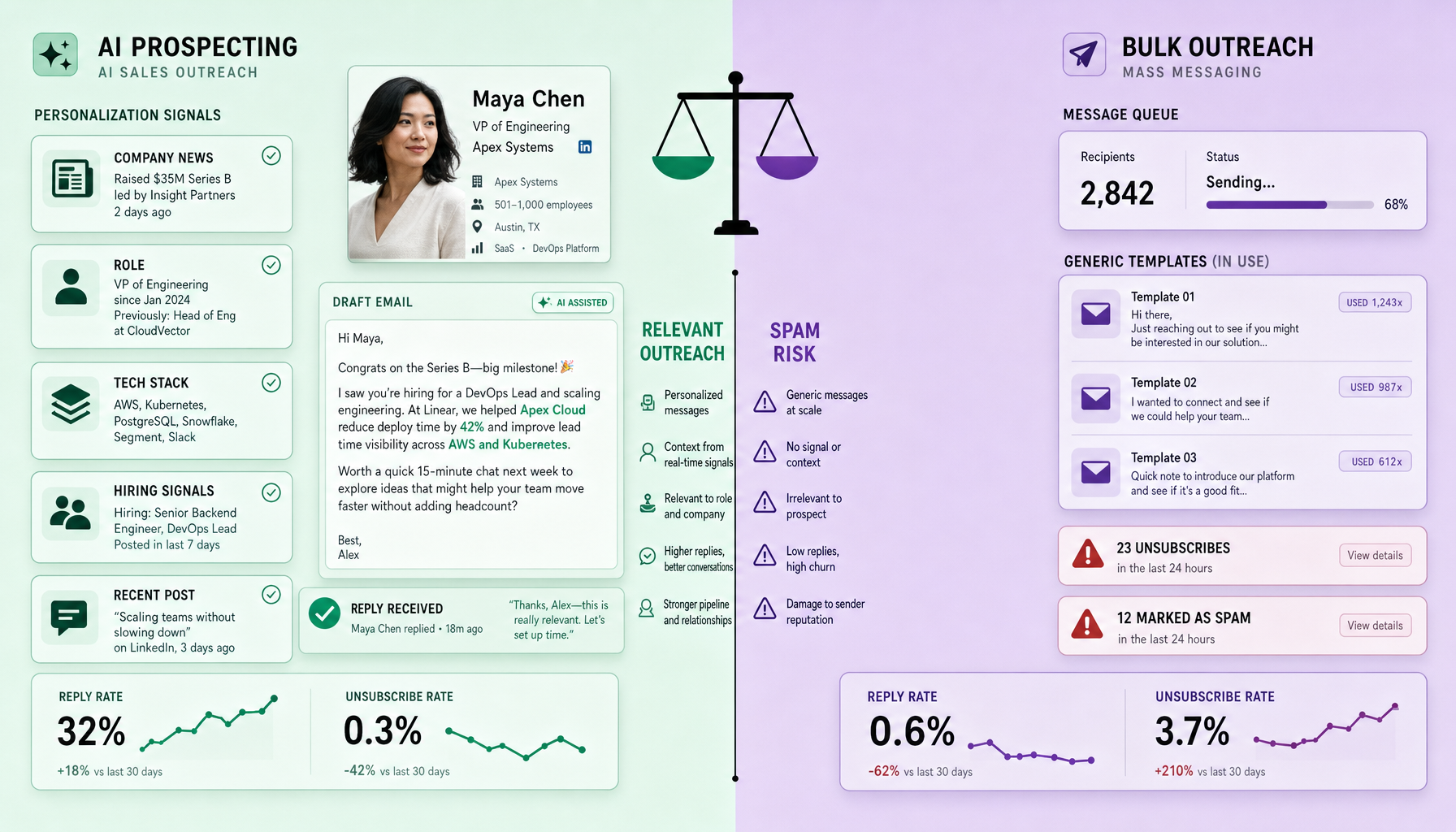
AI outbound personalization helps when it adds real buyer context. It becomes a spam machine when teams use AI sales outreach to mass-produce generic messages with no clear relevance.
In practice, the difference is simple and unforgiving: good AI cold email personalization uses CRM enrichment, trigger events, and intent signals to help a rep say something specific; bad AI prospecting just swaps names, job titles, and company blurbs into the same template. We see the line most clearly in outcomes -- stronger reply quality versus higher unsubscribe rates, bounce risk, and domain damage. At Imversion Technologies Pvt Ltd, we treat user experience as important as functionality, and outbound should follow the same rule: if the message is not useful to the buyer, AI sales automation only scales the mistake.
Key Takeaways
-
Use AI outbound personalization to increase relevance, not just volume. The system works when AI sales outreach pulls from real signals -- CRM enrichment, intent data, hiring spikes, funding rounds, or tech-stack changes -- and turns them into messages a prospect would actually care about.
-
AI cold email personalization becomes spam fast when teams automate shallow research, fake familiarity, or blast the same prompt-built copy across large lists. That hurts reply quality, unsubscribe rates, and domain reputation.
-
The safest operating model is simple: let AI prospecting handle research, segmentation, and draft creation; keep humans responsible for positioning, claims, and final send decisions. User experience is as important as functionality.
-
Measure AI sales automation with balanced metrics: reply rate, meeting rate, bounce rate, unsubscribe rate, time saved per rep, and pipeline quality. Because higher output without trust is not real ROI.
What AI outbound personalization actually means in sales
A lot of teams miss here by scaling words instead of relevance. Real AI outbound personalization is not “Hi {{FirstName}}, saw you work at {{Company}}.” That is token replacement. Fast, easy, and weak.
What this should mean in practice is using structured data plus workflow logic to decide who to contact, why now, and what message angle fits. The inputs often include CRM fields, firmographics, lead enrichment, intent data, trigger events, and public context such as hiring spikes, funding rounds, product launches, or technology stack changes. AI prospecting systems then score accounts, group them by pattern, and generate message drafts tied to a likely business problem.
A practical workflow looks like this:
- Pull account and contact data from a CRM and enrichment source.
- Detect signals -- for example, a SaaS company hiring sales reps after a funding round.
- Map that context to a hypothesis, such as pipeline growth pressure or onboarding complexity.
- Generate outbound email personalization around that hypothesis.
- Route the draft into sequencing tools with human review, send rules, and reply handling.
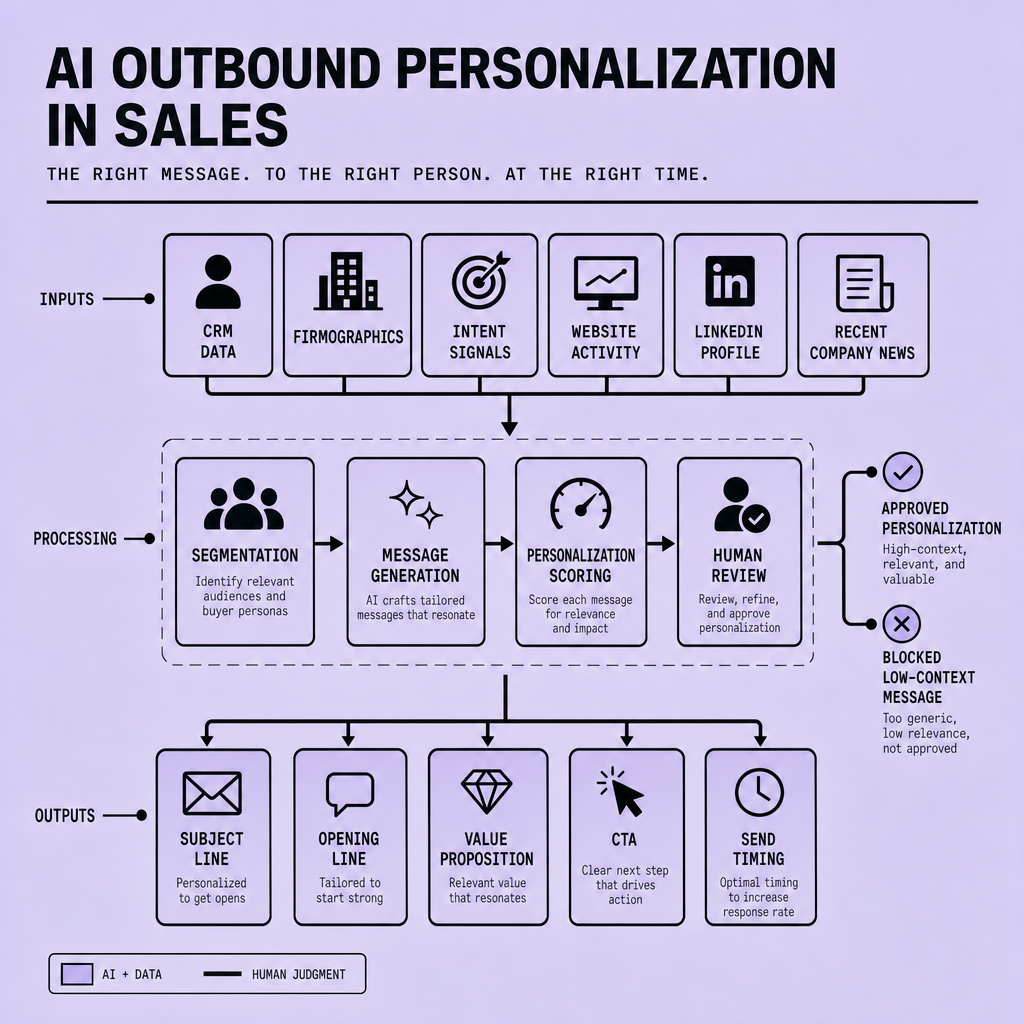
The output should not be a “personalized sentence.” It should be a relevant outreach angle.
Mentioning a prospect’s name, title, or company alone is not real personalization; relevance comes from connecting verified context to a specific problem-solution fit.
That distinction matters because AI cold email personalization can either improve precision or industrialize spam. If the system uses shallow merge tags, the email reads automated even when every field is filled. If it uses context -- say, firmographics plus intent data showing interest in a category and a trigger event like rapid hiring -- AI sales outreach can sound informed, timely, and useful.
We take a firm view on this: user experience is as important as functionality. In outbound, the buyer experience is the product for that first touch. So the best outbound email personalization systems optimize for message relevance, not just send volume.
When AI outbound personalization improves results and when it starts looking like spam
This is where teams usually feel the tradeoff. AI sales outreach adds value when automation increases relevance. It turns into spam the moment scale outruns context.
Teams often chase volume first. That is where performance slips. Speed is not the same as effectiveness; a smaller list with stronger context usually outperforms mass sending with weak personalization. AI outbound personalization works best when the system has reliable inputs -- CRM enrichment, recent trigger events, intent signals, clean contact data -- and a human checks whether the message actually fits the account, role, and timing.
The boundary is trust.
If outbound email personalization references a funding round, hiring spike, tool migration, or stated business priority and connects that signal to a concrete problem, prospects can see why they received the message. If AI cold email personalization grabs shallow details, overstates familiarity, or forces a generic pitch into every sequence, it feels intrusive fast. Once relevance drops, more automation often reduces performance: reply rate falls, unsubscribe rate rises, bounce rate increases, and domain reputation starts taking damage.
| Dimension | Useful-system signal | Spam-machine signal |
|---|---|---|
| Data quality | Current CRM, verified email, real trigger event | Stale list, guessed fields, weak enrichment |
| Message relevance | Tied to role, problem, and timing | Generic template with surface-level tokens |
| Human review | Rep approves high-value sends or samples sequences | Fully auto-sent with no QA |
| Send volume | Gradual ramp based on deliverability and replies | High-volume blasts regardless of response |
A practical rule: use AI prospecting to narrow who should hear from you, then use AI sales automation to support message drafting, lead scoring, and sequencing -- not to replace judgment. We care about user experience as much as functionality, and that applies to outreach too. A prospect reading your email is still having an experience with your brand.
So monitor the right categories: reply rate, meeting rate, unsubscribe rate, bounce rate, and domain health. If volume goes up while trust signals worsen, the system is not scaling well. It is just getting louder.
Best practices for AI outbound personalization and the mistakes that ruin trust
If your targeting is weak, better writing will not save it. Treat AI cold email personalization as a targeting system first and a writing system second. Teams get better results from outbound email personalization when AI helps narrow who should hear what and why now -- not when it sprays polished text across a weak list.
Start with segmentation, not prompts
Build segments from role, company type, pain point, and buying context. Then layer in lead scoring, data enrichment, and trigger events such as funding rounds, hiring spikes, new market launches, or visible tech-stack changes. Good AI sales outreach starts with a clear reason for contact.
A common failure is fake specificity: an email mentions a company headline but the offer has no relationship to it. Prospects notice. Fast.
Use a simple relevance test before send: if the opening line could be swapped into dozens of emails without changing the offer, the personalization is too weak.
Use trigger-based messaging, but keep human review
Trigger-based messaging works because timing creates context. A hiring surge can justify a message about workflow scale. A website relaunch can support a pitch around conversion tracking. But human review still matters -- especially for first-touch messages and high-value accounts. User experience is as important as functionality, and a prospect’s inbox experience counts.
More data is not always better. If your AI sales automation pulls in scraped podcast quotes, old conference bios, and stale job changes, the message becomes creepy or wrong instead of relevant.
Protect trust with list hygiene and sequence logic
Keep CRM records current. Remove bounced domains, duplicate contacts, and stale titles. Check enrichment fields before they feed prompts. Outdated data is one of the fastest ways to make AI prospecting look careless.
Then control follow-up cadence. Over-automated follow-ups ruin trust because they ignore recipient signals. If someone did not reply, changed roles, or already booked through another channel, your sequence logic should adapt.
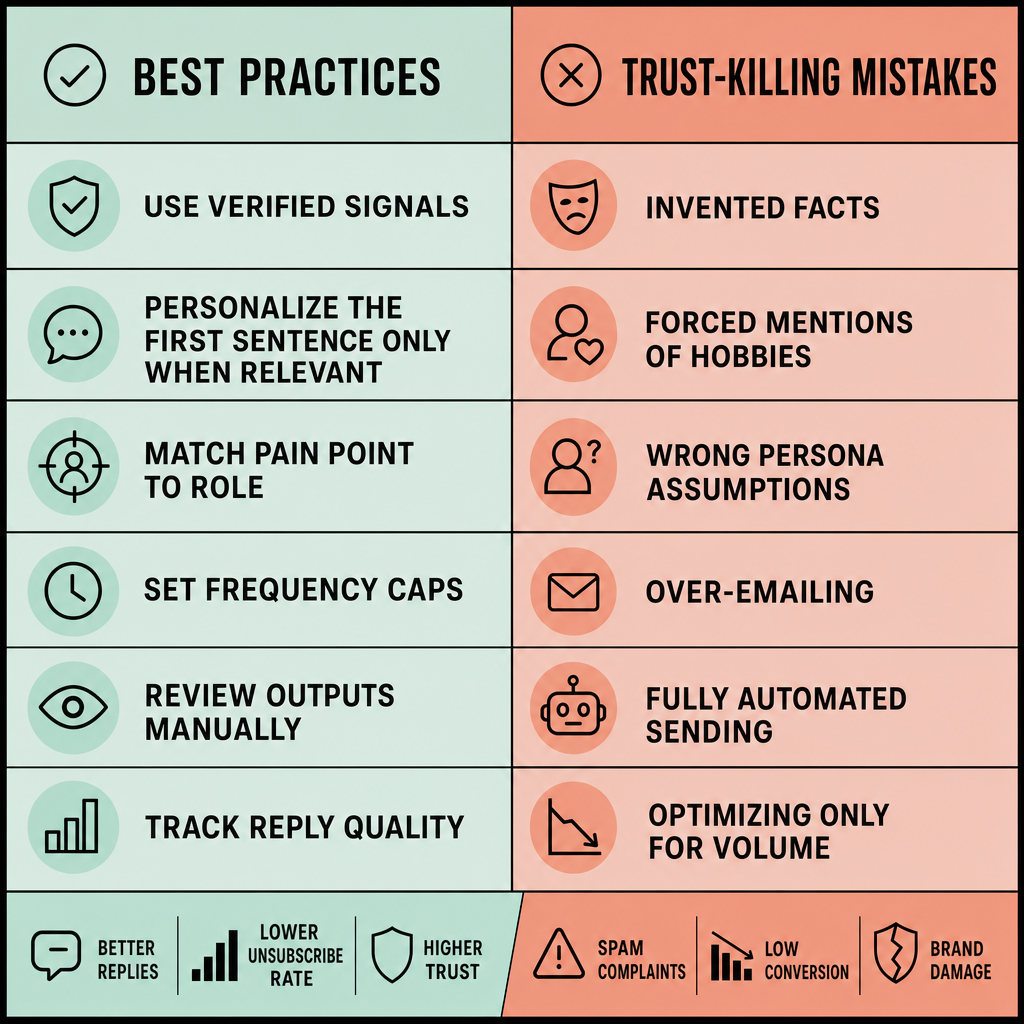
Personalization should make the message feel timely and useful -- not watched.
The practical rule is simple: use AI sales automation to improve relevance, restraint, and consistency. Avoid overreach, and trust improves with it.
Ethical guardrails, implementation tips, ROI, and the best use cases for AI outbound personalization
The hard part is not generating copy. It is building a system that stays useful under pressure. Use AI outbound personalization only if it improves buyer relevance without weakening trust. If the system cannot explain why this person should receive this message now, it is probably just automating noise.
Ethical guardrails: relevance, privacy, and restraint
Teams cross the line when they scrape too much, infer too much, or write messages that feel surveillant. Use data that is lawful, relevant, and understandable to the recipient. In practice, that means checking GDPR and CCPA implications, keeping data provenance clear, honoring opt-outs, and avoiding sensitive personal attributes unless there is a valid basis to process them.
Transparency matters. Not robotic disclosure in every email, but honest messaging. Do not imply first-hand research if a model assembled the draft. Do not manufacture urgency. Do not turn weak signals into claims like “we know your team is struggling with X” unless that point is clearly grounded in public context.
The safest AI sales outreach reads like a useful note, not a stitched-together dossier.
Implementation tips for small teams using AI sales automation
Start narrow. One use case, one segment, one channel.
The fastest way to waste AI sales automation budget is to automate a broken targeting strategy. A practical pilot might use CRM enrichment, lead scoring, and trigger events such as funding rounds, hiring spikes, or a new technology rollout for one vertical. Then route drafts into an email sequencing tool with mandatory human review before send.
Set review checkpoints early:
- data quality: bounce rate, missing fields, stale firmographics
- message quality: relevance, claim accuracy, tone, unsubscribe rate
- business quality: reply rate, meeting rate, positive reply rate
Keep A/B testing simple. Test one variable at a time: trigger-based messaging vs generic messaging, or human-edited drafts vs fully generated drafts.
How to prove ROI
ROI gets fuzzy fast if you only look at output. Measure it across four layers: meetings booked, conversion rate, rep time saved, and pipeline contribution. That gives teams a cleaner picture than reply rate alone. If AI prospecting saves research time but lowers meeting quality, the math is bad. Clean workflows and review rules also reduce rework.
Track outcomes by segment, not just by campaign, or strong accounts will hide weak personalization.
Best use cases for AI cold email personalization
AI cold email personalization works best where contextual signals are concrete and messageable:
- trigger-based AI prospecting tied to hiring, funding, product launches, or stack changes
- account-based marketing programs where multiple contacts need role-specific messaging
- vertical-specific campaigns with repeatable pain points and terminology
- reactivation outreach where CRM history gives clear context
Broad, low-context blasts are where AI sales automation turns into spam fast.
Frequently Asked Questions
What is AI outbound personalization in B2B sales?
AI outbound personalization is the use of data, rules, and language models to tailor prospecting messages based on account context, buying signals, and role-specific needs. Its value comes from improving message fit and prioritization, not from inserting superficial details into a generic template.
How does AI outbound personalization affect email deliverability?
AI outbound personalization can improve deliverability when it reduces irrelevant sends, lowers complaint rates, and supports tighter segmentation. It harms deliverability when teams use AI to increase volume without quality control, which often raises unsubscribes, spam complaints, and negative sender reputation signals.
When should teams use AI sales outreach instead of manual personalization?
Teams should use AI sales outreach when they already understand their target segments and need help researching signals, drafting first passes, and prioritizing accounts. Manual personalization remains better for strategic accounts, ambiguous use cases, and messages that require nuanced judgment or highly specific claims.
What data sources are safest for AI cold email personalization?
The safest data sources for AI cold email personalization are first-party CRM records, verified enrichment fields, public company announcements, and consented behavioral signals. These sources are easier to validate, easier to explain, and less likely to create privacy, accuracy, or trust problems than scraped personal details.
How long does it take to see ROI from AI sales automation?
Most teams can see early efficiency signals from AI sales automation within a few weeks, such as faster research and higher draft output. Reliable ROI usually takes longer because it should be judged on meeting quality, conversion rates, and pipeline contribution rather than activity volume alone.
Make Imversion a preferred source on Google
Like this kind of AI and software analysis? Add Imversion as a preferred source so Google can highlight our articles for you in Search, AI Overviews, and AI Mode.