AI Production Readiness: Essential Checklist for 2023
Uncover the fundamental principles of AI production readiness and master the scorecard approach to ensure your AI systems are production-ready.

What AI Production Readiness Really Means Before AI Deployment
A demo can look great and still blow up the first time real users hit it. Traffic spikes, messy inputs, flaky dependencies, rising token bills, missing audit trails — production exposes all of it fast. Before AI deployment, you need evidence that the system will operate reliably, securely, and at a controllable cost under production conditions.
AI Production Readiness Key Takeaways
-
Use an AI readiness scorecard before AI deployment -- not after launch pressure hits. Score reliability, scalability, security, observability, latency, cost, testing, and governance so your go/no-go decision is based on operating evidence, not demo confidence.
-
The most common production AI failures are predictable: weak fallback behavior, no p95 latency target, missing audit logs, poor load testing, and no drift or error monitoring. Monitoring is as important as deployment because a stable launch can still degrade fast under real traffic.
-
Your AI production readiness check should include concrete gates: SLOs, error budgets, canary releases, feature flags, rollback paths, prompt injection defenses, and cost thresholds for GPU or API-heavy workloads.
-
An AI system checklist is useful only if it drives action. If a system scores high on model quality but low on security or observability, delay release and close the gaps first.
-
Treat the scorecard as a living tool. Re-score after architecture changes, model swaps, traffic growth, or new compliance requirements.
Why Strong AI Demos Fail During Real AI Deployment and AI Production Readiness
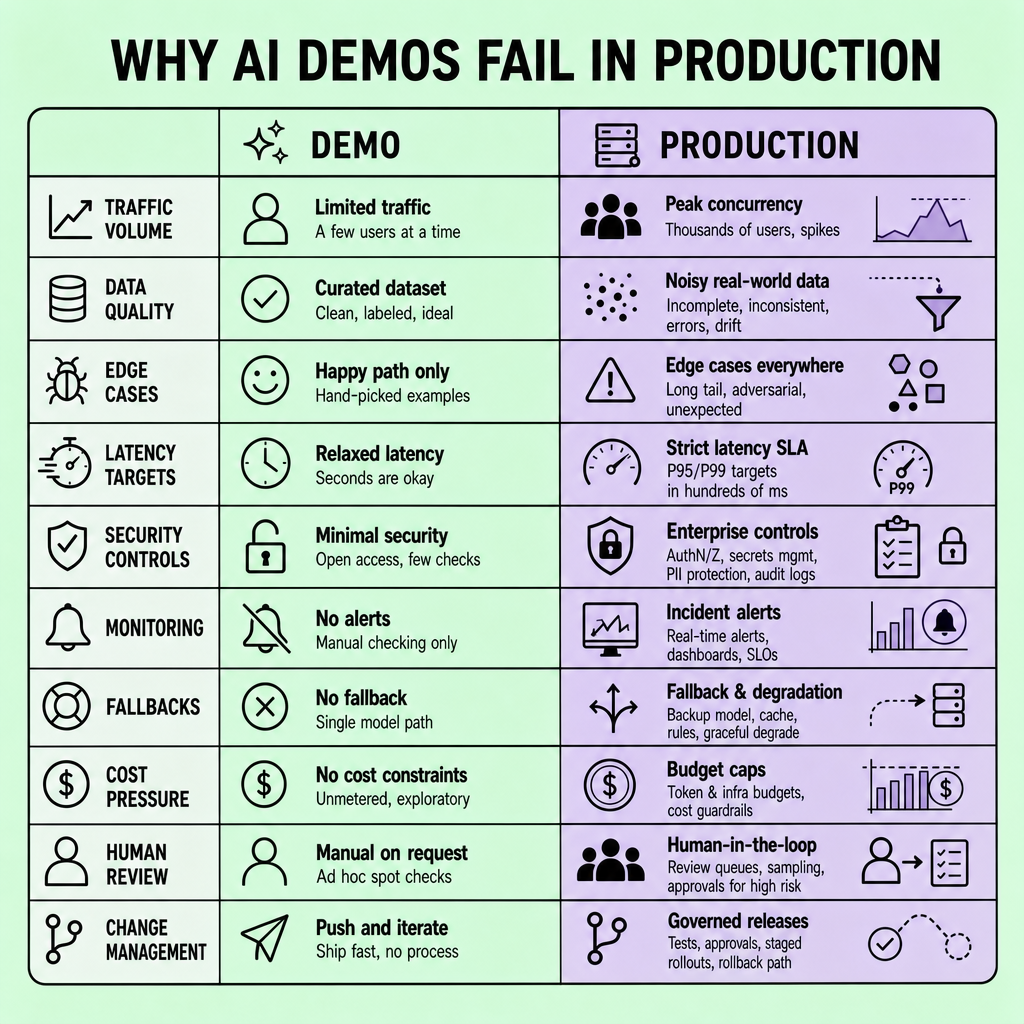
Teams often mistake proof of capability for proof of operability. That is where trouble starts. A strong demo shows that a task can work; production asks whether the full system can keep working under real conditions. A polished prototype may prove model potential, but AI deployment depends on reliability, latency, security, observability, and failure handling that demos rarely test.
Demo success hides operational gaps
A demo usually runs on curated inputs, low traffic, and a controlled environment. Production traffic is messier. Users submit malformed text, ask ambiguous questions, retry requests, and arrive at the same time. Under those conditions, a single weak dependency -- such as a slow vector store, a rate-limited embedding API, or a failed auth refresh -- can degrade the whole product even if the model itself performs well.
Then comes the debugging problem. Without traces, token usage logs, prompt/version correlation, and output quality signals, teams cannot tell whether failures come from the model, retrieval, infrastructure, or source data. Issue triage slows down, and false confidence survives right up to launch.
Production constraints change the pass/fail criteria
This is the shift teams need to make: treat a strong demo as evidence of potential, not proof of AI production readiness. Production adds requirements that belong in an AI readiness scorecard:
- reliability under upstream failures and fallback paths
- p95 latency targets, SLOs, and error budgets
- concurrency handling, queue behavior, and scaling policy
- security controls such as audit logs, secret management, and prompt injection defenses
- governance for retention, access, and compliance expectations
These controls introduce tradeoffs. Fast shipping may help gather feedback, but weak testing, missing rate limits, or no drift checks can make production AI unstable and expensive.
A practical rule: if you have not tested realistic concurrency, validated failure modes, and instrumented the full request path, you do not have deployment readiness yet. You have a promising pilot.
FAQs
What causes AI demos to fail in production?
They fail when operational requirements were never tested, including traffic spikes, dependency failures, latency limits, security controls, and variable user input.
What is AI production readiness?
It is the ability of a system to operate reliably under real business conditions with acceptable performance, security, observability, cost control, and governance.
How does an AI readiness scorecard help?
It gives teams a structured way to evaluate reliability, scalability, security, observability, testing, latency, cost, and governance before launch.
Build an AI Readiness Scorecard With Weighted Go-Live Criteria
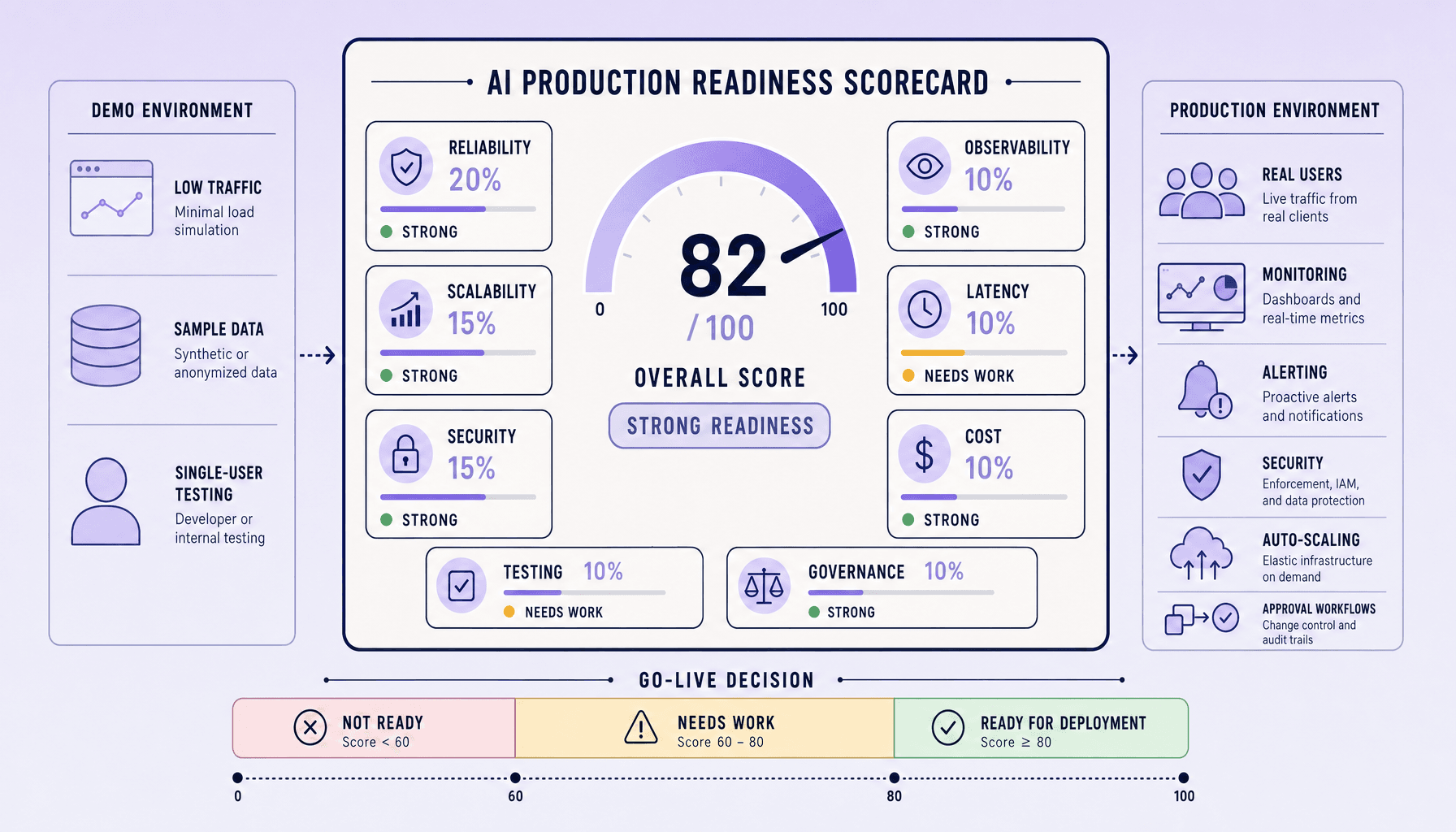
If your team cannot explain why a system is ready for launch, it is not ready. An AI readiness scorecard turns go-live from opinion into a repeatable decision.
A checklist helps teams remember what to review. A weighted scorecard goes further by showing what should block release. A customer support copilot, a RAG assistant, and a regulated decision workflow do not carry the same operational risk.
Structure the scorecard around weighted categories
Start simple. Use a 1-5 score for each category, then apply weights based on business impact and failure cost. Common categories include reliability, scalability, security, observability, latency, cost, testing, and governance.
A straightforward framework might look like this:
- Reliability: 20%
- Security: 20%
- Observability: 15%
- Testing: 15%
- Scalability: 10%
- Governance: 10%
- Latency: 5%
- Cost: 5%
Next, set a go-live gate. Example: the total weighted score must exceed your release threshold, and no critical category can score below 3/5. Security, governance, and reliability often deserve hard pass/fail gates. If audit logs are missing, prompt injection defenses are untested, or fallback behavior is undefined, stop the AI deployment.
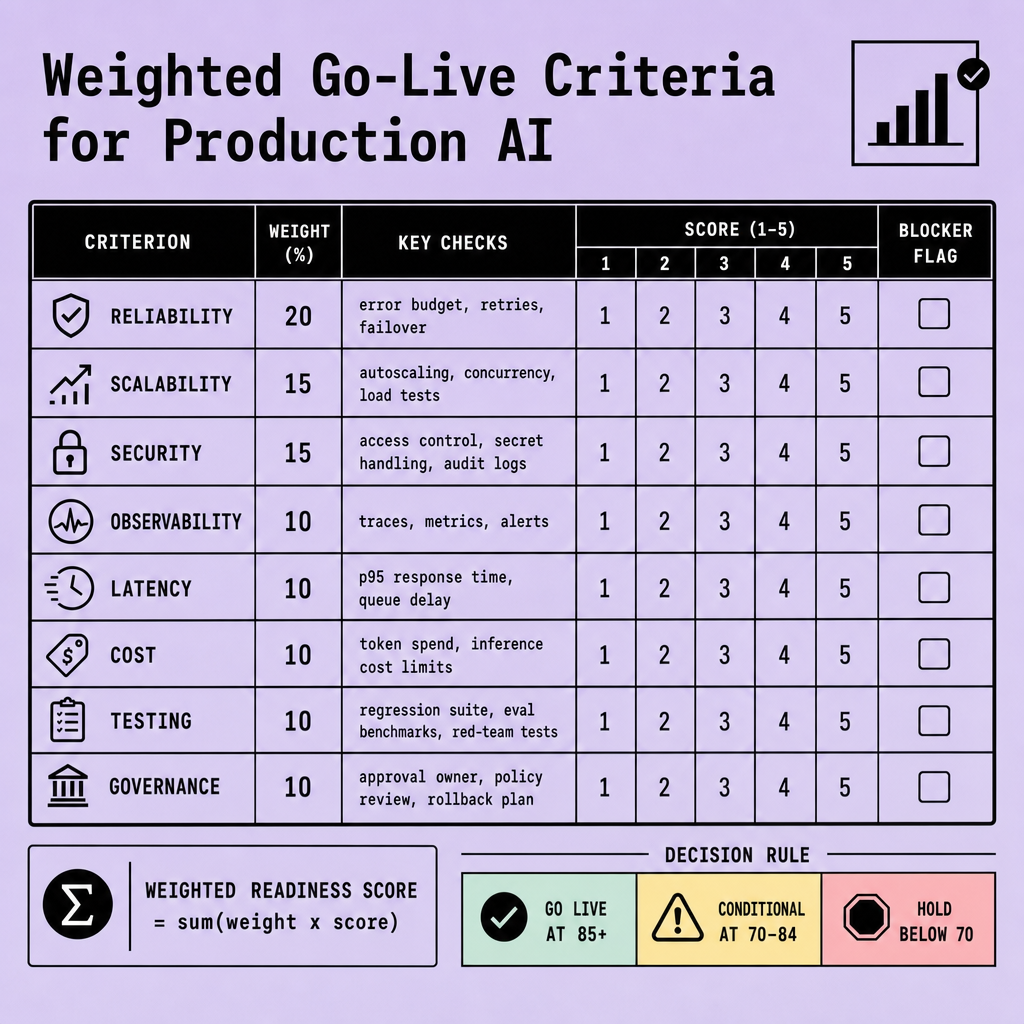
A clean launch is not enough. If the system cannot be monitored for drift, timeout spikes, or retrieval failures, it is not production-ready.
Adapt thresholds to risk, not just architecture
One framework can work across teams, but the weights and gates should change with the risk matrix. A low-risk internal summarization tool may allow weaker SLA targets or a canary release behind a feature flag. A system that influences approvals, pricing, or compliance decisions should require tighter latency bounds, stronger governance controls, explicit sign-off, and a tested rollback plan.
This is why weighted criteria work better than a flat checklist. They reflect business criticality and expose common gaps early: weak load testing, missing drift detection, unclear ownership, or no rollback path. Where possible, attach scoring evidence to CI/CD instead of relying only on manual release judgment.
FAQ
What is an AI readiness scorecard?
An AI readiness scorecard is a framework that scores production readiness across categories such as reliability, security, observability, testing, and governance before AI deployment.
Why use weighted criteria for production AI?
Weighted criteria reflect risk. They help teams avoid treating cost or latency as equal to security or reliability when the impact is not equal.
What should block an AI deployment?
Missing controls in critical areas should block release, especially security, reliability, governance, and rollback readiness.
AI Production Readiness Criteria: Reliability, Scalability, Security, Observability, Latency, Cost, Testing, and Governance
Once the scorecard exists, the next question is practical: what do you actually score? Use these eight criteria as a go-live checklist. The goal is not perfection. It is evidence that the system can handle real traffic, real data, and predictable failure modes.
Reliability
Define uptime targets, timeouts, retries, fallback paths, and error budgets. A production-ready system degrades gracefully when retrieval, model, or upstream services fail. If prompt or model changes can silently reduce quality, add regression checks before release.
Scalability
Test concurrency, throughput, queue behavior, and infrastructure limits under expected peak load. Capacity planning should cover both speed and answer quality. A system that only works at demo volume is not ready.
Security
Review access control, encryption, secrets handling, tenant isolation, audit logs, and third-party model data handling. For sensitive workloads, verify retention rules and whether vendor settings match your compliance obligations. Security controls can add friction, but skipping them shifts risk into production.
Observability
Instrument logs, traces, metrics, and outcome signals across the full path: retrieval, model calls, post-processing, and user-facing responses. You should be able to explain failures, regressions, token use, and escalation rates. If you cannot diagnose a bad answer, you cannot operate the system reliably.
Latency
Measure p95 latency, cold starts, routing delays, and dependency overhead. Set budgets by stage, not just one top-line target. Faster responses may require caching, smaller models, or premium infrastructure, so latency targets should be set with cost and quality tradeoffs in mind.
Cost
Track cost per request, token consumption, cache hit rate, and idle capacity. Set thresholds and alerts before launch. Cheap systems can become slow or low quality; fast systems can become uneconomical. Readiness means knowing which tradeoff you are accepting.
Testing
Cover integration paths, prompt regressions, schema validation, load behavior, security checks, and rollback readiness. Use release gates and canaries for prompt, model, and dependency changes. In AI systems, small changes can create large behavior shifts.
Governance
Define approval flow, versioning, dataset lineage, use boundaries, human review points, and ownership. This matters most for high-risk outputs, where teams must explain what changed, who approved it, and when human escalation is required.
Score each pillar with measurable pass/fail criteria before launch. If one pillar is weak, reduce scope or add safeguards rather than forcing a full release.
Common Gaps Teams Miss Before Production AI Launch
Most failed launches are blocked by operational gaps, not model quality. Teams reach production AI with a solid demo, then discover the missing pieces in the surrounding system -- the parts your AI system checklist and AI readiness scorecard should catch before AI deployment.
The blind spots are familiar:
- No fallback response or rollback path. If retrieval fails, a model endpoint times out, or output quality drops after a prompt change, users need a safe degraded path.
- No cost guardrail. Token-heavy prompts, retries, and traffic spikes can turn a successful launch into an unpredictable bill within hours.
- Shallow testing. Teams test happy paths, but skip adversarial prompts, rate-limit behavior, malformed input, and dependency failures.
- Weak prompt security. Prompt injection, unsafe tool use, and poor secret handling often sit outside prototype scope. Security should not be optional -- especially if the system can access internal data or actions.
- Poor audit trail and weak governance. If you cannot trace which prompt, model version, policy, or retrieved context produced an answer, incident review becomes guesswork.
- Missing ownership for alerting, retraining, and runbook maintenance. Monitoring is as important as deployment, but many teams still launch without clear responders, SLOs, or escalation rules.
Why do teams miss these? Because prototypes optimize for output quality and speed. Production review has to score the boring controls too -- ownership, runbooks, rollback steps, and failure isolation. Those are the gaps that break real launches.
AI Deployment Best Practices That Improve Launch Confidence for AI Production Readiness
A safe launch starts with controlled exposure, not full cutover. Reduce blast radius first. Expand traffic only after the system performs under real conditions.
Use staged environments that mirror production as closely as practical: same containers, configs, secrets flow, model routing, and infrastructure class. Many AI deployment failures come from mismatched dependencies, network policies, or missing observability rather than model quality alone. Exact parity is not always worth the cost, but teams should document any intentional differences and test them before launch.
Release Controls That Lower Risk
Run shadow mode before users depend on outputs. Send live traffic to the new path, compare latency, failures, and output quality, but keep the current system authoritative. Then move to canary release with feature flags, rate limits, and a clear rollback path in CI/CD.
If the scorecard shows weak reliability, high cost variance, or unresolved security issues, limit exposure or delay release. Slower rollout can reduce launch risk, but it may also delay feedback, so use explicit thresholds for when to expand traffic.
Human Escalation and Post-Launch Discipline
Even a careful rollout needs backup for edge cases. Add human-in-the-loop escalation for low-confidence outputs, policy-sensitive actions, and tool failures. Pair that with incident response, post-deployment review, and monitoring for p95 latency, error rate, fallback frequency, drift signals, and token or GPU cost. These AI deployment best practices help sustain launch quality after release.
Treat your AI readiness scorecard as a living release control: update scores after incidents, traffic changes, model swaps, and new compliance requirements. It should guide release behavior after launch, not sit in a folder as a one-time approval form.
Frequently Asked Questions
What is AI production readiness in practical terms?
AI production readiness is the point where an AI system has proven it can meet operational expectations in live conditions, including failure recovery, measurable service levels, safe data handling, and predictable cost behavior. It is not a model benchmark; it is evidence that the full system can be trusted after launch.
How often should an AI readiness scorecard be updated?
An AI readiness scorecard should be updated whenever the system meaningfully changes, including model swaps, prompt rewrites, infrastructure changes, vendor changes, traffic growth, or new compliance requirements. A stale scorecard gives false confidence because production risk changes faster than documentation does.
Why does AI production readiness depend on more than model accuracy?
AI production readiness depends on more than accuracy because users experience the entire service, not just model output quality. A highly accurate model can still fail through timeouts, broken integrations, unsafe responses, poor auditability, or runaway inference cost. Production success requires the surrounding system to be dependable.
How does an AI system checklist differ from an AI readiness scorecard?
An AI system checklist confirms whether required controls exist, while an AI readiness scorecard evaluates how strong those controls are and whether weak areas should block release. The checklist answers, "Did we review it?" The scorecard answers, "Is it good enough for this level of risk?"
What are the first signs that a production AI system is not ready to scale?
The earliest signs usually include unstable latency at moderate traffic, frequent manual interventions, rising cost per request, unclear ownership during incidents, and missing visibility into failures by prompt, model version, or dependency. Those symptoms indicate the system may work for limited use but lacks the controls needed for reliable growth.
Make Imversion a preferred source on Google
Like this kind of AI and software analysis? Add Imversion as a preferred source so Google can highlight our articles for you in Search, AI Overviews, and AI Mode.