AI Scoping Guide: Validate Assumptions for 2026
Discover how product leaders can navigate uncertainty in AI projects with our AI scoping guide. Learn to define metrics and validate critical assumptions.

AI Scoping Guide for Product Leaders: Start With Uncertainty, Not Delivery
Most AI projects do not fail because the team picked the wrong model. They fail because scoping starts with delivery before anyone has reduced the real uncertainty.
AI Scoping Guide Key Takeaways
-
Start with the business outcome, not model hype. A good AI scoping guide ties the work to one operating metric -- handle time, accuracy, review time, or another measurable result. Decisions should be backed by data, or the team will optimize demos instead of value.
-
Most AI feasibility assessment problems are really data problems. Before any build, run an AI readiness assessment on sample data, labels, access, compliance, edge cases, and governance. If the dataset is weak, no prompt tuning will save the project.
-
Define the first test around the single riskiest assumption. Not five assumptions. One. That is what an AI discovery sprint or PoC is for -- a time-boxed check on the thing most likely to kill the idea.
-
Write discovery acceptance criteria before the sprint starts. Include the target workflow, dataset scope, success threshold, and clear exit paths. Because open-ended research drifts, and fixed-price delivery hides uncertainty instead of reducing it.
-
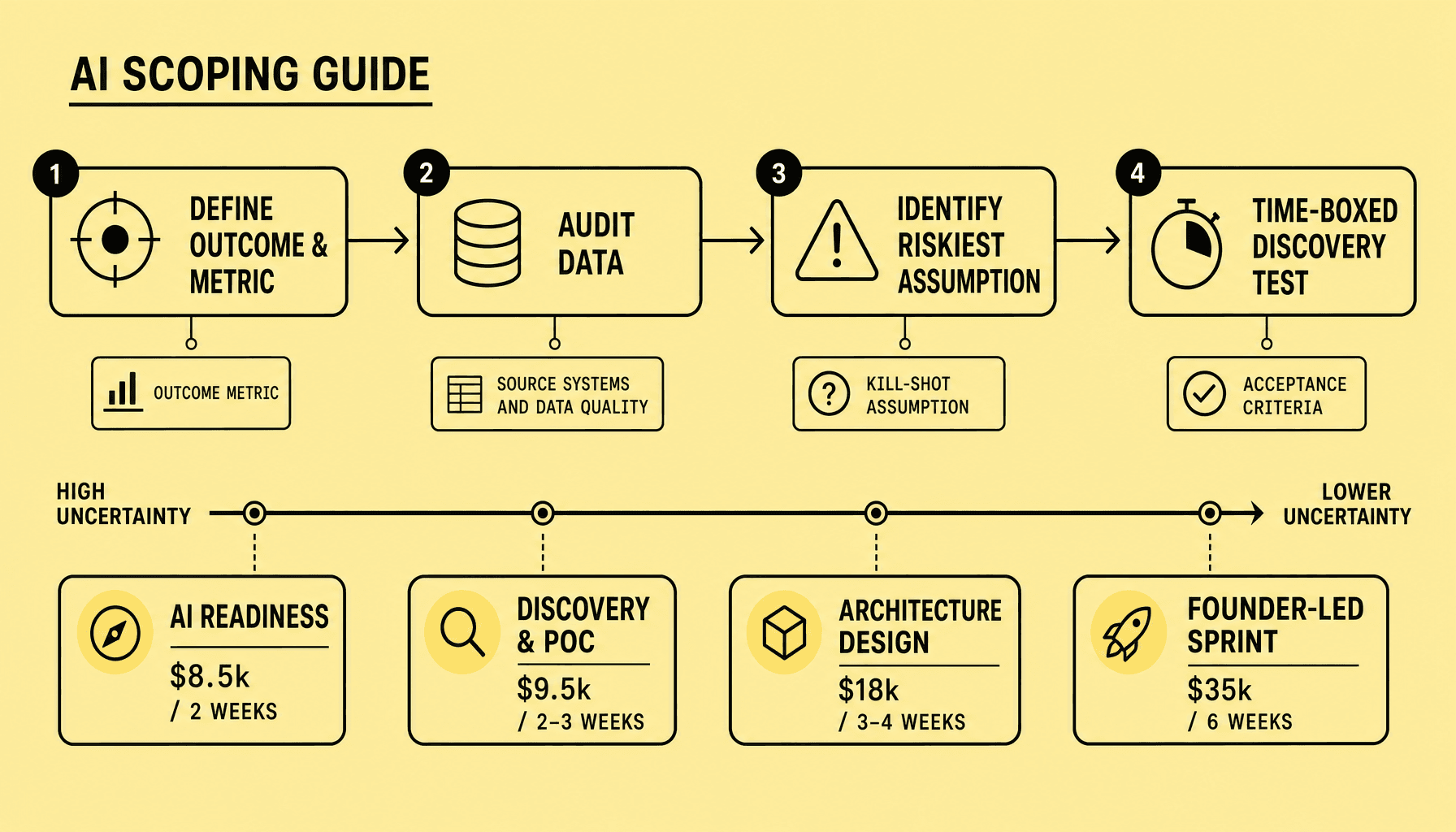
Pick the service by uncertainty level: AI Readiness ($8.5k/2w) for data and fit questions, Discovery & PoC ($9.5k/2–3w) for feasibility, Architecture Design ($18k/3–4w) for implementation planning, and Founder-Led Sprint ($35k/6w) for high-uncertainty bets needing end-to-end momentum.
AI Scoping Guide: Define the Outcome and Metric Before You Scope the AI Work
If the team cannot say what should improve, AI scoping turns into vendor comparison, model debate, and timeline fiction.
Start with the workflow decision you want to improve. Not the model. Not the stack. Not whether the team should use retrieval, fine-tuning, classification, or extraction.
That is the first move in any serious AI scoping guide.
Product leaders usually feel pressure to answer feasibility by asking, “Can AI do this?” But that question is too broad to scope well. A better question is narrower: what operational bottleneck should change if the AI works? Reduce support handle time by 20%. Raise lead qualification accuracy to 85%. Cut document review from 30 minutes to 5. Those are scoping anchors because they connect directly to KPIs and workflow automation.
Proxy metrics do not help much here. A model can score well on precision, recall, or a generic quality rubric and still fail inside the product because it does not change the user’s decision, save time, or reduce cost. If a metric cannot change a workflow decision, it is too abstract to guide an AI feasibility assessment.
Turn a vague AI goal into one business metric
“Use AI for support” is vague.
“Reduce average handle time on tier-1 support tickets by 20% while maintaining escalation accuracy” is scopeable.
“Use AI for sales” is vague.
“Improve lead classification accuracy to 85% on inbound demo requests” is scopeable.
“Use AI on documents” is vague.
“Cut contract review time from 30 minutes to 5 through field extraction and first-pass summarization” is scopeable.
The metric alone is not enough. The team should define the business consequence too: faster agent throughput, better pipeline quality, or fewer manual review hours.
What this changes in the next step
Once the outcome is clear, the rest of the AI product strategy gets sharper. Data review becomes focused. Acceptance criteria become testable. Choosing the next engagement gets easier too: an AI Readiness sprint ($8.5k/2w) if the problem framing is still loose, or an AI Discovery sprint / Discovery & PoC ($9.5k/2–3w) if the metric is clear but feasibility is not.
Scope the result first. Then test whether AI can produce it.
That order beats open-ended research and fixed-price delivery because it stops teams from optimizing the wrong thing during the AI feasibility assessment.
Audit the Data and Find the Single Assumption That Could Kill the Project
A lot of AI projects sound blocked by modeling. The real blocker is usually upstream.
Most AI feasibility problems are data problems first.
Product leaders feel pressure to promise dates early. Before anyone estimates a build, they need a lightweight AI readiness assessment that answers a simpler question: is the blocker the data, the task, or user adoption? Teams often guess. Bad timelines start there.
Run a lightweight data audit before committing to scope
A useful audit is not a months-long exercise. It is a focused check of whether the inputs can support the job.
Review:
- source systems -- CRM, support platform, data warehouse, document store, analytics events
- volume -- not just total records, but usable records for the target task
- structure -- structured tables, free text, PDFs, images, mixed formats
- labels and ground truth -- who created them, how consistent they are, and whether they reflect the real decision
- data quality -- missing fields, duplicates, stale values, formatting drift
- edge cases -- rare document layouts, multilingual inputs, unusual customer paths
- access and compliance -- permissions, PII, retention rules, data governance constraints
- representativeness -- whether a representative sample matches production usage, not just a clean export
This audit should stay concrete. Pull sample rows. Read actual tickets. Inspect failed documents. Compare labeled examples across reviewers. If labels are noisy, the model target may be wrong before modeling even starts.
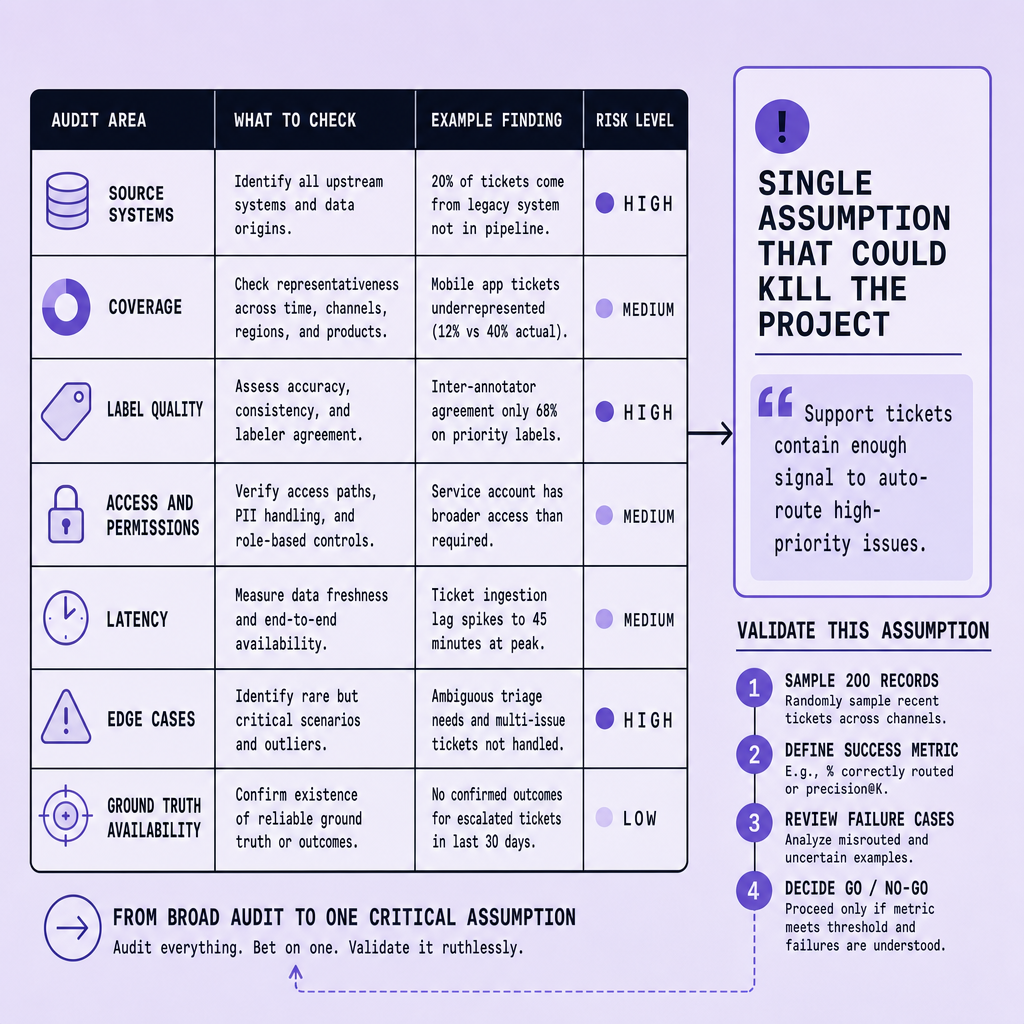
If the team can name five critical risks at once, the scope is still fuzzy. Pick the one that destroys value if false.
Find the single assumption that can kill the project
Every serious AI product strategy has one assumption carrying most of the risk.
For churn prediction, it may be: product usage data contains signals strong enough to predict churn early enough to change behavior. For document extraction: document layouts are consistent enough that field extraction reaches acceptable accuracy without expensive human cleanup. For AI-assisted recommendations: users will trust and act on suggestions inside the workflow.
So how can a product leader tell which risk matters most? Ask what failure would invalidate the project fastest. If clean data does not exist, it is a data risk. If the task exceeds current model performance on real samples, it is a task risk. If outputs are good but nobody uses them, it is an adoption risk.
That is what an AI feasibility assessment is for -- and why an AI discovery sprint should test one assumption, not everything at once.
Run an AI Discovery Sprint With Acceptance Criteria Defined Up Front
This is where teams often waste the most money: they fund an experiment that sounds disciplined but has no real decision point.
Do not fund an open-ended experiment. And do not lock into fixed-price delivery before feasibility is proven. The better move is a time-boxed AI discovery sprint designed to answer one question: should this move forward, change shape, or stop now?
A good sprint succeeds by producing a decision, not by producing code.
What a 2-3 week discovery should actually prove
A solid AI feasibility assessment or AI proof of concept should test the riskiest assumption against representative work, with explicit acceptance criteria set before anyone prototypes. Otherwise teams drift toward polished demos instead of useful evidence.
For most product leaders, a 2-3 week sprint should include:
- a sample selection plan for a representative evaluation set, including normal cases and edge cases
- a baseline, such as current manual accuracy, review time, or handle time
- a prototype method, like extraction, classification, retrieval, or assisted drafting
- an evaluation approach with agreed metrics: accuracy, latency, review burden, and failure modes
- a risk log covering data quality, governance, trust, and integration constraints
- a recommendation: go, iterate, or stop
The sprint should explain failure modes, not just report a score. If results are borderline, that can still be useful. The team learns whether the blocker is model quality, weak labels, process design, or missing data.
Define the decision gates before the sprint starts
Acceptance criteria should be concrete enough to end debate.
For example: proceed only if field extraction reaches the minimum agreed accuracy on representative documents, median latency stays inside the workflow threshold, and human review adds acceptable effort rather than creating a new bottleneck. Stop if labels are too inconsistent to evaluate fairly, document formats vary too widely, or review time remains close to the current manual process.
Discovery acceptance criteria are not “build something useful.” They are “produce enough evidence to make a funding decision.”
This format beats both common alternatives, but it has a tradeoff. A short sprint reduces uncertainty fast; it does not fully de-risk production rollout, integration effort, or change management. Fixed-price delivery assumes feasibility too early. Open research avoids commitment but often avoids decisions.
Match the engagement to the uncertainty
Use the smallest format that can kill risk fast:
- AI Readiness — $8.5k / 2 weeks: outcome, data audit, risk framing
- Discovery & PoC — $9.5k / 2-3 weeks: test one assumption with a baseline and evaluation set
- Architecture Design — $18k / 3-4 weeks: for ideas already shown feasible
- Founder-Led Sprint — $35k / 6 weeks: for high-stakes, high-uncertainty initiatives
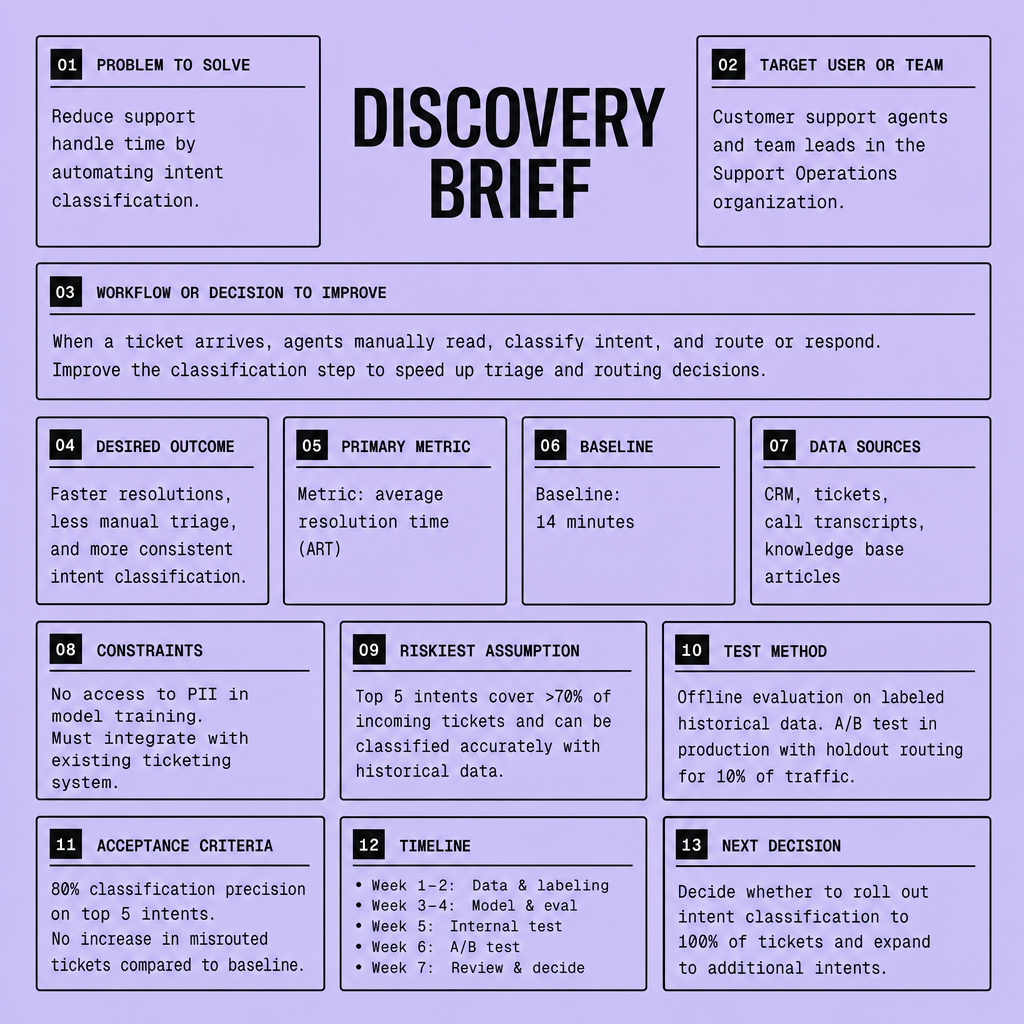
A one-page discovery brief is usually enough: problem, target metric, sample scope, prototype method, acceptance criteria, risks, and final recommendation. Sometimes the best outcome is “not yet.” Expensive to hear. Still cheaper than months of wrong delivery.
Why This AI Scoping Guide Rejects Fixed-Price Delivery and Open-Ended Research
When feasibility is unclear, both common choices are tempting for the wrong reasons. One promises certainty too early. The other postpones commitment so long that no decision survives intact.
A product leader should reject both extremes when feasibility is unclear: the fixed-price contract and the endless research spike.
Fixed-price implementation sounds safe. But it only works when scope risk is low and the team already knows the data, constraints, and failure modes. That is not the situation here. If the hard question is still unresolved -- can the model classify accurately enough, can retrieval ground answers, can extraction handle messy documents, can reviewers trust outputs -- then early pricing does not remove estimation risk. It hides it inside change requests, watered-down deliverables, or quiet quality compromises.
Open-ended research fails in a different way. It creates motion without a decision. Teams review datasets, test prompts, compare vendors, and discuss governance for weeks. Maybe months. But without a deadline and explicit acceptance criteria, the discovery phase can consume budget without answering the only strategic question that matters: proceed, reshape, or stop?
This AI scoping guide takes the middle path -- a scoped, time-boxed AI discovery sprint or AI proof of concept built around one uncertain assumption and one business metric.
| Approach | Best fit | Budget risk | Evidence quality | Stakeholder clarity |
|---|---|---|---|---|
| Fixed-price build | Feasibility already proven | High under uncertainty | Low early, delayed until build | Looks clear, often misleading |
| Open research spike | Very early learning only | Unbounded | Mixed, often fragmented | Low -- no decision point |
| Time-boxed feasibility test | Clear problem, uncertain solution | Capped | High if tied to acceptance criteria | High -- explicit go/no-go |
The practical implication is simple. Buy the smallest engagement that can change a roadmap decision.
For low-to-moderate uncertainty, AI Readiness ($8.5k/2w) or Discovery & PoC ($9.5k/2–3w) is enough. If feasibility is clearer but system design is not, Architecture Design ($18k/3–4w) fits better. And when uncertainty spans product, delivery, and executive alignment, the Founder-Led Sprint ($35k/6w) earns its place.
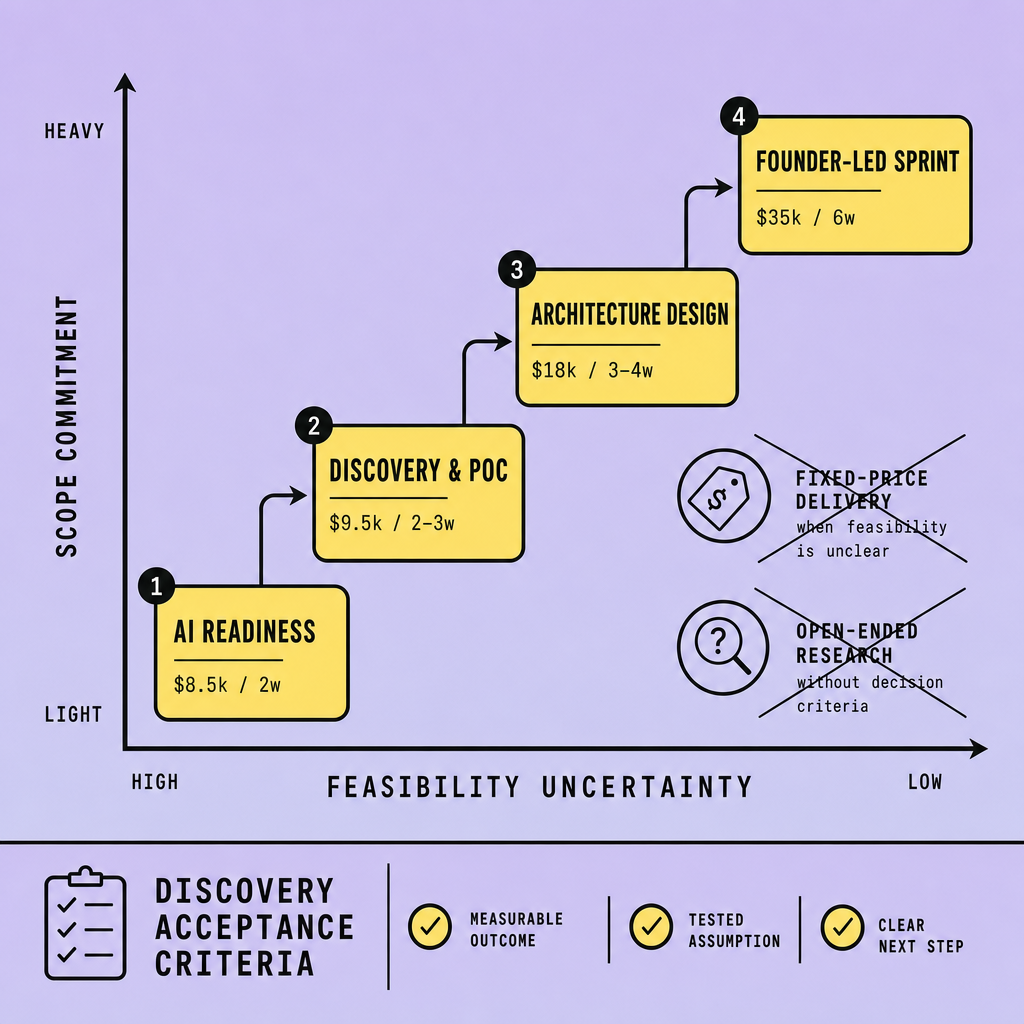
A good AI feasibility assessment should end with a decision, not a pile of notes.
Because unclear feasibility is not a delivery problem first. It is a scoping problem.
AI Scoping Guide: Choose the Right Service by Uncertainty Level: From AI Readiness to Founder-Led Sprint
Teams often overbuy too early. They ask for architecture when they still need proof, or they ask for delivery estimates when the real question is whether the use case survives contact with actual data.
Pick the smallest engagement that removes the biggest unknown first. Teams often buy architecture when what they really need is evidence that the use case is worth pursuing. In practice, service selection should map to uncertainty, not to idea size or AI enthusiasm.
| Service | Price / Duration | Best fit | Main output |
|---|---|---|---|
| AI Readiness | $8.5k / 2w | Unsure about data, labels, access, governance, or basic feasibility | AI readiness assessment, dataset audit, risk map, one-page discovery brief |
| Discovery & PoC | $9.5k / 2–3w | Clear use case, but one assumption could kill it | AI discovery sprint, test plan, AI proof of concept, acceptance-based recommendation |
| Architecture Design | $18k / 3–4w | Feasibility looks credible and the team needs implementation planning | Solution architecture, system flows, integration plan, operational requirements |
| Founder-Led Sprint | $35k / 6w | High-urgency opportunity with cross-functional blockers and strategic stakes | Product sprint covering feasibility, workflow design, decision framing, and delivery path |
A simple uncertainty ladder
If the question is “Do we even have usable data?”, start with AI Readiness. This is the lightest option and fits retrieval, classification, or extraction ideas with messy inputs.
If the question is “Can this use case work well enough to matter?”, choose Discovery & PoC. The sprint should test one riskiest assumption against explicit acceptance criteria, such as accuracy, review-time reduction, trust threshold, or escalation rate.
If the question is “How do we build and operate this safely?”, move to Architecture Design, but only after feasibility has supporting evidence. Architecture without validated feasibility often produces diagrams instead of decisions.
If the question is “We believe this matters, but alignment is slow”, pick the Founder-Led Sprint. It fits cases where product, ops, legal, and engineering need a shared path quickly.
A useful rule: if uncertainty is mostly about data or task viability, do not jump to implementation planning.
A one-page discovery brief can capture the workflow, success metric, sample dataset, label quality issues, riskiest assumption, test method, and go/no-go acceptance criteria. Short, concrete, decidable.
Frequently Asked Questions
What is an AI scoping guide supposed to produce at the end?
An AI scoping guide should produce a funding-quality decision artifact, not just a workshop summary. The output is typically a short brief that names the target metric, current baseline, key data constraints, riskiest assumption, test design, and the exact condition for moving forward, redesigning, or stopping.
How does an AI scoping guide help when multiple teams disagree on feasibility?
An AI scoping guide creates a shared frame for product, engineering, ops, legal, and leadership by forcing everyone to evaluate the same evidence. It reduces opinion-driven planning because the conversation shifts from preferences about tools or vendors to measurable thresholds, representative samples, and explicit decision gates.
Why should discovery acceptance criteria include failure conditions?
Failure conditions prevent teams from rationalizing weak results after time and budget have already been spent. By naming what counts as unacceptable performance before testing begins, leaders protect roadmap quality, avoid sunk-cost bias, and make it easier to stop projects that would otherwise drift into expensive implementation.
When should a team skip straight past an AI scoping guide into architecture or delivery?
A team should skip directly to architecture or delivery only when feasibility is already proven on representative data, the workflow metric is agreed, and the main remaining questions are implementation details. If the core uncertainty is still about data quality, model fit, or user adoption, skipping scoping usually converts unknowns into rework.
How often should an AI scoping guide be revisited after the first sprint?
An AI scoping guide should be revisited whenever the use case, data source, workflow, or success threshold materially changes. It is not a one-time document. If new constraints appear or the original assumption is resolved, the next version should redefine the top risk so the team keeps testing the next decision-relevant unknown.
Make Imversion a preferred source on Google
Like this kind of AI and software analysis? Add Imversion as a preferred source so Google can highlight our articles for you in Search, AI Overviews, and AI Mode.