LLM Data Residency: Understanding Compliance in 2026
Unpack the challenges of LLM data residency and learn best practices for AI compliance, including data flow management and security.

LLM Data Residency: Where Your Tokens Actually Go
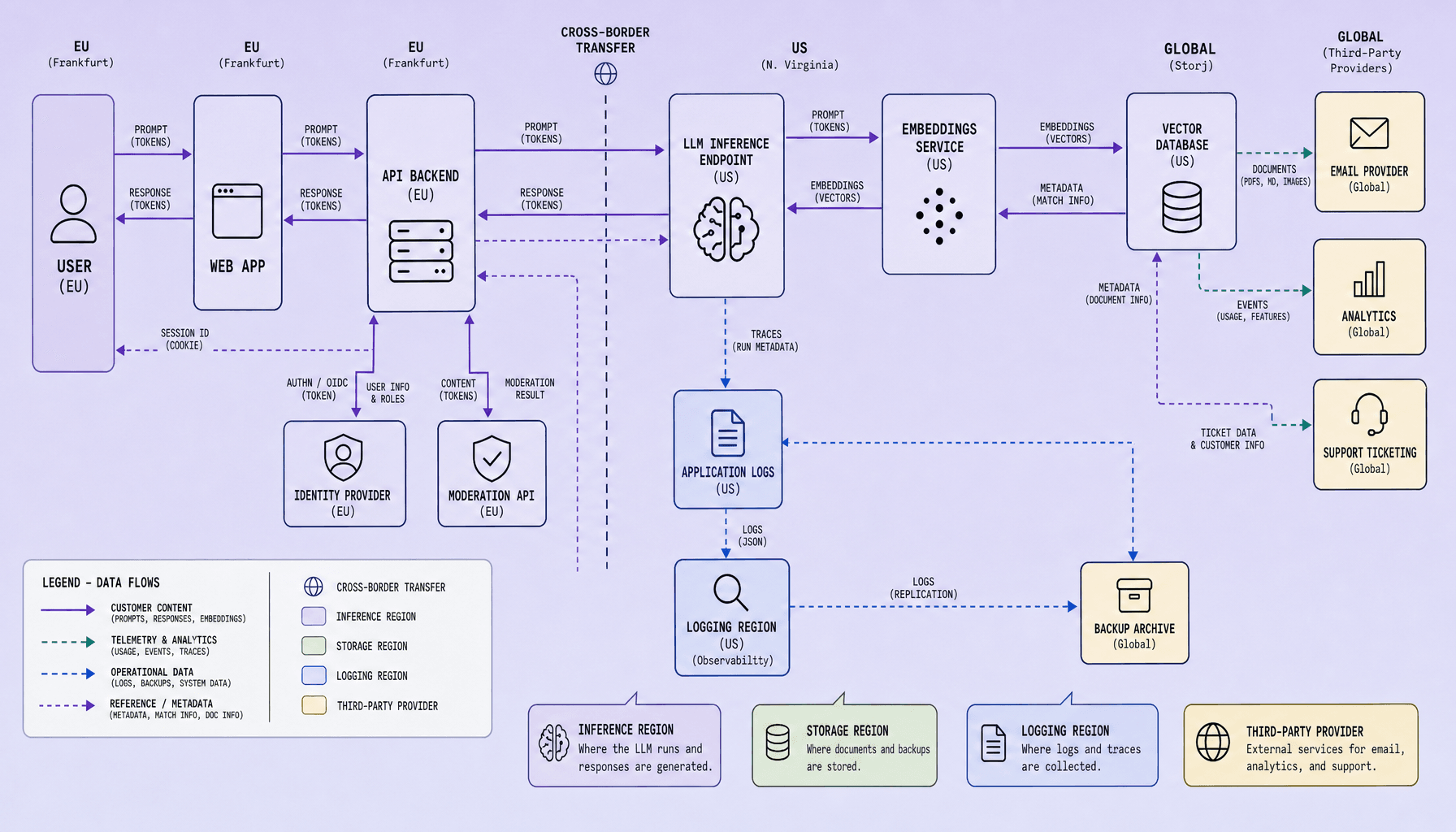
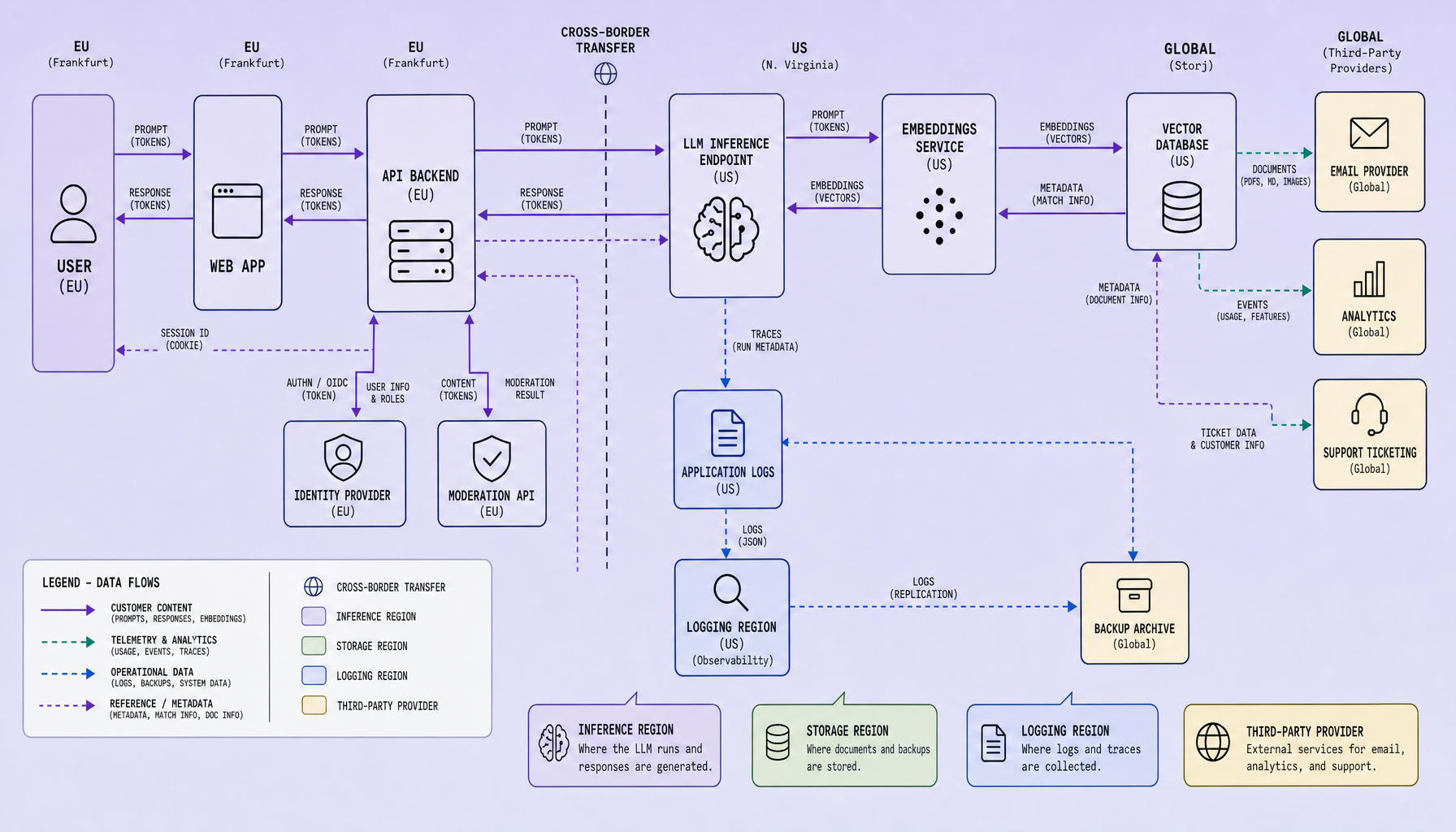
You can host your app in the EU, keep your primary database in-country, and still send prompt data across borders without realizing it. That is the trap. LLM data residency covers far more than your app’s hosting region. Your prompts and outputs can be transmitted, processed, cached, logged, stored, replicated, and accessed across the full application, model, and vendor stack -- often in different jurisdictions than your primary database.12
Teams miss this constantly. A request might start in an EU web app, hit a US-based API gateway, run inference in another region, then land in object storage, vector indexes, CDN logs, and SIEM tooling elsewhere.324 That is why AI data residency and LLM data privacy are architecture problems, not paperwork. Deployment alone is not enough. If you cannot trace where tokens flow, you cannot prove AI compliance or enforce residency controls. In practice, map every hop: inference region, provider retention, backups, support access, and third-party processors before you ship.567
Key Takeaways for LLM Data Residency
- Your app region is not your full LLM data residency boundary. Prompts, files, embeddings, and outputs may be processed in a separate inference region unless you explicitly pin provider-side execution.12
- Logs are a common blind spot. Raw prompts often land in API gateways, CDN logs, tracing tools, SIEM platforms, support systems, and provider retention layers -- which can expand your AI data residency footprint fast.36
- Third-party tools change the compliance picture. Identity, analytics, vector databases, moderation, and backup vendors can trigger cross-border data transfers even if your primary database stays in-country.54
- Architecture choices decide your AI compliance posture: regional model endpoints, BYOK, strict retention windows, log redaction, and vendor mapping. Security should not be optional -- especially where LLM data privacy and regulated data intersect.57
- Practical rule: map every token hop before launch. At Imversion Technologies Pvt Ltd, this is treated as an LLM infrastructure design task, not a checkbox.
Map Where LLM Data Travels Before You Judge Residency Risk
Most residency mistakes happen before the review even starts. Teams look at the database region, answer too quickly, and miss the actual path the data takes. Start with the full path, not the database location. Hosting your app in one region does not define the full LLM data residency boundary. Prompts, files, metadata, and outputs may pass through other systems that process or log data in different regions.12
Request path
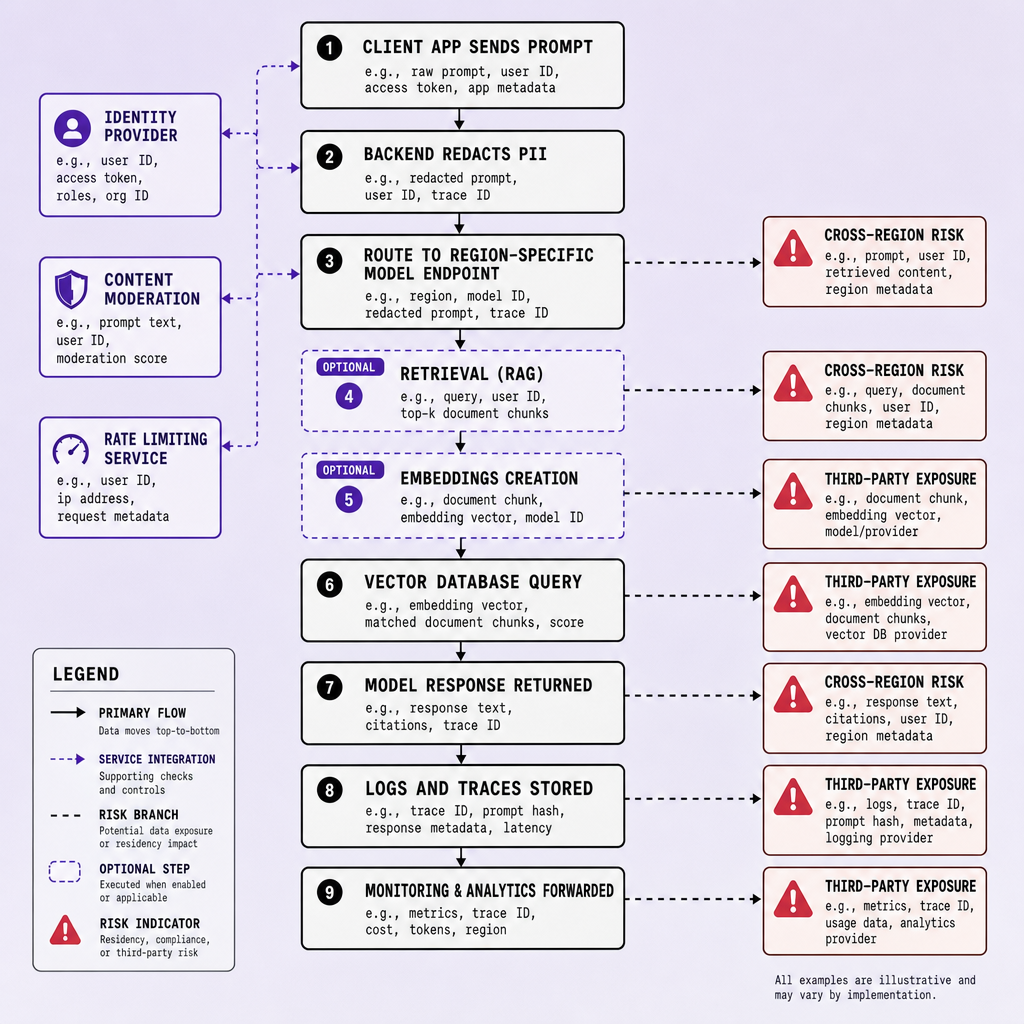
Start at the edge. A request may move through the client app, CDN, WAF, API gateway, backend, and model-facing services before it reaches inference. Each hop can generate logs, traces, cache entries, headers, or support artifacts, and those systems may sit outside your primary app region.13
A common mistake is assuming app region equals model region. Some providers let you deploy in one geography while processing inference in another unless you explicitly pin the inference region or use a residency-scoped offering.32 For compliance review, transient processing matters too, not just long-term storage.51
Build a simple data-flow inventory. List every system that sees prompts, files, identifiers, or outputs.
Retrieval/context path
This is where architectures often get wider than expected. RAG widens the boundary quickly. Your stack may generate embeddings, query a vector database, pull documents from object storage, call search or reranking services, and assemble context before sending the final prompt. That means residency review should include the embedding model, vector database region, document store, and any replication or backup policy tied to them.4
Hidden cross-border flows often appear here. If your vector database is in the EU but your embedding API runs in the US, your architecture already crosses regions. The same issue can arise with managed search, OCR, or translation services.34
Output path
Do not stop at inference. The response path can expand scope again. Output may be post-processed, stored in chat history, sent to analytics, copied into trace logs, indexed for search, or exposed in support tools. Observability matters, but it can also widen residency scope when prompts or outputs land in logging pipelines, SIEM tools, or vendor dashboards.6
Residency review should cover processing, logging, retention windows, backups, and provider-side abuse monitoring -- not just where rows live at rest.56
Practical safeguards include minimizing payload logging, redacting sensitive fields before transport, pinning inference regions, using regional object storage and vector databases, and checking whether cross-border transfer controls such as SCCs are required.37
FAQs
What determines LLM data residency in practice?
The full path: client, edge services, backend, model endpoint, inference region, retrieval stack, logs, storage, analytics, and support tools.
Does hosting my app in the EU guarantee EU-only LLM processing?
No. Inference may run elsewhere unless you explicitly select or contract for an EU inference region.2
Do embeddings affect AI data residency?
Yes. Embeddings, vector queries, and retrieved context can all cross regions depending on your RAG design.4
Are logs part of LLM data privacy scope?
Yes. Prompt and output data in logs, analytics, and incident tooling can create separate residency and retention risk.6
Inference Regions, Storage, and Logging Decide Your Real LLM Data Residency Footprint
A lot of teams stop too early. They pin the app and database to one region, see a green checkbox, and assume the problem is solved. It is not. If you only pin your app and database to one region, you have not solved LLM data residency. You have solved only part of it.
Inference is the first gap. A regional endpoint does not automatically guarantee region-limited processing unless the model, endpoint, retention path, and related access are also constrained.12 In practice, prompts can still pass to a provider-managed service path or review workflow outside your intended boundary. That is where residency assumptions often fail.62
Inference region controls are necessary, not sufficient
Verify where token processing happens, not just where the API hostname resolves. Some platforms now offer regional inference options, and cloud providers document regional RAG patterns.34 Retention, abuse monitoring, and internal replication may still broaden exposure unless they are restricted technically and contractually.52
A useful rule is to treat inference, storage, and access as separate control planes.
Storage quietly expands the footprint
Even if inference stays where you expect, storage can break your residency model later. Prompts and outputs rarely remain transient. Teams often persist them in chat history tables, object storage, vector databases, caches, and backup snapshots. Replication and analytics pipelines can then spread copies further. If embeddings stay in one region but prompt archives or backups land in another, your residency posture is no longer consistent.34
Logs are production data
Logs deserve the same scrutiny as your primary data stores. Treat logs, traces, support exports, CDN logs, API gateway logs, and observability platforms as part of residency scope. Teams may sanitize the primary database but overlook telemetry, SIEM exports, and backups. A well-designed regional deployment still fails the residency test if monitoring systems ship raw prompts or outputs elsewhere.67
| Layer | Typical data | Residency risk | Main control options |
|---|---|---|---|
| Inference | Prompts, files, outputs in transit | Medium to high | Regional endpoint, provider contract, no-retention settings |
| Application storage | Chat history, embeddings, object storage, backup snapshots | High | Region-pinned services, BYOK, retention limits, replication controls |
| Logging and telemetry | API logs, traces, CDN logs, SIEM events, support exports | High and often missed | Redaction, field filtering, regional observability stack, shorter retention |
Best practice: map every store and processor that can receive tokens, including third-party providers, then document any cross-border transfers and required legal mechanisms such as SCCs.537
Third-Party Providers and Cross-Border Data Transfers Create the Biggest Residency Gaps
This is usually where the clean architecture diagram falls apart. The biggest residency failures often start outside the model itself. Teams pin an app to the EU or Singapore, then discover prompts, user identifiers, traces, or attachments moved through vendors they never mapped. That is where data residency breaks in practice.37
Identity, moderation, analytics, and support vendors
Start with the vendors around the model, not just the model provider. Identity providers, moderation APIs, analytics SDKs, customer support platforms, email services, and tracing vendors can all see LLM-related data even when they are not part of inference. A moderation call may receive raw prompt text. A tracing platform may capture request bodies or error payloads. A support tool may expose chat transcripts during escalation.67
Do not rely on the DPA alone. Review each vendor operationally: where data is processed and stored, which subprocessors are involved, whether SCCs are used, and who can access data from which countries.513 A non-model vendor can still create a cross-border transfer if logs, events, or session data leave your approved region.
Model providers and vendor chains
The model layer adds another set of hidden paths. Model providers widen the surface further because inference, safety systems, logging, retention, and support may run on separate internal systems or subprocessors. Hosting your app in one region is not enough if the provider’s inference region is unpinned or provider-side logs replicate elsewhere.2 Some architectures keep processing in-region, while others use multi-region control planes, backups, or remote operational access that expand jurisdictional exposure.14
Replication, failover, and remote operations
Routine infrastructure behavior causes some of the most overlooked transfers. The most overlooked transfer paths are routine infrastructure paths: replicated backups, object storage snapshots, CDN or API gateway logs, SIEM exports, and failover regions. Support escalation matters too. If an engineer in another jurisdiction can view a trace or chat log, that is still cross-border access. Observability tools often become the hidden export channel.56
Review vendors one by one for where LLM data is stored, processed, replicated, and accessed. If architecture and operations are opaque, your compliance posture is opaque too.53
Cross-border transfer scenarios to check first
If you need a short review list, begin here. Check these first: subprocessor lists, regional inference controls, backup replication, failover behavior, support access workflows, retention windows, and whether encryption at rest, BYOK, and log redaction apply consistently across your stack.124
FAQs
What third-party services most often trigger cross-border data transfers in LLM applications?
Identity providers, moderation APIs, analytics SDKs, support platforms, email vendors, tracing tools, and model providers are common sources.
Does hosting my AI app in one region guarantee AI data residency?
No. Inference, logging, backups, subprocessors, and support access can still move data outside that region.12
Why is a DPA not enough for LLM data privacy?
Because legal terms do not show where data is actually processed, replicated, or accessed operationally.
Can non-model vendors affect AI compliance?
Yes. Analytics, tracing, and support vendors may receive prompts, metadata, or transcripts, creating residency and privacy exposure.
What should I verify first for AI data residency?
Verify inference region pinning, subprocessor locations, SCCs, backup replication, failover behavior, support access, and retention settings.53
Choose LLM Infrastructure That Matches LLM Data Residency, Security, and AI Compliance Requirements
Once the data path is clear, architecture decisions get easier. Before that, they are mostly guesswork. Pick the architecture after you map where prompts, embeddings, logs, and provider-side inference actually go. Otherwise, a system can appear compliant while still failing review.
Architecture patterns
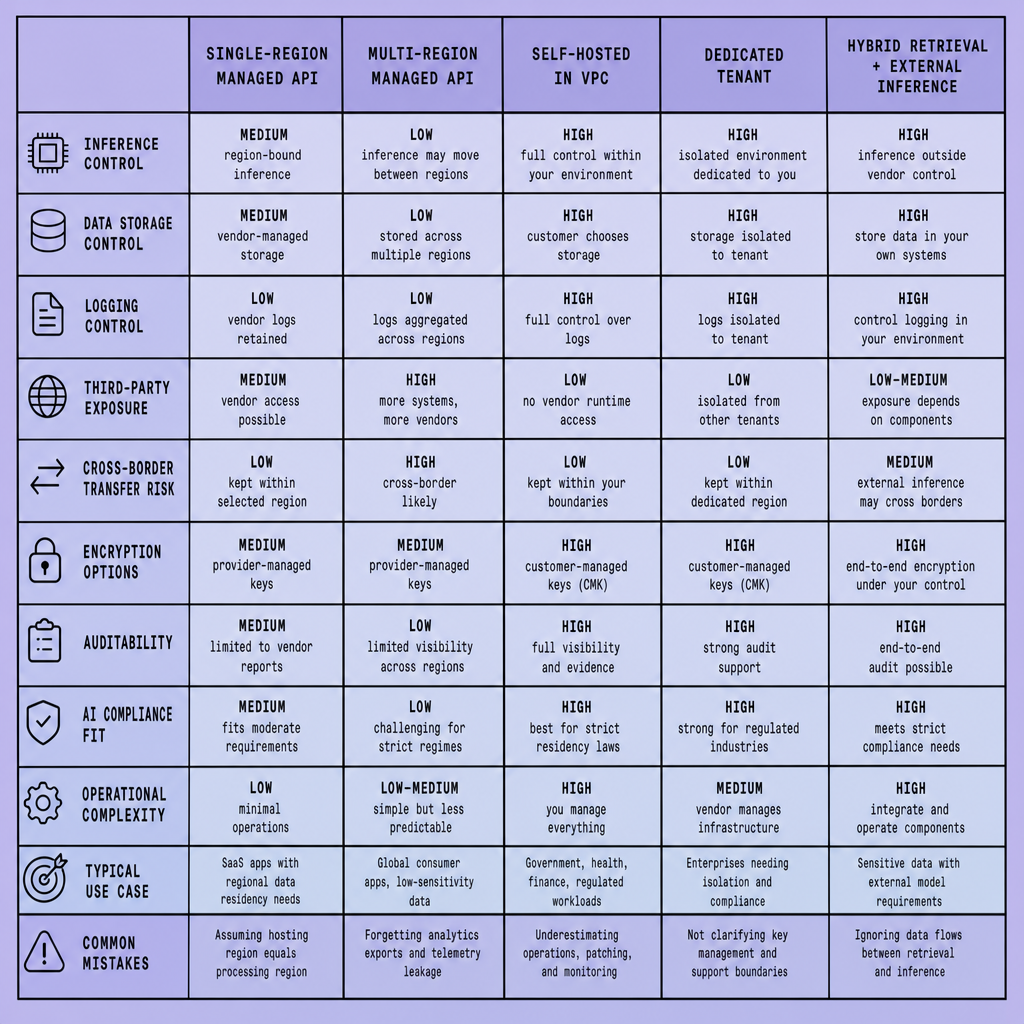
There is no single safe default. A single-region managed API is the fastest option, but only if the provider supports region-pinned inference, clear retention settings, and documented cross-border processing controls.32 It can fit lower-sensitivity workloads, yet stricter residency requirements often uncover gaps in logging, support access, or abuse-monitoring flows.6
Region-pinned provider deployments are stronger. Keeping application traffic, object storage, vector databases, and inference in the same jurisdiction reduces transfer risk across adjacent systems.32 You still need to verify backups, telemetry, and subprocessors.
Self-hosted open models provide the most control over residency and privacy. You choose the VPC, disks, KMS keys, networking, and retention windows. The tradeoff is higher operational complexity and a larger monitoring burden. Without tracing, access logs, and change control, self-hosting does not deliver much practical assurance.
Proxy or gateway patterns sit in the middle. An internal gateway can enforce redaction, prompt templating, per-tenant routing, and policy checks before any model call. That centralizes controls instead of relying on every application team to sanitize data correctly.
Data minimization and retrieval isolation matter as much as hosting choice. Keep sensitive fields out of prompts, store embeddings in-region, isolate RAG indexes by jurisdiction, and avoid mixing source corpora across regions in one vector store.4
Security controls
Good residency controls fail quickly if access controls are weak. Use encryption at rest, BYOK with KMS where supported, RBAC, private networking, short retention windows, and audit logging. HIPAA and similar regimes focus on access, disclosure, and safeguards, not just server location.57
Best first move: minimize prompt payloads, redact sensitive fields before model calls, and region-scope every adjacent system -- CDN logs, API gateways, object storage, vector databases, SIEM, and support tools.
Decision criteria
Now narrow the choice based on risk and operating overhead. Choose managed region-pinned services for speed, self-hosted models for maximum control, and gateways for centralized enforcement. In practice, strong compliance usually comes from combining patterns: pinned inference, isolated retrieval, strict logging controls, and documented transfer boundaries.16
FAQs
What is the best LLM infrastructure for strict data residency?
Usually a region-pinned deployment or self-hosted model with in-region storage, logs, and networking.
Does hosting an app in the EU guarantee LLM data residency?
No. Inference, provider logging, and subprocessors may still process data elsewhere.2
How do you improve LLM data privacy quickly?
Minimize prompt data, redact sensitive fields, restrict retention, and lock down access with RBAC.
Is BYOK enough for AI compliance?
No. BYOK helps with key control, but you still need retention, access control, auditability, and transfer mapping.
Can RAG break AI data residency?
Yes. Your vector database, embedding pipeline, and retrieved documents must stay within the required jurisdiction.4
References
- Data residency for healthcare AI: what the regulations actually require
- What is Data Residency? - Truefoundry
- AI Data Residency Requirements by Region: The Complete Enterprise ...
- Where, Oh, Where Can My Data Be? Four LLM Security/Privacy Tiers
- AI Data Residency: Requirements, Risks, and How to Keep Your ...
- The Inference Region Your Data Residency Policy Forgot to Pin
- Implement RAG while meeting data residency requirements using AWS ...
- EU Data Residency for AI Apps in 2026: The Question Is Not “Which ...
Footnotes
-
https://www.truefoundry.com/blog/data-residency ↩ ↩2 ↩3 ↩4 ↩5 ↩6 ↩7 ↩8 ↩9 ↩10 ↩11
-
https://tianpan.co/blog/2026/06/02/the-inference-region-your-data-residency-policy-forgot-to-pin ↩ ↩2 ↩3 ↩4 ↩5 ↩6 ↩7 ↩8 ↩9 ↩10 ↩11 ↩12 ↩13 ↩14 ↩15
-
https://www.premai.io/blog/ai-data-residency-requirements-by-region-the-complete-enterprise-compliance-guide/ ↩ ↩2 ↩3 ↩4 ↩5 ↩6 ↩7 ↩8 ↩9 ↩10 ↩11 ↩12 ↩13 ↩14 ↩15
-
https://aws.amazon.com/blogs/machine-learning/implement-rag-while-meeting-data-residency-requirements-using-aws-hybrid-and-edge-services/ ↩ ↩2 ↩3 ↩4 ↩5 ↩6 ↩7 ↩8 ↩9 ↩10 ↩11
-
https://www.aptible.com/hipaa-ai-security/data-residency ↩ ↩2 ↩3 ↩4 ↩5 ↩6 ↩7 ↩8 ↩9 ↩10 ↩11 ↩12
-
https://www.solutionstreet.com/blog/2026/08/21/where-oh-where-can-my-data-be-four-llm-security-privacy-tiers/ ↩ ↩2 ↩3 ↩4 ↩5 ↩6 ↩7 ↩8 ↩9 ↩10 ↩11
-
https://petronellatech.com/blog/ai-data-residency-requirements-risks-and-how-to-keep-your-models-and-data-in-country/?srsltid=AfmBOoqEIhw7LIPcHIHvI4_Gxu-ObqQm5KkwwNpf4pJtYr0MNJJusehi ↩ ↩2 ↩3 ↩4 ↩5 ↩6 ↩7 ↩8
Frequently Asked Questions
What is LLM data residency, and how is it different from where my app is hosted?
LLM data residency is the set of jurisdictions where prompts, outputs, embeddings, logs, and related metadata are processed, stored, replicated, or accessed. It is broader than app hosting because inference, telemetry, backups, and vendor subprocessors may operate in different regions even when your frontend and database are local.[^2][^7]
How does LLM data residency affect AI compliance audits?
LLM data residency affects audit scope because reviewers increasingly ask for evidence of actual processing paths, not just contract language or cloud region settings. A defensible audit position requires a system-level map of inference locations, logging flows, subprocessors, retention windows, and access controls tied to each data class.[^1][^3]
Why should I care about AI data residency if my provider says data is encrypted?
Encryption protects confidentiality, but it does not by itself solve residency, transfer, or access-jurisdiction issues. Encrypted data can still be processed in another country, replicated to a backup region, or exposed through support and observability workflows, which means AI compliance depends on geography and operations as well as security controls.
What is the safest LLM infrastructure pattern for regulated workloads?
The safest pattern is usually a region-pinned or self-hosted design with in-region inference, storage, embeddings, logging, and key management, plus strict retention and private networking. The right answer depends on operational maturity, but regulated workloads generally require fewer vendors, fewer transfers, and stronger auditability than default managed setups.[^4][^8]
What are the most common mistakes teams make with LLM data privacy and residency?
The most common mistakes are assuming app region equals inference region, leaving raw prompts in logs, ignoring moderation and analytics vendors, and failing to test backup or failover behavior. Teams also miss support access paths, which can create cross-border exposure even when primary production systems appear region-locked.
Make Imversion a preferred source on Google
Like this kind of AI and software analysis? Add Imversion as a preferred source so Google can highlight our articles for you in Search, AI Overviews, and AI Mode.