Saudi AI Regulation: Essential Insights for Foreign Teams 2026
Understanding Saudi AI regulation is crucial for foreign software teams. Explore SDAIA roles, compliance risks, and best practices for secure data handling.

Saudi AI regulation: what foreign software teams need to know first
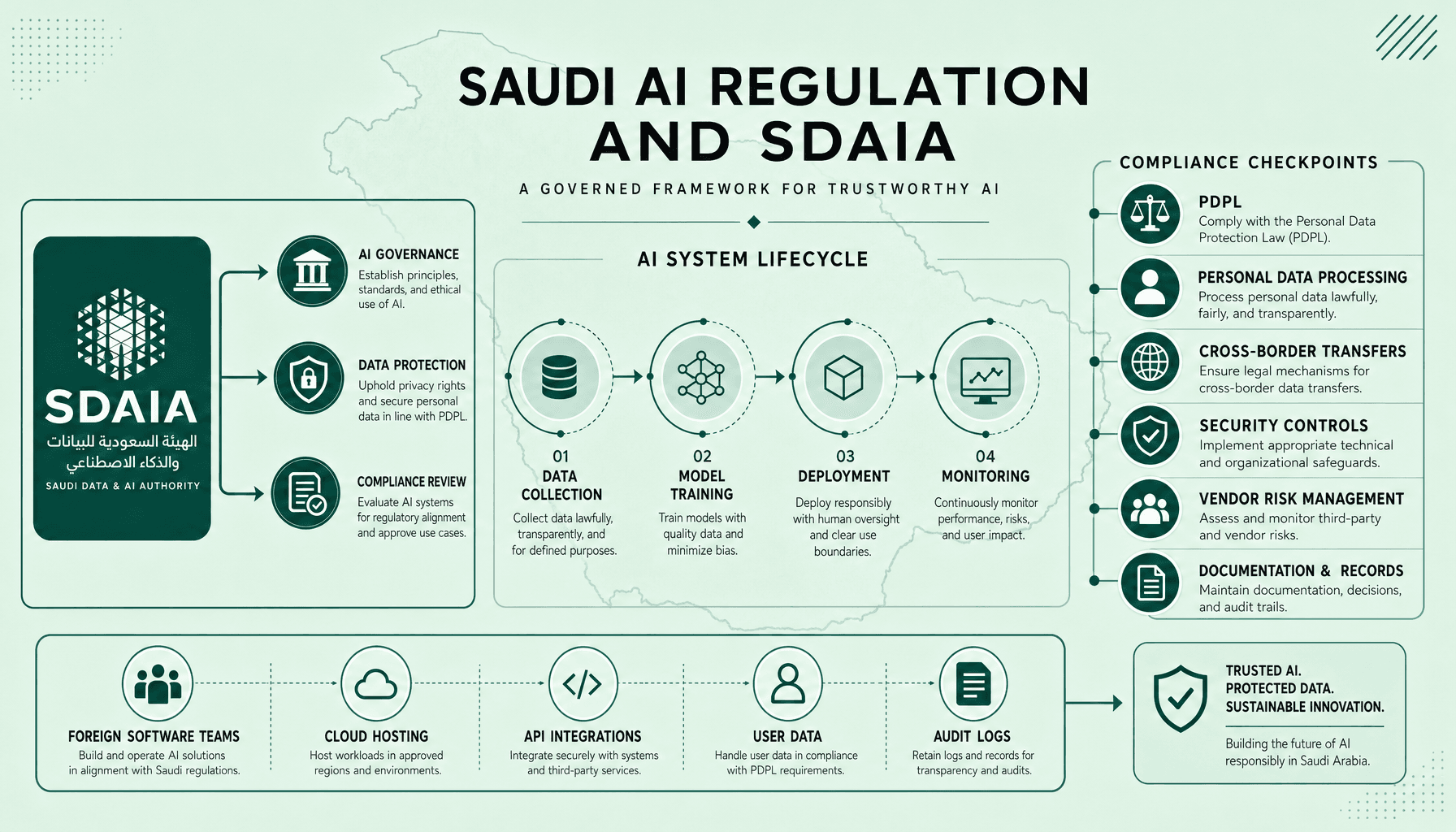
Most teams do not run into trouble with Saudi AI compliance because the model is bad. They run into it because prompts, logs, analytics, training data, or user profiles were wired into the product long before anyone asked where that data goes, who can access it, or whether it can leave Saudi Arabia. Saudi AI regulation is not a policy footnote. It is shaped by SDAIA-led governance expectations and PDPL-based privacy obligations, and foreign teams need to treat it as an engineering and delivery issue from day one.12
If your product touches prompts, logs, analytics, training data, or user profiles in Saudi Arabia, your architecture, hosting, and release process are already part of Saudi AI compliance. Teams that leave this for legal review late usually create expensive rework.
Start with three artifacts: a data map, a cross-border transfer assessment, and a risk review for the AI feature itself. Use the same controls across dev, staging, and production, especially for retention, access, audit logs, and vendor subprocessors.345
Key Takeaways for Saudi AI regulation projects
- Treat Saudi AI regulation as an architecture constraint, not a launch checklist. SDAIA sits at the center of policy, governance, and regulatory direction, so foreign teams should align product, privacy, and delivery decisions early.16
- Assume Saudi PDPL applies if your system touches personal data in prompts, logs, analytics, support tickets, training data, or model outputs linked to individuals.24
- Be careful with cross-border transfers. Map where data is collected, processed, stored, backed up, and accessed, including cloud regions, vendors, and subprocessors, before procurement or deployment locks you in.47
- Build Saudi AI compliance evidence as you ship: consent records, retention schedules, access controls, audit logs, risk reviews, and vendor assessments. Security should not be optional, because weak logging or exposed datasets can become both a privacy and governance failure.15
- Common mistake: teams finalize hosting, telemetry, and API integrations first, then discover Saudi data protection and AI governance Saudi Arabia requirements later. That creates rework. Fast.24
What SDAIA regulates and why Saudi AI regulation matters for foreign AI vendors
If you sell or deploy AI in Saudi Arabia, the hard part is rarely just model quality. You may also need to satisfy buyer expectations around governance, documentation, data handling, and digital trust before deployment moves forward. SDAIA affects more than policy paperwork. It helps shape the governance expectations around data, AI, and digital trust that buyers and public bodies may apply when reviewing a product.16
SDAIA sits at the center of the Kingdom’s national data and AI framework, with a role in policies, standards, and governance direction for data and artificial intelligence.16 For foreign teams, that means Saudi AI regulation is not only about model performance. It is also about whether you can explain, govern, secure, and document the system.
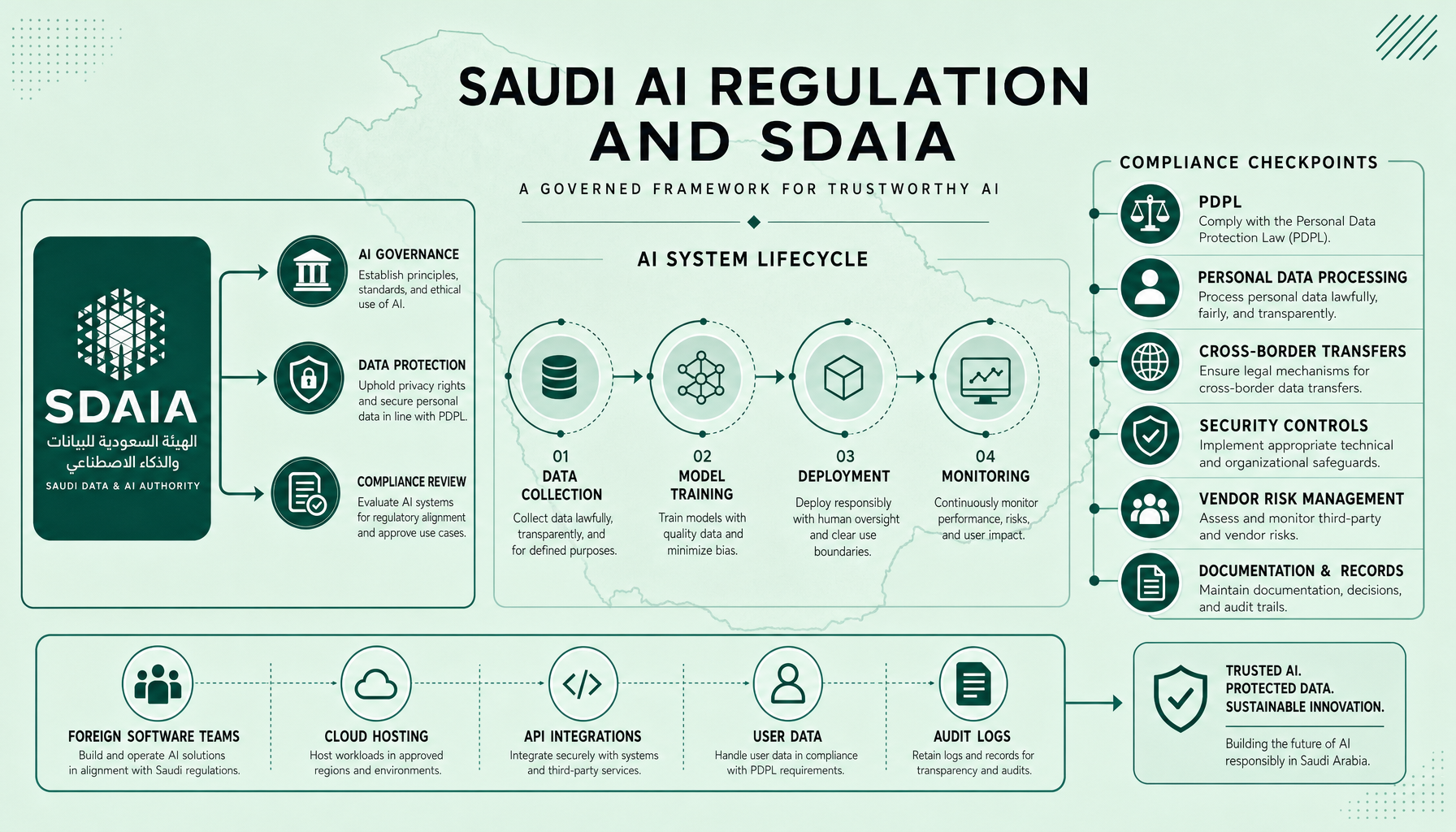
That shifts delivery priorities. Teams often optimize latency, accuracy, and cost first, but Saudi buyers may also review data handling, controls, and governance materials, especially where personal data, automated decision support, or public-sector use is involved.23
The PDPL provides the privacy baseline, so SDAIA’s influence connects to lawful processing, purpose limitation, retention, security controls, and cross-border transfer expectations for personal data.47 In practice, prompt logs, analytics events, fine-tuning datasets, support tickets, and third-party API flows can fall into scope if they contain identifiable data.
For example, if your product sends prompts from Saudi users to an overseas LLM API, you may need a clear data map, transfer assessment, lawful-basis analysis, retention schedule, and vendor security review before procurement or deployment proceeds.47 A single logging or support workflow can create compliance risk even if the model itself performs well.
Common mistakes include:
- choosing cloud regions before mapping data flows
- storing prompts and outputs indefinitely
- ignoring subprocessors or support access
- lacking audit logs, model documentation, or risk reviews
- treating Saudi AI compliance as a contract-stage task
A practical approach is to build governance artifacts alongside the product: data inventories, model cards, access controls, transfer records, and review checkpoints. For foreign software teams, governance readiness is part of product readiness.23
FAQs
What is SDAIA in Saudi Arabia?
SDAIA is the Saudi Data and Artificial Intelligence Authority, a central body shaping national policy, governance, and regulatory direction for data and AI.16
Does SDAIA regulate foreign AI vendors directly?
Foreign vendors may face SDAIA-linked expectations through procurement reviews, sector rules, and data governance requirements tied to deployment in the Kingdom.23
How does PDPL affect AI products in Saudi Arabia?
PDPL applies where your AI system processes personal data, including prompts, logs, user profiles, analytics, and training-related datasets.47
Are cross-border data transfers a Saudi AI compliance issue?
Yes. If personal data moves outside Saudi Arabia, teams should assess transfer rules, safeguards, vendor roles, and documentation requirements under Saudi data protection expectations.47
What documents should foreign software teams prepare?
Start with data maps, retention schedules, transfer assessments, consent records where relevant, audit logs, model cards, and risk reviews aligned to AI governance Saudi Arabia.234
How Saudi AI regulation connects to PDPL and personal data processing
A lot of teams think about AI compliance at the model layer and miss where the real exposure shows up: everyday product operations. If your AI product handles personal data in Saudi Arabia, Saudi PDPL is the baseline. That is the practical link between Saudi AI regulation, SDAIA, and engineering work: AI governance depends on how personal data is collected, used, stored, shared, and retained.14
Where PDPL reaches inside AI systems
Foreign teams often focus on training data first, but production systems usually create the more immediate exposure. Prompts, user accounts, telemetry, support tickets, analytics events, API payloads, and model outputs tied to a person can fall within personal data processing under Saudi data protection rules.47
So PDPL may apply not only to model development, but also to routine product operations. A chatbot that stores prompts for tuning, an analytics pipeline linked to account IDs, or a support workflow that copies model responses into tickets can all involve regulated processing activities.4
What compliance duties software teams should expect
Once PDPL applies, teams should be able to explain why data is processed, what fields are needed, where data flows, who can access it, how long it is kept, and whether it is accessed from or transferred outside Saudi Arabia.147
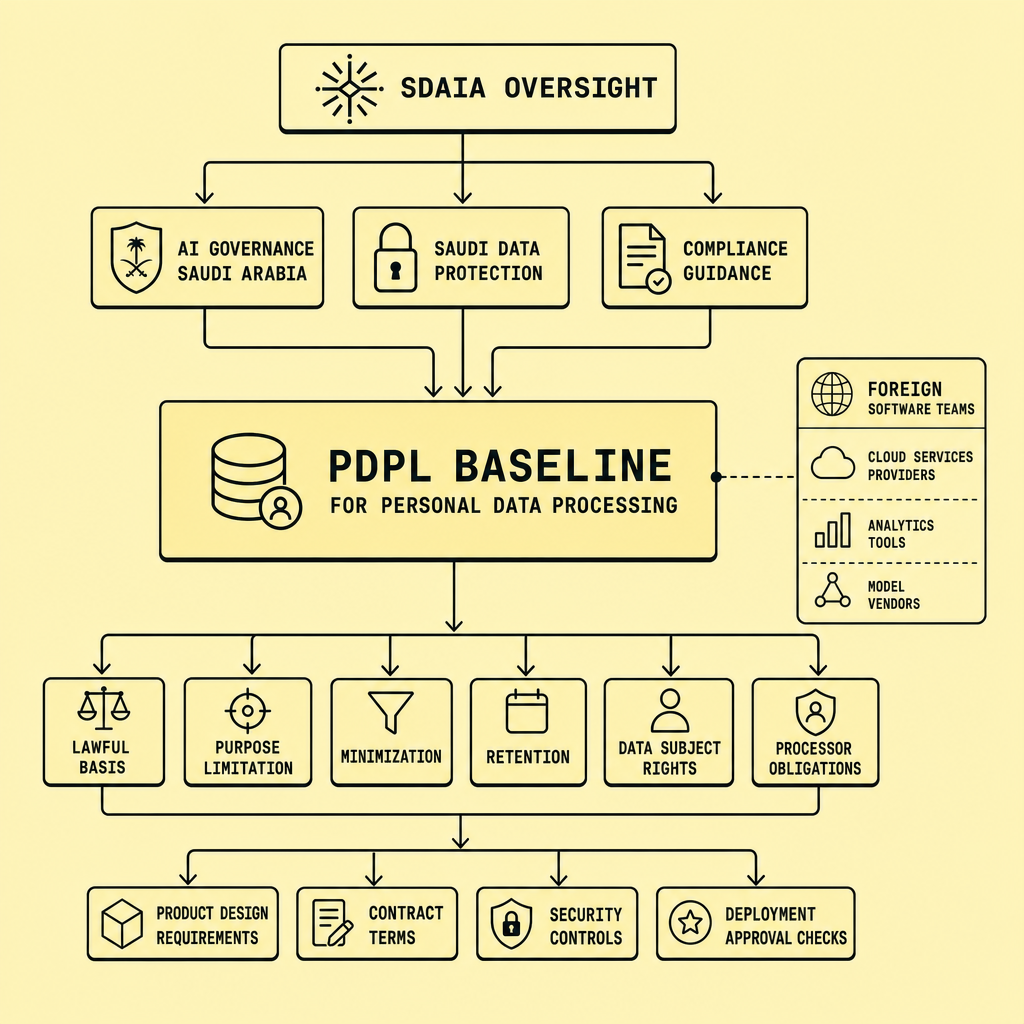
Core duties usually include:
- lawful basis for each processing activity
- purpose limitation for prompts, analytics, and reuse
- data minimization in schemas, logs, and model inputs
- retention limits and deletion workflows
- transparency through notices and product disclosures
- support for data subject rights such as access, correction, and deletion47
Cross-border transfers need early review too. If your model provider, cloud region, or subprocessor sits outside Saudi Arabia, assess that transfer path before procurement or deployment decisions are locked in.45
Implementation mistakes teams make
This is where teams create avoidable mess. Common mistakes include keeping raw prompts indefinitely, logging too much by default, mixing production data into training pipelines, and failing to map vendor subprocessors. Teams should also monitor live data handling, not just secure release pipelines, because compliance depends on what happens after deployment as well.45
A practical starting point is to prepare a data map, retention schedule, transfer assessment, relevant notice or consent records, and audit logs for administrative access before launch.23
FAQs
Does Saudi PDPL apply to AI prompts and chat logs?
Yes. If prompts or chat logs identify a person directly or indirectly, they can be personal data under PDPL.4
Is PDPL the main privacy law behind Saudi AI compliance?
Yes. PDPL is the foundational privacy layer for AI systems that process personal data in Saudi Arabia.14
Do analytics and telemetry count as personal data processing?
Often, yes, especially if events tie back to a user account, device, or profile.4
What about cross-border transfers for AI vendors?
If data is hosted, accessed, or processed outside Saudi Arabia, teams should assess transfer conditions and vendor arrangements early.45
What is a common compliance mistake for foreign software teams?
Ignoring production logs, support tooling, and retention settings while focusing only on model training data.45
Saudi AI regulation for data handling, cross-border transfers, and security controls
Compliance problems usually start with one simple gap: the team cannot clearly trace the full data path. Under Saudi practice, PDPL is the privacy baseline, while SDAIA shapes broader governance expectations. For AI teams, that means compliance depends on knowing where data is collected, stored, processed, exported, and retained.134
Map the full AI data path before you ship
The key question is straightforward: where does personal data go? Not just the main database, but also prompts, uploaded files, embeddings, vector stores, analytics events, support exports, audit trails, backups, and model-provider logs. If a team cannot map those flows, it cannot reliably assess compliance.47
That map should connect directly to architecture choices, including cloud regions, tenant isolation, subprocessors, admin access, and retention schedules. One common problem is keeping core app data in one region while prompts, telemetry, or error traces are sent to external tools in other jurisdictions.47
Treat cross-border transfers as a design decision
Cross-border transfers should be reviewed as both a legal and technical issue. PDPL-related transfer rules and implementing requirements mean teams need to assess whether a transfer is permitted, necessary, and adequately protected.147 That review should cover hosting locations, external vendors, remote support access, contractors, and managed service providers.
The practical takeaway is simple: global tooling may speed delivery, but uncontrolled data movement increases compliance risk.47
Baseline security controls that support compliance
A defensible starting point includes:
- encryption in transit and at rest
- role-based access control with least privilege
- audit logs for admin activity and data access
- retention settings for logs, prompts, and backups
- incident response playbooks with notification paths
- vendor reviews for subprocessors and API providers
Do not stop at launch. A system can drift out of alignment if access rights expand, retention periods are not enforced, or data starts flowing to new vendors without review.25
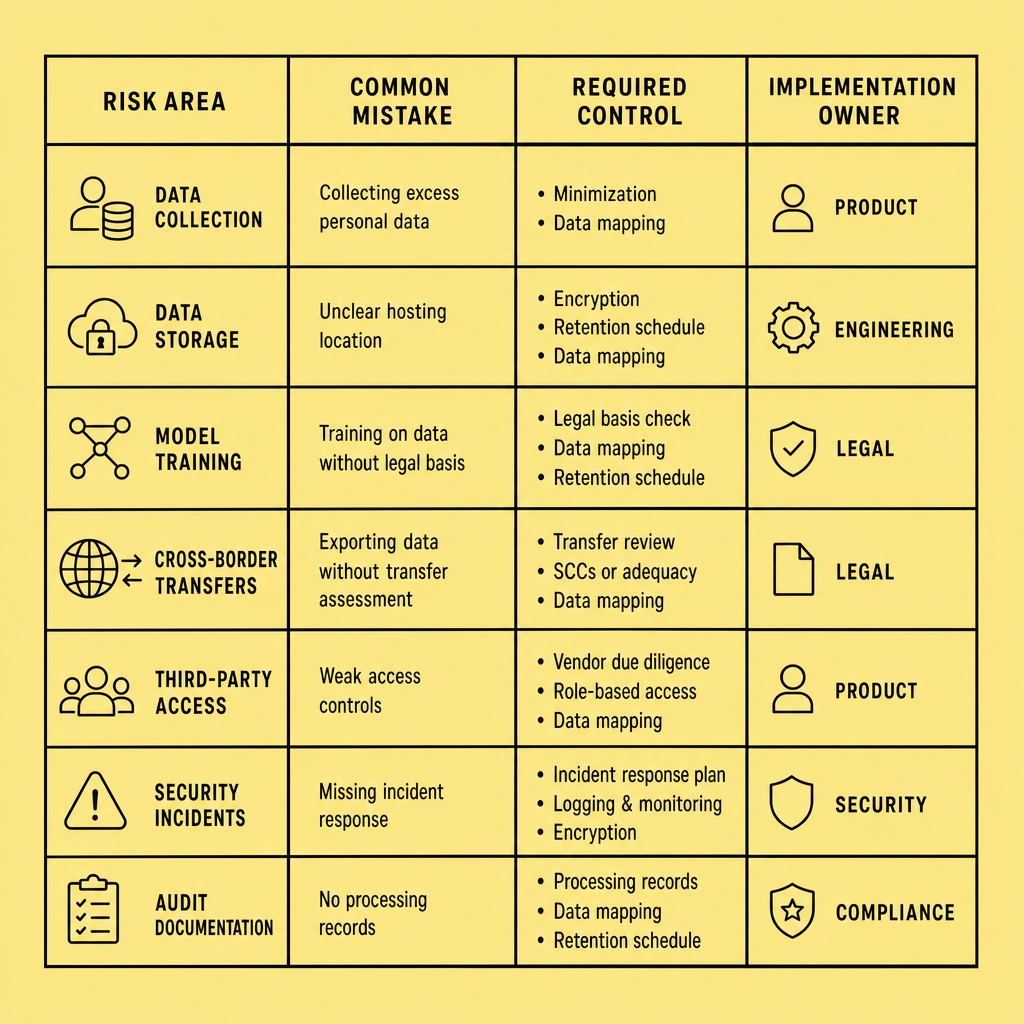
Common mistakes foreign teams make
Frequent issues include default global hosting, undocumented support access, indefinite log retention, training on customer data without clear governance, and buying AI APIs before checking transfer implications. A safer approach is to treat data-flow design as an engineering deliverable, not a policy appendix.247
FAQs
Does Saudi AI regulation require local Saudi data hosting?
Not in every case, but hosting, access, and transfer choices should align with PDPL obligations and transfer controls.14
What is SDAIA’s role in Saudi AI compliance?
SDAIA shapes national data and AI governance expectations and influences privacy, trust, and responsible AI practices.16
Are cross-border transfers allowed under Saudi data protection rules?
They may be, but only after legal and operational assessment of the transfer basis, safeguards, and destination risks.147
What security controls matter most for AI systems in Saudi Arabia?
Encryption, access control, audit logs, retention schedules, subprocessor oversight, and incident response are the practical baseline.25
Risks for foreign software teams and how to implement Saudi AI compliance without rework
The biggest risks are rarely exotic. They come from normal delivery habits: shipping with global defaults, vague ownership, broad logging, and late legal review.
Where foreign teams usually get exposed
Foreign vendors often fail on role clarity first. If your contract, API terms, and product workflow do not clearly define who is the controller and who is the processor, your privacy duties, transfer logic, and incident handling will drift fast.4 Once that confusion reaches production, rework spreads into consent flows, retention rules, subprocessors, and support operations.
The next common miss is infrastructure by default. Teams deploy to their standard cloud region, keep prompts and logs indefinitely for debugging, and route analytics through global tools before checking whether the data flow fits Saudi data protection expectations under PDPL and related governance controls.14 Shipping first and reviewing cross-border transfers later is one of the most expensive mistakes.47
Then there is weak AI documentation. Under evolving AI governance Saudi Arabia, buyers increasingly expect traceability: what model is used, what data it touches, what the known limitations are, and what human oversight exists.23 If you cannot produce model documentation, audit logs, retention schedules, and a DPIA-style review, procurement slows down even before regulators enter the picture.23
The fastest path is usually not a full legal rewrite. It is a tighter data inventory, narrower personal-data scope, and stricter deployment controls before launch.
A practical rollout sequence that prevents rework
Use a short, cross-functional implementation track before release:
- Map data flows. Build a data inventory covering prompts, uploads, logs, analytics, training data, support tickets, and outputs tied to users.47
- Assign roles. Confirm controller, processor, and subprocessor responsibilities in contracts and product operations.4
- Review transfers. Check hosting locations, backup regions, vendor subprocessors, and any external API calls before launch.47
- Reduce retention. Set prompt, log, and trace retention schedules by purpose, not by default platform settings.47
- Document the model. Maintain model cards, behavior limits, fallback rules, and human-review points.23
- Run release governance. Product, engineering, security, and legal should approve one deployment checklist covering privacy, security, vendor due diligence, and incident response.25
At Imversion Technologies Pvt Ltd, I would treat this as release engineering, not admin overhead. Automation reduces human error, especially for retention enforcement, subprocessor inventories, and deployment gates.
References
- Saudi Data & AI Authority's Laws and Regulations
- AI Regulation Saudi Arabia 2025: Laws, Compliance & Insights
- Navigating AI Governance in Saudi Arabia:… | Modulos Blog
- Navigating the data protection landscape in Saudi Arabia - Frontiers
- How SDAIA Regulates Saudi Data Privacy Laws | Complete Guide
- Saudi Data & AI Authority (SDAIA) Compliance - V-Comply
- Saudi Authority for Data and Artificial Intelligence
- AI, Global Regulations In Saudi Arabia: AI Principles and the Future
Footnotes
-
Saudi Data & AI Authority's Laws and Regulations ↩ ↩2 ↩3 ↩4 ↩5 ↩6 ↩7 ↩8 ↩9 ↩10 ↩11 ↩12 ↩13 ↩14 ↩15
-
AI Regulation Saudi Arabia 2025: Laws, Compliance & Insights ↩ ↩2 ↩3 ↩4 ↩5 ↩6 ↩7 ↩8 ↩9 ↩10 ↩11 ↩12 ↩13 ↩14 ↩15
-
Navigating AI Governance in Saudi Arabia:… | Modulos Blog ↩ ↩2 ↩3 ↩4 ↩5 ↩6 ↩7 ↩8 ↩9 ↩10
-
Navigating the data protection landscape in Saudi Arabia - Frontiers ↩ ↩2 ↩3 ↩4 ↩5 ↩6 ↩7 ↩8 ↩9 ↩10 ↩11 ↩12 ↩13 ↩14 ↩15 ↩16 ↩17 ↩18 ↩19 ↩20 ↩21 ↩22 ↩23 ↩24 ↩25 ↩26 ↩27 ↩28 ↩29 ↩30 ↩31 ↩32 ↩33 ↩34 ↩35 ↩36
-
Saudi Data & AI Authority (SDAIA) Compliance - V-Comply ↩ ↩2 ↩3 ↩4 ↩5 ↩6 ↩7 ↩8 ↩9
-
Saudi Authority for Data and Artificial Intelligence ↩ ↩2 ↩3 ↩4 ↩5
-
How SDAIA Regulates Saudi Data Privacy Laws | Complete Guide ↩ ↩2 ↩3 ↩4 ↩5 ↩6 ↩7 ↩8 ↩9 ↩10 ↩11 ↩12 ↩13 ↩14 ↩15 ↩16 ↩17 ↩18
Frequently Asked Questions
What is the first technical step for Saudi AI regulation readiness?
The first technical step is a complete data-flow inventory that tracks prompts, logs, analytics, uploads, model outputs, backups, and vendor handoffs across environments. Without that map, a team cannot validate lawful processing, retention, access, or transfer exposure in a defensible way.
How does Saudi AI regulation affect use of third-party LLM APIs?
Saudi AI regulation affects third-party LLM API use by forcing teams to review what data is sent to the provider, where it is processed, whether it is retained for model improvement, and which subprocessor chain is involved. The compliance issue is usually the surrounding data path, not just the API contract itself.
Why should foreign software teams separate debugging logs from training datasets?
Foreign software teams should separate debugging logs from training datasets because operational logs often contain incidental personal data, access metadata, and support artifacts that were never approved for model reuse. Mixing those sources creates avoidable privacy risk, weakens purpose limitation, and makes deletion requests much harder to honor.
Does Saudi data protection require more than just encrypting AI data?
Yes. Saudi data protection requires more than encryption because compliance also depends on lawful basis, purpose limitation, retention control, access governance, transfer review, and support for data subject rights under the PDPL framework.[^1][^4]
How often should a team review Saudi AI compliance after launch?
A team should review Saudi AI compliance whenever it changes hosting, vendors, retention settings, model behavior, data categories, or support access, and it should also run a periodic scheduled review. Post-launch drift is a common failure point because architectures often change faster than governance records are updated.[^2][^6]
Make Imversion a preferred source on Google
Like this kind of AI and software analysis? Add Imversion as a preferred source so Google can highlight our articles for you in Search, AI Overviews, and AI Mode.