Build vs Buy AI Agents: Strategy Insights for 2026
Uncover the build vs buy AI agents dilemma with a clear decision framework, key takeaways, and expert insights. Make informed choices for your AI strategy.

Build vs Buy AI Agents: The Best Choice for Most Companies
Teams burn time on this decision because both paths sound reasonable until the implementation work starts. Buy too quickly and you hit workflow limits, weak integrations, or governance gaps. Build too early and you inherit infrastructure, evals, monitoring, and maintenance that never needed to be yours. For most teams, the right build vs buy AI agents decision is to buy or configure a vendor platform first. Custom AI agents vs off-the-shelf only swings toward custom when the agent is truly strategic, deeply constrained, or locked to a unique workflow. Hybrid is often the practical middle ground.
Our AI agent decision framework is simple: buy for commoditized use cases, configure a vendor platform for controlled deployment, build only where differentiation or compliance demands it. In practice, a hybrid AI agent strategy -- buy the platform, build the agent logic and integrations -- gives most companies the best balance of speed, control, and switching cost. We use this lens at Imversion Technologies Pvt Ltd because clean code improves long-term productivity, but building infrastructure no one needs does the opposite. If the choice is unclear, a $8.5K, 2-week AI readiness assessment is a sensible first step.
Key Takeaways
-
Most teams should start the build vs buy AI agents decision by assuming buy first. Off-the-shelf and configured vendor options win when the use case is common, speed matters, and the agent is not a real source of competitive advantage.
-
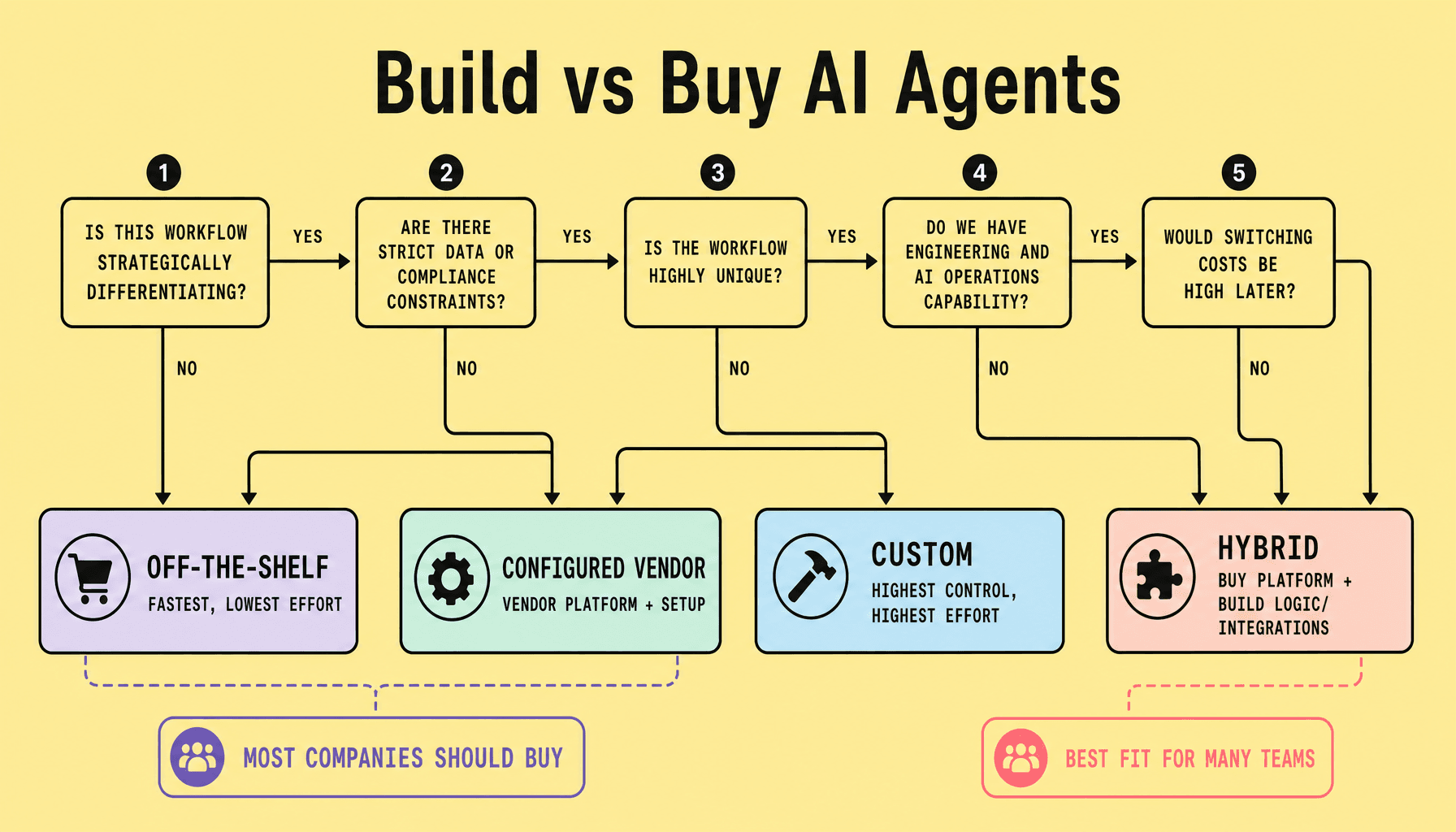
Use an AI agent decision framework built around five checks: differentiation, data constraints, workflow uniqueness, engineering capability, and switching cost. If only one or two are high, custom is usually overkill. If several are high, custom becomes easier to justify.
-
The sharpest tradeoff in custom AI agents vs off-the-shelf is control versus complexity. Custom can deliver tighter orchestration, compliance, and domain logic. But it also creates ongoing ownership -- infra, evals, monitoring, prompt changes, and integration maintenance.
-
For many companies, a hybrid AI agent strategy is the best fit: buy the platform, build the agent logic and integrations. We prefer this because user experience is as important as functionality, and the workflow layer is often where business value actually shows up.
-
If the answer is still unclear, use the $8.5K, 2-week AI readiness assessment to pressure-test scope, budget, architecture, and vendor fit before committing.
Build vs Buy AI Agents Decision Tree: 5 Questions to Choose the Right Path
Start with a bias toward buying. Most teams move faster and avoid unnecessary platform work that way. The real question is not whether an agent can be built. It is whether the value sits in the agent itself or in how it connects to your business.
1) Is the agent part of your competitive differentiation?
If the agent supports a common function -- internal search, meeting summaries, support deflection, or sales assistance -- off-the-shelf or configured vendor tools usually win.
If the agent’s behavior is core to how you sell, operate, underwrite, triage, or fulfill work, custom or hybrid becomes more attractive. Teams often overestimate uniqueness here. A workflow can feel special and still be a standard pattern with better prompts, retrieval, and policy controls.
2) Do data constraints or governance requirements limit vendor options?
A lot of build-vs-buy debates are really governance debates in disguise. If your data can sit inside a vetted SaaS boundary with acceptable governance, a configured vendor is often enough. If you need strict data residency, private deployment, model-level controls, or auditable decision paths, custom or hybrid is usually safer.
Governance is not a side issue; it shapes architecture from day one.
3) How unique is the workflow orchestration?
Simple chat and lookup flows map well to off-the-shelf tools. Multi-step actions -- pulling from ERP, CRM, ticketing, approval systems, and internal knowledge while enforcing business rules -- often push you toward configured vendor or hybrid.
This is usually where the decision stops being cosmetic and becomes operational.
4) Do you have the engineering capability to build and maintain it?
Custom systems need evaluation pipelines, prompt and model versioning, observability, guardrails, and integration support. Not just a demo. If that capability is thin, buy.
5) What is the switching cost if you guess wrong?
A fast launch can still become expensive if you are boxed into the wrong platform six months later. High switching costs often favor a hybrid AI agent strategy. Buy the platform layer, but keep agent logic, integrations, and evaluation outside the vendor where possible. That preserves flexibility if pricing, model quality, or product direction changes.
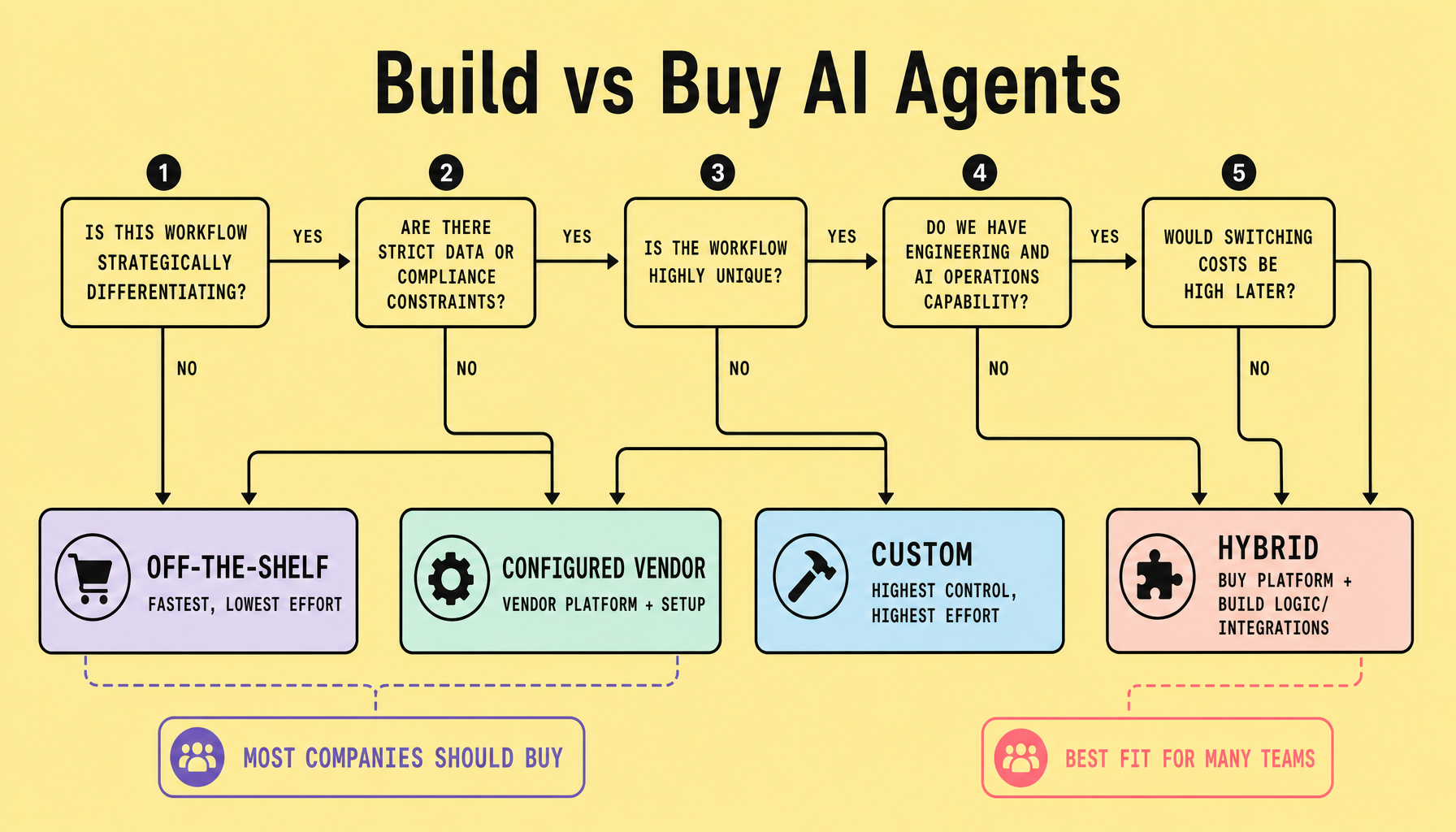
Rule of thumb: buy for commoditized capability, build only for true differentiation, and choose hybrid when workflows are unique but you do not want to own the full AI stack.
If the answer is still unclear, run a short scoping phase first to clarify constraints, architecture, and ownership before committing.
Off-the-Shelf vs Configured Vendor vs Custom vs Hybrid AI Agents
Most companies should buy first, not build first. In the custom AI agents vs off-the-shelf decision, the real question is not features. It is where your advantage actually lives.
Side-by-side comparison
| Approach | Best fit | Speed to value | Control | Cost / maintenance | Main risk |
|---|---|---|---|---|---|
| Off-the-shelf AI agents | Common use cases like internal knowledge chat, meeting notes, basic support automation | Fastest -- often days to a few weeks | Low | Lowest | Workflow mismatch, shallow integration, vendor limits |
| Configured vendor solution | Teams needing policy control, knowledge grounding, human handoff, and system integrations | Fast -- usually weeks | Medium to high | Moderate | Vendor lock-in, boundary of platform flexibility |
| Custom AI agents | Strategic differentiation, regulated workflows, proprietary orchestration, strict latency or compliance needs | Slowest | Highest | Highest | Build complexity, ongoing ops burden, longer payback |
| Hybrid AI agent strategy | Companies that want platform security and observability, but custom logic and integrations | Medium | High where it matters | Moderate to high | Architectural sprawl if ownership is unclear |
Off-the-shelf works because many agent use cases are not unique. Support deflection, internal document Q&A, and simple sales assist often benefit more from strong retrieval, permissions, analytics, and human handoff than from bespoke orchestration. The most expensive option is not automatically the most capable in practice. Platform maturity, observability, and security controls often matter more than raw customization.
That is where configured vendor solutions earn their place. Teams can shape prompts, guardrails, routing rules, connectors, and approval steps without owning the whole stack. For enterprise rollout, that is a strong trade.
Custom wins only when the workflow is the product, or close to it. Think specialized underwriting review, tightly controlled compliance workflows, or domain-specific decision support where generic tools break. But custom also means model ops, evaluations, logging, retries, permissions, and failure handling.
Hybrid is often the best operating model. Buy the foundation. Build the logic and integrations that create value. Keep custom work focused at the orchestration layer so it stays maintainable and easier to replace.
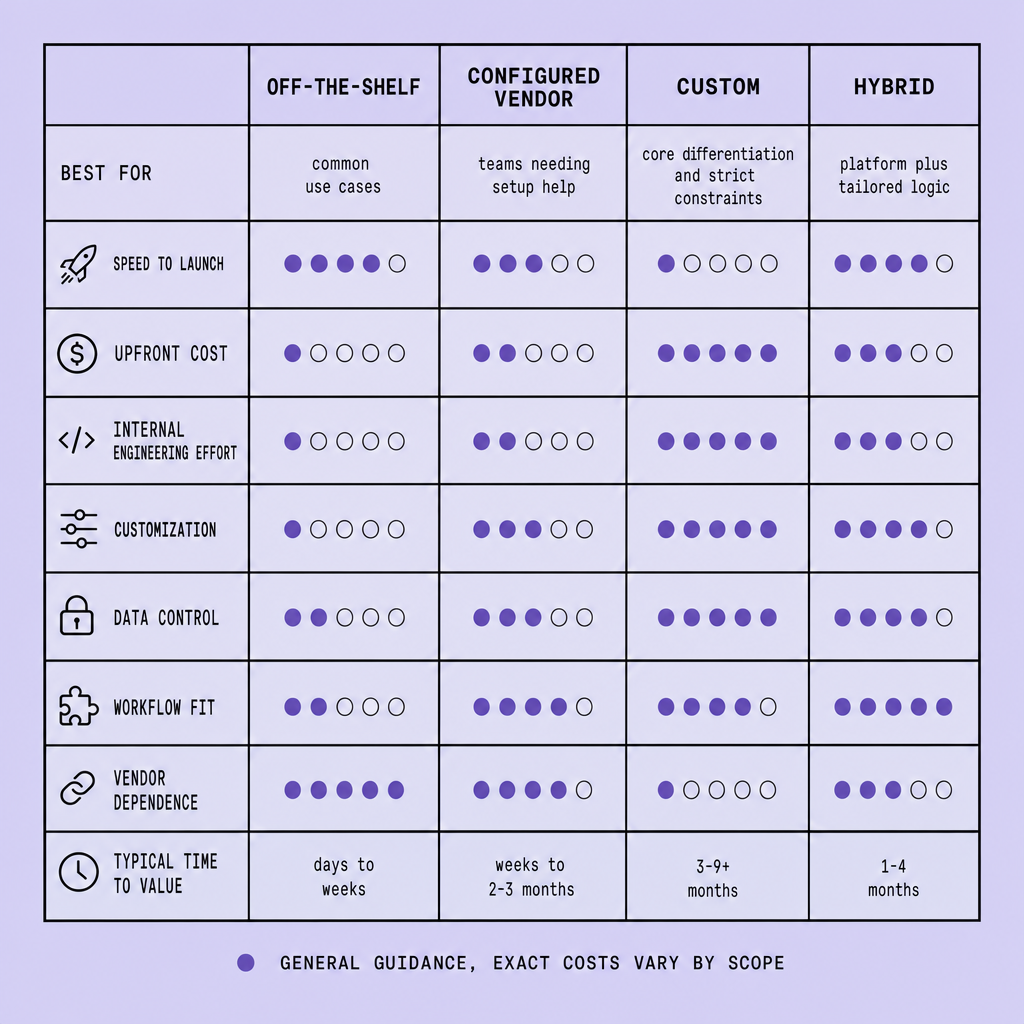
If you are unsure which path fits, the $8.5K, 2-week AI readiness assessment is a practical way to map use cases, constraints, and budget before committing.
Budget and Resourcing Table for Build vs Buy AI Agents
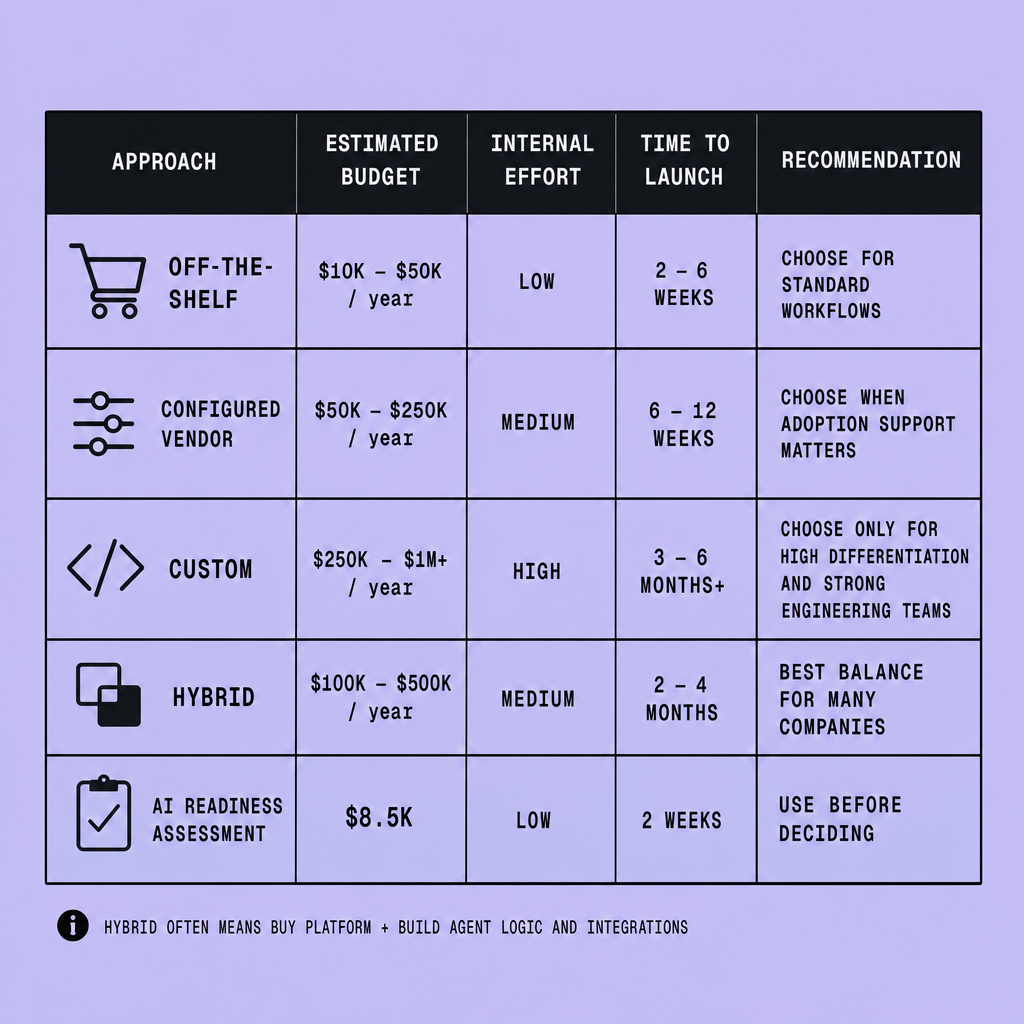
This is where teams often fool themselves. The practical build vs buy AI agents budget is about total cost of ownership, not just license fees or initial development. Setup, integration, testing, monitoring, evaluation, prompt and version management, and ongoing AI operations usually decide whether the system remains maintainable.
Budget and timeline guide
| Approach | Estimated budget range | Internal effort | Implementation timeline | Ideal company profile |
|---|---|---|---|---|
| Off-the-shelf | Low | Low; business owner + light IT/security review | Days to a few weeks | Teams solving common use cases fast |
| Configured vendor | Low to medium | Moderate; ops lead, IT, domain SMEs, light engineering | Few weeks to 2 months | Companies needing policy, workflow, and knowledge-base configuration on an enterprise AI agent platform |
| Custom-built | High to very high | High; sustained engineering capacity across backend, frontend, data, security, and AI operations | 2-6+ months | Firms where the agent is a real differentiator or has strict workflow and data constraints |
| Hybrid AI agent strategy | Medium to high | Moderate to high; platform team plus targeted app/integration work | 1-3 months | Mid-market and enterprise teams needing flexibility without owning the whole stack |
Buying is usually the lowest-risk default. Custom AI agents vs off-the-shelf only tilts toward custom when the agent creates real differentiation, depends on unique workflows, or must meet hard data and control requirements.
Hybrid is often the middle path. Buy the commoditized platform layers, then build the integrations and agent logic that matter to your business.
If the answer is unclear, run a short scoping phase first to define budget, timeline, risks, and required engineering capacity before committing.
Why Buy Platform + Build Agent Logic and Integrations Is Often the Best Hybrid AI Agent Strategy
For many companies, the strongest recommendation is simple: buy the platform layer, build the parts that encode your business. That is usually the best hybrid AI agent strategy.
The reason is practical. Most teams do not gain much from rebuilding AI plumbing. They gain from how the agent applies policy, routes work, uses internal context, and connects to real systems like CRM, ERP, ticketing, search, and document stores. In practice, the hard part in custom AI agents vs off-the-shelf is rarely the model call itself. It is workflow fit.
Buy the platform components that are becoming infrastructure
An enterprise AI agent platform usually handles the parts that are expensive to rebuild and annoying to maintain:
- model management across providers
- security controls and access policies
- observability, logging, and tracing
- evaluation pipelines and prompt/version tracking
- scaling, retries, rate limits, and failover
- guardrails for unsafe outputs and tool misuse
These are not trivial features. They become operational requirements fast -- especially once an agent touches customer data or production workflows. Buying this layer gives teams speed, governance, and a cleaner operating model. And clean code improves long-term productivity; wasting engineering cycles on commodity infrastructure cuts against that.
Build the components that create competitive value
This is where the upside lives.
Build the agent logic, business rules, orchestration, and system integrations that reflect your actual operating model. For example: approval chains, exception handling, account-specific logic, internal retrieval rules, action permissions, and handoffs between humans and automation. A generic vendor workflow often breaks the moment your process has edge cases. Most real processes do.
Within an AI agent decision framework, this is the practical middle path between custom AI agents vs off-the-shelf: buy what is standardized, build what is specific.
Where hybrid can still be the wrong choice
Hybrid is not automatic. If the use case is simple and low-risk, off-the-shelf may be enough. If the agent is a core product differentiator, has strict latency or compliance constraints, or needs highly specialized orchestration, full custom may still win.
If you are unsure where your boundary sits, a $8.5K, 2-week AI readiness assessment is a sensible first step before committing budget to the wrong architecture.
So the rule is clear: buy the foundation, build the advantage.
Use a $8.5K, 2-Week AI Readiness Assessment Before You Build or Buy
If your team is still unsure, do not force a platform decision yet. Start with an AI readiness assessment.
This step matters most when the build vs buy AI agents discussion keeps circling around conflicting goals, unclear ownership, fragmented data, or pressure to “just launch something.” That is usually when teams overspend -- either on custom architecture they did not need, or on vendor tooling that cannot support the real workflow.
Our recommendation is simple: use a $8.5K, 2-week AI readiness assessment to reduce uncertainty before you commit implementation budget.
In two weeks, the assessment should clarify:
- use-case prioritization -- which agent opportunities are worth solving first
- data readiness -- where the source data lives, how usable it is, and what constraints apply
- workflow fit -- whether off-the-shelf, configured vendor, custom, or a hybrid AI agent strategy fits best
- architecture recommendation -- platform, integration, orchestration, and governance needs
- build-vs-buy decision -- using a practical AI agent decision framework
- implementation roadmap -- phased delivery, owners, risks, and next-step budget
Because clean code improves long-term productivity, we do not treat architecture choice as a branding exercise. We treat it as an operating decision.
That changes the conversation. Instead of debating custom AI agents vs off-the-shelf in the abstract, you leave with a scoped recommendation, clearer tradeoffs, and a lower-risk path to execution.
Frequently Asked Questions
What is the biggest hidden cost in build vs buy AI agents?
The biggest hidden cost is not the first invoice or sprint plan; it is long-term operational ownership. AI agents need ongoing evaluation, prompt updates, monitoring, security review, workflow tuning, and integration maintenance. A cheaper starting option can become more expensive if it creates brittle processes or requires constant manual intervention.
How does vendor lock-in affect build vs buy AI agents decisions?
Vendor lock-in matters most when your workflows, prompts, and integrations are deeply embedded inside one platform’s proprietary tooling. The practical way to reduce that risk is to keep business logic, evaluation methods, and core integrations portable so you can change models or vendors without rebuilding the entire agent experience.
Why should a company choose hybrid instead of fully custom?
A hybrid approach works well because it separates commodity infrastructure from business-specific logic. Companies can use a platform for security, scaling, and observability while building only the workflows and integrations that create differentiated value. That usually lowers delivery risk without giving up meaningful control over the user experience.
When should build vs buy AI agents decisions involve legal, security, and operations teams?
These decisions should involve legal, security, and operations teams as soon as the agent will access sensitive data, take actions in business systems, or affect regulated workflows. Early cross-functional review prevents expensive rework by identifying approval requirements, audit needs, user permissions, and failure-handling expectations before architecture choices become hard to reverse.
How do I know if an AI agent is strategic enough to justify custom development?
An AI agent is strategic enough for custom development when its behavior directly shapes revenue, margin, risk, or customer experience in a way competitors cannot easily copy. If the advantage comes from proprietary workflow design, domain rules, or tightly controlled decision-making, custom becomes easier to justify than a generic platform configuration.
Make Imversion a preferred source on Google
Like this kind of AI and software analysis? Add Imversion as a preferred source so Google can highlight our articles for you in Search, AI Overviews, and AI Mode.