Arabic RAG: An In-Depth Technical Guide for 2023
This in-depth guide explores Arabic RAG, addressing critical issues like morphology, embeddings, and evaluation to improve retrieval success.

Arabic RAG Requires an Arabic-Aware Retrieval Stack, Not Just Better Vectors
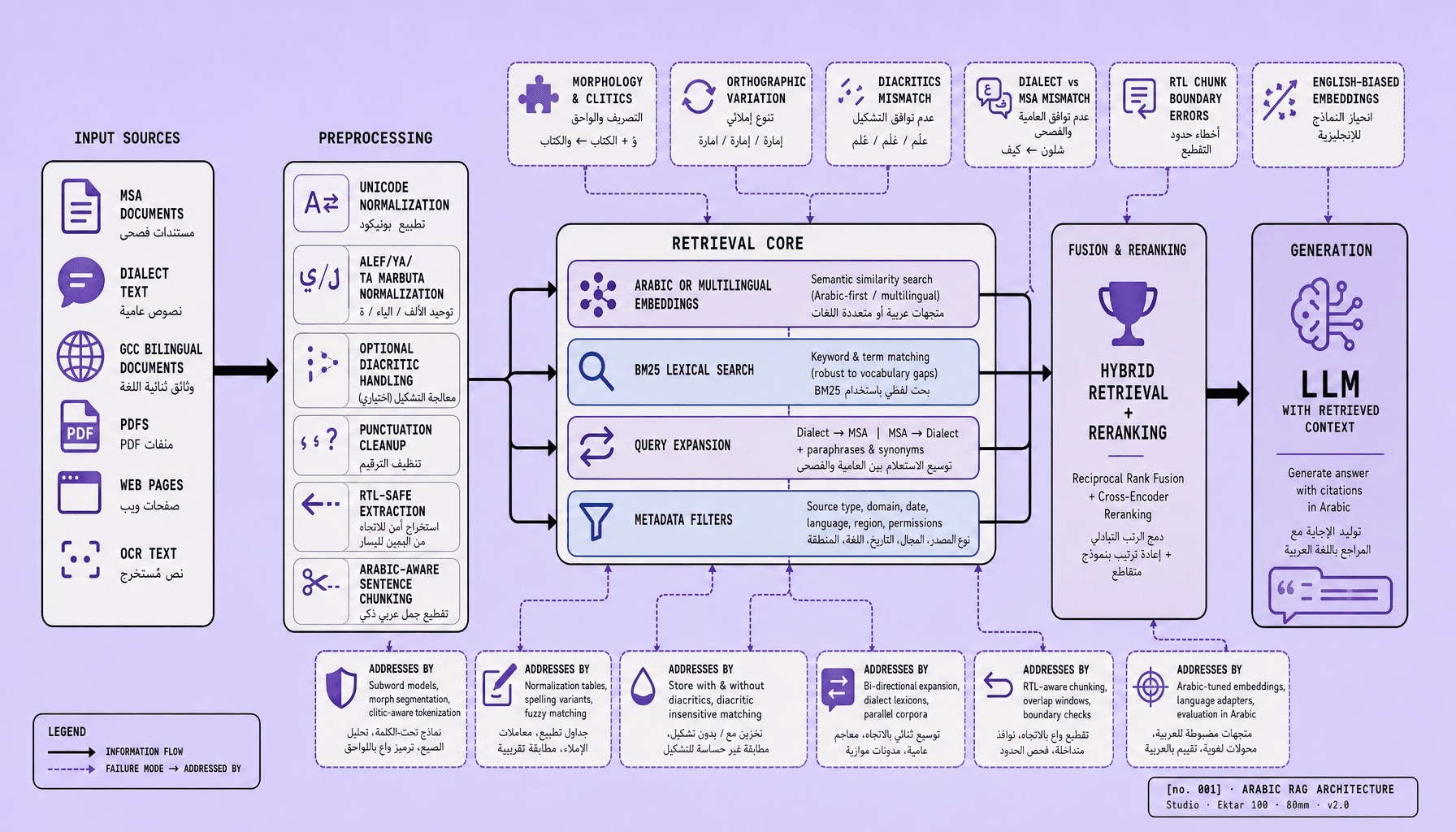
If your Arabic RAG system keeps missing passages that are plainly in the corpus, the problem is usually not the generator. It is retrieval. Swapping in a stronger embedding model helps less than many teams expect, because Arabic retrieval augmented generation tends to fail earlier in the pipeline. In practice, RAG for Arabic succeeds when normalization, morphology-aware indexing, multilingual or Arabic embeddings, hybrid retrieval, dialect handling, RTL-safe chunking, and Arabic evaluation are built together.12
Arabic RAG Key Takeaways
-
Arabic RAG breaks where English pipelines look fine: morphology, clitics, diacritics, hamza/alef variants, dialect spelling, and RTL extraction all reduce recall before generation even starts.134 Naive chunking and OCR text order can poison Arabic information retrieval.
-
Strong RAG for Arabic usually combines Arabic-aware normalization, multilingual or Arabic embedding models, and hybrid retrieval -- dense + BM25 or sparse lexical signals -- then adds reranking on top.152 Single-method stacks miss too many obvious matches.
-
Dialect and MSA must be handled together. Query expansion, alternate spellings, and mixed-script support improve retrieval on real GCC-style corpora that blend Arabic and English terms.16
-
Evaluate Arabic retrieval augmented generation with Arabic golden sets, dialect queries, and mixed Arabic-English prompts using Recall@k, nDCG@k, MRR, and answer faithfulness.2 We see this as an evaluation design issue too -- cleaner evaluation design improves long-term system productivity.
Why Arabic RAG Fails in Practice: Morphology, Orthography, Dialect, and RTL Breakpoints
Most Arabic RAG failures start before generation. Retrieval misses the right evidence, so the model answers from weak context or hallucinates around partial matches. Teams often blame the vector store first. In practice, recall usually improves more from Arabic-aware normalization and indexing multiple text views than from swapping infrastructure.12
That pattern shows up across several layers, and each one can quietly cut recall before anyone notices.
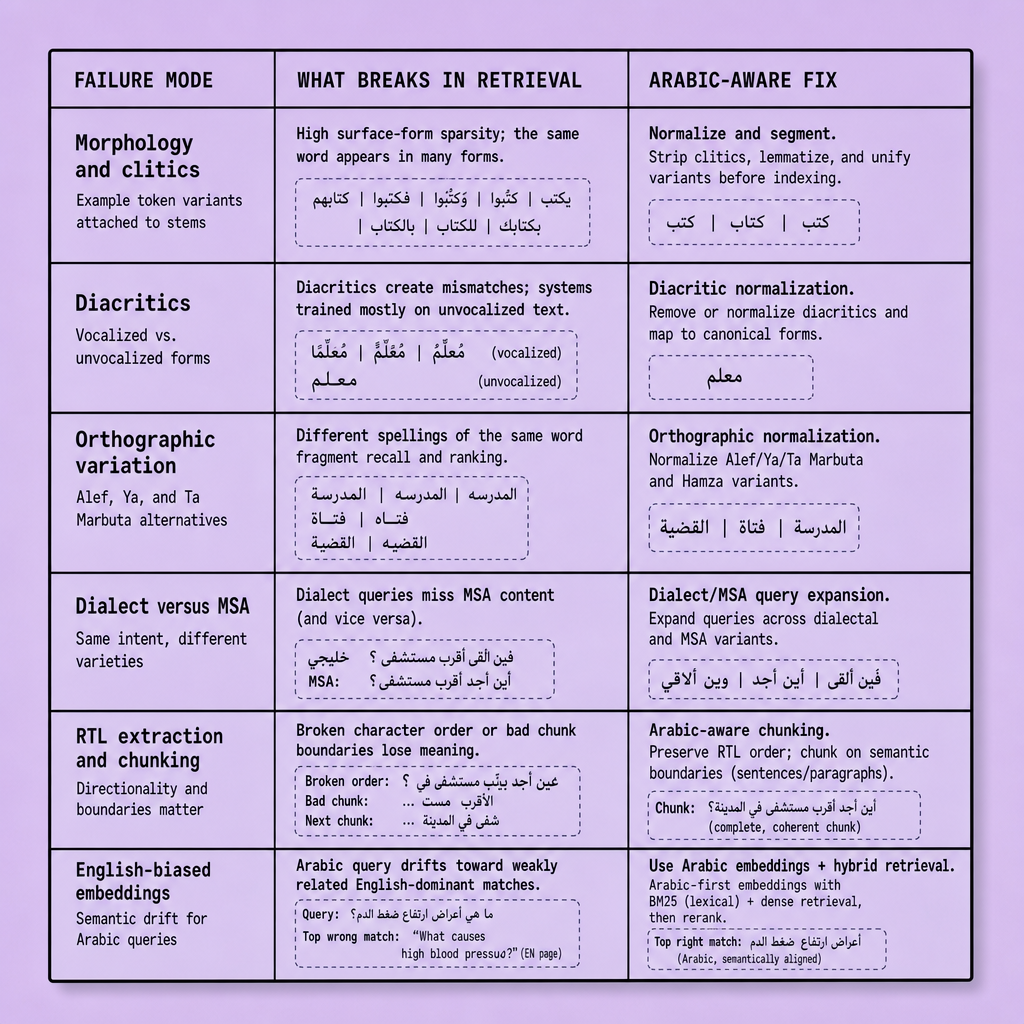
Morphology and clitics break English-style tokenization
Arabic packs grammar into the token itself. A form like وبكتابهم contains conjunction, preposition, noun, and possessive suffix in one surface string. English-first tokenization often leaves it intact as one opaque token, which hurts both BM25-style lexical matching and dense retrieval. Related forms such as يكتبون, كتبت, and مكتوب drift apart unless the pipeline supports stemming, lemmatization, or morphology-aware segmentation.14
This is where naive Arabic information retrieval starts losing Recall@k. If the query uses one inflected form while the document stores another, lexical retrieval misses it. If embeddings were trained with weak Arabic coverage, semantic retrieval can miss it too, because the encoder may not represent those morphology-heavy neighborhoods well enough.12
Orthography fragments obvious matches
Arabic text rarely arrives in one canonical form. Corpora mix diacritized and plain text, أ/إ/آ versus ا, ى versus ي, inconsistent ة/ه, tatweel, Arabic-Indic and Western digits, and OCR noise from PDFs and scans.32 Semantically identical strings then become retrieval-distinct strings.
For RAG for Arabic, Unicode normalization is not a cleanup nicety -- it is a recall feature.
A practical baseline is to index at least raw and normalized views: remove tatweel, unify alef/hamza variants, normalize ى/ي, standardize digits and punctuation, and preserve the original text for display and grounding.15
Dialect, OCR, and RTL extraction create hidden breakpoints
Dialectal Arabic adds another failure layer. Users ask in Gulf, Egyptian, or Levantine forms; documents are often in MSA. The meaning matches, but the wording does not. Without dialect-to-MSA query expansion or multilingual reranking, Arabic retrieval augmented generation can underperform on realistic queries.164
Then document handling makes things worse. OCR errors, broken ligatures, and RTL extraction bugs can reverse chunk order, split tables incorrectly, or interleave Arabic with English headers and numbers. Even relevant chunks may arrive structurally corrupted before retrieval.32 That makes this a pipeline design problem, not a model-only problem: use explicit normalization, Arabic-aware chunking, and retrieval checks at each stage.
Build the Retrieval Core for Arabic RAG: Normalization, Embeddings, and Hybrid Search
Once obvious matches are being missed, it is time to fix retrieval before touching the generator again. Bigger LLMs will not rescue weak recall, and Arabic errors usually start in indexing and matching, not generation.12
Start with normalization. For Arabic RAG, use Unicode normalization, tatweel removal, controlled diacritic handling, and orthographic standardization for alef and hamza variants such as أ/إ/آ → ا.13 Apply explicit policies for ة and ى too, but do not flatten them blindly in the only indexed copy. Strong Arabic retrieval systems usually keep at least three views: raw text for faithful generation, normalized text for robust matching, and an optional stemmed or light-stemmed view for recall under heavy inflection and clitic attachment.124 Character n-grams can also help on the lexical side when OCR noise, dialect spelling drift, or mixed-script content are common.
Do not make destructive normalization your sole source of truth; keep raw text alongside normalized indexes.
After normalization, the encoder choice starts to matter more. English-biased embedding models often underperform on Arabic because their Arabic coverage, dialect exposure, or tokenization choices are weaker.156 Arabic or multilingual embeddings usually retrieve semantically related passages more reliably, especially for MSA-dialect variation and code-switched corpora.16 Treat this as a retrieval design issue, not a vector database issue.
| Approach | Best fit | Main risk | Operational note |
|---|---|---|---|
| BM25 + character n-grams | exact terms, entities, noisy OCR | misses semantic paraphrases | needs normalized field tuning |
| Dense retrieval | paraphrase-heavy Arabic semantic search | weak on rare terms and orthographic drift | choose Arabic/multilingual embeddings |
| Hybrid retrieval | enterprise Arabic RAG | more tuning complexity | fuse BM25 and dense with RRF or weighted scores |
The tradeoff is straightforward. Dense-only systems miss exact legal, financial, and product strings. BM25-only systems miss paraphrase and dialect reformulation. Hybrid retrieval is the safer default. Arabic RAG studies and Arabic lexical IR evaluations report better retrieval quality from hybrid setups than from single-mode retrieval on metrics such as Recall@k, MRR, and nDCG@k.12 Use reciprocal rank fusion when score scales differ across retrievers or vendors. Use weighted score fusion when scores are calibrated and you have a stable benchmark set. A practical starting point is BM25 over raw and normalized fields, plus dense retrieval with Arabic embeddings, fused with reciprocal rank fusion before later weight tuning on Arabic relevance judgments.12
Handle Dialect and Document Structure in Arabic RAG: Query Expansion, Arabic-Aware Chunking, and Reranking
Even a solid retrieval core will struggle if the query and the corpus speak slightly different versions of Arabic. In Arabic RAG, recall often drops when the query is dialectal, transliterated, or code-switched while the corpus is mostly MSA or mixed Arabic-English enterprise text.154
That is where retrieval needs help at the query and chunk level, not just the index level.
Recover recall with controlled query expansion
Start query expansion from a curated lexicon and query logs, not free-form LLM generation. Short Arabic queries are fragile, and aggressive expansion can flood search with false positives. Map dialect terms to MSA and back—for example, شنو / ايش to ما, or أبغى to أريد—then add common English aliases such as leave balance, residency, or VAT when the corpus mixes both languages. For code-switching or Arabizi, normalize likely forms before retrieval, then issue parallel lexical and embedding queries.34
Chunk by Arabic structure, not character count
Poor chunk boundaries hurt retrieval and grounding. Splitters that ignore RTL extraction order, headings, tables, and lists can separate a clause from its qualifier or scramble bilingual rows. Preserve paragraphs and sentences, keep bullet lists intact, detect section headers during parsing, and apply modest chunk overlap only at semantic boundaries.12 This is mainly a retrieval quality issue: chunking rules should stay explicit and maintainable so they can be tuned as document formats change.
Rerank for Arabic relevance
Initial retrieval should be broad; reranking should be strict. Use a cross-encoder reranker or strong multilingual reranker on the top-k candidates to repair ranking errors caused by morphology, mixed terminology, and loose chunk matches.12 The tradeoff is latency, so reranking usually makes the most sense on the final candidate set rather than across the full index.12
Evaluate Arabic RAG with Golden Sets, Dialect Queries, and Mixed English-Arabic Corpora
This is where many teams get a false sense of progress. Answer quality can look acceptable while retrieval is quietly failing on dialect, orthographic variants, or mixed-script enterprise text -- and no prompt rewrite will fix low Recall@k.12 If you care about real-world quality, evaluate retrieval and generation separately. Always.
Build a golden set at the chunk level, not only the document level. For each query, store judged relevant chunks with graded labels such as exact answer-bearing, partially supporting, and non-relevant. Include parallel query variants: MSA, dialectal phrasing, spelling variants without diacritics, and GCC code-switched forms like Arabic policy questions containing English product names, acronyms, or system labels. That matches how Arabic information retrieval breaks in practice, especially across morphology, dialect, and cross-lingual retrieval settings.7248
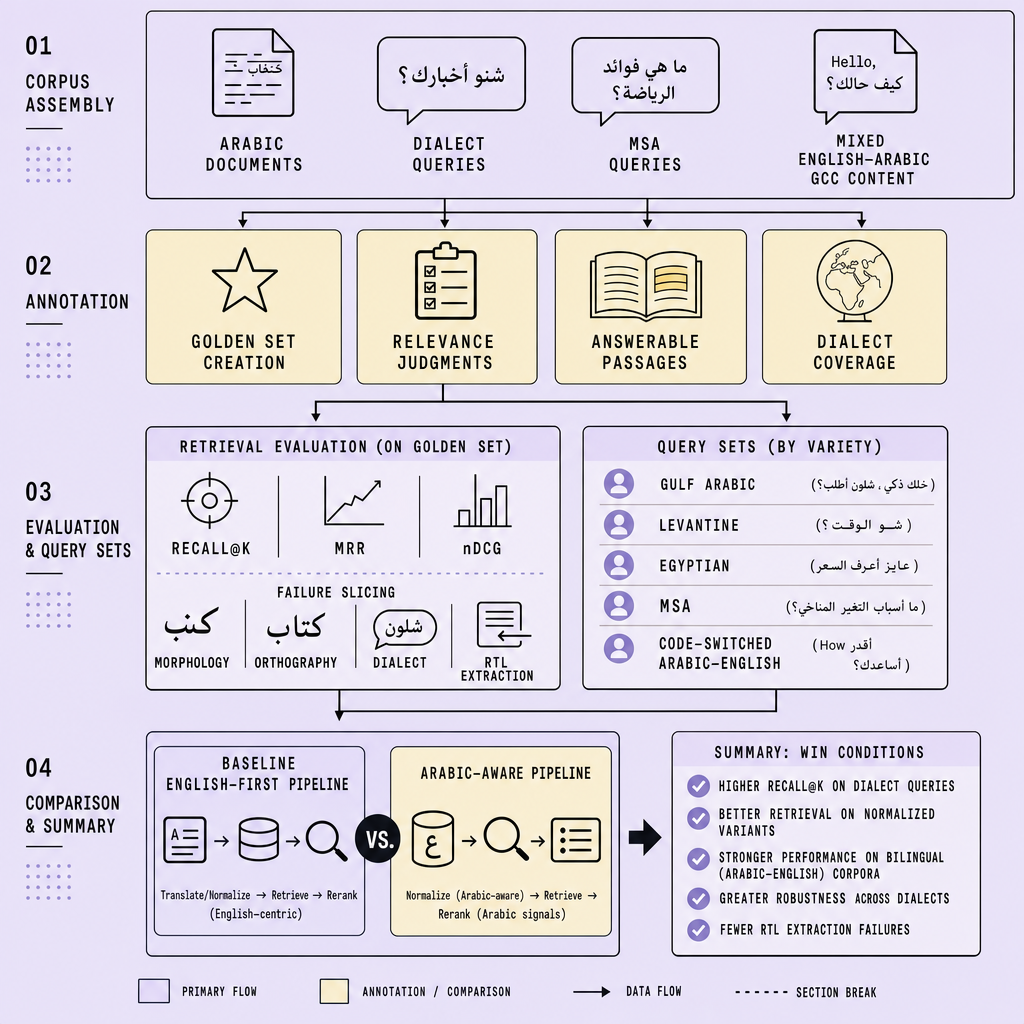
Use retrieval metrics first: Recall@k, nDCG@k, MRR, and context precision. Then score answer quality separately with groundedness, citation accuracy, and hallucination rate against the labeled chunks.12 One recommendation from our side at Imversion Technologies Pvt Ltd: keep evaluator prompts constant during retrieval experiments. Cleaner evaluation design improves long-term productivity, but here it also protects the measurement itself -- otherwise ablations become noise.
Run Arabic-focused ablations
Test one variable at a time:
- normalization on/off
- Arabic vs multilingual embeddings
- dense vs hybrid BM25+dense
- fixed-length vs Arabic-aware chunking
- reranker on/off
- dialect-to-MSA query expansion on/off
Because Arabic retrieval augmented generation is pipeline-sensitive, isolated ablation study design is the only reliable way to see which layer actually improves RAG for Arabic in mixed English-Arabic corpora.156
References
- Optimizing RAG Pipelines for Arabic: A Systematic Analysis of ... - arXiv
- A Comprehensive Review of Arabic NLP — From Calligraphy to ...
- A Guide to Retrieval-Augmented Generation (RAG) for Arabic ...
- Arabic NLP Series | Episode 19: Arabic Information Retrieval
- [PDF] Evaluating RAG Pipelines for Arabic Lexical Information Retrieval
- Towards a Fully Arabic Retrieval-Augmented Generation ...
- [PDF] Morphological Analysis and Generation for Arabic Dialects
- What this actually tests: Cross-lingual retrieval failure diagnosis, and ...
Footnotes
-
Optimizing RAG Pipelines for Arabic: A Systematic Analysis of ... - arXiv ↩ ↩2 ↩3 ↩4 ↩5 ↩6 ↩7 ↩8 ↩9 ↩10 ↩11 ↩12 ↩13 ↩14 ↩15 ↩16 ↩17 ↩18 ↩19 ↩20 ↩21 ↩22 ↩23
-
[PDF] Evaluating RAG Pipelines for Arabic Lexical Information Retrieval ↩ ↩2 ↩3 ↩4 ↩5 ↩6 ↩7 ↩8 ↩9 ↩10 ↩11 ↩12 ↩13 ↩14 ↩15 ↩16 ↩17
-
A Comprehensive Review of Arabic NLP — From Calligraphy to ... ↩ ↩2 ↩3 ↩4 ↩5
-
[PDF] Morphological Analysis and Generation for Arabic Dialects ↩ ↩2 ↩3 ↩4 ↩5 ↩6 ↩7
-
A Guide to Retrieval-Augmented Generation (RAG) for Arabic ... ↩ ↩2 ↩3 ↩4 ↩5
-
Towards a Fully Arabic Retrieval-Augmented Generation ... ↩ ↩2 ↩3 ↩4 ↩5
-
Arabic NLP Series | Episode 19: Arabic Information Retrieval ↩
-
What this actually tests: Cross-lingual retrieval failure diagnosis, and ... ↩
Frequently Asked Questions
What makes Arabic RAG harder than English RAG even when the documents are high quality?
Arabic RAG is harder because retrieval quality depends on morphology, attached clitics, orthographic variation, dialect drift, and RTL extraction fidelity at the same time. A clean corpus is not enough if indexing, chunking, and query processing fail to collapse equivalent forms or preserve Arabic document structure during retrieval.[^1][^5]
How should I evaluate Arabic RAG on a bilingual GCC knowledge base?
Use a chunk-level golden set with MSA, dialectal, and Arabic-English code-switched queries, then report Recall@k, MRR, and nDCG before looking at answer quality. This setup reveals whether failures come from retrieval mismatch, mixed terminology, or generation, which is especially important for GCC corpora containing product names, acronyms, and policy text in both languages.[^5]
Why should Arabic RAG teams keep more than one indexed text view?
Keeping raw, normalized, and optional light-stemmed views lets the system optimize for both recall and fidelity. The normalized view collapses spelling noise, the lexical or stemmed view catches inflectional variation, and the raw view preserves exact wording for grounded answers, audits, and citation display. A single destructive index usually forces a tradeoff you do not need to accept.
Does query expansion always improve Arabic RAG?
No. Query expansion improves Arabic RAG only when it is controlled and domain-aware. Curated dialect-to-MSA mappings, English aliases, and observed search logs usually help, but unconstrained expansion can dilute precision by injecting semantically adjacent yet irrelevant terms. In production, expansion should be evaluated as a retriever change, not assumed to be universally beneficial.
When should I choose reranking over adding a larger embedding model?
Choose reranking when first-stage retrieval already surfaces relevant chunks but orders them poorly. A cross-encoder reranker can repair ranking errors caused by morphology, code-switching, and weak local context without rebuilding the full index. If relevant chunks never enter the candidate set, however, reranking will not help; recall fixes must come first.[^1][^5]
Make Imversion a preferred source on Google
Like this kind of AI and software analysis? Add Imversion as a preferred source so Google can highlight our articles for you in Search, AI Overviews, and AI Mode.