AI Project Pricing Models: Comparing Engagement Strategies for 2026
Delve into AI project pricing models, comparing fixed-price, hourly, and pods to optimize cost and speed in AI engineering work.

How AI project pricing models compare for AI engineering work
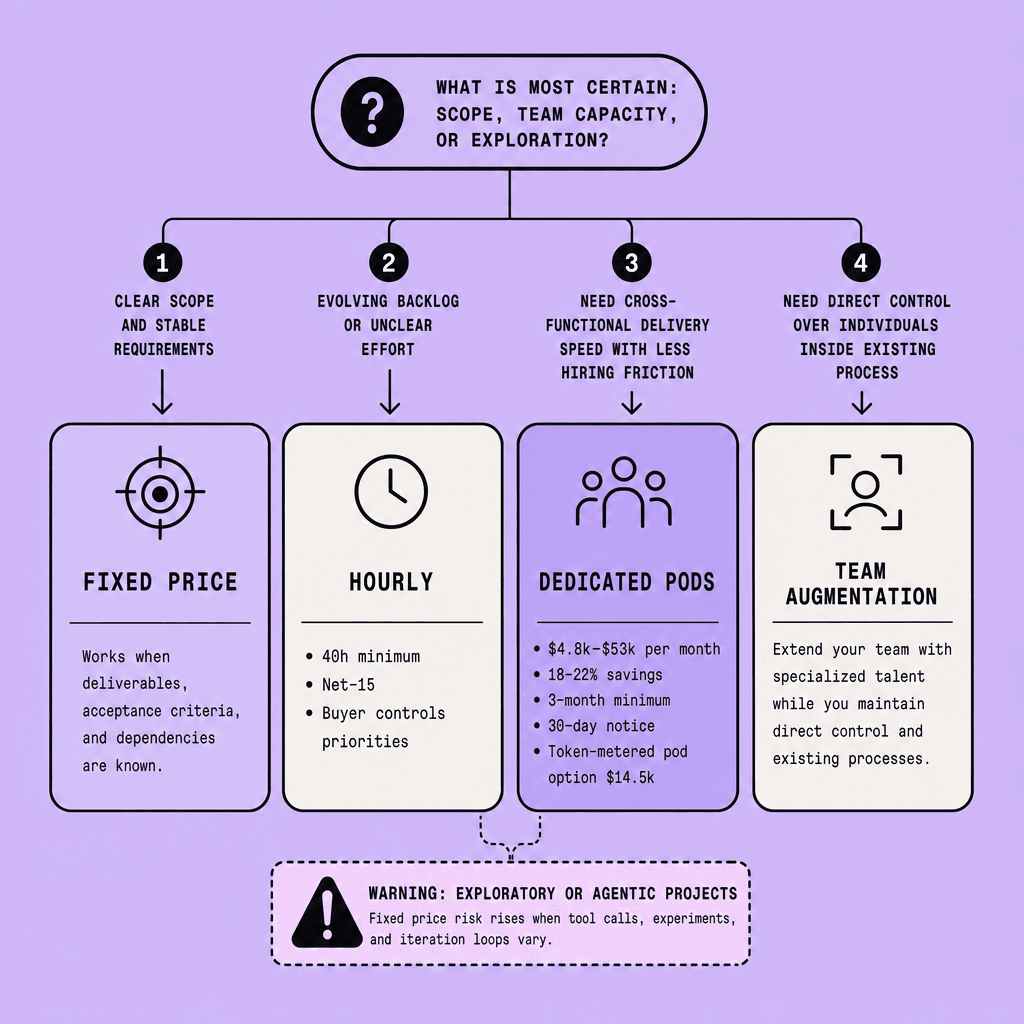
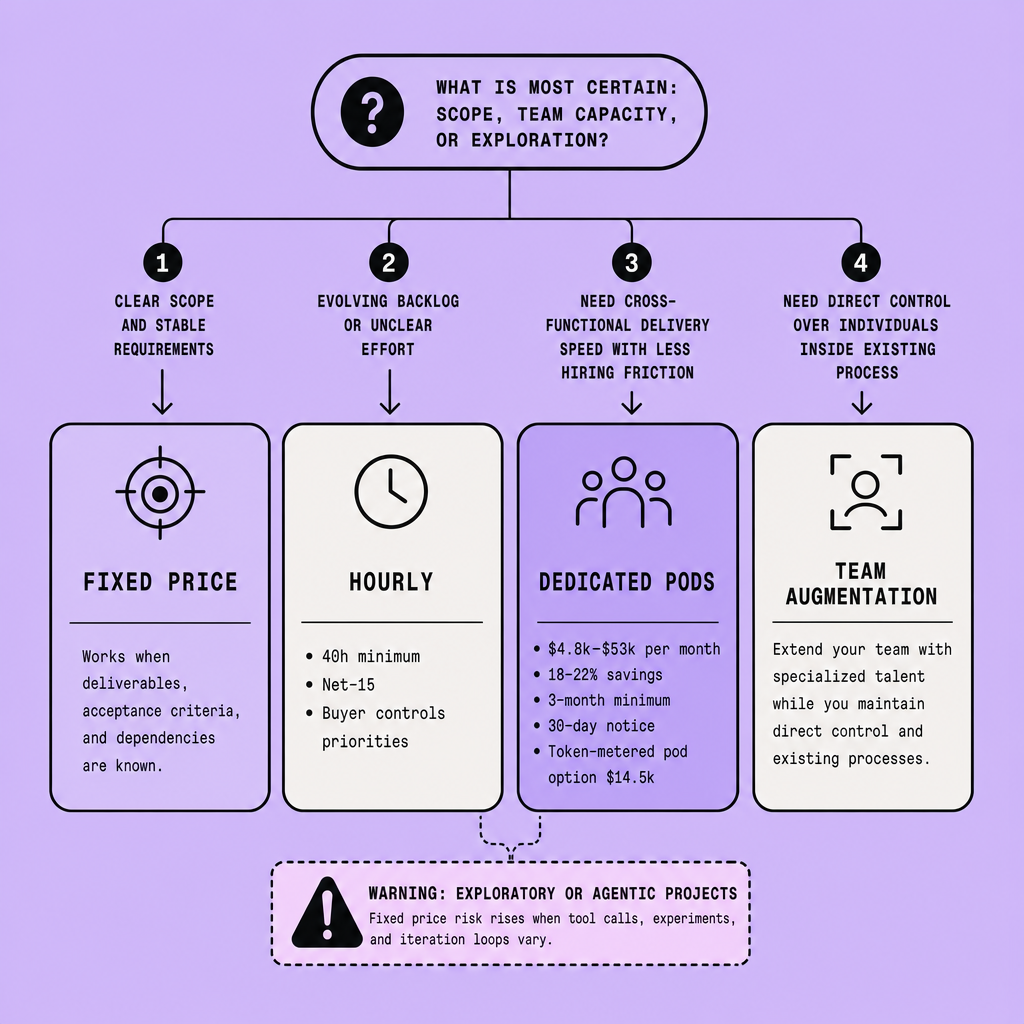
Choosing among AI project pricing models usually goes wrong for one reason: teams anchor on headline cost and ignore where uncertainty will show up later. The tradeoff is simple: fixed price fits stable scope, hourly fits changing scope, dedicated pods balance predictability with speed, and team augmentation gives maximum control with higher client overhead.12 In practice, the best AI engineering engagement models follow scope certainty -- not just budget preference.
Fixed price vs hourly AI development is really a risk-allocation decision. Fixed deals work when acceptance criteria are tight -- often with 30/40/30 billing -- but they break down fast for agentic AI, where eval loops, RAG quality, orchestration, retries, guardrails, latency, and token usage can all shift after the first prototype.2345 Hourly usually runs with a 40-hour minimum and Net-15 terms; it buys flexibility, but spend moves with discovery. Dedicated pods sit in the middle: roughly $4.8k-$53k/month, often showing 18-22% savings, with 3-month minimums, 30-day notice, and some token-metered pod options around $14.5k.16 AI staff augmentation vs dedicated team comes down to ownership -- and at Imversion Technologies Pvt Ltd, the better choice is usually the one with the clearest operating model, because clarity beats complexity.
Key Takeaways for Choosing AI project pricing models
-
Pick AI project pricing models by scope certainty first, not by sticker price. Fixed price gives the most budget control -- often with 30/40/30 billing -- but it works only when requirements, dependencies, and acceptance criteria are stable.12
-
Agentic AI pricing rarely fits fixed scope well. RAG quality, eval loops, orchestration, retries, guardrails, latency, and token variability create estimation error fast, so fixed bids either get padded or break under change.3745
-
Fixed price vs hourly AI development is simple: use fixed price for narrow builds like a defined API, bounded chatbot, or migration with clear outputs; use hourly when discovery is still active, with terms like 40-hour minimums and Net-15 improving flexibility.2
-
Between dedicated pods for AI engineering and AI staff augmentation vs dedicated team, pods fit teams that want lower management overhead, predictable monthly pricing, and 18-22% savings at roughly $4.8k-$53k/month, often with a 3-month minimum and 30-day notice; augmentation fits teams that want direct control of roadmap and delivery.16
-
For token-heavy workloads, a $14.5k token-metered pod can align cost to actual usage -- but only if the team understands why usage spikes, not just that it does.16
Fixed price, hourly, pods, and augmentation: the six-factor comparison buyers actually need
Most buyers start by comparing rates. That is the wrong starting point. In AI work, delivery friction, scope certainty, and estimation error usually matter more than the nominal day rate.12
A better lens is simple: every one of these AI engineering engagement models shifts risk between vendor and client. Compare each model across six factors -- scope certainty, flexibility, cost control, speed, management overhead, and estimation risk. Because fixed price vs hourly AI development is not just a pricing question. It is an ownership question.
Fixed price means a defined statement of work, fixed deliverables, and milestone billing -- often 30/40/30.12 Hourly means time-and-materials, usually with a 40-hour minimum and Net-15 terms.23 Dedicated pods are managed delivery teams on a monthly retainer, commonly priced from $4.8k to $53k per month, with some providers positioning them as 18% to 22% cheaper than equivalent pieced-together staffing; many require a 3-month minimum and 30-day notice. Some AI pods are token-metered -- for example, a $14.5k pod tied to usage and delivery capacity. Team augmentation means embedded staff augmentation inside the client’s workflow, tools, and management structure.16
| Model | Best fit | Main risk holder | Overhead | Flexibility |
|---|---|---|---|---|
| Fixed price | Stable scope, clear acceptance criteria | Vendor first, then both through change requests | Low for client | Low |
| Hourly | Evolving RAG, eval loops, prompt iteration | Client | Medium | High |
| Dedicated pods | Ongoing AI delivery with managed handoff | Shared | Low-medium | Medium-high |
| Team augmentation | Client-led roadmap needing direct control | Client | High | High |
Here is the practical rule. Fixed price works when requirements are narrow, dependencies are known, and success can be tested cleanly -- say a bounded chatbot integration, a single RAG workflow, or a documented API layer.26 Agentic systems do not stay inside that box for long. They add orchestration, retries, guardrails, latency tuning, tool failure paths, and token variability, so estimation risk compounds fast.3745
So the comparison buyers actually need is not fixed price vs hourly AI development in isolation. It is fixed price vs hourly AI development vs pod retainer vs AI staff augmentation vs dedicated team -- mapped to how much uncertainty the project can absorb. Start with the source of uncertainty. Then choose the model.
Fixed price vs hourly AI development: certainty, change tolerance, and billing mechanics
Most AI pricing decisions become easier once you stop treating them as procurement categories and start treating them as delivery constraints. For most AI projects, the choice is straightforward: use fixed price when scope, dependencies, and acceptance criteria are stable; use hourly when discovery, data quality, or solution design may change during delivery.
Fixed price: strong budget certainty, weak change tolerance
Fixed-price contracts work best when deliverables, dependencies, and acceptance criteria are already clear. Think bounded work: a RAG proof of concept with defined data sources, a narrow internal copilot, or an API integration with known inputs and outputs. Commercially, a common structure is 30/40/30 billing -- 30% upfront, 40% at a milestone, 30% on delivery.12
The main benefit is cost certainty with lower administrative overhead. The vendor owns delivery planning. The tradeoff shows up once the build starts: major changes usually become scope change requests, which can slow progress because legal, commercial, and technical assumptions must be revisited.12
Estimation risk also sits more heavily with the vendor. So vendors respond in predictable ways: they price in uncertainty, narrow assumptions, or tighten acceptance criteria. That is why fixed price can look simpler on paper but become more rigid in practice.
This is also where fixed price becomes a weaker fit for agentic AI pricing. Agentic systems add variables that are hard to define early -- orchestration, retries, eval loops, guardrails, latency tradeoffs, token variability, and tool-use behavior. Small requirement changes can expand delivery effort, which is one reason AI-heavy time-and-materials engagements often adapt better than fixed-scope contracts.3745
Hourly: flexible delivery, less budget certainty
When the unknowns are real, hourly or time and materials usually holds up better. A common commercial setup is a 40-hour minimum with Net-15 payment terms.23 This model fits projects with evolving requirements, unclear data quality, or iterative experimentation around prompts, retrieval quality, and model behavior.
Hourly is not automatically more expensive. Because it avoids repeated re-scoping, it can be the cheaper option while discovery is still underway. It also usually handles change faster, since the team can adjust backlog and priorities without renegotiating the full contract.23
For buyers comparing AI project pricing models or AI staff augmentation vs dedicated team, the rule is simple: choose fixed price for stable scope and measurable acceptance criteria; choose hourly when the problem definition or solution shape is still evolving.
Dedicated pods for AI engineering vs staff augmentation: where speed and control really come from
Teams often say they want speed and control at the same time. In practice, they usually have to choose which one matters more operationally. If the buyer wants fast output without building a management layer around external hires, pods usually beat augmentation. If the buyer already has strong internal product ownership, sprint management, and technical leadership, team augmentation gives more control.
That is the practical split in the AI staff augmentation vs dedicated team decision.
Dedicated pods for AI engineering sit in the middle between fixed outsourcing and pure staff extension. The buyer is not just renting hours. The buyer is getting a coordinated unit with shared delivery ownership -- often spanning backend, ML, QA, and project coordination -- under one monthly structure. In the commercial model described here, pods run from $4.8k to $53k per month, typically with 18% to 22% savings versus equivalent individual staffing, a 3-month minimum, and 30-day notice.16 There is also a $14.5k token-metered pod option, which can fit AI systems where usage variability matters as much as engineering throughput.16
But pods trade some day-to-day control for operational efficiency.
With team augmentation, the client gets maximum control. They choose priorities, assign tasks, run ceremonies, review output, manage dependencies, and own delivery cadence.16 That works well when an internal lead already knows how to sequence RAG work, eval loops, orchestration changes, retries, guardrails, and latency tuning. Because understanding why a system is failing -- bad retrieval, weak prompts, tool errors, flaky evals -- is what drives useful prioritization.
Use a dedicated pod when the bottleneck is coordinated execution. Use augmentation when the bottleneck is internal capacity inside an already well-run system.
This is where AI engineering engagement models start to separate more clearly from fixed price vs hourly AI development. Augmentation can look cheaper on paper. But if the client has to supply product management, technical direction, QA discipline, and cross-functional coordination, the hidden cost shows up in slower decisions and uneven throughput.6 Pods usually win when the work needs a managed team to ship continuously. Augmentation wins when the client wants hands on the keyboard -- and is ready to manage them.
Why agentic AI pricing breaks fixed-price assumptions in AI project pricing models
Fixed price starts to crack the moment an AI system must decide, retry, call tools, and recover from bad context on its own. That is the core problem with agentic AI pricing.
A standard app flow is easier to bound. Agentic AI is not. One user request can trigger RAG retrieval, tool calling, an orchestration step, a memory lookup, a guardrails check, and then an evaluation loop if the result fails quality thresholds. Or two loops. Or six. Those paths are nonlinear, and the cost is not just engineering hours -- it is token variability, latency tuning, debugging, and repeated prompt iteration under real traffic.745
Prototype demos hide this badly.
A prototype may succeed with one happy-path prompt and a clean dataset. Production behavior is different: retrieval quality shifts, tools time out, prompts drift, acceptance criteria tighten, and teams discover they need observability, fallback logic, and stricter guardrails before launch.74 Because understanding why the agent failed is essential, evaluation work expands fast -- especially in RAG-heavy systems where a weak chunking or ranking decision can ripple through every answer.
That is why fixed price vs hourly AI development becomes a real risk question, not just a billing preference. In broader AI project pricing models and AI engineering engagement models, fixed scope works best only when the agent has narrow tasks, limited tool paths, stable data, and clear acceptance tests.23 If those conditions are missing, hourly, a token-aware pod, or AI staff augmentation vs dedicated team is easier to manage than pretending the estimate is reliable.
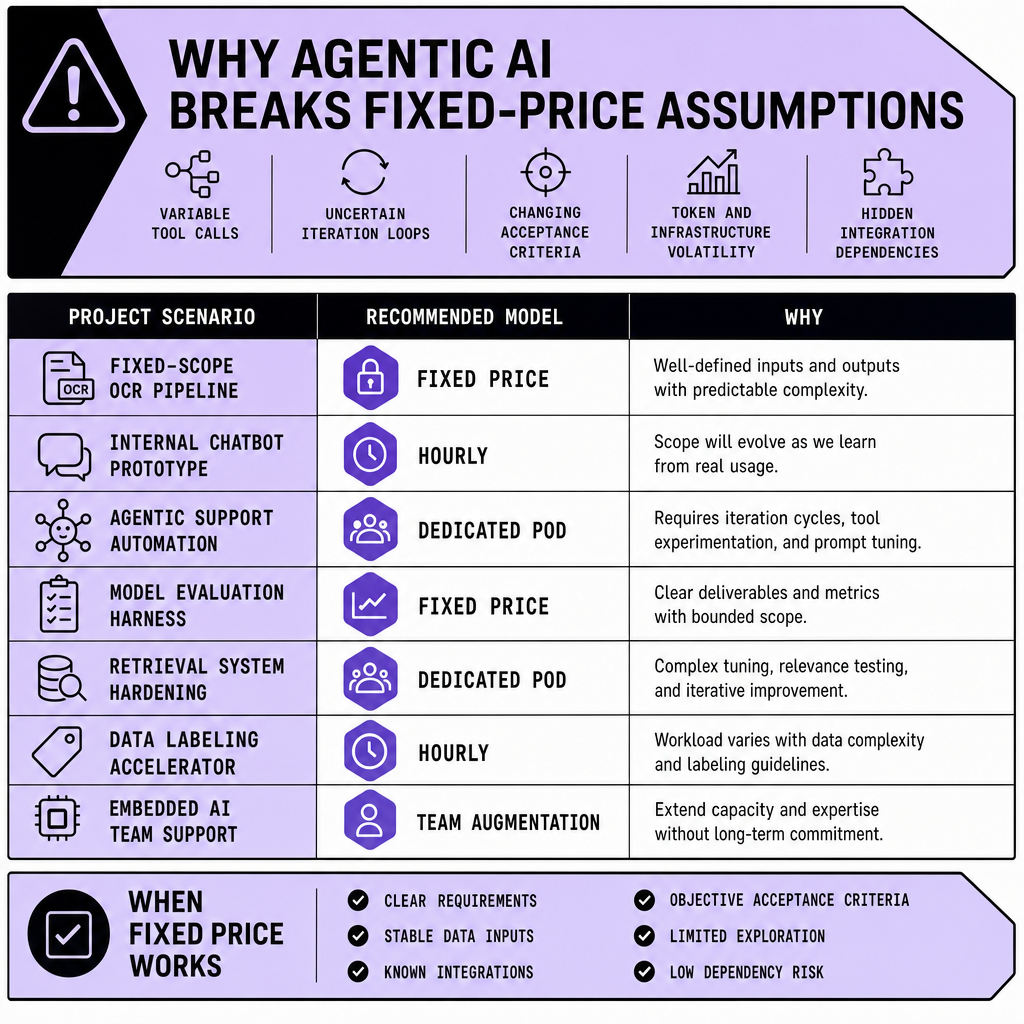
When fixed price works, plus a project-to-model table for common AI engineering scenarios in AI project pricing models
Fixed price can work well. It just needs real discovery first, not uncertainty hidden inside a contract. In AI project pricing models, that usually means clear requirements, known dependencies, stable acceptance criteria, low experimental uncertainty, and bounded deliverables.12 A scoped RAG assistant with fixed data sources, defined evaluation targets, and a clear handoff can fit a 30/40/30 structure.12 A multi-step agent workflow with retries, tool calls, guardrails, latency tuning, and token variability usually cannot, because behavior and cost often change during implementation.745
The grounded recommendation is simple: use fixed price for delivery clarity, not for research disguised as delivery. If the team still needs to validate data quality, prompt strategy, orchestration patterns, or success thresholds, hourly or pod-based delivery is usually safer. The tradeoff is straightforward: fixed price improves budget predictability, but it reduces change tolerance and can push scope debates into change requests when assumptions move.12
| Project | Best-fit model | Why |
|---|---|---|
| proof of concept | Hourly | Fast discovery; changing assumptions |
| RAG assistant | Fixed price or pod | Fixed if corpus, evals, integration points, and handoff are bounded |
| agent workflow | Dedicated pod | Orchestration and reliability evolve during build74 |
| data pipeline / MLOps | Pod or augmentation | Ongoing ops, ownership, and integration needs |
| fine-tuning support | Hourly or augmentation | Iterative data and eval loop |
Borderline case: fixed price vs hourly AI development for a RAG build depends on whether retrieval quality, human handoff, and acceptance tests are already defined. If ongoing optimization is expected, AI staff augmentation vs dedicated team usually beats fixed scope.16
References
- Staff Augmentation vs Dedicated Team vs Fixed Price
- AI Project Pricing: Fixed vs Hourly
- Fixed-Price vs. Hourly Software Development: Why AI Just ...
- The Hidden Cost of Agentic AI: Why Most Projects Still Die ...
- Staff Augmentation vs Managed Team vs Fixed Scope
- Agentic AI costs more than you budgeted. Here's why.
- The Bill Arrives: How to Manage Agentic AI Costs at Scale
- AI Agents vs. Agentic AI: A PM's Guide to the Distinction That ...
Footnotes
-
Staff Augmentation vs Dedicated Team vs Fixed Price ↩ ↩2 ↩3 ↩4 ↩5 ↩6 ↩7 ↩8 ↩9 ↩10 ↩11 ↩12 ↩13 ↩14 ↩15 ↩16 ↩17
-
AI Project Pricing: Fixed vs Hourly ↩ ↩2 ↩3 ↩4 ↩5 ↩6 ↩7 ↩8 ↩9 ↩10 ↩11 ↩12 ↩13 ↩14 ↩15 ↩16
-
Fixed-Price vs. Hourly Software Development: Why AI Just ... ↩ ↩2 ↩3 ↩4 ↩5 ↩6 ↩7 ↩8
-
Agentic AI costs more than you budgeted. Here's why. ↩ ↩2 ↩3 ↩4 ↩5 ↩6 ↩7 ↩8
-
The Bill Arrives: How to Manage Agentic AI Costs at Scale ↩ ↩2 ↩3 ↩4 ↩5 ↩6
-
Staff Augmentation vs Managed Team vs Fixed Scope ↩ ↩2 ↩3 ↩4 ↩5 ↩6 ↩7 ↩8 ↩9 ↩10
-
The Hidden Cost of Agentic AI: Why Most Projects Still Die ... ↩ ↩2 ↩3 ↩4 ↩5 ↩6 ↩7
Frequently Asked Questions
What is the safest way to choose among AI project pricing models when requirements are only partly known?
The safest approach is to separate discovery from delivery. Start with a short hourly or pod-based phase to validate data quality, dependencies, evaluation criteria, and operational constraints, then convert only the stable portion into fixed scope. This reduces rework, avoids padded bids, and makes later fixed pricing more credible.
How do AI project pricing models affect procurement and finance approval?
AI project pricing models affect approval speed because each model creates a different spending pattern and documentation burden. Fixed price is usually easiest for budget sign-off because total cost and milestones are explicit, while hourly and pods are often easier to start operationally because they require less detailed scope definition up front.[^2][^5]
Why should agentic AI budgets include observability and evaluation from day one?
Agentic AI budgets should include observability and evaluation from the start because production failures are often caused by retrieval errors, tool instability, latency spikes, or weak guardrails rather than model quality alone. Without monitoring and eval coverage, teams cannot explain cost growth or improve reliability in a controlled way.[^4][^6][^7]
What is the difference between a token-metered pod and a normal monthly pod?
A token-metered pod ties part of the commercial model to actual AI usage, so it is better suited to workloads where inference volume changes materially over time. A standard monthly pod is better when the main constraint is engineering throughput rather than usage volatility. In the pricing described here, token-metered pod options can be around $14.5k.[^1][^5]
How should buyers compare AI project pricing models beyond headline rate cards?
Buyers should compare AI project pricing models by total operating cost, not just quoted rate. The real comparison should include management time, change-request friction, handoff quality, vendor assumptions, testing responsibility, and the cost of delays if the chosen model cannot absorb uncertainty. The cheapest rate can still produce the most expensive delivery path.
Make Imversion a preferred source on Google
Like this kind of AI and software analysis? Add Imversion as a preferred source so Google can highlight our articles for you in Search, AI Overviews, and AI Mode.