Human Oversight Patterns: Effective Controls for 2026
Explore human oversight patterns that protect outcomes without sacrificing automation. Focus on high-impact decisions to reclaim team efficiency.

Human Oversight Patterns That Protect Outcomes Without Killing Automation
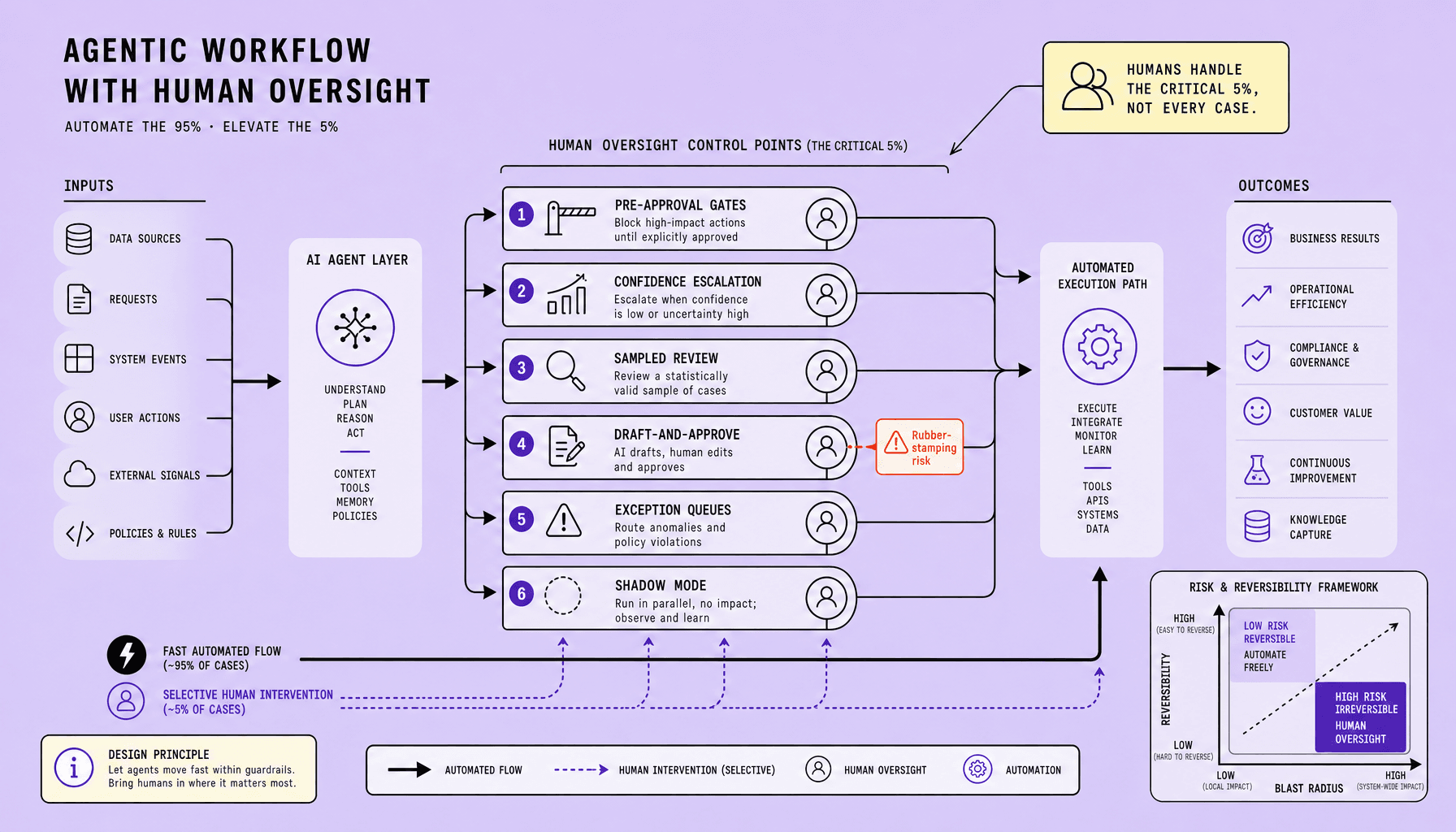
Most teams hit the same wall with agentic workflows: either the system acts too freely and people stop trusting it, or every action gets routed to a reviewer and the promised efficiency disappears. Good human oversight patterns avoid both traps. They do not send every agent action to a person. They target high-impact, ambiguous, novel, or irreversible cases, then leave the routine path automated. That is the core of workable agentic workflow governance -- match controls to reversibility and blast radius so humans handle the critical 5% while automation keeps its speed.
Teams usually get stuck between reckless autonomy and approval theater. Both fail. In practice, human in the loop AI works best as a pattern library: pre-approval gates for irreversible actions like production data deletion or payments over a fixed threshold; confidence escalation for low-certainty routing, compliance screening, or document review; sampled review to calibrate quality without blocking flow; draft-and-approve for outbound content or sensitive decisions; exception queues with SLAs for policy breaks; and shadow mode before live rollout. But every control has a cost -- latency, queue growth, false positives, and eventually rubber-stamping.
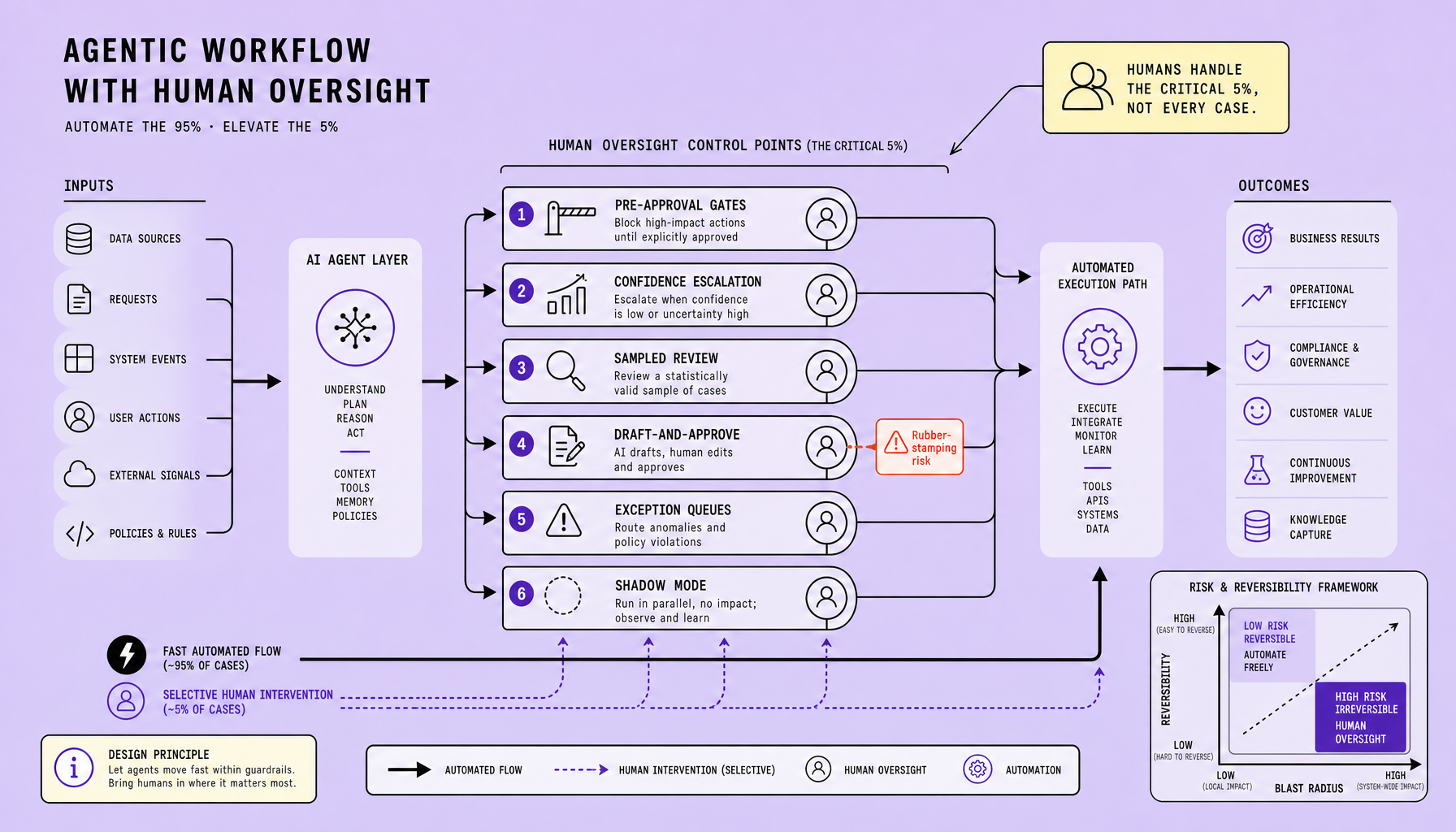
At Imversion Technologies Pvt Ltd, we treat user experience as important as functionality, and that applies here too: if reviewers must touch every case, the system steals time instead of giving it back. So design for reversibility first, then blast radius, and reserve people for judgment-heavy edge cases -- not the whole pipeline.
Key Takeaways for Human Oversight Patterns
Use human oversight patterns to cover the critical 5% -- not every case. In a solid ai oversight framework, the right control depends on reversibility and blast radius: low-impact, reversible actions can run fast; irreversible actions need stronger agentic workflow controls.
| Pattern | Best fit | Latency cost | Predictable failure |
|---|---|---|---|
| Pre-approval gate | Payments over a threshold, production deletion | High | Queue buildup, rubber-stamping |
| Confidence escalation | Routing, screening, document review | Low to medium | Bad calibration, missed edge cases |
| Sampled review | Quality monitoring, policy drift checks | Low | Rare failures slip through |
- Different patterns solve different risks. Draft-and-approve works for external communications; exception queues fit policy breaks with SLAs; shadow mode is best before rollout because it exposes errors without production impact.
- Rubber-stamping is a predictable failure mode of human in the loop ai. If reviewers must approve everything, attention drops and governance becomes theater.
- Our recommendation: design agentic workflow governance around human judgment for ambiguous, novel, or high-blast-radius cases. User experience matters here -- if review UX is noisy, operators will stop thinking.
What Human Oversight Patterns Actually Do in Agentic Workflows
If oversight is treated like a vague safety label, teams end up with controls that look responsible and work badly. Human oversight in agentic workflows is not a generic ethics layer. It is an operational control layer that decides when a person must intervene, approve, review, or simply observe an agent action.
That distinction changes the design. Teams often get stuck between two bad models: full autonomy that feels unsafe, or human in the loop AI on every step, which destroys throughput and turns reviewers into bottlenecks.
The better model is selective control.
Here is the practical version: match the control to reversibility and blast radius. If an action is easy to undo and affects little, like support ticket routing, automate aggressively. If it is hard to reverse or can cause broad damage, like deleting production data or approving a high-value payment, add stronger controls.
Pattern library: what each pattern does
- Pre-approval gates: Human approval before execution. Best for irreversible, regulated, or high-loss actions. Latency cost is high because the workflow pauses. Failure mode: overuse creates queues and rubber-stamping.
- Confidence escalation: The agent proceeds on high-confidence cases and escalates low-confidence, ambiguous, or conflicting ones. Best for compliance screening, document review, and routing. Latency stays low for routine cases. Failure mode: poor calibration creates too many escalations or misses risky edge cases.
- Sampled review: Humans review a percentage of completed actions after the fact. Best for quality monitoring and calibration. Latency is minimal. Failure mode: weak sampling can miss concentrated failure pockets.
- Draft-and-approve: The agent prepares outputs such as replies, summaries, or recommendations, and a human approves or edits. Best where judgment matters but drafting is repetitive. Latency is moderate. Failure mode: reviewers approve drafts by habit.
- Exception queues: Only policy violations, missing fields, or unusual states reach a person. Best for workflow orchestration at scale. Latency is isolated to exception cases. Failure mode: vague rules flood the queue.
- Shadow mode: The agent runs without taking live action while humans compare its decisions to current operations. Best for rollout and calibration. Failure mode: teams never exit observation mode.
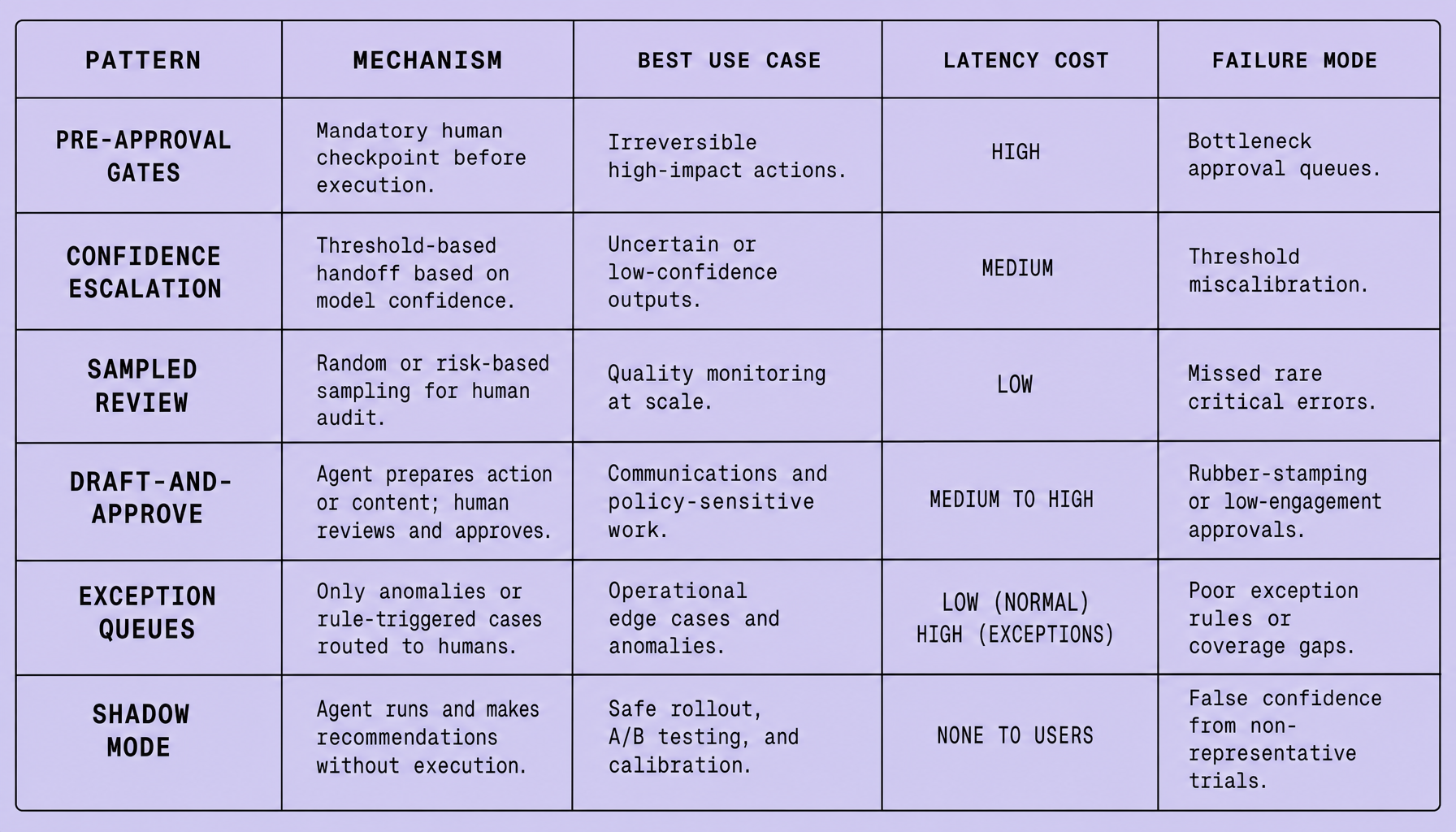
A strong agentic workflow governance design does not maximize approvals. It maximizes the share of meaningful human attention spent where judgment changes the outcome.
That leads to the basic operating rule. Do not ask humans to review every case. Reserve them for the critical 5%: novel, high-consequence, or ambiguous decisions. That keeps routine paths automated while preserving oversight where it matters most.
Use Reversibility and Blast Radius to Choose the Right Human Oversight Pattern
Oversight chosen by habit is usually too heavy, too vague, or both. Start with a simpler rule: choose it by reversibility and blast radius.
Reversibility asks how easily an action can be undone. A support tag can be changed in seconds. A payment release, customer-facing compliance statement, or production data deletion cannot. Blast radius asks how far an error spreads -- one record, one customer, one ledger, or an entire downstream workflow. Together, these two variables give teams a practical ai oversight framework for selecting human in the loop ai controls without crushing automation.
That framing is useful because it cuts through “we have always reviewed this” logic. If a workflow cannot explain a review step in terms of reversibility or blast radius, that step is probably legacy comfort. Not real governance.
Use a simple risk matrix
Map actions into four buckets:
- Low reversibility + high blast radius: use strong approval gates or draft-and-approve. Think production data deletion, large payments, legal notices, or regulated disclosures.
- Low reversibility + low blast radius: use targeted human review, often via exception queues. For example, issuing a refund above a policy threshold to a single account.
- High reversibility + high blast radius: allow controlled autonomy with confidence escalation and sampled review. Customer messaging at scale fits here -- messages can be corrected, but a bad run can affect thousands.
- High reversibility + low blast radius: run autonomously with light agentic workflow controls such as logging, shadow mode, and periodic sampling. Ticket routing is the obvious case.
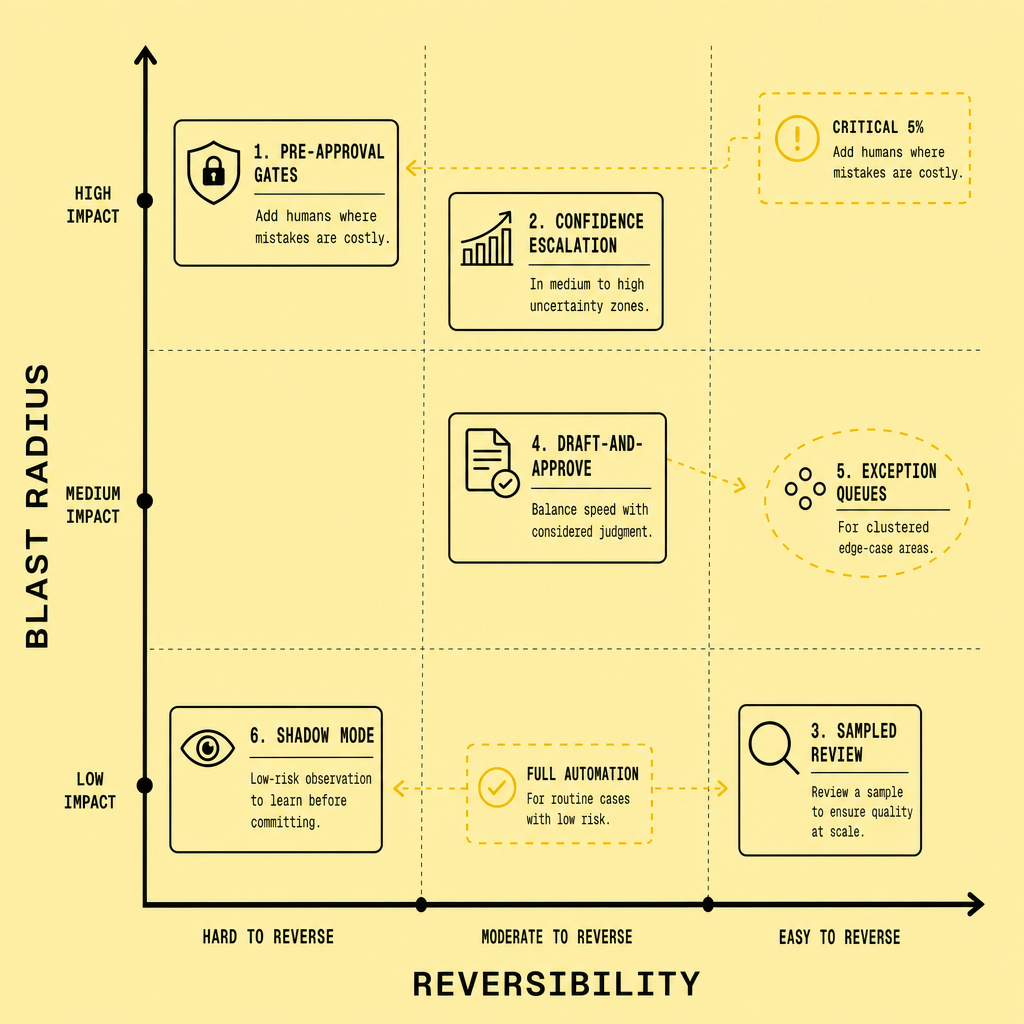
Tie controls to the critical 5%
This is where many systems drift into process bloat. The point of agentic workflow governance is not to put a person in every branch. That fails twice: latency climbs, and reviewers start rubber-stamping. We have seen this pattern often enough to treat it as a design smell. User experience is as important as functionality -- and approval-heavy systems waste operator time while slowing customers down.
So reserve the strong controls for the critical 5%: irreversible, high-impact, ambiguous, or novel cases. Use pre-approval for the hardest edges. Use confidence escalation for uncertain classifications. Use sampled review and shadow mode to monitor low-risk paths without blocking them. Use exception queues where policy, thresholds, or missing context create clear handoff conditions.
That is how teams give people their time back -- by spending human judgment where it changes outcomes, not where it just acknowledges them.
Human Oversight Patterns Library: When to Use Each Control
A workflow does not become safer just because more humans touch it. Usually the opposite happens. The best human oversight patterns do not put a person on every step. They match control cost to downside risk, so people focus on the critical cases instead of turning the whole workflow into manual review.
Pre-approval gates
Mechanism: pause execution until a human approves. Best use case: low-reversibility, high-blast-radius actions such as payments above a policy threshold or production data deletion. Latency cost: highest, because the workflow waits on a person. Failure mode: teams apply gates too broadly, queues form, and reviewers start rubber-stamping.
Confidence escalation
Mechanism: the agent proceeds above defined thresholds and escalates below them, or when signals conflict. Best use case: high-volume decisions with a predictable routine path, such as ticket routing, screening, or document review. Latency cost: low on standard cases, moderate on escalations. Failure mode: poor calibration. Loose thresholds let errors through; tight ones send everything to humans.
Sampled review
Mechanism: humans review a sample of completed actions rather than every case. Best use case: reversible, high-volume workflows where you want quality monitoring without blocking execution. Latency cost: near zero on the live path. Failure mode: weak sampling hides clustered drift or edge-case failures.
Draft-and-approve
Mechanism: the agent prepares output, but a human sends or signs off. Best use case: communication and judgment-heavy work where tone and context matter along with correctness. Latency cost: moderate. Failure mode: reviewers edit every line and erase automation gains, so the draft must be easy to verify quickly.
Exception queues
Mechanism: the system auto-handles normal cases and routes only exceptions to humans, often with SLA tiers. Best use case: mismatches, failed checks, missing fields, or policy conflicts. Latency cost: low for the main flow, variable for exceptions. Failure mode: vague rules turn the queue into a dumping ground.
Shadow mode
Mechanism: the agent runs in parallel without taking action; teams compare its decisions to the live process before rollout. Best use case: staged deployment of new controls. Latency cost: none to production decisions, but there is evaluation overhead. Failure mode: treating shadow results as proof without checking edge cases.
Use stronger controls as reversibility drops and blast radius rises. Reserve approval gates for irreversible actions; use sampling, thresholds, and shadow mode to preserve automation elsewhere.
That is practical agentic workflow governance: targeted controls and human judgment where being wrong has real consequences.
Comparison Table: Oversight Strength, Latency Cost, and Failure Risk
Designing oversight usually means balancing trust against speed. This table is a quick ai oversight framework -- pick the lightest control that matches reversibility and blast radius, so your human in the loop ai design protects the critical 5% without crushing automation.
| Pattern | Mechanism | Best use case | Oversight strength | Latency cost | Reversibility fit | Blast-radius fit | Common failure mode |
|---|---|---|---|---|---|---|---|
| Pre-approval gates | Human approves before action | Payments over threshold, prod deletion | Very high | High | Low reversibility | High blast radius | Rubber-stamped approval gates |
| Confidence escalation | Escalate low-confidence cases | Routing, screening, document review | High if calibrated | Low-Moderate | Mixed | Medium | Bad thresholds; false negatives |
| Sampled review | Review a percentage after action | Routine support, QA checks | Low-Moderate | Low | High reversibility | Low | Drift goes unseen |
| Draft-and-approve | Agent drafts; human sends | External comms, legal/compliance text | High | Moderate | Medium | Medium-High | Reviewer fatigue |
| Exception queues | Only policy exceptions reach humans | SLA-bound ops, edge cases | Moderate-High | Moderate | Mixed | Medium-High | Queue backlog |
| Shadow mode | Agent observes, no execution | Rollouts, calibration, governance | Low live control, high learning | None live | Any | Any pre-launch | Teams mistake simulation for proof |
Avoid Rubber-Stamping and Roll Out Human Oversight Patterns Without Losing Speed
Bad oversight feels safe right up until it slows everything down and still misses the risky cases. The wrong model creates theater. The right one protects outcomes without turning operators into a second execution engine. To keep speed, design review for the few cases where human judgment materially changes risk.
The first failure to avoid is rubber-stamping. If reviewers spend all day approving obvious cases, they stop reviewing and start clicking. Then blanket approvals creep in, vague escalation thresholds flood queues, and exception queues sit unowned until risk and latency pile up together. That is not human in the loop ai. It is manual friction disguised as agentic workflow governance.
Match review strength to reversibility and blast radius
Use the lightest control that fits the downside.
Pre-approval gates belong on irreversible, high-blast-radius actions, such as production data deletion or large payments above a fixed threshold. Strong protection, high latency. Failure mode: teams overuse them, then every case waits for approval and reviewers stop looking closely.
Confidence escalation works better for support routing, compliance screening, and document review. The agent acts when confidence is high and escalates on ambiguity, conflict, or missing context. Fast path for routine work. But bad calibration breaks it: thresholds set too low create noise; too high hides risk.
Sampled review and audit sampling are the pressure test. Review a percentage of completed actions, not every action. Low latency, strong monitoring value. Failure mode: sample rates too small to catch drift, or audits that never feed threshold updates.
Draft-and-approve fits work where wording matters but execution risk is low, like customer replies or internal summaries. The agent drafts. A human approves or edits. Useful, but slow if every draft needs line-by-line polishing.
Exception queues should hold only policy breaches, failed tool calls, or unresolved conflicts. Assign queue ownership, define a service level agreement, and track queue aging. No owner, no governance.
Shadow mode is a practical start for new automations. Run the agent in parallel, log proposed actions, compare against human outcomes, then enable action in stages.
Humans should handle the critical 5% -- the ambiguous, novel, and high-impact cases -- not every case.
Operationalize it clearly: define escalation thresholds, measure escalation rate, track approval turnaround time, audit misses, and review false positives and false negatives. Good human oversight patterns give people time back because they are called in for judgment, not routine clicks.
Frequently Asked Questions
What is the biggest mistake teams make with human oversight patterns?
The biggest mistake is applying the same review control to every action instead of matching oversight to risk. That creates queues, reviewer fatigue, and rubber-stamping, while still failing to focus attention on the rare cases where human judgment actually changes the outcome.
How do human oversight patterns affect automation ROI?
Human oversight patterns preserve automation ROI when they protect only the decisions that are costly to get wrong. If the live path remains automated for routine work, teams keep throughput high while reducing the operational, compliance, and trust costs of preventable failures.
Why should humans handle only the critical 5% in agentic workflows?
Humans should handle only the critical 5% because attention is a scarce resource, and its value is highest on ambiguous, novel, or irreversible decisions. Using people on every case turns oversight into repetitive labor, which lowers review quality and cancels the time savings automation is supposed to create.
How should a team choose between confidence escalation and exception queues?
Confidence escalation is best when model uncertainty is measurable and low-confidence cases can be flagged automatically. Exception queues are better when the trigger is rule-based, such as missing data, policy violations, or failed tool calls. The choice depends on whether the handoff is driven by uncertainty or by explicit business rules.
When should human oversight patterns move out of shadow mode?
Human oversight patterns should move out of shadow mode when the team has measured agreement with current operations, tested edge cases, and defined rollback conditions. Shadow mode is useful for learning, but it becomes a delay tactic if there is no clear threshold for staged activation and live accountability.
Make Imversion a preferred source on Google
Like this kind of AI and software analysis? Add Imversion as a preferred source so Google can highlight our articles for you in Search, AI Overviews, and AI Mode.